PY7A1880026GSM 850/1900 GPRS/EDGE mobile phone with Bluetooth and FM receiver
Sony Corporation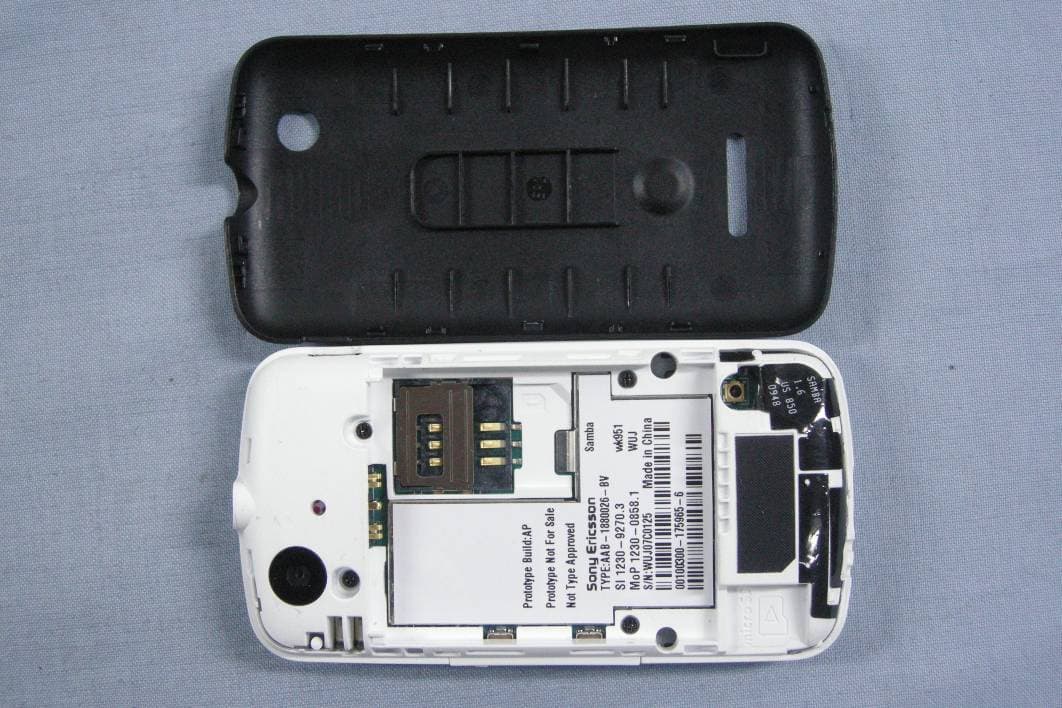
Click to zoom
Application Details
- Equipment Class
- PCE - PCS Licensed Transmitter held to ear
- Date of Grant
- Jun 08, 2010
- Application Purpose
- Original Equipment
- Date of Application
- Jun 08, 2010
- Equipment Note
- GSM 850/1900 GPRS/EDGE mobile phone with Bluetooth and FM receiver
- Frequency Range
- 1850.20000000 - 1909.80000000
- Company
- Sony Corporation
- Country
- Japan
Documents & Files
Document Text
Text extracted from the exhibit documents filed with the FCC. Open a document above to read the original.
Users Manual
Sony Ericsson Spiro ™ User guide Important information Please read the Important information leaflet before you use your mobile phone. Experience more. Discover how. Fill it with pop and let it rock. Share your life in pictures. Or why not go online for the latest updates? Your new phone is the key to a wider world. And it's just around the corner. Get started with this User guide. And join us online to get the full picture. Music, games, apps, updates, downloads, support and more. All in one place: www.sonyericsson.com/spiro Feedback on the User guide Do you have any suggestions on how we can improve this User guide? If so, then email us at [email protected]. Please make sure to type the User guide name in the email subject field. We highly value your feedback! 2 Getting started SIM card The SIM (Subscriber Identity Module) card, which you get from your network operator, contains information about your subscription. Always turn off your phone and detach the charger and battery (if inserted) before you insert or remove the SIM card. PIN You may need a PIN (Personal Identification Number) to activate the services and functions in your phone. Your PIN is supplied by your network operator. Each PIN digit appears as *, unless it starts with emergency number digits such as 112 or 911. You can see and call an emergency number without entering a PIN, if a network is available. If you enter the wrong PIN three times in a row, the SIM card is blocked. See SIM card lock on page 33. 3 To insert the SIM card 1 Remove the battery cover. 2 Slide the SIM card into its holder with the gold-coloured contacts facing down. 4 To insert the battery 1 Insert the battery with the label side up and the connectors facing each other. 2 Slide the battery cover into place and lock it. Turning on the phone To turn on the phone 1 Press and hold down . 2 Open the slider and enter your PIN, if requested. 3 Select OK. 4 Select a language. 5 5 Select Yes to use the setup wizard. If you make a mistake when you enter your PIN, you can press to delete numbers from the screen. Standby After you have turned on the phone and entered your PIN, the name of the network operator appears. This view is called standby. You phone is now ready for use. To turn off the phone • Press and hold down . Before turning off the phone, you must return to standby. Memory card You may have to purchase a memory card separately. Your phone supports a microSD™ memory card, adding more storage space to your phone. This type of card can also be used as a portable memory card with other compatible devices. You can move content between a memory card and the phone memory. 6 To insert a memory card • Remove the battery cover and insert the memory card with the gold-coloured contacts facing down. To remove a memory card • Remove the battery cover and slide the memory card to remove it. 7 Phone overview 1Ear speaker 1 2 3 5 6 4 7 8 9 10 2Screen 3Connector for charger and USB cable 4Selection keys 5Call key 6Shortcut key 7Navigation key, Walkman™ player controls, TrackID™* 8End key, On/off key 9C key (Clear) 10Silent key 8 11 12 13 14 11Connector for handsfree 12Camera lens 13Volume key 14Loudspeaker *The TrackID™ shortcut key may not be available in your phone. 9 Screen icons These icons may appear on the screen. IconDescription Missed call Handsfree connected Ongoing call Text message received Multimedia message received Predictive text input activated Phone set to silent Radio playing Alarm activated Bluetooth™ function activated 10 To charge the battery • Connect the charger to the phone with the power icon on the charger facing upwards. It takes approximately 2.5 hours to fully charge the battery. You can still use your phone while it is charging. The phone battery is partly charged when you buy it. It may take a few minutes before the battery icon appears on the screen. The battery will start to discharge a little after it is fully charged and then charges again after a certain time. This is to extend battery life and may result in the charge status showing a level below 100 percent. 11 Menu overview PlayNow™ Camera Alarms Calls** All, Answered, Dialled, Missed Internet Messaging Write new, Inbox/ Conversations, Messages, Call voicemail Contacts Organiser File manager**, Applications, Torch, Calendar, Tasks, Notes, Timer, Stopwatch, Calculator Entertainment Online services*, PlayNow™, Radio, Games, TrackID™, Record sound Media WALKMAN Settings** General, Sounds & alerts, Display, Calls, Connectivity * Some menus are operator-, network- and subscription-dependent. ** You can use the navigation key to scroll between tabs in submenus. 12 Navigation The main menus are shown as icons. Some submenus include tabs. To access the main menu • When Menu appears on the screen, press the centre selection key. • When Menu does not appear on the screen, press the End key, then press the centre selection key. To navigate the phone menus 1 Press the centre selection key to select Menu. 2 Press the navigation key upwards, downwards, left or right to move through the menus. To select an item • Scroll to the item and press the centre selection key To scroll between tabs • Press the navigation key left or right . To go back one step in a menu • Select Back. 13 To end a function • Press . To return to standby • Press . To delete an item • Scroll to the item and press . Shortcuts You can use the navigation key shortcuts from standby or use the shortcut menu to get quick access to certain functions. To use navigation key shortcuts • Press the navigation key upwards, downwards, left or right to go directly to a function. To edit a navigation key shortcut • Select Menu > Settings > General > Shortcuts. The WALKMAN shortcut cannot be changed. To open the shortcut menu • Press . To add a shortcut 1 Press . 2 Scroll to New shortcut and select Add. To delete or move a shortcut 1 Press . 2 Scroll to a shortcut and select Options. 3 Select an option. To turn the sound on or…
Text truncated - open the document above for the full version.
Users Manual
FCC Statement Sony Ericsson W100a Walkman™ GSM GPRS/EDGE 850/1900 Important Information United States & Canada THIS PHONE MODEL HAS BEEN CERTIFIED IN COMPLIANCE WITH THE GOVERNMENT’S REQUIREMENTS FOR EXPOSURE TO RADIO WAVES. The W100a Series mobile phones have been designed to comply with applicable safety requirements for exposure to radio waves. Your wireless phone is a radio transmitter and receiver. It is designed to not exceed the limits* of exposure to radio frequency (RF) energy set by governmental authorities. These limits establish permitted levels of RF energy for the general population. The guidelines are based on standards that were developed by international scientific organizations through periodic and thorough evaluation of scientific studies. The standards include a safety margin designed to assure the safety of all individuals, regardless of age and health. The radio wave exposure guidelines employ a unit of measurement known as the Specific Absorption Rate (SAR). Tests for SAR are conducted using standardized methods with the phone transmitting at its highest certified power level in all used frequency bands. While there may be differences between the SAR levels of various phone models, they are all designed to meet the relevant guidelines for exposure to radio waves. For more information on SAR, please refer to the safe and efficient use chapter in the User Guide. The highest SAR value as reported to the authorities for this phone model when tested for use by the ear is 1.20 W/kg*, and when worn on the body is 0.65 W/kg* for speech and 1.03 W/kg* for data calls. Body worn measurements are made while the phone is in use and worn on the body with a Sony Ericsson accessory supplied with or designated for use with this phone. It is therefore recommended that only Ericsson and Sony Ericsson original accessories be used in conjunction with Sony Ericsson phones. **Before a phone model is available for sale to the public in the US, it must be tested and certified by the Federal Communications Commission (FCC) that it does not exceed the limit established by 2 the government-adopted requirement for safe exposure*. The tests are performed in positions and locations (i.e., by the ear and worn on the body) as required by the FCC for each model. The FCC has granted an Equipment Authorization for this phone model with all reported SAR levels evaluated as in compliance with the FCC RF exposure guidelines. While there may be differences between the SAR levels of various phones, all mobile phones granted an FCC equipment authorization meet the government requirement for safe exposure. SAR information on this phone model is on file at the FCC and can be found under the Display Grant section of http://www.fcc.gov/oet/fccid after searching on FCC ID PY7A1880026. Additional information on SAR can be found on the Cellular Telecommunications & Internet Association (CTIA) website at http://www.phonefacts.net. * In the United States and Canada, the SAR limit for mobile phones used by the public is 1.6 watts/kilogram (W/kg) averaged over one gram of tissue. The standard incorporates a margin of safety to give additional protection for the public and to account for any variations in measurements. **This paragraph is only applicable to authorities and customers in the United States. 3 Important Information Latin & South America Radio wave exposure and Specific Absorption Rate (SAR) information The W100a Series mobile phones have been designed to comply with applicable safety requirements for exposure to radio waves. These requirements are based on scientific guidelines that include safety margins designed to assure the safety of all persons, regardless of age and health. The radio wave exposure guidelines employ a unit of measurement known as the Specific Absorption Rate, or SAR. Tests for SAR are conducted using standardised methods with the phone transmitting at its highest certified power level in all used frequency bands. While there may be differences between the SAR levels of various phone models, they are all designed to meet the relevant guidelines for exposure to radio waves. For more information on SAR, please refer to the safety chapter in the User Guide. SAR data information for residents in countries that have adopted the SAR limit recommended by the International Commission on Non-Ionizing Radiation Protection (ICNIRP), which is 2 W/kg averaged over ten (10) gram of tissue (for example European Union, Japan, Brazil and New Zealand): The highest SAR value for this model phone when tested by Sony Ericsson for use at the ear is 0.79 W/kg (10g). 8 FCC Statement This device complies with Part 15 of the FCC rules. Operation is subject to the following two conditions: (1) This device may not cause harmful interference, and (2) This device must accept any interference received, including interference that may cause undesired operation. Any change or modification not expressly approved by Sony Ericsson may void the user's authority to operate the equipment. This equipment has been tested and found to comply with the limits for a Class B digital device, pursuant to Part 15 of the FCC Rules. These limits are designed to provide reasonable protection against harmful interference in a residential installation. This equipment generates, uses and can radiate radio frequency energy and, if not installed and used in accordance with the instructions, may cause harmful interference to radio communications. However, there is no guarantee that interference will not occur in a particular installation. If this equipment does cause harmful interference to radio or television reception, which can be determined by turning the equipment off and on, the user is encouraged to try to correct the interference by one or more of the following measures: • Reorient or relocate the receiving antenna. • Increase the separation between the equipment and receiver. • Connect the equipment into an outlet on a circuit diffe…
Text truncated - open the document above for the full version.
Users Manual
Important information Sony Ericsson Consumer Web site At www.sonyericsson.com/support there is a support section where help and tips are only a few clicks away. Here you will find the latest computer software updates and tips on how to use your product more efficiently. Service and support You have access to a portfolio of exclusive service advantages such as: • Global and local Web sites providing support. • A global network of Contact Centers. • An extensive network of Sony Ericsson service partners. • A warranty period. Learn more about the warranty conditions in theLimited warrantysection. At www.sonyericsson.com/support, you can find the latest support tools and information. For operator-specific services and features, please contact your network operator. You can also contact our Contact Centers. If your country/ region is not represented in the list below, please contact your local dealer. (Calls are charged according to national rates, including local taxes, unless the phone number is a toll-free number.) If your product needs service, please contact the dealer from whom it was purchased, or one of our service partners. For warranty claims, save proof of purchase. Guidelines for Safe and Efficient Use Please follow these guidelines. Failure to do so might entail a potential health risk or product malfunction. If in doubt as to its proper function, have the product checked by a certified service partner before charging or using it. Recommendations for care and safe use of our products • Handle with care and keep in a clean and dust-free place. 2 • Warning! May explode if disposed of in fire. • Do not expose to liquid or moisture or excess humidity. • For optimum performance, the product should not be operated in temperatures below -10°C(+14°F) or above +45°C(+113°F). Do not expose the battery to temperatures above +60°C(+140°F). • Do not expose to flames or lit tobacco products. • Do not drop, throw or try to bend the product. • Do not paint or attempt to disassemble or modify the product. Only Sony Ericsson authorised personnel should perform service. • Consult with authorised medical staff and the instructions of the medical device manufacturer before using the product near pacemakers or other medical devices or equipment. • Discontinue use of electronic devices, or disable the radio transmitting functionality of the device, where required or requested to do so. • Do not use where a potentially explosive atmosphere exists. • Do not place the product, or install wireless equipment, in the area above an air bag in a car. • Caution: Cracked or broken displays may create sharp edges or splinters that could be harmful upon contact. • Do not use the Bluetooth Headset in positions where it is uncomfortable or will be subject to pressure. Children Warning! Keep out of the reach of children. Do not allow children to play with mobile phones or accessories. They could hurt themselves or others. Products may contain small parts that could become detached and create a choking hazard. Power supply (Charger) Connect the charger to power sources as marked on the product. Do not use outdoors or in damp areas. Do not alter or subject the cord to damage or stress. Unplug the unit before 3 cleaning it. Never alter the plug. If it does not fit into the outlet, have a proper outlet installed by an electrician. When a power supply is connected there is a small drain of power. To avoid this small energy waste, disconnect the power supply when the product is fully charged. Use of charging devices that are not Sony Ericsson branded may pose increased safety risks. Battery New or idle batteries can have short-term reduced capacity. Fully charge the battery before initial use. Use for the intended purpose only. Charge the battery in temperatures between +5°C(+41°F) and +45°C(+113°F). Do not put the battery into your mouth. Do not let the battery contacts touch another metal object. Turn off the product before removing the battery. Performance depends on temperatures, signal strength, usage patterns, features selected and voice or data transmissions. Only Sony Ericsson service partners should remove or replace built-in batteries. Use of batteries that are not Sony Ericsson branded may pose increased safety risks. Replace the battery only with another Sony Ericsson battery that has been qualified with the product per the standard IEEE-1725. Use of an unqualified battery may present a risk of fire, explosion, leakage or other hazard. Personal medical devices Mobile phones may affect implanted medical equipment. Reduce risk of interference by keeping a minimum distance of 15 cm(6 inches) between the phone and the device. Use the phone at your right ear. Do not carry the phone in your breast pocket. Turn off the phone if you suspect interference. For all medical devices, consult a physician and the manufacturer. Driving Some vehicle manufacturers forbid the use of phones in their vehicles unless a handsfree kit with an external antenna supports the installation. Check with the vehicle manufacturer's representative to be sure that the mobile phone or Bluetooth 4 handsfree will not affect the electronic systems in the vehicle. Full attention should be given to driving at all times and local laws and regulations restricting the use of wireless devices while driving must be observed. GPS/Location based functions Some products provide GPS/Location based functions. Location determining functionality is provided “As is” and “With all faults”. Sony Ericsson does not make any representation or warranty as to the accuracy of such location information. Use of location-based information by the device may not be uninterrupted or error free and may additionally be dependent on network service availability. Please note that functionality may be reduced or prevented in certain environments such as building interiors or areas adjacent to buildings. Caution: Do not use GPS functionality in a manner which causes distraction from …
Text truncated - open the document above for the full version.
Cover Letter(s)
Sony Er~csson Confidentiality Request 2010-05-11 CWA10:204 SEMC/CVVALG Afrah Sadiq +46108012250 Receiver Federal Communications Commission Subject: Request for Confidentiality FCC 10: PY7A1880026 To Whom It May Concern: In accordance with §0.459 of CFR 47, Sony Ericsson Mobile Communications AS requests confidentiality for the below listed items for our mobile phone type MB 1880026-BV, FCC ID: PY7A1880026: 1. Block Diagram 2. Schematic Diagram 3. Part List 4. Operational/Technical Descriptions These items contain detailed system and equipment description and related information about the product which Sony Ericsson Mobile Communications AS considers to be proprietary, confidential and a custom design which otherwise would not be released to the general public. Since this design is a basis from which future technological products will evolve, Sony Ericsson Mobile Communications AS also feels that this information would be of benefit to its competitors, and that the disclosure of the information in these exhibits would give our competitors an unfair advantage in the market. Please contact the undersigned if there are any further questions or additional information needed in this matter. :ca'dS' Afrah Sadiq Development Engineer - Global Type Approval Sony Ericsson Mobile Communications AS Sony Ericsson Mobile Communications AS Styrelsens sate: Lund Momsnr· VA. TNo: SE556615665801 Registered office: Lund Organisationsnr· Reg No: 556615-6658 Postadress • Mail Besoksadress • Office address Telefon • Telephone Telefax • Telefax SE-221 88 Lund Nya Vattentornet Nat 010-80 00000 Nat 010-8002040 Sweden Lund Int ...46108000000 Int +46108002040
External Photos
No.2010TAR055 Page 9 of 20 ANNEX A: EUT photograph Mobile Phone Mobile Phone ©Copyright. All rights reserved by TMC Beijing. No.2010TAR055 Page 10 of 20 Mobile Phone Mobile phone ©Copyright. All rights reserved by TMC Beijing. No.2010TAR055 Page 11 of 20 Mobile phone Disassembly Mobile phone Disassembly ©Copyright. All rights reserved by TMC Beijing.
ID Label/Location Info
1 (1) Company Internal MARKING DRAWING Prepared (also subject responsible if other) No. SEM/CVVGP, Leif Hedin 1232-5990 Uen Approved Checked Date Rev Reference SEM/CVVGP, Leif Hedin 2010-02-11 1 2 W100a, Label Content Specification, Mobile Phone, A- version 1 General information Mobile Phone label part no • 1231-0397 Bar code • Print quality: according to COSMETIC GUIDELINE – Bar code labels document 1222-6072 Uen • Quiet zone: No bar codes are allowed to be closer to a label edge than 2 mm! Text If applicable, or nothing else specified, Zebra printer Scaleable Smooth Font CG Triumvirate Bold Condensed is imposed. When needed, the text is adjusted to fit the label. Coordinates “(x/y)” under each line number specifies the bottom / left alignment for text, graphics and bar codes, x is measured vertically, and y horizontally from the upper left corner of the label (landscape format), both in mm. When needed, the alignment is adjusted to fit the label. 2 Printing information Content Format Line 1 (25,0/5,0) WEE trashcan without bar symbol. Graphics, min. height 5mm, According to 1202-5537. Line 2a (31,0/4,5) Sony Ericsson stylized name. Graphics, height 1,5 mm. According to 1200-1925. Line 2b (31,0/21,0) Model Name “W100a” Text, height 1,2 mm. Line 2c (31,0/27,0) Repair week, if applicable. “Ry’W’ww” (y = year, ww = week) Text, height 1,2 mm. Line 3a (33,0/4,5) Type number of the phone, “Type: AAB-1880026-BV”. Text, height 1,2 mm. Line 3b (33,0/21,0) HW & SW identification field, if applicable; “FFGG” Text, height 1,2 mm. According to Type-testing report under Product Model Specifying Document Line 3c (33,0/27,0) Location code of where the phone is flashed, if applicable, “XXX” Text, height 1,2 mm. Line 4a (35,0/4,5) “FCC ID: PY7A1880026” Text, height 1,2 mm. Line 4b (35,0/21,0) Product number without revision of the Sales Item in which the phone is packed, if applicable. “SI XXXX-XXXX” Text, height 1,2 mm. Line 5a (37,0/4,5) “IC: 4170B-A1880026” Text, height 1,2 mm. Line 5b (37,0/21,0) Production week (flash), “yy’W’ww” (yy = year, ww = week) Text, height 1,2 mm. Line 6a (39,0/4,5) Supplier’s identification for trace-ability of the telephone, as desired by supplier (e.g. “S/N: nnn....” for serial number). Text, height 1,2 mm. Defined by supplier. Line 6b (39,0/21,0) Marking of origin. “Made in Xxx”; “Xxx” = actual country of production of the included telephone, in English Text, height 1,2 mm. Company Internal MARKING DRAWING 2 (2) Prepared (also subject responsible if other) No. SEM/CVVGP, Leif Hedin 1232-5990 Uen Approved Checked Date Rev Reference SEM/CVVGP, Leif Hedin 2010-02-11 1 2 Line 7 (41,0/4,5) Line 6a in bar code. As desired by supplier (e.g. only actual number). Bar code, height 2,0 mm. As desired by supplier (e.g. Code 128 symbology). Line 8 (43,5/4,5) Actual electronic serial number (IMEI) of the mobile phone, “00000000-000000-0” Text, height 1,2 mm. In the format TAC-SNR-CD. TAC and SNR derived from pos 500 in BOM. CD = check digit according to the Luhn formula (ISO/IEC 7812), GSM 02.16. Line 9 (45,5/4,5) Line 8 in bar code (only actual number, without data identifier). Bar code, height 2,0 mm. Code 128 symbology, code C subset. If uneven number of digits, code B subset shall be used for the last digit. 3 Layout The conceptual picture (for Zebra 90XiII printer, or equivalent) should not be considered as specifications, but as an additional help for setting up the label. 3.1 Conceptual picture double underlined = major changes since last revision. Company Internal MARKING DRAWING 4 (4) Prepared (also subject responsible if other) No. SEM/CVVGP, Leif Hedin 1232-5990 Uen Approved Checked Date Rev Reference SEM/CVVGP, Leif Hedin 2010-02-11 1 17 Label placement To find the label follow these steps: 1. Remove the cover on the rear side of the product. 2. Remove the battery. 3. The label is located behind the battery. Rear side of the phone Place for battery Label placement
Internal Photos
No.2010TAR055 Page 12 of 20 Mobile phone Disassembly Mobile phone Disassembly ©Copyright. All rights reserved by TMC Beijing. No.2010TAR055 Page 13 of 20 Mobile phone Disassembly Mobile phone Disassembly ©Copyright. All rights reserved by TMC Beijing. No.2010TAR055 Page 14 of 20 Mobile phone Disassembly Battery ©Copyright. All rights reserved by TMC Beijing.
RF Exposure Info
No.2010SAR00009 Page 1 of 94 ©Copyright. All rights reserved by TMC Beijing. SAR TEST REPORT for FCC No. 2010SAR00009 For Sony Ericsson Mobile Communications(China) Co., Ltd. GSM 850/1900 dual bands mobile phone W100a With Hardware Version: A Software Version: P1BC014 SEMC ID: AAB-1880026-BV Industry Canada ID: 4170B-A1880026 FCCID: PY7A1880026 FCC 2.948 Listed: No.733176 IC O.A.T.S listed: No.6629A-1 Issued Date: 2010-3-8 No. DAT-P-114/01-01 Note: The test results in this test report relate only to the devices specified in this report. This report shall not be reproduced except in full without the written approval of TMC Beijing. Test Laboratory: TMC Beijing, Telecommunication Metrology Center of MIIT No. 52, Huayuan Bei Road, Haidian District, Beijing, P. R. China 100191. Tel:+86(0)10-62304633-2079, Fax:+86(0)10-62304793 Email:[email protected]. www.emcite.com No. 2010SAR00009 Page 2 of 94 TABLE OF CONTENT 1 TEST LABORATORY..................................................................................................................3 1.1 TESTING LOCATION........................................................................................................................................ 3 1.2 TESTING ENVIRONMENT................................................................................................................................. 3 1.3 PROJECT DATA............................................................................................................................................... 3 1.4 SIGNATURE..................................................................................................................................................... 3 2 GENERAL INFORMATION .........................................................................................................4 2.1 STATEMENT OF COMPLIANCE......................................................................................................................... 4 2.2 APPLICANT INFORMATION.............................................................................................................................. 4 2.3 MANUFACTURER INFORMATION..................................................................................................................... 4 3 EQUIPMENT UNDER TEST (EUT) AND ANCILLARY EQUIPMENT (AE) ................................5 3.1 ABOUT EUT ................................................................................................................................................... 5 3.2 INTERNAL IDENTIFICATION OF EUT USED DURING THE TEST.......................................................................... 5 3.3 INTERNAL IDENTIFICATION OF AE USED DURING THE TEST............................................................................. 5 3.4 ANTENNA DESCRIPTION.................................................................................................................................. 5 4 CHARACTERISTICS OF THE TEST ..........................................................................................6 4.1 APPLICABLE LIMIT REGULATIONS.................................................................................................................. 6 4.2 APPLICABLE MEASUREMENT STANDARDS...................................................................................................... 6 5 OPERATIONAL CONDITIONS DURING TEST ..........................................................................6 5.1 SCHEMATIC TEST CONFIGURATION................................................................................................................. 6 5.2 SAR MEASUREMENT SET-UP.......................................................................................................................... 6 5.3 DASY4 E-FIELD PROBE SYSTEM..................................................................................................................... 7 5.4 E-FIELD PROBE CALIBRATION........................................................................................................................ 8 5.5 OTHER TEST EQUIPMENT...............................................................................................................................9 5.6 EQUIVALENT TISSUES..................................................................................................................................... 9 5.7 SYSTEM SPECIFICATIONS.............................................................................................................................. 10 6 CONDUCTED OUTPUT POWER MEASUREMENT................................................................. 11 6.1 SUMMARY.................................................................................................................................................... 11 6.2 CONDUCTED POWER.................................................................................................................................... 11 7 TEST RESULTS ........................................................................................................................12 7.1 DIELECTRIC PERFORMANCE......................................................................................................................... 12 7.2 SYSTEM VALIDATION.................................................................................................................................... 12 7.3 SUMMARY OF MEASUREMENT RESULTS....................................................................................................... 13 7.4 SUMMARY OF MEASUREMENT RESULTS (BLUETOOTH FUNCTION) ..............................................................…
Text truncated - open the document above for the full version.
Contact Information
Applicant
Mika Kaneko(Chief Regulatory Compliance Manager)
Technical Contact
Sony Ericsson Mobile Communications ABJohan Wedin Svensk
Nya Vattentornet · Lund · Sweden
Technical Specifications
| # | Rule Parts | Frequency Range | Power Output | Emission | Tolerance |
|---|---|---|---|---|---|
| 4 | 24E | 1.85 GHz - 1.91 GHz | 122.00 mW | 300KG7W | 0.032 ppm |
Other Applications from Sony Corporation
PY7-75158T
Jul 16, 2026GSM/WCDMA/LTE Phone with BT, DTS/UNII a/b/g/n/ac/ax, NFC and GNSS
Equipment Class
NII - Unlicensed National Information Infrastructure TXPY7-52715J
Jul 16, 2026GSM/WCDMA/LTE Phone with BT, DTS/UNII a/b/g/n/ac/ax, NFC and GNSS
Equipment Class
DXX - Part 15 Low Power Communication Device TransmitterPY7-84526Y
Jul 16, 2026GSM/WCDMA/LTE Phone with BT, DTS/UNII a/b/g/n/ac/ax, NFC and GNSS
Equipment Class
PCE - PCS Licensed Transmitter held to earPY7-30515Z
Apr 13, 2026GSM/WCDMA/LTE/NR Phone with BT, DTS/UNII a/b/g/n/ac/ax/be, NFC, GNSS and WPT
Equipment Class
DXX - Part 15 Low Power Communication Device TransmitterPY7-73716J
Apr 11, 2024GSM/WCDMA/LTE Phone with BT, DTS/UNII a/b/g/n/ac, NFC and GNSS
Equipment Class
PCE - PCS Licensed Transmitter held to ear