PY7A1880033Mobile phone with Bluetooth, WLAN 802.11bg and FM Rx
Sony Corporation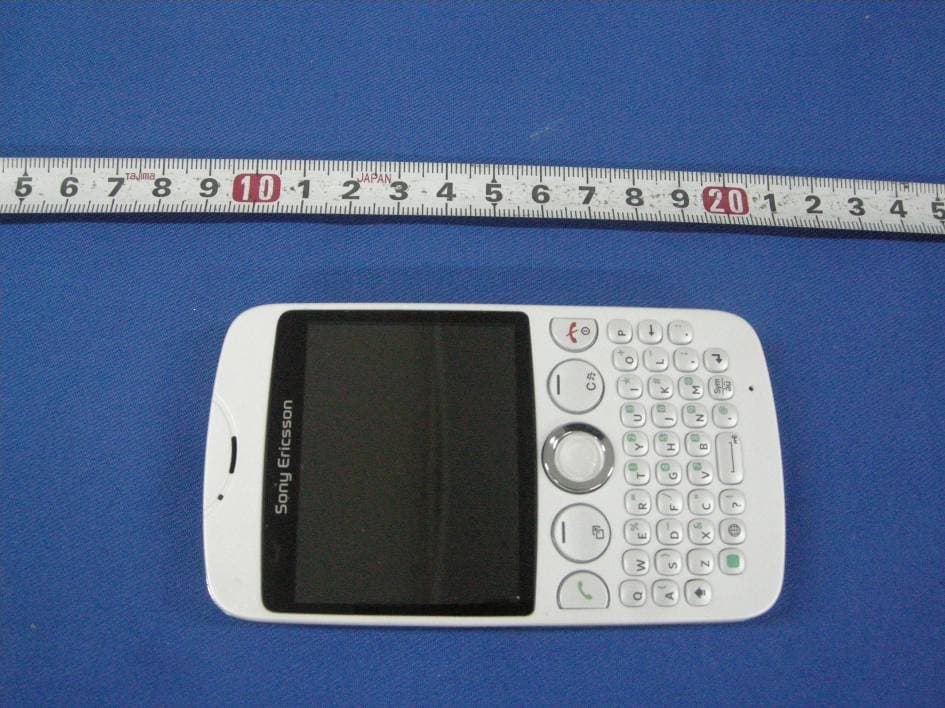
Click to zoom
Application Details
- Equipment Class
- PCE - PCS Licensed Transmitter held to ear
- Date of Grant
- Aug 10, 2011
- Application Purpose
- Original Equipment
- Date of Application
- Aug 10, 2011
- Equipment Note
- Mobile phone with Bluetooth, WLAN 802.11bg and FM Rx
- Frequency Range
- 1850.20000000 - 1909.80000000
- Company
- Sony Corporation
- Country
- Japan
Documents & Files
Document Text
Text extracted from the exhibit documents filed with the FCC. Open a document above to read the original.
Users Manual
Sony Ericsson txt Startup guide Sony Ericsson Mobile Communications AB SE-221 88 Lund, Sweden www.sonyericsson.com 1251-1671.1 Important information Please read the Important information leaflet before you use your mobile phone. Some of the services and features described in this User guide are not supported in all countries/regions or by all networks and/or service providers in all areas. Without limitation, this applies to the GSM International Emergency Number 112. Please contact your network operator or service provider to determine availability of any specific service or feature and whether additional access or usage fees apply. Getting started Some basic getting started instructions are printed on the box supplied with your phone. Below you will also find information to help get you started. To insert the SIM card • Open the cover and insert the SIM card with the gold-coloured contacts facing down. To insert or remove a memory card You may have to purchase a memory card separately. 1 Remove the battery cover and insert the memory card with the gold-coloured contacts facing down. 2 To remove the memory card, first remove the battery cover, then press the hook and draw the memory card outwards. To insert the battery + - 1 Insert the battery with the label side up and the connectors facing each other. 2 Put the battery cover into place. To turn on the phone 1 Press and hold down the key. 2 Enter your PIN, if requested. 3 Select OK. 4 Select a language. 5 Select Yes to start the setup wizard. If you make a mistake when you enter your PIN, you can press to delete numbers. To turn off the phone • Press and hold down . Before turning off the phone, you must return to standby. Starting your phone for the first time The first time you start your phone, a setup guide helps you enter essential phone settings and import contacts. You can also access the setup guide later from the phone settings. To set the time and date at startup 1 When the setup guide prompts you to set the time and date at startup, select Yes. 2 Enter the hour and minute fields to adjust the time. 3 When you're done, select Save. 4 Enter the year, month and day fields to adjust the date. 5 When you're done, select Save. To import contacts from a SIM card • When you start your phone for the first time with a SIM card inserted, the setup guide prompts you to import your SIM contacts. Select Yes. Getting to know your phone Phone overview 1Ear speaker Q W E % R = T 1 Y 2 U 3 l * O + P A ( S ( D F G 4 H 5 J 6 K # L - Z X & C “ V 7 B 8 N 9 M 0 , ; . : @ Sym au ? ! 1 2 3 5 7 9 68 4 2Screen 3Navigation key 4Selection key 5Call key 6Shortcut key 7Keypad 8Clear key 9End key, On/off key 10Handset connector 10 12 13 14 11 11Camera lens 12Speaker 13Volume key 14Connector for charger and USB cable Charging the battery Your phone battery is partly charged when you buy the phone. It may take a few minutes before the battery icon appears on the screen when you connect the phone charger cable to a power source, such as a USB port or a phone charger. You can still use your phone while it is charging. The battery will start to discharge a little after it is fully charged and then charges again after a certain time when the phone charger is connected. This is to extend battery life and may result in the charge status showing a level below 100 percent. To charge the phone using the power adapter • Connect the phone to a power outlet using the USB cable and the power adapter. Navigation The main menus are shown as icons. Some submenus include tabs. To access the main menu • When Menu appears on the screen, press the centre selection key. • When Menu does not appear on the screen, press the End key, then press the centre selection key. To navigate the phone menus 1 Press the centre selection key to select Menu. 2 Press the navigation key upwards, downwards, left or right to move through the menus. To select an item • Scroll to the item and press the centre selection key To scroll between tabs • Press the navigation key left or right . To go back one step in a menu • Select Back. To end a function • Press . To return to standby • Press . Friends application The Friends application collects communications with your top five friends into one view. All communications – Facebook™ or Twitter™ updates, text and multimedia messages, missed calls – appear in standby. This application may not be available in all countries or regions. To add a friend to the Friends application 1 From standby, select Friends. 2 Select Add. 3 All contacts in your phone are displayed. Select a contact to add it as one of your five closest friends. You can add one friend at a time. 4 To add another friend, press the navigation key left or right to scroll to another icon. 5 Select Add and press the navigation key up or down to select a contact. To call a friend from the Friends application 1 From standby, select Friends. 2 Press the navigation key left or right to select a friend. 3 Scroll to and select Call. To view a received message in the Friends application 1 When a messaging notification appears, select Friends. 2 Press the navigation key left or right to select the friend who sent the message. 3 Scroll to , then select Open > View. To reply to a message using the Friends application 1 From standby, select Friends. 2 Press the navigation key left or right to select a friend. 3 Scroll to . 4 Select Open > View and scroll to the message you want to reply to. 5 Select Reply to reply to the message. To access Facebook via the Friends application 1 From standby, select Friends. 2 Press the navigation key left or right to select a friend. 3 Scroll to and select Open. You can also manage Twitter™ events in a similar way. To adjust the Friends update frequency 1 From standby, select Friends. 2 Select Options > My settings > Update frequency. 3 Select an option. Instant messaging Use the IM (Instant Messaging) application to chat with other people and participate in IM groups to dis…
Text truncated - open the document above for the full version.
Cover Letter(s)
Sony Ericsson Confidentiality Request 2011-07-19 CVDVBA11 :350 SEMC/CVDVBA Afrah Sadiq +46 10 80 12250 Receiver Federal Communications Commission Subject: Request for Confidentiality FCC 10: PY7A1880033 To Whom It May Concern: In accordance with §0.459 of CFR 47, Sony Ericsson Mobile Communications AB requests confidentiality for the below listed items for our mobile phone type AAB 1880033-BV, FCC 10: PY7 A 1880033: 1. Block Diagram 2. Schematic Diagram 3. Part List 4. Operational/Technical Descriptions These items contain detailed system and equipment description and related information about the product which Sony Ericsson Mobile Communications AB considers to be proprietary, confidential and a custom design which otherwise would not be released to the general public. Since this design is a basis from which future technological products will evolve, Sony Ericsson Mobile Communications AB also feels that this information would be of benefit to its competitors, and that the disclosure of the information in these exhibits would give our competitors an unfair advantage in the market. Please contact the undersigned if there are any further questions or additional information needed in this matter. Best Regards, I Afrah Sadiq Development Engineer - Global Type Approval Sony Ericsson Mobile Communications AS Sony Ericsson Mobile Communications AS Styrelsens sate : L und Moms nr· II.A. T. No: SE556615665801 Registered office: Lund Organisationsnr· Reg No: 556615-6658 Postadress • Mail Besoksadress • Office address Telefon • Telephone Telef ax • Telefax SE -221 88 Lund Nya Vattentorn et Nat 010-80 00000 Nat 010-80 02040 Sweden Lund Int +46 10 80 00000 Int +46 10 80 02040
External Photos
No.2011TAR366 Page 10 of 23 ©Copyright. All rights reserved by TMC Beijing. ANNEX A: EUT photograph Mobile Phone Mobile Phone No.2011TAR366 Page 11 of 23 ©Copyright. All rights reserved by TMC Beijing. Mobile Phone Mobile Phone No.2011TAR366 Page 12 of 23 ©Copyright. All rights reserved by TMC Beijing. Mobile Phone Mobile Phone
ID Label/Location Info
1 (2) Company Internal MARKING DRAWI NG Prepared (also subject responsible if other) No. SEM/CVVGP, Anna Englund 1252-3709 Uen Approved Checked Date Rev Reference SEM/CVVGP, Anna Englund 2011-05-12 1 6 CK13i, Mobile Phone Label Content, ROW, Made in... 1 General information Mobile Phone label part no 1246-9813 Mobile Phone label content part no 1252-3708 Bar code Print quality: according to COSMETIC GUIDELINE – Bar code labels document 1222-6072 Uen Quiet zone: No bar codes are allowed to be closer to a label edge than 2 mm! Text If applicable, or nothing else specified, Zebra printer Scaleable Smooth Font CG Triumvirate Bold Condensed is imposed. When needed, the text is adjusted to fit the label. Coordinates “(x/y)” under each line number specifies the bottom / left alignment for text, graphics and bar codes, x is measured vertically, and y horizontally from the upper left corner of the label (landscape format), both in mm. When needed, the alignment is adjusted to fit the label. 2 Printing information Content Format Line 1a (2,0/3,0) Sony Ericsson stylized name. Graphics, height 1,5 mm. According to 1200-1925 Line 1b (2,0/20,0) Model Name “CK13i” Text, height 1,2 mm. According to Chapter 1 in MLCI. Line 1c (2,0/26,8) Marking of origin; “Made in Xxx” “Xxx” = actual country of production of the included telephone, in English Text, height 1,2 mm. Line 2a (4,0/3,0) Product number of the Sales Item in which the phone is packed, if applicable. “SI XXXX-XXXX” Text, height 1,2 mm. Line 2b (4,0/20,0) Production week (flash), “yyWww” (yy = year, ww = week Text, height 1,2 mm. Line 2c (4,0/26,8) Repair week, if applicable. “RyyWww” (y = year, ww = week) Text, height 1,2 mm. Line 2b (4,0/33,0) ”FCC ID: PY7A1880033” Text, height 1,2 mm. According to Chapter 1 in MLCI. Line 3a (6,0/3,0) “TYPE: AAB-1880033-BV” Text, height 1,2 mm. According to Chapter 1 in MLCI. Line 3b (6,0/20,0) HW & SW identification field, if applicable; “FFGG” Text, height 1,2 mm. According to Type-testing report under Product Model Specifying Documents Line 3c (6,0/26,8) Location code of where the phone is flashed, if applicable, “XXX” Text, height 1,2 mm Line 3d (6,0/33,0) “IC: 4170B-A1880033” Text, height 1,2 mm. According to Chapter 1 in MLCI. Company Internal MARKING DRAWING 2 (2) Prepared (also subject responsible if other) No. SEM/CVVGP, Anna Englund 1252-3709 Uen Approved Checked Date Rev Reference SEM/CVVGP, Anna Englund 2011-05-12 1 6 Line 4 (8,0/4,0) Line 4 in bar code, according to line 5a. As desired by supplier (e.g. only actual number). Bar code, height 2,0 mm. As desired by supplier (e.g. Code 128 symbology). Line 5a (9,5/4,0) Supplier’s identification for trace-ability of the telephone, as desired by supplier (e.g. “S/N: nnn....” for serial number). Text, height 1,2 mm. Defined by supplier. Line 5b (9,5/20,0) Actual electronic serial number (IMEI) of the mobile phone, “00000000-000000-0” Text, height 1,2 mm. In the format TAC-SNR-CD. TAC and SNR derived from pos 500 in BOM. CD = check digit according to the Luhn formula (ISO/IEC 7812), GSM 02.16. Line 6 (9,3/3,0) Line 6 in bar code, according to line 5b. As desired by supplier (e.g. only actual number). Bar code, height 2,0 mm. As desired by supplier (e.g. Code 128 symbology). Line 7a (17,5/3,0) CE approval symbol, the NB-“0682” and “Alert Symbol” in one artwork Graphics, height 5 mm. According to 1242-7470 Line 7b (17,5/33,0) WEEE trashcan without bar symbol Graphics, min. height 5mm, according to 1202-5537. 3 Layout The conceptual picture (for Zebra 90XiII printer, or equivalent) should not be considered as specifications, but as an additional help for setting up the label. 3.1 Conceptual picture double underlined = major changes since last revision Confidential MARKING DRAWING 1(1) Document number R evision 1252-3709 Uen Prepared by Date 2011-05-12 Contents responsible if other than preparer Remarks This document is managed in metaDoc. Approved by Note: Any hard copy of this document is for reference only. D ue to template and application dependencies the header and footer may fail to display correct data. It is the responsibility of the user to ensure that they have a correct and valid version. Any outdated hard copy is invalid and must be removed from possible use. Label placement To find the label follow these steps: 1 . Remove the cover on the rear side of the product. 2. Remove the battery. 3. The label is located behind the battery. Rear side of the phone Place for battery Label placement
Internal Photos
No.2011TAR366 Page 14 of 23 ©Copyright. All rights reserved by TMC Beijing. Mobile phone Disassembly Mobile phone Disassembly No.2011TAR366 Page 15 of 23 ©Copyright. All rights reserved by TMC Beijing. Mobile phone Disassembly Mobile phone Disassembly No.2011TAR366 Page 16 of 23 ©Copyright. All rights reserved by TMC Beijing. Battery Battery No.2011TAR366 Page 17 of 23 ©Copyright. All rights reserved by TMC Beijing. Data Cable
RF Exposure Info
Date/Time: 6/14/2011 1:47:06 PM Test Laboratory: Sony Ericsson Mobile Communications Mugua-Body-Flat15mm-GSM1900-EGPRS-High DUT: Mugua; Type: DUT; Serial: #20352 Communication System: GPRS 1900; Frequency: 1909.8 MHz;Duty Cycle: 1:4.15 Medium parameters used: f = 1909.8 MHz; σ = 1.54 mho/m; ε r = 51.8; ρ = 1000 kg/m 3 Phantom section: Flat Section Measurement Standard: DASY4 (High Precision Assessment) DASY4 Configuration: zProbe: ET3DV6 - SN1539; ConvF(4.23, 4.23, 4.23); Calibrated: 11/16/2010 zSensor-Surface: 4mm (Mechanical Surface Detection) zElectronics: DAE3 Sn415; Calibrated: 11/16/2010 zPhantom: SAM with CRP (High Band Body); Type: SAM; Serial: TP: 1020 zMeasurement SW: DASY4, V4.7 Build 80; Postprocessing SW: SEMCAD, V1.8 Build 172 Body 4 EDGE/Area Scan (51x91x1): Measurement grid: dx=15mm, dy=15mm Maximum value of SAR (interpolated) = 1.12 mW/g Body 4 EDGE/Zoom Scan (5x5x7)/Cube 0: Measurement grid: dx=8mm, dy=8mm, dz=5mm Reference Value = 10.3 V/m; Power Drift = -0.190 dB Peak SAR (extrapolated) = 1.52 W/kg SAR(1 g) = 1.02 mW/g; SAR(10 g) = 0.616 mW/g Maximum value of SAR (measured) = 1.12 mW/g 0 dB = 1.12mW/g Page 1 of 1 7/11/2011file://C:\Program Files\DASY4\Documentation\Mugua-Body-Flat15mm-GSM1900-E ... Date/Time: 6/14/2011 1:29:57 PM Test Laboratory: Sony Ericsson Mobile Communications Mugua-Body-Flat15mm-GSM1900-EGPRS-Low DUT: Mugua; Type: DUT; Serial: #20352 Communication System: GPRS 1900; Frequency: 1850.2 MHz;Duty Cycle: 1:4.15 Medium parameters used: f = 1850.2 MHz; σ = 1.48 mho/m; ε r = 52; ρ = 1000 kg/m 3 Phantom section: Flat Section Measurement Standard: DASY4 (High Precision Assessment) DASY4 Configuration: zProbe: ET3DV6 - SN1539; ConvF(4.23, 4.23, 4.23); Calibrated: 11/16/2010 zSensor-Surface: 4mm (Mechanical Surface Detection) zElectronics: DAE3 Sn415; Calibrated: 11/16/2010 zPhantom: SAM with CRP (High Band Body); Type: SAM; Serial: TP: 1020 zMeasurement SW: DASY4, V4.7 Build 80; Postprocessing SW: SEMCAD, V1.8 Build 172 Body 3 EDGE/Area Scan (51x91x1): Measurement grid: dx=15mm, dy=15mm Maximum value of SAR (interpolated) = 1.10 mW/g Body 3 EDGE/Zoom Scan (5x5x7)/Cube 0: Measurement grid: dx=8mm, dy=8mm, dz=5mm Reference Value = 9.97 V/m; Power Drift = -0.001 dB Peak SAR (extrapolated) = 1.45 W/kg SAR(1 g) = 0.984 mW/g; SAR(10 g) = 0.590 mW/g Maximum value of SAR (measured) = 1.09 mW/g 0 dB = 1.09mW/g Page 1 of 1 7/11/2011file://C:\Program Files\DASY4\Documentation\Mugua-Body-Flat15mm-GSM1900-E ... Date/Time: 6/14/2011 1:16:02 PM Test Laboratory: Sony Ericsson Mobile Communications Mugua-Body-Flat15mm-GSM1900-EGPRS-Mid DUT: Mugua; Type: DUT; Serial: #20352 Communication System: GPRS 1900; Frequency: 1880 MHz;Duty Cycle: 1:4.15 Medium parameters used: f = 1880 MHz; σ = 1.51 mho/m; ε r = 51.9; ρ = 1000 kg/m 3 Phantom section: Flat Section Measurement Standard: DASY4 (High Precision Assessment) DASY4 Configuration: zProbe: ET3DV6 - SN1539; ConvF(4.23, 4.23, 4.23); Calibrated: 11/16/2010 zSensor-Surface: 4mm (Mechanical Surface Detection) zElectronics: DAE3 Sn415; Calibrated: 11/16/2010 zPhantom: SAM with CRP (High Band Body); Type: SAM; Serial: TP: 1020 zMeasurement SW: DASY4, V4.7 Build 80; Postprocessing SW: SEMCAD, V1.8 Build 172 Body 2 EDGE/Area Scan (51x91x1): Measurement grid: dx=15mm, dy=15mm Maximum value of SAR (interpolated) = 1.17 mW/g Body 2 EDGE/Zoom Scan (5x5x7)/Cube 0: Measurement grid: dx=8mm, dy=8mm, dz=5mm Reference Value = 9.89 V/m; Power Drift = -0.158 dB Peak SAR (extrapolated) = 1.53 W/kg SAR(1 g) = 1.04 mW/g; SAR(10 g) = 0.627 mW/g Maximum value of SAR (measured) = 1.17 mW/g 0 dB = 1.17mW/g Page 1 of 1 7/11/2011file://C:\Program Files\DASY4\Documentation\Mugua-Body-Flat15mm-GSM1900-E ... Date/Time: 6/14/2011 11:05:29 AM Test Laboratory: Sony Ericsson Mobile Communications Mugua-Body-Flat15mm-GSM1900-Speech-High DUT: Mugua; Type: DUT; Serial: #20352 Communication System: DCS 1900; Frequency: 1909.8 MHz;Duty Cycle: 1:8.3 Medium parameters used: f = 1909.8 MHz; σ = 1.54 mho/m; ε r = 51.8; ρ = 1000 kg/m 3 Phantom section: Flat Section Measurement Standard: DASY4 (High Precision Assessment) DASY4 Configuration: zProbe: ET3DV6 - SN1539; ConvF(4.23, 4.23, 4.23); Calibrated: 11/16/2010 zSensor-Surface: 4mm (Mechanical Surface Detection) zElectronics: DAE3 Sn415; Calibrated: 11/16/2010 zPhantom: SAM with CRP (High Band Body); Type: SAM; Serial: TP: 1020 zMeasurement SW: DASY4, V4.7 Build 80; Postprocessing SW: SEMCAD, V1.8 Build 172 Body 3/Area Scan (51x91x1): Measurement grid: dx=15mm, dy=15mm Maximum value of SAR (interpolated) = 0.664 mW/g Body 3/Zoom Scan (5x5x7)/Cube 0: Measurement grid: dx=8mm, dy=8mm, dz=5mm Reference Value = 7.89 V/m; Power Drift = -0.123 dB Peak SAR (extrapolated) = 0.884 W/kg SAR(1 g) = 0.596 mW/g; SAR(10 g) = 0.359 mW/g Maximum value of SAR (measured) = 0.659 mW/g 0 dB = 0.659mW/g Page 1 of 1 7/11/2011file://C:\Program Files\DASY4\Documentation\Mugua-Body-Flat15mm-GSM1900-Sp ... Date/Time: 6/13/2011 1:36:09 PM Test Laboratory: Sony Ericsson Mobile Communications Mugua-Body-Flat15mm-GSM850-GPRS-High DUT: Mugua; Type: DUT; Serial: #20352 Communication System: GSM 850; Frequency: 848.8 MHz;Duty Cycle: 1:4.15 Medium parameters used: f = 848.8 MHz; σ = 0.984 mho/m; ε r = 52.7; ρ = 1000 kg/m 3 Phantom section: Flat Section Measurement Standard: DASY4 (High Precision Assessment) DASY4 Configuration: zProbe: ET3DV6 - SN1539; ConvF(5.66, 5.66, 5.66); Calibrated: 11/16/2010 zSensor-Surface: 4mm (Mechanical Surface Detection) zElectronics: DAE3 Sn415; Calibrated: 11/16/2010 zPhantom: SAM with CRP (Low Band Body); Type: SAM; Serial: TP: 1031 zMeasurement SW: DASY4, V4.7 Build 80; Postprocessing SW: SEMCAD, V1.8 Build 172 Body 4 GPRS/Area Scan (51x91x1): Measurement grid: dx=15mm, dy=15mm Maximum value of SAR (interpolated) = 1.25 mW/g Body 4 GPRS/Zoom Scan (5x5x7)/Cube 0: Measurement grid: dx=8mm, dy=8mm, dz=5mm Reference Value = 34.8 V/m; Power Drift = 0.014 dB Peak SAR (extrapolated) = 1.60 W/kg SAR(1 g) = 1.19 mW/g; SAR(10 g) …
Text truncated - open the document above for the full version.
RF Exposure Info
Company Internal INSTRUCTION 1 (20) Prepared (also subject responsible if other) No. LD/SEMC/BGUG/NM Ramadan Plicanic GUG/N 03:141 Approved Checked Date Rev Reference LD/SEMC/BGUG/NMC Mats Hansson 060220 E File Note: Any hard copy of this document is for reference only. Due to template and application dependecies the header and footer may fail to display correct data. It is the responsibility of the user to ensure that they have a corect and valid version. Any outdated hard copy is invalid and must be removed from possible use. Sony Ericsson SAR Measurement Specification of Wireless Terminals Contents 1 Introduction and scope ........................................................................................................2 2 References ........................................................................................................................... 2 3 Physical quantities, units and constants............................................................................... 4 4 Definitions ........................................................................................................................... 4 5 Measurement system specifications .................................................................................... 4 5.1 General ................................................................................................................................ 4 5.2 Phantom............................................................................................................................... 5 5.3 SAR measurement equipment ............................................................................................. 5 5.4 Scanning system .................................................................................................................. 6 5.5 Wireless device holder ........................................................................................................ 6 5.6 Other equipment .................................................................................................................. 6 6 Protocol for SAR assessment .............................................................................................. 7 6.1 Measurement preparation ....................................................................................................7 6.2 Tests to be performed .......................................................................................................... 7 6.3 Measurement procedure ......................................................................................................7 6.4 Post processing .................................................................................................................... 8 7 Measurement uncertainty .................................................................................................... 9 Annex A Tissue simulating material preparation .............................................................................. 9 Annex B Dielectric property measurements .................................................................................... 12 Annex C SAR measurement procedure ........................................................................................... 13 Annex D Measurement system performance check and validation ................................................. 15 Annex E Uncertainty budgets for 1g and 10g SAR assessments with DASY................................. 17 Company Internal INSTRUCTION 2 (20) Prepared (also subject responsible if other) No. LD/SEMC/BGUG/NM Ramadan Plicanic GUG/N 03:141 Approved Checked Date Rev Reference LD/SEMC/BGUG/NMC Mats Hansson 060220 E File Note: Any hard copy of this document is for reference only. Due to template and application dependecies the header and footer may fail to display correct data. It is the responsibility of the user to ensure that they have a corect and valid version. Any outdated hard copy is invalid and must be removed from possible use. 1. Introduction and scope It is a Sony Ericsson policy that all RF transmitting product models shall comply with relevant recommendations, standards and regulations on human exposure to electromagnetic fields. In the reference section below, the most important RF safety guidelines are listed [9-13]. If no national standard or regulation is available in a country, the international recommendation from ICNIRP [9] shall be applied. The RF safety guidelines specify basic restrictions and reference levels. In the frequency range of interest for mobile communications, the basic restrictions are expressed as Specific Absorption Rate (SAR) limits and the reference levels as field strength or power density limits. The reference levels are provided for the purpose of simple measurements of compliance with the basic restrictions, and they are primarily applicable in the far-field region of a RF source. Measured values greater than the reference levels do not necessarily mean that the basic restrictions are exceeded. In the near-field region of mobile communication devices (handsets), field strength values exceeding the reference levels may be observed. Compliance with the basic SAR restrictions has therefore to be verified. SAR (W/kg) is a measure of the rate of RF energy absorption in tissue. The localized SAR limits depend on whether the device is classified for use by the general public (uncontrolled environment) or workers (controlled environment). Mobile communication equipment are usually used by the general public and should consequently be in compliance with the general public limits, which are 2.0 W/kg averaged in 10 gram of tissue in the ICNIRP guidelines [9] and 1.6 W/kg averaged in 1 gram in the ANSI/IEEE standard [10]. Because of the lower limit and the smaller averaging mass, the ANSI/IEEE limit is slightly more conservative than the ICNIRP limit. The averaging times are also different, 6 minutes in the ICNIRP recommendations and 30 minutes in the IEE…
Text truncated - open the document above for the full version.
RF Exposure Info
Company Internal REPORT 1 (16) Prepared (also subject responsible if other) No. BA/SEMC/CVVBAU Rob Carr CVDVBA11:352 Approved Checked Date Rev Reference BA/SEMC/CVVBAU Jon Kenny JK 110711 A File Test Report issued by Accredited SAR Laboratory for FCC ID: PY7A1880033 (CK13i) to FCC OET BULLETIN 65 SUPPLEMENT C 01-01 IEEE STD 1528:2003 IC RSS-102 ISSUE 4 Date of test: 2011-06-08 to 2011-07-15 Laboratory: Sony Ericsson SAR Test Laboratory Sony Ericsson Mobile Communications AB Maplewood, Chineham Business Park Basingstoke, RG24 8YB, England Testing Engineer: Robert Carr [email protected] +44 2087625958 Testing Approval: Jon Kenny [email protected] +44 2087625957 Statement of Compliance Sony Ericsson Mobile Communications AB declares under its sole responsibility that the product Sony Ericsson Type AAB-1880033-BV; FCC ID PY7A1880033; IC 4170B-A1880033 to which this declaration relates, is in conformity with the appropriate RF exposure standards recommendations and guidelines. It also declares that the product was tested in accordance with the appropriate measurement standards, guidelines and recommended practices. Any deviations from these standards, guidelines and recommended practices are noted below: (None) This laboratory is accredited to ISO/IEC 17025 (SWEDAC accreditation no. 1847). Laboratories are accredited by the Swedish Board for Accreditation and Conformity Assessment (SWEDAC) under the terms of Swedish legislation. The accredited laboratory activities meet the requirements in SS-EN ISO/IEC 17025 (2005). This report may not be reproduced other than in full, except with the prior written approval of the issuing laboratory. The results and statements contained herein relate only to the items tested. The names of individuals involved may be mentioned only in connection with the statements or results from this report. Sony Ericsson encourages all feedback, both positive and negative, on this report. © Sony Ericsson Mobile Communication AB, 2011 Company Internal REPORT 2 (16) Prepared (also subject responsible if other) No. BA/SEMC/CVVBAU Rob Carr CVDVBA11:352 Approved Checked Date Rev Reference BA/SEMC/CVVBAU Jon Kenny JK 110711 A File Table of contents 1 INTRODUCTION .................................................................................................................................................................. 3 2 CUSTOMER DETAILS ........................................................................................................................................................ 3 3 DEVICE UNDER TEST ........................................................................................................................................................ 3 3.1 ANTENNA DESCRIPTION ................................................................................................................................................... 3 3.2 DEVICE DESCRIPTION ...................................................................................................................................................... 4 4 TEST EQUIPMENT .............................................................................................................................................................. 6 4.1 DOSIMETRIC SYSTEM ....................................................................................................................................................... 6 5 ELECTRICAL PARAMETERS ON THE TISSUE SIMULATING LIQUID .............................................................. 7 5.1 DIELECTRICS FOR FREQUENCIES TESTED ........................................................................................................................ 8 6 SYSTEM ACCURACY VERIFICATION .......................................................................................................................... 9 7 SAR MEASUREMENT UNCERTAINTY ....................................................................................................................... 10 8 ....................................................................................................................................................................................................... 11 8.1 TEST RESULTS ................................................................................................................................................................ 11 8.2 SIMULTANEOUS TRANSMITTERS .................................................................................................................................... 12 9 REFERENCES ..................................................................................................................................................................... 13 APPENDIX .................................................................................................................................................................................... 14 9.1 PHOTOGRAPHS OF THE DEVICE UNDER TEST ........................…
Text truncated - open the document above for the full version.
Contact Information
Applicant
Mika Kaneko(Chief Regulatory Compliance Manager)
Test Firm
TMC-Telecommunication Metrology Center of M.I.I.TChongwen Song
Technical Specifications
| # | Rule Parts | Frequency Range | Power Output | Emission | Tolerance |
|---|---|---|---|---|---|
| 4 | 24E | 1.85 GHz - 1.91 GHz | 130.00 mW | 300KG7W | 0.02 ppm |
Other Applications from Sony Corporation
PY7-75158T
Jul 16, 2026GSM/WCDMA/LTE Phone with BT, DTS/UNII a/b/g/n/ac/ax, NFC and GNSS
Equipment Class
NII - Unlicensed National Information Infrastructure TXPY7-52715J
Jul 16, 2026GSM/WCDMA/LTE Phone with BT, DTS/UNII a/b/g/n/ac/ax, NFC and GNSS
Equipment Class
DXX - Part 15 Low Power Communication Device TransmitterPY7-84526Y
Jul 16, 2026GSM/WCDMA/LTE Phone with BT, DTS/UNII a/b/g/n/ac/ax, NFC and GNSS
Equipment Class
PCE - PCS Licensed Transmitter held to earPY7-30515Z
Apr 13, 2026GSM/WCDMA/LTE/NR Phone with BT, DTS/UNII a/b/g/n/ac/ax/be, NFC, GNSS and WPT
Equipment Class
DXX - Part 15 Low Power Communication Device TransmitterPY7-73716J
Apr 11, 2024GSM/WCDMA/LTE Phone with BT, DTS/UNII a/b/g/n/ac, NFC and GNSS
Equipment Class
PCE - PCS Licensed Transmitter held to ear