PY7A3880105Mobile phone with Bluetooth, WLAN 802.11bgn, GPS/A-GPS, ANT+ and FM Rx
Sony Corporation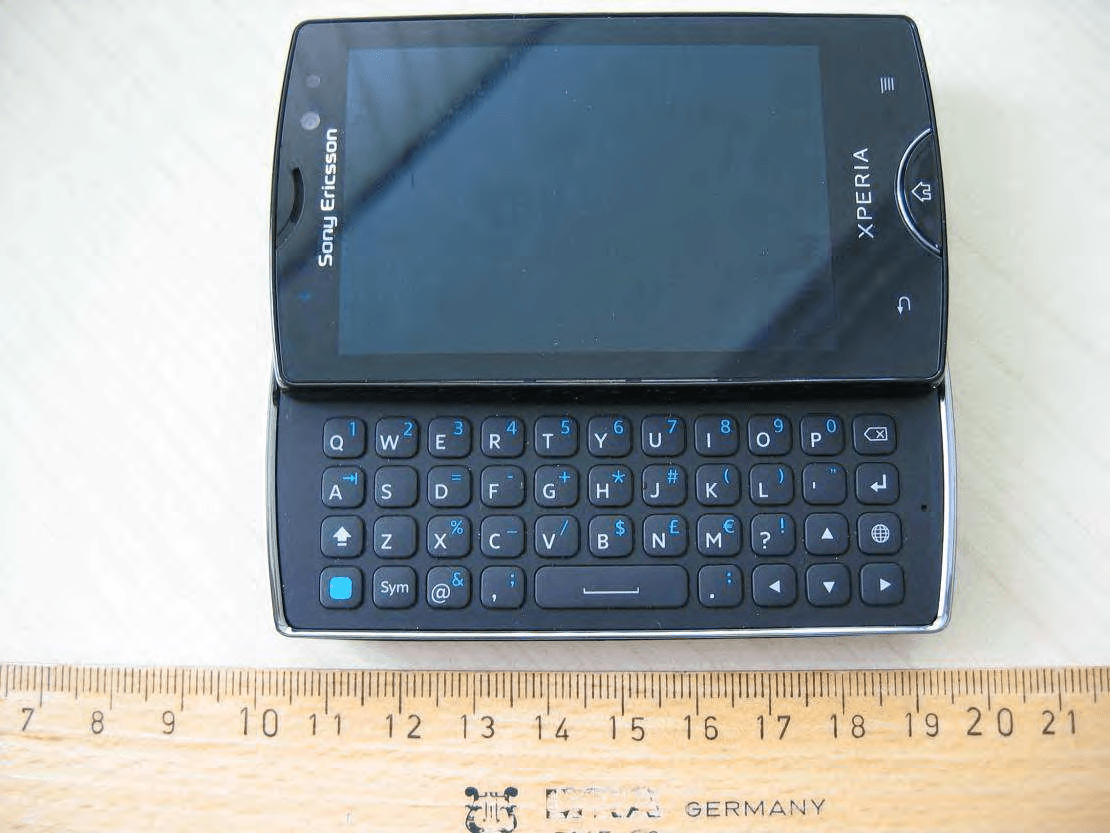
Click to zoom
Application Details
- Equipment Class
- PCE - PCS Licensed Transmitter held to ear
- Date of Grant
- Jul 20, 2011
- Application Purpose
- Original Equipment
- Date of Application
- Jul 20, 2011
- Equipment Note
- Mobile phone with Bluetooth, WLAN 802.11bgn, GPS/A-GPS, ANT+ and FM Rx
- Frequency Range
- 1852.40000000 - 1907.60000000
- Company
- Sony Corporation
- Country
- Japan
Documents & Files
Document Text
Text extracted from the exhibit documents filed with the FCC. Open a document above to read the original.
Users Manual
Xperia ™ mini pro Startup guide Sony Ericsson Mobile Communications AB SE-221 88 Lund, Sweden www.sonyericsson.com 1248-4734.1 Welcome Digital User guide This Startup guide is aimed at getting you through the first hour of using your new phone. As part of our Greenheart™ initiatives, we have placed a full-length User guide in the phone and on the web. By keeping the full User guide in digital format, we have cut down substantially on the amount of paper we print. You can find more information on how to access the in-phone User guide and other support at the end of this Startup guide. Important information Please read the Important information leaflet before you use your mobile phone. Assembly To remove the battery cover To insert the SIM card and the battery S/N: XXXABC12340000000-000000-0 SI XXXX-XXXX Made in Xxx TYPE: AAD-3880105-BV IC: 4170B-A3880105 XXX FFGG yyWww RyyWww SK17i FCC ID: PY7A3880105 To attach the battery cover Phone basics Phone overview 21 3 10 1198 5 6 7 4 1214 13 15 16 17 18 19 20 1. Notification LED/ Battery status 2. Proximity sensor 1 3. Proximity sensor 2 4. Ear speaker 5. Front camera 6. Light sensor 7. Touch screen 8. Menu key 9. Home key 10. Back key 11. Keyboard 12. Power key/Screen lock 13. Connector for charger/Micro USB cable 14. Headset connector 15. Camera LED light 16. Camera lens 17. Volume key/Zoom key 18. Camera key 19. Speaker 20. Strap hole Turning on the phone To turn on the phone To enter your SIM card PIN code • Tap the numbers on the screen to enter the personal identification number (PIN) for your SIM card. Waking up the screen To activate the screen • Press or press briefly. To unlock the screen • Drag the icon to the right across the screen. Using the hardware keys Back • Go back to the previous screen • Close the on-screen keypad, a dialog box, an options menu, or the Notification panel Home • Go to the Home screen or to the Application screen from any application or screen • Press and hold to open a window showing your most recently used applications Menu • Open a list of options available in the current screen or application Using the touch screen To open or highlight an item • Tap the item. To scroll • Drag or flick your finger in the direction you want to scroll on the screen. To zoom with two fingers • Place two fingers on the screen at once and pinch them together (to zoom out) or spread them apart (to zoom in). Typing text Use one of the following methods to type text containing letters, numbers and other characters: • Slide-out keyboard • On-screen keyboard • Phonepad When you are using the slide-out keyboard, the on-screen input methods become unavailable. Using the slide-out keyboard 1 2 3 4 7 8 9 5 6 1Change the character case and turn on the caps lock. For some languages, this key is used to access extra characters in the language. 2Mode toggle key – Press here to activate associated keys featuring characters of the same colour. For example, press this key once and then press the "Q" key to enter "1". 3Display symbols and smileys 4Enter a space 5Navigate left and right within a text field, or among other word and character options 6Navigate up and down within a text field, across rows, or among other word and character options 7Open the text input settings menu to change, for example, the Writing languages. 8Enter a carriage return or confirm text input 9Delete a character before the cursor All illustrations are for illustration purposes only and may not accurately depict the actual phone. Set up your phone The first time you start your phone, a setup guide explains basic phone functions and helps you enter essential settings. You can also access the setup guide later. To access the setup guide 1 From the Home screen, tap . 2 Tap Setup guide. Android™ – what and why? An Android™ phone is based on an open source platform, and is pre-loaded with Google™ services. To make the best out of any provided Google™ services, you should create a Google™ account and sign in to it when you first start your phone. With the account, you can extend the functionality of the phone by downloading applications and games from a constantly growing collection at Android Market™. You need to have Internet access for many of the features in Android. Accounts and services Use online services in your phone. Sign in with your existing account or sign up and create an account. Google™ account Use Gmail™ to send emails, Google Talk™ to chat with friends, and Android Market™ to download applications. Sony Ericsson account Store your phone contacts on a secure Sony Ericsson server, and you'll always have a backup online. Exchange Active Sync account Synchronise your phone with your corporate Exchange Active Sync account. This way, you keep your work email, contacts and calendar events with you at all times. To add an account 1 From your Home screen, tap . 2 Tap Settings > Accounts & sync > Add account. 3 Tap the account type you want to add and then follow the registration wizard. Getting contacts into your phone The first time you open the Contacts application, you get hints on how to start adding contacts to your phone. This is a good time to choose a method that suits your situation and setup. View all import options on www.sonyericsson.com/support/ contacts. Here are two recommended options: Synchronise your phone with contacts already stored with an online synchronisation service, such as Sony Ericsson Sync or Google Sync™. Import contacts from a SIM card. You may not be able to transfer all information from one phone to another using this method because of limited memory on the SIM card. To synchronise your phone contacts with a synchronisation account 1 From your Home screen, tap , then tap . 2 Press , then tap Settings > Accounts & sync. 3 To set up a synchronisation account, tap Add account and follow the on-screen instructions. If you have already set up a synchronisation account and you want to sync with that account, tap the account, press , and ta…
Text truncated - open the document above for the full version.
Users Manual
FCC Statement Declaration of Conformity Sony Ericsson SK17a UMTS HSPA Band 1 2 5 GSM GPRS/EDGE 850/900/1800/1900 Important Information United States & Canada THIS PHONE MODEL HAS BEEN CERTIFIED IN COMPLIANCE WITH THE GOVERNMENT’S REQUIREMENTS FOR EXPOSURE TO RADIO WAVES. The SK17a Series mobile phones have been designed to comply with applicable safety requirements for exposure to radio waves. Your wireless phone is a radio transmitter and receiver. It is designed to not exceed the limits* of exposure to radio frequency (RF) energy set by governmental authorities. These limits establish permitted levels of RF energy for the general population. The guidelines are based on standards that were developed by international scientific organizations through periodic and thorough evaluation of scientific studies. The standards include a safety margin designed to assure the safety of all individuals, regardless of age and health. The radio wave exposure guidelines employ a unit of measurement known as the Specific Absorption Rate (SAR). Tests for SAR are conducted using standardized methods with the phone transmitting at its highest certified power level in all used frequency bands. While there may be differences between the SAR levels of various phone models, they are all designed to meet the relevant guidelines for exposure to radio waves. For more information on SAR, please refer to the safe and efficient use chapter in the User Guide. The highest SAR value as reported to the authorities for this phone model when tested for use by the ear is 0.63 W/kg*, and when worn on the body is 1.26 W/kg* for speech and 1.33 W/kg* for data calls. For body-worn operation, the phone has been tested when positioned a minimum of 15 mm from the body without any metal parts in the vicinity of the phone or when properly used with an appropriate Sony Ericsson accessory and worn on the body. For devices which include “WiFi hotspot” functionality, body-worn SAR measurements for operation of the device operating in WiFi hotspot mode were taken using a separation distance of 10mm. 2 Use of third-party accessories may result in different SAR levels than those reported. **Before a phone model is available for sale to the public in the US, it must be tested and certified by the Federal Communications Commission (FCC) that it does not exceed the limit established by the government-adopted requirement for safe exposure*. The tests are performed in positions and locations (i.e., by the ear and worn on the body) as required by the FCC for each model. The FCC has granted an Equipment Authorization for this phone model with all reported SAR levels evaluated as in compliance with the FCC RF exposure guidelines. While there may be differences between the SAR levels of various phones, all mobile phones granted an FCC equipment authorization meet the government requirement for safe exposure. SAR information on this phone model is on file at the FCC and can be found under the Display Grant section of http://www.fcc.gov/oet/fccid after searching on FCC ID PY7A3880105. Additional information on SAR can be found on the Cellular Telecommunications & Internet Association (CTIA) website at http://www.phonefacts.net. * In the United States and Canada, the SAR limit for mobile phones used by the public is 1.6 watts/kilogram (W/kg) averaged over one gram of tissue. The standard incorporates a margin of safety to give additional protection for the public and to account for any variations in measurements. **This paragraph is only applicable to authorities and customers in the United States. 3 Renseignements importants États-Unis et Canada CE MODÈLE DE TÉLÉPHONE A ÉTÉ CERTIFIÉ CONFORME AUX EXIGENCES GOUVERNEMENTALES RELATIVES À L'EXPOSITION AUX ONDES RADIOÉLECTRIQUES. Les téléphones mobiles de la SK17a ont été conçus pour répondre aux normes de sécurité en vigueur en matière d'exposition aux ondes radioélectriques. Votre téléphone sans fil est un émetteur et un récepteur radio. Il est conçu de manière à ne pas dépasser les limites* d'exposition à l'énergie des fréquences radio (RF) établies par les autorités gouvernementales. Ces limites fixent les niveaux maximaux d'énergie RF auxquels peut être soumis le grand public. Ces lignes directrices sont basées sur des normes qui ont été élaborées par des organisations scientifiques internationales par le biais d'évaluations périodiques et approfondies des études scientifiques. Ces normes prévoient une marge de sécurité visant à assurer la protection de tous les individus, peu importe leur âge et leur état de santé. Les lignes directrices relatives à l'exposition aux ondes radioélectriques utilisent une unité de mesure appelée « Taux d'absorption spécifique » (TAS). Les tests de TAS sont effectués selon des méthodes standardisées dans lesquelles le téléphone émet dans toutes les bandes de fréquences utilisées, à la plus forte puissance pour laquelle il a été homologué. Bien que le TAS puisse être différent d'un modèle de téléphone à un autre, tous les appareils sont conçus pour respecter les lignes directrices relatives aux ondes radioélectriques. Pour en savoir plus sur le TAS, reportez-vous au chapitre sur l'utilisation efficace et sans danger du guide de l'utilisateur. Le TAS le plus élevé relevé par les autorités pour ce modèle de téléphone est de 0.63 W/kg* lorsqu'il est testé en utilisation près de l'oreille, et de 1.26 W/kg* pour les appels vocaux et de 1.33 W/kg* pour les transmissions de données lorsqu'il est porté sur le corps. En mode d’utilisation porté sur le corps, le téléphone a été testé lorsqu’il est à au moins 15 mm du corps et à l’écart de toute pièce en métal, ou lorsqu’il est utilisé de façon adéquate 4 avec un accessoire Sony Ericsson et porté sur le corps. Pour les appareils munis de la fonctionnalité « point d'accès WiFi », en mode d'utilisation porté sur le corps, les mesures du TAS de l'appareil en mode WiFi ont été prises à une distance de sécurité de 10 mm. L'utilisation d'…
Text truncated - open the document above for the full version.
Attestation Statements
Prepared by SEM/CVGAERB GAVIN HAN Contents responsible if other than preparer Approved by SEM/CVGAERB (ROGER SONG) the responsibility of the user to ensure that they have a correct and valid version. Any outdated hard copy is invalid and must b FCC/SAR Hotspot Power Back Off implementation in PY7A3880104 This document is regarding the power back off implementation in PY7A3880105 during Wifi Hotspot mode for SAR measurement. When Hotspot mode is activated, an automatic RF power reduction is activated and reduces the maximum output RF power Hotspot mode is deactivated, the RF output power levels return to their normal RF power level. Band UMTS Band 2 (only applica GSM1900 1 slot GSM1900 2 slot GSM1900 3 slot GSM1900 4 slot GSM850 2 slot GSM850 3 slot GSM850 4 slot Confidential PROJECT REPORT Document number 9/0362-1/FCP 119 1010/1 Uen Date 2011-07-15 Remarks This document is managed in metaDoc. responsibility of the user to ensure that they have a correct and valid version. Any outdated hard copy is invalid and must be removed from possible use. FCC/SAR Hotspot Power Back Off implementation in PY7A3880104 and PY7A3880105 This document is regarding the power back off implementation in PY7A3880104 during Wifi Hotspot mode for SAR measurement. When Hotspot mode is activated, an automatic RF power reduction is activated and reduces the maximum output RF power level, please refer to below table for detailed info Hotspot mode is deactivated, the RF output power levels return to their normal RF power level. Power reduction able for PY7A3880105) 4.7dB 4.2dB 3.7dB 3.9dB 3.9dB 1.7dB 2.8dB 2.9dB 1(1) Revision A This document is managed in metaDoc. e removed from possible use. FCC/SAR Hotspot Power Back Off implementation in PY7A3880104 and When Hotspot mode is activated, an automatic RF power reduction is activated and reduces , please refer to below table for detailed info. When Wifi Hotspot mode is deactivated, the RF output power levels return to their normal RF power level.
Cover Letter(s)
Sony Ericsson Confidentiality Request 2011-07-14 CVDVBA11 :330 SEMC/CVDVBA Afrah Sadiq +46108012250 Receiver Federal Communications Commission Subject: Request for Confidentiality FCC ID: PY7A3880105 To Whom It May Concern: In accordance with §0.459 of CFR 47, Sony Ericsson Mobile Communications AB requests confidentiality for the below listed items for our mobile phone type AAD 3880105-BV, FCC 10: PY7A3880105: 1. Block Diagram 2. Schematic Diagram 3. Part List 4. OperationallTechnical Descriptions These items contain detailed system and equipment description and related information about the product which Sony Ericsson Mobile Communications AB considers to be proprietary, confidential and a custom design which otherwise would not be released to the general public. Since this design is a basis from which future technological products will evolve, Sony Ericsson Mobile Communications AB also feels that this information would be of benefit to its competitors, and that the disclosure of the information in these exhibits would give our competitors an unfair advantage in the market. Please contact the undersigned if there are any further questions or additional information needed in this matter. Best Regards, Afrah Sadiq Staff Verification Engineer Global Type Approval Sony Ericsson Mobile Communications Nya Vattentornet 221 88 Lund, Sweden Fax: +46 108002441 sonyericssol-l,com Sony Ericsson Mobile Communications AB Styrelsens sate: Lund Momsnr· v.A. T.No: SE556615665801 Registered office: Lund Organisationsnr • Reg No: 556615-6658 Postadress • Mail Besbksadress • Office address Telefon • Telephone Telefax • Telefax SE-221 88 Lund Nya Vattentornet Nat 010-80 00000 Nat 010-80 02040 Sweden Lund I nt +46 10 80 00000 Int +46 10 80 02040
External Photos
Annex to Test Report No.: 1-2977-36-02/11-A 2011-06-08 Page 18 of 29 An ne x B E x te rna l ph ot ogra phs o f the E UT Photo documentation Photo 4: Annex to Test Report No.: 1-2977-36-02/11-A 2011-06-08 Page 19 of 29 Photo 5: Photo 6: Annex to Test Report No.: 1-2977-36-02/11-A 2011-06-08 Page 20 of 29 Photo 7: Photo 8: Annex to Test Report No.: 1-2977-36-02/11-A 2011-06-08 Page 21 of 29 Photo 9: Photo 10: Annex to Test Report No.: 1-2977-36-02/11-A 2011-06-08 Page 22 of 29 Photo 11:
ID Label/Location Info
Company Internal MARKING DRAWING 1 (2) Prepared (also subject responsible if other) No. SEM/CVVGP, Anna Englund 1249-0294 Uen Approved Checked Date Rev Reference SEM/CVVGP, Anna Englund 2011-04-01 1 2 SK17a, Mobile Phone label content, a-version 1 General information MLCI=Main Label Content Information 2 Information Content Format Line 1a (3,0/16,0) Sony Ericsson stylized name. Graphics, height 1,5 mm. According to 1200-1925. Line 1b (3,0/33,0) Model Name “SK17a” Text, height 1,2 mm. According to Chapter 1 in MLCI. Line 2b (5,0/16,0) Product number of the Sales Item in which the phone is packed, if applicable. “SI XXXX-XXXX” Text, height 1,2 mm. Line 2b (5,0/33,0) Location code of where the phone is flashed, if applicable, “XXX” Text, height 1,2 mm. Line 3a (7,0/2,0) SIM-card logo Graphics height 6,0mm, acc to 1001-4476, rotated 90 degrees Line 3b (7,0/16,0) Type number of the phone, “TYPE: AAD-3880105-BV”. Text, height 1,2 mm. According to Chapter 1 in MLCI. Line 3c (7,0/33,0) HW & SW identification field, if applicable; “FFGG” Text, height 1,2 mm. According to Type-testing report under Product Model Specifying Documents Line 4 (8,3/10,15) A square shaped hole in the drawing, already made in the label material 4,00x4,50 mm Line 5a (9,0/16,0) ”FCC ID: PY7A3880105” Text, height 1,2 mm. According to Chapter 1 in MLCI. Line 5b (9,0/33,0) Production week (flash), “yy’W’ww” (yy = year, ww = week) Text, height 1,2 mm. Line 6a (10,5/16,0) “IC: 4170B-A3880105” Text, height 1,2 mm. According to Chapter 1 in MLCI. Mobile Phone label part no • 1243-7509 Mobile Phone label content part no • 1249-0293 Bar code • Print quality: according to COSMETIC GUIDELINE – Bar code labels document 1222-6072 Uen • Quiet zone: No bar codes are allowed to be closer to a label edge than 2 mm! Text If applicable, or nothing else specified, Zebra printer Scaleable Smooth Font CG Triumvirate Bold Condensed is imposed. When needed, the text is adjusted to fit the label. Coordinate s “(x/y)” under each line number specifies the bottom / left alignment for text, graphics and bar codes, x is measured vertically, and y horizontally from the upper left corner of the label (landscape format), both in mm. When needed, the alignment is adjusted to fit the label. Company Internal MARKING DRAWING 2 (2) Prepared (also subject responsible if other) No. SEM/CVVGP, Anna Englund 1249-0294 Uen Approved Checked Date Rev Reference SEM/CVVGP, Anna Englund 2011-04-01 1 2 Line 6b (10,5/33,0) Repair week, if applicable. “RyyWww” (yy = year, ww = week) Text, height 1,2 mm. Line 7 (13,5/4,0) Line 8a in bar code. As desired by supplier (e.g. only actual number). Bar code, height 2,0 mm. As desired by supplier (e.g. Code 128 symbology). Line 8a (15,0/5,0) Supplier’s identification for trace-ability of the telephone, as desired by supplier (e.g. “S/N: nnn....” for serial number). Text, height 1,2 mm. Defined by supplier. Line 8b (15,0/18,0) Actual electronic serial number (IMEI) of the mobile phone, “00000000-000000-0” Text, height 1,2 mm. In the format TAC-SNR-CD. TAC and SNR derived from pos 500 in BOM. CD = check digit according to the Luhn formula (ISO/IEC 7812), GSM 02.16. Line 9 (17,5/4,0) Line 8b in bar code (only actual number, without data identifier). Bar code, height 2,0 mm. Code 128 symbology, code C subset. If uneven number of digits, code B subset shall be used for the last digit. Line 10 (23,0/2,0) CE approval symbol, the NB-“0682” and “Alert Symbol” in one artwork Graphics, height 5 mm. According to 1242-7470 Line 11 (26,0/3,0) Marking of origin. “Made in Xxx”; “Xxx” = actual country of production of the included telephone, in English Text, height 1,2 mm. Line 12 (27,0/34,0) WEEE trashcan without bar symbol Graphics, min. height 5mm, according to 1202-5537. 3 Layout The conceptual picture (for Zebra 90XiII printer, or equivalent) should not be considered as specifications, but as an additional help for setting up the label. 3.1 Conceptual picture double underlined = major changes since last revision. Confidential MARKING DRAWING 1(1) Document number R evision 1249-0294 Uen Prepared by Date 2011-04-01 Contents responsible if other than preparer Remarks This document is managed in metaDoc. Approved by Note: Any hard copy of this document is for reference only. D ue to template and application dependencies the header and footer may fail to display correct data. It is the responsibility of the user to ensure that they have a correct and valid version. Any outdated hard copy is invalid and must be removed from possible use. Label placement To find the label follow these steps: 1 . Remove the cover on the rear side of the product. 2. Remove the battery. 3. The label is located behind the battery. Rear side of the phone Place for battery Label placement
RF Exposure Info
No.2011SAR00072 Page 1 of 168 ©Copyright. All rights reserved by TMC Beijing. SAR TEST REPORT No. 2011SAR00072 For Sony Ericsson Mobile Communications(China) Co., Ltd. GSM/GPRS/EDGE & UMTS/HSPA Phone AAD-3880105-BV SK17a With Hardware Version: AP Software Version: 4.0.A.2.268 SEMC ID: AAD-3880105-BV Industry Canada ID: 4170B-A3880105 FCCID: PY7A3880105 Issued Date: 2011-07-20 No. DGA-PL-114/01-02 Note: The test results in this test report relate only to the devices specified in this report. This report shall not be reproduced except in full without the written approval of TMC Beijing. Test Laboratory: TMC Beijing, Telecommunication Metrology Center of MIIT No. 52, Huayuan Bei Road, Haidian District, Beijing, P. R. China 100191. Tel:+86(0)10-62304633-2079, Fax:+86(0)10-62304793 Email:[email protected]. www.emcite.com No.2011SAR00072 Page 2 of 168 TABLE OF CONTENT 1 Test Laboratory..........................................................................................................................3 1.1 TESTING LOCATION........................................................................................................................................ 3 1.2 TESTING ENVIRONMENT................................................................................................................................. 3 1.3 PROJECT DATA............................................................................................................................................... 3 1.4 SIGNATURE..................................................................................................................................................... 3 2 General Information...................................................................................................................4 2.1 STATEMENT OF COMPLIANCE......................................................................................................................... 4 2.2 APPLICANT INFORMATION.............................................................................................................................. 4 2.3 MANUFACTURER INFORMATION..................................................................................................................... 4 3 Equipment Under Test (EUT) and Ancillary Equipment (AE) .................................................5 3.1 ABOUT EUT ................................................................................................................................................... 5 3.2 INTERNAL IDENTIFICATION OF EUT USED DURING THE TEST.......................................................................... 5 3.3 INTERNAL IDENTIFICATION OF AE USED DURING THE TEST............................................................................. 5 3.4 ANTENNA DESCRIPTION.................................................................................................................................. 5 4 CHARACTERISTICS OF THE TEST ..........................................................................................6 4.1 APPLICABLE LIMIT REGULATIONS.................................................................................................................. 6 4.2 APPLICABLE MEASUREMENT STANDARDS...................................................................................................... 6 5 OPERATIONAL CONDITIONS DURING TEST ..........................................................................7 5.1 SCHEMATIC TEST CONFIGURATION................................................................................................................. 7 5.2 SAR MEASUREMENT SET-UP.......................................................................................................................... 7 5.3 DASY4 E-FIELD PROBE SYSTEM..................................................................................................................... 8 5.4 E-FIELD PROBE CALIBRATION........................................................................................................................ 9 5.5 OTHER TEST EQUIPMENT............................................................................................................................. 10 5.6 EQUIVALENT TISSUES................................................................................................................................... 11 5.7 SYSTEM SPECIFICATIONS.............................................................................................................................. 12 6 CONDUCTED OUTPUT POWER MEASUREMENT.................................................................12 6.1 SUMMARY.................................................................................................................................................... 12 6.2 CONDUCTED POWER.................................................................................................................................... 12 7 TEST RESULTS ........................................................................................................................20 7.1 DIELECTRIC PERFORMANCE......................................................................................................................... 20 7.2 SYSTEM VALIDATION.................................................................................................................................... 22 7.3 SUMMARY OF MEASUREMENT RESULTS....................................................................................................... 23 7.4 SUMMARY OF MEASUREMENT RESULTS (BLUETOOTH AND WIFI FUNCTION) ............................................... 28 7.5 CONCLUSION................................................................................................................................................ 32 8 Measurement Uncertainty .......................................................................................................32 9 MAIN TEST INSTRUMENTS ......................…
Text truncated - open the document above for the full version.
Test Report
2011-06-08 Testing laboratory CETECOM ICT Services GmbH Untertuerkheimer Strasse 6 – 10 66117 Saarbruecken / Germany Phone: + 49 681 5 98 - 0 Fax: + 49 681 5 98 - 9075 Internet: http://www.cetecom.com e-mail: [email protected] Accredited test laboratory: The test laboratory (area of testing) is accredited according to DIN EN ISO/IEC 17025 DAkkS registration number: D-PL-12076 Area of Testing: Radio/Satellite Communications 47 CFR Part 22 Title 47 of the Code of Federal Regulations Part 22 - 47 CFR Part 24 Title 47 of the Code of Federal Regulations; Chapter I Part 24 - RSS - 132 Issue 2 Spectrum Management and Telecommunic Specifications Cellular Telephones Employing New Technologies Operating in the Bands 824 MHz and 869 For further applied test standards please refer Kind of test item: Model name: FCC ID: IC: Frequency: Power supply: Temperature range: Test performed: 2011-06-08 Jakob Reschke TEST REPORT Test report no.: 1-2977-36-02/11-A aboratory Applicant The test laboratory (area of testing) is accredited 12076-01-01 munications Sony Ericsson Mobile Communications AB Nya Vattentornet 22188 Lund / Sweden Phone: +46 46 19 30 00 Fax: +46 46 19 32 95 Contact: Johan Wedin e-mail: [email protected] Phone: +46 70 71 95 73 6 Manufacturer Sony Ericsson Mobile Com Nya Vattentornet 22188 Lund / Sweden Test standard/s Title 47 of the Code of Federal Regulations; Chapter I Public mobile services Title 47 of the Code of Federal Regulations; Chapter I Personal communications services Spectrum Management and Telecommunications Policy - Specifications Cellular Telephones Employing New Technologies Operating in the Bands 824 MHz and 869-894 MHz For further applied test standards please refer to section 3 of this test report. Test item GSM Mobile Phone (GPRS/EGPRS) 850/900/1800/1900; UMTS FDD1/FDD2/FDD5 (HSUPA/HSDPA); BT+EDR; WLAN+Hotspot; A GPS; ANTplus AAD-3880105-BV PY7A3880105 4170B-A3880105 GSM: 824.2 – 848.8 MHz, 1850.2 – 1909.8 MHz UMTS: 826.4 – 848.6 MHz, 1852.4 – 1907.6 MHz 3.70 V DC by Li-Polymer Battery (EP500) and Power Supply -30 °C to 60 °C Test report authorised 2011-06-08 Stefan Bös Page 1 of 106 Applicant Sony Ericsson Mobile Communications AB [email protected] +46 70 71 95 73 6 Manufacturer Sony Ericsson Mobile Communications AB Radio Standards Cellular Telephones Employing New Technologies Operating in the Bands 824-849 GSM Mobile Phone (GPRS/EGPRS) 850/900/1800/1900; UMTS FDD1/FDD2/FDD5 (HSUPA/HSDPA); BT+EDR; WLAN+Hotspot; A- Polymer Battery (EP500) and Power Supply eport authorised: Test report no.: 1-2977-36-02/11-A 2011-06-08 Page 2 of 106 1 Table of contents 1 Table of contents ............................................................................................................................................ 2 2 General information ....................................................................................................................................... 4 2.1 N…
Text truncated - open the document above for the full version.
Contact Information
Applicant
Mika Kaneko(Chief Regulatory Compliance Manager)
Technical Contact
Sony Ericsson Mobile Communications ABH�kan Sj�berg
Nya Vattentornet · Lund · Sweden
Technical Specifications
| # | Rule Parts | Frequency Range | Power Output | Emission | Tolerance |
|---|---|---|---|---|---|
| 6 | 24E | 1.85 GHz - 1.91 GHz | 270.00 mW | 4M59F9W | 0.0069 ppm |
Other Applications from Sony Corporation
PY7-75158T
Jul 16, 2026GSM/WCDMA/LTE Phone with BT, DTS/UNII a/b/g/n/ac/ax, NFC and GNSS
Equipment Class
NII - Unlicensed National Information Infrastructure TXPY7-52715J
Jul 16, 2026GSM/WCDMA/LTE Phone with BT, DTS/UNII a/b/g/n/ac/ax, NFC and GNSS
Equipment Class
DXX - Part 15 Low Power Communication Device TransmitterPY7-84526Y
Jul 16, 2026GSM/WCDMA/LTE Phone with BT, DTS/UNII a/b/g/n/ac/ax, NFC and GNSS
Equipment Class
PCE - PCS Licensed Transmitter held to earPY7-30515Z
Apr 13, 2026GSM/WCDMA/LTE/NR Phone with BT, DTS/UNII a/b/g/n/ac/ax/be, NFC, GNSS and WPT
Equipment Class
DXX - Part 15 Low Power Communication Device TransmitterPY7-73716J
Apr 11, 2024GSM/WCDMA/LTE Phone with BT, DTS/UNII a/b/g/n/ac, NFC and GNSS
Equipment Class
PCE - PCS Licensed Transmitter held to ear