PY7A8880001Mobile phone with Bluetooth, WLAN 802.11bgn, GPS/A-GPS, ANT+, RFID and FM Rx
Sony Corporation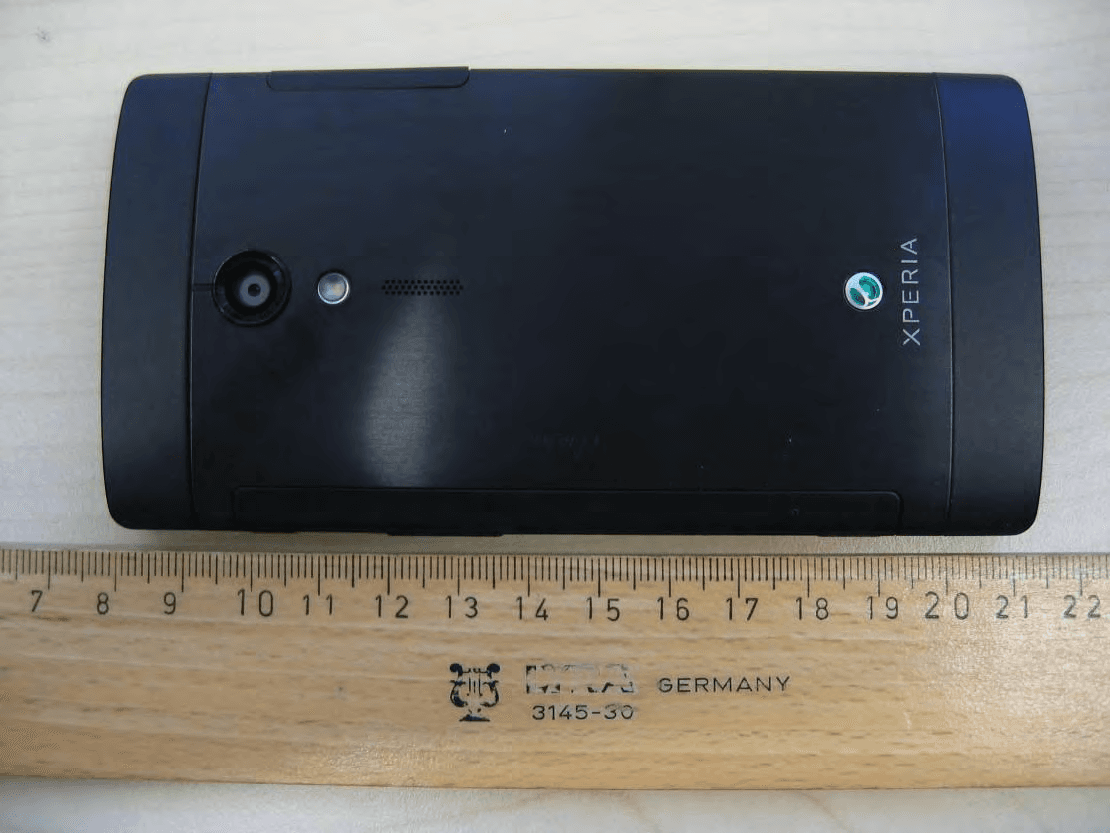
Click to zoom
Application Details
- Equipment Class
- DXT - Part 15 Low Power Transceiver, Rx Verified
- Date of Grant
- May 28, 2012
- Application Purpose
- Original Equipment
- Date of Application
- May 13, 2012
- Equipment Note
- Mobile phone with Bluetooth, WLAN 802.11bgn, GPS/A-GPS, ANT+, RFID and FM Rx
- Frequency Range
- 2402.00000000 - 2480.00000000
- Company
- Sony Corporation
- Country
- Japan
Documents & Files
Document Text
Text extracted from the exhibit documents filed with the FCC. Open a document above to read the original.
Users Manual
Startup guide English Xperia™ Ion LT28at Sony Ericsson Mobile Communications AB SE-221 88 Lund, Sweden www.sonymobile.com xxxx-xxxx.1 Welcome Important information Please read the Important information leaflet before you use your mobile phone. Assembly To remove the top cover To insert the memory card and the SIM card The memory card may not be included at purchase in all markets. To attach the top cover To view your IMEI number • Remove the cover to view your IMEI number. Phone basics Phone overview 1. Proximity sensor 2. Headset connector 3. Ear speaker 4. Front camera lens 5. Notification LED (Battery status) 6. Power key 7. Volume key/Zoom key 8. Camera key 9. Search key 10. Microphone 11. Back key 12. Home key 13. Menu key 14. Touchscreen 15. HDMI™ connector 16. Connector for charger/USB cable 17. Top cover 18. Camera lens 19. Camera LED light 20. Speaker Use the accessories provided with your phone, or other compatible accessories, for optimal performance. Turning on the phone To turn on the phone Your SIM card PIN is initially supplied by AT&T, but you can change it later from the Settings menu. To correct a mistake made while entering your SIM card PIN, tap . It may take a while for the phone to start up. Waking up the screen To activate the screen • Briefly press the power key . To unlock the screen • Drag to the right across the screen. Using the keys Menu • Open a list of options available in the current screen or application Home • Go to the Home screen from any application or screen • Press and hold to open a window showing your most recently used applications Back • Go back to the previous screen • Close the on-screen keypad, a dialog box, an options menu, or the Notification panel Search • Shortcut to Google™ Search Set up your phone What is Android? Android is your phone's operating system. Since it's developed by Google™, your phone is preloaded with several Google™ services, such as Google Maps™ and Google™ web search. To use some of the services provided by Google™, you need a Google account. With a Google account you can access Android Market™ – an application store providing both free and paid applications for easy download to your phone. What is different about Android? Android™ is an open system, which means that you're not limited to using applications and services from only one provider. Google™ account Use Gmail™ to send emails, Google Talk™ to chat with friends, and Android Market™ to download applications. To add an account 1 From your Home screen, tap . 2 Tap Settings > Accounts & sync > Add account. 3 Tap the account type you want to add and then follow the registration wizard. Basic settings The first time you start your phone, a setup guide explains basic phone functions and helps you enter essential settings. You can also access the setup guide later. To access the setup guide manually 1 From the Home screen, tap . 2 Find and tap Setup guide. Transferring contacts to your new phone Transferring contacts to your new phone can sometimes be complicated, but help is available. You can transfer contacts from several phone brands, including iPhone, Samsung, HTC and Nokia. You need: • An Internet-connected PC running Windows® • A USB cable for your old phone • A USB cable for your new Android™ phone • Your old phone • Your new Android™ phone If you don't have access to all of the items listed above, go to www.sonymobile.com to find out about other ways to transfer your contacts. Get started transferring your contacts Use the PC Companion program to transfer your contacts. It's free, and the installation files are already saved on your new phone. PC Companion also offers a range of other features, including help to update your phone software. To install PC Companion 1 New phone: Turn on your new Android™ phone and connect it to a PC using a USB cable. 2 New phone: Tap Install to install PC Companion on the PC. 3 Computer: If a popup window appears, select Run Startme.exe. In the new popup window that appears, click Install to start the installation and then follow the instructions to complete the installation. To transfer contacts to your new phone using PC Companion 1 Make sure that PC Companion is installed on your PC. 2 Open the PC Companion program on the PC, then click Contacts Setup and follow the instructions to transfer your contacts. Finding your way Home screen Your phone Home screen is the equivalent of the desktop on a computer. You can customise your Home screen with widgets, shortcuts, folders, themes, wallpaper and other items. The Home screen extends beyond the regular screen display width, so you need to flick left or right to view content in one of the screen's four extensions. The items in the bar at the bottom of the screen are always available for quick access. To go to the Home screen • Press . To browse the Home screen • Flick right or left. To change your Home screen wallpaper 1 From your Home screen, press . 2 Tap Wallpaper, then select a wallpaper. Widgets Widgets are small applications that you can use directly on your Home screen. For example, the Music player widget allows you to start playing music directly. Application screen The Application screen, which you open from your Home screen, contains the applications that come installed with your phone as well as the applications you download. The Application screen extends beyond the regular screen width, so you need to flick left and right to view all content. To open the Application screen • From your Home screen, tap . To open an application • From your Home screen or the Application screen, tap the application. Applications An application is a phone program that helps you perform a task. For example, there are applications to make calls, take photos and download more applications. Status and notifications The status bar at the top of your screen shows what's going on in your phone. For example, new message and calendar notifications appear here. Checking notifications and ongoing ac…
Text truncated - open the document above for the full version.
Cover Letter(s)
Confidentiality Request 2012-04-03 CGQBDA12:065 SOMC/CGQBADS Håkan Sjöberg +46 10 80 13559 Receiver Federal Communications Commission Subject: Request for Confidentiality FCC ID: PY7A8880001 To Whom It May Concern: In accordance with §0.459 of CFR 47, Sony Mobile Communications AB requests confidentiality for the below listed items for our Sony Ericsson mobile phone type AAL- 8880001-CV, FCC ID: PY7A8880001: 1. Block Diagram 2. Schematic Diagram 3. Part List 4. Operational/Technical Descriptions These items contain detailed system and equipment description and related information about the product which Sony Mobile Communications AB considers to be proprietary, confidential and a custom design which otherwise would not be released to the general public. Since this design is a basis from which future technological products will evolve, Sony Mobile Communications AB also feels that this information would be of benefit to its competitors, and that the disclosure of the information in these exhibits would give our competitors an unfair advantage in the market. Please contact the undersigned if there are any further questions or additional information needed in this matter. Best Regards, _____________________ Håkan Sjöberg Manager - HW verification Global Type Approval Sony Mobile Communications Tel: +46 108013559 hakan.sjoberg@ sonymobile.com Short Term Confidentiality Request SOMC/CGQBADS Håkan Sjöberg +46 10 80 13559 2012-04-03 CGQBDA12:105 Receiver Federal Communications Commission Subject: Request for Temporary Confidentiality FCC ID: PY7A8880001 To Whom It May Concern: In accordance with §0.459 of CFR 47 and Public Notice DA 04-1705, Sony Mobile Communications AB requests in addition to confidentiality request CGQBDA12:065 temporary confidentiality for 180 days of the below listed items for our mobile phone type AAL-8880001-CV, FCC ID: PY7A8880001: 1. User Manual 2. Test set-up 3. External and Internal photos When the announcement of the product is done, the TCB will be notified to remove the Short Term Confidentiality. Please contact the undersigned if there are any further questions or additional information needed in this matter. Best Regards, ______________________ Håkan Sjöberg Manager - HW verification Global Type Approval Sony Mobile Communications Tel: +46 108013559 hakan.sjoberg@ sonymobile.com
External Photos
Test report no.: 1-4254/12-04-10 2012-02-02 Page 44 of 58 An nex B External ph ot ogra phs o f the E UT Photo documentation Photo 3: Test report no.: 1-4254/12-04-10 2012-02-02 Page 45 of 58 Photo 4: Photo 5: Test report no.: 1-4254/12-04-10 2012-02-02 Page 46 of 58 Photo 6: Photo 7: Test report no.: 1-4254/12-04-10 2012-02-02 Page 47 of 58 Photo 8: Photo 9:
ID Label/Location Info
Company Internal MARKING DRAWING 1 (2) Prepared (also subject responsible if other) No. SEM/CGOVDPLG, Anna Englund 1264-4111 Uen Approved Checked Date Rev Reference SEM/CGOVDPLG, Anna Englund 2012-03-12 1 4 LT28i, Aoba, Mobile Phone label, RoW 1 General information Mobile Phone label part no • 1264-3886 Mobile Phone label content part no • 1264-4112 Bar code • Print quality: according to COSMETIC GUIDELINE – Bar code labels document 1222-6072 Uen • Quiet zone: No bar codes are allowed to be closer to a label edge than 2 mm! Text If applicable, or nothing else specified, Zebra printer Scaleable Smooth Font CG Triumvirate Bold Condensed is imposed. When needed, the text is adjusted to fit the label. Coordinates “(x/y)” under each line number specifies the bottom / left alignment for text, graphics and bar codes, x is measured vertically, and y horizontally from the upper left corner of the label (landscape format), both in mm. When needed, the alignment is adjusted to fit the label. MLCI= Main Label Content Information Document 2 Printing information Content Format Line 1a (2,0/20,0) Sony Ericsson stylized name. Graphics, height 1,5 mm. According to 1200-1925 Line 1b (2,0/25,3) Model Name “LT28i” Text, height 1,2 mm. According to Chapter 1 in MLCI. Line 2a (4,0/2,8) Product number and revision of the mobile phone, “MoP XXXX-XXXX.RR” Text, height 1,2 mm. Line 2b (4,0/20,0) Product number with revision of the Sales Item in which the phone is packed, if applicable. “SI XXXX-XXXX.RR” Text, height 1,2 mm. Line 3a (6,7/2, 8) Actual electronic serial number (IMEI) of the mobile phone, “00000000-000000-0” Text, height 1,2mm. In the format TAC-SNR-CD. TAC and SNR derived from pos 500 in BOM. CD = check digit according to the Luhn formula (ISO/IEC 7812), GSM 02.16. Line 3b (6,7/20,0) Line 3a in barcode (IMEI-number) Bar code, height 2,0 mm. As desired by supplier (e.g. Code 128 symbology). Line 4a (9,0/3,5) “TYPE: AAL-8880001-CV” Text, height 1,2 mm. According to Chapter 1 in MLCI. Company Internal MARKING DRAWING 2 (2) Prepared (also subject responsible if other) No. SEM/CGOVDPLG, Anna Englund 1264-4111 Uen Approved Checked Date Rev Reference SEM/CGOVDPLG, Anna Englund 2012-03-12 1 4 Line 4b (9 ,0/20,0) HW & SW identification field, if applicable; “FFGG” Text, height 1,2 mm. According to Type-testing report under Product Model Specifying Documents Line 4c (9,0/29,5) ”FCC ID: PY7A8880001” Text, height 1,2 mm. According to Chapter 1 in MLCI. Line 4c (9,0/47,0) “IC: 4170B-A8880001” Text, height 1,2 mm. According to Chapter 1 in MLCI. Line 5a (13,0/39,0) Supplier’s identification for trace-ability of the telephone, as desired by supplier (e.g. “S/N: nnn....” for serial number). Text, height 1,2 mm. Defined by supplier. Line 5b (13,0/53,0) Location code of where the phone is flashed, if applicable, “XXX” Text, height 1,2 mm. Line 6a (15,2/39,0) Production week (flash), “yyWww” (yy = year, ww = week) Text, height 1,2 mm. Line 6b (15,2/53,0) Repair week, if applicable. “RyyWww” (yy = year, ww = week) Text, height 1,2 mm. Line 7a (16,2/3,8) CE approval symbol, the NB-“0682” and “Alert Symbol” in one artwork Graphics, height 5 mm. According to 1242-7470 Line 7b (16,2/32,0) WEEE trashcan without bar symbol Graphics, min. height 5mm, according to 1202- 5537. Line 8a (19,0/19,0) Marking of origin; “Made in Xxx” “Xxx” = actual country of production of the included telephone, in English Text, height 1,2 mm. 3 Layout The conceptual picture (for Zebra 90XiII printer, or equivalent) should not be considered as specifications, but as an additional help for setting up the label. 3.1 Conceptual picture double underlined = major changes since last revision.
Internal Photos
Test report no.: 1-4254/12-04-10 2012-02-02 Page 48 of 58 An nex C Inter nal p ho to gra phs o f the E UT Photo documentation Photo 10: Test report no.: 1-4254/12-04-10 2012-02-02 Page 49 of 58 Photo 11: Photo 12: Test report no.: 1-4254/12-04-10 2012-02-02 Page 50 of 58 Photo 13: Photo 14: Test report no.: 1-4254/12-04-10 2012-02-02 Page 51 of 58 Photo 15: Photo 16: Test report no.: 1-4254/12-04-10 2012-02-02 Page 52 of 58 Photo 17: Photo 18: Test report no.: 1-4254/12-04-10 2012-02-02 Page 53 of 58 Photo 19: Photo 20: Test report no.: 1-4254/12-04-10 2012-02-02 Page 54 of 58 Photo 21: Photo 22: Test report no.: 1-4254/12-04-10 2012-02-02 Page 55 of 58 Photo 23: Photo 24: Test report no.: 1-4254/12-04-10 2012-02-02 Page 56 of 58 Photo 25: Photo 26:
Test Report
2012-02-02 Page 1 of 58 TEST REPORT Test report no.: 1-4254/12-04-10 Testing laboratory Applicant CETECOM ICT Services GmbH Untertuerkheimer Strasse 6 – 10 66117 Saarbruecken / Germany Phone: + 49 681 5 98 - 0 Fax: + 49 681 5 98 - 9075 Internet: http://www.cetecom.com e-mail: [email protected] Accredited Testing Laboratory: The testing laboratory (area of testing) is accredited according to DIN EN ISO/IEC 17025 (2005) by the Deutsche Akkreditierungsstelle GmbH (DAkkS) The accreditation is valid for the scope of testing procedures as stated in the accreditation certificate with the registration number: D-PL-12076-01-01 Area of Testing: Radio/Satellite Communications Sony Ericsson Mobile Communications AB Nya Vattentornet 22188 Lund / SWEDEN Phone: +46 46 19 30 00 Fax: +46 46 19 32 95 Contact: Håkan Sjöberg e-mail: [email protected] Phone: +46 46 19 35 59 Manufacturer Sony Ericsson Mobile Communications AB Nya Vattentornet 22188 Lund / SWEDEN Test standard/s 47 CFR Part 15 Title 47 of the Code of Federal Regulations; Chapter I Part 15 - Radio frequency devices RSS - 210 Issue 8 Spectrum Management and Telecommunications - Radio Standards Specification Low-power Licence-exempt Radiocommunication Devices (All Frequency Bands): Category I Equipment For further applied test standards please refer to section 3 of this test report. Test Item Kind of test item: GSM Mobile Phone 850/900/1800/1900; GPRS/EGPRS; UMTS FDDI/FDDII/FDDV; HSPA; LTE Band 4/17; BT EDR; WLAN b/g/n; ANT+; GPS; HDMI; RFID Model name: AAL-8880001-BV FCC ID: PY7A8880001 IC: 4170B-A8880001 Frequency [MHz]: 2400.00 – 2483.50 MHz Technology tested: ANT+ Antenna: Integrated antenna Power Supply: 3.7 V DC by Li-Polymer Battery Temperature Range: -20°C to +55 °C Test report authorised: Test performed: 2012-02-02 Stefan Bös 2012-02-02 Jakob Reschke Senior Testing Manager Testing Manager Test report no.: 1-4254/12-04-10 2012-02-02 Page 2 of 58 1 Table of contents 1 Table of contents ............................................................................................................................................ 2 2 General information ....................................................................................................................................... 3 2.1 Notes and disclaimer .......................................................................................................................... 3 2.2 Application details ............................................................................................................................... 3 3 Test standard/s ............................................................................................................................................... 3 4 Test environment ............................................................................................................................................ 4 5 Test item .......................................................................................................................................................... 4 6 Test laboratories sub-contracted ................................................................................................................. 4 7 Summary of measurement results ............................................................................................................... 5 8 RF measurements .......................................................................................................................................... 6 8.1 Description of test setup .................................................................................................................... 6 8.1.1 Radiated measurements............................................................................................................. 6 8.2 Additional comments .......................................................................................................................... 7 8.3 RSP100 test report cover sheet / performance test data ................................................................ 8 9 Measurement results ...................................................................................................................................... 9 9.1 Timing of the transmitter .................................................................................................................... 9 9.2 Spectrum bandwidth – 99% bandwidth ........................................................................................... 11 9.3 Maximum field strength .................................................................................................................... 14 9.4 Band edge compliance radiated ...................................................................................................... 15 9.5 TX spurious emissions radiated ...................................................................................................... 18 9.6 RX spurious emissions radiated ...................................................................................................... 29 9.7 Spurious emissions radiated < 30 MHz ........................................................................................... 33 9.8 Spurious emissions conducted < 30 MHz....................................................................................... 36 10 Test equipment and ancillaries used for tests ................................................................................... 39 11 Observations ......................................................................................................................................... 41 Annex A Photographs of the test setup ...................................................................................................... 42 Annex B External photographs of the EUT ................................................................................................. 44 Annex C Internal photographs of the EUT ..…
Text truncated - open the document above for the full version.
Test Setup Photos
Test report no.: 1-4254/12-04-10 2012-02-02 Page 42 of 58 An nex A Pho tog raphs o f t h e test se tu p Photo documentation Photo 1: Test report no.: 1-4254/12-04-10 2012-02-02 Page 43 of 58 Photo 2:
Contact Information
Applicant
Mika Kaneko(Chief Regulatory Compliance Manager)
Technical Contact
Test Firm
cetecom advanced GmbHGerald Schmidt
Technical Specifications
| # | Rule Parts | Frequency Range | Power Output |
|---|---|---|---|
| 1 | 15C | 2.40 GHz - 2.48 GHz | - |
Other Applications from Sony Corporation
PY7-75158T
Jul 16, 2026GSM/WCDMA/LTE Phone with BT, DTS/UNII a/b/g/n/ac/ax, NFC and GNSS
Equipment Class
NII - Unlicensed National Information Infrastructure TXPY7-52715J
Jul 16, 2026GSM/WCDMA/LTE Phone with BT, DTS/UNII a/b/g/n/ac/ax, NFC and GNSS
Equipment Class
DXX - Part 15 Low Power Communication Device TransmitterPY7-84526Y
Jul 16, 2026GSM/WCDMA/LTE Phone with BT, DTS/UNII a/b/g/n/ac/ax, NFC and GNSS
Equipment Class
PCE - PCS Licensed Transmitter held to earPY7-30515Z
Apr 13, 2026GSM/WCDMA/LTE/NR Phone with BT, DTS/UNII a/b/g/n/ac/ax/be, NFC, GNSS and WPT
Equipment Class
DXX - Part 15 Low Power Communication Device TransmitterPY7-73716J
Apr 11, 2024GSM/WCDMA/LTE Phone with BT, DTS/UNII a/b/g/n/ac, NFC and GNSS
Equipment Class
PCE - PCS Licensed Transmitter held to ear