Text extracted from the exhibit documents filed with the FCC. Open a document above to read the original.
SenseTag TM User Manual QuantifiedAg.com [email protected] QuantifiedAg.com [email protected] 2 Support Thank you for selecting Quantified Ag ® products. For product updates and support, visit http://support.quantifiedag.com. Phone : (844) 414-2691. Trademarks Quantified Ag ® and the Quantified Ag ® logo are trademarks and/or registered trademarks of Pixobot ® , Inc. and/or its subsidiaries in the United States and/or other countries. Information is subject to change without notice. © Pixobot ® , Inc. All rights reserved. 3 Safety and Regulatory Information Read all of the instructions listed here and/or in the user manual before you operate this device. Give particular attention to all safety precautions. Retain the instructions for future reference. This device must be installed and used in strict accordance with the manufacturer’s instructions, as described in the user documentation that is included with the device. Comply with all warning and caution statements in the instructions. Observe all warning and caution symbols that are affixed to this device. Installation of this device must be in accordance with national wiring codes and conform to local regulations. Do not overload outlets or extension cords, as this can lead to risk of fire or electric shock. Overloaded AC outlets, extension cords, frayed power cords, damaged or cracked wire insulation, and broken plugs are dangerous. They may result in a shock or fire hazard. Do not open the device. Do not perform any servicing other than that contained in the installation and troubleshooting instructions. Refer all servicing to qualified service personnel. This device should not be used in an environment that exceeds _______. FCC Statements FCC Interference Statement This equipment has been tested and found to comply with the limits for a Class B digital device, pursuant to Part 15 of the FCC Rules. These limits are designed to provide reasonable protection against harmful interference in a residential environment. This equipment generates uses and can radiate radio frequency energy, and if not installed and used in accordance with the instructions, may cause harmful interference to radio communications. However, there is no guarantee that interference will not occur in a particular installation. Potential harmful interference to radio or television reception can be determined by turning the device off and on. If this equipment does cause such interference, the user is encouraged to make attempts to correct the interference by taking one or more of the following measures: ● Reorient or relocate the receiving antenna ● Increase the separation between the device and receiver ● Consult the dealer or an experienced radio/TV technician for help This device complies with Part 15 of the FCC Rules. Operation is subject to the following two conditions: (1) this device may not cause harmful interference, and (2) this device must accept any interference received, including interference that may cause undesired operation. FCC CAUTION: Any changes or modifications not expressly approved by Motorola for compliance could void the user’s authority to operate the equipment. 4 FCC RADIATION EXPOSURE STATEMENT This equipment complies with FCC radiation exposure limits set forth for an uncontrolled environment. To comply with the FCC RF exposure compliance requirements, the separation distance between the antenna and a person’s body (including hands, wrists, feet and ankles) must be at least 20 cm (8 inches). This transmitter must not be co-located, or operating in conjunction with, any other antenna or transmitter. The availability of specific channels and/or operational frequency bands are country-dependent,and are firmware programmed at the factory to match the intended destinations. The firmware setting is not accessible by the end user. 5 RESTRICTIONS ON THE USE OF WIRELESS DEVICES In some situations or environments, the use of wireless devices may be restricted by the proprietor of the building or responsible representatives of the organization. For example, using wireless equipment in any environment where the risk of interference with other devices or services is perceived or identified as harmful. If you are uncertain as to the applicable policy for the use of wireless equipment in a specific organization or environment, you are encouraged to ask for authorization to use the device prior to turning on the equipment. The manufacturer is not responsible for any radio or television interference caused by unauthorized modification of the devices included with this product, or the substitution or attachment of connecting cables and equipment, other than that specified by the manufacturer. Correction of the interference caused by such unauthorized modification, substitution, or attachment is the responsibility of the user. The manufacturer and its authorized resellers or distributors are not liable for any damage or violation of government regulations that may arise from failing to comply with these guidelines. 6 Table of Contents OVERVIEW .................................................................................................................................................. 7 OPERATING SPECIFICATIONS .................................................................................................................................. 7 ACTIVATION............................................................................................................................................................... 9 TAGGING .................................................................................................................................................................. 10 Figure 1 SenseTag Full Assembly ................................................................................... 7 Figure 2 PCB Assembly Bottom Side .............................................................................. 8 Figure 3 PCB Assembly Top Sid…
Text truncated - open the document above for the full version.
Authority to Act as Agent Date: March 17th, 2020 American Certification Body, Inc. 6731 Whittier Avenue Suite C110 McLean, VA 22101 To Whom It May Concern: Nic Johnson of the Nebraska Center for Excellence in Electronics (NCEE Labs) is authorized to act on our behalf, until otherwise notified, for applications to American Certification Body, Inc. (ACB). We certify that we are not subject to denial of federal benefits, that includes FCC benefits, pursuant to Section 5301 of the Anti-Drug Abuse Act of 1988, 21 U.S.C. 862. Further, no party, as defined in 47 CFR 1.2002 (b), to the application is subject to denial of federal benefits, that includes FCC benefits. We also declare that the information provided to the FCC is true and correct to the best of our knowledge (47 CFR 2.911(d)) and we have been informed of the grantee responsibilities (47 CFR 2.909) with regard to certified equipment. Thank you, Dated this 17th day of March, 2020. Agency Agreement Expiration Date: 17 March 2021 _Mr Perry Howell__ By: (Signature) (Print name) Title: _President_ On behalf of: __Communication Systems Solutions, Inc Telephone: (402) 261-8688__x201____________________
Request for Confidentiality Date: 2020 FEB 27 Subject: Confidentiality Request for: FCC ID: QQIET300 Pursuant to FCC 47 CRF 0.457(d), the applicant requests that a part of the subject FCC application be held confidential. Type of Confidentiality Requested Exhibit Short Term Permanent Block Diagrams Short Term Permanent Operation Description/Theory of Operation Short Term Permanent Schematics Short Term Test Setup Photos Communications Systems Solutions, Inc. has spent substantial effort in developing this product and it is one of the first of its kind in industry. Having the subject information easily available to "competition" would negate the advantage they have achieved by developing this product. Not protecting the details of the design will result in financial hardship. Permanent Confidentiality: The applicant requests the exhibits listed above as permanently confidential be permanently withheld from public review due to materials that contain trade secrets and proprietary information not customarily released to the public. Short-Term Confidentiality: The applicant requests the exhibits selected above as short term confidential be withheld from public view for a period of ___(specify number of days not to exceed 180) 1 ___ days from the date of the Grant of Equipment Authorization and prior to marketing. This is to avoid premature release of sensitive information prior to marketing or release of the product to the public. Applicant is also aware that they are responsible to notify ACB in the event information regarding the product or the product is made available to the public. ACB will then release the documents listed above for public disclosure pursuant to FCC Public Notice DA 04-1705. NOTE for Industry Canada Applications: The applicant understands that until such time that IC distinguishes between Short Term and Permanent Confidentiality, either type of marked exhibit above will simply be marked Confidential when submitted to IC. Sincerely, By: __________________________ Nic Johnson (Agent), Technical Manager, NCEE Labs (Signature/Title 2 ) (Print name) 1 - Please refer to http://acbcert.com/documents/misc-docs/Memo-Short-Term-Vs-Standard-Confidentiality.pdf for complete details. 2 - Must be signed by applicant contact given for applicant on the FCC site, or by the authorized agent if an appropriate authorized agent letter has been provided. Letters should be placed on appropriate letterhead.
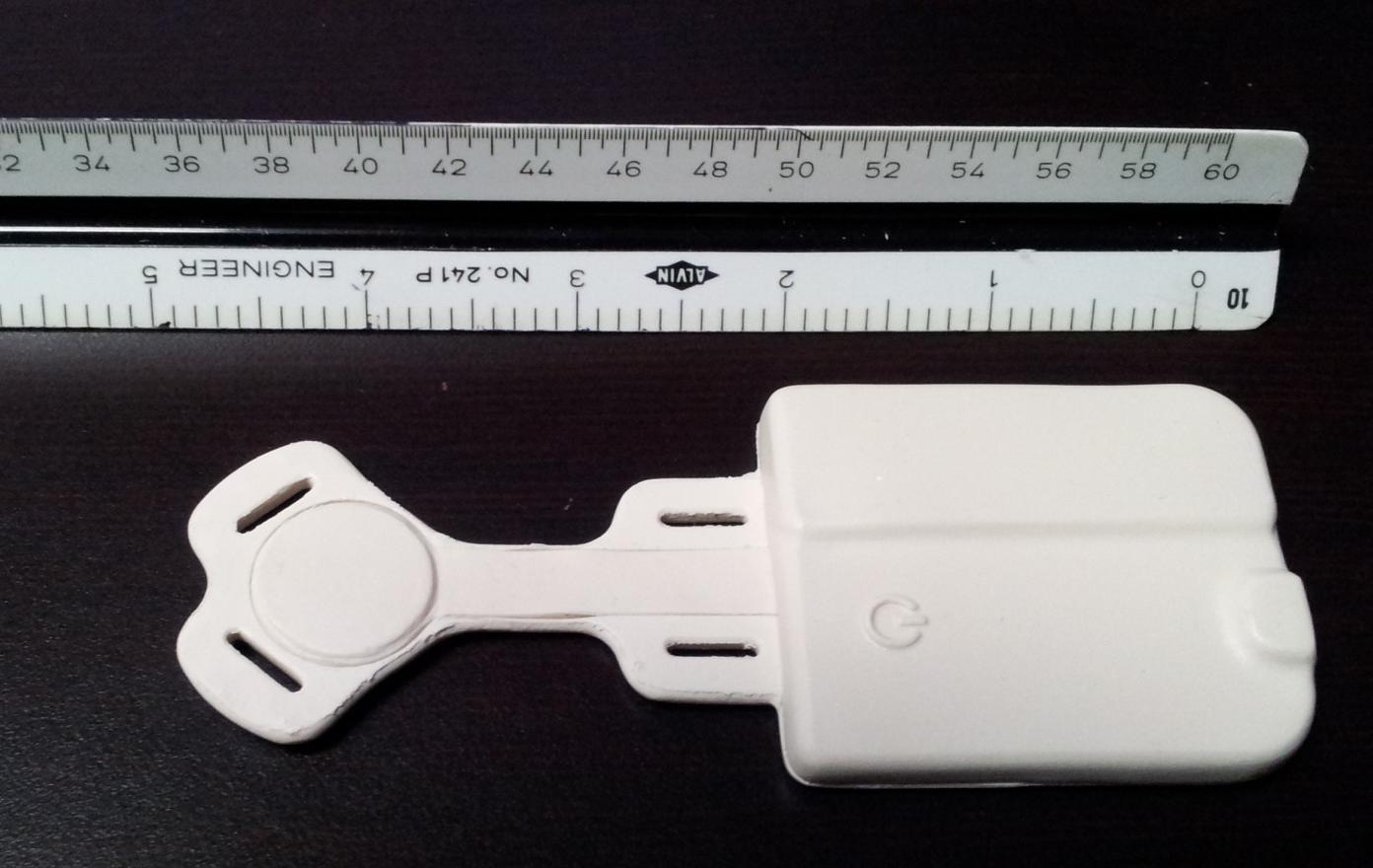
External Photos Page 1 of 2 External Photos Page 2 of 2
LABEL FCC ID: QQIET300 Note: The label is indelibly thermally printed on weather-resistant vinyl material with permanent adhesive. The device is less than 9cm long and is too small to fit the entire FCC compliance statement. The statement has therefore been placed in the user’s manual.
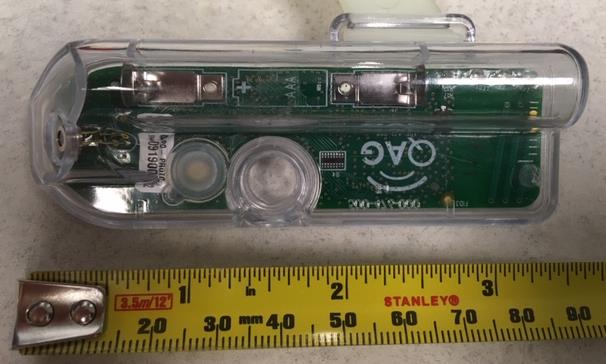
Internal Photos Internal Photos Internal Photos Antenna indicated by red box
Page 1 of 2 FCC ID: QQIET100 Maximum exposure limits from CFR 47, FCC Part 1.1310: Table 1—Limits for Maximum Permissible Exposure (MPE) Frequency range (MHz) Electric field strength (V/m) Magnetic field strength (A/m) Power density (mW/cm 2 ) Averaging time (minutes) (A) Limits for Occupational/Controlled Exposure 0.3-3.0 614 1.63 *100 6 3.0-30 1842/f 4.89/f *900/f 2 6 30-300 61.4 0.163 1.0 6 300-1,500 f/300 6 1,500-100,000 5 6 (B) Limits for General Population/Uncontrolled Exposure 0.3-1.34 614 1.63 *100 30 1.34-30 824/f 2.19/f *180/f 2 30 30-300 27.5 0.073 0.2 30 300-1,500 f/1500 30 1,500-100,000 1.0 30 The power density is calculated as shown below: S = (P x G)/(4 x π x d^2) – used to calculate exposure at 20 cm d = √(S/(P x G) x 4 X π) – used to calculate minimum distance to meet limits S= power density P = transmitter conducted power (in mW) G = antenna numeric gain d = distance to radiation center Page 2 of 2 Table 2 – Power Density Calculations Frequency Antenna Gain Output power Power Density Limit Distance MHz dBi mW mW/cm^2 mW/cm^2 923.3 2.14 7.59 0.0035563 0.0616 20 925.6 2.14 6.35 0.0029753 0.0617 20 927.5 2.14 6.38 0.0029894 0.0618 20 Note: This equipment is not intended to be operated by hand. It is expected that a 20cm separation will be maintained at all times.
The Nebraska Center for Excellence in Electronics (NCEE) authorizes the above named company to reproduce this report provided it is reproduced in its entirety for use by the company’s employees only.Any use that a third party makes of this report, or any reliance on or decisions made based on it, are the responsibility of such third parties. NCEE accepts no responsibility for damages, if any, suffered by any third party as a result of decisions made or actions based on this report. This report applies only to the items tested. Amended FCC/ISED Test Report Client: Communications Systems Solutions 6030 S. 58th St. STE C Lincoln, NE 68516 Product: SenseTag Test Report No: R20190919-20-E1A Approved By: __________________ Nic S. Johnson, NCE Technical Manager iNARTE Certified EMC Engineer #EMC-003337-NE DATE: 14 May 2020 Total Pages: 57 NCEE Labs Report Number: R20190919-20-E1A Test Report Applicant: Communications Systems Solutions The Nebraska Center for Excellence in Electronics 4740 Discovery Drive Lincoln, NE 68521 Page 2 of 57 Tables of Figures Table of Tables 1.0 Summary of test results 1.1 Test Results 1.2 Test Methods 1.2.1 Radiated Emissions 2.0 Description 2.1 Equipment under test 2.2 Laboratory description 2.3 Description of test modes 2.4 Applied standards 2.5 Description of support units 2.6 Configuration of system under test 3.0 Test equipment used 4.0 Detailed Results 4.1 Unique antenna requirement 4.2 Radiated Emissions 4.3 Bandwidth 4.4 Maximum peak output power 4.5 Bandedges 4.6 Power spectral density 4.7 Carrier frequency separation, number of hopping channels, Time of Occupancy Appendix A – Test photos Appendix B – Sample calculation Appendix C – RF exposure evaluation NCEE Labs Report Number: R20190919-20-01-E1A Test Report Applicant: Communications Systems Solutions Page 3 of 57 1.0 Summary of test results 1.1 Test Results The EUT has been tested according to the following specifications: APPLIED STANDARDS: FCC Part 15, Subpart C Industry Canada RSS-Gen Issue 4, RSS-247 Issue 1 Standard Section Test Type and Limit Result Remark FCC Part 15.203 RSS-Gen Issue 5, Section 8.3 Unique Antenna Requirement Pass Meets the requirement FCC Part 15.207 RSS-Gen Issue 5, Section 8.8 Conducted Emissions NA Meets the requirement FCC Part 15.209 RSS-Gen Issue 5, Section 8.9 ANSI C63.10, Section 6.5, 6.6 Radiated Emissions Pass Meets the requirement FCC Part 15.247(a)(1) RSS-247 Issue 2 Section 5.2.1 ANSI C63.10, Section 11.8.1 Minimum Bandwidth, Pass Meets the requirement FCC Part 15.247(b), RSS-247 Issue 2 Section 5.4.2 ANSI C63.10, Section 11.12.2.4 Maximum Peak Output Power Pass Meets the requirement FCC Part 15.247(c) RSS-247 Issue 2 Section 5.5 ANSI C63.10, Section 6.5, 6.6 Transmitter Radiated Emissions, Pass Meets the requirement FCC Part 15.247(c) RSS-247 Issue 2 Section 5.5 ANSI C63.10, Section 6.10.6.2, 11.11, 11.12, 11.13 Band Edge Measurement, Limit: 20dB less than the peak value of fundamental frequency Pass Meets the requirement FCC Part 15.247(f), RSS-247 Issue 2 Section 5.2.2 ANSI C63.10, Section 11.10.2 Power Spectral Density Pass Meets the requirement FCC Part 15.247(f), ANSI C63.10, Section 7.7.2, 7.7.3, 7.7.4 RSS-247 Issue 2, Section 5.3 Carrier frequency separation, number of hopping channels, Time of Occupancy Pass Meets the requirement NCEE Labs Report Number: R20190919-20-01-E1A Test Report Applicant: Communications Systems Solutions Page 4 of 57 2.0 Description 2.1 Equipment under test The Equipment Under Test (EUT) was a wireless ear tag which is intended to communicate with gateway placed on a tower. EUT Received Date: 20 September 2019 EUT Tested Dates: 20 September 2019 – 26 February 2020 10 August 2016 – 12 September 2016 (Section 4.7) PRODUCT SenseTag MODEL QAG SERIAL NUMBER 09190002 POWER SUPPLY 1.5 VDC (AAA Battery) ANTENNA TYPE PCB NOTE: 1. For more detailed features description, please refer to the manufacturer's specifications or User's Manual. 2.2 Laboratory description All testing was performed at the NCEE Lincoln facility. Laboratory environmental conditions varied slightly throughout the tests: Relative humidity of 52 4% Temperature of 23 3 Celsius 2.3 Description of test modes The EUT operates on, and was tested at the frequencies below: Channel Frequency Lowest 902.3 Middle 908.6 High 914.9 NCEE Labs Report Number: R20190919-20-01-E1A Test Report Applicant: Communications Systems Solutions Page 5 of 57 2.4 Applied standards and regulations The EUT uses digital modulation and operates in the 902 MHz to 928 MHz band. According to the specifications of the manufacturer, it must comply with the requirements of the following standards and regulations: 1. ANSI C63.10:2013 2. FCC Part 15, Subpart C (15.247) 3. FCC Part 15, Subpart C (15.207 and 15.209) 4. Industry Canada RSS-Gen Issue 5 5. Industry Canada RSS-247 Issue 2 All test items have been performed and recorded as per the above. 2.5 Description of support units None 2.6 Configuration of system under test This EUT was set to transmit in a worse-case scenario with modulation on. The manufacturer modified the unit to transmit continuously on Low, Mid and High Channels. NCEE Labs Report Number: R20190919-20-01-E1A Test Report Applicant: Communications Systems Solutions Page 6 of 57 3.0 Test equipment used DESCRIPTION AND MANUFACTURER MODEL NO. SERIAL NO. LAST CALIBRATION DATE CALIBRATION DUE DATE Software Version 1.60 ESK-1 2575 N/A N/A Rohde & Schwarz Test Receiver ES126 100037 30 Jan 2018 30 Jan 2020***** Keysight MXE Signal Analyzer N9038A MY59050109 23 Apr 2019 23 Apr 2021 Keysight EXA Signal Analyzer N9010A MY56070862 14 Dec 2018 14 Dec 2020 SunAR RF Motion JB1 A082918-1 15 Oct 2018 15 Oct 2020 EMCO Horn Antenna 3115 6416 26 Jan 2018 26 Jan 2020 EMCO Horn Antenna 3116 2576 31 Jan 2018 31 Jan 2020 Rohde & Schwarz Preamplifier TS-PR18 3545700803 09 Mar 2018* 09 Mar 2020* Trilithic High Pass Filter 6HC330 23042 09 Mar 2018* 09 Mar 2020* Rohde & Schwarz LISN ESH3-Z5 836679/010 25 Jul 2019 25 J…
Text truncated - open the document above for the full version.
TEST SETUP PHOTOS Figure 1 – Radiated Emissions Test Setup, 30MHz – 1GHz TEST SETUP PHOTOS Figure 2 - Radiated Emissions Test Setup, Vertical, 1GHz – 25GHz
| # | Rule Parts | Frequency Range | Power Output |
|---|---|---|---|
| 1 | 15C | 902.3 MHz - 914.9 MHz | 5.00 mW |

Baby Monitor
Equipment Class
DTS - Digital Transmission System