RI7G83Tri-band GSM/GPRS PCS Phone
Telit Communications S.p.A.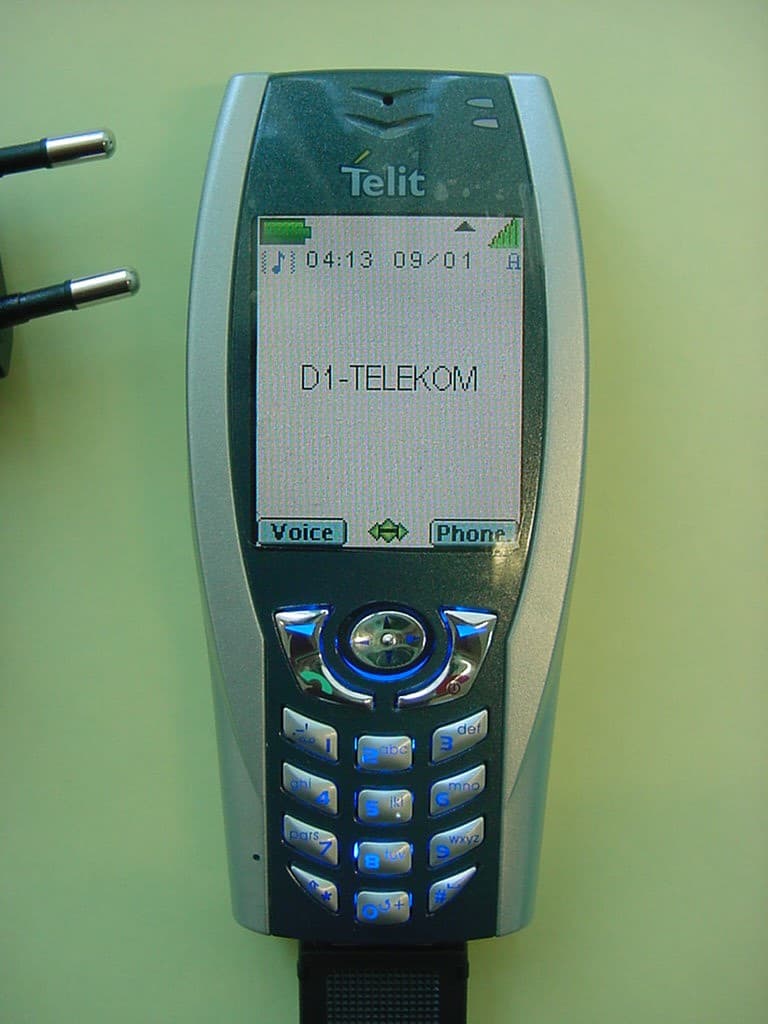
Click to zoom
Application Details
- Equipment Class
- PCE - PCS Licensed Transmitter held to ear
- Date of Grant
- Oct 14, 2004
- Application Purpose
- Original Equipment
- Date of Application
- Oct 14, 2004
- Equipment Note
- Tri-band GSM/GPRS PCS Phone
- Frequency Range
- 1850.20000000 - 1909.80000000
- Company
- Telit Communications S.p.A.
- Country
- Italy
Documents & Files
Document Text
Text extracted from the exhibit documents filed with the FCC. Open a document above to read the original.
Users Manual
1 USER'S MANUAL INTRODUCTION Congratulations, and thank you for buying a Telit cellular phone. This cellular phone is a tri-band unit. Thanks to its compatibility with EGSM 900 MHz, DCS 1800 MHz, and PCS 1900 MHz networks, it can be used in all European Union member countries, and in other Countries where a GSM 900/1800/1900 MHZ network is available. By exploiting the phone's standard MMS (Multimedia Messaging System) compatibility, the CCD camera installed on the back of the phone allows you to take photographs as you would with a normal digital camera. You can save the photos and send them to other cell phones or to a pc, via e- mail or IrDA connection. A Java Virtual Machine allows the G83 to execute Java applications; you can download them from the web in a WAP session or from a pc, connecting it to the phone with the optional data cable. Polyphonic SMAF sound system allows you to use your favorites melodies as ringtones, downloading them from the web or installing the ones you received from other users. CE CONFORMITY MARKING This phone conforms to European Union Standards: •R&TTE 99/5/CE •89/336/CEE •73/23/CEE In order to comply with European Directive 99/5/CE, this phone was made in accordance with the following directives: •GSM (Radio spectrum). Standards: EN 301 511 and 3GPP 51.010-1 •EMC (Electromagnetic compatibility). Standards: EN 301 489-1 and EN 301 489-7 •SAFETY (Safety Standards for electric devices and SAR). Standards: EN 60950 and EN 50361 In order to make continuous improvements to the product, technical specifications, design, or any other information described in this manual are subject to changes without notice. 2003 © Dai Telecom S.p.A. All rights reserved. 2 SIM CARD 2 S IM C ARD 1 USEFUL NUMBERS & ACCESS CODES To receive more information about the product, or to send suggestions write to [email protected] or visit our website at www.telit.net To use the telephone, there are a few numbers and access codes you need to save. It may prove useful to write the information on this page, cut it out, and keep it in a safe place! IMEI ____________________________________ Security access code _____________________ Autolock access code _____________________ Telephone number ____________________ SIM number __________________________ PIN ______________ PIN2 ______________ PUK______________ PUK2 _____________ Voice Mail Access Code _______________ Telephone number ____________________ SIM number __________________________ PIN _____________ PIN2 ______________ PUK _____________ PUK2 _____________ Voice Mail Access Code _______________ 3 G83: SEVERAL WAYS TO MAKE THE MOST OF IT With the G83 you can enjoy features beyond the normal use of a phone, limited to SMS messages or calls. The quality of sound has been greatly improved with the introduction of the polyphonic ringtones. The G83 allows you to send and receive e-mail and MMS; with the IrDA connection or the optional data cable you can send and receive ringtones, images, vCalendar and vCard. What is a vCard? it’s a standard format for a business card, conceived for the exchange of personal informations (PDI, Personal Data Interchange) between different devices (websites, e-mail, mobile phones, PDA (Personal Data Assistant). With a vCard, besides your name and surname, you can also send and receive many other useful informations: addresses (home, office, etc.), phone numbers (mobile, home, office, fax...), URL of your website, e-mail addresses, and even images and sounds) What is a vCalendar? Similarly to vCard, vCalendar allows you to exchange informations about task and appointments you saved in your calendar, or about your to do list (to do: a memo you make to remember a task, for example “bring the car to the garage”). Connecting your G83 to a personal computer via the data cable, you ‘ll be able to: • edit and modify the phonebook • write, send and save into your pc • manage your vCard and vCalendar • send to the pc the pics you took with the phone, or, vice versa, send new images to your phone • manage the voice memo feature • edit and modify the connection parameters of the phone • manage the Java applets (see “Java” on page 30) In order to connect a G83 to a Personal Computer using the data cable, the MsSync application must be installed on it. You can download MsSync, free of charge, from Telit website, www.telit.net 4 INSTALLING THE SIM CARD In order to activate the phone on a GSM network, you must use a valid “plug- in" (small) format SIM card. The SIM card is available through your network operator or service provider. • Turn OFF the phone • Press the chromium-plated button on the bottom of the phone and remove the rear cover, lifting the bottom side. • Looking at the rear side of the phone, the SIM slot is on the left, as shown in the image below. Insert the SIM card with the cutted edge in the upper right. • Put the cover back, by laying the upper side first, just below the CCD window, then push the bottom side till the chromium-plated button is fastened. 5 CHARGING THE BATTERY This cell phone is powered by a rechargeable Lithium battery. Lithium batteries are not subject to the so-called "memory-effect" (progressive loss of energy efficiency if incorrectly charged); you can connect the phone to the charger anytime, irrespective of the level of in the battery. IMPORTANT WARNINGS •Charge the unit only when the battery is installed •Use only original Telit batteries and battery chargers. How to charge the battery • Connect the charger lead to the plug on the bottom of the phone assuring it is completely inserted - the arrow on the charger connector should be on the same side as the keypad; finally, plug the charger into a wall outlet. •If the level of the battery is too low, a small time lag may occur before the recharge begins; in case, wait a little bit longer. • If the unit is turned off, the LED (light-emitting diode) in the upper right-hand corner of the screen will light up; steady red LED: charging steady green …
Text truncated - open the document above for the full version.
Cover Letter(s)
1 Chris Harvey From:Ricardo Orejas Rodríguez [[email protected]] Sent:Friday, October 08, 2004 4:10 PM To:Chris Harvey Cc:Marianne Bosley Subject:RE: Additional Information needed Dai Telecom FCC ID: RI7G83 MT#16286 Chris, Do you have any example of the "MPE calculation for the GPRS handheld mode"? and FCC ID would be enough, because I have been checking about 20 applications from different companies for GSM/GPRS phones and I have not found something similar, Thanks and best regards, Ricardo Orejas Type Approval Consultant CETECOM - Spain Phone: +34 952 619 317 - Email: [email protected] -----Mensaje original----- De: Chris Harvey [mailto:[email protected]] Enviado el:viernes, 08 de octubre de 2004 20:25 Para:Ricardo Orejas Rodríguez CC:'Marianne Bosley' Asunto:RE: Additional Information needed Dai Telecom FCC ID: RI7G83 MT#16286 Ricardo, there are still problems with what was provided. From what I can tell, the 2 new SAR measurements are supposed to be in addition to the original measurements at the same channel and position. Unfortunately they replaced the original plots with the new ones. This is not a great deal as I can include both reports in the assessment. However, they have not provided the tissue dielectric measurements and the system validation data for the measurements performed on 10/08/04. These measurements are required to be submitted for each day on which SAR measurements are performed. I am also still waiting for the MPE calculation for the GPRS handheld mode of operation (requested twice before). Please contact me if you have any questions. I am still awaiting for the above information. Best regards, Chris Harvey -----Original Message----- From: Ricardo Orejas Rodríguez [mailto:[email protected]] Sent: Friday, October 08, 2004 9:41 AM To: Chris Harvey Cc: Marianne Bosley Subject: RE: Additional Information needed Dai Telecom FCC ID: RI7G83 MT#16286 Importance: High Chris, OK, I understand. 2 Attached you can find the test reports. Fortunatly the sample was still in Taiwan and they have repeated some testing. Please check if it is OK, if so, I will wait for the certificate this afternoon, please try to provide it as soon as possible because I will be here just waiting for the certificate or your news. << File: SAR test report.pdf >> If you have any doubt please do not hesitate to contact me Regards, Ricardo Orejas Type Approval Consultant CETECOM - Spain Phone: +34 952 619 317 - Email: [email protected] -----Mensaje original----- De: Chris Harvey [mailto:[email protected]] Enviado el:viernes, 08 de octubre de 2004 4:00 Para:Ricardo Orejas Rodríguez; Mª Gema Briseño Pascual CC:'Marianne Bosley' Asunto:RE: Additional Information needed Dai Telecom FCC ID: RI7G83 MT#16286 Ricardo, I agree that this does seem strict, but these are the parameters we must operate under, and we are subjected to great scrutiny from the FCC. This requirement is located in OET 65 Supplement C 2001 page 49: The SAR distribution may be plotted to verify the peak SAR locations with respect to the near-field exposure characteristics of the transmitter. All peaks within 2.0 dB (58.5%) of the highest peak identified by the interpolated data should be evaluated with a fine resolution volume scan to determine the highest one-gram averaged SAR (See Reference [19]). The FCC requires that these 2 nd hot-spots be documented. I agree that this is likely to be a similar low SAR value to the first peak on the same plot, but I am not allowed to deviate from the procedure. The test laboratory should be aware of the FCC requirements for 2 nd hot-spot measurements. Thank you for your understanding. Best regards, Chris Harvey -----Original Message----- From: Ricardo Orejas Rodríguez [mailto:[email protected]] Sent: Thursday, October 07, 2004 6:27 PM To: Chris Harvey; Mª Gema Briseño Pascual Cc: Marianne Bosley Subject: RE: Additional Information needed Dai Telecom FCC ID: RI7G83 MT#16286 Importance: High Hi Chris, I have checked the test report and I have found what you are talking about. I think that you are being quite strict on this issue as you can see that the results are really far bellow of the limits, but I am not in position to discuss with you this as you are the expert and I am just learning about all FCC rules, items, etc... I will try to find out an answer from the test laboratory and if they can not assure that testing was performed in the 2nd hot spot, we will send back the sample to the lab to test again SAR in that possition but checking now all possible hot spots. 3 Anyway I will appreciate if you can inform to me where in FCC OET 65 Sup. is indicated this requirement because I have not been able to find it. Best regards, Ricardo -----Mensaje original----- De: Ricardo Orejas Rodríguez Enviado el:jueves, 07 de octubre de 2004 21:54 Para:'Chris Harvey'; Mª Gema Briseño Pascual CC:'Marianne Bosley' Asunto:RE: Additional Information needed Dai Telecom FCC ID: RI7G83 MT#16286 Dear Chris, Thanks for the information, could you please address me to the exact requirement in OET Bulletin 65 and where the problem appears in the test report? Regarding the user's manual please check page 48 of the document attached and please let me know if this is acceptable. thanks and best regards, Ricardo Orejas Type Approval Consultant CETECOM - Spain Phone: +34 952 619 317 - Email: [email protected] -----Mensaje original----- De: Chris Harvey [mailto:[email protected]] Enviado el:jueves, 07 de octubre de 2004 21:46 Para:Ricardo Orejas Rodríguez; Mª Gema Briseño Pascual CC:'Marianne Bosley' Asunto:RE: Additional Information needed Dai Telecom FCC ID: RI7G83 MT#16286 Ricardo, I have received your responses to the issues raised. I can accept all except for the SAR 2 nd hot-spot issue. Body-worn SAR is required because the phone could be used when it is in the pocket or using a third-party holster. However, your explanation of the Body-worn GPRS operation is acceptable, since it is not likely …
Text truncated - open the document above for the full version.
Cover Letter(s)
Federal Communication Commision Equipment Authorization Division, Application Processing Branch 7435 Oakland Mills Road Columbia, MD 21048 October 5, 2004 TO WHOM IT MAY CONCERN Pursuant to Paragraphs §0.457 and 0.459 of the Commission’s Rules (47 C.F.R.) and Section §552(b)(4) of the Freedom of Information Act, DAI Telecom S.p.A. requests confidentiality for the following products: FCC ID Number Product Title/Model RI7G83 PCS mobile phone / G83 For the product stated above, we request that the following information be held confidential: 1) Circuit diagrams 2) Block Diagrams 3) Bill of materials 4) Operational Description No other items submitted as part of the equipment authorization filing process are deemed confidential. The above exhibits contain DAI Telecom S.p.A. trade secrets and proprietary information that could be of benefit to our competitors regarding the design of our GSM devices. This material is not customarily available to the general public and we request that it be withheld from public inspection. If you have any questions, please feel free to contact me at the address shown below. Sincerely, P.A. Mr. Claudio Novati Quality System Manager DAI Telecom S.p.A. Viale Stazione di Prosecco 5/B, I-34010 Trieste, Italy
ID Label/Location Info
Federal Communication Commission Equipment Authorization Division, Application Processing Branch 7435 Oakland Mills Road Columbia, MD 21048 October 5, 2004 RE: RI7G83 TO WHOM IT MAY CONCERN Identification label of the equipment: FCC ID Number Product Title/Model RI7G83 PCS phone/G83 Per Sec. 2.925 (Identification of the equipment): ... (d) In order to validate the grant of equipment authorization, the nameplate or label shall be permanently affixed to the equipment and shall be readily visible to the purchaser at the time of purchase. (1) As used here, permanently affixed means that the required nameplate data is etched, engraved, stamped, indelibly printed, or otherwise permanently marked on a permanently attached part of the equipment enclosure. Alternatively, the required information may be permanently marked on a nameplate of metal, plastic, or other material fastened to the equipment enclosure by welding, riveting, etc., or with a permanent adhesive. Such a nameplate must be able to last the expected lifetime of the equipment in the environment in which the equipment will be operated and must not be readily detachable. (2) As used here, readily visible means that the nameplate or nameplate data must be visible from the outside of the equipment enclosure. It is preferable that it be visible at all times during normal installation or use, but this is not a prerequisite for grant of equipment authorization. ... The equipment RI7G83 will be marketed with the battery removed, not mounted together with the equipment, the customer will need to place the battery on the battery compartment. So at the time of purchase the customer will clearly see and read the identification label. If you have any questions, please feel free to contact me at the address shown below. Sincerely, P.A. Mr. Claudio Novati Quality System Manager DAI Telecom S.p.A. Viale Stazione di Prosecco 5/B, I-34010 Trieste, Italy
ID Label/Location Info
IMPORTADOR: SKY WIRELESS, S.A. DE C.V. AV. MINAS PALACIO 42-8 COL. SAN ANTONIO ZOMEYUCAN C.P. 53750 NAUCALPAN DE JUAREZ, EDO. DE MEXICO R.F.C.: SWI-020529-QE0 TEL: (55) 53-01-82-32 FAX: (55) 53-01-35-81 TELEFONO CELULAR MARCA: TELIT MODELO: G83 HECHO Y ENSAMBLADO EN ESTADOS UNIDOS DE AMERICA CARACTERISTICAS ELECTRICAS TELEFONO: 3,7 V INCLUYE: BATERIA RECARGABLE MODELO: PP60 3,7 V 700 mAh ADAPTADOR ca/cc MODELO: TA3521-EU ENTRADA: 100-240 V~ 50/60 Hz 0,3 A SALIDA: 5,2 V 700 mA single packaging box ADAPTADOR ca/cc MODELO:TA3521-EU ENTRADA: 100 - 240 V 50/60 Hz 0,3 A SALIDA: 5,2 V - - - 600mA HECHO EN: COREA battery charger - USAR EL ADAPTADOR ca/cc SUMINISTRADO. - NO ALMACENAR O EXPONERLA A TEMPERATURAS ALTAS 60°C (140°F) O A LA HUMEDAD. - NO INTENTAR DESARMARLA. - DEBE SER RECICLADA ADECUADAMENTE. - NO CORTOCIRCUITAR LAS TERMINALES. - NO EXPONERLA AL FUEGO. BATERIA DE ION DE LITIO 3,7 V - - - 700 mAh HECHO EN: COREA battery MODELO: G83IMEI: 123456789012345 IMEI: 123456789012345 HECHO Y ENSAMBLADO EN: E.U.A. FCC ID: RI7G83 MANUFACTURADO POR SKYCELL AMERICA INC. 3,7 V - - - IMEI label multiple packaging (10 pieces each) MODELO: G83 IMEI: 123456789012345 IMEI: 123456789012345 IMEI: 123456789012345 IMEI: 123456789012345 IMEI: 123456789012345 IMEI: 123456789012345 IMEI: 123456789012345 IMEI: 123456789012345 IMEI: 123456789012345 IMEI: 123456789012345 IMPORTADOR: SKY WIRELESS, S.A. DE C.V. AV. MINAS PALACIO 42-8 COL. SAN ANTONIO ZOMEYUCAN C.P. 53750 NAUCALPAN DE JUAREZ, EDO. DE MEXICO R.F.C.: SWI-020529-QE0 TEL: (55) 53-01-82-32 FAX: (55) 53-01-35-81 TELEFONO CELULAR MARCA: TELIT MODELO: G83 HECHO Y ENSAMBLADO EN: E.U.A. pallet label IMPORTADOR: SKY WIRELESS, S.A. DE C.V. AV. MINAS PALACIO 42-8 COL. SAN ANTONIO ZOMEYUCAN C.P. 53750 NAUCALPAN DE JUAREZ, EDO. DE MEXICO R.F.C.: SWI-020529-QE0 TEL: (55) 53-01-82-32 FAX: (55) 53-01-35-81 TELEFONO CELULAR MARCA: TELIT MODELO: G83 HECHO Y ENSAMBLADO EN ESTADOS UNIDOS DE AMERICA Net weight: Gross weight: Lot n°: Pallet n°: Q.ty pcs: 500 bar code MODELO: PP60 bar code
ID Label/Location Info
Federal Communication Commission Equipment Authorization Division, Application Processing Branch 7435 Oakland Mills Road Columbia, MD 21048 October 5, 2004 RE: 15.19 Statement (FCC ID: RI7G83) TO WHOM IT MAY CONCERN The statement: "This device complies with Part 15 of the FCC Rules. Operation is subject to the following two conditions: (1) this device may not cause harmful interference, and (2) this device must accept any interference received, including interference that may cause undesired operation” Is not placed in the label of the equipment due to the following reasons: - Type label is too small (No room for this writing). - Required text is already included in the user guide This statement is placed in a prominent location in the instruction manual. Please contact me if there is any information you may need. If you have any questions, please feel free to contact me at the address shown below. Sincerely, P.A. Mr. Claudio Novati Quality System Manager DAI Telecom S.p.A. Viale Stazione di Prosecco 5/B, I-34010 Trieste, Italy
RF Exposure Info
attn: Reviewing Engineer Federal Communications Commission 7435 Oakland Mills Road Columbia, MD 21046 2004-10-09 MPE CALCULATION FOR GPRS HANDHELD MODE OF THE EQUIPMENT G83 FCC ID Number Product Title/Model RI7G83 GSM/GPRS Triband phone / G83 TO WHOM IT MAY CONCERN In GPRS handheld mode we can assume a separation distance of at least 20 cm of the transmitter from body. The product RI7G83 uses an integrated antenna. Antenna gain can be calculated as the difference of the measured EIRP and measured RF power at the RF port. Antenna gain. Measured EIRP are recorded in page 11 of the test report 2_3745-01-01/04 while measured RF power at the RF port can be found in page 8. The difference is always lower than –0.7 dB, so we can conclude that the antenna gain is lower than 0.7 dBi or 0.85 The table below is excerpted from Table 1B of 47 CFR 1.1310 titled Limits for Maximum Permissible Exposure (MPE), Limits for General Population/Uncontrolled Exposure: Frequency Range (MHz) Power Density (mW/cm 2 ) Averaging Time (minutes) 300 – 1500 f/1500 30 1500 – 100.000 1.0 30 The equipment RI7G83 transmits in the 1850.2 – 1902.8 MHz frequency range, so the applicable MPE limit is 1 mW/cm 2 . Under the conditions stated above MPE limits can be guaranteed as the calculation below shows: MPE calculation for the lowest channel (CH 512: 1850.2 MHz): Average power measured in GSM mode at the RF port = 28.2 dBm = 660.69 mW The average power in GPRS mode is twice the one in GSM mode so: Average power measured in GPRS mode at the RF port = 31.2 dBm = 1321.39 mW Using Equation from page 18 of OET Bulletin 65, Edition 97-01: S = P·G/4πR 2 Where, S = power density in mW/cm 2 (1 mW/cm) P = power input to the antenna G = power gain of the antenna in the direction of interest relative to an isotropic radiator R = distance to the centre of radiation of the antenna in cm (20 cm Prediction distance) We obtain the following results: Average power in GPRS mode (at RF port) (dBm) Antenna Gain (dBi) Average power in GPRS mode (radiated) (dBm) Average power in GPRS mode (radiated) (mW) R - Prediction distance (cm) S - Power density (mW/cm 2 ) 31.2 - 0.7 30.5 1122.02 20 0.22 This prediction demonstrates that the power density levels at a distance of 20 cm are below the maximum levels allowed by the FCC rules when the equipment transmits in the lower channel. MPE calculation for the middle channel (CH 661: 1879.8 MHz): Average power measured in GSM mode at the RF port = 28.5 dBm = 707.94 mW The average power in GPRS mode is twice the one in GSM mode so: Average power measured in GPRS mode at the RF port = 31.5 dBm = 1415.89 mW Using Equation from page 18 of OET Bulletin 65, Edition 97-01: S = P·G/4πR 2 Where, S = power density in mW/cm 2 (1 mW/cm) P = power input to the antenna G = power gain of the antenna in the direction of interest relative to an isotropic radiator R = distance to the centre of radiation of the antenna in cm (20 cm Prediction distance) We obtain the following results: Average power in GPRS mode (at RF port) (dBm) Antenna Gain (dBi) Average power in GPRS mode (radiated) (dBm) Average power in GPRS mode (radiated) (mW) R - Prediction distance (cm) S - Power density (mW/cm 2 ) 31.5 - 0.7 30.8 1202.26 20 0.24 This prediction demonstrates that the power density levels at a distance of 20 cm are below the maximum levels allowed by the FCC rules when the equipment transmits in the middle channel. MPE calculation for the highest channel (CH 810: 1909.2 MHz): Average power measured in GSM mode at the RF port = 28.4 dBm = 691.83 mW The average power in GPRS mode is twice the one in GSM mode so: Average power measured in GPRS mode at the RF port = 31.4 dBm = 1383.66 mW Using Equation from page 18 of OET Bulletin 65, Edition 97-01: S = P·G/4πR 2 Where, S = power density in mW/cm 2 (1 mW/cm) P = power input to the antenna G = power gain of the antenna in the direction of interest relative to an isotropic radiator R = distance to the centre of radiation of the antenna in cm (20 cm Prediction distance) We obtain the following results: Average power in GPRS mode (at RF port) (dBm) Antenna Gain (dBi) Average power in GPRS mode (radiated) (dBm) Average power in GPRS mode (radiated) (mW) R - Prediction distance (cm) S - Power density (mW/cm 2 ) 31.4 - 0.7 30.7 1174.90 20 0.23 This prediction demonstrates that the power density levels at a distance of 20 cm are below the maximum levels allowed by the FCC rules when the equipment transmits in the highest channel. Conclusion: The equipment RI7G83 complies with the MPE uncontrolled exposure limit.. Sincerely, P.A. Mr. Claudio Novati Quality System Manager DAI Telecom S.p.A. Viale Stazione di Prosecco 5/B, I-34010 Trieste, Italy
Test Report
CETECOM ICT Services GmbH Radio Satellite Communication Untertürkheimer Straße 6-10 . D-66117 Saarbrücken Telefon: +49 (0)681 598-0 Telefax: - 9075 Test report No.: 2_3745-01-01/04 This test report consists of 54 pages Page 1 (54) Recognized by the Federal Communications Commission Anechoic Chamber Registration No.: 90462 (FCC) Anechoic Chamber Registration No.: 3463 (IC) TCB ID: DE 0001 Accredited by the German Accreditation Council DAR–Registration Number TTI–P–G 081/94-D0 Independent ETSI compliance test house ETSI Test Report No.: 2_3745-01-01/04 Applicant: DAI TELECOM S.p.A. Type: Telit G83 Test Standards: FCC Part 22, 24 RSS132, 133 FCC ID: R17G83 IC: - CETECOM ICT Services GmbH Test report No.: 2_3745-01-01/04 Date: 2004-09-09 Page 2 (54) Table of Contents 1 GENERAL INFORMATION................................................................................................... 3 1.1 NOTES................................................................................................................................... 3 1.2 TESTING LABORATORY......................................................................................................... 3 1.3 D ETAILS OF APPLICANT........................................................................................................ 4 1.4 A PPLICATION DETAILS.......................................................................................................... 4 1.5 TEST ITEM............................................................................................................................. 5 1.6 TEST STANDARDS................................................................................................................. 6 2 STATEMENT OF COMPLIANCE........................................................................................... 7 2.1 SUMMARY OF MEASUREMENT RESULTS............................................................................... 7 2.1.1 PCS1900..................................................................................................................... 7 2.1.2 GSM 850..................................................................................................................... 7 3 MEASUREMENTS AND RESULTS...................................................................................... 8 3.1 PART PCS 1900 .................................................................................................................. 8 3.1.1 RF Power Output....................................................................................................... 8 3.1.2 Frequency Stability.................................................................................................. 12 3.1.3 Radiated Emissions................................................................................................ 15 3.1.4 Receiver Radiated Emissions............................................................................... 22 3.1.5 Conducted Spurious Emissions............................................................................ 26 3.1.6 Block Edge Compliance......................................................................................... 30 3.1.7 Occupied Bandwidth............................................................................................... 32 4 TEST EQUIPMENT AND ANCILLARIES USED FOR TESTS....................................... 41 ANNEX A: PART 15 B TESTS ANNEX B: TEST SETUP PHOTOS ANNEX C: EXTERNAL PHOTOS ANNEX D: INTERNAL PHOTOS CETECOM ICT Services GmbH Test report No.: 2_3745-01-01/04 Date: 2004-09-09 Page 3 (54) 1 GENERAL INFORMATION 1.1 Notes The test results of this test report relate exclusively to the test item specified in 1.5. The CETECOM ICT Services GmbH does not assume responsibility for any conclusions and generalizations drawn from the test results with regard to other specimens or samples of the type of the equipment represented by the test item. The test report may only be reproduced or published in full. Reproduction or publication of extracts from the report requires the prior written approval of the CETECOM ICT Services GmbH. 1.2 Testing Laboratory CETECOM ICT Services GmbH Untertürkheimer Straße 6 - 10 66117 Saarbrücken Germany Telephone: + 49 681 598 - 9100 Telefax: + 49 681 598 - 9075 E-mail: [email protected] Internet: www.cetecom-ict.de Accredited testing laboratory The test laboratory (area of testing) is accredited according to DIN EN ISO/IEC 17025. DAR registration number: TTI-P-G-081/94-D0 Listed by: Federal Communications Commission (FCC) Identification/Registration No : 90462 Laboratory Manager : 2004-06-01 RSC 8431 Berg M. Date Section Name Signature Technical responsibility for area of testing: 2004-06-01 RSC 8412 Hausknecht D. Date Section Name Signature CETECOM ICT Services GmbH Test report No.: 2_3745-01-01/04 Date: 2004-09-09 Page 4 (54) 1.3 Details of Applicant Name: DAI Telecom S.p.A. Address: Viale Stazione di Prosecco 5/B City: I-34010 Trieste Country: Italy Phone: +39 040 4192111 Fax: Contact: Andrea Fragiacomo Phone: +39 040 4192111 Fax: e-mail: [email protected] 1.4 Application Details Date of test: 2004-09-08 to 2004-09-09 CETECOM ICT Services GmbH Test report No.: 2_3745-01-01/04 Date: 2004-09-09 Page 5 (54) 1.5 Test Item Type of equipment: GSM / PCS Module GSM900/1800/1900 Brand name: Telit Model name : G83 Manufacturer: DAI Telecm S.p.A. Address: Viale Stazione di Prosecco 5/B City: I-34010 Trieste Country: Italy Frequency: 1850.2 – 1909.8 MHz Type of modulation: 300KGXW Number of channels: 300 (PCS1900) Antenna: Integral antenna Power supply (normal): 3,7 V DC Li-Ion Battery Output power GSM 850: - Output power GSM 1900: cond : 28.6 dBm Peak, ERP: 25.75 dBm (Burst); EIRP: 27.9 dBm (Burst) Transmitter Spurious (worst case) 0,44 μW (noise floor) Receiver Spurious (worst case) 160.3μV/m @ 3m (noise floor @ 25 GHz) FCC ID: RI7G83 Certification No. IC: - Open Area Test Site IC No.: 3436 IC Standards RSS132, Issue 1, RSS133…
Text truncated - open the document above for the full version.
Test Report
Report No. : ES/2004/90004 Page : 1 of 43 TEST REPORT Equipment Under Test : G83 FCC ID : RI7G83 Model No. : G83 Applicant : DAI Telecom S.p.A. Address of Applicant : Via Stazione di Prosecco 5/B Date of Receipt : 2004.09.17 Date of Test(s) : 2004.09.21-2004.09.22,2004.10.08 Date of Issue : 2004.10.11 Standards: FCC OET Bulletin 65 supplement C, ANSI/IEEE C95.1 , C95.3 IEEE 1528 2002 In the configuration tested, the EUT complied with the standards specified above. Remarks: This report details the results of the testing carried out on one sample, the results contained in this test report do not relate to other samples of the same product. The manufacturer should ensure that all products in series production are in conformity with the product sample detailed in this report. This report may only be reproduced and distributed in full. If the product in this report is used in any configuration other than that detailed in the report, the manufacturer must ensure the new system complies with all relevant standards. Any …
Text truncated - open the document above for the full version.
Contact Information
Applicant
Paolomaria Schiratti(VP Global Certification)
Test Firm
Centro de Tecnologia de las Comunicaciones, S.A.Alejandro Llamas
Technical Specifications
| # | Rule Parts | Frequency Range | Power Output | Emission | Tolerance |
|---|---|---|---|---|---|
| 1 | 24E | 1.85 GHz - 1.91 GHz | 617.00 mW | 300KGXW | 0.0380000000 ppm |
Other Applications from Telit Communications S.p.A.
RI7FE910C04WWI
Jul 01, 20265G Radio Module
Equipment Class
PCB - PCS Licensed TransmitterRI7FE910C04NA
Jun 23, 20265G Radio Module
Equipment Class
CBE - Citizens Band End User DevicesRI7LE910T1SN
Apr 09, 2026LE910T1-SN
Equipment Class
JBP - Part 15 Class B Computing Device PeripheralRI7ME310T1W1
Mar 11, 2026ME310T1-W1
Equipment Class
PCB - PCS Licensed TransmitterRI7LE310X1LA
Jan 08, 2026LTE Cat 1 bis module
Equipment Class
JBP - Part 15 Class B Computing Device Peripheral