Text extracted from the exhibit documents filed with the FCC. Open a document above to read the original.
SUP362, ACT Patient User Guide, Rev C, DCR 11-023 ACT I and ACT III Patient User Guide PLEASE CALL 1.800.517.6330 FOR 24/7 CUSTOMER SUPPORT Page 2 ACT I and ACT III Patient User Guide This user guide includes information and instructions about the ACT (Continuous ECG Monitor and Arrhythmia Detector) monitoring system. Please read it carefully before you begin testing. If you have any questions regarding the ACT monitoring system please contact LifeWatch at 1-800-517-6330. Federal Law (USA) restricts this device to sale by or on the order of a practitioner licensed by the law of the State in which he/she practices to use or order the use of the device. CAUTION: This manual should always accompany the unit. All personnel utilizing the ACT system must have read and be familiar with the contents of this manual. First time use – You must call LifeWatch to receive instructions on how to proceed for the first time use. The first time the ACT monitoring system is activated and is attached to you, it will display screens that are not seen in regular use. These screens are calibration procedures the ACT monitoring system needs to perform to adjust its operation for first time use. Please read the “First Time Activation” section, for more details. Page 3 Authorized representatives: Europe Obelis s.a Boulevard Général Wahis 53 1030 Brussels, BELGIUM Tel: + (32) 2. 732.59.54 Fax: + (32) 2.732.60.03 E-mail: [email protected] USA LifeWatch, Inc. O’Hare International Center 10255 West Higgins Road Suite 120 Rosemont, IL 60018 Tel: 847-720-2295 Fax: 847-720-1995 Toll Free: 800-633-3361 Fax: 800-954-2375 Email: [email protected] Israel Card Guard Scientific Survival, Ltd. 2 Pekeris St. Rabin Science Park Rehovot 76100 Israel Tel: 972 8 9484000 Fax: 972 8 9484044 Email: [email protected] Copyright Declaration Copyright © 2011 LifeWatch Services, Inc. All rights reserved. LifeWatch, Watching Life, and LifeStar ACT are trademarks of LifeWatch Services, Inc. LifeWatch reserves the right to change specifications at any time without notice. Microsoft, ActiveSync, MSN, Outlook, Windows, Windows Media, Win CE, Windows NT, and the Windows logo are either registered trademarks or trademarks of Microsoft Corporation in the United States and/or other countries. Microsoft products are licensed to OEMs by Microsoft Licensing, Inc., a wholly owned subsidiary of Microsoft Corporation. The Bluetooth trademarks are owned by Bluetooth SIG, Inc., U.S.A. and licensed to Taiyo Yuden Co., Ltd. Card Guard, Card Guard logo, Instromedix, Instromedix logo, CG-6108, ACT, ACT-III and PMP 4® are trademarks or registered trademarks of the LifeWatch® Group of Companies. All other brand names and product names used in this document are trade names, service marks, trademarks, or registered trademarks of their respective owners. Page 4 The information and screens provided in this manual are subject to change without notice. Card Guard Scientific Survival Ltd. SHALL NOT BE LIABLE FOR TECHNICAL OR EDITORIAL ERRORS OR OMISSIONS CONTAINED HEREIN; NOR FOR INCIDENTAL OR CONSEQUENTIAL DAMAGES RESULTING FROM THE FURNISHING, PERFORMANCE, OR USE OF THIS MATERIAL. Illustrations included in this manual are general representations only and are not meant to comply with specific regulatory requirements. Page 5 Table of Contents 1. Introduction............................................................... 8 Intended Use ................................................................. 8 Important Symbols ....................................................... 12 Warnings and Cautions ............................................... 13 Symbols on Equipment and Labeling .......................... 22 Glossary....................................................................... 24 2. General Description ............................................... 26 3. System Description ................................................ 28 4. The ACT Kit ............................................................. 29 Contents ...................................................................... 29 The ACT III 3-lead Description ..................................... 31 The ACT III 3-lead Description with Connectable Patient Lead Wires .......................... 32 Cell Phone Monitor Information ................................... 33 Important Information Before Use ................................ 35 General ........................................................................ 35 Starting/Stopping the ACT Sensor ............................... 36 No Connection with Cell Phone Monitor ...................... 36 Sensor Sound Prompts ................................................ 36 5. Using the ACT Monitoring System ........................ 37 Before Starting ............................................................. 37 Electrode Information ................................................... 38 Electrode Placement .................................................... 39 Changing Electrodes ................................................... 42 Sensor Battery Insertion / Replacement ...................... 43 Page 6 Cell Phone Monitor Recharging Procedure .................. 50 First Time Activation .................................................... 53 Monitoring Period ......................................................... 57 Manual Event Recording .............................................. 61 6. Cell Phone Monitor Messages ............................... 67 Sensor Battery Low ...................................................... 68 Cell Phone Monitor Battery Low ................................... 69 Sensor (Bluetooth) Disconnection ................................ 70 Cell Phone Monitor Transmission Problem .................. 71 Electrode Connectivity ................................................. 72 Code Messages ........................................................... 76 7. Maintenance .........................................................…
Text truncated - open the document above for the full version.
Card Guard Scientific Survival Ltd., 2 Pekeris St., P.O. Box 527, Rehovot, 76100 ISRAEL Tel.: 972-8-948-4000 Fax: 972-8-948-4044 Date: 6 March 2011 Federal Communications Commission Authorization and Evaluation Division Confidentiality Request regarding application for certification of FCC ID: YB8ACT1 Pursuant to Sections 0.457 and 0.459 of the Commission’s Rules, we hereby request confidential treatment of information accompanying this application as outlined below: CONF APPENDIX CG-6108 BlkDia.pdf CONF APPENDIX CG-6108 PartsLst.xls CONF APPENDIX CG-6108 Schem.pdf The above materials contain trade secrets and proprietary information not customarily released to the public. The public disclosure of these materials may be harmful to the applicant and provide unjustified benefits to its competitors. The applicant understands that pursuant to Section 0.457 of the Rules, disclosure of this application and all accompanying documentation will not be made before the date of the Grant for this application. Sincerely, Thank you, Signature: Printed Name: Benny Tal VP OEM/ODM Card Guard Scientific Survival Ltd.
REPLACE WITH OFFICIAL COMPANY LOGO / LETTERHEAD Date: 6 March, 2011 To: Timco Engineering Inc. To Whom It May Concern We hereby authorize Mr. Shaike Raz of I.T.L. (Product Testing) Ltd (ITL) to sign FORM 731 on our behalf for the following application: FCC ID: YB8ACT1 Thank you, Thank you, Signature: Printed Name: Benny Tal VP OEM/ODM Card Guard Scientific Survival Ltd.
REPLACE WITH OFFICIAL COMPANY LOGO / LETTERHEAD Date: 6 March 2011 To Whom It May Concern We hereby authorize I.T.L. (Product Testing) Ltd (ITL) to act on our behalf regarding the FCC ID Change Process for the following application: FCC ID: YB8ACT1 Thank you, Signature: Printed Name: Benny Tal VP OEM/ODM Ca rd Gua rd Scientific Survival Ltd.
Card Guard Scientific Survival Ltd., 2 Pekeris St., P.O. Box 527, Rehovot, 76100 ISRAEL Tel.: 972-8-948-4000 Fax: 972-8-948-4044 Date: 6 March 2011 attn: Reviewing Engineer Federal Communications Commission 7435 Oakland Mills Road Columbia, MD 21046 To Whom It May Concern: The CG-6108 ACT – 1 Lead, FCC ID: YB8ACT1 and label is so small that it cannot include the statement specified in FCC Part 15 Sub-part A, Section 15.19 (a) (3) “This device complies with Part 15 of the FCC Rules. Operation is subject to the following two conditions: (1) This device may not cause harmful interference and (2) This device must accept any interference received, including interference that may cause undesired operation." Due to this reason, we are using the provisions of Part 15 Sub-part A, Section 15.19 (a) (5) and this statement appears in a prominent location in the user manual. Please contact me if there is any information you may need. Thank you, Signature: Printed Name: Benny Tal VP OEM/ODM Card Guard Scientific Survival Ltd.
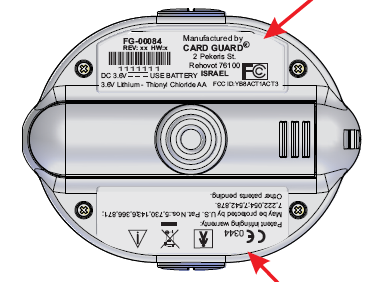
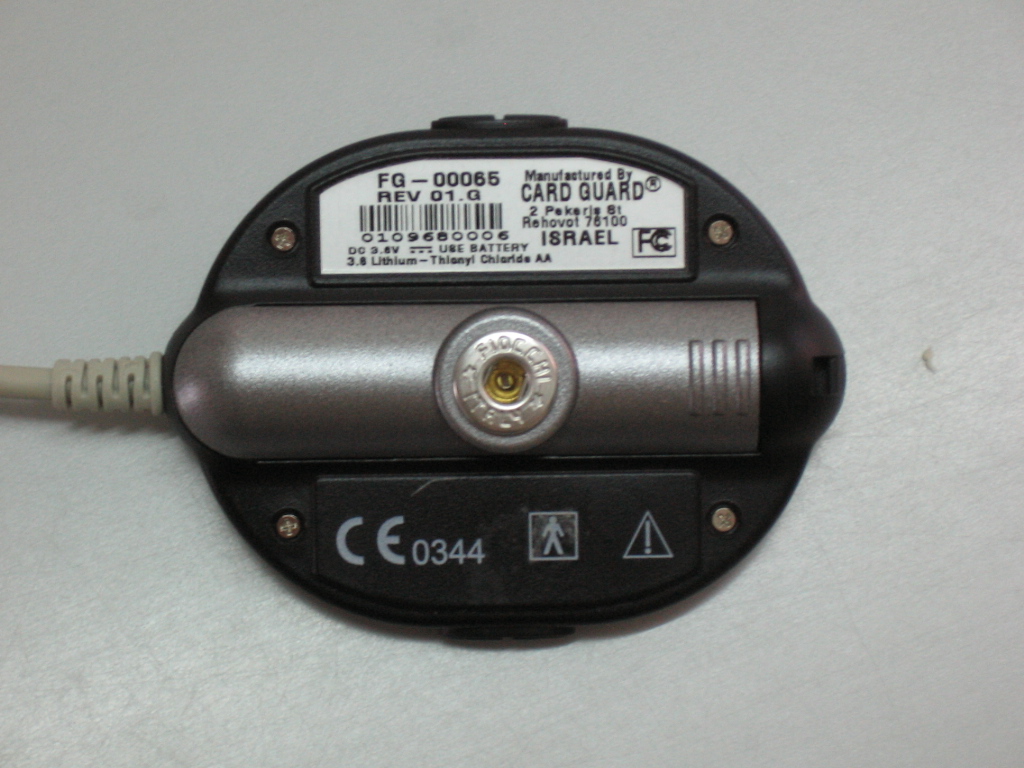
DATE OF DWG . A 4 DWG CHECKED PROJECT: - ACT I ASSY REV. - DWG REV. 03 SCALE - DIMENSIONS ARE IN MM GENERAL TOLERANCES 0.2 DEGREES - SN Label ACT I label DWG N0. LA-00048 DESIGN 03 March 11 ASHER K KLEIN KLEIN SHEET 1 OF 1 VP ENGINEERING R CARD GUARD Scientific Survival LTD. TM 39 mm 12.5 mm 1111111 Notes:1. Generic logo, material metalized polyester 2. Solvent resistant3. Background color: Silver or White4. Print color: Black5. Font: Arial R Manufactured by CARD GUARD 2 Pekeris St. Rehovot 76100 ISRAEL REV: xxFG-00065 DC 3.6V USE BATTERY 3.6V Lithium - Thionyl Chloride AA MOSHE Y FCC ID:YB8ACT1
Special 510(k) for CG-6108 Continuous ECG monitor and Arrhythmia Detector Section 13: Device Description / Description of Changes Page 13-1 of 2 Section 13: Device Description / Description of Changes 1. Device Introduction 1.1. The CG-6108 ACT-1L Continuous ECG Monitor and Arrhythmia Detector (ACT-1L) is designed for self-testing by patients at home and for analysis by medical professionals at a remote Monitoring Center. 1.2. The ECG chest-worn sensor is used for the acquisition and transmission of the ECG signal. The sensor is equipped with three electrode leads (electrodes contacts) on a harness intended to connect with FDA cleared ECG electrodes. The sensor works in conjunction with a hand held cellular device which contains the arrhythmia detection software application. Pictures of the sensor and handheld computing device are shown in Figures 1 and 2 below. 1.3. The sensor houses a 3.6V AA lithium-thionyl chloride battery, an ECG channel circuit, an impedance measurement circuit, a pacemaker detection circuit, a 2-hour flash buffer memory, a Bluetooth transceiver and a buzzer. The ECG signals are received, filtered and amplified in the input circuit, stored in the flash memory buffer and transmitted via Bluetooth to the hand held device (cellular smart phone). The hand held device runs a proprietary application that is configured to process and transmit the ECG recordings (via cellular network) that are also stored along with the detected physiological events on a micro-SD memory card. When a physiological event is detected, the handheld device transmits the recorded ECG automatically, via cellular link, to a Monitoring Center for professional analysis. If the patient is out of the cellular network coverage area, the hand-held device will send all events that were stored when the cellular link is re- established. The hand held device can also transmit ECG alarms via landline telephone through an optional landline Bluetooth modem. Figure 1: ACT 1L Sensor and ECG Leads Special 510(k) for CG-6108 Continuous ECG monitor and Arrhythmia Detector Section 13: Device Description / Description of Changes Page 13-2 of 2 HTC 5800 Samsung i617 Blackjack Figure 2: Available Handheld Cellular Computing Devices 2. Indications For Use: 2.1. The CG-6108 Continuous ECG Monitor and Arrhythmia Detector is intended for use by patients who experience transient symptoms that may suggest cardiac arrhythmia. The device continuously monitors a one lead ECG, automatically generates an alarm triggered by an arrhythmia detection algorithm or generates an alarm manually triggered by the patient, and transmits the recorded data transtelephonically to a Monitoring Center. The Monitoring Center provides the ECG data to the medical practitioner for evaluation. 3. Classifying Regulation and Product Code 3.1. Regulation Number: 21 CFR 870.1025, 21 CFR 870.2920 3.2. Product Code: DSI, DXH
Card Guard Scientific Survival Ltd., 2 Pekeris St., P.O. Box 527, Rehovot, 76100 ISRAEL Tel.: 972-8-948-4000 Fax: 972-8-948-4044 Date: 6 March 2011 To Whom It May Concern I hereby declare that there is no tune-up procedure for: FCC ID: YB8ACT1 Thank you, Thank you, Signature: Printed Name: Benny Tal VP OEM/ODM Card Guard Scientific Survival Ltd.
Test Report E100150.01 Card Guard Scientific Survival Ltd. Page 1 of 51 FCC ACC M Ver 1.1 05Mayl 2000 DATE: 13 March 2011 I.T.L. (PRODUCT TESTING) LTD. FCC Radio Test Report for Card Guard Scientific Survival Ltd. Equipment under test: CG-6108 ACT - 1 Lead FG-00065 Written by: ____________________________ D. Shidlowsky, Documentation Approved by: For/__________________________ R. Gotfrid, Test Engineer Approved by: _____________________________ I. Raz, EMC Laboratory Manager This report must not be reproduced, except in full, without the written permission of I.T.L. (Product Testing) Ltd. This report relates only to items tested. Test Report E100150.01 Card Guard Scientific Survival Ltd. Page 2 of 51 FCC ACC M Ver 1.1 05Mayl 2000 Measurement/Technical Report for Card Guard Scientific Survival Ltd. CG-6108 ACT - 1 Lead FG-00065 FCC ID: YB8ACT1 This report concerns: Original Grant: X Class I Change: Class II Change: Equipment type: Frequency Hopping Spread Spectrum Limits used: 47CFR15 Section 15.247 Measurement procedure used is ANSI C63.4-2003. Application for Certification Applicant for this device: prepared by: (different from "prepared by") Ishaishou Raz Benny Tal ITL (Product Testing) Ltd. Card Card Scientific Survival Ltd. Kfar Bin Nun 2 Pekeris St. D.N. Shimshon 99780 Rehovot 76100 Israel Israel e-mail [email protected] Tel: +972- 8 - 948 - 4000 Fax: +972- 8 - 948 - 4040 e-mail: [email protected] TABLE OF CONTENTS 1. GENERAL INFORMATION ------------------------------------------------------------------------------- 5 1.1 Administrative Information ................................................................................. 5 1.2 List of Accreditations ......................................................................................... 6 1.3 Product Description ........................................................................................... 7 1.4 Test Methodology .............................................................................................. 7 1.5 Test Facility ....................................................................................................... 7 1.6 Measurement Uncertainty ................................................................................. 7 2. SYSTEM TEST CONFIGURATION --------------------------------------------------------------------- 8 2.1 Justification ........................................................................................................ 8 2.2 EUT Exercise Software ..................................................................................... 8 2.3 Special Accessories .......................................................................................... 8 2.4 Equipment Modifications ................................................................................... 8 2.5 Configuration of Tested System ........................................................................ 8 3. TEST SET-UP PHOTOS ----------------------------------------------------------------------------------- 9 4. NUMBER OF HOPPING FREQUENCIES -----------------------------------------------------------10 4.1 Test Specification ............................................................................................ 10 4.2 Test Procedure ................................................................................................ 10 4.3 Results table .................................................................................................... 13 4.4 Test Equipment Used. ..................................................................................... 13 5. CHANNEL FREQUENCY SEPARATION ------------------------------------------------------------14 5.1 Test Specification ............................................................................................ 14 5.2 Test procedure ................................................................................................ 14 5.3 Results table .................................................................................................... 15 5.4 Test Equipment Used. ..................................................................................... 15 6. RADIATED POWER OUTPUT --------------------------------------------------------------------------16 6.1 Test Specification ............................................................................................ 16 6.2 Test procedure ................................................................................................ 16 6.3 Results Calculation .......................................................................................... 17 6.4 Test Equipment Used. ..................................................................................... 18 7. DWELL TIME ON EACH CHANNEL ------------------------------------------------------------------19 7.1 Test Specification ............................................................................................ 19 7.2 Test Procedure ................................................................................................ 19 7.3 Results table .................................................................................................... 22 7.4 Test Equipment Used. ..................................................................................... 22 8. 20DB BANDWIDTH ---------------------------------------------------------------------------------------23 8.1 Test Specification ............................................................................................ 23 8.2 Test procedure ................................................................................................ 23 8.3 Test Results .................................................................................................... 25 8.4 Test Equipment Used. ..................................................................................... 25 9. BAND EDGE ---------------------------------------------------------------------------------…
Text truncated - open the document above for the full version.
| # | Rule Parts | Frequency Range | Power Output |
|---|---|---|---|
| 1 | 15C | 2.40 GHz - 2.48 GHz | 1.00 mW |

CG-6108 ACT-3 LEAD
Equipment Class
DSS - Part 15 Spread Spectrum Transmitter