Text extracted from the exhibit documents filed with the FCC. Open a document above to read the original.
1 ACT Patient Guide This user guide includes information and instructions about the ACT (Continuous ECG Monitor and Arrhythmia Detector, and monitor with software application) and will help familiarize you using the ACT system, so please take a moment to read it carefully before you begin testing. Note: This manual is for ACT Monitor Application version 5.4, ACT 1L Sensor version 0.1G and ACT Sensor 3L version 1.0.4 IMPORTANT First time use ā The patient must call the service provider to receive instructions on how to proceed for the first time use. The first time the ACT system is activated and is attached to the patient there will be displayed screens not seen in regular use. These screens are calibration procedures the ACT system needs to perform to adjust its operation to the patient. Please read the Caution on page 36, for more details. CAUTION: Place used batteries in the kit that you have received from your service provider and make sure they will be returned to your service provider. If you have any questions regarding the ACT please refer to your representative. IMPORTANT This device complies with Part 15 of the FCC Rules. Operation is subject to the following two conditions: (1) This device may not cause harmful interference, and (2) This device must accept any interference received, including interference that may cause undesired operation. NOTE: THE MANUFACTURER IS NOT RESPONSIBLE FOR ANY RADIO OR TV INTERFERENCE CAUSED BY UNAUTHORIZED MODIFICATIONS TO THIS EQUIPMENT. SUCH MODIFICATIONS COULD VOID THE USER'S AUTHORITY TO OPERATE THE EQUIPMENT.
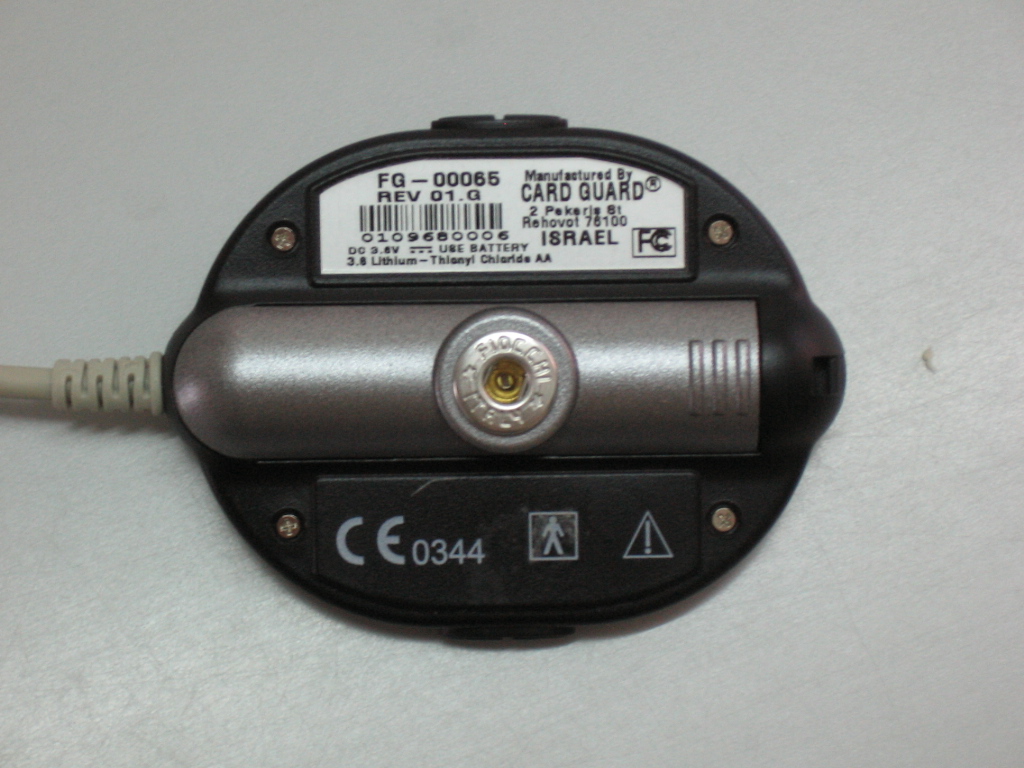
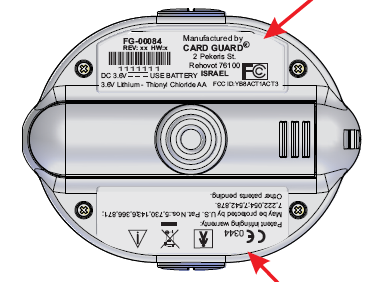
1111111 R Manufactured by CARD GUARD 2 Pekeris St. Rehovot 76100 ISRAEL REV: xx HW:x FG-00084 DC 3.6V USE BATTERY 3.6V Lithium - Thionyl Chloride AA FCC ID:YB8ACT1ACT3 1111111 R Manufactured by CARD GUARD 2 Pekeris St. Rehovot 76100 ISRAEL REV: xx HW:x FG-00084 DC 3.6V USE BATTERY 3.6V Lithium - Thionyl Chloride AA FCC ID:YB8ACT1ACT3 LA-00009 Patent infringing warrenty: May be protected by U.S. Pat. Nos.:5,730,143;6,366,871; 7,222,054;7,542,878. Other patents pending. 0344 LA-00044 Patent infringing warrenty: May be protected by U.S. Pat. Nos.:5,730,143;6,366,871; 7,222,054;7,542,878. Other patents pending. 0344
DATE OF DWG. A 4 DWG CHECKED PROJECT: - ACT and ACT III ASSY REV. - DWG REV. 07 SCALE - DIMENSIONS ARE IN MM GENERAL TOLERANCES 0.2 DEGREES - SN Label ACT III label DWG N0. LA-00009 DESIGN 18 April 10 ASHER K KLEIN KLEIN SHEET 1 OF 1 VP ENGINEERING R CARD GUARD Scientific Survival LTD. TM 39 mm 12.5 mm 1111111 Notes: 1. Generic logo, material metalized polyester 2. Solvent resistant 3. Background color: Silver or White 4. Print color: Black 5. Font: Arial R Manufactured by CARD GUARD 2 Pekeris St. Rehovot 76100 ISRAEL REV: xx HW:x FG-00084 DC 3.6V USE BATTERY 3.6V Lithium - Thionyl Chloride AA MOSHE Y FCC ID:YB8ACT1ACT3
TOP Bottom
ACT-3L Continuous ECG Monitor, Arrhythmia Detector Device Description This document contains proprietary information of Document No. Rev. Page of CARD GUARD Scientific Survival Ltd. DD-0029 02 1 7 CG-6108 ACT-3L Continuous ECG Monitor and Arrhythmia Detector Device Description, Principles of Operation RESTRICTION ON USE, DUPLICATION, OR DISCLOSURE OF PROPRIETARY INFORMATION This document contains proprietary information, which is the sole property of the company. The document is submitted to the recipient for his use only. By receiving this document the recipient undertakes not copy or disclose part of, or the whole of the information contained herein to any third party without receiving beforehand, written permission from submitting company. Name Title Signature Date Written by Sergey Yakirevich Team Leader CMS Agile April 06, 2010 Approved by A. Gonorovsky RA Manager CMS Agile Approved by Nir Geva Project Manager CMS Agile ACT-3L Continuous ECG Monitor, Arrhythmia Detector Device Description This document contains proprietary information of Document No. Rev. Page of CARD GUARD Scientific Survival Ltd. DD-0029 02 2 7 Rev. Date Change Description 01 March 27, 2008 Initial issue 02 April 06, 2010 Technical Specs updated ACT-3L Continuous ECG Monitor, Arrhythmia Detector Device Description This document contains proprietary information of Document No. Rev. Page of CARD GUARD Scientific Survival Ltd. DD-0029 02 3 7 1. DEVICE DEFINITION The CG-6108 ACT-3L Continuous ECG Monitor and Arrhythmia Detector is designed for self-testing by patients at home and for analysis by medical professionals at a remote Monitoring Center. It comprises a chest-worn ECG sensor and a handheld device with a proprietary application, configured to process and transmit the ECG recordings. The chest-worn unit includes 4 electrodes on a harness. It houses a 3.6V lithium-thionyl chloride AA battery and a Bluetooth transceiver for the acquisition, recording, and transmission of the ECG signal and a buzzer. The ECG signals are transmitted via Bluetooth to the handheld device. When an event is detected it is wirelessly transmitted to the CG Monitoring Center for professional analysis. The handheld device is equipped with shared memory used to record the signal received from the sensor and to allow pre- and post processing options through the use of this memory in a dual memory loop configuration, both running in parallel. One loop is auto-triggered, with programmable thresholds that starts recording on detecting specific rhythms and arrhythmias or when manually activated by the patient. The second, and longer, recording loop is controlled remotely to provide the physician with more information, when requested by the CG Monitoring Center. The handheld device automatically transmits the recorded ECG, via cellular link, to the Monitoring Center. When cellular service is unavailable the patient can transmit via landline telephone. 2. GLOSSARY AF Atrial Fibrillation - a type of heart arrhythmia in which the upper chamber of the heart (atria) quivers instead of pumping in an organized way. In this condition, the atrias do not completely empty when the heart beats, which can cause blood clots to form. Application A Card Guard proprietary handheld device program for receiving, storing, displaying and transmitting data gathered from the CG-6108 System Bradycardia HR slowness, usually fewer than 60 beats per minute in an adult human. Center Card Guard proprietary internet-enabled program for patient records storing and retrieval. For use by physicians and medical professionals Bluetooth (BT) Wireless communication protocol. Handheld device Small mobile hand-held computing device Heart Rate, HR Number of beats per minute, measured as bpm Tachycardia A rapid heart rate, especially one above 100 beats per minute in an adult ACT-3L Continuous ECG Monitor, Arrhythmia Detector Device Description This document contains proprietary information of Document No. Rev. Page of CARD GUARD Scientific Survival Ltd. DD-0029 02 4 7 3. CHEST UNIT Figure 1. Chest-worn ECG Sensor ā External appearance The device functional block diagram is shown in Figure 2. ECG Channels Three Leads ADC 12bit Impedance Measurement Contact Test Circuit Flash Mem buffer 128 MB RA LA RL Controller JTAG Interface connector Discharge switch V REF Pacemaker Detection Battery Monitor V BAT = 3.6V PWMCPU RAM UART Flash SPII/O external interupt BT Chip BTFlash Mem Antenna Bluetooth Module LL Flash Mem buffer 128 MB Figure 2. Chest-worn ECG Sensor - Functional Block Diagram The 3-L chest-worn sensor has 4 disposable electrodes attachable to a harness. The sensor receives analog ECG data from the electrodes attached to the patient body and it continuously transmits this signal to the wireless handheld device via BT protocol - for processing. ACT-3L Continuous ECG Monitor, Arrhythmia Detector Device Description This document contains proprietary information of Document No. Rev. Page of CARD GUARD Scientific Survival Ltd. DD-0029 02 5 7 The chest-worn sensor is powered by a 3.6V lithium-thionyl chloride AA battery. The sensorās ECG channels constitutes a differential amplifier with 20 MOhm impedance; Band frequency 0.05 ā 120 Hz. The baseline is stabilized by a HiPass filter capacitor discharge mechanism, which is controlled by μC. The electrode-to-skin contact is monitored with the impedance measuring circuit and a special SW application used to evaluate the electrode-to-skin impedance at f=10 Hz. The impedance is checked for each electrode separately vs. the reference electrode. The sine signal synthesized by the μC is applied via the voltage divider between the tested and the reference electrodes. When the impedance is high, the voltage across the divider is higher. The ADC is sensing three samples of this signal with an interval sec25m=Ļ. The divider output voltage is a function of impedance. The μC SW uses three samples for evaluation of the divider signal amplitude. This sampā¦
Text truncated - open the document above for the full version.
DATE: 11 May 2010 I.T.L. (PRODUCT TESTING) LTD. FCC Radio Test Report for Card Guard Scientific Survival Ltd. Equipment under test: CG-6108 ACT ā 3 Lead FG-00084 Written by: ____________________________ A. Moses, Documentation Approved by: _____________________________ A. Moses, Test Engineer Approved by: _____________________________ I. Raz, EMC Laboratory Manager This report must not be reproduced, except in full, without the written permission of I.T.L. (Product Testing) Ltd. This report relates only to items tested. Test Report E96691.00 Card Guard Scientific Survival Ltd. Page 1 of 54 FCC ACC M Ver 1.1 05Mayl 2000 Test Report E96691.00 Card Guard Scientific Survival Ltd. Page 2 of 54 FCC ACC M Ver 1.1 05Mayl 2000 Measurement/Technical Report for Card Guard Scientific Survival Ltd. CG-6108 ACT ā 3 Lead FG-00084 FCC ID: YB8ACT1ACT3 This report concerns: Original Grant: X Class I Change: Class II Change: Equipment type: Frequency hopping Spread Spectrum Limits used: 47CFR15 Section 15.247 Measurement procedure used is ANSI C63.4-2003. Application for Certification Applicant for this device: prepared by: (different from "prepared by") Ishaishou Raz Benny Tal ITL (Product Testing) Ltd. Card Card Scientific Survival Ltd. Kfar Bin Nun 2 Pekeris St. D.N. Shimshon 99780 Rehovot 76100 Israel Israel e-mail [email protected] Tel: +972- 8 - 948 - 4000 Fax: +972- 8 - 948 - 4040 e-mail: [email protected] Test Report E96691.00 Card Guard Scientific Survival Ltd. Page 3 of 54 FCC ACC M Ver 1.1 05Mayl 2000 TABLE OF CONTENTS 1. GENERAL INFORMATION ------------------------------------------------------------------------------- 5 1.1 Administrative Information ................................................................................. 5 1.2 List of Accreditations ......................................................................................... 6 1.3 Product Description ........................................................................................... 7 1.4 Test Methodology .............................................................................................. 7 1.5 Test Facility ....................................................................................................... 7 1.6 Measurement Uncertainty ................................................................................. 7 2. SYSTEM TEST CONFIGURATION --------------------------------------------------------------------- 8 2.1 Justification ........................................................................................................ 8 2.2 EUT Exercise Software ..................................................................................... 8 2.3 Special Accessories .......................................................................................... 8 2.4 Equipment Modifications ................................................................................... 8 2.5 Configuration of Tested System ........................................................................ 8 3. NUMBER OF HOPPING FREQUENCIES -----------------------------------------------------------10 3.1 Test Specification ............................................................................................ 10 3.2 Test Procedure ................................................................................................ 10 3.3 Results table .................................................................................................... 15 4. CHANNEL FREQUENCY SEPARATION ------------------------------------------------------------16 4.1 Test Specification ............................................................................................ 16 4.2 Test procedure ................................................................................................ 16 4.3 Results table .................................................................................................... 17 4.4 Test Instrumentation Used .............................................................................. 18 5. RADIATED POWER OUTPUT --------------------------------------------------------------------------19 5.1 Test Specification ............................................................................................ 19 5.2 Test procedure ................................................................................................ 19 5.3 Results Calculation .......................................................................................... 20 5.4 Test Equipment Used. ..................................................................................... 21 6. DWELL TIME ON EACH CHANNEL ------------------------------------------------------------------22 6.1 Test Specification ............................................................................................ 22 6.2 Test Procedure ................................................................................................ 22 6.3 Test Results .................................................................................................... 22 6.1 Results............................................................................................................. 24 6.2 Test Equipment Used. ..................................................................................... 24 7. 20 DB BANDWIDTH ---------------------------------------------------------------------------------------25 8. BAND EDGE ------------------------------------------------------------------------------------------------28 8.1 Test procedure ................................................................................................ 28 8.2 Results table .................................................................................................... 29 8.3 Test Equipment Used. ..................................................................................... 30 9. RADIATED EMISSION, 9 KHZ ā 30 MHZ -----------------------------------------------------------31 9.1 Testā¦
Text truncated - open the document above for the full version.
| # | Rule Parts | Frequency Range | Power Output |
|---|---|---|---|
| 1 | 15C | 2.40 GHz - 2.48 GHz | 120.00 µW |

CG-6108 ACT-1 LEAD
Equipment Class
DSS - Part 15 Spread Spectrum Transmitter