YU2-EOXISHearing System
audifon GmbH & Co KG
Click to zoom
Application Details
- Equipment Class
- DXX - Part 15 Low Power Communication Device Transmitter
- Date of Grant
- Apr 03, 2012
- Application Purpose
- Original Equipment
- Date of Application
- Apr 03, 2012
- Equipment Note
- Hearing System
- Frequency Range
- 10.52500000 - 10.52500000
- Company
- audifon GmbH & Co KG
- Country
- Germany
Documents & Files
Document Text
Text extracted from the exhibit documents filed with the FCC. Open a document above to read the original.
Users Manual
018867 -212-341-3040 /12/2011 High-tech made in Germany www.audifon.com audifon GmbH & Co. KG Werner-von-Siemens-Straße 2 99625 Kölleda Germany Corporate Headquarters [email protected] Phone +49-3635-4056-590 Fax +49 -3635-4056-589 eoxSolutions for better hearing Instructions for use High-tech made in Germany Last revised: 07.12.2011 audifon declares that the product audifon eox meets the requirements of the Directive 1999/5/EC. The full text of the Declaration of Conformity can be inspected at audifon GmbH & Co. KG, Werner-von-Siemens-Strasse 2, 99625 Kölleda, Germany. Intended use of hearing aids hearing aids by audifon are utilized to compensate impairments in personal hearing. They require an individual fitting in per formance, executed by a hearing aid professional. The hearing aid’s mode of action is the reception of sound using a microphone, digital processing of the signal and playback of the amplified Sound. Intended use of combined Tinnitus-Retraining-instruments Instruments for Tinnitus-Retraining-Therapy (TRT) from audifon are intended for usage as part of a professionally guided Tinnitus-Retraining-Therapy only. Utilizing an artificially generated background noise, TRT- instruments support distraction from the tinnitus and to pursue the long-term goal of tinnitus habituation. 1 Contents 1. Introduction .........................................................2 2. Over view of different styles ..................................3 3. Behind-The-Ear hearing aids .................................4 3.1 Construction ..................................................4 3.2 Start-up and operation ...................................5 3.3 Switching the hearing aids on and off ..............6 3.4 Multi-functional rocker switch ........................7 3.4.1 Volume selection .....................................8 3.4.2 Selecting the hearing programs ..............9 3.5 Direct Audio Input ..........................................11 3.6 Care instructions ............................................13 4. In-The-Ear hearing aids .........................................14 4.1 Construction ..................................................14 4.2 Start-up and operation ...................................15 4.3 Switching the hearing aids on and off ..............16 4.4 Volume selection (hearing aids with volume control) ..............................................17 4.5 Selecting the hearing programs (for hearing aids with a program switch) .........18 4.6 Care instructions ............................................19 5. Automatic telephone program .............................20 6. Cobined TRT-Instruments .....................................22 7. Safety and care instructions ..................................23 8. Troubleshooting ...................................................25 9. Environmentally-friendly disposal .........................26 10. Ser vice ..................................................................28 Warranty card 2 1. Introduction Congratulations on the purchase of your new audifon hearing aids. Your hearing care professional has adjusted the hearing aids to your individual requirements. These instructions are therefore intended to help you use your audifon hearing aids prop er l y. Please read through the following operating and care instructions carefully to avoid malfunctions and faults. If you follow these instructions, your hearing aids will prove an invaluable help in your day-to-day communication with your surroundings and other people. The specific model of your hearing aids is shown on the sticker on the packaging, or on the warranty card or printed on the hearing aids themselves. If you have any further questions, please contact your hearing care professional. 3 2. Overview of different styles* M/M TRT S/S TRT IS/IS TRT IS+/IS+ TRT 13 312 312 13 Behind-The-Ear Behind-The-Ear In-T he -E ar In-T he -E ar 4 4 14 14 Low battery warning An audible signal indicates the end of the batter y’s life (approx. 30 minutes before the batter y runs out). The audio-sequence from transmitter and receiver differ from themselves. Ask your hearing care professional to demonstrate the audio sequences. We recommend to use audifon zinc air batteries. Please follow the instructions on the batter y packaging. Please dispose of used batteries in the appropriate containers at your health care professional’s premises. Always switch your hearing aids off after use. Remove the batter y if your hearing aids are out of use for long periods. * The variety of types depends on sales area. ** American Association of Poison Control Centers 1-800-222-1222 – open 24 hours a day www.aapcc.org ModelBatteryStylesFrom page Important safety information**: Keep batteries and hearing aids away from children and pets. There is a risk of swallowing! If a batter y is swallowed, consult a doctor immediately. 4 4 3 2 1 6 3. Behind-The-Ear hearing aids 3.1 Construction Your hearing aids comprise the following elements: Note: Your hearing aids may differ from the illustrations. Earhook Microphone inlets Rocker switch Audio input, optional Batter y compartment and ON/OFF switch Batter y compartment lock 5 5 3 1 1 5 2 6 4 0297 5 3.2 Start-up and operation To start your hearing aids first insert a batter y in the batter y compartment. Remove a batter y from its packaging. Note: If you are using a zinc air batter y, remove the protective film and wait a few minutes before inserting it. Hold the hearing aids upright as shown in the picture and gently rock them on a hard sur face, i.e. table top. The door will open to OFF position. Now you are able to open the battery compartment completely. Insert the batter y in the batter y compartment. Ensure that the + symbol on the batter y is visible when you have inserted it. 6 Switching on Your hearing aids are switched on and off via the batter y compartment. To turn on, simply close the batter y compartment. The batterie compartment snap into place noticeable. T…
Text truncated - open the document above for the full version.
Internal Photos
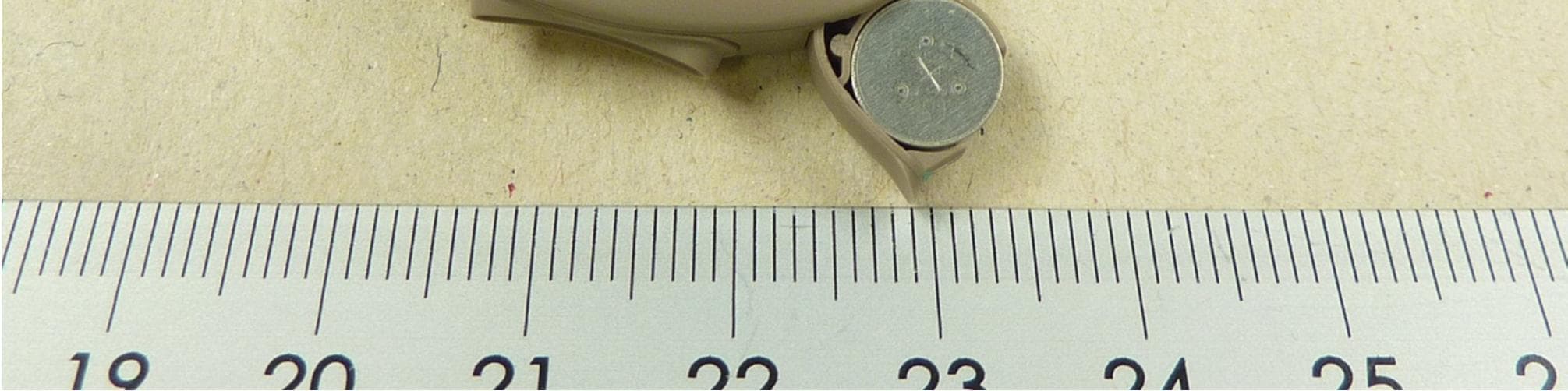
ANNEX CINTERNAL PICTURES Test engineer:Raimund BLASKReport Number:F120962E3 Date of issue:26 March2012Order Number:12-120962page1 of 2 ANNEX CINTERNAL PICTURES Test engineer:Raimund BLASKReport Number:F120962E3 Date of issue:26 March2012Order Number:12-120962page2 of 2
Test Report
Königswinkel 10 32825 Blomberg Germany Phone:+49 (0) 52 35 95 00-0 Fax:+49 (0) 52 35 95 00-10 Test Report Report Number: F120962E3 Applicant: audifon GmbH & Co. KG Manufacturer: audifon GmbH & Co. KG Equipment under Test (EUT): Hearing System “eoxI S TRT”, “viaIS”, “eoxIS” Laboratory (CAB) accredited by DeutscheGesellschaft für Akkreditierung mbH in compliance with DIN EN ISO/IEC 17025 under the Reg. No. DGA-PL-105/99-22, FCC Test site registration number 90877and Industry Canada Test site registration IC3469A-1 Testengineer:Raimund BLASKReport Number:F120962E3 Dateof issue:26 March 2012Order Number:12 -120962page2 of 19 REFERENCES [1]ANSI C63.4-2009American National Standard for Methods of Measuring of Radio-Noise Emissions from Low-Voltage Electrical and Electronic Equipment in the Range of 9 kHz to 40 GHz. [2]FCC CFR 47 Part 15 (October 2011)Radio Frequency Devices [3]RSS-210 Issue 8 (December2010)Low-power Licence-exempt Radiocommunication Devices (All Frequency Bands): Category I Equipment [4]RSS-GenIssue 3 (December 2010)General Requirements and Information for the Certification of Radiocommunication Equipment TEST RESULT The requirements of the tests performed as shown in the overview (clause4) werefulfilled by the equipment under test. The complete test results are presented in the following. RESERVATION T h i s t e s t r e p o r t i s o n l y v a l i d i n i t s o r i g i n a l f o r m . Anyreproduction of its contents in extracts without written permission of the accredited test laboratory PHOENIX TESTLAB GmbH is prohibited. The test results herein refer only to the tested sample. PHOENIX TESTLAB GmbH is not responsible for any generalizations or conclusions drawn from these test results concerning further samples. Any modification of the tested samples is prohibited and leads to the invalidity of this test report. Each page necessarily contains the PHOENIX TESTLAB Logo and the TEST REPORT NUMBER. Testengineer:Raimund BLASKReport Number:F120962E3 Dateof issue:26 March 2012Order Number:12-120962page3 of19 Contents:Page 1IDENTIFICATION...................................................................................................................4 1.1APPLICANT.......................................................................................................................4 1.2MANUFACTURER.............................................................................................................4 1.3TEST LABORATORY........................................................................................................4 1.4EUT (EQUIPMENT UNDER TEST)...................................................................................5 1.5TECHNICAL DATA OF EQUIPMENT................................................................................5 1.6DATES..............................................................................................................................5 2OPERATIONAL STATES.......................................................................................................6 3ADDITIONAL INFORMATION (as declared by the applicant):................................................6 4OVERVIEW............................................................................................................................7 5METHODS OF MEASUREMENT...........................................................................................8 5.1RADIATED EMISSIONS....................................................................................................8 5.2RADIATED EMISSIONS.................................................................................................. 15 5.2.1TEST RESULTS (RADIATED EMISSIONS) ...........................................................15 5.2.1.1PRELIMINARY AND FINAL RADIATED EMISSION MEASUREMENT..............15 5.2.1.2PRELIMINARY MEASUREMENT (30MHz to 1 GHz)........................................17 6TEST EQUIPMENT AND ANCILLARIES USED FOR TESTS..............................................18 7REPORT HISTORY.............................................................................................................18 8LIST OF ANNEXES..............................................................................................................19 Testengineer:Raimund BLASKReport Number:F120962E3 Dateof issue:26 March 2012Order Number:12-120962page4 of19 1IDENTIFICATION 1.1APPLICANT Name:audifon GmbH & Co. KG Address:Werner-von-Siemens-Straße 2 99625 Kölleda Country:Germany Name for contact purposes:Mr. Stephan Teders Tel:+49-(0)-2202-92638-14 Fax:+49-(0)-2202-92638-29 e-mail address:[email protected] 1.2MANUFACTURER Name:audifon GmbH & Co. KG Address:Werner-von-Siemens-Straße 2 99625 Kölleda Country:Germany Name for contact purposes:Mr. Stephan Teders Tel:+49-(0)-2202-92638-14 Fax:+49-(0)-2202-92638-29 e-mail address:[email protected] 1.3TEST LABORATORY The tests were carried out at:PHOENIX TESTLAB GmbH Königswinkel 10 32825 Blomberg Germany accredited byDGA Deutsche Gesellschaft für Akkreditierung mbHin compliance with DIN EN ISO/IEC 17025 under Reg. No.DGA-PL-105/99-22,FCC Test site registration number 90877andIndustry Canada Test site registration IC3469A-1. Testengineer:Raimund BLASKReport Number:F120962E3 Dateof issue:26 March 2012Order Number:12-120962page5 of19 1.4EUT (EQUIPMENT UNDER TEST) Testobject: *Hearing System Type: *“eox ISTRT”; “via IS”, “eox IS” Antenna type: *Integral H-Field-Antenna (6mm x 2mm coil with 22 turns) Hardware version: *- Software version: *- 1.5TECHNICAL DATA OF EQUIPMENT Duty cycle class: *Up to 100% Ratedtransmitter field strength: *≤ -13 dBμA/m @ 1m distance Channel spacing: *- ITU classification: *545KF1D Alignment range: *10.525MHz Switching range: *10.525MHz Modulation: *FSK Bit rate of transmitter: *298 kBit/s Supply Voltage:* (TX)U Nom =1.4 VU Min =0.9VU Max =1.7V Power Supply:* (TX)1.4 V ZincAir-Battery Temperature range:*-20°C to 55°C (tested range), 0°C to 35°C (manufa…
Text truncated - open the document above for the full version.
Test Setup Photos
ANNEX APHOTOGRAPHS Test engineer:Raimund BLASKReportNumber:F120962E3 Date of issue:26 March2012Order Number:12-120962page1 of 3 120962emi1.JPG: Test set-up radiated emission (E-Field) ANNEX APHOTOGRAPHS Test engineer:Raimund BLASKReportNumber:F120962E3 Date of issue:26 March2012Order Number:12-120962page2 of 3 120962emi2.JPG: Test set-uppreliminaryradiated emission (H-Field) ANNEX APHOTOGRAPHS Test engineer:Raimund BLASKReportNumber:F120962E3 Date of issue:26 March2012Order Number:12-120962page3 of 3 120962emi3.JPG: Test set-upfinalradiatedemission (H-Field)
Contact Information
Applicant
Stephan Teders(Engineer F&E)
Test Firm
PHOENIX TESTLAB GmbHHolger Bentje
Technical Specifications
| # | Rule Parts | Frequency Range | Power Output |
|---|---|---|---|
| 1 | 15C | 10.525 MHz - 10.525 MHz | - |
Other Applications from audifon GmbH & Co KG
YU2-FAROR
Apr 09, 2015Hearing System
Equipment Class
DXX - Part 15 Low Power Communication Device Transmitter
YU2-EOXIST
Apr 02, 2012Hearing System
Equipment Class
DXX - Part 15 Low Power Communication Device Transmitter
YU2-VIAIS
Apr 02, 2012Hearing System
Equipment Class
DXX - Part 15 Low Power Communication Device Transmitter
YU2-EOXISXT
Feb 22, 2012Hearing System
Equipment Class
DXX - Part 15 Low Power Communication Device Transmitter
YU2-VIAISX
Feb 22, 2012Hearing System
Equipment Class
DXX - Part 15 Low Power Communication Device Transmitter