A3LSCHA633Single-Mode Cellular Phone (CDMA)
Samsung Electronics Co Ltd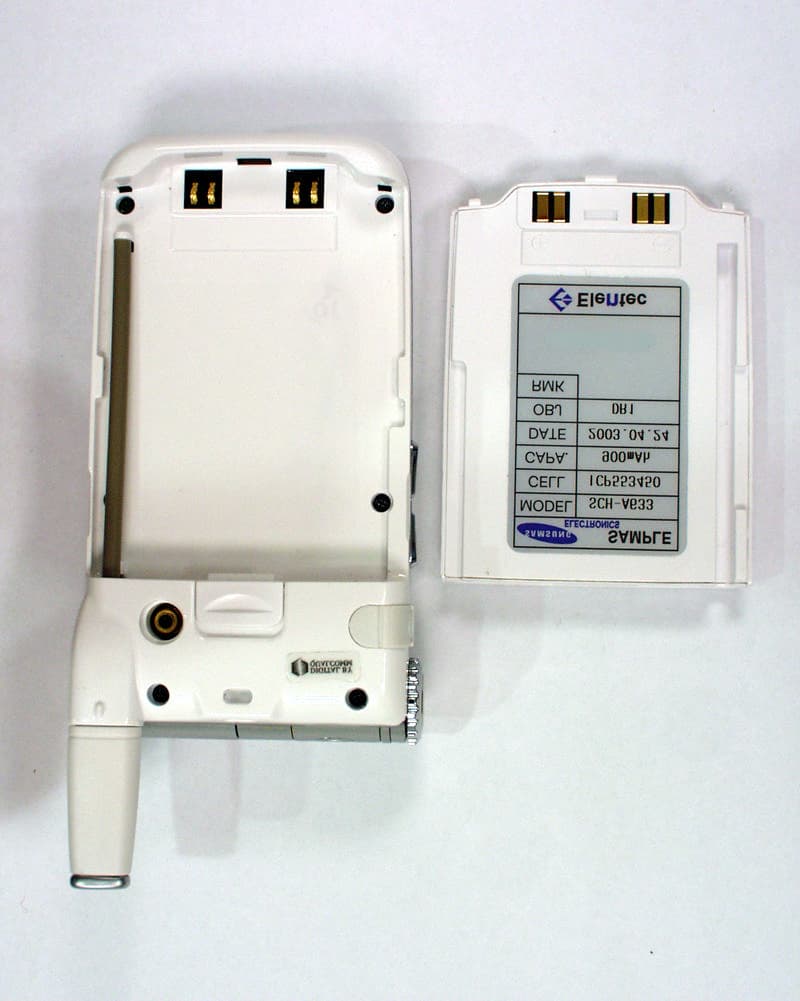
Click to zoom
Application Details
- Equipment Class
- TNE - Licensed Non-Broadcast Transmitter Held to Ear
- Date of Grant
- Aug 14, 2003
- Application Purpose
- Original Equipment
- Date of Application
- Aug 14, 2003
- Equipment Note
- Single-Mode Cellular Phone (CDMA)
- Frequency Range
- 824.70000000 - 848.31000000
- Company
- Samsung Electronics Co Ltd
- Country
- United States
Documents & Files
Document Text
Text extracted from the exhibit documents filed with the FCC. Open a document above to read the original.
Users Manual
ELECTRONICS World Wide Web http://www.samsungmobile.com CELLULAR PHONE SCH-A633 User’s Manual Printed in Korea Código No.: GH68-XXXXXA English. 05/2003.Rev.1.0 Please read this manual before operating your phone, and keep it for future reference. Draft version (2003/05/14) All phone functions couldn’t be checked because the software of the current working sample was unstable. The descriptions in this manual were borrowed from the other manuals. The functions will be checked and, therefore, the contents will be corrected in the next version. * Some contents of this manual may differ from your phone depending upon the software of the phone or your service provider. 3 Important Safety Precautions.................................................. 7 Unpacking................................................................................... 9 Your Phone Phone’s Parts ................................................................................ 10 Display ......................................................................................... 13 Backlight ...................................................................................... 15 Camera ........................................................................................ 15 Getting Started Using a Battery ............................................................................. 17 Switching the Phone On or Off ....................................................... 20 Using the Soft Keys ........................................................................ 22 Your Phone’s Modes ...................................................................... 23 Call Functions Making a Call ................................................................................ 26 Emergency Dialling ....................................................................... 27 Redialing the Last Number ............................................................ 28 Making a Call from Phonebook ..................................................... 28 Prepend Dialling ........................................................................... 29 Speed-dialling ............................................................................... 29 Four-digit Dialling ......................................................................... 31 Pause Dialling .............................................................................. 32 Voice Dialling ................................................................................ 34 Adjusting the Volume During a Call ............................................... 36 Answering a Call ............................................................................ 36 Options During a Call ..................................................................... 37 Using Caller ID .............................................................................. 38 Viewing Missed Calls ...................................................................... 38 Call Forwarding ............................................................................. 39 Call Waiting ................................................................................... 39 Three-way Calling .......................................................................... 40 Table of ContentsFCC RF EXPOSURE INFORMATION In August 1996 the Federal Communications Commission (FCC) of the United States with its action in Report and Order FCC 96-326 adopted an updated safety standard for human exposure to radio frequency electromagnetic energy emitted by FCC regulated transmitters. Those guidelines are consistent with the safety standards previously set by both U.S. and international standards bodies. The design of this phone complies with the FCC guidelines and these international standards. Use only the supplied antenna or one that is approved. Unauthorized antennas, modifications, or attachments could impair call quality, damage the phone, or result in a violation of FCC regulations. Do not use the phone with a damaged antenna. If a damaged antenna comes into contact with the skin, a minor burn may result. Please contact your local dealer for a replacement antenna. Body-worn Operation This device was tested for typical body-worn operations with the back of the phone kept 1.5 cm. from the body. To maintain compliance with FCC RF exposure requirements, use only belt-clips, holsters or similar accessories that maintain at least a 0.59 inch (1.5 cm.) separation distance, between the user's body and the back of the phone, including the antenna, whether extended or retracted. The use of belt-clips, holsters and similar accessories should not contain metallic components in its assembly. The use of accessories that do not satisfy these requirements may not comply with FCC RF exposure requirements, and should be avoided. Vehicle Mounted External Antenna (optional, if available.) A minimum separation distance of 7.9 inches (20cm) must be maintained between a person and the vehicle mounted external antenna to satisfy FCC RF exposure requirements. For more information about RF exposure, please visit the FCC web site at www .fcc.gov 45 Entering Text Changing the Text Input Mode ........................................................ 42 Using the T9 (English) Mode .......................................................... 43 Using the Alphabet Mode ............................................................... 45 Using the Symbol Mode ................................................................. 47 Using the Number Mode ................................................................ 47 Using the Menus Accessing a Menu Function by Scrolling .......................................... 48 Accessing a Menu Function by Using Its Shortcut ...............................49 List of Menu Functions ................................................................... 50 Phone Book Find (Menu 1-1)..................................................................…
Text truncated - open the document above for the full version.
Users Manual
74 CCaallll HHiissttoorryy 75 Call DurationMenu 3-5 Your phone records the amount of air time, or talk time, used. Using this option, you can view the number of the calls to or from your phone, and the air time for all of the calls. You can easily erase the call time record at any time. This option is convenient for estimating your usage. Note: This feature is not intended to be used for billing purposes. The following options are available: Last Call: shows the time of the last call. Total Dialled Call: shows the number of all calls you made and the total duration of the calls since the time counter was last set to zero by using the Reset All option. Total Received Call: shows the number of all calls you received and the total duration of the calls since the time counter was last set to zero by using the Reset All option. Reset All: erases all of the time measurements and resets all of the air time counters. Life Time: shows the number and total duration of all calls made to or from your phone since the phone was shipped from the factory. Sounds You can use the Sounds menu to customize various sound settings, such as the: •ringer volume, type, and tone. •alert sounds and key tone. •sound which plays when the phone is switched on or off. Ring TonesMenu 4-1 This option allows you to set the unique ringer melodies for the following items: Calls: allows you to set a unique ringer for incoming voice calls. Messages: allows you to have a distinctive ringer for incoming text messages and voicemail messages independently. Schedules: allows you to have a distinctive ringer for schedule alarm settings. Select a unique ringer melody using the Navigation keys. After you change it, it plays for a few seconds. 77 SSoouunnddss 76 SSoouunnddss AlertsMenu 4-3 Your phone gives audible alerts (beeps) at a specified time to inform you that certain things have happened. The alerts only occur in your earpiece so that the other person does not hear them. The available alerts are: Service : when this option is set to On, the phone sounds an alert when you exit or return to a service area. Call Connect: when this option is set to On, the phone sounds the connect tone when your call is connected to the system. Call Disconnect: when this option is set to On, the phone sounds the disconnect tone when a call is disconnected. Folder Open/Closed: when this option is set to On, the phone sounds an alert when you open or close the folder. Ringer VolumeMenu 4-2 This menu allows you to adjust the ringer volume. Calls: allows you to adjust the ringer volume for incoming voice calls. Messages: allows you to adjust the ringer volume for incoming messages. Alarms/Schedules: allows you to adjust the ringer volume for alarm settings or scheduled events. Press the Navigation keys to adjust the volume level or select a ringer type. The following options are available: - Silent: the phone does not sound a ring. - Vibrate: the phone switches to the vibration mode. An incoming call vibrates the phone. - 1-Beep: the phone sounds a beep. - Level 1 ~ 8: adjust the volume level. The more bars, the louder. - High+Vib: the phone rings in the highest volume level and then vibrates. Notes: • The options available may be different depending on the selected ringer item. • When “Emergency call only” appears after you end an emergency call, the ringer volume for calls and messages is automatically set to Level 4. 78 SSoouunnddss 79 Key ToneMenu 4-4 In this menu, you can set up the sound your phone generates when you press a key. The following options are available: Volume: adjusts the volume using the Navigation keys or the volume keys on the left side of the phone. Note: When “Emergency call only” appears after ending an emergency call, the key tone is automatically set to Level 4. Type: allows you to select the type of the key tone. Choose one of Beep, Drum, Piano, and Lady’s Voice. Length: enables you to select Shortor LongDTMF (dual-tone multi-frequency) tones. DTMF tones are sent by your phone to access teleservices, such as a bank account. The system used by the bank or other service determines if you need short or long DTMF tones. If the service is digital, as most are, short DTMF tones will almost always work. Power On/Off MelodyMenu 4-5 You can turn on or off the melody that the phone plays when it is switched on or off. Choose Onto use the power on/off sound or Offnot to use it. Display The Display feature enables you to customize various settings for the display and the light. LanguageMenu 5-1 This menu allows you to change the language of voice prompts, menus and key input. You can choose a language, either English, Hindi, Marathior Gujarathi. Service AreaMenu 5-2 This menu displays the service area where you currently are. The service area is also displayed for about 5 seconds when your phone is registered onto a network or when you make or receive a call. Menu ThemeMenu 5-3 This menu allows you to select the menu display style. You can choose a style, either Nature or Camera. 80 DDiissppllaayy 81 DDiissppllaayy BannerMenu 5-5 This option allows you to set a banner message to be displayed at the bottom of the display in Standby Mode. 1. If necessary, press the CLRkey to delete each letter of the old greeting. Press are hold the CLRkey to clear the display. 2. Enter your banner message. For further information about how to enter characters, see page xx. 3. When you finish entering the message, press the Nextsoft key. The screen allowing you to change the banner colour appears. 4. Press the Left or Right key to change the colour for the text font and press the Down key. 5. Press the Left or Right key to change the colour for the text shadow and press the Savesoft key. WallpaperMenu 5-4 You can change the background image (wall paper) to be displayed in Standby Mode. On the Image Wallpaper list, you can select one from the default animation images and downloaded images. In addition, you can choose Digital Clock, Analog Clockor Dual C…
Text truncated - open the document above for the full version.
Attestation Statements
July 28, 2003 Federal Communications Commission Authorization and Evaluation Div. Equipment Authorization Branch 7435 Oakland Mills Road Columbia, MD 21046 In re: Samsung Electronics Co., Ltd. FCC ID.: A3LSCHA633 Request for Confidentiality To Whom It May Concern: In accordance with 0.459 of CFR 47, Samsung Electronics Co., Ltd. requests confidentiality for the Block Diagram, Schematics, Parts list, Tune-up Procedure, Operational and Circuit Description of the attached test report. These documents contain detailed system and equipment descriptions and related information about the product, which Samsung Electronics Co., Ltd. considers to be proprietary, confidential, and a custom design and otherwise, would not release to the general public. Since this design is a basis from which future technological products will evolve, Samsung feels that this information would be of benefit to its competitors, and that the disclosure of the information in these documents would give our competitors an unfair advantage in the market. Sincerely, Wallace Oh Engineering Manager Samsun Samsung Electronics America
External Photos
© 2003 SAMSUNG ELECTRONICS Co., Ltd. SAMSUNG FCC ID: A3LSCHA633 Single-Mode Cellular Phone © 2003 SAMSUNG ELECTRONICS Co., Ltd. SAMSUNG FCC ID: A3LSCHA633 Single-Mode Cellular Phone © 2003 SAMSUNG ELECTRONICS Co., Ltd. SAMSUNG FCC ID: A3LSCHA633 Single-Mode Cellular Phone © 2003 SAMSUNG ELECTRONICS Co., Ltd. SAMSUNG FCC ID: A3LSCHA633 Single-Mode Cellular Phone © 2003 SAMSUNG ELECTRONICS Co., Ltd. SAMSUNG FCC ID: A3LSCHA633 Single-Mode Cellular Phone
ID Label/Location Info
© 2003 SAMSUNG ELECTRONICS Co., Ltd. SAMSUNG FCC ID: A3LSCHA633 Single-Mode Cellular Phone SAMSUNG ELECTRONICS CO., LTD. MODEL NO: SCH-A633 FCC ID: A3LSCHA633 MADE IN KOREA SAMSUNG ELECTRONICS CO., LTD
Internal Photos
© 2003 SAMSUNG ELECTRONICS Co., Ltd. SAMSUNG FCC ID: A3LSCHA633 Single-Mode Cellular Phone © 2003 SAMSUNG ELECTRONICS Co., Ltd. SAMSUNG FCC ID: A3LSCHA633 Single-Mode Cellular Phone
RF Exposure Info
2 of 25 Contents 1. General Information.............................................................................................3 2. Description of Device...........................................................................................3 3. Description of Test Equipment..............................................................................4 3.1 SAR Measurement Setup.........................................................................................4 3.2 DASY3 E-Field Probe.............................................................................................5 3.3 SAM Phantom.....................................................................................................6 3.4 Brain & Muscle Simulating Mixture Characterization....................................................7 3.5 Device Holder for transmitters.................................................................................8 3.6 Validation Dipole...................................................................................................8 3.7 Equipment Calibration.............................................................................................9 4. SAR Measurement Procedure.............................................................................10 5. Description of test position..............................................................................11 5.1 SAM Phantom Shape............................................................................................11 5.2 Cheek/Touch Position............................................................................................11 5.3 Ear/Tilt 15 Position..............................................................................................13 5.4 Body/Holster/Belt Clip Configuration.......................................................................14 6. Measurement Uncertainty..................................................................................16 7. System Verification.........................................................................................17 7.1 Tissue Verification..............................................................................................17 7.2 Test System Validation...........................................................................................17 8. SAR Measurement Results.................................................................................18 8.1 Measurement Results(Cellular CDMA Right Head SAR-Touch)....................................19 8.2 Measurement Results(Cellular CDMA Right Head SAR-Tilt)........................................20 8.3 Measurement Results(Cellular CDMA Left Head SAR-Touch)......................................21 8.4 Measurement Results(Cellular CDMA Left Head SAR-Tilt)..........................................22 8.5 Measurement Results(Cellular CDMA Body SAR w/o Holster).......................................23 9. Conclusion.......................................................................................................24 10. Reference......................................................................................................25 3 of 25 1. GENERAL INFORMATION Test Sample : Single-Mode Cellular Phone (CDMA) Model Number : SCH-A633 Serial Number : Identical prototype (S/N : #FA-0 14-J) Manufacturer : SAMSUNG ELECTRONICS Co., Ltd. Contact : WS YOON, Manager Phone : +82- 54-479-5699 Fax : +82- 54-479-5715 Test Standard : §2.1093; FCC/OET Bulletin 65, Supplement C(July 2001) FCC Classification : Non-Broadcast Transmitter Held to Ear (TNE) Test Dates : July 8,2003 ~ July 9,2003 Tested for : FCC/TCB Certification 2. DESCRIPTION OF DEVICE Tx Freq. Range : 824.70 – 848.31 MHz (CDMA) Rx Freq. Range : 869.70 – 893.31 MHz (CDMA) Max. RF Output Power : 0.228 W ERP PCS (23.58 dBm) Antenna Manufacturer : SB TELCOM Model No. : NSB231-01S0800-SS176 Antenna Dimensions : Length = 8.80 Cm 4 of 25 3. DESCRIPTION OF TEST EQUIPMENT 3.1 SAR Measurement Setup Robotic System Measurements are performed using the DASY3 automated dosimetric assessment system. Which is made by Schmid & Partner Engineering AG (SPEAG) in Zurich, Switzerland and consists of high precision robotics system (Stäubli), robot controller, Pentium computer, near-field probe, probe alignment sensor, and the SAM twin phantom containing the brain equivalent material. The robot is a six-axis industrial robot performing precise movements to position the probe to the location (points) of maximum electromagnetic field (EMF) (see Fig. 3.1). Figure 3.1 SAR Measurement System Setup System Hardware A cell controller system contains the power supply, robot controller, teach pendant (Joystick), and a remote control is used to drive the robot motors. The PC consists of the Samsung Pentium 550MHz computer with Windows 2000 system and SAR Measurement Software DASY3, A/D interface card, LCD monitor, mouse and keyboard. The Stäubli Robot is connected to the cell controller to allow software manipulation of the robot. A data acquisition electronic (DAE) circuit that performs the signal amplification, signal multiplexing, AD-conversion, offset measurements, mechanical surface detection, collision detection, etc. is connected to the Electro-optical coupler (EOC). The EOC performs the conversion from the optical into digital electric signal of the DAE and transfers data to the PC plug-in card. 5 of 25 System Electronics The DAE3 consists of a highly sensitive electrometer-grade preamplifier with auto-zeroing, a channel and gain-switching multiplexer, a fast 16-bit AD-converter and a command decoder and control logic unit. Transmission to the PC-card is accomplished through an optical downlink for data and status information and an optical uplink for commands and clock lines. The mechanical probe mounting device includes two different sensor systems for frontal and sidewise probe contacts. They are also used for mechanical surface detection and probe collision detecti…
Text truncated - open the document above for the full version.
RF Exposure Info
SAMSUNG FCC ID: A3LSCHA633 -- 835MHz.CDMA Head SAR SAM(900MHz) Phantom; Right Cheek(CRP) Section; Probe:ET3DV6 - SN1617; ConvF(6.40,6.40,6.40) Med. Parameters Head 835 MHz: σ = 0.87 mho/m ε r = 40.9 ρ = 1.00 g/cm 3 ; Antenna Position -- In; Crest Factor 1.0 SAR (1g): 1.44 mW/g, SAR (10g): 0.845 mW/g SAMSUNG Single-Mode CDMA Cellular Phone Model: SCH-A633 CDMA Mode, Ch.363 [835.89MHz]; Standard Battery, Ambient Temp. (°C) - 21.0 Conducted Power=24.5dBm; Right Head Phantom, Cheek/Touch Position; Meas. Tissue Temp. (°C) - 20.6 Test Date--07/08/2003 [FCC/OET Bulletin 65-Supplement C, July 2001] SAR Tot [mW/g] 1.30E-1 3.91E-1 6.51E-1 9.12E-1 1.17E+0 SAMSUNG FCC ID: A3LSCHA633 -- 835MHz.CDMA Head SAR SAM(900MHz) Phantom; Right Cheek(CRP) Section; Probe:ET3DV6 - SN1617; ConvF(6.40,6.40,6.40) Med. Parameters Head 835 MHz: σ = 0.87 mho/m ε r = 40.9 ρ = 1.00 g/cm 3 ; Antenna Position -- In; Crest Factor 1.0 SAR (1g): 0.239 mW/g, SAR (10g): 0.171 mW/g SAMSUNG Single-Mode CDMA Cellular Phone Model: SCH-A633 CDMA Mode, Ch.363 [835.89MHz]; Standard Battery, Ambient Temp. (°C) - 21.0 Conducted Power=24.5dBm; Right Head Phantom, Ear/Tilt 15 deg Position; Meas. Tissue Temp. (°C) - 20.6 Test Date--07/08/2003 [FCC/OET Bulletin 65-Supplement C, July 2001] SAR Tot [mW/g] 2.49E-2 7.47E-2 1.25E-1 1.74E-1 2.24E-1 SAMSUNG FCC ID: A3LSCHA633 -- 835MHz.CDMA Head SAR SAM(900MHz) Phantom; Left Cheek(CRP) Section; Probe:ET3DV6 - SN1617; ConvF(6.40,6.40,6.40) Med. Parameters Head 835 MHz: σ = 0.87 mho/m ε r = 40.9 ρ = 1.00 g/cm 3 ; Antenna Position -- In; Crest Factor 1.0 SAR (1g): 1.12 mW/g, SAR (10g): 0.679 mW/g SAMSUNG Single-Mode CDMA Cellular Phone Model: SCH-A633 CDMA Mode, Ch.777 [848.31MHz]; Standard Battery, Ambient Temp. (°C) - 21.0 Conducted Power=24.5dBm; Left Head Phantom, Cheek/Touch Position; Meas. Tissue Temp. (°C) - 20.6 Test Date--07/08/2003 [FCC/OET Bulletin 65-Supplement C, July 2001] SAR Tot [mW/g] 1.08E-1 3.25E-1 5.41E-1 7.57E-1 9.74E-1 SAMSUNG FCC ID: A3LSCHA633 -- 835MHz.CDMA Head SAR SAM(900MHz) Phantom; Left Cheek(CRP) Section; Probe:ET3DV6 - SN1617; ConvF(6.40,6.40,6.40) Med. Parameters Head 835 MHz: σ = 0.87 mho/m ε r = 40.9 ρ = 1.00 g/cm 3 ; Antenna Position -- In; Crest Factor 1.0 SAR (1g): 0.253 mW/g, SAR (10g): 0.179 mW/g SAMSUNG Single-Mode CDMA Cellular Phone Model: SCH-A633 CDMA Mode, Ch.777 [848.31MHz]; Standard Battery, Ambient Temp. (°C) - 21.0 Conducted Power=24.5dBm; Left Head Phantom, Ear/Tilt 15 deg Position; Meas. Tissue Temp. (°C) - 20.6 Test Date--07/08/2003 [FCC/OET Bulletin 65-Supplement C, July 2001] SAR Tot [mW/g] 2.57E-2 7.71E-2 1.29E-1 1.80E-1 2.31E-1 SAMSUNG FCC ID: A3LSCHA633 -- 835MHz.CDMA Head SAR SAM(900MHz) Phantom; Flat Section; Probe:ET3DV6 - SN1617; ConvF(6.30,6.30,6.30) Med. Parameters Body 835 MHz: σ = 0.94 mho/m ε r = 54.1 ρ = 1.00 g/cm 3 ; Antenna Position -- In; Crest Factor 1.0 SAR (1g): 0.757 mW/g, SAR (10g): 0.514 mW/g SAMSUNG Single-Mode CDMA Cellular Phone Model: SCH-A633 CDMA Mode, Ch.777 [848.31MHz]; Standard Battery, Ambient Temp. (°C) - 22.3 Conducted Power=24.5dBm; Spacing=1.5cm from flat phantom to phone, w/o beltclip or holster, Tissue Temp. (°C) - 20.0 Test Date--07/09/2003 [FCC/OET Bulletin 65-Supplement C, July 2001] SAR Tot [mW/g] 8.29E-2 2.49E-1 4.15E-1 5.80E-1 7.46E-1
RF Exposure Info
© 2003 SAMSUNG ELECTRONICS Co., Ltd. SAMSUNG FCC ID: A3LSCHA633 Single-Mode Cellular Phone © 2003 SAMSUNG ELECTRONICS Co., Ltd. SAMSUNG FCC ID: A3LSCHA633 Single-Mode Cellular Phone © 2003 SAMSUNG ELECTRONICS Co., Ltd. SAMSUNG FCC ID: A3LSCHA633 Single-Mode Cellular Phone © 2003 SAMSUNG ELECTRONICS Co., Ltd. SAMSUNG FCC ID: A3LSCHA633 Single-Mode Cellular Phone © 2003 SAMSUNG ELECTRONICS Co., Ltd. SAMSUNG FCC ID: A3LSCHA633 Single-Mode Cellular Phone © 2003 SAMSUNG ELECTRONICS Co., Ltd. SAMSUNG FCC ID: A3LSCHA633 Single-Mode Cellular Phone © 2003 SAMSUNG ELECTRONICS Co., Ltd. SAMSUNG FCC ID: A3LSCHA633 Single-Mode Cellular Phone © 2003 SAMSUNG ELECTRONICS Co., Ltd. SAMSUNG FCC ID: A3LSCHA633 Single-Mode Cellular Phone © 2003 SAMSUNG ELECTRONICS Co., Ltd. SAMSUNG FCC ID: A3LSCHA633 Single-Mode Cellular Phone © 2003 SAMSUNG ELECTRONICS Co., Ltd. SAMSUNG FCC ID: A3LSCHA633 Single-Mode Cellular Phone © 2003 SAMSUNG ELECTRONICS Co., Ltd. SAMSUNG FCC ID: A3LSCHA633 Single-Mode Cellular Phone © 2003 SAMSUNG ELECTRONICS Co., Ltd. SAMSUNG FCC ID: A3LSCHA633 Single-Mode Cellular Phone
Test Report
Radiated Spurious & Harmonic Conversion Table amp Radiated Spurious & Harmonic Configuration for Calibration
Test Report
PCTEST PT. 22/24 REPORT FCC MEASUREMENT REPORT Reviewed By: Quality Manager Test Report S/N: 22.230924466.A3L Test Dates: September 24-25, 2003 Phone Type: Single-Mode Cellular (CDMA) FCC ID: A3LSCHA633 Page 1 of 18 © 2003 PCTEST ENGINEERING LABORATORY, INC. PCTEST Engineering Laboratory, Inc. 6660-B Dobbin Road • Columbia, MD 21045 • U.S.A. TEL (410) 290-6652 • FAX (410) 290-6654 http://www.pctestlab.com CERTIFICATE OF COMPLIANCE FCC Part 22 Certification SAMSUNG ELECTRONICS CO., LTD. Dates of Tests: September 24-25, 2003 3351 Michelson Drive, Suite 290 Test Report S/N: 22.230924466.A3L Irvine, CA 92612 Test Site: PCTEST Lab, Columbia MD FCC ID A3LSCHA633 APPLICANT SAMSUNG ELECTRONICS CO., LTD. Classification: Non-Broadcast Transmitter Held to Ear (TNE) FCC Rule Part(s): §22(H), §22.901(d); §2 EUT Type: Single-Mode Cellular Phone (CDMA) Model: SCH-A633 Tx Frequency Range: 824.70 – 848.31MHz (CDMA) Rx Frequency Range: 869.70 – 893.31MHz (CDMA) Max. RF Output Power: 0.228 W ERP CDMA (23.58 dBm) Max. SAR Measurement: 1.44 W/kg CDMA Head SAR; 0.757 W/kg CDMA Body SAR Emission Designator(s): 1M25F9W (CDMA) Test Device Serial No. Identical Prototype [S/N: FA-014-J] This equipment has been shown to be capable of compliance with the applicable technical standards as indicated in the measurement report and was tested in accordance with the measurement procedures specified in §2.947. I attest to the accuracy of data. All measurements reported herein were performed by me or were made under my supervision and are correct to the best of my knowledge and belief. I assume full responsibility for the completeness of these measurements and vouch for the qualifications of all persons taking them. Grant conditions: Output is ERP. SAR compliance for body-worn operating configuration is based on a separation distance of 1.5 cm between the back of the unit and the body of the user. End-users must be informed of the body-worn operating requirements for satisfying RF exposure compliance. Belt clips or holsters may not contain metallic components. The highest reported SAR values are – Head: 1.44 W/kg: Body-worn: 0.757 W/kg. PCTEST certifies that no party to this application has been denied the FCC benefits pursuant to Section 5301 of the Anti-Drug Abuse Act of 1988, 21 U.S.C. 862. 230924466.A3L PCTEST PT. 22/24 REPORT FCC MEASUREMENT REPORT Reviewed By: Quality Manager Test Report S/N: 22.230924466.A3L Test Dates: September 24-25, 2003 Phone Type: Single-Mode Cellular (CDMA) FCC ID: A3LSCHA633 Page 2 of 18 © 2003 PCTEST ENGINEERING LABORATORY, INC. TABLE OF CONTENTS 1.1 SCOPE 3 2.1 INTRODUCTION 4 3.1 INSERTS 5 4.1 DESCRIPTION OF TESTS 6-8 5.1 EFFECTIVE RADIATED POWER OUTPUT 9 6.1 RADIATED MEASUREMENTS 10-12 7.1 FREQUENCY STABILITY 13-14 8.1 PLOTS OF EMISSIONS 15 9.1 LIST OF TEST EQUIPMENT 16 10.1 SAMPLE CALCULATIONS 17 11.1 CONCLUSION 18 APPENDIX A: TEST PLOTS PCTEST PT. 22/24 REPORT FCC MEASUREMENT REPORT Reviewed By: Quality Manager Test Report S/N: 22.230924466.A3L Test Dates: September 24-25, 2003 Phone Type: Single-Mode Cellular (CDMA) FCC ID: A3LSCHA633 Page 3 of 18 © 2003 PCTEST ENGINEERING LABORATORY, INC. MEASUREMENT REPORT 1.1 Scope Measurement and determination of electromagnetic emissions (EME) of radio frequency devices including intentional and/or unintentional radiators for compliance with the technical rules and regulations of the Federal Communications Commission. §2.1033 General Information Applicant Name: SAMSUNG ELECTRONICS CO., LTD. Address: 3351 Michelson Drive, Suite 290 Irvine, CA 92612 • FCC ID: A3LSCHA633 • Quantity: Quantity production is planned • Emission Designators: 1M25F9W (CDMA) • Tx Freq. Range: 824.70 – 848.31 MHz (CDMA) • Rx Freq. Range: 869.70 – 893.31 MHz (CDMA) • Max. Power Rating: 0.228 W ERP CDMA (23.58 dBm) • FCC Classification(s): Non-Broadcast Transmitter Held to Ear (TNE) • Equipment (EUT) Type: Single-Mode Cellular Phone (CDMA) • Modulation(s): CDMA • Frequency Tolerance: ± 0.00025% (2.5 ppm) • FCC Rule Part(s): §22(H), §22.901(d) • Dates of Tests: September 24-25, 2003 • Place of Tests: PCTEST Lab, Columbia, MD U.S.A. • Test Report S/N: 22.230924466.A3L PCTEST PT. 22/24 REPORT FCC MEASUREMENT REPORT Reviewed By: Quality Manager Test Report S/N: 22.230924466.A3L Test Dates: September 24-25, 2003 Phone Type: Single-Mode Cellular (CDMA) FCC ID: A3LSCHA633 Page 4 of 18 © 2003 PCTEST ENGINEERING LABORATORY, INC. 2.1 INTRODUCTION These measurement tests were conducted at PCTEST Engineering Laboratory, Inc. facility in New Concept Business Park, Guilford Industrial Park, Columbia, Maryland. The site address is 6660-B Dobbin Road, Columbia, MD 21045. The test site is one of the highest points in the Columbia area with an elevation of 390 feet above mean sea level. The site coordinates are 39° 11'15" N latitude and 76° 49'38" W longitude. The facility is 1.5 miles North of the FCC laboratory, and the ambient signal and ambient signal strength are approximately equal to those of the FCC laboratory. There are no FM or TV transmitters within 15 miles of the site. The detailed description of the measurement facility was found to be in compliance with the requirements of § 2.948 according to ANSI C63.4 on October 19, 1992. Measurement Procedure The radiated and spurious measurements were made outdoors at a 3-meter test range (see Figure2). The equipment under test is placed on a wooden turntable 3-meters from the receive antenna. The receive antenna height and turntable rotations were adjusted for the highest reading on the receive spectrum analyzer. A half-w…
Text truncated - open the document above for the full version.
Contact Information
Applicant
Jenni Chun(General Manager)
Technical Contact
PCTEST Engineering Lab., Inc.Randy Ortanez
[email protected]410-290-6652
6660-B Dobbin Road · Columbia, Maryland · United States
Test Firm
SAMSUNG ELECTRONICS CO., LTD.No Cheon Park
Technical Specifications
| # | Rule Parts | Frequency Range | Power Output | Emission | Tolerance |
|---|---|---|---|---|---|
| 1 | 22.901(d) | 824.7 MHz - 848.31 MHz | 228.00 mW | 1M25F9W | 2.5000000000 ppm |
Other Applications from Samsung Electronics Co Ltd
A3LSMS741B
Aug 05, 2026Portable Handset
Equipment Class
6VL - 15E 6 GHZ Very Low Power DeviceA3LSMX940
Jul 31, 2026BT,BLE Tablet DTS,UNII a,b,g,n,ac,ax,be and digitizer
Equipment Class
DTS - Digital Transmission SystemA3LSMS741U
Jul 30, 2026Portable Handset
Equipment Class
6CD - 15E 6 GHz Low Power Dual ClientA3LSMX840
Jul 27, 2026BT,BLE Tablet DTS,UNII a,b,g,n,ac,ax and Digitizer
Equipment Class
DSS - Part 15 Spread Spectrum TransmitterA3LSMX848U
Jul 27, 2026WCDMA, LTE, 5G NR Tablet BT,BLE, DTS,UNII a b g n ac ax and Digitizer
Equipment Class
JBP - Part 15 Class B Computing Device Peripheral