EMJB81301Bluetooth Wireless Stereo Headset
Primax Electronics Ltd
Click to zoom
Application Details
- Equipment Class
- DSS - Part 15 Spread Spectrum Transmitter
- Date of Grant
- Aug 28, 2006
- Application Purpose
- Original Equipment
- Date of Application
- Aug 28, 2006
- Equipment Note
- Bluetooth Wireless Stereo Headset
- Frequency Range
- 2402.00000000 - 2480.00000000
- Company
- Primax Electronics Ltd
- Country
- Taiwan
Documents & Files
Document Text
Text extracted from the exhibit documents filed with the FCC. Open a document above to read the original.
Users Manual
General Information Thank you for purchasing PSH-1A Wireless Stereo Headset. Your new device is a stylish product that enables you to communicate comfortably with compatible mobile phones that support Bluetooth wireless technology. WARNING: Using a mobile phone while driving can distract you and may cause accidents. Driving with both ears covered may violate Traffic Regulations in certain countries. Please consult your local authorities. Getting started What’s included (1) Headset(2) User Guide (3) Power adaptor** (4) USB cable** ** depends on customer require Overview of the headset (1) Indicator Light Status indication with blue and red lights (2) Volume Down button Decreases the volume (3) Volume Up button Increases the volume (4) Multifunction button Power on/off, play/pause, answer/end a call (5) Forward button Forward to next song (6) Backward button Go back to the previous song (7) Charger connector Charge the headset Before using the headset for the first time, you must charge it for approximately 3.5 hours. When the battery is fully charged, it provides up to 12 hours of talk time, 10 hours of music playing time and up to 350 hours of standby time. Always use the charger provided in the sales package. 1. Connect the charger cable to the headset. 2. Plug the charger into a wall socket. The lights turn to solid red in charging status. 3. When the battery is fully charged, the red light will turn off. Turn on / off the headset To turn on the headset Press the Multifunction button for more than 3 seconds. You will hear a long high tone beep from the earpiece and see blue light on right earpiece flashing three times rapidly. To turn off the headset Press and hold the Multifunction button. You will hear a long high tone beep from the earpiece and see solid red light on for 3 seconds on right earpiece. Pair the PSH-1A headset and your mobile phone or other devices You will need to pair your PSH-1A with Bluetooth-enabled mobile phone and/or devices before you can use it. Your PSH-1A can be paired with up to 8 compatible phones/devices. However, it can only be connected to one phone at a time. To pair the headset... 1. Make sure the headset is off. Press and hold the Multifunction button for more than 7 seconds, until you short low tone beeps from the earpiece and the blue and red lights flashing alternately. 2. Refer to user guide of the phone / device and set the phone / device into pairing mode. 3. When the phone / device finds the headset, PSH-1A will be shown. Please accept and confirm with the presskey 0000 (4 zeros). 4. Once pair and connection are succeeded, you will hear a short high tone beep and see blue light flashing. The headset is now ready to serve. The PSH-1A will automatically reconnect to the last-connected phone / device. If the connection is failed due to phone / device not found, the headset will automatically enter into pairing mode. Connecting with two devices simultaneously It is possible to connect the PSH-1A to two devices at the same time, so that you can listen to the music and keep phone connectivity at the same time. To do so, please pair with cellular phone first and keep connecting profiles on both ends. Make the cellular phone’s Bluetooth service disconnected from the headset. Then, pair the PSH-1A with MP3 player or computer. After this completed, let the cellular phone ‘find’ the headset again. In this scenario, when there is an incoming call, the incoming call will be overriding music. Only when the call is ended that music will be resumed. Button general operating functions Adjusting volume Press the Volume Up button to increase the volume. To decrease the volume, press Volume Down button. Reset paired devices To reset the pairing list on your phone, while power on, press and hold both Forward and Backward buttons. The light will be flashing in purple. By doing this, all previous saved pairing profile will be erased. Reset hardware To reset the hardware, plug the charger and press Volume Up and Volume Down buttons simultaneously. By doing this, the headset will be reset and power will be turn off. Play music in stereo To Start Play Make sure your headset is connected in Advanced Audio profile. Press Multifunction button once to play the music. To Pause Press Multifunction button to pause. Jump to next track Press the Forward button to forward to the next song. Jump to previous track Press the Backward button to backward to the previous song. Fast forward * Press and hold Forward button to perform fast forward. Rewind * Press and hold the Backward button to perform rewind. * Fast forward and rewind functions might be unavailable on some cellular phones. Those features are phone dependant. Phone related functions Answer a call You will hear a ringing tone form earpiece when the phone received a call. Press the Multifunction button once briefly to pick up the call. You will hear a brief beep when the call is picked up. End a call To end an active call, press briefly the Multifunction button once briefly to end the call. You will hear a high tone beep when the call is ended. Reject a call Press and hold the Multifunction button for more than 2 seconds to reject a call you don’t want to answer. You will hear a brief beep when the call is rejected. Redialing the last dialed number To redial the last dialed number, press and hold the Multifunction button. You will hear a brief beep when the call is successfully dialed. Voice dialing (Phone dependant) Press and hold the Volume Down button for 3 seconds to activate voice dialing feature. You will hear a brief beep. Now you can start to perform voice dialing. Please notice that this function is phone dependant. Please refer to the phone user guide for more information. What the sound means Power on / offLong high tone beep Pairing modeShort low tone beeps Connection lost / failLong low tone beep Connection establishedShort high tone beep Sound volume over range (too loud or reaching mute) Descending low tones …
Text truncated - open the document above for the full version.
Cover Letter(s)
Date: Aug 23, 2006 Federal Communications Commission Authorization and Evaluation Division Confidentiality Request FCC ID: EMJB81301 Pursuant to Sections 0.457 and 0.459 of the Commission’s Rules, the Applicant hereby requests confidential treatment of information accompanying this Application as outlined below: Schematics Block Diagram The above materials contain trade secrets and proprietary information not customarily released to the public. The public disclosure of these matters might be harmful to the Applicant and provide unjustified benefits to its competitors. The Applicant understands that pursuant to Rule 0.457, disclosure of this Application and all accompanying documentation will not be made before the date of the Grant for this application. Sincerely yours, ------------------------------------------------------------------- C.T. Huang Compliance Dept. / Director Phone: 886-2-2798-9008 ext.1710 Fax: 886-2-8797-1565 Email: [email protected]
External Photos
Page 1 CONSTRUCTION PHOTOS OF EUT
ID Label/Location Info
6 D C B A 765 43 2 1 A B C D E 1 2 3 4 5 REV. DESCRIPTION ENG.APPROVAL R PRIMAXMANUFACTURINGLTD. USED FINISH SCALE TITLE DWGNO. FILENAME UNITDR. CHKD. APPD. MATERIAL THESEDRAWINGANDSPECIFICATIONS ARETHEPROPERTYOFPRIMAX ELECTRONICSLTD.ANDSHALLNOTBE REPRODUCEDCOPIEDORUSEDINANY MANNERWITHOUTTHEPRIORWRITTEN CONSENTOFPRIMAXELECTRONICSLTD. UNLESSOTHERWISESPECIFIED: DIMENSIONSAREINMILLIMETERS ANGULARTOLERANCE:1.0 DIMENSIONS 0.00TO30.00mm 30.01TO80.00mm 80.01TO150.00mm 150.01 TOLERANCE 0.10mm 0.13mm 0.15mm 0.20mm SIZE SHEETREV. 1 1 mm DONOTSCALEDRAWING THISDRAWINGMAYBEUSEDINWHOLEORPART 910000137350 TYPELABEL 910000137350.CDR 1 SEENOTE2 HongmingHu 08/01/2006 ZERO HaoyuLee HaoyuLee NOTE: 1.TOBEPRINTEDINPRODUCTIONUSING THERMALTRANSFERRIBBONB110CRBLACK. 2.MATERIAL:50# 3. RequirementofPRIMAXGreenPart: 1.ComplywithPRIMAXQW-5Q002Green ProductChemicalSubstancesSpecification. 2.Followcustomer'sspecificationasrequired. R0.5mmx3 23.00mm 100% 200% PSH-1A FCCID:EMJB81301 S/N:YWWSSSSS MadeinChina PSH-1A FCCID:EMJB81301 S/N:YWWSSSSS MadeinChina
ID Label/Location Info
FCC ID: EMJB81301 FCC LABEL LOCATION The label will be permanently affixed at a conspicuous location on the device. LABEL
Internal Photos
Page 2 Page 3 Page 4 Page 5
Operational Description
FCC ID: EMJB81301 Report No.: RF950601A12 Operational Description The device is a Frequency Hopping device with 79 hopping frequencies. The antenna type is Inverted-F Antenna and there is no antenna connector used. The EUT is a unit that contains a Bluetooth radio module. Bluetooth is a short-range wireless technology operating in the 2.4GHz band. It enables devices to have the ability to form networks and exchange information. The other instruction, please have a look at the user’s manual.
RF Exposure Info
Report No: SA950601A121 RF EXPOSURE REPORT REPORT NO.: SA950601A12 MODEL NO.: PSH-1A ACCORDING: FCC Guidelines for Human Exposure IEEE C95.1 APPLICANT : PRIMAX ELECTRON ADDRESS : No. 669, Ruey Kuang Road, Neihu, Taipei, Taiwan, R.O.C. ISSUED BY : Advance Data Technology Corporation LAB ADDRESS : No. 47, 14 th Ling, Chia Pau Tsuen, Linko Hsiang 244, Taipei Hsien, Taiwan, R.O.C. Report No: SA950601A122 RF Exposure Measurement 1. Introduction In this document, we try to prove the safety of radiation harmfulness to the human body for our product. The limit for Maximum Permissible Exposure (MPE) specified in FCC 1.1310 is followed. The Gain of the antenna used in this product is measured in a Fully Anechoic Chamber (FAC) calibrated for antenna measurement in ADT, and also the maximum total power input to the antenna is measured. Through the Friis transmission formula and the maximum gain of the antenna, we can calculate the distance, away from the product, where the limit of MPE is reached. Although the Friis transmission formula is a far field assumption, the calculated result of that is an over-prediction for near field power density. We will take that as the worst case to specify the safety range. 2. RF Exposure Limit According to FCC 1.1310: The criteria listed in the following table shall be used to evaluate the environmental impact of human exposure to radio-frequency (RF) radiation as specified in 1.1307(b) LIMITS FOR MAXIMUM PERMISSIBLE EXPOSURE (MPE) Frequency Range (MHz) Electric Field Strength (V/m) Magnetic Field Strength (A/m) Power Density (mW/cm 2 ) Average Time (minutes) (A)Limits For Occupational / Control Exposures 300-1500......F/3006 1500-100,000......56 (B)Limits For General Population / Uncontrolled Exposure 300-1500......F/15006 1500-100,000......1.030 F = Frequency in MHz Report No: SA950601A123 3. Friis Formula Friis transmission formula: Pd = (Pout*G) / (4*pi*r 2 ) where Pd = power density in mW/cm 2 Pout = output power to antenna in mW G = gain of antenna in linear scale Pi = 3.1416 R = distance between observation point and center of the radiator in cm If we know the maximum Gain of the antenna and the total power input to the antenna, through the calculation, we will know the MPE value at distance 20cm. Ref.: David K. Cheng, Field and Wave Electromagnetics, Second Edition, Page 640, Eq. (11-133). 4. EUT Operating condition The software provided by manufacturer enabled the EUT to transmit data at lowest, middle and highest channel individually. Report No: SA950601A124 5. Conclusion No Evaluation Required if power is below this threshold: F(GHz)mW Low2.402 High2.480 24.58 Maximum measured transmitter power: Pout (dBm)Pout (mW) Conducted Power2.711.866 EIRP Power0.761.191 *Note: The antenna is Inverted-F antenna with –1.95gain Threshold for no SAR evaluation is 24.58mW Transmitter power is 1.866mW Conclusion: No SAR evaluation required since Transmitter Pout is below FCC threshold
Test Report
Report No.: RF950601A121Report Format Version 2.0.5 FCC TEST REPORT REPORT NO.: RF950601A12 MODEL NO.: PSH-1A RECEIVED: July 25, 2006 TESTED: July 28 ~ Aug. 11, 2006 ISSUED: Aug. 22, 2006 APPLICANT: PRIMAX ELECTRONICS LTD. ADDRESS: No. 669, Ruey Kuang Road, Neihu, Taipei, Taiwan, R.O.C. ISSUED BY: Advance Data Technology Corporation LAB LOCATION: No. 47, 14th Ling, Chia Pau Tsuen, Lin Kou Hsiang 244, Taipei Hsien, Taiwan, R.O.C. This test report consists of 64 pages in total. It may be duplicated completely for legal use with the approval of the applicant. It should not be reproduced except in full, without the written approval of our laboratory. The client should not use it to claim product endorsement by CNLA, A2LA or any government agencies. The test results in the report only apply to the tested sample. Report No.: RF950601A122Report Format Version 2.0.5 TABLE OF CONTENTS 1.CERTIFICATION.............................................................................................4 2.SUMMARY OF TEST RESULTS.....................................................................5 2.1MEASUREMENT UNCERTAINTY..................................................................6 3.GENERAL INFORMATION..............................................................................7 3.1GENERAL DESCRIPTION OF EUT................................................................7 3.2DESCRIPTION OF TEST MODES..................................................................8 3.2.1CONFIGURATION OF SYSTEM UNDER TEST.............................................9 3.2.2TEST MODE APPLICABILITY AND TESTED CHANNEL DETAIL................10 3.3.3GENERAL DESCRIPTION OF APPLIED STANDARDS...............................11 3.3.4DESCRIPTION OF SUPPORT UNITS..........................................................12 4.TEST TYPES AND RESULTS.......................................................................13 4.1CONDUCTED EMISSION MEASUREMENT................................................13 4.1.1LIMITS OF CONDUCTED EMISSION MEASUREMENT..............................13 4.1.2TEST INSTRUMENTS..................................................................................13 4.1.3TEST PROCEDURES...................................................................................14 4.1.4DEVIATION FROM TEST STANDARD.........................................................14 4.1.5TEST SETUP................................................................................................14 4.1.6EUT OPERATING CONDITIONS..................................................................15 4.1.7TEST RESULTS............................................................................................16 4.2RADIATED EMISSION MEASUREMENT.....................................................28 4.2.1LIMITS OF RADIATED EMISSION MEASUREMENT...................................28 4.2.2TEST INSTRUMENTS..................................................................................29 4.2.3TEST PROCEDURES...................................................................................30 4.2.4DEVIATION FROM TEST STANDARD.........................................................30 4.2.5TEST SETUP................................................................................................31 4.2.6EUT OPERATING CONDITIONS..................................................................31 4.2.7TEST RESULTS............................................................................................32 4.3NUMBER OF HOPPING FREQUENCY USED.............................................38 4.3.1LIMIT OF HOPPING FREQUENCY USED...................................................38 4.3.2TEST INSTRUMENTS..................................................................................38 4.3.3TEST PROCEDURES...................................................................................38 4.3.4DEVIATION FROM TEST STANDARD.........................................................39 4.3.5TEST SETUP................................................................................................39 4.3.6TEST RESULTS............................................................................................39 4.4DWELL TIME ON EACH CHANNEL.............................................................41 4.4.1LIMIT OF DWELL TIME USED......................................................................41 4.4.2TEST INSTRUMENTS..................................................................................41 4.4.3TEST PROCEDURES...................................................................................41 4.4.4DEVIATION FROM TEST STANDARD.........................................................41 4.4.5TEST SETUP................................................................................................42 4.4.6TEST RESULTS............................................................................................42 4.5CHANNEL BANDWIDTH..............................................................................46 4.5.1LIMITS OF CHANNEL BANDWIDTH............................................................46 4.5.2TEST INSTRUMENTS..................................................................................46 Report No.: RF950601A123Report Format Version 2.0.5 4.5.3TEST PROCEDURE.....................................................................................46 4.5.4DEVIATION FROM TEST STANDARD.........................................................47 4.5.5TEST SETUP................................................................................................47 4.5.6EUT OPERATING CONDITION....................................................................47 4.5.7TEST RESULTS............................................................................................47 4.6HOPPING CHANNEL SEPARATION............................................................50 4.6.1LIMIT OF HOPPING CHANNEL SEPARATION............................................50 4.6.2TEST I…
Text truncated - open the document above for the full version.
Test Setup Photos
Report No.: RF950601A1263Report Format Version 2.0.5 5.PHOTOGRAPHS OF THE TEST CONFIGURATION CONDUCTED EMISSION TEST (For Mode A) Report No.: RF950601A1264Report Format Version 2.0.5 CONDUCTED EMISSION TEST (For Mode B) Report No.: RF950601A1265Report Format Version 2.0.5 RADIATED EMISSION TEST (For Mode A) Report No.: RF950601A1266Report Format Version 2.0.5 RADIATED EMISSION TEST (For Mode B) Report No.: RF950601A1267Report Format Version 2.0.5 RADIATED EMISSION TEST (For Mode C)
Contact Information
Applicant
Nelson Chou(Manager)
Technical Contact
Advance Data Technology Corporation (Hwa Ya)Gary Chang
[email protected]886-3-3183232
No. 19, Hwa Ya 2nd Rd., Kwei Shan Hsiang · Taoyuan Hsien · Taiwan
Non-Technical Contact
Advance Data Technology CorporationAnnie Chang
[email protected]886-2-2605-2180
Test Firm
Bureau Veritas CPS (H.K.) Ltd. Taoyuan BranchTommy Wu
Technical Specifications
| # | Rule Parts | Frequency Range | Power Output |
|---|---|---|---|
| 1 | 15C | 2.40 GHz - 2.48 GHz | 2.00 mW |
Other Applications from Primax Electronics Ltd
EMJ-BHS2705
Aug 28, 2026Wireless Headset
Equipment Class
DTS - Digital Transmission SystemEMJMMOBTN5O
Aug 22, 2024wegear MW1 Creator Mouse
Equipment Class
DTS - Digital Transmission SystemEMJDDGRFN5
Aug 22, 2024wegear MW1 2.4G Dongle
Equipment Class
DXX - Part 15 Low Power Communication Device Transmitter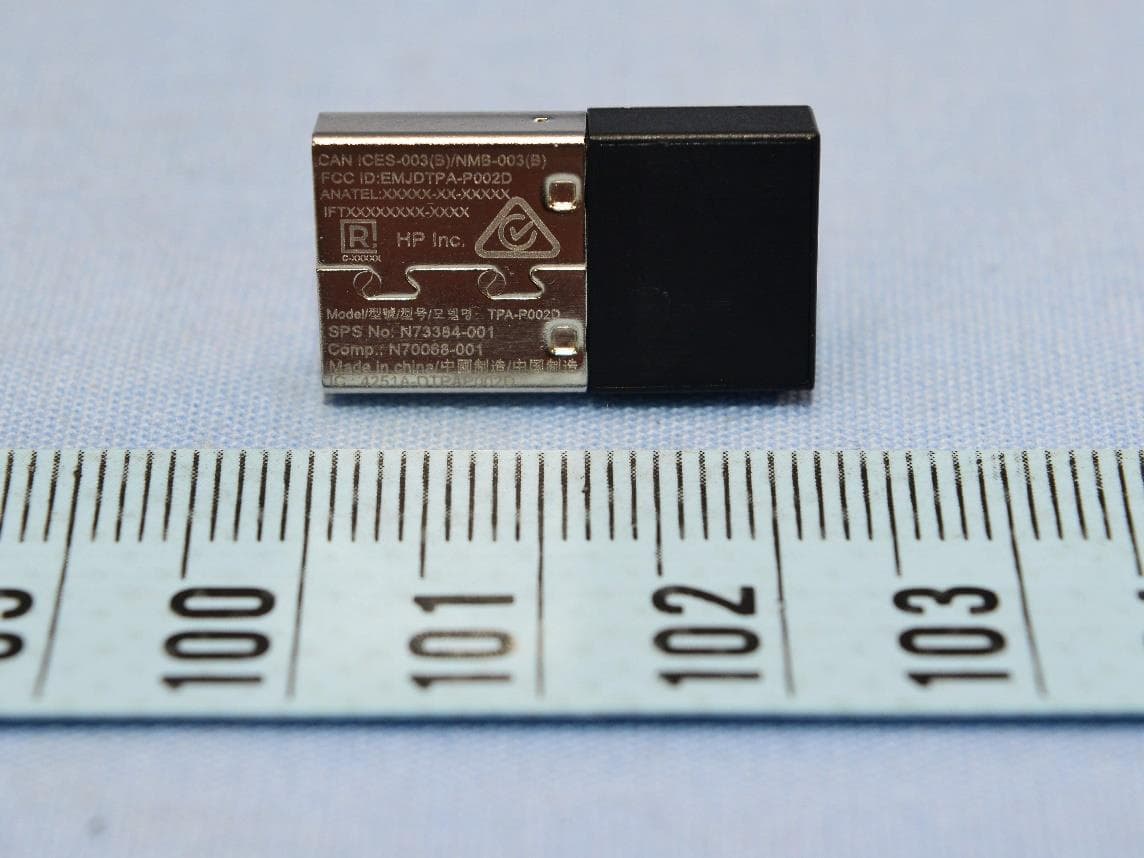
EMJDTPA-P002D
Jan 14, 2024Dongle
Equipment Class
DXX - Part 15 Low Power Communication Device Transmitter
EMJOH1
Oct 29, 2023Level Bridge
Equipment Class
DTS - Digital Transmission System