EMJK305BXRocketfish Bluetooth Keyboard
Primax Electronics Ltd
Click to zoom
Application Details
- Equipment Class
- DSS - Part 15 Spread Spectrum Transmitter
- Date of Grant
- May 01, 2007
- Application Purpose
- Original Equipment
- Date of Application
- May 01, 2007
- Equipment Note
- Rocketfish Bluetooth Keyboard
- Frequency Range
- 2402.00000000 - 2480.00000000
- Company
- Primax Electronics Ltd
- Country
- Taiwan
Documents & Files
Document Text
Text extracted from the exhibit documents filed with the FCC. Open a document above to read the original.
Users Manual
Bluetooth Keyboard and Mouse Combo Set User Manual Insert Page Up P a g e D o w n D e le te E n d Home * _ / N um Lock H om e 7 9 8 Pg U p + 4 6 5 E n te r E n d 1 In s 0 D e l . 3 P g D n 2 - - Q P { [ { [ \ W E RT Y U IO T ab B a cks pa ce + = _ - ) ( * & ^ % $ # @ ! ~ ` 1 0 2 3 4 5 6 7 8 9 Enter C a p s L o c k : ; " ' A SD FG HJ K L / Z X C V B N M < , . > ? S hift Shift Ctrl Alt Alt Ctrl P rt S c r S c re e n S croll Pause Break Lo c k Esc F 1 F 2 F 3 F 4 F 5 F 6 F 7 F 8 F 9 F 1 0 F 1 1 F 12 Bluetooth Keyboard and Mouse Combo Set FCC Compliance Statement This device complies with part 15 of the FCC Rules. Operation is subject to the following two conditions: (1) This device may not cause harmful interference, and (2) this device must accept any interference received, including interference that may cause undesired operation. This equipment has been tested and found to comply with the limits for a Class B digital device, pursuant to part 15 of the FCC Rules. These limits are designed to provide reasonable protection against harmful interference in a residential installation. This equipment generates, uses and can radiate radio frequency energy and, if not installed and used in accordance with the instructions, may cause harmful interference to radio communications. However, there is no guarantee that interference will not occur in a particular installation. If this equipment does cause harmful interference to radio or television reception, which can be determined by turning the equipment off and on, the user is encouraged to try to correct the interference by one or more of the following measures: - Reorient or relocate the receiving antenna. - Increase the separation between the equipment and receiver. - Connect the equipment into an outlet on a circuit different from that to which the receiver is connected. - Consult the dealer or an experienced radio/TV technician for help. Bluetooth Keyboard and Mouse Combo Set About this manual Thank you for your purchase of this Bluetooth keyboard and mouse combo set. This topics covered in this manual are listed as following. FIntroduction FInstalling the Batteries FInstalling and Uninstalling the WIDCOMM Bluetooth Stack FSetting up the Keyboard and Laser Mouse FUsing the Mouse Software FUsing the WIDCOMM Bluetooth Stack FTroubleshooting Bluetooth Keyboard and Mouse Combo Set Contents Introduction ................................................ 1 Package List .....................................................................1 Features ...........................................................................2 Product Views ..................................................................3 Installing the Batteries ................................... 6 Keyboard ..........................................................................6 Laser Mouse .....................................................................7 Installing and Uninstalling the WIDCOMM Bluetooth Stack ......................................................... 8 Installing the WIDCOMM Bluetooth Stack ........................8 Uninstalling the WIDCOMM Bluetooth Stack .................12 Setting up the Keyboard and Laser Mouse .......... 13 Automatic Pairing in Boot Mode .....................................13 Quick Pairing in Windows ...............................................15 Pairing on WIDCOMM Bluetooth Stack ..........................16 Using the Mouse Software .............................. 18 Installing the Bluetooth Mouse Software ........................18 Uninstalling the Bluetooth Mouse Software ....................19 Adjusting the Tilt/ Scroll Wheel Speed ...........................19 Using the WIDCOMM Bluetooth Stack ................. 21 Using the Stack for the First Time ..................................21 Connecting to the other HID Devices .............................22 Troubleshooting .......................................... 23 Bluetooth Keyboard and Mouse Combo Set 1 1 Introduction 1.1 Package List Before you start using the set, check the following contents in your package. If anything is missing, contact your retailer. KeyboardBatteries for the keyboard and mouse Laser MouseUSB Bluetooth dongle User Manual EscF1F2F3F4F5F6F7F8F9F10F11F12 Prt Scr Screen Insert Backspace Enter Enter AltCtrl Caps Lock Ta b AltCtrl Page Up Page Down + = _ - - - )( * * & ^%$#@!~ ` _ / + Delete Scroll End Home Home 798 End 1 1 0 23 4 5 6 7 8 9 QP { [ { [ \ / WE R T Y U I O A : ; " ' SDFGHJ KL ZXCVB NM < , . > ? Ins 0 Del . 4 PgUp 3 PgDn Num Lock 65 2 ShiftShift Pause Break Lock User Manu al Bluetooth Keyboard and Mouse Combo Set 2 1.2 Features Keyboard/ Laser Mouse • Keyboard - 104-key design - Ten frequently used hotkeys - One connect button • Laser mouse - Tilt/ scroll wheel - Three mouse buttons (Left, right, and middle buttons) - Four media key buttons - One pairing button • Power saving mode • Excellent performance working range up to 10 meters (line-of- sight) • Power saving mode • Dual color status LED indicator USB Bluetooth Dongle • One pairing button • Bluetooth specification v1.0 and v2.0 compliant • Supports both keyboard and mouse • Supports additional Bluetooth devices System Requirements • Bluetooth/USB keyboard & mouse supported computer • Microsoft Windows 2000, XP or later • WIDCOMM Bluetooth software version 5.0 • Bluetooth Mouse software for configuring the scrolling speed Bluetooth Keyboard and Mouse Combo Set 3 1.3 Product Views Keyboard NoIconDescriptionNoIconDescription 1Left button7Stop button 2Rewind button8Fast Forward 3 Tilt/ Scroll Wheel button 9Rewind 4Fast Forward button10Mute 5Play/ Pause button11Status LED 6Fast Forward button12 Connect Connect button EscF1F2F3F4F5F6F7F8F9F10F11F12 Prt Scr Screen Insert Backspace Enter Enter AltCtrl Caps Lock Ta b AltCtrl Page Up Page Down + = _ - - - )( * * & ^%$#@!~ ` _ / + Delete Scroll End Home Home 798 End 1 1 0 23 4 5 6 7 8 9 QP { [ { [ \ / WE R T Y U I O A : ; " ' SDFGHJ KL ZXCVB NM < , . > ? In…
Text truncated - open the document above for the full version.
Cover Letter(s)
Date: April 30, 2007 Federal Communications Commission Authorization and Evaluation Division Confidentiality Request FCC ID: EMJK305BX Pursuant to Sections 0.457 and 0.459 of the Commission’s Rules, the Applicant hereby requests confidential treatment of information accompanying this Application as outlined below: Schematics Block Diagram The above materials contain trade secrets and proprietary information not customarily released to the public. The public disclosure of these matters might be harmful to the Applicant and provide unjustified benefits to its competitors. The Applicant understands that pursuant to Rule 0.457, disclosure of this Application and all accompanying documentation will not be made before the date of the Grant for this application. Sincerely yours, ------------------------------------------------------------------- C.T. Huang Compliance Dept./ Director Phone: 886-2-2798-9008 ext.1710 Fax: 886-2-8797-1565 Email: [email protected]
Cover Letter(s)
Power of Attorney Date: April 20, 2007 To whom it may concern: We, the undersigned PRIMAX ELECTRONICS LTD. hereby authorize Advance Data Technology Corporation (ADT) of Taiwan to act on our behalf in all matters relating to all processes required in the FCC Part 15C approval and any communication needed with the national authority. Any and all acts carried out by ADT on our behalf shall have the same effects as acts of our own. If you have any questions regarding the authorization, please don’t hesitate to contact us. Thank you! Sincerely yours, ------------------------------------------------------------------- C.T. Huang Compliance Dept./ Director Phone: 886-2-2798-9008 ext.1710 Fax: 886-2-8797-1565 Email: [email protected]
External Photos
Page 1 CONSTRUCTION PHOTOS OF EUT
ID Label/Location Info
FCC ID: EMJK305BX FCC LABEL LOCATION The label will be permanently affixed at a conspicuous location on the device. Label
Internal Photos
Page 2 Page 3 Page 4 Page 5
Operational Description
FCC ID: EMJK305BX Report No.: RF960309A06 Operational Description The device is a Frequency Hopping device with 79 hopping frequencies. The antenna type is Printed Antenna and there is no antenna connector used. The EUT is a unit that contains a Bluetooth radio module. Bluetooth is a short-range wireless technology operating in the 2.4GHz band. It enables devices to have the ability to form networks and exchange information. The other instruction, please have a look at the user’s manual.
RF Exposure Info
Report No: SA960309A06 1 RF EXPOSURE REPORT REPORT NO.: SA960309A06 MODEL NO.: RF-BTKB2 ACCORDING: FCC Guidelines for Human Exposure IEEE C95.1 APPLICANT : PRIMAX ELECTRONICS LTD. ADDRESS : No. 669, Ruey Kuang Road, Neihu, Taipei, Taiwan, R.O.C. ISSUED BY : Advance Data Technology Corporation LAB ADDRESS : No. 47, 14 th Ling, Chia Pau Tsuen, Linko Hsiang 244, Taipei Hsien, Taiwan, R.O.C. Report No: SA960309A06 2 Conclusion No Evaluation Required if power is below this threshold: F(GHz) mW Low 2.402 High 2.480 24.58 Maximum measured transmitter power: Pout (dBm) Pout (mW) Conducted Power 2.95 1.972 EIRP Power 2.95 1.972 *Note: The antenna is Printed antenna with 0dBi gain Threshold for no SAR evaluation is 24.58mW Transmitter power is 1.972mW Conclusion: No SAR evaluation required since Transmitter Pout is below FCC threshold
Test Report
Report No.: RF960309A06 1 Report Format Version 2.0.5 FCC TEST REPORT REPORT NO.: RF960309A06 MODEL NO.: RF-BTKB2 RECEIVED: March 9, 2007 TESTED: March 15 ~ April 15, 2007 ISSUED: April 24, 2007 APPLICANT: PRIMAX ELECTRONICS LTD. ADDRESS: No. 669, Ruey Kuang Road, Neihu, Taipei, Taiwan, R.O.C. ISSUED BY: Advance Data Technology Corporation LAB LOCATION: No. 47, 14th Ling, Chia Pau Tsuen, Lin Kou Hsiang 244, Taipei Hsien, Taiwan, R.O.C. This test report consists of 45 pages in total. It may be duplicated completely for legal use with the approval of the applicant. It should not be reproduced except in full, without the written approval of our laboratory. The client should not use it to claim product endorsement by CNLA, A2LA or any government agencies. The test results in the report only apply to the tested sample. Report No.: RF960309A06 2 Report Format Version 2.0.5 TABLE OF CONTENTS 1. CERTIFICATION.............................................................................................4 2. SUMMARY OF TEST RESULTS.....................................................................5 2.1 MEASUREMENT UNCERTAINTY..................................................................6 3. GENERAL INFORMATION.............................................................................7 3.1 GENERAL DESCRIPTION OF EUT................................................................7 3.2 DESCRIPTION OF TEST MODES..................................................................8 3.2.1 CONFIGURATION OF SYSTEM UNDER TEST.............................................8 3.2.2 TEST MODE APPLICABILITY AND TESTED CHANNEL DETAIL..................9 3.3.3 GENERAL DESCRIPTION OF APPLIED STANDARDS...............................10 3.3.4 DESCRIPTION OF SUPPORT UNITS..........................................................10 4. TEST TYPES AND RESULTS.......................................................................11 4.1 CONDUCTED EMISSION MEASUREMENT................................................11 4.2 RADIATED EMISSION MEASUREMENT.....................................................11 4.2.1 LIMITS OF RADIATED EMISSION MEASUREMENT...................................11 4.2.2 TEST INSTRUMENTS..................................................................................12 4.2.3 TEST PROCEDURES...................................................................................13 4.2.4 DEVIATION FROM TEST STANDARD.........................................................13 4.2.5 TEST SETUP................................................................................................14 4.2.6 EUT OPERATING CONDITIONS..................................................................14 4.2.7 TEST RESULTS............................................................................................15 4.3 NUMBER OF HOPPING FREQUENCY USED.............................................19 4.3.1 LIMIT OF HOPPING FREQUENCY USED...................................................19 4.3.2 TEST INSTRUMENTS..................................................................................19 4.3.3 TEST PROCEDURES...................................................................................19 4.3.4 DEVIATION FROM TEST STANDARD.........................................................20 4.3.5 TEST SETUP................................................................................................20 4.3.6 TEST RESULTS............................................................................................20 4.4 DWELL TIME ON EACH CHANNEL.............................................................22 4.4.1 LIMIT OF DWELL TIME USED......................................................................22 4.4.2 TEST INSTRUMENTS..................................................................................22 4.4.3 TEST PROCEDURES...................................................................................22 4.4.4 DEVIATION FROM TEST STANDARD.........................................................22 4.4.5 TEST SETUP................................................................................................23 4.4.6 TEST RESULTS............................................................................................23 4.5 CHANNEL BANDWIDTH...............................................................................27 4.5.1 LIMITS OF CHANNEL BANDWIDTH............................................................27 4.5.2 TEST INSTRUMENTS..................................................................................27 4.5.3 TEST PROCEDURE.....................................................................................27 4.5.4 DEVIATION FROM TEST STANDARD.........................................................28 4.5.5 TEST SETUP................................................................................................28 4.5.6 EUT OPERATING CONDITION....................................................................28 4.5.7 TEST RESULTS............................................................................................28 4.6 HOPPING CHANNEL SEPARATION............................................................31 4.6.1 LIMIT OF HOPPING CHANNEL SEPARATION............................................31 Report No.: RF960309A06 3 Report Format Version 2.0.5 4.6.2 TEST INSTRUMENTS..................................................................................31 4.6.3 TEST PROCEDURES...................................................................................31 4.6.4 DEVIATION FROM TEST STANDARD.........................................................32 4.6.5 TEST SETUP................................................................................................32 4.6.6 TEST RESULTS............................................................................................32 4.7 MAXIMUM PEAK OUTPUT POWER............................................................35 4.7.1 LIMITS OF MAXIMUM PEAK OUTPU…
Text truncated - open the document above for the full version.
Test Setup Photos
1 PHOTOGRAPHS OF THE TEST CONFIGURATION RADIATED EMISSION TEST
Contact Information
Applicant
Nelson Chou(Manager)
Technical Contact
Advance Data Technology Corporation (Lin Kou)Ken Liu
[email protected]886-2-2605-2180
No.47, 14 Ling, Chia Pau Tsuen, Lin Kou Hsiang · Linkou, Taipei · Taiwan
Non-Technical Contact
Advance Data Technology CorporationAnnie Chang
[email protected]886-2-2605-2180
Test Firm
Bureau Veritas CPS (H.K.) Ltd. Taoyuan BranchRichard Chen
Technical Specifications
| # | Rule Parts | Frequency Range | Power Output |
|---|---|---|---|
| 1 | 15C | 2.40 GHz - 2.48 GHz | 2.00 mW |
Other Applications from Primax Electronics Ltd
EMJ-BHS2705
Aug 28, 2026Wireless Headset
Equipment Class
DTS - Digital Transmission SystemEMJMMOBTN5O
Aug 22, 2024wegear MW1 Creator Mouse
Equipment Class
DTS - Digital Transmission SystemEMJDDGRFN5
Aug 22, 2024wegear MW1 2.4G Dongle
Equipment Class
DXX - Part 15 Low Power Communication Device Transmitter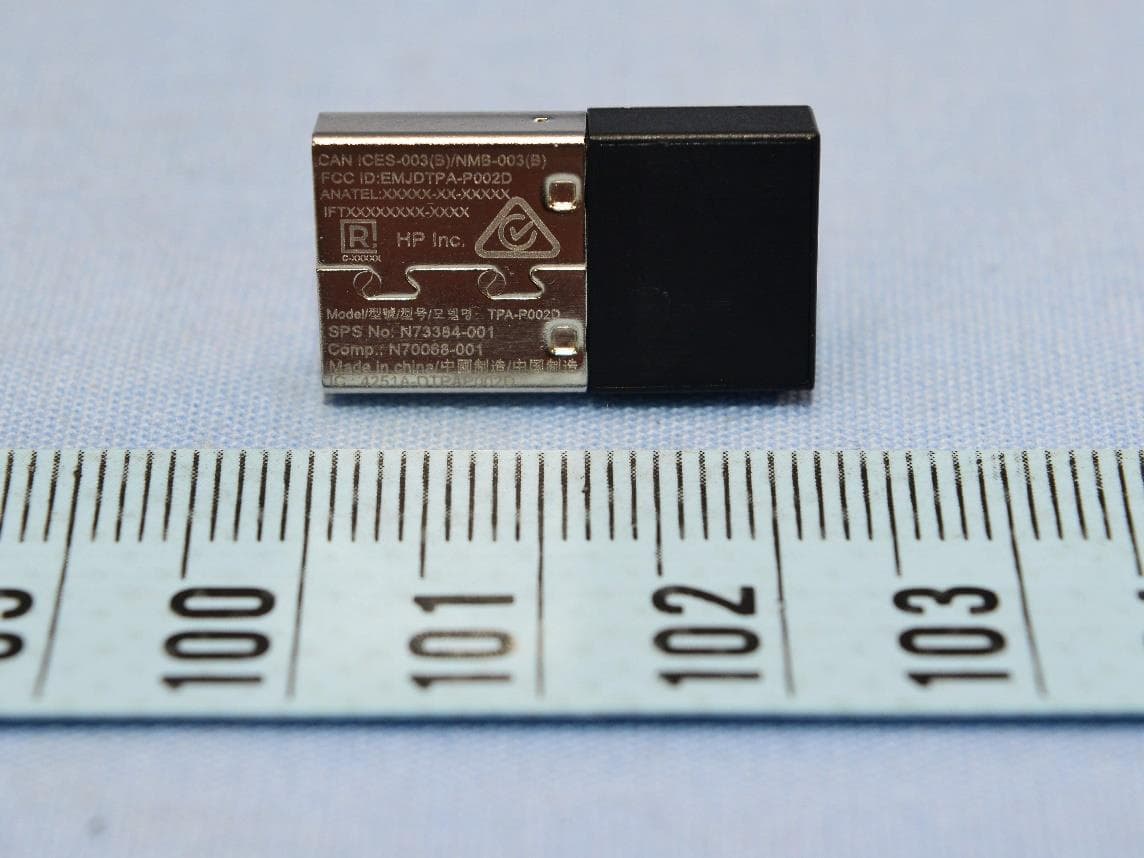
EMJDTPA-P002D
Jan 14, 2024Dongle
Equipment Class
DXX - Part 15 Low Power Communication Device Transmitter
EMJOH1
Oct 29, 2023Level Bridge
Equipment Class
DTS - Digital Transmission System