EMJMWM713Mouse
Primax Electronics Ltd
Click to zoom
Application Details
- Equipment Class
- DSS - Part 15 Spread Spectrum Transmitter
- Date of Grant
- Feb 05, 2013
- Application Purpose
- Original Equipment
- Date of Application
- Feb 05, 2013
- Equipment Note
- Mouse
- Frequency Range
- 2402.00000000 - 2480.00000000
- Company
- Primax Electronics Ltd
- Country
- Taiwan
Documents & Files
Document Text
Text extracted from the exhibit documents filed with the FCC. Open a document above to read the original.
Users Manual
Dell™ Ultra Violet Touch Mouse (online user’s manual) Features: Dell™ Ultra Violet Touch Mouse • Dell™ Ultra Violet Touch Mouse Front View • Dell™ Ultra Violet Touch Mouse Rear View Dell™ Ultra Violet Touch Mouse Front View No. Description 1 Left Mouse Click 2 Touch Scroll 3 Right Mouse Click 4 Battery Indicator - Amber (blinks): Low Battery - Amber (solid): Battery Charging - White (solid): Charging Complete Dell™ Ultra Violet Touch Mouse Rear View No. Description 1 USB port cover 2 Optical Sensor 3 Power Button and Indicator - White (solid): Power on - Blue (blinks): In Pairing mode Setup: Dell™ Ultra Violet Touch Mouse • Charging Dell™ Ultra Violet Touch Mouse • Installing Dell™ WM713 Wireless Touch Mouse Software • Pairing Dell™ Ultra Violet Touch Mouse • Configuring Dell™ Ultra Violet T ouch Mouse Settings Charging Dell™ Ultra Violet Touch Mouse Before using this touch mouse for the first time, you need to charge using the USB cable. Normal charge is approximately 4 hours. 1. Open the USB port cover. 2. Connect one end of the USB cable to the mini USB port of the mouse. 3. Connect the other end of the USB cable to the notebook or computer. The Amber LED lights up while the battery is charging. The White LED lights up when the battery is fully charged. Once the USB cable is unplugged, the White LED is turned off. Installing Dell™ WM713 Wireless Touch Mouse Software To customize the touch mouse settings, you need to install the Wireless Touch Mouse software into your notebook or computer. 1. Insert the supplied software CD into your CD-ROM drive. The software installation file should load automatically. If it does not, click Start > Run, enter the path of your CD-ROM drive (D: for example) and browse for the setup.exe file. Double-click the file to load the installation file. 2. Click Next to continue. 3. Specify the location to install the software and click Next. 4. Click Install to begin installation. 5. The software installation may take a while to complete. 6. Click Finish to complete the installation. 7. Click Yes to reboot your computer system. Pairing Dell™ Ultra Violet Touch Mouse The touch mouse needs to be paired and connected to your notebook or computer before it can be used. 1. Click Start > Dell WM713 Wireless Touch Mouse to launch the software. <Windows 7> <Windows 8> 2. Click General Settings. 3. Press and hold the Power button for three seconds. The Blue LED (on the Power button) blinks, indicating the touch mouse is in pairing mode. 4. Click Bluetooth Pairing. The detected devices appear on the screen. 5. Click Dell Bluetooth Mouse and click Next to continue. 6. Click Close to complete the pairing connection. Configuring Dell™ Ultra Violet Touch Mouse Settings You can specify functions for each button, set touch scroll speed, and configure other preferences settings via Dell™ WM713 Wireless Touch Mouse software. 1. Click Start > Dell WM713 Wireless Touch Mouse to launch the software. 2. To customize the setting, click the respective option and change the settings. For example, customizing Up Swipe action: Click Up swipe and then select one of the available options. <Select setting item> <Adjust setting> See the following table for all available functions/settings, and to which buttons they can be assigned. Settings Gesture Options Attributes Windows 7 Windows 8 Battery level % - Pointer speed 1-100 Left-handed General Settings Mouse use Right-handed Scroll On/Off Scroll inertia On/Off Scroll speed 1-100 Pan On/Off Pan inertia On/Off Scroll Settings Pan speed 1-100 App Switching Recent Apps Back Forward Left edge swipe Nothing Windows Charms Back Forward Right edge swipe Nothing Windows Charms Back Forward Swipe to left Nothing App Switching Recent Apps Back Forward 1 Finger Gestures Swipe to right Nothing Settings Gesture Options Attributes Windows 7 Windows 8 Search Max windows Show desktop Up swipe Nothing Show desktop Min windows Windows Start 2 Finger Gestures Down swipe Show desktop Troubleshooting: Dell™ Ultra Violet Touch Mouse If you have problems with your mouse: Check if the mouse battery level is low. Check if the mouse is turned on. Check if the USB receiver is plugged into a computer USB port. Remove and insert the USB receiver again. Check if the USB receiver is securely connected to the computer USB port. A loose connection may cause the mouse to malfunction. If you still have a problem, use another USB port or restart your computer. Only use the mouse on a clean, flat, non-slippery surface in order to ensure smooth and accurate cursor action. Check the computer system requirements to make sure that your system is compatible. For further assistance with any other questions you may have, please contact our customer service or your dealer for technical support. Specifications: Dell™ Ultra Violet Touch Mouse • General • Electrical • Physical Characteristic • Environmental • Bluetooth 3.0 Wireless General Manufacturer Primax Electronics Co., Ltd. Model number WM713 Connection type Bluetooth 3.0 Supported Operating Systems Microsoft® Windows® 7 SP1 or later , Windows 8 Electrical Battery life 1 months before low battery indicator LED is triggered Battery require Lithium-ion (embedded) Physical Characteristic Height 24.90 mm Width 58.4 mm Length 108.10 mm Weight 118 g Environmental Operating temperature 0 °C to 40 °C Storage temperature -40 °C to 65 °C Operating humidity 90%max Relative Humidity, non condensing Storage humidity 90%max Relative Humidity, non condensing Bluetooth 3.0 Wireless Radio transmission The baseband transmit data is GFSK Modulated in the 2.4GHz ISM band Range 10m radio range. No performance degradation up to max radio range (10m).
Users Manual
Recycling Information Dell recommends that customers dispose of their used computer hardware, monitors, printers, and other peripherals in an environmentally sound manner. Potential methods include reuse of parts or whole products and recycling of products, components, and/ or materials. For specific information on Dell’s worldwide recycling programs, see www.dell.com/recyclingworldwide. Regulatory Notices For Electromagnetic Compatibility (EMC), regulatory information and Safety Best Practices information, see the Regulatory Compliance home page on www.dell.com at the following location: www.dell.com/regulatory_compliance. Dell has determined that this product is a Class B harmonized product. This product may contain built-in laser devices. To prevent any risk of exposure to laser radiation, do not disable or open the product assembly for any reason. The product comply with safety requirements and are classified as Class 1 Laser Products, under the US DHHS Standard and IEC/ EN60825-1 Laser Safety Standard. This device contain no user adjustments or any user serviceable or replaceable parts. Air Travel Restrictions Consult and abide by air travel restrictions applicable to electronic devices and the use and transportation of battery packs. For more information see the Regulatory Compliance homepage on www.dell.com at the following location: www.dell.com/regulatory_compliance. EU Authorised Representative: Dell Products Europe BV Raheen Business Park Limerick, Ireland www.dell.com Waste Electrical and Electronic Equipment (WEEE) Directive In the European Union, this label indicates that this product should not be disposed of with household waste. It should be deposited at an appropriate facility to enable recovery and recycling. For information on how to recycle this product in your country, please visit: www.euro.dell.com/recycling. Директива за изхвърляне на електрическо и електронно оборудване (WEEE) В Европейския съюз този етикет означава, че този продукт не бива да се изхвърля заедно с домакинските отпадъци. Той трябва да бъде изхвърлен на подходящо място, за да се позволи възстановяването или рециклирането му. За информация относно отговорността за рециклиране на този продукт във вашата страна, моляпосетете: www. euro. dell. com/ recycling. Směrnice WEEE (Waste Electrical and Electronic Equipment) Tento štítek označuje v Evropské unii, že tento produkt nesmí být likvidován s domovním odpadem. Musí být předán specializované sběrně pro recyklaci a další využití. Pokyny o recyklaci tohoto produktu ve vaší zemi viz: www. euro. dell. com/ recycling. Direktiv for bortskaffelse af elektrisk og elektronisk udstyr (WEEE) I den Europæiske Union indikerer denne etiket, at dette produkt ikke bør kasseres sammen med husholdningsaffald. Det bør bortskaffes ved en egnet facilitet for at muliggøre genbrug. For information om hvordan dette produkt genbruges i dit land, bedes du gå til: www. euro. dell. com/ recycling. Richtlijn WEEE, Waste Electrical and Electronic Equipment (afdanken van elektrische en elektronische apparaten) In de Europese Unie geeft dit label aan dat dit product niet via huishoudelijk afval mag worden afgedankt. Het moet gedeponeerd worden bij een daarvoor geschikte voorziening zodat herstel en recycling mogelijk zijn. Raadpleeg voor meer informatie over verantwoorde recycling van dit product in uw land de website: www. euro. dell. com/ recycling. Elektriliste ja elektrooniliste seadmete kasutusjärgne töötlemine (direktiiv WEEE) Euroopa Liidu riikides tähistab selline silt toodet, mida ei tohi kasutusjärgselt olmejäätmete hulka visata. Taoline toode tuleb viia jäätmekäitlusettevõttesse, kus seda nõuetekohaselt töödeldakse. Toote käitlemise kohta oma kodumaal leiate teavet aadressilt www. euro. dell. com/ recycling. Direktiivi sähkö- ja elektroniikkalaiteromusta (WEEE) Euroopan unionissa tämä tarra tarkoittaa, että tuotetta ei tule hävittää kotitalousjätteen joukossa. Se tulee toimittaa asianmukaiseen paikkaan uudelleenkäyttöä tai kierrätystä varten. Tietoja tämän tuotteen kierrättämisestä eri maissa saat seuraavasta osoitteesta: www. euro. dell. com/ recycling. Directive sur la mise au rebut des appareils électriques et électroniques (Waste Electrical and Electronic Equipment - WEEE) En Union européenne, cette étiquette indique que ce produit ne doit pas être jeté avec les déchets ménagers. Il doit être mis au rebut dans un centre de dépôt spécialisé pour un recyclage approprié. Pour obtenir davantage d’informations sur le recyclage approprié de ce produit dans votre pays, veuillez vous rendre sur le site : www. euro. dell. com/ recycling. Richtlinine für Abfall von elektrischen und elektronischen Geräten (WEEE) In der Europäischen Union wird mit diesem Etikett darauf hingewiesen, dass dieses Produkt nicht mit dem Hausmüll entsorgt werden sollte. Es sollte an einer entsprechenden Einrichtung abgegeben werden, um Wiedergewinnung und Recycling zu ermöglichen. Weitere Informationen über das Recyceln dieses Produkts erhalten Sie unter: www. euro. dell. com/ recycling. Οδηγία σχετικά με τα απόβλητα ειδών ηλεκτρικού και ηλεκτρονικού εξοπλισμού (ΑΗΗΕ) Στην Ευρωπαϊκή Ένωση, αυτή η ετικέτα υποδεικνύει ότι αυτό το προϊόν δεν πρέπει να απορρίπτεται μαζί με τα οικιακά απορρίμματα. Θα πρέπει να αποκομίζεται σε κατάλληλο χώρο ώστε να είναι δυνατή η ανάκτηση και η ανακύκλωση. Για πληροφορίες σχετικά με την ανακύκλωση αυτού του προϊόντος στη χώρα σας, επισκεφθείτε τη διεύθυνση: www. euro. dell. com/ recycling. Waste Electrical and Electronic Equipment (WEEE), azaz az elektromos és elektronikus berendezések hulladékaira vonatkozó irányelv Az Európai Unióban az ilyen címkével jelölt terméket tilos háztartási hulladékként kezelni. Az ilyen hulladékot a helyreállíthatóság és az újrahasznosíthatóság érdekében a megfelelő elfogadóhelyre kell szállítani. A termék saját országán belül érvényes újrahasznosításával kapcsolatban információt a következő weboldalon talál: www. euro. dell. com/ recycling. Di…
Text truncated - open the document above for the full version.
Cover Letter(s)
No. 669, Ruey Kuang Road Neihu Taipei, Taiwan, R.O.C. Tel: 883-2-2798-9008 Fax: 886-2-8798-1565 Date: January 28, 2013 Federal Communications Commission Authorization and Evaluation Division Confidentiality Request FCC ID: EMJMWM713 Pursuant to Sections 0.457 and 0.459 of the Commission’s Rules, the Applicant hereby requests confidential treatment of information accompanying this Application as outlined below: Schematics Block Diagram The above materials contain trade secrets and proprietary information not customarily released to the public. The public disclosure of these matters might be harmful to the Applicant and provide unjustified benefits to its competitors. The Applicant understands that pursuant to Rule 0.457, disclosure of this Application and all accompanying documentation will not be made before the date of the Grant for this application. Sincerely yours, ------------------------------------------------------------------- C.T. Huang Compliance Dept. / Director Phone: 886-2-2798-9008 ext.1710 Fax: 886-2-8797-1565 Email: [email protected]
Cover Letter(s)
No. 669, Ruey Kuang Road Neihu Taipei, Taiwan, R.O.C. Tel: 883-2-2798-9008 Fax: 886-2-8798-1565 January 28, 2013 Date: January 28, 2013 Federal Communications Commission Authorization and Evaluation Division Subject: Short‐term confidentiality request regarding application for certification of FCC ID: EMJMWM713 Pursuant to DA 04‐1705 of the Commission’s public notice, we request short‐term confidential treatment for the following information until May 31, 2013 in order to ensure sensitive business information remains confidential until the actual marketing of the device. External Photos Te st setup photos User’s Manual Internal Photos Sincerely yours, ------------------------------------------------------------------- C.T. Huang Compliance Dept. / Director Phone: 886-2-2798-9008 ext.1710 Fax: 886-2-8797-1565 Email: [email protected]
Cover Letter(s)
No. 669, Ruey Kuang Road Neihu Taipei, Taiwan, R.O.C. Tel: 883-2-2798-9008 Fax: 886-2-8798-1565 Power of Attorney Date: January 28, 2013 T o whom it may concern: We, the undersigned PRIMAX ELECTRONICS LTD. hereby authorize Bureau Veritas Consumer Products Services (H.K.) Ltd., Taoyuan Branch (BV CPS Taoyuan Branch) of Taiwan to act on our behalf in all matters relating to all processes required in the FCC Part 15C approval and any communication needed with the national authority. Any and all acts carried out by BV CPS Taoyuan Branch on our behalf shall have the same effects as acts of our own. If you have any questions regarding the authorization, please don’t hesitate to contact us. Thank you! Sincerely yours, -------------------------------------- C.T. Huang Compliance Dept. / Director Phone: 886-2-2798-9008 ext.1710 Fax: 886-2-8797-1565 Email: [email protected]
External Photos
Page 1 CONSTRUCTION PHOTOS OF EUT Page 2
ID Label/Location Info
SN Size:28*3.5mm COFETEL: RCPLEMOXX-0 00 0 IC:4251A-MWM713 ETA: xxxxx/2012/WRLO N889 R XXX- XXXXXX BC 159910 Mouse鼠标 Rating额定:5 Model 型号:WM713 Made in China中国制造 FCCID:EMJMWM713 CMIIT ID:2012DJ0000 V 300mA
Internal Photos
Page 3 Page 4 Page 5 Page 6
Operational Description
FCC ID: EMJMWM713 Report No.: RF130121D01 Operational Description This device is a Mouse. The transmitter of the EUT is powered by 3.7Vdc from battery or 5Vdc from host equipment. The antenna is Printed antenna without The other instruction, please have a look at the users manual.
RF Exposure Info
Report No: SA130121D01 1 of 6 Report Format Version 5.0.0 RF EXPOSURE REPORT REPORT NO.: SA130121D01 MODEL NO.: WM713 FCC ID: EMJMWM713 RECEIVED: Jan. 21, 2013 TESTED: Jan. 22 ~ 24, 2013 ISSUED: Jan. 28, 2013 APPLICANT: PRIMAX ELECTRONICS LTD. ADDRESS: No. 669, Ruey Kuang Road, Neihu, Taipei, Taiwan, R.O.C. ISSUED BY: Bureau Veritas Consumer Products Services (H.K.) Ltd., Taoyuan Branch LAB LOCATION: No. 47, 14th Ling, Chia Pau Vil., Lin Kou Dist., New Taipei City, Taiwan ( R.O.C. ) This report is for your exclusive use. Any copying or replication of this report to or for any other person or entity, or use of our name or trademark, is permitted only with our prior written permission. This report sets forth our findings solely with respect to the test samples identified herein. The results set forth in this report are not indicative or representative of the quality or characteristics of the lot from which a test sample was taken or any similar or identical product unless specifically and expressly noted. Our report includes all of the tests requested by you and the results thereof based upon the information that you provided to us. You have 60 days from date of issuance of this report to notify us of any material error or omission caused by our negligence, provided, however, that such notice shall be in writing and shall specifically address the issue you wish to raise. A failure to raise such issue within the prescribed time shall constitute your unqualified acceptance of the completeness of this report, the tests conducted and the correctness of the report contents. Unless specific mention, the uncertainty of measurement has been explicitly taken into account to declare the compliance or non-compliance to the specification. This report should not be used by the client to claim product certification, approval, or endorsement by any government agencies. Report No: SA130121D01 2 of 6 Report Format Version 5.0.0 TABLE OF CONTENTS RELEASE CONTROL RECORD .................................................................................... 3 1. CERTIFICATION .............................................................................................. 4 2. EVALUATION RESULT ................................................................................... 5 3. SAR TEST EXCLUSION THRESHOLDS ......................................................... 6 4. CONCLUSION ................................................................................................. 6 Report No: SA130121D01 3 of 6 Report Format Version 5.0.0 RELEASE CONTROL RECORD ISSUE NO. REASON FOR CHANGE DATE ISSUED SA130121D01 Original release Jan. 28, 2013 Report No: SA130121D01 4 of 6 Report Format Version 5.0.0 1. CERTIFICATION PRODUCT: Mouse MODEL NO.: WM713 BRAND: DELL APPLICANT: PRIMAX ELECTRONICS LTD. TESTED: Jan. 22 ~ 24, 2013 TEST SAMPLE: ENGINEERING SAMPLE STANDARDS: FCC Part 2 (Section 2.1093) FCC OET Bulletin 65, Supplement C (01-01) IEEE C95.1 The above equipment has been tested by Bureau Veritas Consumer Products Services (H.K.) Ltd., Taoyuan Branch, and found compliance with the requirement of the above standards. The test record, data evaluation & Equipment Under Test (EUT) configurations represented herein are true and accurate accounts of the measurements of the sample’s EMC characteristics under the conditions specified in this report. PREPARED BY : , DATE: Jan. 28, 2013 ( Jessica Cheng / Specialist ) APPROVED BY : , DATE: Jan. 28, 2013 ( Ken Liu / Manager ) Report No: SA130121D01 5 of 6 Report Format Version 5.0.0 2. EVALUATION RESULT Following FCC KDB 447498 D01 “General SAR test exclusion guidance” The corresponding SAR Exclusion Threshold condition, listed below: 1) The 1-g and 10-g SAR test exclusion thresholds for 100 MHz to 6 GHz at test separation distances ≤ 50 mm are determined by: [(max. power of channel, including tune-up tolerance, mW)/(min. test separation distance, mm)] ·[√f(GHz)] ≤ 3.0 for 1-g SAR and ≤ 7.5 for 10-g extremity SAR,16 where ÿ f(GHz) is the RF channel transmit frequency in GHz . ÿPower and distance are rounded to the nearest mW and mm before calculation. ÿThe result is rounded to one decimal place for comparison The test exclusions are applicable only when the minimum test separation distance is ≤ 50 mm and for transmission frequencies between 100 MHz and 6 GHz. When the minimum test separation distance is < 5 mm, a distance of 5 mm is applied to determine SAR test exclusion. 2) At 100 MHz to 6 GHz and for test separation distances > 50 mm, the SAR test exclusion threshold is determined according to the following: a) [Threshold at 50 mm in step 1) + (test separation distance - 50mm)·( f(MHz)/150)] mW, at 100MHz to 1500 MHz b) [Threshold at 50 mm in step 1) + (test separation distance - 50 mm)·10] mW at > 1500 MHz and ≤ 6 GHz 3) At frequencies below 100 MHz, the following may be considered for SAR test exclusion. a) The threshold at the corresponding test separation distance at 100 MHz in step 2) is multiplied by [1 + log(100/f(MHz))] for test separation distances > 50 mm and < 200 mm. b) The threshold determined by the equation in a) for 50 mm and 100 MHz is multiplied by ½ for test separation distances ≤ 50 mm. c) SAR measurement procedures are not established below 100 MHz. When SAR test exclusion cannot be applied, a KDB inquiry is required to determine SAR evaluation requirements for any test results to be acceptable. Report No: SA130121D01 6 of 6 Report Format Version 5.0.0 3. SAR TEST EXCLUSION THRESHOLDS Maximum measured transmitter power: Frequency (GHz) Max. Power (mW) Min. test separation distance (mm) SAR test exclusion calculation value (NOTE 2) 10-g extremity SAR test exclusion thresholds Result 2.402 ~ 2.480 0.4 5 0.124 7.5 Pass NOTE: 1. The antenna type is Printed antenna with -0.63dBi gain. 2. Calculate SAR test exclusion thresholds from condition “1” formulas. 4. CONCLUSION Since Source-base time average power is below SAR test exclusion power thresholds, the SAR e…
Text truncated - open the document above for the full version.
Test Report
Report No.: RF130121D01 1 of 41 Report Format Version 5.0.0 FCC TEST REPORT REPORT NO.: RF130121D01 MODEL NO.: WM713 FCC ID: EMJMWM713 RECEIVED: Jan. 21, 2013 TESTED: Jan. 22 ~ 24, 2013 ISSUED: Jan. 28, 2013 APPLICANT: PRIMAX ELECTRONICS LTD. ADDRESS: No. 669, Ruey Kuang Road, Neihu, Taipei, Taiwan, R.O.C. ISSUED BY: Bureau Veritas Consumer Products Services (H.K.) Ltd., Taoyuan Branch LAB LOCATION: No. 47, 14th Ling, Chia Pau Vil., Lin Kou Dist., New Taipei City, Taiwan ( R.O.C. ) This report is for your exclusive use. Any copying or replication of this report to or for any other person or entity, or use of our name or trademark, is permitted only with our prior written permission. This report sets forth our findings solely with respect to the test samples identified herein. The results set forth in this report are not indicative or representative of the quality or characteristics of the lot from which a test sample was taken or any similar or identical product unless specifically and expressly noted. Our report includes all of the tests requested by you and the results thereof based upon the information that you provided to us. You have 60 days from date of issuance of this report to notify us of any material error or omission caused by our negligence, provided, however, that such notice shall be in writing and shall specifically address the issue you wish to raise. A failure to raise such issue within the prescribed time shall constitute your unqualified acceptance of the completeness of this report, the tests conducted and the correctness of the report contents. Unless specific mention, the uncertainty of measurement has been explicitly taken into account to declare the compliance or non-compliance to the specification. This report should not be used by the client to claim product certification, approval, or endorsement by TAF or any government agencies. Report No.: RF130121D01 2 of 41 Report Format Version 5.0.0 Table of Contents RELEASE CONTROL RECORD ............................................................................................ 4 1. CERTIFICATION ......................................................................................................... 5 2. SUMMARY OF TEST RESULTS ................................................................................. 6 2.1 MEASUREMENT UNCERTAINTY .............................................................................. 6 3. GENERAL INFORMATION ......................................................................................... 7 3.1 GENERAL DESCRIPTION OF EUT ............................................................................ 7 3.2 DESCRIPTION OF TEST MODES.............................................................................. 8 3.2.1 TEST MODE APPLICABILITY AND TESTED CHANNEL DETAIL ............................... 9 3.3 DESCRIPTION OF SUPPORT UNITS ...................................................................... 11 3.3.1 CONFIGURATION OF SYSTEM UNDER TEST ....................................................... 11 3.4 GENERAL DESCRIPTION OF APPLIED STANDARDS ........................................... 12 4. TEST TYPES AND RESULTS ................................................................................... 13 4.1 CONDUCTED EMISSION MEASUREMENT ............................................................ 13 4.1.1 LIMITS OF CONDUCTED EMISSION MEASUREMENT .......................................... 13 4.1.2 TEST INSTRUMENTS .............................................................................................. 13 4.1.3 TEST PROCEDURES............................................................................................... 14 4.1.4 DEVIATION FROM TEST STANDARD ..................................................................... 14 4.1.5 TEST SETUP ............................................................................................................ 15 4.1.6 EUT OPERATING CONDITIONS .............................................................................. 15 4.1.7 TEST RESULTS ....................................................................................................... 16 4.2 RADIATED EMISSION AND BANDEDGE MEASUREMENT .................................... 18 4.2.1 LIMITS OF RADIATED EMISSION AND BANDEDGE MEASUREMENT .................. 18 4.2.2 TEST INSTRUMENTS .............................................................................................. 19 4.2.3 TEST PROCEDURES............................................................................................... 20 4.2.4 DEVIATION FROM TEST STANDARD ..................................................................... 20 4.2.5 TEST SETUP ............................................................................................................ 21 4.2.6 EUT OPERATING CONDITIONS .............................................................................. 21 4.2.7 TEST RESULTS ....................................................................................................... 22 4.3 NUMBER OF HOPPING FREQUENCY USED ......................................................... 26 4.3.1 LIMIT OF HOPPING FREQUENCY USED ............................................................... 26 4.3.2 TEST SETUP ............................................................................................................ 26 4.3.3 TEST INSTRUMENTS .............................................................................................. 26 4.3.4 TEST PROCEDURES............................................................................................... 26 4.3.5 DEVIATION FROM TEST STANDARD ..................................................................... 26 4.3.6 TEST RESULTS ....................................................................................................... 26 4.4 DWELL TIME ON EACH CHANNEL ......................................................................... 28 4.4.1 LIMIT OF DWELL T…
Text truncated - open the document above for the full version.
Test Setup Photos
1 of 2 PHOTOGRAPHS OF THE TEST CONFIGURATION CONDUCTED EMISSION TEST 2 of 2 RADIATED EMISSION TEST
Contact Information
Applicant
Nelson Chou(Manager)
Test Firm
Bureau Veritas CPS (H.K.) Ltd., Taoyuan BranchRichard Chen
Technical Specifications
| # | Rule Parts | Frequency Range | Power Output |
|---|---|---|---|
| 1 | 15C | 2.40 GHz - 2.48 GHz | 400.00 µW |
Other Applications from Primax Electronics Ltd
EMJ-BHS2705
Aug 28, 2026Wireless Headset
Equipment Class
DTS - Digital Transmission SystemEMJMMOBTN5O
Aug 22, 2024wegear MW1 Creator Mouse
Equipment Class
DTS - Digital Transmission SystemEMJDDGRFN5
Aug 22, 2024wegear MW1 2.4G Dongle
Equipment Class
DXX - Part 15 Low Power Communication Device Transmitter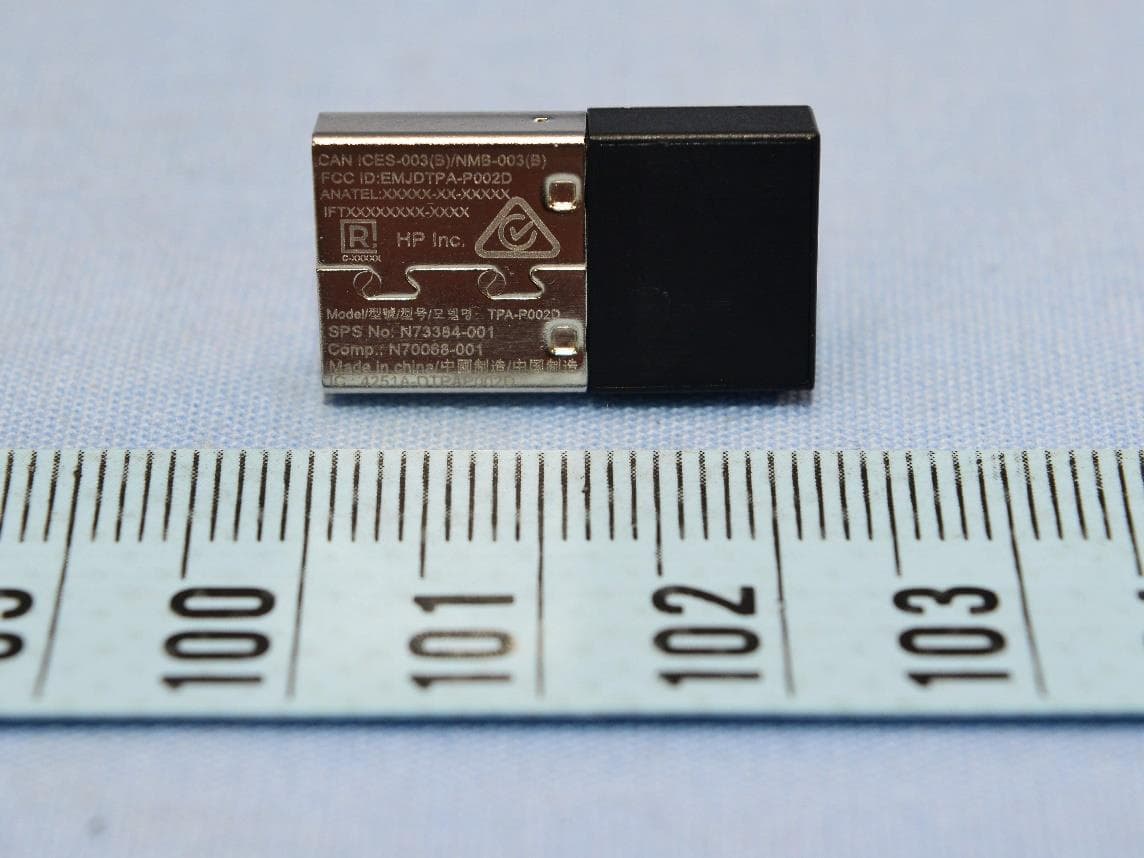
EMJDTPA-P002D
Jan 14, 2024Dongle
Equipment Class
DXX - Part 15 Low Power Communication Device Transmitter
EMJOH1
Oct 29, 2023Level Bridge
Equipment Class
DTS - Digital Transmission System