GMLNSB-5NX
Microsoft Corporation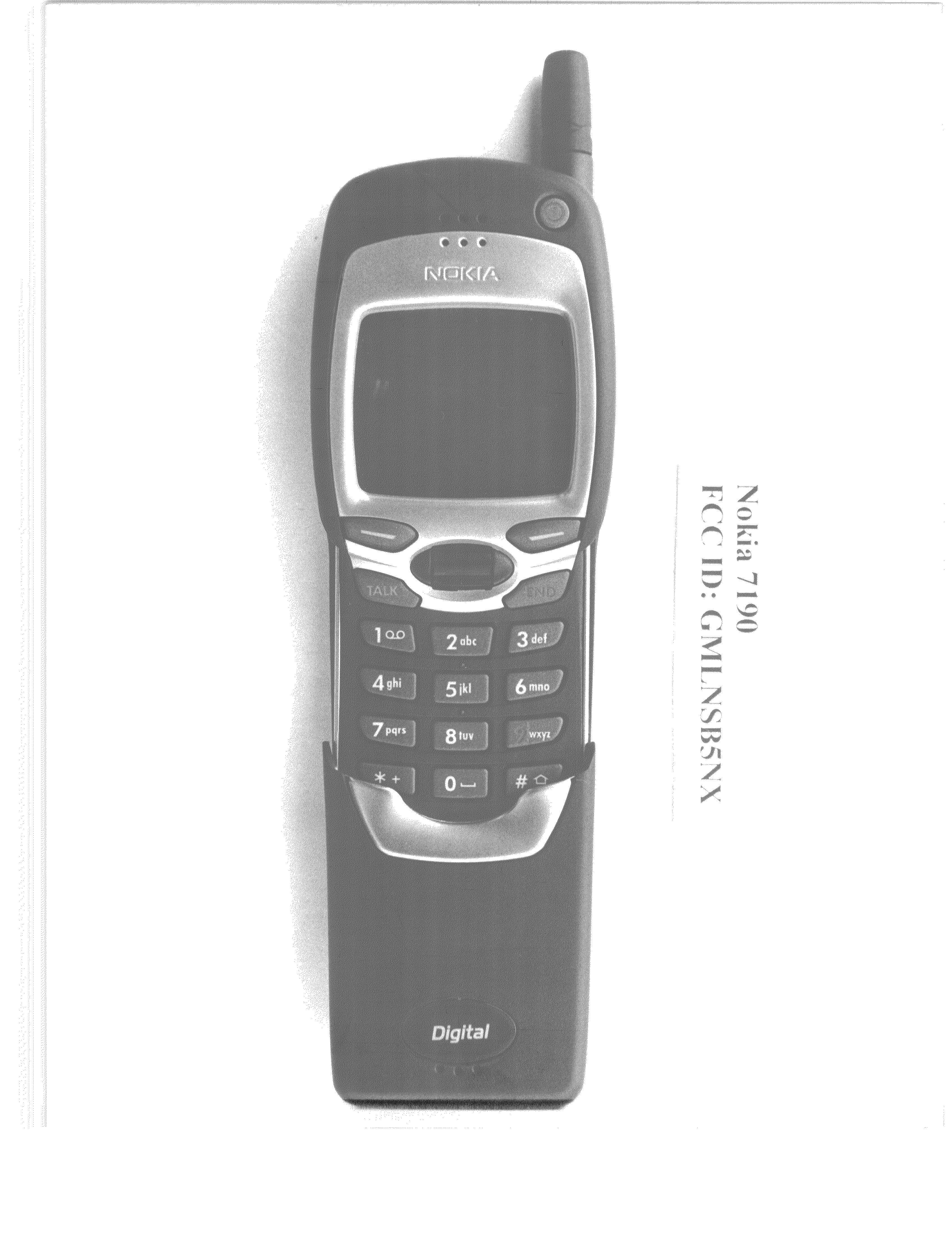
Click to zoom
Application Details
- Equipment Class
- PCE - PCS Licensed Transmitter held to ear
- Date of Grant
- Jul 25, 1999
- Application Purpose
- Original Equipment
- Date of Application
- Apr 22, 1999
- Frequency Range
- 1850.20000000 - 1909.80000000
- Company
- Microsoft Corporation
- Country
- United States
Documents & Files
Document Text
Text extracted from the exhibit documents filed with the FCC. Open a document above to read the original.
Users Manual
7190 UG version 0.043/15/99 Nokia 7190 (HD955) Owner’s Manual version 0.04 7190 UG version 0.043/15/99 The wireless phone described in this guide is approved for use in GSM 1900 and AMPS 800 networks. Copyright information Part No. 935nnnn, Issue No. 1 © 1999 Nokia Mobile Phones. All rights reserved. Printed in Canada nn/99 Nokia, Nokia Connecting People and the Original Accessories logos are trademarks of Nokia Corporation and/or its affiliates. US Patent No 5818437 and other pending patents. T9 text input software Copyright (C) 1999. Tegic Communications, Inc. All rights reserved. The information contained in this Owner’s Manual was written for Nokia phone NSB-5. The right to make changes and improvements to any of the products described in this guide without prior notice is reserved. These commodities are authorized by the U.S. Government for export only to Canada, Mexico, or the United States. They may not be resold, diverted, transferred, or otherwise disposed of in any other country, either in their original form or after being incorporated through an intermediate process into other end-items, without the written approval of the U.S. Department of State. FCC/Industry Canada Notice Your phone may cause TV or radio interference (for example, when using a telephone in close proximity to receiving equipment). The FCC or Industry Canada can require you to stop using your telephone if such interference cannot be eliminated. If you require assistance, contact your local service facility. This device complies with part 15 of the FCC rules. Operation is subject to the condition that this device does not cause harmful interference. 7190 UG version 0.0413/15/99 Contents For Your Safety . . . . . . . . . . . . . . . . . . . . . . . . . . . . . . .1 1.Welcome . . . . . . . . . . . . . . . . . . . . . . . . . . . . . . . . . . . .3 How to use this manual . . . . . . . . . . . . . . . . . . . . . . . .3 Network services. . . . . . . . . . . . . . . . . . . . . . . . . . .3 Updates . . . . . . . . . . . . . . . . . . . . . . . . . . . . . . . . . .4 How to contact Nokia. . . . . . . . . . . . . . . . . . . . . . . . . .4 2.Preparing your phone for use. . . . . . . . . . . . . . . . . . . .5 Diagrams . . . . . . . . . . . . . . . . . . . . . . . . . . . . . . . . . . . .5 Front . . . . . . . . . . . . . . . . . . . . . . . . . . . . . . . . . . . .5 Back. . . . . . . . . . . . . . . . . . . . . . . . . . . . . . . . . . . . .5 Top. . . . . . . . . . . . . . . . . . . . . . . . . . . . . . . . . . . . . .5 Bottom. . . . . . . . . . . . . . . . . . . . . . . . . . . . . . . . . . .6 About the labels on your phone. . . . . . . . . . . . . . . . . .6 Getting started . . . . . . . . . . . . . . . . . . . . . . . . . . . . . . .6 Install the SIM card. . . . . . . . . . . . . . . . . . . . . . . . . . . .6 Notes about SIM cards. . . . . . . . . . . . . . . . . . . . . .7 Charge the battery . . . . . . . . . . . . . . . . . . . . . . . . . . . .7 Switch the phone on (or off) . . . . . . . . . . . . . . . . . . . .8 3.About Your Phone. . . . . . . . . . . . . . . . . . . . . . . . . . . . .9 Using the keys. . . . . . . . . . . . . . . . . . . . . . . . . . . . . . . .9 Using the selection keys. . . . . . . . . . . . . . . . . . . .10 7190 UG version 0.0423/15/99 Using the roller. . . . . . . . . . . . . . . . . . . . . . . . . . . 10 Using the sliding cover. . . . . . . . . . . . . . . . . . . . . . . . 11 Re-attaching the slide. . . . . . . . . . . . . . . . . . . . . 11 About display indicators & icons. . . . . . . . . . . . . . . .12 About the phone book. . . . . . . . . . . . . . . . . . . . . . . .12 About the menu . . . . . . . . . . . . . . . . . . . . . . . . . . . . .13 List of main menu functions . . . . . . . . . . . . . . . . . . .15 List of phone book menu functions . . . . . . . . . . . . .19 4.Calls. . . . . . . . . . . . . . . . . . . . . . . . . . . . . . . . . . . . . . . 21 Making & answering calls. . . . . . . . . . . . . . . . . . . . . 21 Making a call . . . . . . . . . . . . . . . . . . . . . . . . . . . . 21 Making a call using voice dial. . . . . . . . . . . . . . . 21 Answering a call. . . . . . . . . . . . . . . . . . . . . . . . . . 21 Adjusting the earpiece volume. . . . . . . . . . . . . .22 Last number redial. . . . . . . . . . . . . . . . . . . . . . . .22 Calling your voice mailbox . . . . . . . . . . . . . . . . .22 In-call functions. . . . . . . . . . . . . . . . . . . . . . . . . . . . .23 Call waiting . . . . . . . . . . . . . . . . . . . . . . . . . . . . .23 Call hold . . . . . . . . . . . . . . . . . . . . . . . . . . . . . . . .23 Making a conference call . . . . . . . . . . . . . . . . . .24 Transferring a call . . . . . . . . . . . . . . . . . . . . . . . .24 Call log . . . . . . . . . . . . . . . . . . . . . . . . . . . . . . . . . . . .25 Missed calls . . . . . . . . . . . . . . . . . . . . . . . . . . . . .25 Dialed calls. . . . . . . . . . . . . . . . . . . . . . . . . . . . . .25 Received calls. . . . . . . . . . . . . . . . . . . . . . . . . . . .25 7190 UG version 0.0433/15/99 Clear call lists . . . . . . . . . . . . . . . . . . . . . . . . . . . .25 Show call duration. . . . . . . . . . . . . . . . . . . . . . . .26 Show call costs. . . . . . . . . . . . . . . . . . . . . . . . . . .26 Call cost settings . . . . . . . . . . . . . . . . . . . . . . . . .26 Call forwarding . . . . . . . . . . . . . . . . . . . . . . . . . . . . . .27 5.Customizing your phone. . . . . . . . . . . . . . . . . . . . . . .28 Profiles. . . . . . . . . . . . . . . . . . . . . . . . . . . . . . . . . . . . .28 How to select a profile. . . . . . . . . . . . . . . . . . . . .28 How to customize a profile . . . . . . . . . . . . . . . . .28 Settings you can customize. . . . . . . . . . . . . . . . .29 Renaming profiles. . . . . . . . . . . . . . . . . . . . . . . . .30 Setting the display language . . . . . . . . . . . . . . . . . . .31 Displaying the clock . . . . . . . . . . . . . . …
Text truncated - open the document above for the full version.
Cover Letter(s)
June 22, 1999 Federal Communications Commission Authorization and Evaluation Division 7435 Oakland Mills Rd Columbia, MD 21046 Attention:Mr. Greg Czumak Applicant:Nokia Mobile Phones Equipment: 7190, Type NSB-5NX FCC ID:GMLNSB-5NX EA Number: EA93994 Correspondence Reference Number:7933 Date of Original E-Mail:05/25/1999 Greg, This is in response to your e-mail of May 25, 1999. 1.) The Applicant will be happy to accept a value of 790mW on the grant. 2.) The analog device in question is a "piggyback" module with it's own antenna and Grant. Please refer to FCC ID: LJPNRM-1X. 3.) Disregard the blank page in this section. Any further questions please let me know. Via Internet, I can be reached at [email protected] Sincerely, William H. Graff Director of Engineering M. Flom Associates, Inc.
Operational Description
HD955 Pica GSM “A Full Featured Phone for the Advanced Business user in a a Small and Sleek Package offering a Big Display for easy use” Sales argumentation: * High Quality, Large Display • High quality pixel display for easier reading (larger fonts, more text lines) • Large display for easier reading of full length SMS messages • Ease of use with context sensitive soft key interface * Advanced Wireless Solutions • Infrared for cordless communication between phone and PC and printers (no cable hassle) • Phone-to-phone infrared transfer of names, phone numbers and messages • WAP compliant product supports VAS * Advanced Digital Features • Future proof UI supporting GSM Phase 2+ features available • Alternative line service with 2 lines: Multiple lines offer a personal line and a business line with separate ringing tones and call forwarding options • High speed data support (14,4 kbps) * Superior Audio • Enhanced Full Rate voice codec • Omni directional / noise cancelling microphone • Leak tolerant speaker * Superior Performance • Extended performance provided by true 3V engine • With standard battery up to 5h talk time and 20 days standby time, with performance battery up to 9h talk time and 33 days standby time * Lifestyle Personalization • Profile settings allows adjustment of phone to your environment and lifestyle • Personal ringing tones recognize caller by tone • Games: play yourself or others using IR link • Animated CLI icons ** * Ergonomic Design • Roller key for faster scrolling and easy selection • Small without sacrifizing functionality, features and performance • Modern sleek styling and comfortable tapered form supporting the large display * Broad range of accessories • Full range of Nokia accessories as well as new advanced data accessories PC Suite DIMENSIONS • Volume: 128 cc • Weight: 5.36 oz. • Length: 4.9 inch • Width (max): 2 inch • Thickness (max) 0.95 inch KEY FEATURES Display and Keypad • Large, high resolution, illuminated graphical display • Animations • Multiple language • Dynamic Text Font • Profile selection under Power key Hardware characteristics • Fixed antenna • Top RF connector • Small SIM • Real time clock • Infrared capablity (IrDa) - Exchange names, calander, rining tones HD955 Pica GSM Nokia Mobile Phones - confidential - Printer directly to printer • Internal Data support (14,400 bps) • Dual codecs (FR, EFR) • Automatic Slide open button • Ringing volume –102 dB UI / Software features • Predictive text input • Voice Activiated Dialing (Stores 18 Voice tags) • Value Added Services (VAS): - Nokia Smart Messaging - WAP compliance w/encryprion • Roller key for fast and easy scrolling and selection • Profile Selection (enables fast selection of phone settings for different environments) • Advanced phase 2+ features: - Calling name presentation - Call transfer - SIM application toolkit class 2 (except call control) - Completion of calls to busy subscriber • Ascending ringing tones • Personal alert tones • Graphical CLI icons & caller ID • OTA phone programming • OTA CLI Logos • OTA Operator Logos • OTA Rining Tones • IR applications - PC - phone data link - Phone to phone communication (CLI icons, phonebook, ringing tone, games) - Printing (SMS, phonebook) • 3 Games • Alarm clock and calendar • MO / MT SMS • Digital voice encryption • Call Forwarding, call waiting • Store up to 1000 names & addresses - 2 address (home & email) - 5 phone numbers (home, work, mobile etc) • Store up to 600 Calander entries - Day & week viewing • Calling Card support ACCESSORIES • Li-Ion 900 mAh • NiMH 900 mAh (vibrator version also available) • Li-Ion 1500 mAh • Standard Travel Charger • Rapid Travel Charger • Cigarette Lighter Charger • Desktop Stand with 2 slots • Personal Handsfree • Basic Car Holder • Active Car Holder - handsfree module - combined microphone & speaker unit • AMPS module support • PC Suites Software • Headset • Belt Clip CD ROM SOFTWARE • PC Suite Software for 7190 • Owners Manual • Accessory Guide • Multimedia WAP presentation • Marketing Connection Catalog • 3 rd Party software • GSM1900 information • Technical information • 7190 Q & A POWER MANAGEMENT Capacity (mAh) Talk time EFR Standby Li-Ion 9009003h 20 min- 5h14-20 days Li-Ion 150015005h 30min- 9h23-33 days
RF Exposure Info
NOKIA MOBILE PHONES 1 March 25th, 1999 P.O. Box 86 Joensuunkatu 7E FIN-24101 SALO Finland FEDERAL COMMUNICATIONS COMMISSION Equipment Authorization Branch 7435 Oaklands Mills Road Columbia, MD 21046 SAR TEST REPORT of Nokia 7190 Gentlemen, Please find attached SAR test report of FCC ID: GMLNSB-5NX For and on behalf of Nokia Mobile Phones Ltd. Respectfully, Sami Savela RF Design Engineer Responsible for NMP SAR measurements NOKIA MOBILE PHONES 2 ContentsPage 1.Description of the measurement3 2.Description of calibration by manufacturer4 3.List of standards4 4.Device list5 5.Equipment under test6 5.1Verification and results6 5.2Specification of Liquid6 5.3Specification of position with phone against 7 generic twin phantom 5.4The phone position against generic twin 8 phantom 5.5Results of SAR for 1g 9 Appendix 111 Appendix 212 Appendix 313 Appendix 414 Appendix 515 Appendix 616 Appendix 717 Appendix 818 Appendix 919 Appendix 1020 NOKIA MOBILE PHONES 3 1.Description of the measurement This measurement was done by E-field scanning system for dosimetric assessments. It is robot-based system which allows automated E-field scanning in tissue simulating solutions. The measurements are based on the induced specific absorption rate (SAR) definition of relevant ANSI / IEEE standards. The dosimetric assessment system of Nokia Mobile Phones is manufactured by Prof. Niels Kuster at ETH (Schmid & Partner Engineering AG) in Switzerland, Europe. The method used to determine the 1 gram average value of SAR is: Initially a coarse scan is performed over the whole area on a 15 x 15 mm grid. From this coarse scan, the location at which the maximum value is measured is used as the centre for a second, more detailed scan. This second scan is based on a 3 dimensional grid of 5 x 5 x 7 points on a grid of 8 mm. The average SAR values are computed using the 3D spline inter- polation algorithm. The 3D spline is composed on three one-dimensional splines with the “Not a knot” condition in the x, y and z directions (1), (2). The volume is integrated with the trapezoidal algorithm. 1000 points (10x10x10) are interpolated to calculate the average. All neighbouring volumes are evaluated until no neighbouring volume with a higher average is found. (1) W. Gander, Computermathematik, Birkhauser, Basel, 1992 (2) W. H. Press, S. A Teukolsky, W. T. Vettering and B. P. Flannery, Numerical Recipes in C, The Art of Scientific Computing, second edition, Cambridge University Press, 1992 NOKIA MOBILE PHONES 4 2.Description of calibration by manufacturer The calibration of data acquisition electronics and probe was done by the manufacturer. (Appendix 3 and 7) - the data acquisition unit is calibrated and tested using a FLUKE 702 Process Calibrator - measurement uncertainty is less than ± 20% for various tissues simulating solutions and frequencies: - these calibration parameters were measured using a temperature probe developed by manufacturer - description of the probe calibration and examples of the evaluation are enclosed in Appendix 7 3.List of standards ANSI/IEEE Std C95.1-1992 IEEE Standard for Safety Levels with Respect to Human Exposure to Radio Frequency Electromagnetic Fields, 3 kHz to 300 GHz ANSI/IEEE Std C95.3-1992 IEEE Recommended Practice for the Measurement of Potentially Hazardous Electromagnetic Fields-RF and Microwave NOKIA MOBILE PHONES 5 4.Device list: Automated E-field scanning system for dosimetric assessments System. Calibration due August 1999. Technical data (Appendix 1) Probe ET3DV4, SN: 1105, Recalibrated due August 1999 Technical data (Appendix 2) DASY-dosimetric assessment system, DAE V2, SN: 213, Calibration due August 1999 (Appendix 3) Industrial robot and Control unit, type STÄUBLI CS7 RX 90(CR) NO:595148-01, Technical data (Appendix 4) Generic Twin Phantom Version 3 (Appendix 6). PC COMPAQ 466 laser printer QMS magicolor plus Devices for preparation of the brain tissue simulating liquids -General laboratory equipment for preparation of liquids -Magnetic stirrer with heating plate IKA RET CV, SN:792708 -Scale Mettler Doleto, SN: 2114177678 HP 85070A Dielectric probe system - network analyzer HP 8753B, SN:2716U00762, Calibration due April 1999 - cables - probe stand - dielectric probe kit NO: US33020242 - PC AST PREMMIA 4/66 d - HP-IB 82335B (interface and software) Dipole Validation kit for 1800 MHz band, Schmid & Partner Engineering AG, Typ: D1800V2, SN: 207, Recalibrated/Verification due August 1999 - signal generator ROHDE & SCHWARZ, 1038.6002.03 , Calibration due July 2000 - power meter, ROHDE & SCHWARZ, 857.8008.02, Calibration due November 1999 - amplifier ZHL-42 (SMA), 022488-RM:4152 NOKIA MOBILE PHONES 6 5. Equipment under test Unit: NOKIA 7190 FCC-ID: GMLNSB-5NX 5.1Verification and results Validation of the measurement system was made before measurement using the Validation kit. Appendix: 8 and 9 This validation measurement makes sure that the repeatability of SAR measurement value with careful positioning is better than 10 %. On 1800 MHz band error was < 7 % compared to the parameter of manufacturer SAR results (0.25W): 9.28 mW/g (1g) and 9.85 mW/g (1g). Appendix: 8 and 9 5.2Specification of Liquid The liquids were done using the “Recipe 1800MHz” for liquid of brain tissue, respectively, and preparation bases on brochure. Appendix 5 1800 MHz liquid was used with the 1800 MHz validation kit measurement. The parameters was measured by liquid testing of HP85070A Dielectric probe system. The amount of used liquid were 20 litres. Liquid parameters ε r (Relative permittivity) and σ (Conductivity) were measured by HP 85070A Dielectric probe system. 1800 MHz: ε r = 40.3 σ = 1.73 1850 MHz: ε r = 40.1 σ = 1.75 1880 MHz: ε r = 40.0 σ = 1.78 1910 MHz: ε r = 39.8 σ = 1.81 NOKIA MOBILE PHONES 7 5.3Specification of position with phone against generic twin phantom The position of the phone relative to the head phantom is shown on page 8. The centre of the phone’s earpiece is aligned such that it is co-axial …
Text truncated - open the document above for the full version.
RF Exposure Info
NOKIA MOBILE PHONES 11 Appendix 1 pages 1 - 9 AUTOMATED E-FIELD SCANNING SYSTEM FOR DOSIMETRIC ASSESSMENTS 1 Automated E-Field Scanning System for Dosimetric Assessments Thomas Schmid, Oliver Egger and Niels Kuster Swiss Federal Institute of Technology Zurich, Switzerland Abstract- The interest in accurate dosimetric measure- ments inside phantoms that simulate biological bodies has burgeoned since several regulatory commissions began call- ing for or recommending the testing for compliance with safety standards of low power devices . This paper presents a newly developed, robot-based system that allows auto- mated E-field scanning in tissue simulating solutions. The distinguishing characteristics of the system are its high sen- sitivity and its broad dynamic range (1 pW/g to 100 mW/g) over the entire frequency range (10 MHz to over 3 GHz) used for mobile communications. The reproducibility of the dosimetric evaluations has been shown to be considerably better than f 5%. This has been accomplished by the use of an improved isotropic E-field probe connected to amplifiers with extremely low noise and drift characteristics in con- junction with digital processing of the data. Special empha- sis has been placed on system reliability, user-friendliness and graphic visualization of data. Keywords- I. INTRODUCTION The question of whether low power transceivers comply with current safety limits was first raised by Cleveland et al. [l]. Two years later the study of the absorption mech- anism in the near field of sources revealed a direct contra- diction of the exclusion clause for low power devices with basic safety restrictions [2]. Additional findings of the lat- ter study relevant for this paper were: In the close near field, induced currents are mainly caused by the inductive coupling of the high frequency (HF) current distribution on the radiating structure with the biological body. The induced specific absorption rate (SAR) depends more on the actual design and the position of the ra- diating structure with respect to the body than on the inhomogeneity of the tissue. Devices with an input power of considerably less than 1 W might violate the basic safety limits for partial body exposure which are: 1.6 mW/g averaged over 1 g (ANSI/IEEE [3]), 2.0 mW/g averaged over 10 g tissue (CENELEC [4]) respectively. These findings have been confirmed in the following by studies with partially homogeneous bodies exposed to dipole and helix antennas [5], [6] and by a study with largely inhomogeneous head phantoms [7]. Several recently published dosimetric studies on current mobile phones found spatial peak SAR values in the range Author’s address: Swiss Federal Institute of Technology (ETH), CH-8092 Zurich. Switzerland - Submitted to IEEE Transactions on Microwave Technology, January 1995, Accepted in July 1995 of the safety limits for uncontrolled environments [8], [9], 1101, [ill, P21, [13]. U n d er certain conditions, these limits were exceeded [8], [ll], [lo], [13]. This caused some concern in the industry as the current trend towards miniaturiza- tion with shorter antennas is bound to lead to higher ab- sorption if these issues are not carefully considered during the design process. Taking various concerns and factors into consideration, individual type approval using dosimetric tests is the most sound approach for both the public as well as industry. As far back as 1992, the German Agency for Radiation Pro- tection [14] recommended type approval for mobile com- munication devices. The FCC [15] has now taken a similar stance and is calling for the demonstration that the maxi- mum SAR for PCS devices with output power of more than 100 mW complies with the ANSI/IEEE guidelines for SAR values. Needless to say, such test procedures will lead to deci- sions with far-reaching economic consequences. It is there- fore essential that the testing procedure meets the highest possible standards of accuracy, reproducibility, standard- ization and availability during the design procedure of new devices. A critical issue is the operating position of the device being tested. In case compliance must be demon- strated for the use of the device under all operational condi- tions [14], it is not sufficient to test the device by measure- ment or computation in one particular predefined position (e.g., normal position). Instead, the “worst case” exposure situation among all operational conditions must be tested. This “worst case”’ exposure situation can only be deter- mined by varying the most relevant parameters such as the position of the device, the operational condition of the de- vice (e.g., extended or retracted antenna), use by left or right handers, variations of head shape and the position of the hand holding the device. As no system is yet available that satisfies all these re- quirements, several groups are currently engaged in devel- oping numerical simulation tools or measurement systems for safety assessments of handheld transceivers. Although anatomical details can now be represented with considerable detail, the numerical approach is fraught with serious difficulties: (1) As today’s transceivers have been optimized with regard to size, weight and appear- ance, simple modelling of the transmitter as a metal box with antenna may not suffice, even if the geometry has been correctly discretized.The reason is that consider- able HF currents may flow on internal substructures of the Fig. 1.Laboratory set up including robot, probe, data acquisition electronics, phantom and PC. transceivers which, in turn, can induce high SAR values. The HF coupling mechanisms of these internal structures are often not obvious and it can therefore be difficult to arrive at the appropriate numerical modelling. In addi- tion, these effects can undergo considerable changes in the vicinity of the scatterer. (2) If compliance under all op- erational conditions is required, a number of simulations must be performed, which necessitate te…
Text truncated - open the document above for the full version.
RF Exposure Info
NOKIA MOBILE PHONES 20 Appendix 10 pages 1 - 10 SAR MEASUREMENT RESULTS
RF Exposure Info
NOKIA MOBILE PHONES 12 Appendix 2 pages 1 - 8 PROBE ET3DV4 SN: 1105
RF Exposure Info
NOKIA MOBILE PHONES 13 Appendix 3 pages 1 - 5 DASY- DOSIMETRIC ASSESSMENT SYSTEM CALIBRATION REPORT DATA ACQUISITION ELECTRONICS
RF Exposure Info
NOKIA MOBILE PHONES 14 Appendix 4 page 1 INDUSTRIAL ROBOT AND CONTROL UNIT
RF Exposure Info
NOKIA MOBILE PHONES 15 Appendix 5 pages 1 - 3 BRAIN TISSUE SIMULATING LIQUIDS
RF Exposure Info
NOKIA MOBILE PHONES 16 Appendix 6 pages 1 - 2 GENERIC TWIN PHANTOM Version 3.
RF Exposure Info
NOKIA MOBILE PHONES 17 Appendix 7 pages 1 - 11 PROBE CALIBRATION
RF Exposure Info
NOKIA MOBILE PHONES 18 Appendix 8 pages 1 - 12 DIPOLE VALIDATION KITS
RF Exposure Info
NOKIA MOBILE PHONES 19 Appendix 9 pages 1 - 2 VERIFY WITH DIPOLE VALIDATION KITS
RF Exposure Info
DOCUMENTTYPE1 (1) TypeUnitOrDepartmentHere TypeYourNameHereTypeDateHere July 1, 1999 Todd Thayer RF Systems Engineer Nokia Mobile Phones, Research & Development 6000 Connection Dr Irving, Texas 75039 Phone (972) 894-4783, Mobile (214) 912-8362, Fax (972) 894-4849 Email: [email protected] Greg Czumak FCC Application Processing Branch FCC ID:GMLNSB-5NX Correspondence Reference Number: 8476 731 Confirmation NumberEA93994 Dear Mr. Czumak, I am responding to your concerns relating to the Analog Module that can be purchased as an accessory for the 7190 Cellular Phone. The FCC testing (including SAR) was performed with Hardware Version 1.95 in April, 1999. In January, 1999, we performed the SAR measurements on Hardware Version 1.92. Hardware Version 1.92 preceded 1.95, there was not a 1.93 or 1.94 build. The following measurements were obtained in January: ConfigurationNetworkLow Channel Mid Channel High Channel 7190 AloneGSM1.221.090.907 7190 with Analog ModuleGSM1.000.9290.605 7191 with Analog ModuleAnalog0.3180.3930.16 The above measurements were made at peak transmitter output and are in units of mW/g. There were no hardware changes to the 7190 between Versions 1.92 to 1.95 that would have affected the operation of the Analog Module. The Analog Module that will be sold as an accessory for the 7190 is the same hardware that was approved by the FCC in December, 1997, FCC ID: LJPNRM-1X. If you need more information please contact me at your earliest convenience. Thanks Todd P.S. I will register this attachment on the electronic filing site.
Test Report
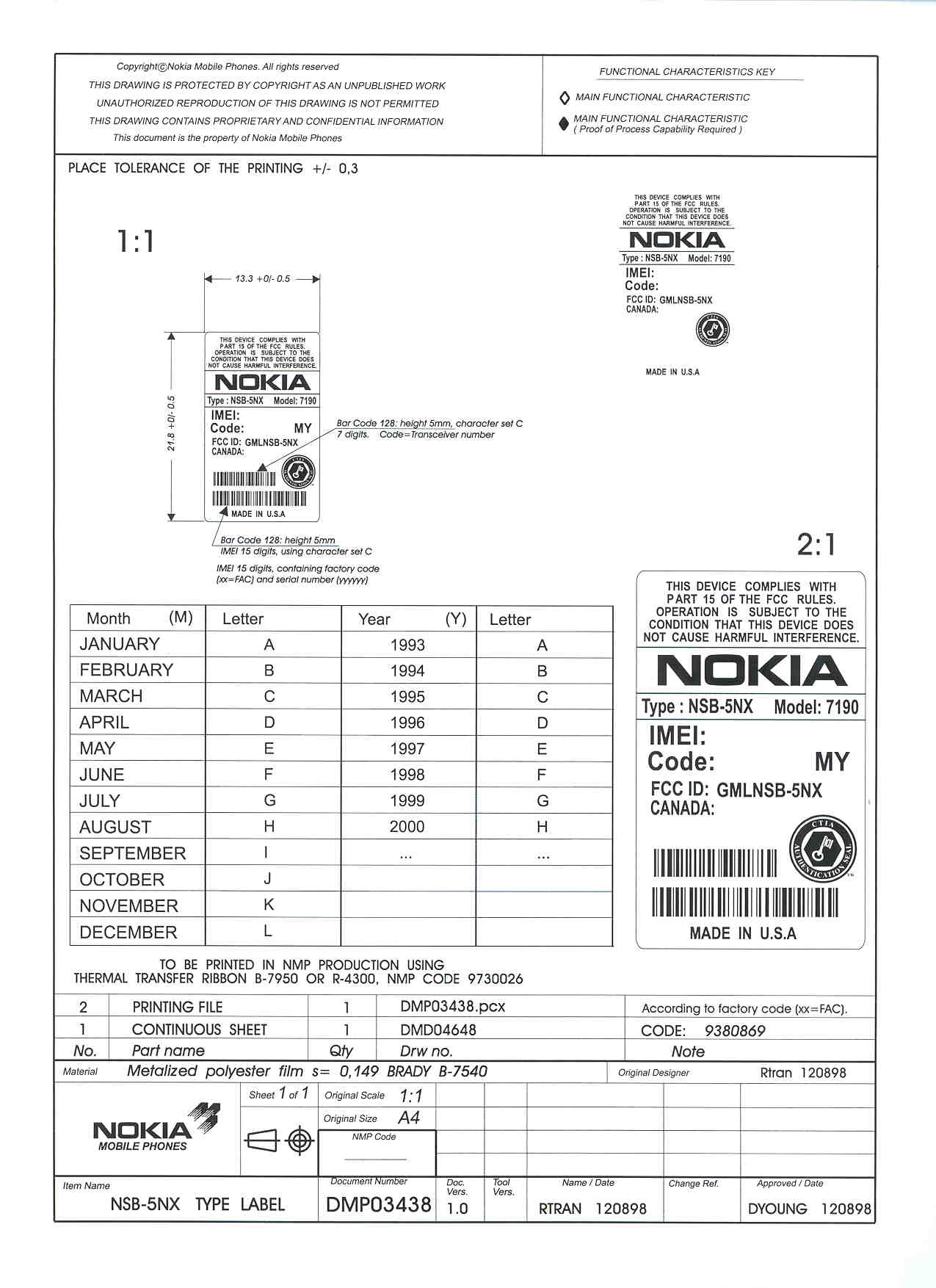
FCC ID: GMLNSB-5NX MFA p9940010, d9940048 Date:April 23, 1999 Federal Communications Commission EQUIPMENT APPROVAL SERVICES P.O. Box 358315 Pittsburgh, PA 15251-5315 Attention:Authorization & Evaluation Division Applicant:Nokia Mobile Phones, Inc. Equipment:7190, Type NSB-5NX FCC ID:GMLNSB-5NX FCC Rules:24, Confidentiality Gentlemen: On behalf of the Applicant, enclosed please find Application Form 731, Engineering Test Report and all pertinent documentation, the whole for approval of the referenced equipment as shown. Filing fees are attached. We trust the same is in order. Should you need any further information, kindly contact the writer who is authorized to act as agent. Sincerely yours, Morton Flom, P. Eng. enclosure(s) CERTIFIED MAIL, R.R.R. cc: Applicant MF/cvr FCC ID: GMLNSB-5NX MFA p9940010, d9940048 Date:April 23, 1999 Federal Communications Commission EQUIPMENT APPROVAL SERVICES P.O. Box 358315 Pittsburgh, PA 15251-5315 Attention:Authorization & Evaluation Division Applicant:Nokia Mobile Phones, Inc. Equipment:7190, Type NSB-5NX FCC ID:GMLNSB-5NX Gentlemen: As per instructions received, enclosed herewith please find completed Remittance Advice Form 159 for the referenced equipment, bearing original signature, and the application having been electronically filed. Sincerely yours, Morton Flom, P. Eng. enclosure(s) CERTIFIED MAIL, R.R.R. cc: Visa cc: File MF/cvr FCC ID: GMLNSB-5NX MFA p9940010, d9940048 LIST OF EXHIBITS (FCC CERTIFICATION (PCS TRANSMITTERS) - REVISED 9/28/98) APPLICANT:Nokia Mobile Phones, Inc. FCC ID:GMLNSB-5NX BY APPLICANT: 1. LETTER OF AUTHORIZATION 2. IDENTIFICATION DRAWINGS, 2.1033(c)(11) LABEL LOCATION OF LABEL COMPLIANCE STATEMENT LOCATION OF COMPLIANCE STATEMENT 3. PHOTOGRAPHS, 2.1033(c)(12) 4. CONFIDENTIALITY REQUEST: 0.457 and 0.459 5. DOCUMENTATION: 2.1033(c) (3)INSTALLATION/OPERATING MANUAL (9)TUNE-UP/ALIGNMENT PROCEDURE (10)SCHEMATIC DIAGRAM (10) CIRCUIT DESCRIPTION BY M.F.A. INC. A.TESTIMONIAL & STATEMENT OF CERTIFICATION B.STATEMENT OF QUALIFICATIONS FCC ID: GMLNSB-5NX MFA p9940010, d9940048 Sub-part 2.1033(c): EQUIPMENT IDENTIFICATION FCC ID: GMLNSB-5NX NAMEPLATE DRAWING ATTACHED, EXHIBIT 1. LOCATION AS PER LABEL DRAWING(S) DATE OF REPORT April 23, 1999 SUPERVISED BY:Morton Flom, P. Eng. FCC ID: GMLNSB-5NX MFA p9940010, d9940048 THE APPLICANT HAS BEEN CAUTIONED AS TO THE FOLLOWING: 15.21INFORMATION TO USER. The users manual or instruction manual for an intentional radiator shall caution the user that changes or modifications not expressly approved by the party responsible for compliance could void the user's authority to operate the equipment. 15.27(a)SPECIAL ACCESSORIES. Equipment marketed to a consumer must be capable of complying with the necessary regulations in the configuration in which the equipment is marketed. Where special accessories, such as shielded cables and/or special connectors are required to enable an unintentional or intentional radiator to comply with the emission limits in this part, the equipment must be marketed with, i.e. shipped and sold with, those special accessories. However, in lieu of shipping or packaging the special accessories with the unintentional or intentional radiator, the responsible party may employ other methods of ensuring that the special accessories are provided to the consumer, without additional charge. Information detailing any alternative method used to supply the special accessories for a grant of equipment authorization or retained in the verification records, as appropriate. The party responsible for the equipment, as detailed in § 2.909 of this chapter, shall ensure that these special accessories are provided with the equipment. The instruction manual for such devices shall include appropriate instructions on the first page of text concerned with the installation of the device that these special accessories must be used with the device. It is the responsibility of the user to use the needed special accessories supplied with the equipment. FCC ID: GMLNSB-5NX MFA p9940010, d9940048 TABLE OF CONTENTS RULEDESCRIPTIONPAGE .Test Report1 2.1033(c)General Information Required2 2.1033(c)(14) Rule Summary4 .Standard Test Conditions and Engineering Practices5 2.1046(a), 24.232(b) Carrier Output Power (Radiated)6 2.1049(c), 24.232(b). Transmitter Conducted Measurements8 2.1053(a).Transmitter Radiated Measurements15 2.1055(a)(1), 24.238 Frequency Stability (Temperature Variation)18 2.1055(b)(1)Frequency Stability (Voltage Variation)21 2.202(g) Necessary Bandwidth and Emission Bandwidth22 FCC ID: GMLNSB-5NX MFA p9940010, d9940048 PAGE NO.1 of 22. Required information per ISO/IEC Guide 25-1990, pa…
Text truncated - open the document above for the full version.
Contact Information
Applicant
Hasnain Syed(Director, EMC, SI and RF Compliance)
Technical Contact
M. Flom Associates, Inc.Morton Flom
[email protected]480-926-3100
3356 N. Sam Marcos · Chandler, Arizona · United States
Test Firm
M. Flom Associates, Inc.Morton Flom
Technical Specifications
| # | Rule Parts | Frequency Range | Power Output | Emission | Tolerance |
|---|---|---|---|---|---|
| 1 | 24E | 1.85 GHz - 1.91 GHz | 790.00 mW | 257KGXW | 100.0000000000 Hz |
Other Applications from Microsoft Corporation

GMLRM-88A
Apr 11, 2006GSM 850/900/1800/1900MHz Cellphone w/BT
Equipment Class
JBP - Part 15 Class B Computing Device Peripheral
GMLRM-88
Jan 19, 2006GSM 850/900/1800/1900MHz Cellphone w/BT
Equipment Class
DSS - Part 15 Spread Spectrum Transmitter
GMLNPM-10X
Oct 29, 2003Dual Band Mobile Phone
Equipment Class
PCE - PCS Licensed Transmitter held to ear
GMLRH-25
Sep 10, 2003Tri mode Dual Band Cellular Phone
Equipment Class
PCE - PCS Licensed Transmitter held to ear
GMLRH-42
Aug 27, 2003Nokia 2220 single band cellphone
Equipment Class
TNE - Licensed Non-Broadcast Transmitter Held to Ear