GMLNSC-4
Microsoft Corporation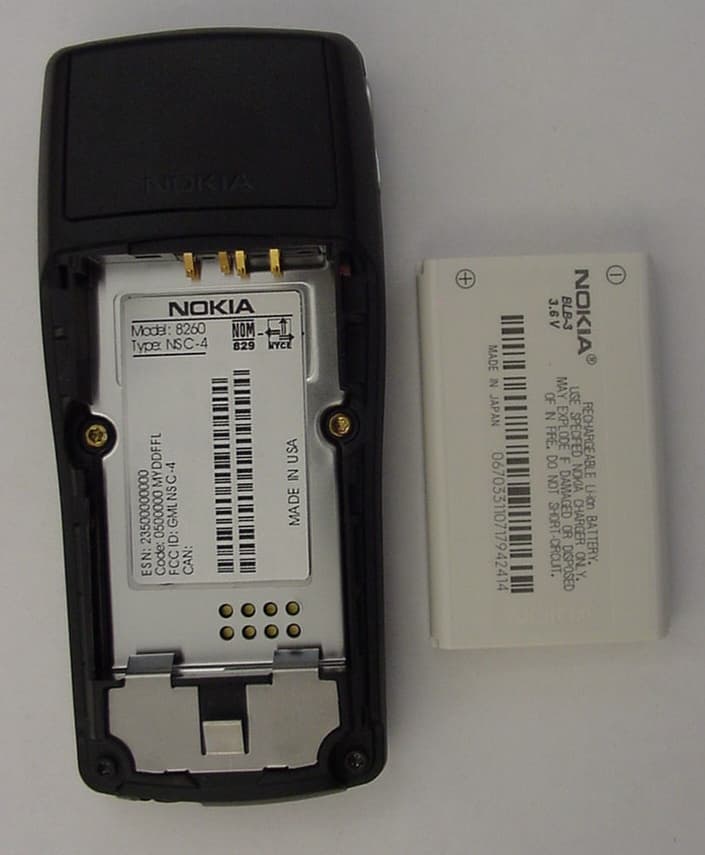
Click to zoom
Application Details
- Equipment Class
- TNE - Licensed Non-Broadcast Transmitter Held to Ear
- Date of Grant
- Jan 10, 2002
- Application Purpose
- Original Equipment
- Date of Application
- Jul 17, 2001
- Frequency Range
- 824.00000000 - 849.00000000
- Company
- Microsoft Corporation
- Country
- United States
Documents & Files
Document Text
Text extracted from the exhibit documents filed with the FCC. Open a document above to read the original.
Users Manual
8260 User Guide version v. 0.06 [ i ]3/6/00 Nokia 8260 User Guide Version 0.06 8260 User Guide version v. 0.06 [ ii ] 3/6/00 Copyright information Part No. 9352523, Issue 1, nn.nnnn © 2000 Nokia Mobile Phones. All rights reserved. Printed in Canada nn/2000. Nokia, Nokia Connecting People, and the Original Accessories logos are trademarks of Nokia Corporation and/or its affiliates. FCC/Industry Canada Notice Your phone may cause TV or radio interference (for example, when using a telephone in close proximity to receiving equipment). The FCC or Industry Canada can require you to stop using your telephone if such interference cannot be eliminated. If you require assistance, contact your local service facility. This device complies with part 15 of the FCC rules. Operation is subject to the condition that this device does not cause harmful interference. 8260 User Guide version v. 0.06 [ iii ]3/6/00 Contents 1. For your safety. . . . . . . . . . . . . . . . . . . . . . . . . . . . . . . . 1 2. Welcome . . . . . . . . . . . . . . . . . . . . . . . . . . . . . . . . . . . . 3 Before you begin . . . . . . . . . . . . . . . . . . . . . . . . . . . . . . 3 Contacting Nokia . . . . . . . . . . . . . . . . . . . . . . . . . . . . . 4 When you need to contact your service provider . . . . 4 3. Prepare your phone for use . . . . . . . . . . . . . . . . . . . . . 5 Install the battery . . . . . . . . . . . . . . . . . . . . . . . . . . . . .5 First, remove the back cover . . . . . . . . . . . . . . . . .5 Next, insert the battery . . . . . . . . . . . . . . . . . . . . . 5 Last, replace the back cover. . . . . . . . . . . . . . . . . . 5 Charge the battery . . . . . . . . . . . . . . . . . . . . . . . . . 6 When you need to remove the battery . . . . . . . . . . . . 6 4. Get to know your phone . . . . . . . . . . . . . . . . . . . . . . . . 7 Keys and screen . . . . . . . . . . . . . . . . . . . . . . . . . . . . . . .7 Navigation keys . . . . . . . . . . . . . . . . . . . . . . . . . . . . . . 10 Indicators and icons . . . . . . . . . . . . . . . . . . . . . . . . . . 11 5. Make and answer calls . . . . . . . . . . . . . . . . . . . . . . . .14 Make a call . . . . . . . . . . . . . . . . . . . . . . . . . . . . . .14 Answer a call. . . . . . . . . . . . . . . . . . . . . . . . . . . . .14 Adjust the earpiece volume . . . . . . . . . . . . . . . . .15 8260 User Guide version v. 0.06 [ iv ]3/6/00 Redial the last-dialed number . . . . . . . . . . . . . . 15 Use caller ID . . . . . . . . . . . . . . . . . . . . . . . . . . . . . 15 Keep calls private . . . . . . . . . . . . . . . . . . . . . . . . . 16 6. Use phone menus . . . . . . . . . . . . . . . . . . . . . . . . . . . . 17 Navigate menus . . . . . . . . . . . . . . . . . . . . . . . . . . . . . 17 Scroll through menus . . . . . . . . . . . . . . . . . . . . . 17 Use a shortcut . . . . . . . . . . . . . . . . . . . . . . . . . . . 17 Change menu levels . . . . . . . . . . . . . . . . . . . . . . . 18 Get help . . . . . . . . . . . . . . . . . . . . . . . . . . . . . . . . 18 List of shortcuts . . . . . . . . . . . . . . . . . . . . . . . . . . . . . 18 7. Enter letters and numbers . . . . . . . . . . . . . . . . . . . . . 22 Enter letters . . . . . . . . . . . . . . . . . . . . . . . . . . . . . . . . 22 Edit names . . . . . . . . . . . . . . . . . . . . . . . . . . . . . . 23 Change from capital (uppercase) letters . . . . . . 23 Use punctuation and special characters . . . . . . 23 Enter numbers. . . . . . . . . . . . . . . . . . . . . . . . . . . . . . . 24 Use special characters in numbers . . . . . . . . . . . 24 List of special characters . . . . . . . . . . . . . . . . . . . 24 8. Use the phone book . . . . . . . . . . . . . . . . . . . . . . . . . . 25 About the phone book . . . . . . . . . . . . . . . . . . . . . . . . 25 Use phone book menus . . . . . . . . . . . . . . . . . . . . . . . 25 Change views . . . . . . . . . . . . . . . . . . . . . . . . . . . . . . . 26 Add names and numbers . . . . . . . . . . . . . . . . . . . . . . 27 Change a stored telephone number . . . . . . . . . . . . . 27 8260 User Guide version v. 0.06 [ v ]3/6/00 Recall and redial numbers . . . . . . . . . . . . . . . . . . . . .28 Erase stored names and numbers . . . . . . . . . . . . . . .29 Erase the entire phone book. . . . . . . . . . . . . . . . . . . .30 Check memory status . . . . . . . . . . . . . . . . . . . . . . . . .30 9. Use voice mail . . . . . . . . . . . . . . . . . . . . . . . . . . . . . . . 31 When you have a message . . . . . . . . . . . . . . . . . . . . . 31 Set up your voice mailbox . . . . . . . . . . . . . . . . . . . . . 31 Set greetings and passwords . . . . . . . . . . . . . . . . . . .32 Listen to your voice messages . . . . . . . . . . . . . . . . . .32 10. Work with the call log . . . . . . . . . . . . . . . . . . . . . . . .33 Check the call log . . . . . . . . . . . . . . . . . . . . . . . . . . . .33 Check missed calls . . . . . . . . . . . . . . . . . . . . . . . .34 Check previously dialed calls . . . . . . . . . . . . . . . .35 Check received calls . . . . . . . . . . . . . . . . . . . . . . .35 Clear call lists . . . . . . . . . . . . . . . . . . . . . . . . . . . .35 Check call timers . . . . . . . . . . . . . . . . . . . . . . . . . . . . .36 Turn on a current call timer . . . . . . . . . . . . . . . . .37 Clear call timers . . . . . . . . . . . . . . . . . . . . . . . . . .37 11. Use advanced calling features . . . . . . . . . . . . . . . . . .38 Set in-call options. . . . . . . . . . . . . . . . . . . . . . . . . . . .38 Use call waiting . . . . . . . . . . . . . . . . . . . . . . . . . . . . . .39 Store the call waiting feature code. . . . . . . . . . .39 Manage calls . . . . . . . . . . . . . . . . . . . . . . . . . . . . .40 Make a conference call . . . . . . . . . . . . . . . . . . . .40 8260 User Guide version v. 0.06 [ vi ]3/6/00 Use call forwarding . . . . . . . . . . . . . . . . . . . . . . . . . . 41 Store the call …
Text truncated - open the document above for the full version.
Cover Letter(s)
Date: July 18, 2001 Applicant: Nokia Inc. 6000 Connection Dr. Irving, TX 75039 FCC ID: GMLNSC-4 Attention: equipment Authorization Branch REQUEST FOR CONFIDENTIALITY Pursuant to Sections 0.457(d)(1)(ii) and 0.459 of the Commission's Rules, the Applicant hereby requests confidential treatment of some of the information accompanying this Application of FCC ID: GMLNSC-4 as outlined below: -Exhibit 4: Block Diagram -Exhibit 5: Schematic Diagrams -Exhibit 10: List of Active Devices and Tune-Up Procedure -Exhibit 12: Theory of Operation/Description of Circuitry These materials contain trade secrets and proprietary information not customarily released to the public and the public disclosure of these matters might be harmful to the Applicant and provide unjustified benefits to its competitors. The Applicant understands that pursuant to Rule 0.457(d)(1)(ii) disclosure of this Application and all accompanying documentation will not be made before the date of the Grant for this Application. Sincerely yours, Morton Flom, P. Eng.
Cover Letter(s)
PC Site Oulu Exhibit 11 DTX02655-EN Applicant: Nokia Mobile Phones FCC ID: GMLNSC-4 Copyright 2001 Nokia Mobile Phones 7 (13) 4.3 Muscle Tissue Simulant The composition of the muscle tissue simulating liquid for 835MHz is 56.0%De-Ionized Water 41.76% Sugar 1.21%HEC 0.76%Salt 0.27%Preservative Dielectric Parametersf [MHz] Description ε εε ε r σ σσ σ [S/m] Temp [° °° °C] Measured Value57.00.9522 835 Recommended Value56.10.9522 Recommended values are adopted from FCC Tissue Dielectric Properties web page at http:// www.fcc.gov/fcc-bin/dielec.sh 4.4 Phantoms Two phantoms, "Generic Twin Phantom", manufactured by SPEAG, were used during the measurements. One phantom was filled with 835 MHz head tissue-simulating liquid and the other with 835 MHz muscle tissue-simulating liquid. The thickness of phantom shell is 2 mm except for the ear, where a 4 mm ear spacer provides a 6 mm spacing from the tissue boundary.
Cover Letter(s)
RESPONSE TO FCC QUESTION #4 1 (1) FCC ID GMLNSC-4 October 1, 2001 FCC Question: The conducted output power in the tune up procedure does not agree with the conducted output power in the EMC report. Please correct and indicate the conducted output power in the EMC report. Nokia Response: FCC ID GMLNSC-4 was not designed to allow conducted measurements to be performed. The method used to measure the conducted power is not properly tuned to the RF output of the handportable phone. The RF adapter is not set at the 50 ohm impedance point. This impedance mismatch along with the variation from channel to channel (note the chosen channels for the tuning do not match the channels that were tested for conducted RF Power Output) can easily account for the variation between the tuning targets for power output and the measured power output.
External Photos
G M L N S C - 4 G M L N S C - 4 G M L N S C - 4 G M L N S C - 4 G M L N S C - 4
ID Label/Location Info
25 June 2001 Applicant: Nokia Mobile Phones FCC ID: GMLNSC-4 Copyright c 2001 Nokia Mobile Phones MA DE IN U SA Model: 8260 Type: NSC-4 E S N: 23500000000 Code: 0500000 MY DDFFL FCC ID: GML NS C -4 CAN: MA DE IN U SA Model: 8260 Type: NSC-4 E S N: 23500000000 Code: 0500000 MY DDF F L F CC I D: GML NS C -4 CAN: MA DE IN U S A Model: 8260 Type: NSC-4 E S N: 23500000000 Code: 0500000 MY DDFF L FC C ID : GMLN S C -4 CAN: 25 June 2001 Applicant: Nokia Mobile Phones FCC ID: GMLNSC-4 Copyright c 2001 Nokia Mobile Phones 8260 User Guide version 0.051 [ ii ]1/18/00 Copyright information Part No. 9352523, Issue 1, nn.nnnn © 2000 Nokia Mobile Phones. All rights reserved. Printed in Canada nn/2000. Nokia, Nokia Connecting People, and the Original Accessories logos are trademarks of Nokia Corporation and/or its affiliates. FCC/Industry Canada Notice Your phone may cause TV or radio interference (for example, when using a telephone in close proximity to receiving equipment). The FCC or Industry Canada can require you to stop using your telephone if such interference cannot be eliminated. If you require assistance, contact your local service facility. This device complies with part 15 of the FCC rules. Operation is subject to the condition that this device does not cause harmful interference.
Internal Photos
G M L N S C - 4 G M L N S C - 4 G M L N S C - 4 G M L N S C - 4
RF Exposure Info
PC Site Oulu Exhibit 11 DTX02655-EN Applicant: Nokia Mobile Phones FCC ID: GMLNSC-4 Copyright 2001 Nokia Mobile Phones 1 (13) SAR Compliance Test Report Test report no.: Not numbered Date of report: 8-Jun-2001 Number of pages: 21 Contact person: Olli Kautio Responsible test engineer: Pertti Mäkikyrö Testing laboratory: Nokia Mobile Phones Elektroniikkatie 10 P.O. Box 50 FIN-90571 OULU Finland Tel. +358-10-5051 Fax. +358-10-505 7222 Client: Nokia Mobile Phones 6000 Connection Dr. Mailstop 2:200 Irving Tx, 75039 USA Tel. +1 972 894 5000 Fax. +1 972 894 4589 Tested devices: GMLNSC-4, CSH-1 Supplement reports: - Testing has been carried out in accordance with: ANSI/IEEE Std C95.1-1992 IEEE Standard for Safety Levels with Respect to Human Exposure to Radio Frequency Electromagnetic Fields, 3 kHz to 300 GHz ANSI/IEEE Std C95.3-1992 IEEE Recommended Practice for the Measurement of Potentially Hazardous Electromagnetic Fields-RF and Microwave Documentation: The documentation of the testing performed on the tested devices is archived for 15 years at PC Site Oulu Test results: The tested device complies with the requirements in respect of all parameters subject to the test. The test results and statements relate only to the items tested. The test report shall not be reproduced except in full, without written approval of the laboratory. Date and signatures: 8-Jun-2001 For the contents: Pertti Mäkikyrö Engineering Manager, EMC Miia Nurkkala Test Engineer PC Site Oulu Exhibit 11 DTX02655-EN Applicant: Nokia Mobile Phones FCC ID: GMLNSC-4 Copyright 2001 Nokia Mobile Phones 2 (13) CONTENTS 1.SUMMARY FOR SAR TEST REPORT ..........................................................................................................................3 1.1MAXIMUM RESULTS FOUND DURING SAR EVALUATION............................................................................................................ 3 1.1.1Head Configuration.......................................................................................................................................................... 3 1.1.2Body Worn Configuration............................................................................................................................................... 3 1.1.3Measurement Uncertainty ............................................................................................................................................. 3 2.DESCRIPTION OF TESTED DEVICE .............................................................................................................................4 2.1PICTURE OF PHONE...................................................................................................................................................................... 4 2.2D ESCRIPTION OF THE ANTENNA................................................................................................................................................... 4 2.3B ATTERY OPTIONS........................................................................................................................................................................ 4 2.4B ODY WORN ACCESSORIES......................................................................................................................................................... 4 3.TEST CONDITIONS ........................................................................................................................................................5 3.1ENVIRONMENT............................................................................................................................................................................. 5 3.2T EST SIGNAL, FREQUENCIES, AND OUTPUT POWER..................................................................................................................... 5 4.DESCRIPTION OF THE TEST EQUIPMENT.................................................................................................................5 4.1SYSTEM ACCURACY VERIFICATION.............................................................................................................................................. 5 4.2H EAD TISSUE SIMULANT.............................................................................................................................................................. 6 4.3M USCLE TISSUE SIMULANT......................................................................................................................................................... 7 4.4P HANTOMS.................................................................................................................................................................................. 7 5.DESCRIPTION OF THE TEST PROCEDURE ................................................................................................................8 5.1TEST POSITIONS............................................................................................................................................................................ 8 5.1.1Against Phantom Head ................................................................................................................................................... 8 5.1.2Body Worn Configuration............................................................................................................................................. 10 5.2S CAN PROCEDURES................................................................................................................................................................... 11 5.3SAR A VERAGING METHODS...................................................................................................................................................... 11 6.MEASUREMENT UNCERTAINTY ............................................................................................................................. 12 6.1DESCRIPTION OF INDIVIDUAL MEASU…
Text truncated - open the document above for the full version.
RF Exposure Info
[ 112 ] If certain features are in use (Keyguard, fixed dialing, restrict calls, and so on), you might first need to turn those features off before you can make an emergency call. Consult this guide and your local cellular service provider. When making an emergency call, remember to give all of the necessary information as accurately as possible. Remember that your wireless phone might be the only means of communication at the scene of an accident— do not terminate the call until given permission to do so. Radio frequency (RF) signals THIS MODEL PHONE MEETS THE GOVERNMENT'S REQUIREMENTS FOR EXPOSURE TO RADIO WAVES. Your wireless phone is a radio transmitter and receiver. It is designed and manufactured not to exceed the emission limits for exposure to radio frequency (RF) energy set by the Federal Communications Commission of the U.S. Government. These limits are part of comprehensive guidelines and establish permitted levels of RF energy for the general population. The guidelines are based on standards that were developed by independent scientific organizations through periodic and thorough evaluation of scientific studies. The standards include a substantial safety margin designed to assure the safety of all persons, regardless of age and health. The exposure standard for wireless mobile phones employs a unit of measurement known as the Specific Absorption Rate, or SAR. The SAR limit set by the FCC is 1.6W/kg.* Tests for SAR are conducted using standard operating positions accepted by the FCC with the phone transmitting at its highest certified power level in all tested frequency bands. Although the SAR is determined at the highest certified power level, the actual SAR level of the phone while operating can be well below the maximum value. This is because the phone is designed to operate at multiple power levels so as to use only the power required to reach the network. In general, the closer you are to a wireless base station antenna, the lower the power output. [ 113 ] Reference information Before a phone model is available for sale to the public, it must be tested and certified to the FCC that it does not exceed the limit established by the government-adopted requirement for safe exposure. The tests are performed in positions and locations (e.g., at the ear and worn on the body) as required by the FCC for each model. The highest SAR value for this model phone as reported to the FCC when tested for use at the ear is 1.08 W/Kg and when worn on the body, as described in this user guide, is 0.41 W/Kg. (Body-worn measurements differ among phone models, depending upon available accessories and FCC requirements). While there may be differences between the SAR levels of various phones and at various positions, they all meet the government requirement. The FCC has granted an Equipment Authorization for this model phone with all reported SAR levels evaluated as in compliance with the FCC RF exposure guidelines. SAR information on this model phone is on file with the FCC and can be found under the Display Grant section of http://www.fcc.gov/oet/fccid after searching on FCC ID GMLNSC-4. For body worn operation, to maintain compliance with FCC RF exposure guidelines, use only Nokia approved accessories. When carrying the phone while it is on, attach the phone to the specific belt-clip or place the phone in the specific Nokia carrying cases that have been tested for compliance. Use of non-Nokia-approved accessories may violate FCC RF exposure guidelines and should be avoided. * In the United States and Canada, the SAR limit for mobile phones used by the public is 1.6 watts/kg (W/kg) averaged over one gram of tissue. The standard incorporates a substantial margin of safety to give additional protection for the public and to account for any variations in measurements. SAR values may vary depending on national reporting requirements and the network band. For SAR information in other regions please look under product information at http://www.nokia.com.
Test Report
FCC ID: GMLNSC-4 MFA p0150003, d0150014 Date of Report: Date of Submission: May 18, 2001 July 18, 2001 Federal Communications Commission Via: Electronic Filing Attention: Authorization & Evaluation Division Applicant: Nokia Inc. Equipment: 8260, Type NSC-4 FCC ID: GMLNSC-4 FCC Rules: 22H, Confidentiality Gentlemen: On behalf of the Applicant, enclosed please find Application Form 731, Engineering Test Report and all pertinent documentation, the whole for approval of the referenced equipment as shown. Filing fees are attached. We trust the same is in order. Should you need any further information, kindly contact the writer who is authorized to act as agent. Sincerely yours, Morton Flom, P. Eng. enclosure(s) cc: Applicant MF/cvr FCC ID: GMLNSC-4 MFA p0150003, d0150014 LIST OF EXHIBITS (FCCCERTIFICATION(CELLULAR TRANSMITTERS) - REVISED 9/28/98) APPLICANT: Nokia Inc. FCC ID: GMLNSC-4 BY APPLICANT: 1. LETTER OF AUTHORIZATION 2. IDENTIFICATION DRAWINGS, 2.1033(c)(11) xLABEL xLOCATION OF LABEL xCOMPLIANCE STATEMENT xLOCATION OF COMPLIANCE STATEMENT 3. PHOTOGRAPHS, 2.1033(c)(12) x 4. CONFIDENTIALITY REQUEST: 0.457 and 0.459 x 5. DOCUMENTATION: 2.1033(c) (3) USER MANUAL x (9) TUNE UP INFO x (10) SCHEMATIC DIAGRAM x (10) CIRCUIT DESCRIPTION x BLOCK DIAGRAM x PARTS LIST x ACTIVE DEVICES x 6. ATTESTATION: ESN: Section 22.919 x 7. ATTESTATION: OET: Section 22.933 x 8. SAR Report by Nokia (Finland) x BY M.F.A. INC. A. TESTIMONIAL & STATEMENT OF CERTIFICATION B. STATEMENT OF QUALIFICATIONS FCC ID: GMLNSC-4 MFA p0150003, d0150014 TRANSMITTER CERTIFICATION of FCC ID: GMLNSC-4 MODEL: 8260, Type NSC-4 to FEDERAL COMMUNICATIONS COMMISSION Rule Part(s) 22H, Confidentiality DATE OF REPORT: May 18, 2001 ON THE BEHALF OF THE APPLICANT: Nokia Inc. AT THE REQUEST OF : P.O. T39-4289618 Nokia Mobile Phones 6000 Connection Drive Irving, TX 75039 Attention of: (972) 894-5000; Fax: -5698 Michael J. Mobley, Lead Type Approvals (972) 894-4917; FAX: -5698 Cellphone: (214) 668-9465 [email protected] SUPERVISED BY: Morton Flom, P. Eng. FCC ID: GMLNSC-4 MFA p0150003, d0150014 THE APPLICANT HAS BEEN CAUTIONED AS TO THE FOLLOWING: 15.21 INFORMATION TO USER. The users manual or instruction manual for an intentional radiator shall caution the user that changes or modifications not expressly approved by the party responsible for compliance could void the user's authority to operate the equipment. 15.27(a) SPECIAL ACCESSORIES. Equipment marketed to a consumer must be capable of complying with the necessary regulations in the configuration in which the equipment is marketed. Where special accessories, such as shielded cables and/or special connectors are required to enable an unintentional or intentional radiator to comply with the emission limits in this part, the equipment must be marketed with, i.e. shipped and sold with, those special accessories. However, in lieu of shipping or packaging the special accessories with the unintentional or intentional radiator, the responsible party may employ other methods of ensuring that the special accessories are provided to the consumer, without additional charge. Information detailing any alternative method used to supply the special accessories for a grant of equipment authorization or retained in the verification records, as appropriate. The party responsible for the equipment, as detailed in § 2.909 of this chapter, shall ensure that these special accessories are provided with the equipment. The instruction manual for such devices shall include appropriate instructions on the first page of text concerned with the installation of the device that these special accessories must be used with the device. It is the responsibility of the user to use the needed special accessories supplied with the equipment. FCC ID: GMLNSC-4 MFA p0150003, d0150014 TABLE OF CONTENTS RULE DESCRIPTION PAGE . Test Report 1 2.1033(c) General Information Required 2 2.1033(c)(14) Rule Summary 5 . General Information 6 . Standard Test Conditions and Engineering Practices 7 2.1046(a) Carrier Output Power (Conducted) 8 2.1046(a) R. F. Power Output (Radiated) 10 2.1047(a) Audio Frequency Response 12 2.1047(a) Audio Low Pass Filter (Voice Input) 14 2.1047(b) Modulation Limiting 17 . Measurement Of Maximum Deviation 20 2.1049(c)(1), 22 Emission Masks (Occupied Bandwidth) 23 22.917 Emission Requirements - . Worst Case Modulation & Wideband Data 41 2.1051, 22.917 Spurious Emissions at Antenna Terminals 52 2.1053(a) Field Strength of Spurious Radiation 57 2.1055(a)(1) Frequency Stability (Temperature Variation) 62 2.1055(b)(1) Frequency Stability (Voltage Variation) 64 FCC ID: GMLNSC-4 MFA p0150003, d0150014 PAGE NO.1of64. Required information per ISO/IEC Guide 25-1990, paragraph 13.2: a) TEST REPORT b) Laboratory: (FCC: 31040/SIT) (Canada: IC 2044) M. Flom Associates, Inc. 3356 N. San Marcos Place, Suite 107 Chandler, AZ 85225 c) Report Number: d0150014 d) Client: Nokia Mobile Phones 6000 Connection Drive Irving, TX 75039 e) Identification: 8260, Type NSC-4 FCC ID: GMLNSC-4 Description: UHF FM Portable Transceiver f) EUT Condition: Not required unless specified in individual tests. g) Report Date: May 18, 2001 EUT Received: May 14, 2001 h, j, k): As indicated in individual tests. i) Sampling method: No sampling procedure used. l) Uncertainty: In accordance with MFA internal quality manual. m) Supervised by: Morton Flom, P. Eng. n) Results: The results presented in this report relate only to the item tested. o) Reproduction: This report must not be reproduced, except in full, without written permission from this laboratory. FCC ID: GMLNSC-4 MFA p0150003, d0150014 PAGE NO.2of64. LIST OF GENERAL INFORMATION REQUIRED FOR CERTIFICATION IN ACCORDANCE WITH FCC RULES AND REGULATIONS, VOLUME II, PART 2 AND TO 22H, Confidentiality Sub-part 2.1033 (c)(1): NAME AND ADDRESS OF APPLICANT: Nokia Inc. 6000 Connection Drive Irving, TX 75039 MANUFACTURER: Nokia Mobile Phones Manufacturing (USA), Inc. 5650 Alliance Gateway Fort Worth, …
Text truncated - open the document above for the full version.
Test Report
FCC ID: GMLNSC-4 MFA p0150003, d0150014 PAGE NO.8 of 64. AMNEDED December 11, 2001 NAME OF TEST: Carrier Output Power (Conducted) SPECIFICATION: 47 CFR 2.1046(a) TEST EQUIPMENT: As per attached page MEASUREMENT PROCEDURE 1. The EUT was connected to a resistive coaxial attenuator of normal load impedance, and the unmodulated output power was measured by means of an R. F. Power Meter. 2. Measurement accuracy is±3%. MEASUREMENT RESULTS MHz dbm Lo Watts, Conducted High Watts, Conducted AMPS MODE: 824.040 21.6 0.148 0.147 836.400 21.3 0.138 0.138 848.970 20.0 0.103 0.104 TDMA MODE: 825.290 27.8 0.6065 0.606 836.400 27.6 0.578 0.579 847.720 26.1 0.410 0.41 PERFORMED BY: Doug Noble, B.A.S. E.E.T.
Contact Information
Applicant
Hasnain Syed(Director, EMC, SI and RF Compliance)
Technical Contact
M. Flom Associates, IncMorton Flom
[email protected]480 926 3100
3356 N. San Marcos Pl., Suite 107 · Chandler, Arizona · United States
Non-Technical Contact
M. Flom Associates, Inc.Morton Flom
[email protected]480 926 3100
Test Firm
M. Flom Associates, Inc.Morton Flom
Technical Specifications
| # | Rule Parts | Frequency Range | Power Output | Emission | Tolerance |
|---|---|---|---|---|---|
| 3 | 22.901(d) | 824 MHz - 849 MHz | 603.00 mW | 30K0DXW | 2.5 ppm |
Other Applications from Microsoft Corporation

GMLRM-88A
Apr 11, 2006GSM 850/900/1800/1900MHz Cellphone w/BT
Equipment Class
JBP - Part 15 Class B Computing Device Peripheral
GMLRM-88
Jan 19, 2006GSM 850/900/1800/1900MHz Cellphone w/BT
Equipment Class
DSS - Part 15 Spread Spectrum Transmitter
GMLNPM-10X
Oct 29, 2003Dual Band Mobile Phone
Equipment Class
PCE - PCS Licensed Transmitter held to ear
GMLRH-25
Sep 10, 2003Tri mode Dual Band Cellular Phone
Equipment Class
PCE - PCS Licensed Transmitter held to ear
GMLRH-42
Aug 27, 2003Nokia 2220 single band cellphone
Equipment Class
TNE - Licensed Non-Broadcast Transmitter Held to Ear