GMLNSD-1AWHand Held Dual Band Tri Mode Cellular Telephone
Microsoft Corporation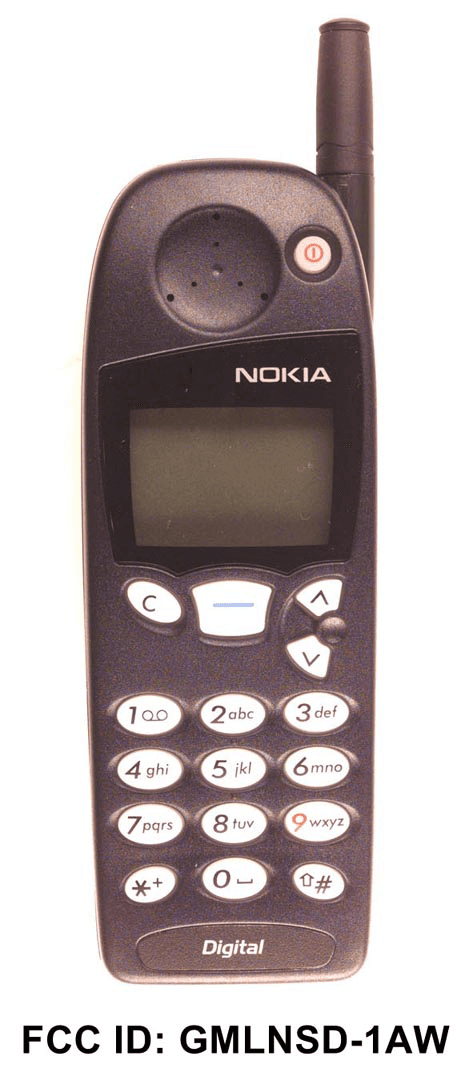
Click to zoom
Application Details
- Equipment Class
- PCE - PCS Licensed Transmitter held to ear
- Date of Grant
- Jul 19, 2000
- Application Purpose
- Original Equipment
- Date of Application
- Jan 04, 2000
- Equipment Note
- Hand Held Dual Band Tri Mode Cellular Telephone
- Frequency Range
- 1850.00000000 - 1910.00000000
- Company
- Microsoft Corporation
- Country
- United States
Documents & Files
Document Text
Text extracted from the exhibit documents filed with the FCC. Open a document above to read the original.
Users Manual
Nokia 5185 User Guide Draft v1.0 Keys (Scroll keys) Scroll through menus, sub- menus, and the phone book. Press and hold for continuous scrolling. (Power key) Press and hold to turn your phone on or off. (Softkeys) Their current function is dis- played above the key; these labels change when accessing the various phone features. Push this key to end a phone call or to re- turn to the start screen. Use this key to dial and answer phone calls. MenuNames Fixed antenna Do not attempt to extend or remove! Press to select upper or lower case letters when editing text. Press and hold while or is displayed to enter numbers rather than let- ters. Press this key to select special characters when entering text and numbers. Earpiece Press the scroll keys up or down during a call to adjust the lis- tening volume. Use this key to enter an empty space between letters when entering text. Para obtener un manual del usuario en español favor de llamar o enviar un fax al teléfono 1-888-NOKIA2U (1-888-665-4228), fax 813-287-6612. 7 1. Safety At A Glance Read these simple guidelines before using your phone. Failure to comply with these guidelines may be dangerous or illegal. Note: For more detailed safety information, “Important Safety Information” on page88. Road Safety Comes First Don’t use a hand-held phone while driving; park the vehicle first. Switch Off In Hospitals Switch off your phone when near medical equipment. Follow any regulations or rules in force. Switch Off On Aircraft Mobile phones can cause interference. Using them on aircraft is illegal. Switch Off When Refueling Do not use the phone at a refueling point. Do not use near fuels or chemicals. Switch Off Near Blasting Do not use the phone where blasting is in progress. Observe restrictions, and follow any regulations or rules in force. Interference All mobile phones may get interference which could affect performance. Use Sensibly Use only in the normal position (to ear). Avoid unnecessary contact with the antenna when phone is on. Qualified Service Only qualified service personnel may install or repair cellular phone equipment. 8 Accessories and Batteries Use only approved accessories and batteries. Do not connect incompatible products. FCC/Industry Canada Notice Your phone may cause TV or radio interference (e.g. when using a telephone in close proximity to receiving equipment). The FCC/ Industry Canada can require you to stop using your telephone if such interference can not be eliminated. If you require assistance, contact your local service facility. This device complies with part 15 of the FCC rules. Operation is subject to the condition that this device does not cause harmful interference. Using this Guide The wireless phone described in this guide is approved for use in CDMA/AMPS networks. A number of features included in this guide are called Network Services. They are special services provided by wireless service providers. Before you can take advantage of any of these Network Services, you must subscribe to the service(s) from your home service provider and obtain instructions for their use. Disclaimer It’s possible that you may not be able to activate your phone on all wireless systems. Please see your service provider for details. 9 2. Getting Connected This section will help you understand the ins and outs of charging and using your battery. Attaching your battery Simply place the battery in the grooves on the back of your phone. Then slide the battery upward until it clicks. Note: Use only those batteries approved by the phone manufacturer and recharge your battery only with the chargers approved by the manufacturer. See “Important Battery Information” on page12. Charging your new battery Your phone can be used with either a rechargeable Li-Ion or NiMH battery. Note that a new battery’s full performance is achieved only after two or three complete charge and discharge cycles. With your phone powered on or off, connect the lead from the charger to the bottom of your phone. You can also place your phone on the charging stand (with the stand connected to a standard 120V AC outlet via either the ACP-7U or ACP-9U AC/DC adaptors). When the battery begins charging, your phone will beep once and the battery strength indicator on the right side of the display will begin to scroll after a few seconds. 10 If your phone displays Not charging, charging is suspended. Check that the battery is connected only to an approved charging device. If the battery is very hot or cold, wait for a while; charging will automatically resume after the battery is restored to its normal operating temperature. If charging still fails, contact your dealer. When a charger is not in use, disconnect it from the power source. Do not leave the battery connected to a charger for longer than a week, since overcharging may shorten its life. Important: If left unused, a fully charged battery will discharge itself over time. When is a good time to charge? Actually, you can charge anytime. If you have a NiMH battery, you should allow it to completely discharge once in a while. When your phone beeps once and displays Battery low, you only have a couple of minutes of talk time remaining. The repetition rate of these battery-low warnings depend on the remaining battery capacity and the battery condition. These warnings are more frequent when you’re in a call. Note: The phone will not give you the warning tone under certain conditions. See “Warning and game tones” on page81. Once all the power has drained from your battery, you’ll hear three beeps with the message Recharge battery on your display. At this point, your phone will switch itself off and you’ll need to recharge your battery. When is charging complete? When the charge indicators stop scrolling, your phone is considered fully charged. However, a slight increase in charge may occur if your phone is left connected to the charger for a couple more hours. This is called “trickle charge” or “maintenance charge.” 11 Charg…
Text truncated - open the document above for the full version.
Cover Letter(s)
NOKIA MOBILE PHONES, Inc. 12278 Scripps Summit Drive San Diego, CA 92131 Tel. (858) 831 5000 23 December 1999 Federal Communications Commission, Authorization & Evaluation Division, 7435 Oakland Mills Road, Columbia, MD 21046 Attention: Equipment Authorization Branch PER:47 CFR 22.919 RE:FCC ID: GMLNSD-1AW The Electronic Serial Number (ESN) for each transceiver is unique. The ESN host component is permanently attached to a main circuit board of the mobile transmitter and the integrity of the unit’s operating software is not alterable. The ESN is isolated from fraudulent contact and tampering. ! The host component does not contain other information, it is not removable and its electrical connections are not accessible. " The host component does contain other information, and the ESN information is encoded using: ! (1) Multiplication or division by a polynomial. " (2) Cyclic coding. " (3) The spreading of ESN bits over various non-sequential memory locations. The ESN is factory set and is not alterable, transferable, removable, or otherwise able to be manipulated. Cellular mobile equipment is designed such that any attempt to remove, tamper with, or change the ESN chip, its logic system, or firmware originally programmed by the manufacturer will render the mobile transmitter inoperative. NOKIA MOBILE PHONES, Inc. Jari Niemelä Product Project Manager, Product Development, San Diego NOKIA MOBILE PHONES, Inc. 12278 Scripps Summit Drive San Diego, CA 92131 Tel. (858) 831 5000 23 December 1999 Federal Communications Commission, Authorisation & Evaluation Division, 7435 Oakland Mills Road, Columbia, MD 21046 Attention: Equipment Authorisation Branch We hereby certify that the tranceiver FCC ID: GMLNSD-1AW complies with OET Bulletin No. 53 as referenced in Section 22.915 of the Commission’s rules and with TIA/EIA/IS-95-A Mobile Station-Base Station Compatibility Standard for Dual-Mode Wideband Spread Spectrum Cellular System and ANSI J-STD-008-1996 Personal Station-Base Station Compatibility Requirements for 1.8 to 2.0 GHz Code Division Multiple Access (CDMA) Personal Communications Systems. Compliance was determined by testing appropriate parameters according to standards. Extensive field testing has been performed in several locations in the USA to verify the compatibility against different systems. NOKIA MOBILE PHONES, Inc. Jari Niemelä Product Project Manager, Product Development, San Diego
Cover Letter(s)
NOKIA MOBILE PHONES, Inc. 12278 Scripps Summit Drive San Diego, CA 92131 Tel. (858) 831 5000 23 December 1998 Federal Communications Commission, Authorisation & Evaluation Division, 7435 Oakland Mills Road, Columbia, MD 21046 Attention: Equipment Authorisation Branch REQUEST FOR CONFIDENTIALITY Pursuant to Sections 0.457 (d) (l) (ii) and 0.459 of the Commission’s Rules, the Applicant hereby requests confidential treatment of some of the information accompanying this Application of FCC ID:GMLNSD-1AW and as outlined below: -block diagram -schematic diagrams -description of circuitry / theory of operation -list of active devices -tune-up procedures These materials contain trade secrets and proprietary information not customarily released to the public and the public disclosure of these matters might be harmful to the Applicant and provide unjustified benefits to its competitors. The Applicant understands that pursuant to Rule 0.457 (d) (l) (ii) disclosure of this Application and all accompanying documentation will not be made before the date of the Grant for this Application. NOKIA MOBILE PHONES, Inc. Jari Niemelä Product Project Manager, Product Development, San Diego
Cover Letter(s)
L:\MFA\FCC letter re Bill Graff.doc May 23, 2000 Federal Communications Commission Gentlemen: Please be advised that William H. (Bill) Graff is no longer employed by M. Flom Associates, Inc. in any capacity nor as a consultant. The only contact person to replace him is Morton Flom, P. Eng., President. Telephone number: 480 926 3100, FAX: 480 926 3598, email: general@mflom. Regards, Morton Flom, P. Eng., President M. Flom Associates, Inc.
ID Label/Location Info
22 Dec 99 FCC ID: GMLNSD-1AW Applicant: Nokia Mobile Phones, Inc.Copyright © 1999 Nokia Mobile Phones, Inc. 22 Dec 99 FCC ID: GMLNSD-1AW Applicant: Nokia Mobile Phones, Inc.Copyright © 1999 Nokia Mobile Phones, Inc. NOKIA MOBILE PHONES, Inc. 12278 Scripps Summit Drive San Diego, CA 92131 Tel (858) 831 5000 23 November 1999 Federal Communications Commission, Authorisation & Evaluation Division, 7435 Oakland Mills Road, Columbia, MD 21046 Attention: Equipment Authorisation Branch COMPLIANCE STATEMENT OF NOKIA 5185, FCC ID: GMLNSD-1AW The compliance statement can be seen in User Guide of NOKIA 5185 because the size of the handportable NOKIA 5185 and its identification label are so small that the compliance statement can not be printed visible enough. NOKIA MOBILE PHONES, Inc. Jari Niemelä Product Project Manager, Product Development, San Diego 8 Accessories and Batteries Use only approved accessories and batteries. Do not connect incompatible products. FCC/Industry Canada Notice Your phone may cause TV or radio interference (e.g. when using a telephone in close proximity to receiving equipment). The FCC/ Industry Canada can require you to stop using your telephone if such interference can not be eliminated. If you require assistance, contact your local service facility. This device complies with part 15 of the FCC rules. Operation is subject to the condition that this device does not cause harmful interference. Using this Guide The wireless phone described in this guide is approved for use in CDMA/AMPS networks. A number of features included in this guide are called Network Services. They are special services provided by wireless service providers. Before you can take advantage of any of these Network Services, you must subscribe to the service(s) from your home service provider and obtain instructions for their use. Disclaimer It’s possible that you may not be able to activate your phone on all wireless systems. Please see your service provider for details.
RF Exposure Info
NOKIA MOBILE PHONES, Inc. 12278 Scripps Summit Drive San Diego, CA 92131 Tel. (858) 831 5000 18 December 1999 Federal Communications Commission, Authorisation & Evaluation Division, 7435 Oakland Mills Road, Columbia, MD 21046 Attention: Equipment Authorisation Branch We hereby certify that the transceiver FCC ID:GMLNSD-1AW complies with ANSI/IEEE C95.1-1992 Standard for Safety Levels with Respect to Human Exposure to Radio Frequency Electromagnetic Fields, 3kHz to 300 GHz. Compliance was determined by testing appropriate parameters according to standard. NOKIA MOBILE PHONES, Inc. Jari Niemelä Product Project Manager, Product Development, San Diego
RF Exposure Info
NOKIA MOBILE PHONES, Inc. 12278 Scripps Summit Drive San Diego, CA 92131 Tel (858) 831 5000 01 May 2000 Federal Communications Commission, Authorization & Evaluation Division, 7435 Oakland Mills Road, Columbia, MD 21046 Attention: FCC Application Processing Branch RE: FCC ID: GMLNSD-1AW 731 Confirmation number EA96445 Correspondence reference number: 12708 & 12927 Reply to Correspondence 12708 question #2 Nokia 5185 FCC ID: GMLNSD-1AW has a provision for body-worn operations with BCH-12U belt clip with either HDC-9 headset or LPS-1 loopset (for hearing impaired customers). As two following tables indicate, Nokia 5185 complies with requirements addressing body- worn SAR. Full test report can be found attached to this document. Body SAR Analog Mode AMPS Meas # Phone positionFrequency MHz/Channel Power [dBm] SAR (1g)[mW/g] 1Body worn, BCH-12U Belt Clip against flat phantom 836/38326.01.19 2Body worn, Display against flat phantom 836/38326.00.78 FCC ID: GMLNSD-1AW Calculated from measured values to match 26 dBm conducted P out FCC LIMIT1.60 mW/g (ANSI/IEEE) Body SAR Digital Mode PCS CDMA Meas # Phone positionFrequency MHz/Channel Power [dBm] SAR (1g)[mW/g] 1Body worn, BCH-12U Belt Clip against flat phantom 1880/60022.50.40 2Body worn, Display against flat phantom 1880/60022.51.02 FCC ID: GMLNSD-1AW Measured values with 22.5 dBm conducted P out FCC LIMIT1.60 mW/g (ANSI/IEEE) Nokia 5185 was also evaluated for SAR in user hand. As following two tables show, Nokia 5185 complies also with these requirements. Test report for hand SAR evaluation is attached to this document. Hand SAR Analog Mode AMPS PositionFrequency MHz/Channel Power [dBm] Hand SAR (10g)[mW/g] Back side836/38326.00.86 FCC ID: GMLNSD-1AW Calculated from measured values to match 26 dBm conducted P out RECOMMENDED LIMIT4.0 mW/g Hand SAR Digital Mode PCS CDMA PositionFrequency MHz/Channel Power [dBm] Hand SAR (10g)[mW/g] Back side1880/60022.51.30 FCC ID: GMLNSD-1AW Measured values with 22.5 dBm conducted P out RECOMMENDED LIMIT4.0 mW/g A new User Manual page with body-worn operation advisory is attached to this document. Reply to Correspondence 12708 question #3 Attached you can find requested updated info on e-probe calibration. BODY SAR REPORT1 (4) NOKIA MOBILE PHONES2000-4-27 Sami Savela Evaluation of SAR in Body Worn Configurations GMLNSD-1AW. Introduction Our approach was to measure the SAR, when phone is used with body worn accessories or is against the Flat Phantom. Body worn accessory BCH-12U (Picture 1) was tested. The measurement test equipment and setup was the same as used and referred in SAR TEST REPORT of NOKIA 5185. Picture 1. Belt Clip BCH-12U. Test method Measurements were done with the Dasy 2 dosimetric assessment system DAE V2, SN: 213 and with the generic Twin Phantom version 3 from Schmid & Partner Engineering Ag. The phone was positioned in body worn accessory against Flat Phantom. Additionally, the device was positioned against the Flat Phantom i.e. display and keypad touching the phantom. The point of maximum SAR was searched. Then the SAR was measured with a 3-dimensional cube measurement. The maximum output power level in middle channel was used (836 MHz on AMPS mode and 1880 MHz on CDMA PCS mode). The method overestimates the SAR, because brain equivalent liquid was used and this has higher conductivity than tissues in the body. Results Graphical presentations of test positions with the highest SAR values are presented in the end of this report. BODY SAR REPORT2 (4) NOKIA MOBILE PHONES2000-4-27 Sami Savela Analog mode AMPS meas. nr: Phone position Frequency MHz / channel Power dBm SAR (1g)[mW/g] 1 Body Worn, Belt Clip (BCH-12U) against Flat Phantom 836 / 383 24.7 0.88 2 Body Worn, Display against Flat Phantom 836 / 383 24.7 0.58 FCC ID: GMLNSD-1AW MEASURED: 2000-4-26/NMP FCC limit 1.60[mW/g] (ANSI/IEEE ) Digital mode CDMA PCS meas. nr: Phone position Frequency MHz / channel Power dBm SAR (1g)[mW/g] 3 Body Worn, Belt Clip (BCH-12U) against Flat Phantom 1880 / 600 22.5 0.40 4 Body Worn, Display against Flat Phantom 1880 / 600 22.5 1.02 FCC ID: GMLNSD-1AW MEASURED: 2000-4-26/NMP FCC limit 1.60[mW/g] (ANSI/IEEE ) Summary The SAR values found for the portable cellular phone (FCC ID: GMLNSD-1AW) are below the maximum recommended levels of 1.6 mW/g. BODY SAR REPORT3 (4) NOKIA MOBILE PHONES2000-4-27 Sami Savela Figure 1. SAR-plot GMLNSD-1AW with Belt Clip BCH-12U BODY SAR REPORT4 (4) NOKIA MOBILE PHONES2000-4-27 Sami Savela Figure 2. SAR-plot GMLNSD-1AW body worn HAND SAR REPORT1 (1) NOKIA MOBILE PHONES2000-4-27 Sami Savela Evaluation of SAR in user hand for Nokia phone 5185. FCC ID: GMLNSD-1AW. Introduction There is no internationally accepted method to measure the SAR-value in user hand, when the phone is used beside the head. The position of the hand is also difficult to determine. Our approach was to measure the maximum SAR, that can occur when hand covers the back of the phone. In practice the situation, however, is different, because the hand is touching the phone in many places and this can change the current distribution. Test method Measurements were done with the Dasy 2 dosimetric assessment system DAE V2, SN:213 and with the generic Twin Phantom version 3 from Schmid & Partner Engineering Ag. The phone was positioned back, i.e. antenna and battery, against the flat part of the phantom. The point of maximum SAR was searched. Then the SAR was measured in 10g mass. The maximum output power level was used. Middle channel on AMPS and TDMA PCS mode was used, because there was not big differencies between SAR-values of different channels originally measured with the head phantom. The method overestimates the SAR: The whole back of the phone, including the antenna area, was scanned for the hand SAR evaluation, even though this is not consistent with the instructions in the user's guide to not touch the antenna unnecessarily. Brain equivalent liquid was used and this has higher conductivity than tissues in the ha…
Text truncated - open the document above for the full version.
RF Exposure Info
NOKIA MOBILE PHONES, Inc. 12278 Scripps Summit Drive San Diego, CA 92131 Tel (858) 831 5000 20 June 2000 Federal Communications Commission, Authorization & Evaluation Division, 7435 Oakland Mills Road, Columbia, MD 21046 Attention: FCC Application Processing Branch RE: FCC ID: GMLNSD-1AW 731 Confirmation number EA96445 Correspondence reference number: 13961 Reply to Correspondence Reference Number 13961 questions Question 1. Latest reply requests radiated output changes that are different from previously measured results, please submit the corresponding test data. Please find test data attached to this reply. Question 2. SAR compliance for body-worn conditions with the back of the phone against the body, when inserted in a person's pocket, has not been demonstrated. Please either modify proposed body-worn SAR statement in the manual to exclude pocket use or provide additional SAR data to support such operating configuration. (also see below for tissue dielectric parameters) We have modified our Nokia 5185 User Guide SAR statement to exclude this addressed non-demonstrated situation as follows: Radio frequency (RF) signals Your wireless handheld portable telephone is a low power radio transmitter and receiver. When it is ON, it receives and also sends out radio frequency (RF) signals. In August, 1996, the Federal Communications Commission (FCC) adopted RF exposure guidelines with safety levels for handheld wireless phones. Those guidelines are consistent with safety standards previously set by both U.S. and international standards bodies: ANSI C95.1 (1992)*, NCRP Report 86 (1986)*, ICNIRP (1996)*. Those standards were based on comprehensive and periodic evaluations of the relevant scientific literature. For example, over 120 scientists, engineers, and physicians from universities, government health agencies and industry reviewed the available body of research to develop the ANSI Standard (C95.1). The design of your phone complies with the FCC guidelines (and those standards). To maintain compliance with FCC RF exposure guidelines, use only Nokia approved accessories. When carrying the phone while it is on, place the phone in Nokia approved belt clip or place the phone in a pocket so that the keypad faces your body. *American National Standards Institute, National Council on Radiation Protection and Measurements; International Commission on Non-Ionizing Radiation Protection. Question 3. Except for operations next to a person's head, all other operating configurations should generally be tested for SAR using muscle equivalent tissue dielectric parameters. Latest reply indicates head tissue parameters have higher energy absorption than muscle is incorrect. Muscle has higher conductivity, which generally results in higher SAR. Please clarify if the existing body-worn and hand SAR data can be adjusted accordingly with respect to muscle equivalent parameters for demonstrating compliance or provide new test data using muscle equivalent parameters. Permittivity and conductivity of muscle tissue simulating liquids at 1850 MHz is shown in table 1. and at 836 MHz in table 2.. FCC recommendation is acquired from http://www.fcc.gov/fcc-bin/dielec.sh 1850 MHzPermittivityConductivity FCC recommendation54.3732491.418387 Used brain tissue41.61.72 Table 1. Properties of liquids simulating muscle tissue @1850MHz 836 MHzPermittivityConductivity FCC recommendation 56.1113360,946714 Used brain tissue 44,30,80 Table 2. Properties of liquids simulating muscle tissue @ 836 MHz FCC recommended conductivity would lead to higher SAR results than the liquid used. On the other hand, the used permittivity compensates some of the difference caused by the used conductivity. Even if the measured SAR values were multiplied by factor 1.18, which is the difference between the conductivity values on the 800MHz band, the maximum body SAR result would stay within SAR limits. This approach leads however to overestimation of SAR. Question 4. Body-worn SAR data for AMPS mode was tested at 24.7 dBm and scaled to an output level of 26 dBm. Previously measured conducted output and head SAR results were indicating 25.6 dBm, which should be the maximum AMPS mode output for this filing. The ERP (25.8 dBm ERP, 26.0 dBm conducted) requested in the latest reply will be adjusted accordingly, with respect to the difference in conducted output (26.0-25.6 dBm), to 25.4 dBm or to test results requested in item # 1 above. Due to some discrepancies in previous 800MHz test data we conducted re-measurements on this frequency band. Based on these test results (See Question 1.) we have decided to set output power levels for this product as follows: 800 MHz AMPS mode Maximum output power conducted26.5 dBm (447 mW) Maximum corresponding output power radiated27.7 dBm ERP (589 mW) 800 MHz CDMA mode Maximum output power conducted24.5 dBm (282 mW) Maximum corresponding output power radiated27.7 dBm ERP (437 mW) Corresponding worst case SAR values on 800MHz band will therefore be as follows Head SAR Analog mode AMPS Meas. #Phone position Freq.[MHz]/ Channel PowerWhip in (1g)[mW/g] Whip up (1g)[mW/g] 1,290º824/99126.5dBm0.380.90 3,490º836/38326.5dBm0.741.03 5,690º849/79926.5dBm0.741.08 FCC ID: GMLNSD-1AW Calculated from measured values to match 26.5dBm P out FCC LIMIT 1.60 mW/g1.60 mW/g Body SAR Analog mode AMPS Meas. #Phone positionFreq.[MHz] / Channel PowerBody SAR (1g)[mW/g] 1Body worn, BCH-12U Belt Clip against flat phantom 836/38326.5dB m 1.34 2Body worn, Display against flat phantom 836/38326.5dB m 0.88 FCC ID: GMLNSD-1AW Calculated from measured FCC LIMIT 1.60 mW/g values to match 26.5dBm P out Hand SAR Analog mode AMPS Meas. #PositionFreq.[MHz] / Channel PowerHand SAR (10g)[mW/g] 1Back side836/38326.5dB m 0.96 FCC ID: GMLNSD-1AW Calculated from measured values to match 26.5dBm P out RECOMMENDED LIMIT 4.0 mW/g Question 5. Please confirm or clarify the output power for 800 MHz CDMA mode. Head SAR data is indicating substantially higher SAR with 2 dB lo…
Text truncated - open the document above for the full version.
RF Exposure Info
NOKIA MOBILE PHONES, Inc. 12278 Scripps Summit Drive San Diego, CA 92131 Tel (858) 831 5000 17 July 2000 Federal Communications Commission, Authorization & Evaluation Division, 7435 Oakland Mills Road, Columbia, MD 21046 Attention: FCC Application Processing Branch RE: FCC ID: GMLNSD-1AW 731 Confirmation number EA96445 Correspondence reference number: 15017 Reply to Correspondence Reference Number 15017 questions Question 1. PCS band output data is missing from the revised output power results submitted on 6/26/00. The discrepancy in output for PCS band ( 245 mW vs 112 mW EIRP) needs to be addressed. <Attach answer & M. Floms results here> Question 2. The re-measured output for AMPS is higher than previously measured, but SAR tests were not done at the higher output level. The output indicated in the SAR report and those in the original EMC data for AMPS mode have about 0.9 dB variation across the band. The latest output results do not have such variations and what used to be the channel with the lowest output corresponds to the channel with the highest output in the latest data. Some performance changes appear to have occurred in the latest version of this device and it is not even clear if the original SAR results are still applicable. Furthermore, the applicant is scaling this SAR data to justify up to 1.8 dB increase in output, about 50% increase. The SAR data neither supports the latest output power measurements nor the increase in output. It is also not clear if any changes that might have occurred could also affect SAR for the PCS band. Please clarify these discrepancies and retest SAR as necessary. The device allows power adjustment separately on 5 channels of the band. When decision about higher power level was made, it was also decided to adjust every point separately as indicated in originally attached tuning instructions. So the scaling to the 26.5dBm level on the three channels is correct and consistent with the current tuning procedure. Please find test data attached for additional evaluation. Analog mode AMPS, beside head meas. nr: Phone position Frequency MHz / channel Power dBm SAR (1g)[mW/g] 1 90°, Whip in 849 / 799 26.5 0.76 2 90°, Whip up 849 / 799 26.5 1.06 FCC ID: GMLNSD-1AW MEASURED: 2000-7-17/NMP FCC limit 1.60[mW/g] (ANSI/IEEE) Analog mode AMPS, against flat phantom meas. nr: Phone position Frequency MHz / channel Power dBm SAR (1g)[mW/g] 3 Body Worn, Belt Clip (BCH-12U) against Flat Phantom, Whip in 836 / 383 26.5 1.23 4 Body Worn, Belt Clip (BCH-12U) against Flat Phantom, Whip up 836 / 383 26.5 1.31 FCC ID: GMLNSD-1AW MEASURED: 2000-7-17/NMP FCC limit 1.60[mW/g] (ANSI/IEEE) Question 3. Please delete any reference to body-worn use in a person's pocket for the latest proposed body-worn statement. Pocket use requires the device to be tested with both the front and the back against a muscle-equivalent phantom. Since there is no effective mechanism to ensure users will always put the phone in their pockets with the keypad facing the body, unless the device is tested for SAR with both the front and back, pocket use should not be suggested. The proposed statement needs to be revised accordingly. We have modified our 5185 User Guide SAR statement to exclude pocket use. Radio frequency (RF) signals Your wireless handheld portable telephone is a low-power radio transmitter and receiver. When it is on, it receives and sends out radio frequency (RF) signals. In August 1996, the Federal Communications Commission (FCC) adopted RF exposure guidelines that included safety levels for handheld wireless phones. Those guidelines are consistent with safety standards previously set by both U.S. and international standards bodies: ANSI C95.1 (1992)*, NCRP Report 86 (1986)*, ICNIRP (1996)*. Those standards were based on comprehensive and periodic evaluations of the relevant scientific literature. For example, over 120 scientists, engineers, and physicians from universities, government health agencies and industry reviewed the available body of research to develop the ANSI Standard (C95.1). The design of your phone complies with the FCC guidelines (and those standards). For body worn operation, to maintain compliance with FCC RF exposure guidelines, use only Nokia approved accessories. When carrying the phone while it is on, use the specific Nokia belt-clip that has been tested for compliance. Use of non-Nokia-approved accessories may violate FCC RF exposure guidelines and should be avoided. *American National Standards Institute, National Council on Radiation Protection and Measurements; International Commission on Non-Ionizing Radiation Protection.
Test Report
FCC ID: GMLNSD-1AW MFA p99c0005, d0010001 Date:January 3, 2000 Federal Communications Commission Via: Electronic Filing Attention:Authorization & Evaluation Division Applicant:Nokia Mobile Phones, Inc. Equipment:5185, Type NSD-1AW FCC ID:GMLNSD-1AW FCC Rules:22, 24, Confidentiality Gentlemen: On behalf of the Applicant, enclosed please find Application Form 731, Engineering Test Report and all pertinent documentation, the whole for approval of the referenced equipment as shown. Filing fees are attached. We trust the same is in order. Should you need any further information, kindly contact the writer who is authorized to act as agent. Sincerely yours, Willia…
Text truncated - open the document above for the full version.
Contact Information
Applicant
Hasnain Syed(Director, EMC, SI and RF Compliance)
Technical Contact
M. Flom Associates, Inc.William H Graff
[email protected]480 926 3100
3356 N. San Marcos Place · Chandler, Arizona · United States
Non-Technical Contact
M. Flom Associates, IncMorton Flom
[email protected]480 926 3100
Test Firm
M. Flom Associates, Inc.Morton Flom
Technical Specifications
| # | Rule Parts | Frequency Range | Power Output | Emission | Tolerance |
|---|---|---|---|---|---|
| 4 | 24E | 1.85 GHz - 1.91 GHz | 275.00 mW | 1M25F9W | 2.5 ppm |
Other Applications from Microsoft Corporation

GMLRM-88A
Apr 11, 2006GSM 850/900/1800/1900MHz Cellphone w/BT
Equipment Class
JBP - Part 15 Class B Computing Device Peripheral
GMLRM-88
Jan 19, 2006GSM 850/900/1800/1900MHz Cellphone w/BT
Equipment Class
DSS - Part 15 Spread Spectrum Transmitter
GMLNPM-10X
Oct 29, 2003Dual Band Mobile Phone
Equipment Class
PCE - PCS Licensed Transmitter held to ear
GMLRH-25
Sep 10, 2003Tri mode Dual Band Cellular Phone
Equipment Class
PCE - PCS Licensed Transmitter held to ear
GMLRH-42
Aug 27, 2003Nokia 2220 single band cellphone
Equipment Class
TNE - Licensed Non-Broadcast Transmitter Held to Ear