GMLRH-40Single Band, Dual Mode Cellular Phone
Microsoft Corporation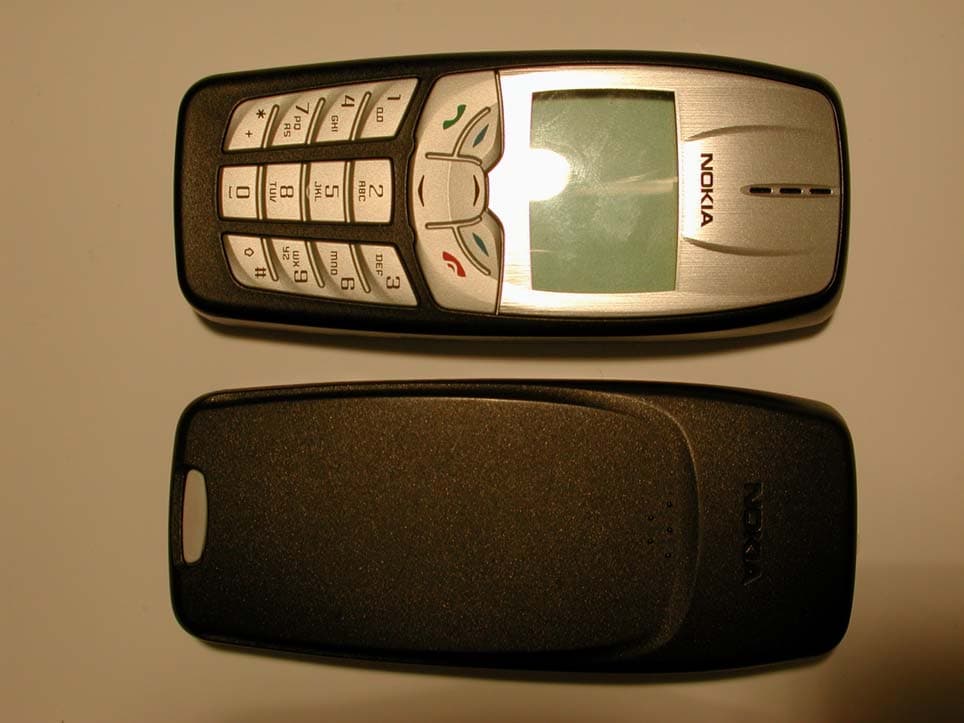
Click to zoom
Application Details
- Equipment Class
- TNE - Licensed Non-Broadcast Transmitter Held to Ear
- Date of Grant
- Jun 18, 2003
- Application Purpose
- Original Equipment
- Date of Application
- Jun 18, 2003
- Equipment Note
- Single Band, Dual Mode Cellular Phone
- Frequency Range
- 824.04000000 - 848.97000000
- Company
- Microsoft Corporation
- Country
- United States
Documents & Files
Document Text
Text extracted from the exhibit documents filed with the FCC. Open a document above to read the original.
Users Manual
User Guide for Nokia 2220/2260 Phone What information is needed? NumbersWhere is the number? My numberWireless service provider Voice mail numberWireless service provider Wireless provider’s numberWireless service provider Provider’s customer careWireless service provider Model number2220 2260 Label on back of phone (under battery). Phone type RH-40 (for 2220) RH-39 (for 2260) Back of title page. Electronic serial number (ESN) Label on back of phone (under battery). See “Find your phone’s label” on page 14. 2220_2260.ENv1_9356390_.book Page i Wednesday, May 28, 2003 4:10 PM The wireless phone described in this guide is approved for use in the TDMA and AMPS networks. LEGAL INFORMATION Part No. 9356390, Issue No. 1a Copyright © 2003 Nokia. All rights reserved. Nokia, Nokia Connecting People, the Nokia Original Accessories logos, Nokia 2220, Nokia 2260, Xpress-on, Pairs II, Space Impact and Snake II are trademarks or registered trademarks of Nokia. All other product and company names mentioned herein may be trademarks or tradenames of their respective owners Printed in Canada 05/2003, electronic file created 05/28/2003 US Patent No 5818437 and other pending patents. T9 text input software Copyright ©1999-2003. Tegic Communications, Inc. All rights reserved. Includes RSA BSAFE cryptographic or security protocol software from RSA Security. The information contained in this user guide was written for the Nokia RH-39 phone and the Nokia RH-40 phone. Nokia operates a policy of continuous development. Nokia reserves the right to make changes and improvements to any of the products described in this document without prior notice. UNDER NO CIRCUMSTANCES SHALL NOKIA BE RESPONSIBLE FOR ANY LOSS OF DATA OR INCOME OR ANY SPECIAL, INCIDENTAL, AND CONSEQUENTIAL OR INDIRECT DAMAGES HOWSOEVER CAUSED. THE CONTENTS OF THIS DOCUMENT ARE PROVIDED “AS IS.” EXCEPT AS REQUIRED BY APPLICABLE LAW, NO WARRANTIES OF ANY KIND, EITHER EXPRESS OR IMPLIED, INCLUDING, BUT NOT LIMITED TO, THE IMPLIED WARRANTIES OF MERCHANTABILITY AND FITNESS FOR A PARTICULAR PURPOSE, ARE MADE IN RELATION TO THE ACCURACY AND RELIABILITY OR CONTENTS OF THIS DOCUMENT. NOKIA RESERVES THE RIGHT TO REVISE THIS DOCUMENT OR WITHDRAW IT AT ANY TIME WITHOUT PRIOR NOTICE. EXPORT CONTROLS This product contains commodities, technology or software exported from the United States in accordance with the Export Administration regulations. Diversion contrary to U.S. or Canadian law is prohibited. FCC/INDUSTRY CANADA NOTICE Your phone may cause TV or radio interference (for example, when using a telephone in close proximity to receiving equipment). The FCC or Industry Canada can require you to stop using your telephone if such interference cannot be eliminated. If you require assistance, contact your local service facility. This device complies with part 15 of the FCC rules. Operation is subject to the condition that this device does not cause harmful interference. 2220_2260.ENv1_9356390_.book Page ii Wednesday, May 28, 2003 4:10 PM Nokia 2220/2260 User GuideLLLCopyright © 2003 Nokia Contents 1 For your safety . . . . . . . . . . . . . . . . . . . . . . . . . . . . . . . . . . . . . . . 1 2 Welcome and quick guide . . . . . . . . . . . . . . . . . . . . . . . . . . . . . . . 5 Get the most out of this guide . . . . . . . . . . . . . . . . . . . . . . . . . . . . . . . . . . . . . . . . . 5 Get started with the quick guide . . . . . . . . . . . . . . . . . . . . . . . . . . . . . . . . . . . . . . . . 7 Understand wireless network services . . . . . . . . . . . . . . . . . . . . . . . . . . . . . . . . . . . 9 Register your phone . . . . . . . . . . . . . . . . . . . . . . . . . . . . . . . . . . . . . . . . . . . . . . . . . . 9 E-newsletters . . . . . . . . . . . . . . . . . . . . . . . . . . . . . . . . . . . . . . . . . . . . . . . . . . . . . . . 9 The antenna . . . . . . . . . . . . . . . . . . . . . . . . . . . . . . . . . . . . . . . . . . . . . . . . . . . . . . . 10 The battery . . . . . . . . . . . . . . . . . . . . . . . . . . . . . . . . . . . . . . . . . . . . . . . . . . . . . . . . 10 Set up your headset . . . . . . . . . . . . . . . . . . . . . . . . . . . . . . . . . . . . . . . . . . . . . . . . . 13 Get help . . . . . . . . . . . . . . . . . . . . . . . . . . . . . . . . . . . . . . . . . . . . . . . . . . . . . . . . . . . 14 3 Basic operations . . . . . . . . . . . . . . . . . . . . . . . . . . . . . . . . . . . . . 17 Switch your phone on or off . . . . . . . . . . . . . . . . . . . . . . . . . . . . . . . . . . . . . . . . . . 17 Make and answer calls . . . . . . . . . . . . . . . . . . . . . . . . . . . . . . . . . . . . . . . . . . . . . . . 17 Check the start screen . . . . . . . . . . . . . . . . . . . . . . . . . . . . . . . . . . . . . . . . . . . . . . . 19 Check in-phone help . . . . . . . . . . . . . . . . . . . . . . . . . . . . . . . . . . . . . . . . . . . . . . . . 20 Browse phone menus . . . . . . . . . . . . . . . . . . . . . . . . . . . . . . . . . . . . . . . . . . . . . . . . 21 Contact list menu . . . . . . . . . . . . . . . . . . . . . . . . . . . . . . . . . . . . . . . . . . . . . . . . . . . 25 4 Text entry . . . . . . . . . . . . . . . . . . . . . . . . . . . . . . . . . . . . . . . . . . 26 Standard text entry . . . . . . . . . . . . . . . . . . . . . . . . . . . . . . . . . . . . . . . . . . . . . . . . . 26 Spaces, punctuation, and special characters entry . . . . . . . . . . . . . . . . . . . . . . . . 27 Predictive text . . . . . . . . . . . . . . . . . . . . . . . . . . . . . . . . . . . . . . . . . . . . . . . . . . . . . . 29 5 Contact list . . . . . . . . . . . . . . . . . . . . . . . . . . . . . . . . . . . . . . . . . 31 Use contact list menus . . . . . . . . . . . . . . . . . . . . . . . . . . . . . . . . . . . . . . . . . . . . . . . 31 Save names, numbers, and e-mail addresses . . . . . . . . . . . . . . . . . . . . . . . . . . . . . 31 Recall names and numbers . . . . . . . . . . . . . . . . . . …
Text truncated - open the document above for the full version.
Attestation Statements
Federal Communications Commission DA 00-132 Before the Federal Communications Commission Washington, D.C. 20554 In the Matter of 911 Call Processing Modes ) ) ) WT Docket No. 99-328 ORDER Adopted: January 27, 2000 Released: January 28, 2000 By the Chief, Wireless Telecommunications Bureau: I. INTRODUCTION AND BACKGROUND 1. In its Second Report and Order in the Wireless E911 Rulemaking, CC Docket No. 94- 102, 1 the Commission adopted Section 22.921 of its rules, 47 C.F.R.§ 22.921. To help improve 911 call completion, this rule requires new analog wireless handsets, and multimode handsets when operating in analog mode, to be able to complete 911 calls to either analog carrier in an area, regardless of the programming of the handset for non-911 calls. The rule takes effect on February 13, 2000. 2 Further, the Commission approved three proposed 911 call processing modes, while stating general principles for other acceptable modes and encouraging the development of further improvements in 911 call completion, including the extension of improved calling methods to digital services. 3 The Commission delegated authority to the Wireless Telecommunications Bureau (Bureau) to consider and approve, deny, or approve with modification new or revised 911 call processing modes. 4 2. On October 27, 1999, Nokia, Inc. filed a letter with the Bureau requesting approval for an alternate 911 call completion method for Nokia’s multi-mode products, including both digital and analog transmission technologies. 5 Nokia describes its method as based on the Automatic A/B Roaming- Intelligent Retry (A/B-IR) method approved in the Second Report and Order , but going further to attempt call completion on all systems on which a handset is capable of operating, including both analog and digital modes. Specifically, Nokia states that its multi-mode handsets will be programmed with the capability to access all systems on which they have the capacity for operating. 6 When a 911 call is dialed, 1 Revision of the Commission’s Rules To Ensure Compatibility With Enhanced 911 Emergency Calling Systems, CC Docket No. 94-102, Second Report and Order, 14 FCC Rcd 10954 (1999). (Second Report and Order). 2 Id. at 10992. See also Revision of the Commission’s Rules To Ensure Compatibility With Enhanced 911 Emergency Calling Systems, CC Docket No. 94-102, Third Memorandum Opinion and Order, FCC 00-7, released January 13, 2000 (Third Memorandum Opinion and Order) at paras. 5-8. 3 Second Report and Order, 14 FCC Rcd at 10993. 4 Id. at 10993, 10995. 5 Letter from David Siddall, Counsel to Nokia, to Thomas Sugrue, Chief, Wireless Telecommunications Bureau, Oct. 27, 1999 (Nokia Request). 6 Nokia Request at 3. Federal Communications Commission DA 00-132 2 the Nokia handset will first attempt to complete the call with the “presently acquired system,” 7 i.e . , the system the handset is currently using for non-emergency calls, whether this system is analog or digital. If the call cannot be completed with that system, the handset will next attempt to complete the call using the handset’s preferred roaming list (PRL). If the call cannot be completed on any of the preferred systems, the handset will attempt to complete the call on any and all additional systems on which it is capable of operating, analog or digital, regardless of the handset’s programmed preferences. 8 3. In a Public Notice in this docket, the Bureau sought comment on this proposal, in particular on whether the proposed method is consistent with the Commission’s rules and the principles set out by the Commission for 911 call processing modes. 9 Comments supporting the proposal were filed by AT&T, Cellular Telecommunications Industry Association (CTIA), and the National Emergency Number Association (NENA). The Wireless Consumer’s Alliance, Inc. (WCA) filed comments opposing the proposal, claiming that the Nokia proposal does not meet conditions adopted by the Commission to mitigate against “lock-in” of calls on the caller’s preferred carrier and delays in 911 call processing. 10 In response to the WCA comments and to Bureau staff requests, Nokia supplied additional information to justify approval of its proposed 911 call completion method. 11 On December 30, 1999, Nokia requested a deferral of the February 13, 2000 deadline for Nokia’s multi-mode handsets until four months after the Commission rules on its call completion proposal, to allow time to implement necessary changes in those handsets. 12 In response to Bureau staff requests, Nokia subsequently provided additional information to justify the requested extension. 13 II. DISCUSSION 4. Based on our review of the Nokia request and the record, we approve Nokia’s proposed 911 call completion method, subject to the same two conditions that the Commission imposed in the Second Report and Order to address lock-in concerns associated with the A/B-IR call completion method. 14 First, the handset must provide effective feedback to inform the user when 911 call processing is underway and has not finished, for example in the form of an audible tone or message in addition to a 7 Id., Attachment at 4. 8 Id at 3. 9 Public Notice, “Comments Sought on 911 Call Processing Method Proposed by Nokia,” DA 99-2508, released Nov.10, 1999. 10 WCA Comments in Opposition to the Nokia Application (WCA Comments). See also Letter from Carl Hilliard, WCA, to Magalie Roman Salas, Secretary, FCC, January 11, 2000 (WCA January 11 Ex parte Letter). 11 See Letter from David Siddall, Counsel to Nokia, to Magalie Roman Salas, Secretary, FCC, December 30, 2000 (Nokia December 30 Ex Parte Letter); Letter from David Siddall, Counsel to Nokia, to Magalie Roman Salas, Secretary, FCC, January 19, 2000 (Nokia January 19 Ex Parte Letter). 12 Letter from David Siddall, Counsel to Nokia, to Thomas Sugrue, Chief, Wireless Telecommunications Bureau, Dec. 30, 1999 (Nokia Waiver Letter) at 2. 13 See Letter from David Siddall, Counsel to Nokia, to Kris Monteith, Chief, Policy D…
Text truncated - open the document above for the full version.
Cover Letter(s)
American Telecommunications Certification Body Inc. 6731 Whittier Ave, McLean, VA 22101 April 29, 2003 RE: Nokia, Inc. FCC ID: GMLRH-40 After a review of the submitted information, I have a few comments on the above referenced Application. EMC Report/General: 1) The top/bottom internal photographs of the main board are too dark to distinguish the components. Please provide clearer top/bottom photographs of the main board. 2) There is conflicting information regarding the frequency and modes of operation for this device throughout this application. Please help clarify the following by providing new exhibits or explanations as necessary: a) The device appears to be a single-band, dual mode phone according to the theory of operation. However the 731 form section 4(a) states a dual band, single mode phone. Additionally, only AMPS information appears to be given on the 731 form, while the application also appears to support additional TDMA functionality in the 800 MHz band. b) The test reports (page 5 of 32) says the tuning bands include 1850-1909.92 while the 731 form only shows 824.04-848.97. However, other information suggest only operation in the 800 MHz band. If the device is capable of tuning to the 1.8 GHz range but will not be manufactured for operation in this range, please provide an explanation as to how the end product will not be capable of transmitting/receiving in this band and how it will be disabled such that the end user can not activate this functionality. c) Information in the users manual, page 105 mentions operation in the 1850.04-1909.92. However the remainder of this application does not appear to support this. 3) The labeling exhibit must include a photograph or drawing showing the placement of the label on the device. Please provide a corrected exhibit which includes this. 4) The List of active Components listed in the Confidentiality letter does not appear to have been provided. Please provide. 5) Please provide information regarding the DC voltages/currents applied into the several elements of the final radio frequency amplifying device for normal operation over the power range as required by 2.1033(c)(8). 6) Please provide information regarding the description of all circuitry and devices provided for determining and stabilizing frequency, for suppression of spurious radiation, for limiting modulation, and for limiting power as required by 2.1033(c)(10). 7) Please provide modulation limiting, frequency response of audio low pass filter, and transmitter audio frequency response as required by 2.1047. Please note that this information is still required as given in Part 2, even though specific requirements specified in Part 22 have recently been removed from the rules. 8) Please provide necessary bandwidth calculations using Carson's Rule for AMPS and occupied bandwidth measurements to show necessary bandwidth for TDMA. 9) The temperature chamber listed in the report appears out of calibration, please comment. 10) FYI. The power listed on the 731 form should match the power as specified by the limits (i.e. conducted, EIRP, ERP, etc.). For Part 22 the limit is specified in ERP, therefore the power on the 731 should be listed as the ERP power measured via the substitution method. z Page 2April 29, 2003 SAR Report: 11) The SAR reports mentions 2 model BLC-2 batteries, while the users manual does not mention the second model. Please explain. 12) The conducted powers given in the EMC/SAR report should not exceed those specified in the tune-up procedure or theory of operation. However, the maximum conducted power for AMPS appears to be greater than that specified in the tune up procedure by 0.3 dB. Please explain. 13) Please explain the use of the 835 MHz dipole only for the body verification and use of the 900 MHz for the head verification. Why wasn’t 835 MHz dipole used for both? 14) Conductivity must be within 5% of recommended values. Please note that conductivity tested on 2/26/03 exceeded this value in the SAR reports for the BOM 1 & BOM 2 (page 9). 15) From the photographs it can not be determined if the device holder surrounded, enclosed, covered, or obstructed the internal antenna. Please explain and provide additional photographs if possible. 16) Please provide the original plots for each of the Z-Axis plots provided (i.e. the original plots for the 2 TDMA Z-axis plots which appear to have been performed on a different day were not provided). Note that not all information is provided on the Z-Axis plot (i.e. Powerdrift). 17) Review of the users manual lists multiple accessories (LPS-3 Inductive Loopset, HAD-9 TTY Adapter, HDC-5 Headset, HDE-2 Headset, HDB-5 Headset, HDC-10 Headset, and CSM-6 leather clip case.). However it appears that only the HDE-2 Headset was tested. Since not all combinations have been tested, a justification must be made as to the determination of the worse case configuration(s). 18) The users manual mentions an accessory CSM-6 case with clip. However, it is not certain whether the clip portion of this device contains any metal. Please explain if this accessory contains any metal. Note that all belt holder accessories containing metal must be tested. 19) Plots should list both liquid and ambient temperatures. It appears that only the liquid temperatures were provided. 20) For course scans, what was the probe tip distance to phantom inner surface? 21) The Z-axis plots provided in the report only confirm a 3-4 cm liquid depth. The FCC likes to be able to confirm that the 15 cm liquid depth was present by supporting photographs or Z-axis data which shows this depth. This was not provided for the actual test. Please confirm that the liquid depth was at least 15 cm. Timothy R. Johnson Examining Engineer mailto: [email protected] The items indicated above must be submitted before processing can continue on the above referenced application. Failure to provide the requested information may result in application termination. Correspondence sho…
Text truncated - open the document above for the full version.
Cover Letter(s)
American Telecommunications Certification Body Inc. 6731 Whittier Ave, McLean, VA 22101 June 13, 2003 RE: Nokia, Inc. FCC ID: GMLRH-40 After a review of the submitted information, I have a few comments on the above referenced Application. EMC Report/General: 1) The label must generally be viewable from the exterior of the device with the exception that it may located inside the battery compartment but not be located on the battery itself. From the photographs provided showing mainly the internal board assemblies, it can not adequately be determined if the label is viewable once the device is assembled. Please provide a photograph with the device fully assembled (but battery compartment open and battery removed as necessary) that shows that the label is viewable. 2) The parts list referenced in previous question 4) does not appear to have been provided. 3) Please comment on the DC voltages associated with the DC currents given in previous question 5. 4) The FCC has recently notified us that we must show compliance off the occupied bandwidth at each Block Edge (A, B, A', B'). However, it only needs to be done for the worse case modulation. The worse-case modulation accepted by the FCC is considered the one with the widest bandwidth since that will require the greatest 1% measurement RBW to be used. 5) Carson's Rule calculations could not be found in the new reports (2M + 2 DK) as specified. Please help me locate these. Additionally, please see examples in the attached document that gives an idea of what we are looking for. 6) The occupied bandwith plot provided for TDMA does not show the measured bandwidth for 99% of the power. Please provide a plot that includes this information. 7) The previous request should have included a request for the occupied bandwidth plots for various AMPS modes as well (unmodulated, voice, SAT, DTMF, SAT + voice, SAT + DTMF). 8) Please explain the use of 2700 Hz in the frequency modulation plots. The FCC has typically preferred 2500 Hz. --- Continued on Next Page --- z Page 2June 13, 2003 SAR Report: 9) Regarding the use of 835 and 900 MHz dipoles, please note that the FCC has specified that the verification must take place within TX Band (See attached OCT 2002 training Day 4 Session 2). Since both were used during this testing we will accept the results. However, please be aware that the FCC could ask for corrected reading and future reports should use the 835 MHz dipole. 10) Regarding previous question 14), the FCC has been asking for new measurements to be made when the 5% tolerance is exceeded. The explanation provide seems to no longer be considered adequate to the FCC. Please reference email attached regarding acceptance > 5%. Timothy R. Johnson Examining Engineer mailto: [email protected] The items indicated above must be submitted before processing can continue on the above referenced application. Failure to provide the requested information may result in application termination. Correspondence should be considered part of the permanent submission and may be viewed from the Internet after a Grant of Equipment Authorization is issued. Please do not respond to this correspondence using the email reply button. In order for your response to be processed expeditiously, you must submit your documents through the AmericanTCB.com website. Also, please note that partial responses increase processing time and should not be submitted. Any questions about the content of this correspondence should be directed to the sender.
Cover Letter(s)
RE: FCC ID GMLRH-40 1 (1) 16-May-03 Responses to ATCB Questions dated April 29, 2003. 1. See updated photo. 2. A and B – the product is a single band, dual-mode product (TDMA/AMPS) that operates only in the 800 MHz frequency range. C – The User Guide is used for both the single- and dual-band versions of this product, and will therefore have information about both. 3. See attached photo excerpt. 4. A full parts list is included per request by the FCC for more than 1 year. This is superceding the limited list that was only showing the active devices. 5. See attached document. 6. See attached document. 7. See attached updated test reports. 8. This information should be in the updated test reports. 9. A calibrated thermometer was used to monitor the temperature, but this information was not placed into the original report. This has been corrected in the updated report. 10. Thank you - your comment is noted. 11. The SAR report mentions a 950mAh BLC-2 and a 1000mAh BLC-2; there are no markings on the batteries to indicate whether they are 950mAh or 1000mAh so the user guide need only state it once. 12. We were testing a worst-case scenario. 13. With head liquid our 835 MHz dipole tends to give validation results close to the upper limit (+10%) of the validation window with results often outside this window. We have discussed this issue with SPEAG and we have ordered another 835 MHz dipole. We are expecting to receive it in June. The same 835 MHz dipole gives expected validation results with body liquid. Our 900 MHz dipole gives expected validation results with head liquid. According to our understanding, validations at 835 MHz with body liquid or at 900 MHz with head liquid are sufficient for 835 MHz head SAR measurements. 14. When conductivity is higher than recommended, the SAR results are overestimated. 15. See attached document. 16. SAR plots have been given for AMPS mode only. As TDMA and AMPS use the same frequencies, SAR distributions are identical. The phone has only one band, only two liquids were used (body and head), so two Z-axis plots would have been sufficient e.g. for BOM 2, head AMPS with result 1.23 and body AMPS with result 1.12. Your comment regarding powerdrift on Z-axis plots is noted. 17. Awaiting information. 18. Awaiting information. 19. Ambient temperature is given in section 4.1. 20. The distance was 1.4 mm. 21. The liquid depth was 15 +/-0.5 cm during the measurements. The Z-axis plots show that there were no harmful reflections from upper surface of the liquid in the depths where the SAR scans take place.
Cover Letter(s)
RE: FCC IC GMLRH-40 1 (1) 296-May-03 Responses to ATCB Questions dated April 29, 2003. 17. All the listed accessories use the same jack plug connector and all the pins are wired. It is evident, that from SAR point of view all those accessories are identical. 18. CSM-6 consists of leather case and plastic clip, but it includes also small metal part, rivet, that attaches leather case and plastic clip together. The metal rivet will be removed and the carry case will be renamed. CSM-6 is taken out from the list of accessories designated for GMLRH-40. Please find updated UG in the upload.
External Photos
Applicant: Nokia, Inc FCC ID GMLRH-40 Copyright © 2003, Nokia, Inc.
ID Label/Location Info
The wireless phone described in this guide is approved for use in the TDMA and AMPS networks. LEGAL INFORMATION Part No. 9356390, Issue No. 1 Copyright © 2003 Nokia. All rights reserved. Nokia, Nokia Connecting People, the Nokia Original Accessories logos, Nokia 2220, Nokia 2260, Xpress-On, Pairs II, Space Impact and Snake II are trademarks or registered trademarks of Nokia. All other product and company names mentioned herein may be trademarks or tradenames of their respective owners Printed in Canada 04/2003 US Patent No 5818437 and other pending patents. T9 text input software Copyright ©1999-2003. Tegic Communications, Inc. All rights reserved. Includes RSA BSAFE cryptographic or security protocol software from RSA Security. The information contained in this user guide was written for the Nokia RH-39 phone and the Nokia RH-40 phone. Nokia operates a policy of continuous development. Nokia reserves the right to make changes and improvements to any of the products described in this document without prior notice. UNDER NO CIRCUMSTANCES SHALL NOKIA BE RESPONSIBLE FOR ANY LOSS OF DATA OR INCOME OR ANY SPECIAL, INCIDENTAL, AND CONSEQUENTIAL OR INDIRECT DAMAGES HOWSOEVER CAUSED. THE CONTENTS OF THIS DOCUMENT ARE PROVIDED “AS IS.” EXCEPT AS REQUIRED BY APPLICABLE LAW, NO WARRANTIES OF ANY KIND, EITHER EXPRESS OR IMPLIED, INCLUDING, BUT NOT LIMITED TO, THE IMPLIED WARRANTIES OF MERCHANTABILITY AND FITNESS FOR A PARTICULAR PURPOSE, ARE MADE IN RELATION TO THE ACCURACY AND RELIABILITY OR CONTENTS OF THIS DOCUMENT. NOKIA RESERVES THE RIGHT TO REVISE THIS DOCUMENT OR WITHDRAW IT AT ANY TIME WITHOUT PRIOR NOTICE. EXPORT CONTROLS This product contains commodities, technology or software exported from the United States in accordance with the Export Administration regulations. Diversion contrary to U.S. or Canadian law is prohibited. FCC/INDUSTRY CANADA NOTICE Your phone may cause TV or radio interference (for example, when using a telephone in close proximity to receiving equipment). The FCC or Industry Canada can require you to stop using your telephone if such interference cannot be eliminated. If you require assistance, contact your local service facility. This device complies with part 15 of the FCC rules. Operation is subject to the condition that this device does not cause harmful interference. MADE IN MEXICO FCC ID: Type: Model: RH-40 XXXX 12345678901 1234567MYDDFL ESN: Code: GMLRH-40 IC: 661N-RH40 Single Band MADE IN MEXICO FCC ID: Type: Model: RH-40 XXXX 12345678901 1234567MYDDFL ESN: Code: GMLRH-40 IC: 661N-RH40
Internal Photos
Applicant Nokia, Inc. FCC ID GMLRH-40 Copyright © 2003 Nokia Inc. Applicant Nokia, Inc. FCC ID GMLRH-40 Copyright © 2003 Nokia Inc. Applicant Nokia, Inc. FCC ID GMLRH-40 Copyright © 2003 Nokia Inc. Antenna Applicant Nokia, Inc. FCC ID GMLRH-40 Copyright © 2003 Nokia Inc.
Internal Photos
Applicant Nokia, Inc. FCC ID GMLRH-40 Copyright © 2003 Nokia Inc.
Operational Description
DOCUMENTTYPE 1 (1) Dallas PCC Prasad Srinivasan 18 th Jan 2002 DC Currents in the RF stage ( All Currents measured are RMS values in milliamperes) Low band TDMA Power Levels Lowest Channel ( # 991) Mid Channel ( # 383) Highest Channel (# 799) 2 202 ma 198 ma 197 ma 3 137 ma 138 ma 122 ma 4 93 ma 94 ma 85 ma 5 51 ma 52 ma 46 ma 6 35 ma 36 ma 33 ma 7 26 ma 27 ma 27 ma 8 20 ma 19 ma 18 ma 9 17 ma 17 ma 15 ma 10 16 ma 16 ma 14 ma High Band TDMA Power Levels Lowest Channel ( # 2) Mid Channel ( # 1000) Highest Channel (# 1998) 2 220 ma 218 ma 242 ma 3 158 ma 147 ma 143 ma 4 117 ma 111 ma 108 ma 5 65 ma 59 ma 58 ma 6 46 ma 43 ma 42 ma 7 38 ma 37 ma 37 ma 8 20 ma 19 ma 19 ma 9 17 ma 17 ma 17 ma 10 15 ma 15 ma 15 ma Low Band AMPS Power Levels Lowest Channel ( #991) Mid Channel (# 383) Highest Channel ( # 799) 2 593 ma 570 ma 561 ma 3 397 ma 396 ma 358 ma 4 274 ma 274 ma 247 ma 5 156 ma 156 ma 141 ma 6 114 ma 114 ma 106 ma 7 87 ma 87 ma 83 ma
RF Exposure Info
Nokia 2220/2260 User Guide 87Copyright © 2003 Nokia Certification Information (SAR) THIS MODEL PHONE MEETS THE GOVERNMENT'S REQUIREMENTS FOR EXPOSURE TO RADIO WAVES. Your wireless phone is a radio transmitter and receiver. It is designed and manufactured not to exceed the emission limits for exposure to radio frequency (RF) energy set by the Federal Communications Commission of the U.S. Government. These limits are part of comprehensive guidelines and establish permitted levels of RF energy for the general population. The guidelines are based on standards that were developed by independent scientific organizations through periodic and thorough evaluation of scientific studies. The standards include a substantial safety margin designed to assure the safety of all persons, regardless of age and health. The exposure standard for wireless mobile phones employs a unit of measurement known as the Specific Absorption Rate, or SAR. The SAR limit set by the FCC is 1.6W/kg.* Tests for SAR are conducted using standard operating positions accepted by the FCC with the phone transmitting at its highest certified power level in all tested frequency bands. Although the SAR is determined at the highest certified power level, the actual SAR level of the phone while operating can be well below the maximum value. This is because the phone is designed to operate at multiple power levels so as to use only the power …
Text truncated - open the document above for the full version.
Contact Information
Applicant
Hasnain Syed(Director, EMC, SI and RF Compliance)
Technical Contact
Nokia Mobile Phones, Inc.Nerina Walton
[email protected]972-894-4501
6000 Connection Drive MS 2:200 · Irving, Texas · United States
Non-Technical Contact
Nokia Mobile PhonesAlan Ewing
[email protected]972-894-4744
Test Firm
Nemko Dallas, Inc.Michael Cantwell
Technical Specifications
| # | Rule Parts | Frequency Range | Power Output | Emission | Tolerance |
|---|---|---|---|---|---|
| 3 | 22H | 824.04 MHz - 848.97 MHz | 493.00 mW | 30K0DXW | 2.5 ppm |
Other Applications from Microsoft Corporation

GMLRM-88A
Apr 11, 2006GSM 850/900/1800/1900MHz Cellphone w/BT
Equipment Class
JBP - Part 15 Class B Computing Device Peripheral
GMLRM-88
Jan 19, 2006GSM 850/900/1800/1900MHz Cellphone w/BT
Equipment Class
DSS - Part 15 Spread Spectrum Transmitter
GMLNPM-10X
Oct 29, 2003Dual Band Mobile Phone
Equipment Class
PCE - PCS Licensed Transmitter held to ear
GMLRH-25
Sep 10, 2003Tri mode Dual Band Cellular Phone
Equipment Class
PCE - PCS Licensed Transmitter held to ear
GMLRH-42
Aug 27, 2003Nokia 2220 single band cellphone
Equipment Class
TNE - Licensed Non-Broadcast Transmitter Held to Ear