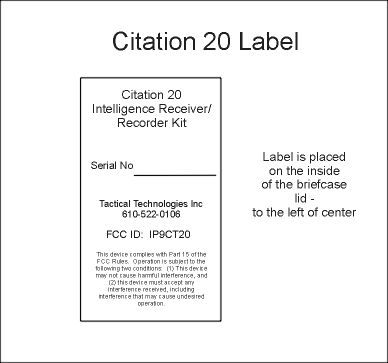
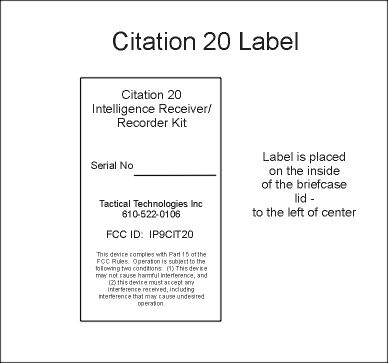
IP9CIT20Intelligence Receiver
Tactical Technologies Inc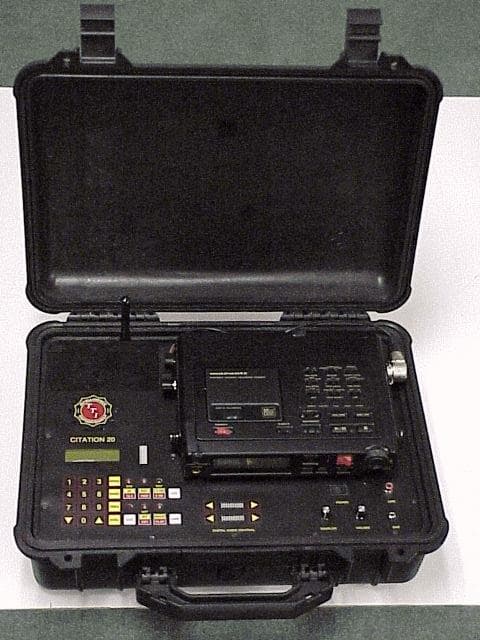
Click to zoom
Application Details
- Equipment Class
- CXX - Communications Rcvr for use w/ licensed Tx and CBs
- Date of Grant
- Oct 12, 2000
- Application Purpose
- Original Equipment
- Date of Application
- Sep 14, 2000
- Equipment Note
- Intelligence Receiver
- Frequency Range
- 150.00000000 - 174.00000000
- Company
- Tactical Technologies Inc
- Country
- United States
Documents & Files
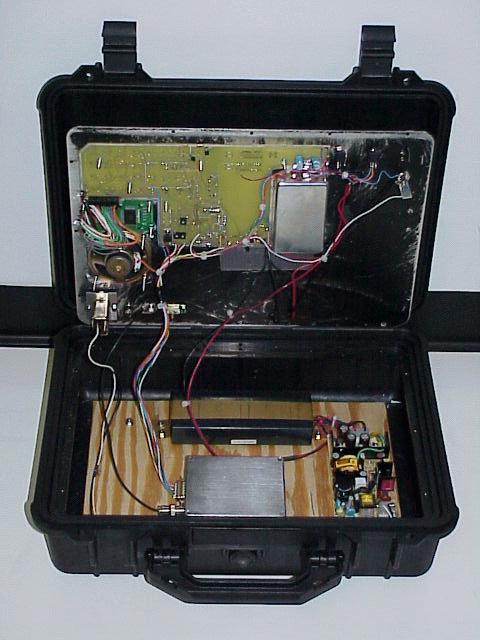
Document Text
Text extracted from the exhibit documents filed with the FCC. Open a document above to read the original.
Users Manual
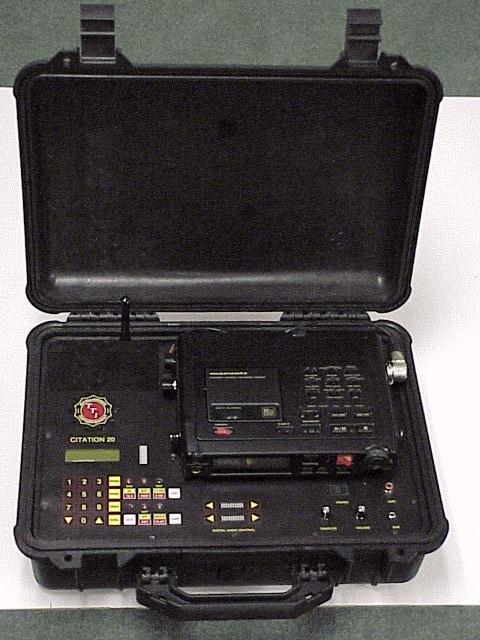
CITATION 20 INTELLIGENCE KIT OPERATING INSTRUCTIONS © Tactical Technologies Inc 2 CITATION 20 SYNTHESIZED INTELLIGENCE KIT DESCRIPTION The Tactical Technologies Inc. CITATION 20 Synthesized Briefcase Intelligence Kit is a multipurpose system designed for portable receiving and/or recording of covert intelligence gathering operations. The receiver is a highly sensitive narrow band synthesized VHF-FM receiver with a 100 channel memory that operates in the 150-174 MHz range and is designed to meet the NTIA-102 narrowband (12.5 kHz channel spacing) standards. The receiver can also be set to receive transmissions from devices designed prior to the NTIA-102 standard (25 kHz channel spacing). An informative LCD display and multiple LED bar graphs highlight the Citation 20's control panel. The unit is easy to program either in the Tech Office or "on the road". The unit's software features a "FIELD SECURE" mode that eliminates the numeric frequency information from the LCD display and leaves only the channel number and the assigned alpha/numeric name. In this mode, the programmed frequency list is protected from additions or subtractions. The recording system comes with a high quality Marantz PMD 201 cassette recorder, and the monitoring system is enhanced with Tactical Technologies Inc.'s own dual band Digital Audio Controls. Bass and/or Treble frequencies of the received audio can be monitored during initial reception, or during playback of a recording. These tonal adaptations will NOT be recorded via the on-board Marantz, thus retaining the integrity of the original recording. Also included as standard equipment is an Adaptive Digital Audio Filter (DSP switch), which can eliminate unwanted background noise from the received audio, or from a pro-recorded session. This ADAF audio also can NOT be recorded via the on-board recorder. The panel includes many illuminated displays and switches - all of which can be turned off so that the panel remains dark for night time operations when this is a necessity. As an option, the CITATION 8 can be equipped with descrambling. This will permit decoded receiving/recording of a scrambled transmission from a compatibly scrambled Tactical Technolo- gies Inc. transmitter or repeater. GENERAL OPERATIONS INITIAL SETUP POWER 1.) Select one of the three possible power sources you will be using during operations. a.) Internal Rechargeable Battery Pack. No additional setup is required. Check to make sure battery if fully charged. See section entitled "CHARGING AND CARING FOR THE INTERNAL BATTERY" b.) External 12 VDC power source. 3 Connect the single pin female connector found on the 12VDC cigarette lighter cable to the male connector found on the left outside panel of the Citation 20 case. Push the cable end connector into the panel mounted connector on the case. Lock the connectors together by rotating the sleeve on the cable end clockwise to thread it onto the panel mounted connector. Hand tighten only. c.) 110 VAC power source. Connect the 3 pin female connector found on the 110 VAC cable to the male connector found on the left outside panel of the Citation 20 case. Locate the correct alignment configuration, and push the cable end connector into the panel mounted connector on the case. 2.) Turn power on by pushing the POWER switch. The LED indicator on the switch should illuminate and the LCD display should come on, indicating that the unit is operational under the selected power source. PROGRAMMING THE CITATION 20 The Citation 20 can store frequency and name information for up to 100 channels in its nonvolatile, internal memory. Use the KEYPAD for data entry and retrieval. LAMP The LAMP key toggles the LCD displays illumination on and off. It is advisable to use the Lamp sparingly during internal battery operations in an effort to conserve battery life. PROGRAMMING A FREQUENCY ... 1.) SELECT A CHANNEL TO BE PROGRAMMED A.) Press the CHNL key. A blinking cursor will appear at the first digit of the NUMERIC CHANNEL NUMBER on the display. Enter a two digit channel number from 00 to 99. Or........ B.) Press the UP ARROW or the DOWN ARROW keys to scroll through the channel numbers. Stop at the desired channel. The Citation 20 retains "last active channel frequency information" in its memory at all times. When changing channels from an active, programmed channel to a blank, non-active channel, the synthesizer will keep the receiver tuned to the last active frequency until a new frequency is either programmed in, or a channel is selected which has been preprogrammed. So even though the display may be on a blank channel, the receiver may still tuned to an active channel. This operation is normal. 2.) ENTER A FREQUENCY FOR THE DISPLAYED CHANNEL Press the FREQ key , then enter the frequency. Once the FREQ key is pressed, the display shows a blinking cursor on the FREQUENCY portion of the display. The frequency portion of the display looks like this: 4 Your data entry begins with the tens column. The hundred's column and the decimal point are permanently displayed. The standard Citation 20 will accept any frequency from 150.0000 MHz through 174.0000 MHz, in 2.5 kilohertz steps. Data entry into the thousandths column must be either a 0, 2, 5, or a 7. The Citation will automatically fill in the last column. A "0" in the thousandths column yields a "0" in the final column, "2" yields a "5", a "5" yields a "0", and a "7" yields a "5". Any other entry in the thousandths column is an invalid entry, and the Citation will return a blinking cursor, requesting valid data. Please see the following example: Your initial entry is 154.65 ....... 154.65 -> you enter "0" -> display shows 154.6500 MHzValid 154.65 -> you enter "1" -> display shows 154.65?? MHzInvalid 154.65 -> you enter "2" -> display shows 154.6525 MHzValid 154.65 -> you enter "3" -> display shows 154.65?? MHzInvalid 154.65 -> you enter "4" -> display shows 154.65?? MHzInvalid 154.65 -> you enter "5" -> display shows 154.655…
Text truncated - open the document above for the full version.
Block Diagram
Citation 20 Receiver FCC ID# IP9CIT20 Frequency Range 150 - 174 Mhz BLOCK DIAGRAM KEYBOARD-------MICROPROCESSORS----------LCD DISPLAY * * TXCO----PLL----OSCILLATOR * * RF PRE-AMP * * * NARROW RF INPUT---RF AMP--------MIXER---IF FILTER---IF AMP BANDPASS * WIDE * FILTER * * * ************************************************* * DISCRIMINATOR *--SCRAMBLER-- DE-EMPAHSISED * * AUDIO---------MULTIPLEXIER---AUDIO---------------SPEAKER * AMPLIFIER----RECORDER * * *--DIGITAL---- AUDIO CONTROL
Contact Information
Applicant
Richard B Snyder(President)
Test Firm
Radiation Sciences IncorporatedDaniel Signore
215-256-4133Fax: 215-256-0775
Technical Specifications
| # | Rule Parts | Frequency Range | Power Output |
|---|---|---|---|
| 1 | 15B | 150 MHz - 174 MHz | - |
Other Applications from Tactical Technologies Inc
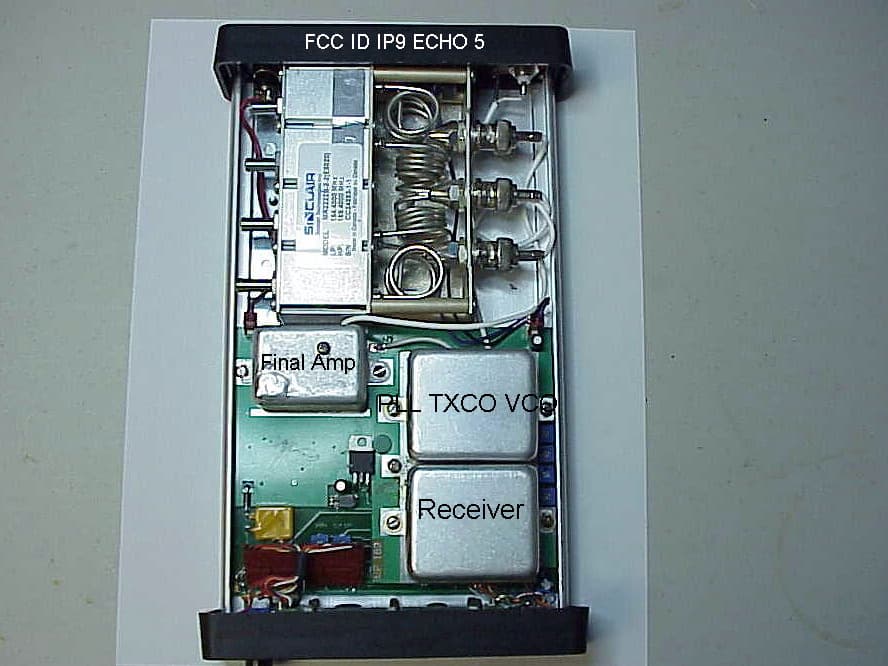
IP9ECHO5
Aug 21, 2005Repeater
Equipment Class
TNB - Licensed Non-Broadcast Station Transmitter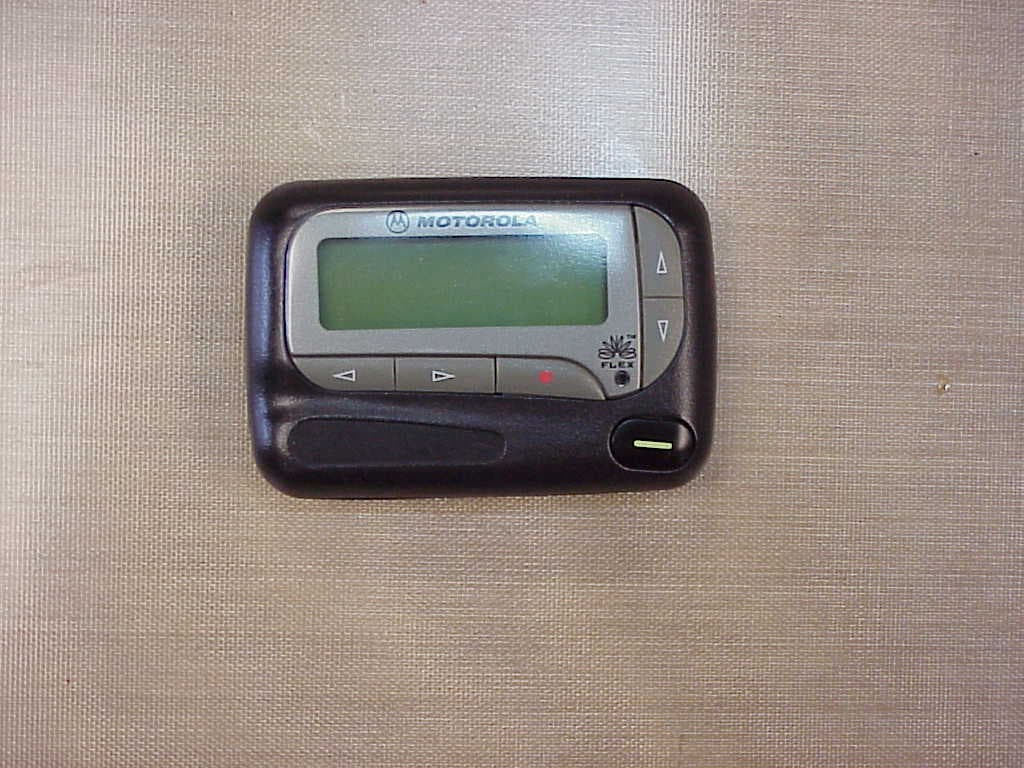
IP9801VI
Jun 22, 2005Synthesized VHF Surveillance Voice Transmitter
Equipment Class
TNT - Licensed Non-Broadcast Transmitter Worn on Body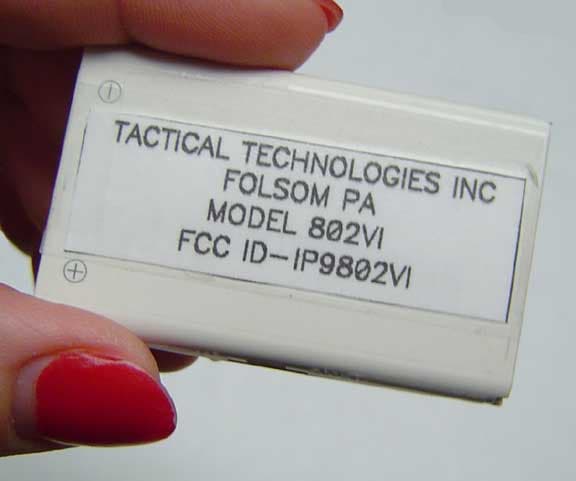
IP9802VI
May 05, 2005Synthesized VHF Surveillance Voice Transmitter
Equipment Class
TNT - Licensed Non-Broadcast Transmitter Worn on Body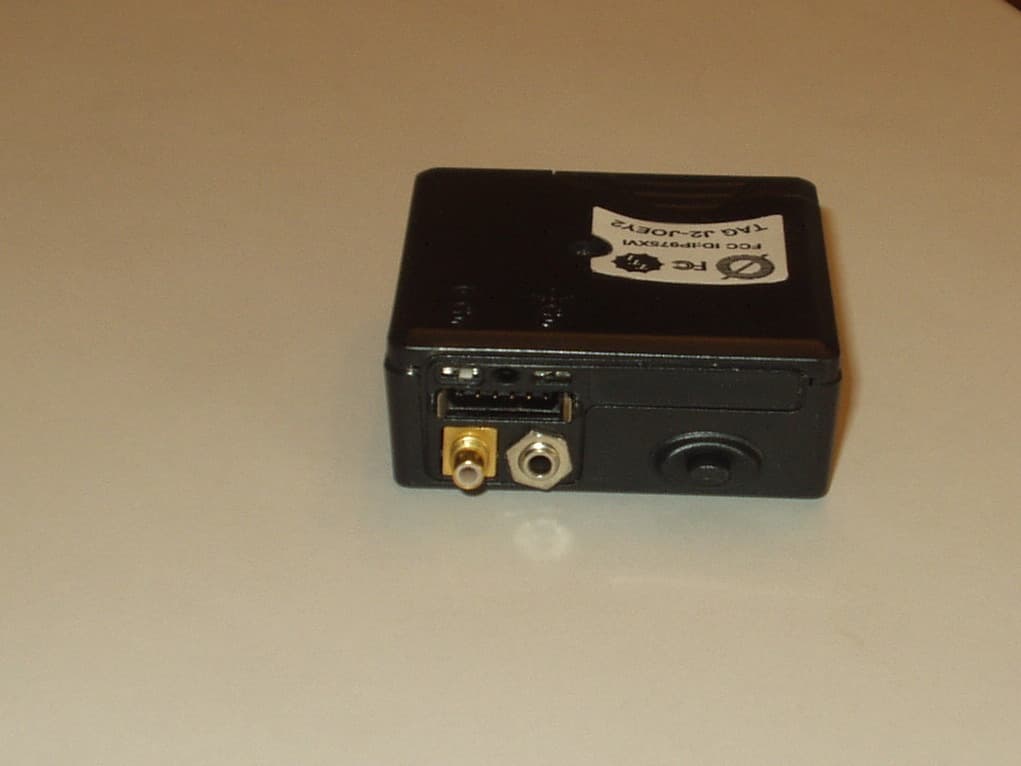
IP975XVI
Mar 28, 2005Synthesized VHF Surveillance Voice Transmitter
Equipment Class
TNT - Licensed Non-Broadcast Transmitter Worn on Body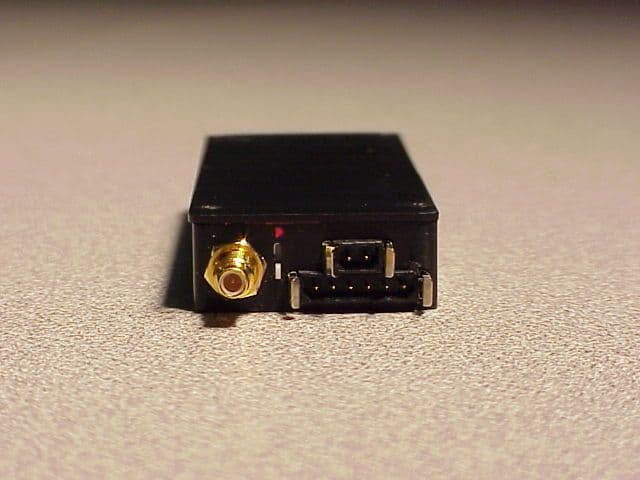
IP9751V
Dec 01, 2002Law Enforcement Surveillance Transmitter
Equipment Class
LMS - Part 90 Location & Monitoring Transmitter