L2C0051TRVehicle Safety Radar
APTIV Services US LLC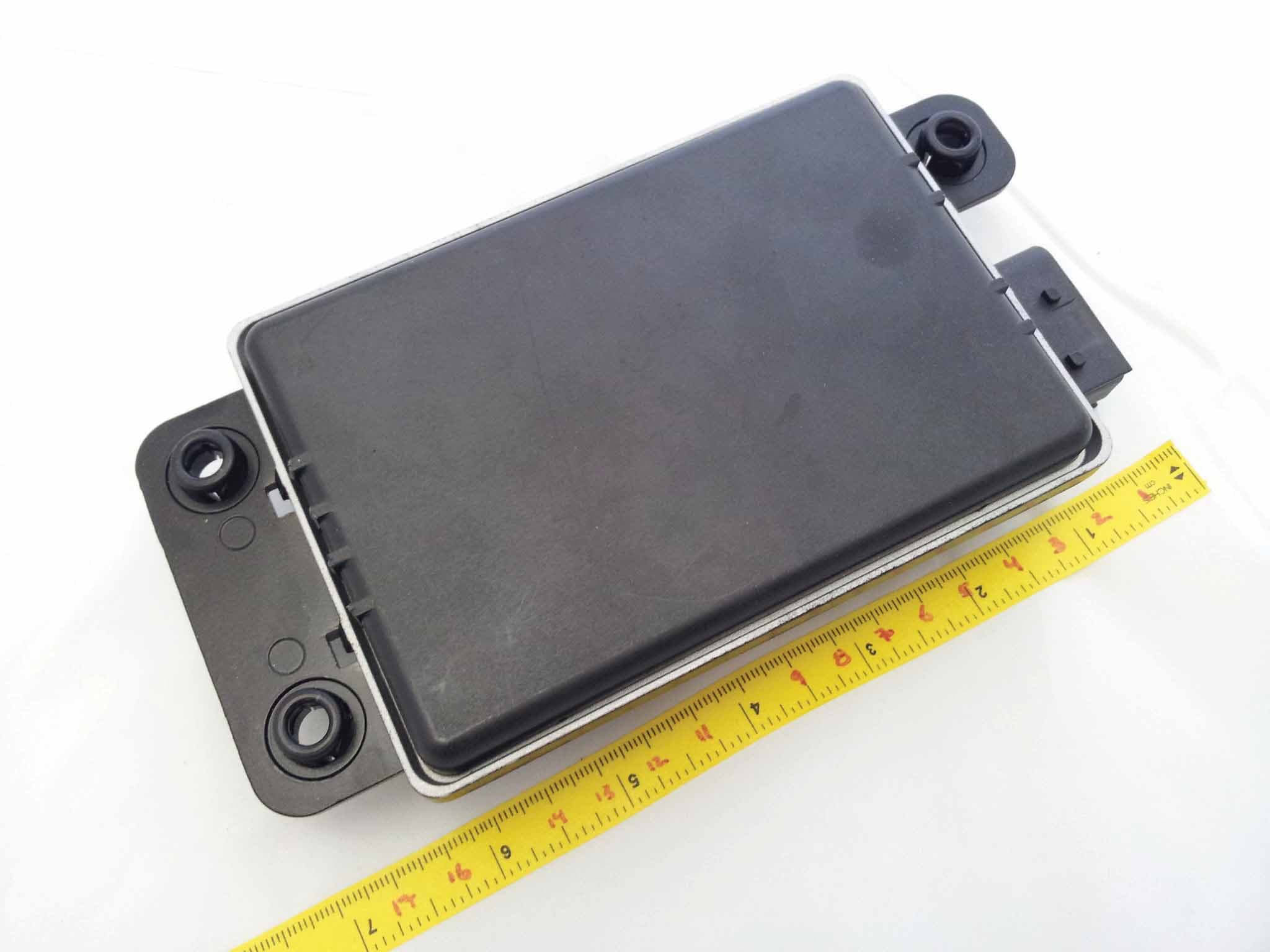
Click to zoom
Application Details
- Equipment Class
- FDS - Part 15 Field Disturbance Sensor
- Date of Grant
- Oct 01, 2012
- Application Purpose
- Original Equipment
- Date of Application
- Sep 30, 2012
- Equipment Note
- Vehicle Safety Radar
- Frequency Range
- 76550.00000000 - 76780.00000000
- Company
- APTIV Services US LLC
- Country
- United States
Documents & Files
Document Text
Text extracted from the exhibit documents filed with the FCC. Open a document above to read the original.
Users Manual
May 4, 2012 Re: Certification for Delphi ESR2.5L Model / FCC ID: L2C0051TR IC: 3432A-0051TR The device under test is manufactured by the grantee (Delphi Electronics & Safety) and sold as an OEM product. Per 47 CFR 2.909, 2.927, 2.931, 2.1033, 15.15(b) etc..., the grantee must ensure the end-user has all applicable / appropriate operating instructions. When end-user instructions are required, as is the case with this product, the grantee must notify the OEM to notify the end-user. Delphi Electronics & Safety will supply the following information to the reseller/distributor dictating what must be included in the end user’s manual for the commercial product. IN FORMATION TO BE INCLUDED IN THE END USER'S MANUAL The following information (in blue) must be included in the end product user’s manual t o ensure continued FCC and Industry Canada regulatory compliance. The ID numbers must be included in the manual if the device label is not readily accessible to the end user. The compliance paragraphs (in blue) below must be included in the user's manual. ************************************************************************ Model / FCC ID: L2C0051TR IC: 3432A-0051TR Th is device complies with Part 15 of the FCC Rules and with Industry Canada license-exempt RSS standard(s). Operation is subject to the following two conditions: (1) This device may not cause harmful interference, and (2) This device must accept any interference received, including interference that may cause undesired operation. Le présent appareil est conforme aux CNR d'Industrie Canada applicables aux appareils radio exempts de licence. L'exploitation est autorisée aux deux conditions suivantes: (1) l'appareil ne doit pas produire de brouillage, et (2) l'utilisateur de l'appareil doit accepter tout brouillage radioélectrique subi, même si le brouillage est susceptible d'en compromettre le fonctionnement. Note: Changes or modifications not expressively approved by the party responsible for compliance could void the user's authority to operate the equipment. The term “IC:” before the radio certification number only signifies that Industry Canada technical specifications were met. Note: This equipment complies with radiation exposure limits set forth for an uncontrolled environment. This equipment should be installed and operated with minimum distance of 20 cm between the radiator and the body of any persons, user or bystander.
Cover Letter(s)
September 12, 2012 Federal Communications Commission Equipment Approval Services P.O. Box 358315 Pittsburgh, PA 15251-5315 Re: Certification for Delphi Radar Model/PN(s): L2C0051TR FCC ID: L2C0051TR IC: 3432A-0051TR Please find enclosed application materials for certification of Delphi Radar. We tested it and found it to comply with FCC Part 15. If there are any questions regarding the application or testing performed, please contact me at the above address or call 734-483-4211, fax 734-647-2106, or e-mail [email protected]. Sincerely, Valdis V. Liepa Research Scientist
Cover Letter(s)
World Headquarters and Customer Center 5725 Delphi Drive Troy, Michigan 48098-2815 USA Federal Communications Commission Applications Processing Branch 7435 Oakland Mills Road Colombia, MD 21046 Re: Letter of Agency for FCC Compliance Testing Please be advised that Delphi Electronics & Safety authorizes Dr. Valdis V. Liepa of the University of Michigan, Department of Electrical Engineering and Computer Science, Ann Arbor, Michigan, to act on our behalf in front of the Federal Communications Commission with respect to all matters relating to certification. Anti-Drug Abuse Certification: I further certify that no party (as defined in 1.2002 of CFR47, 1992) to this application, including myself, is subject to a denial of federal benefits, that includes FCC benefits, pursuant to Section 5301 of the Anti Drug Abuse Act of 1988, 21 U.S.C. 853(a). Dated this 15 th day of November, 2011. By: ___________ _____________ __ Brian Johnson (Signature) Title: Engineering Group Manager email: [email protected] On behalf of: Delphi Electronics & Safety Telephone: (765) 451-5770
Cover Letter(s)
Re: Certification for Delphi Radar FCC ID: L2C0051TR IC: 3432A-0051TR REQUEST FOR CONFIDENTIALITY Pursuant to FCC 47 CRF 0.457(d) and 0.459 and IC RSP-100, Section 10, Delphi requests that a part of the subject application be held confidential. Delphi has spent substantial effort in developing this product and it is one of the first of its kind in industry. Having the subject information easily available to "competition" would negate the advantage they have achieved by developing this product. Not protecting the details of the design will result in financial hardship. Type of Confidentiality Requested Exhibit Short Term Permanent (1) ID Label & Location Short Term Permanent (3) External Photos Short Term Permanent 1 (4) Block Diagram Short Term Permanent (5) Schematics Short Term Permanent (7) Test Setup Photos Short Term Permanent (8) User’s Manual Short Term Permanent (9) Internal Photos Short Term Permanent (10) Parts List & Placement Short Term Permanent (11) RF Exposure Short Term Permanent (12) Description of Operation 1. Block Diagram includes internal oscillator frequency information that the manufacturer considers to be proprietary. Permanent Confidentiality: Delphi requests the exhibits listed above as permanently confidential be permanently withheld from public review. Short-Term Confidentiality (FCC Only): Delphi requests the exhibits selected above as short term confidential be withheld from public view for a period of 45 days from the date of the Grant of Equipment Authorization and prior to marketing. If there are any questions regarding this request, please contact me at the above address or call 734-483-4211, fax 734-647-2106 or e-mail [email protected]. Sincerely, Valdis V. Liepa, Research Scientist University of Michigan
Operational Description
Operational Description: The DUT is named ESR 2.5T, which stands for Electronically Scanned Radar Version 2.5. The “T” indicates “Truck” program. The Device Under Test (DUT) is a 76.5 GHz vehicular radar. The device employs a dynamic chirp modulated transmit array. Multiple receive antennas are used to determine target angular resolution through digital beam forming. When installed on a vehicle, the device will operate when the vehicle is running. The nominal operating voltage is 24.0 VDC. System Requirements The Radar is part of an automotive adaptive cruise control (ACC) system. The vehicle control functions are performed by a separate Controller supplied by Delphi. The Radar is responsible for the sensing functions only. The Radar measures the following parameters and provides these to the Controller: Parameter Operational Range Range 1 meters to 175 meters (long range operation) 1 to 60m (medium range operation) Range Rate -100 meters/sec to +40meters/sec Angle +/-10 degrees Data Update Rate 20 Hz
RF Exposure Info
RF Exposure Statement Requirement: According to CFR 15 §1.1307 (b)(1), systems operating under the provisions of this section shall be operated in a manner that ensures the public is not exposed to radio frequency energy level in excess of the Commission’s guidelines. SAR Testing: The peak EIRP rating of the DUT when employing TX2(LR) mode is 29.8 dBm or 955 mW with an on- time of 17.8 ms in every 53.0 ms period. The Peak EIRP rating of the DUT when in TX1(SR) mode is 21.8 dBm or 151 mW with an on-time of 18.2 ms in every 50.3 ms period, as detailed in the radar test report. Thus, the average output power under normal worst-case operation of the Radar is computed as: EIRPavg (mW) = (955 mW x 17.8 ms + 151 mW x 18.2 ms) / 50.3 ms = 393 mW or 25.9 dBm. Per the calculations below, SAR measurements are not necessary. Health Hazard: The following table summarizes the power density at a minimum separation distance of 5.6 cm and at 20 cm as calculated from FCC OET Bulletin 65. Potential Health Hazard Radiation Level Worst Case Pk EIRP meas. (dBm) Avg EIRP comp. (dBm) S 5.6cm (mW/cm 2 ) S 20cm (mW/cm 2 ) Normal Operation 29.8 25.9 1.0 0.078 The following equations were used in calculating power density (S) 10 )( 10)()( dBGain mWPomWEIRP 2 2 )(4 )( )/( cmR mWEIRP cmmWS , R = 20 cm
Test Report
University of Michigan Radiation Laboratory FCC Part 15 / IC RSS-210/Gen - Test Report No. 417124-641 Page 1 of 12 The University of Michigan Radiation Laboratory 3228 EECS Building Ann Arbor, MI 48109-2122 Tel: (734) 764-0500 Measured Radio Frequency Emissions From Delphi 76.7 GHz Radar FCC ID: L2C0051TR IC: 3432A-0051TR Report No. 417124-641 September 12, 2012 Copyright © 2012 For: Delphi Automotive Systems One Corporate Center, Kokomo, IN 46904-9005 Contact: Bill Lusa e- mail: [email protected] Tel: 734-484-1387 Fax: 734-484-1389 Tests supervised by: Measurements made by: Valdis V. Liepa Report approved by: _____________________ Valdis V. Liepa Test Report Prepared by: Valdis V. Liepa Research Scientist Summary Testing for compliance with FCC Regulations Part 15, Subpart C, Section 253 and Industry Canada RSS- 210 was performed on Delphi 76.7 GHz Radar model L2C0051TR. This device is subject to the Rules and Regulations as a Field Disturbance Device. In testing completed on September 9, 2012, we determined that the L2C0051TR meets FCC/IC regulations for average power density at 3 meters by 35.6 dB in the worst case. Spurious emissions meet out of band emissions regulations by more than 11.9 dB. University of Michigan Radiation Laboratory FCC Part 15 / IC RSS-210/Gen - Test Report No. 417124-641 Page 2 of 12 1. Introduction This Delphi 76.7 GHz Radar was tested for compliance with FCC Regulations, Part 15, adopted under Docket 87-389, April 18, 1989 as subsequently amended, and with Industry Canada RSS-210/Gen, Issue 8, December 2010 . The tests were performed at the University of Michigan Radiation Laboratory following the procedures described in the FCC MM-Wave Test Procedures. Test site description and attenuation characteristics are on file with FCC Laboratory, Columbia, Maryland (FCC Reg. No: 91050) and with Industry Canada, Ottawa, ON (File Ref. No: IC 2057A-1). 2. Test Procedure and Equipment Used The pertinent test equipment commonly used in our facility for measurements is listed in Table 2.1 below. The middle column identifies the specific equipment used in these tests. Table 2.1 Test Equipment. Test Instrument Eqpt. Used Manufacturer/Model Spectrum Analyzer (9kHz-22GHz) Hewlett-Packard 8593A SN: 3107A01358 Spectrum Analyzer (9kHz-26GHz) Hewlett-Packard 8593E, SN: 3412A01131 Spectrum Analyzer (9kHz-26GHz) X Hewlett-Packard 8563E, SN: 3310A01174 Spectrum Analyzer (9kHz-40GHz) X Hewlett-Packard 8564E, SN: 3745A01031 Power Meter Hewlett-Packard, 432A Power Meter Anritsu, ML4803A/MP Harmonic Mixer (26-40 GHz) X Hewlett-Packard 11970A, SN: 3003A08327 Harmonic Mixer (40-60 GHz) X Hewlett-Packard 11970U, SN: 2332A00500 Harmonic Mixer (50-90 GHz) X Hewlett-Packard 11970V, SN: 2521A00179 Harmonic Mixer (75-110 GHz) X Hewlett-Packard 11970W, SN: 2521A00179 Harmonic Mixer (140-220 GHz) X Pacific Millimeter Prod., GMA, SN: 26 S-Band Std. Gain Horn S/A, Model SGH-2.6 C-Band Std. Gain Horn X University of Michigan, NRL design XN-Band Std. Gain Horn X University of Michigan, NRL design X-Band Std. Gain Horn X S/A, Model 12-8.2 X-band horn (8.2- 12.4 GHz) Narda 640 X-band horn (8.2- 12.4 GHz) Scientific Atlanta , 12-8.2, SN: 730 K-band horn (18-26.5 GHz) FXR, Inc., K638KF Ka-band horn (26.5-40 GHz) X FXR, Inc., U638A U-band horn (40-60 GHz) X Custom Microwave, HO19 W-band horn(75-110 GHz) X Custom Microwave, HO10 G-band horn (140-220 GHz) X Custom Microwave, HO5R Bicone Antenna (30-250 MHz) University of Michigan, RLBC-1 Bicone Antenna (200-1000 MHz) University of Michigan, RLBC-2 Dipole Antenna Set (30-1000 MHz) University of Michigan, RLDP-1,-2,-3 Dipole Antenna Set (30-1000 MHz) EMCO 2131C, SN: 992 Active Rod Antenna (30 Hz-50 MHz) EMCO 3301B, SN: 3223 Active Loop Antenna (30 Hz-50 MHz) EMCO 6502, SN:2855 Ridge-horn Antenna (300-5000 MHz) X University of Michigan Amplifier (5-1000 MHz) Avantak, A11-1, A25-1S Amplifier (5-4500 MHz) X Avantak Amplifier (4.5-13 GHz) X Avantek, AFT-12665 Amplifier (6-16 GHz) X Trek Amplifier (16-26 GHz) X Avantek LISN Box University of Michigan Signal Generator Hewlett-Packard 8657B University of Michigan Radiation Laboratory FCC Part 15 / IC RSS-210/Gen - Test Report No. 417124-641 Page 3 of 12 3. Device Under Test 3.1 Identification The Device Under Test (DUT) is a 76-77 GHz vehicular radar employing two distinct chirps (one for Short Range and Long Range detection) using two distinct transmit chain s (planar arrays). The DUT is approximately 18 x 10 x 3. 5 cm in dimension and is designed for use as a forward looking radar on a 24 VDC vehicle. Figure 3.1 Test Configuration Block Diagram 3.2 Variants There is only a single variant of the radar in question. 3.4 Samples A laptop was provided to setup radar functionality over the CAN bus, directing the radar to operate in both the normal dual chirp modulated mode and a CW at the lowest and highest frequencies of each chirp band. The nominal operating voltage is 24 VDC; for testing this was supplied by a laboratory power supply. 3.3 Modes of Operation The DUT is capable of only one normal mode of operation, as tested. Furthermore, the device operates only when the motor vehicle onto which it is installed is running. In normal operation, the DUT transmits alternating Long Range and Short Range chirps using two transmit chains. The Short Range (SR) chirp emanates from the transmit chain TX1 array which exhibits a manufacturer declared nominal gain of 16 dBi. The Long Range (LR) chirp emanates from the transmit chain TX2 array which exhibits a manufacturer declared nominal antenna gain of 22 dBi. Both chains emit uniform broadside patterns (e.g. normal to the radome) The DUT chirps (sweeps) 76.55 to 76.78 GHz and back in 55 us starting with the TX1(SR) mode. The up-sweep is blanked (attenuated) and the down-sweep transmits at full power. The TX1(SR) chirp lasts 18.2 ms. The DUT then switches to TX2(LR) and chirps 76.55 to 76.66 GHz at the same 55 us rate, but transmits only on the second down-sweep (e.g. other sweeps …
Text truncated - open the document above for the full version.
Contact Information
Applicant
Brian W Johnson(Engineering Group Manager)
Technical Contact
University of Michigan/EECSValdis V. Liepa
[email protected]734-483-4211
1301 Beal Avenue · Ann Arbor · United States
Test Firm
University of MichiganValdis Liepa
Technical Specifications
| # | Rule Parts | Frequency Range | Power Output |
|---|---|---|---|
| 1 | 15.253 | 76.55 GHz - 76.78 GHz | 955.00 mW |
Other Applications from APTIV Services US LLC
L2CSRR6PS
Apr 09, 2024SRR6PS
Equipment Class
VRD - Part 95 Vehicular Radar SystemsL2C0093TR
Mar 12, 2024Wireless Charging Module
Equipment Class
8CC - Part 18 Consumer Device
L2C0090TR
Oct 04, 2023Passive entry Keyless Go with tire pressure and door handle monitoring radio frequency module
Equipment Class
DCD - Part 15 Low Power Transmitter Below 1705 kHz
L2C0089TR
Jun 05, 2023FO3-TR903BDA
Equipment Class
DSC - Part 15 Security/Remote Control Transmitter
L2C0084TR
Jul 27, 2021Wireless Power Transfer Charger
Equipment Class
8CC - Part 18 Consumer Device