M5ZTHLWireless Temperature/Humidity Sensor
Mesa Laboratories, Inc.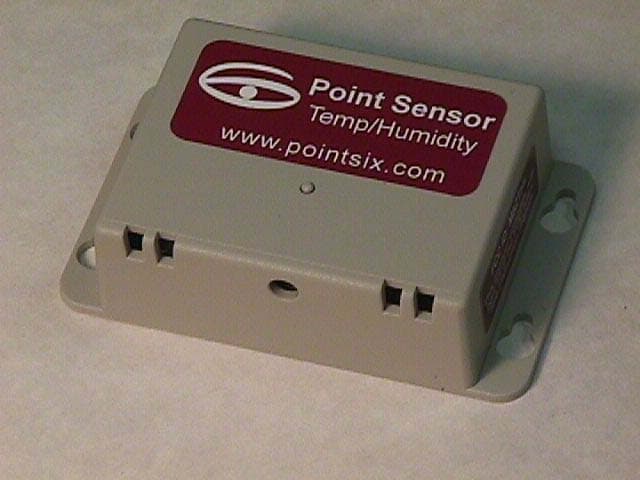
Click to zoom
Application Details
- Equipment Class
- DSC - Part 15 Security/Remote Control Transmitter
- Date of Grant
- Mar 10, 2003
- Application Purpose
- Original Equipment
- Date of Application
- Mar 10, 2003
- Equipment Note
- Wireless Temperature/Humidity Sensor
- Frequency Range
- 417.90000000 - 418.20000000
- Company
- Mesa Laboratories, Inc.
- Country
- United States
Documents & Files
Document Text
Text extracted from the exhibit documents filed with the FCC. Open a document above to read the original.
Users Manual
FCC ID: M5ZTHL Installation and Operation Instructions for the Wireless Temp/Humidity. Point Six, Inc. Wireless Temperature/Relative-Humidity Sensor Model Point Sensor Temp/Humidity Installation and Operation Instructions The Point Sensor Temp/Humidity sensor transmits a digital temperature, relative- humidity (or light level) and a unique serial number to a 418 MHz receiver. The Point Sensor Temp/Humidity is enclosed in a high impact ABS enclosure for direct surface mounting in the environment to be measured. The Point Sensor Temp/Humidity is battery operated. Application: Apply the sensor to the surface to be monitored with double-sided adhesive tape. Make sure that the side labeled with FCC ID is visible and away from any metal surfaces. Service Function: The wireless sensor has an installation mode switch. A momentary push of this switch will start the convert/transmit cycles. When new and until this button is pushed the Point Sensor Temp/Humidity will not transmit. The Point Sensor Temp/Humidity will transmit a special installation status mark in the data packet immediately after the installation/start switch is pushed. After the start a push of the installation switch will result in the immediate transmission of temperature, relative- humidity ID and installation status mark. Battery: A 3.6 Volt lithium battery powers the Point Sensor Temp/Humidity wireless sensor. The battery will last for more than 10 years in the idle state (as shipped from the manufacturer). The Point Sensor Temp/Humidity will transmit data for as long as 5 years at a rate of once each minute once started. The Point Sensor Temp/Humidity is completely covered with a water resistant conformal coating to protect the electronics from the environment and condensation. The user can replace the battery. The Point Sensor Temp/Humidity may be placed in a quiescent state (battery life greater than 10 years) by holding the installation switch closed for more than 4 seconds. FCC ID: M5ZTHL Wireless Sensor Data Format The Point Six, Inc. 418 MHz wireless sensors require a compatible receiver with the ability to receive, error check and provide RS232 and RS422/485 interface. This document describes the data format provided by the HA8-wow 418 MHz. Receiver. The transmit packet from a receiver is approximately 15 milliseconds in duration and consists of 13 bytes of data: 1-byte ID/Mode field 8-byte serial number 2-byte temperature/relative-humidity or temperature/light level 2-byte CRC-16 error check The HA8-wow receiver processes this packet. The receiver performs a CRC-16 error check on the packet. If the data is not accurate it is discarded. When a packet is received that is error free it is converted to a 29-character packet and transmitted out the serial port at 19,200 Baud. The data is transmitted serially in ASCII Hex format and terminated with a CR character. This format requires two bytes for each byte of data; 14 data bytes x 2=28 plus the CR is 29 characters. See the HA8-wow specification for details. The resulting binary data format of the packet is: 1-byte ID field this field will contain a byte whose LSBit indicates the service state of the transmitter, 0=normal, 1=service mode. 8-byte serial# this field contains the serial number of the 1-Wire sensor. 2-byte data this field contains the temperature %RH stored MSB first. The MSbit of the MSB is the sign bit for the temperature value which is stored as the LSB in ½ deg C units. THIS DEVICE COMPLIES WITH PART 15 OF THE FCC RULES, OPERATION IS SUBJECT TO THE FOLLOWING TWO CONDITIONS: (1) THIS DEVICE MAY NOT CAUSE HARMFUL INTERFERENCE AND (2) THIS DEVICE MUST ACCEPT ANY INTERFERENCE RECEIVED, INCLUDING INTERFERENCE THAT MAY CAUSE UNDESERED OPERATION FCC ID: M5ZTHL MADE IN USA FCC ID: M5ZTHL Bits 0-6 of the MSB contain the RH value in %RH (0-100%). In the case of light level bits 0-6 of the MSB is the relative light level. 2-byte CRC-16 this is the originally received data packet CRC as described above. 1-byte checksum the checksum is a mod 256 sum of all the ASCII character values in the response but does not include the CR Example: C8 28AE9105000000AA2D2DD474AB<CR> This field is the mode indicator, the LS-bit which indicates the service state of the transmitter, C8=normal, C7=service mode. C828AE9105000000AA 2D2DD474AB <CR> This field is the unique serial number of the 1-Wire sensor. C828AE9105000000AA2D2D D474AB <CR> This is the temperature and %RH field. The MSBit of the MSByte is low so the temperature is a positive number, 2D is 45 so the temperature is +22.5 C. The %RH is 45. A value on this field of A1F2 would represent a temperature of (242-256)/2 or -7 C and a %RH or 33. Temperature is stored in the LSByte, if the MSBit of the MSB is 1 than the temperature is negative and the conversion math is (n-256)/2 otherwise use n/2. C828AE9105000000AA2D2DD474 AB <CR> This field is the CRC-16 error check as was originally received and checked. This CRC is over the first 11 bytes of the packet starting with the mode flags and ending with inclusion of the temperature data. C828AE9105000000AA2D2DD474AB <CR> This field is the mod 256 sum of all the ASCII character values in the response but does not include the <CR>. C828AE9105000000AA2D2DD474AB <CR> This is the CR terminator, 0Dhex. FCC ID: M5ZTHL FCC Radio Frequency Interference Statement Wireless Temp/Humidity Sensor FCC ID: M5ZTHL NOTE: This equipment has been tested and found to comply with the limits for a Class B digital device, pursuant to Part 15, Subpart B, of the FCC Rules. This equipment generates, uses, and can radiate radio frequency energy. If not installed and used in accordance with the instructions, it may cause interference to radio communications. The limits are designed to provide reasonable protection against such interference in a residential situation. However, there is no guarantee that interference will not occur in a particular installation. If this equipment does cause interference to radio or t…
Text truncated - open the document above for the full version.
Cover Letter(s)
Mar 05, 2003 Federal Communications Commission Equipment Approval Services re: FCC ID: M5ZTHL Gentlemen: Enclosed please find the Point Six, Inc. application for FCC Certification of the Point Six Wireless Analog transmitter, Model Point Sensor Analog. The test data submitted as part of this application were prepared by dBi Corporation, 216 Hillsboro Ave., Lexington, Kentucky 40511-2105. DBi Corporation has A2LA accreditation for EMC testing. Certificate number 1985-01, valid to September 30, 2004. The facility used for radiated measurements is owned by Lexmark International, Inc. and was recognized by the Commission as meeting the requirements of section 2.948 of the Rules via a letter dated August 20, 1998. We submit the information in this application pursuant to the requirements of section 2.1033 and Part 15 of the Federal Communications Commission Rules and Regulations. We request that the Commission grant equipment authorization as soon as it is determined that the attached Application for Equipment Authorization is acceptable. We further request that the schematics and block diagrams of the Point Six Wireless Temperature/Relative Humidity transmitter, Model Point Sensor Temp/Humidity, be treated as confidential information as provided for in 47 CFR Section 0.459 (d) (2). Point Six considers this information to be a trade secret. The schematics and block diagrams are in Word files (included with this application) and are listed as M5ZTHL (Schematics).doc and M5ZTHL (Block-Diag).doc respectively. Thank you in advance for your assistance. If further information is required concerning this application, please do not hesitate to contact me. Sincerely John I. Compton President, Point Six, Inc. Point Six, Inc. 391 Codell Drive Lexington, Ky. 40509 859-266-3606 Fax 266-0702
External Photos
FCC ID: M5ZTHL Wireless Temp/Humidity Sensor Exterior Overall View.
ID Label/Location Info
FCC ID: M5ZTHL FCC label and location of label on the product. FCC ID Label shown on the bottom of Wireless Temp/Humidity Transmitter, Model Point Sensor Temp/Humidity THIS DEVICE COMPLIES WITH PART 15 OF THE FCC RULES, OPERATION IS SUBJECT TO THE FOLLOWING TWO CONDITIONS: (1) THIS DEVICE MAY NOT CAUSE HARMFUL INTERFERENCE AND (2) THIS DEVICE MUST ACCEPT ANY INTERFERENCE RECEIVED, INCLUDING INTERFERENCE THAT MAY CAUSE UNDESERED OPERATION FCC ID: M5ZTHL
Internal Photos
FCC ID: M5ZTHL Top View of the Wireless Temp/Humidity Sensor Board. FCC ID: M5ZTHL Bottom View of the Wireless Temp/Humidity Sensor Board.
Operational Description
FCC ID: M5ZTHL Operational description of the Wireless Sensor, Model Point Sensor Temp/Humidity Description of the circuit functions, ground system and antenna of the Point Six Point Sensor Temp/Humidity Wireless transmitter: The Point Sensor Temp/Humidity wireless temperature-relative humidity sensor is a lithium battery operated, microprocessor based, 418 MHz. transmitter that transmits both digital temperature data, a unique 64-bit serial number and either % Relative humidity or light level data. The microprocessor is brought up from a power down state every 4 seconds by a DS2417 time of day clock interrupt output. Relative humidity and light data are taken from a 12-bit ADC. The temperature is measured with a DS18B20 digital temperature sensor, which has a unique 64-bit serial number that can be read by the microprocessor. The microprocessor counts the 4-second interrupt cycles from the DS2417 clock until the transmit period has expired. The microprocessor then reads the temperature from the previous temperature conversion, combines it with the serial number and % RH or light level data and transmits the entire data packet serially with a Linx Technologies TXM-418-LC-R 418 MHz. Transmitter module. The microprocessor then starts another temperature conversion cycle and powers down into a quiescent state to wait for the next interrupt from the DS2417 clock. The PC board bottom layer is a ground plane and the antenna is a 1/4-wave loop that has been etched in PC board material and placed into the ABS enclosures cover. The entire electronics is coated with conformal coating to protect it from condensation.
Test Report
dBi Corporation FCC Certification Test Report Point Six, Inc. Point Sensor Temperature/Humidity FCC ID M5ZTHL Report Number 03dBi005 Laboratory dBi Corporation 03dBi005 Page 2 of 17 ADMINISTRATIVE INFORMATION Historical Record: Because dBi Corporation is a testing entity, and not a manufacturer, this original test report is being transmitted to the manufacturer. dBi Corporation will keep a copy for its historical records and to satisfy A2LA-Audit requirements. We strongly recommend archiving the unit(s) that we tested to facilitate answering future inquiries regarding this product. FCC Records: The FCC requires the records for Class A or Class B products to be retained by the responsible party for at least two years after the manufacture of said equipment has been permanently discontinued. These records should include the original certification or verification test report, quality audit data, and the test procedures used. Measurement Uncertainties: The Lexmark Electromagnetic Compatibility Laboratory (EMC Lab) has a documented calculation of the measurement uncertainties associated with the tests performed at the Lexmark site. Ongoing Compliance: The data contained in this test report applies only to the specific sample(s) tested, under the test conditions described herein. The manufacturer must ensure that all additional units have similar performance, by assembling them from components with identical electrical and mechanical characteristics. The manufacturer must also ensure that any modifications made to bring the test sample(s) into compliance are implemented on all production units. The manufacturer has full responsibility for ensuring that the product continues to comply with the FCC requirements throughout its manufacturing life. The manufacturer should check all changes to the product that could change its interference profile. A2LA Approval: dBi Corporation has been accredited by the American Association for Laboratory Accreditation (A2LA) for Radiated Emissions and Conducted Emissions testing. Copies of our Accreditation Certificate and Scope of Accreditation follow. The Federal Communications Commission (FCC) recognized the Lexmark site as meeting the requirements of section 2.948 of the FCC Rules in a letter dated December 10, 2001. This information is on file with the FCC under Registration No. 949691. Note: This report may be copied as needed, as long as it is copied in its entirety. dBi Corporation 03dBi005 Page 3 of 17 dBi Corporation 03dBi005 Page 4 of 17 dBi Corporation 03dBi005 Page 5 of 17 ADMINISTRATIVE DATA Manufacturer: Point Six, Inc. 391 Codell Dr Lexington, KY 40509 USA Product: Point Sensor Temperature/Humidity Model/Type Number: None FCC ID: M5ZTHL Rating: Not applicable (internal battery) Summary of Testing: The test data in this report shows that the Point Sensor Temperature/ Humidity complies with FCC 47 CFR Part 15, specifically with Section 15.231(e) for operation in the 418MHz band. Modifications Made to the Equipment Under Test (EUT) in Order to Comply: None. Measurement Equipment Used: see attached data sheets. Measurements According to: FCC 47 CFR Part 15, using ANSI C63.4:1992 Report Prepared by: John R. Barnes KS4GL, PE, NCE, ESDC Eng, SM IEEE Testing Performed by: dBi Corporation 216 Hillsboro Ave Lexington, KY 40511-2105, USA Testing Performed on: February 25-26, 2003 Testing Performed at: Lexmark International, Inc. Development Lab Lexington, KY 40550 USA dBi Corporation 03dBi005 Page 6 of 17 INFORMATION RELATING TO PRODUCT RF INTERFERENCE Product: Point Sensor Temperature/Humidity Model/Type Number: None FCC ID: M5ZTHL Rating: Not applicable (internal battery) Suppression Components: none. Clock Frequencies: 32.768kHz, 4MHz, 418MHz. Cables: None. Electronic Circuit Boards: Temperature/Humidity PC Board, part number P1616 Size of Device: 22 mm high by 80 mm wide by 50 mm deep. Weight 0.05 kg. dBi Corporation 03dBi005 Page 7 of 17 Radiated Emissions 30-4180 MHz Radiated Emission Standards: FCC 47 CFR Part 15, using ANSI C63.4:1992 (Section 15.231(e) limits for operation in the 418MHz band). Product: Point Sensor Temperature/Humidity Model/Type Number: None FCC ID: M5ZTHL Rating: Not applicable (internal battery) Serial Number: 001 Host and Other Peripherals: None Name of Test: Radiated Interference Test Procedure: ANSI C63.4:1992 Test Location: 10m & 3m Semianechoic chambers, Lexmark test facility, located in Lexington, KY Test Distance: 3m Test Instrumentation: See attached sheet Note: Transmitting at 1 second intervals to speed up testing. Test Results: Tables 1, 2, and 3, and the Transmitted Bandwidth measurements show that this unit meets the radiated interference requirements of FCC Part 15, for an intentional radiator licensed to operate at 418MHz under Section 15.231(e). For the fundamental, under Section 15.231(e), the average limit is calculated by linear interpolation from 1500uV/m at 260MHz, to 5000uV/m at 470MHz when measured at 3m. Average limit = ((5000uV/m-1500uV/m)*(418MHz-260MHz)/(470MHz-260MHz))+1500uV/m = 4133uV/m = 20*log(4133) dB(uV/m) = 72.33dB(uV/m). Section 15.35(b) sets the peak limit for the fundamental to 20 dB above the average limit, or 92.33dB(uV/m). For spurious emissions, Section 15.231(e) sets the average limit to 20dB below the maximum permitted fundamental level, or 52.33dB(uV/m). Section 15.231(b)(2) permits this same limit of 52.33dB(uV/m) to be used for quasipeak measurements. Section 15.35(b) sets the peak limit to 20dB above the average limit, or 72.33dB(uV/m). Section 15.209 permits 53.98dB(uV/m) quasipeak from 960-1000MHz, 53.98dB(uV/m) average above 1000MHz, and with Section 15.35(b), 73.98dB(uV/m) peak above 1000MHz when measured at 3m. SIGNED_______________________________DATE February 27, 2003 John R. Barnes KS4GL, PE, NCE, ESDC Eng, SM IEEE, PRESIDENT dBi Corp. dBi Corporation 03dBi005 Page 8 of 17 Radiated Emissions Data 30-4180 MHz TABLE 1 Quasipeak Measurements Receiver Meas. Freq. MHz Vertical Re…
Text truncated - open the document above for the full version.
Test Report
To Whom It May Concern: The Point Six, Inc. wireless Temperature/Humidity transmitter (model Point Sensor Temp/Humidity) transmits a 15-16 millisecond packet once each 600-10 seconds. This is identical to the data packet timing of a previously certified “M5ZWOW”. The packet consists of transmitter-on/transmitter-off timing that represents the serial number and vibration data. The duty cycle is approximately 50%. The packet time can vary with serial number between 14- 16 milliseconds. The packet data is controlled by a microprocessor whose timing is based on a ceramic resonator that is very stable. The packet below (figure #2) illustrates a typical data packet, the worst case, 16 milliseconds, cannot be shown because serial number would have to be forced to make this so. Figure #1 illustrates the overall timing; a packet is sent each 10 seconds in this worst case. The battery used during the tests was new and was a standard 3.6 Volt Lithium cell. The battery is a 3.6 Volt Lithium chemistry, which has a flat discharge curve from new to about 90% used. In this application the battery requires about 5 years to discharge to the point that it cannot be used. The battery was used for no other purpose and had operated in the test unit for only a short time when the test was performed. The label will be Flexcon 2 mil PM200S mylar with a Flexcon 1 mil PM100C Polyester laminate. John I. Compton President, Point Six, inc. Point Six , Inc. 391 Codell Drive Lexington, Ky. 40509 859-266-3606 Fax 271-0702 Figure #1 Overall timing Figure #2 Packet Timing
Test Setup Photos
dBi Corporation 03dBi005 Page 15 of 17 TEST SETUPS RADIATED TEST CONFIGURATION 30-1000MHz dBi Corporation 03dBi005 Page 16 of 17 RADIATED TEST CONFIGURATION 30-1000MHz Three Orthogonal Axes dBi Corporation 03dBi005 Page 17 of 17 RADIATED TEST CONFIGURATION 1000-4180MHz
Contact Information
Applicant
Jasmine Stone(Director of Quality)
Test Firm
Lexmark International, Inc.John Fessler
Technical Specifications
| # | Rule Parts | Frequency Range | Power Output |
|---|---|---|---|
| 1 | 15.231(e) | 417.9 MHz - 418.2 MHz | - |
Other Applications from Mesa Laboratories, Inc.
M5ZTMPC
Apr 23, 2012IR Point Sensor
Equipment Class
DSC - Part 15 Security/Remote Control Transmitter
M5ZFDEZIO
Aug 15, 2007IR Field Disturbance Sensor
Equipment Class
DSC - Part 15 Security/Remote Control Transmitter
M5ZP6HWSO
Mar 14, 2007Temperature Sensor
Equipment Class
DSC - Part 15 Security/Remote Control Transmitter
M5ZIRPROX2
Apr 18, 2006IR Proximity Counter
Equipment Class
DSC - Part 15 Security/Remote Control Transmitter
M5ZIRPC2
Mar 09, 2003IR Counter Transmitter
Equipment Class
DSC - Part 15 Security/Remote Control Transmitter