OPFXB55Connected wrist-watch
BREITLING USA, INC.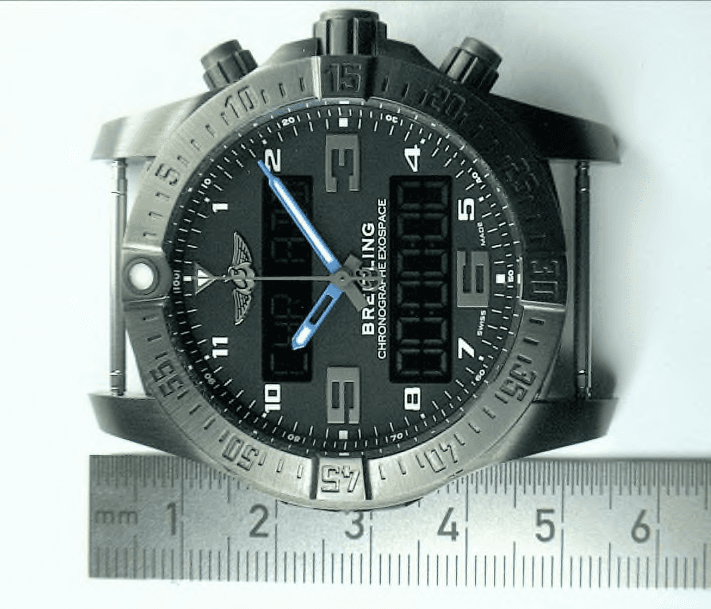
Click to zoom
Application Details
- Equipment Class
- DTS - Digital Transmission System
- Date of Grant
- Nov 01, 2015
- Application Purpose
- Original Equipment
- Date of Application
- Nov 01, 2015
- Equipment Note
- Connected wrist-watch
- Frequency Range
- 2402.00000000 - 2480.00000000
- Company
- BREITLING USA, INC.
- Country
- United States
Documents & Files
Document Text
Text extracted from the exhibit documents filed with the FCC. Open a document above to read the original.
Users Manual
BREITLING EXOSPACE B55 USER MANUAL CONTENTS 1.General instructions a)Reference time and timezones b)Functions c)User interfaces d)Light intensity setting e)“Parking” the hands f)Blocking a function g)Connecting the watch to a smartphone 2.Rechargeable battery and power management a)Rechargeable battery b)Power management c)Battery charging 3.Initializing the watch 4.Adjusting the time base of the watch (UTC) a)Setting ( SET UTC ) 5.Setting the date (SETDATE) 6.Setting the main timezone (TIME) a)Setting ( SETTIME ) 7.Configuring the watch (SETTING) a) SyNCHRO b) TILT ( ON or OFF ) c) LIGHT ( SHORT , MEDIUM or LONG ) d) DISPLAy ( DISP ON or DISPOFF ) e) NIGHT MODE ( ON or OFF ) f) TONE ( OFF , PUSH , PUSH+HR or PUSH+CH ) g) HANDPRK ( 5 MIN or DBLPRES ) h) MODE ( PILOT or SPORT ) i) CONNECT ( ON or OFF ) 8.Date display (DATE) 9.Alarms (AL1toAL7) a)Setting ( SET AL x) b)Use 10. Chronograph with intermediate/split times and tachymeter (CHR ADD) a)Measuring a single time b)Measuring a period with intermediate/split time(s) c)Flyback d)Tachymeter e)Converting units of speed f)Introducing the distance for the tachymeter g)Rereading intermediate times h)Recovering times i)Synchronizing the seconds hand 11. Lap timer chronograph (LAP TMR) a)Recording several laps ( LAP ) b)Synchronizing the seconds hand c)Recovering times 12. Block-to-block and Flight time chronograph (CHRFLGT) a)Setting ( SETFLGT ) b)Recording a block time with flight time c)Recording a flight time alone d)Rereading block times e)Manual introduction of ICAO codes for airports f)Erasing one or more blocks g)Recovering times 13. Countdown countup clock (CDCUCLK) a)Setting ( SETCDCU ) b)Use 14. Countup alarm (ALCU) a)Setting ( SETALCU ) b)Use 15. Countdown (TIMER) a)Setting ( SET TMR ) b)Use 16. Second timezone (TIME 2) a)Setting ( SET T2 ) b) SWAP function c)An example using the SWAP function 17. Notifications received from a smartphone (NOTIFy) a)Reading notifications b)Setting notifications 18. Battery charging status (BATxx%) a) DEEP SLEEP mode b) SOFT SLEEP mode 19. In the event of problems 20. List of words in user interface 21. Certifications 1. GENERAL INSTRUCTIONS This multifunction chronograph, chronometer-certified by the COSC, is equipped with a rechargeable battery. Depending on how it is used, it will need to be charged every 20 to 50 days. It also has the option of connecting to a smartphone such as an AppleiPhone®or Android™(Samsung, ...). The connection is achieved through Bluetooth® Low Energy (BLE) or Bluetooth® Smart. a) Reference time and timezones IMPORTANT: It must be understood that the reference time for the watch is the UTC timezone (standing for Coordinated Universal Time), which corresponds to the former GMT (Greenwich Mean Time) designation. This can be found on the www.breitling.com website. The local time (TIME) and the second timezone (TIME 2) are adjusted according to the time difference with the UTC timezone (in one hour and/or 15-minute increments). b) Functions The following functions are available by default: 1. TIME: Main timezone, permanently indicated by the hands, with the option of displaying the date (DATE) – see chapters 5, 6 and 8. 2. AL 1 to AL 7: seven daily alarms– see chapter 9. 3. CHR ADD: chronograph with intermediate/split times and tachymeter – see chapter 10. 4. LAP TMR: “lap” counter chronograph to calculate lap times – see chapter 11. 5. CHRFLGT: Recording “block times” and/or“flight time”, by memorizing the startm take-off, landing and stop times, as well as the date of the flight and take-off and landing airports – see chapter 12. 6. CDCUCLK (CountDown CountUp CLocK): countdown followed by “long term” chronograph or MET (Mission Elapsed Time) – see chapter 13. 7. ALCU: alarm connected to the mission (MET) chronograph – see chapter 14. 8. TIMER: countdown – see chapter 15. 9. TIME 2: second timezone, can easily be exchanged with the main TIME zone – see chapter 16. 10. UTC: reference time of the watch that must correspond to the UTC time – see chapter 4. 11. NOTIFY: if the watch has been paired with a smartphone, the option exists of receiving notifications of incoming telephone calls, SMS and emails on the watch. In addition, the time of the next meeting taking place during the day can be displayed – see chapter 17. 12. SETTING: various settings that make it possible to configure and personalize the watch – see chapter 7. 13. BAT: Battery charge status indicator – see chapter 18. The three functions, CHRFLGT, CDCUCLK and ALCU, can be temporarily masked if not required (see chapter 7.h). c) User interfaces The watch has 3 central hands (hours H, minutes M and seconds SEC) as well as 2 digital displays: upper screen at 12 o’clock (consisting of 7 alphanumeric digits ███████ ) and lower screen at 6 o’clock (6 digits 88 : 88 : 88 ). The different functions are selected by turning the crown. The latter shows two stable axial positions: – neutral 1 (to change functions) – pulled out 2 (for settings) – as well as an unstable position 0 (which acts as a pushpiece, notably to light up the digital displays). The crown can be turned forwards (clockwise) or backwards (anti-clockwise). If one forgets the winding stem in the pulled out position, the upper screen will display PUSH CROWN at regular intervals, while a beep will sound every 30 seconds. A short press on the crown will light up the two digital displays. If the TILT function has been activated (see chapter 7.b), the light will automatically switch on depending on the position of the wrist. The watch has two pushpieces (P1 at 2 o’clock and P2 at 4 o’clock), whose action is connected to the function selected. Depending on the desired action, the user must give a short or long (about 2 seconds) press. If no action is associated with the pushpieces, NOP will appear in the upper screen. WAIT : indicates that the watch is in the process of calculating. OVF (overflow) indicates that a counter limit has been exceeded. d) Light intensity …
Text truncated - open the document above for the full version.
External Photos
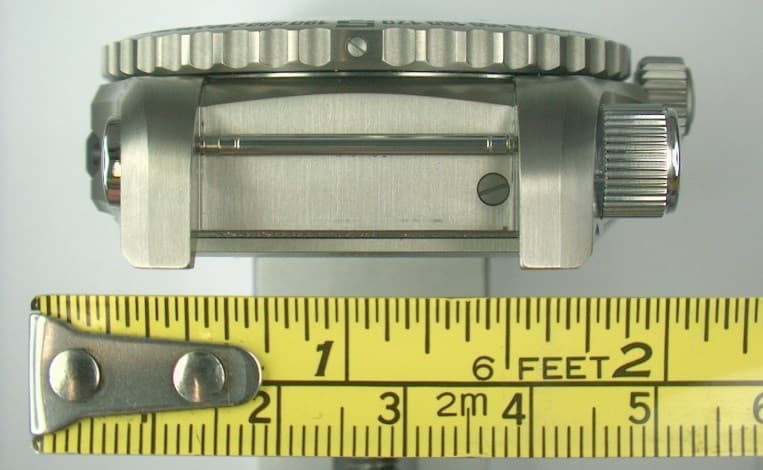
External photos of the watch head Note : -Pictures are made without bracelet, which is available in rubber (different colors) -Watch head could be black or grey -Several dial colors will be available August 2015 B55
Internal Photos
Internal photos of the watch and of the electrical module Opened watch head E-module – A-side E-module – B-side August 2015 B55
RF Exposure Info
RF Exposure FCC FCC ID: OPFXB55 Model: Exospace B55 SAR test exclusion according to KDB447498 ( General RF Exposure Guidance v05r02) Equation from Chapter 4.3.1: Standalone SAR test exclusion considerations (page 11 and ff). (1) Standalone SAR test exclusion for 100 MHz to 6 GHz at test separation distances ≤ 50mm P ≤ (Threshold 1-g;10-g ) * d separation / f (GHz) ½ where P max. Power of channel (incl. tune-up tolerance [mW]) Threshold 1-g;10-g is 3 for 1-g; 7.5 for 10-g d separation is the min. test separation distance in mm (5 mm is used if the distance is less) f (GHz) is the RF channel transmit frequency in GHz The table below gives the calculated maximal power that could be used for source based time averaged conducted power, adjusted for tune up tolerance. If this is below the calculated value SAR testing is obsolete. Bluetooth Low Energy: f in [MHz] d separation [mm]Threshold 1-g;10-g Powerlimit [mW] P max-declared [mW] Exclusion 2402,00539,71,0yes 2440,00539,61,0yes 2480,00539,51,0yes Note: Pmax-declared = Average Power Conducted (Peak Power - Duty cycle correction factor(2.2 dB for Bluetooth LE)) + Tune up tolerance Tune up tolerance declared: +2dB Co-location: no ______________________ Mihail Dorongovskij CETECOM ICT Services GmbH Untertürkheimer Str.6-10 - 66117 Saarbrücken - Germany
Test Setup Photos
Test report no.: 1-0209/15-01-01_AnnexD Page 1 of 7 Annex D This test report annex is electronically signed and valid without handwriting signature. For verification of the electronic signatures, the public keys can be requested at the testing laboratory. Test report annex authorised: Mihail Dorongovskij Testing Manager Radio Communications & EMC Test report no.: 1-0209/15-01-01_AnnexD Page 2 of 7 EUT Test setup photos Photo 1: Photo 2: Test report no.: 1-0209/15-01-01_AnnexD Page 3 of 7 Photo 3: Photo 4: Test report no.: 1-0209/15-01-01_AnnexD Page 4 of 7 Photo 5: Photo 6: Test report no.: 1-0209/15-01-01_AnnexD Page 5 of 7 Photo 7: Photo 8: Test report no.: 1-0209/15-01-01_AnnexD Page 6 of 7 Photo 9: Test report no.: 1-0209/15-01-01_AnnexD Page 7 of 7 Document history Version Applied changes Date of release Initial release 2015-10-14
Contact Information
Applicant
Thierry Prissert(President)
Test Firm
cetecom advanced GmbHGerald Schmidt
Technical Specifications
| # | Rule Parts | Frequency Range | Power Output |
|---|---|---|---|
| 1 | 15C | 2.40 GHz - 2.48 GHz | 1.00 mW |
Other Applications from BREITLING USA, INC.
OPFX763
Jun 09, 2015EMERGENCY
Equipment Class
PLB - Personal Locator Beacons
OPFE56X21-Y
Jul 19, 2000Back-up survival instrument intended for use in the event of aviation accident.
Equipment Class
TNB - Licensed Non-Broadcast Station Transmitter