P4M-DTSS-1900CDMA Data Modem with DTSS-1900
AnyDATA Corporation
Click to zoom
Application Details
- Equipment Class
- PCB - PCS Licensed Transmitter
- Date of Grant
- Apr 01, 2002
- Application Purpose
- Original Equipment
- Date of Application
- Apr 01, 2002
- Equipment Note
- CDMA Data Modem with DTSS-1900
- Frequency Range
- 1851.30000000 - 1908.70000000
- Company
- AnyDATA Corporation
- Country
- United States
Documents & Files
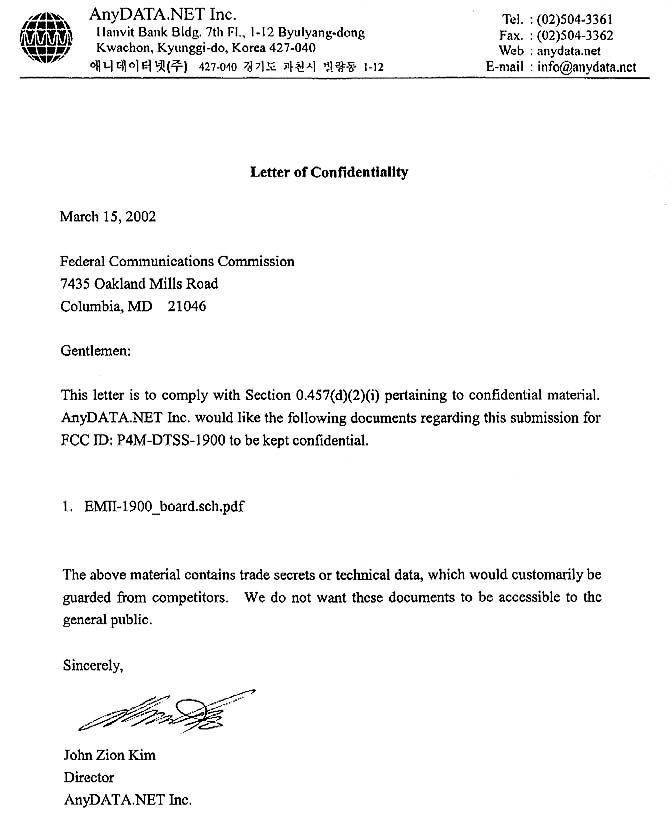
Document Text
Text extracted from the exhibit documents filed with the FCC. Open a document above to read the original.
Users Manual
Interface Description EMII-1900 Service Manual Application Information EMII-1900 V1.0 AnyDATA.NET Proprietary Use Subject to Restrictions 1.9G CDMA Wireless Kit EMII-1900 AnyDATA.NET Inc. Hanvit Bank B/D 6F Byulyang-dong Kwachon KOREA Tel) 82-2-504-3360 Fax) 82-2-504-3362 SERVICE MANUAL Interface Description EMII-1900 Service Manual Application Information EMII-1900 V1.0 AnyDATA.NET Proprietary Use Subject to Restrictions Introduction The EMII-1900 is designed for the test and simulation of the CDMA wireless data communications. User can connect the EMII-1900 to your PC or Notebook and easily test the wireless communications. User can use this to develop your applications software even before user...s own hardware is ready. It also can be used as a debugging during user...s hardware test. Disclaimer and Limitation of Liability AnyDATA.NET Inc. assumes no responsibility for any damage or loss resulting from the misuse of its products. AnyDATA.NET Inc. assumes no responsibility for any loss or claims by third parties, which may arise through the use of its products. AnyDATA.NET Inc. assumes no responsibility for any damage or loss caused by the deletion or loss of data as a result of malfunctions or repairs. The information disclosed herein is the exclusive property of AnyDATA.NET Inc. and no part of this publication may be reproduced or transmitted in any form or by any means including electronic storage, reproduction, adaptation , translation , execution or transmission without the prior written consent of AnyDATA.NET Inc. The information contained in this document is subject to change without notice. FCC RF Exposure Information Warning! Read this information before using this device. In August 1996 the Federal Communications Commission (FCC) of the United States with its action in Report and Order FCC 96-326 adopted an updated safety standard for human exposure to radio frequency electromagnetic energy emitted by FCC regulated transmitters. Those guidelines are consistent with the safety standard previously set by both U.S. and international standards bodies. The design of this device complies with the FCC guidelines and these international standards. Interface Description EMII-1900 Service Manual Application Information EMII-1900 V1.0 AnyDATA.NET Proprietary Use Subject to Restrictions CAUTION n Operating Requirements The user can not make any changes or modifications not expressly approved by the party responsible for compliance, otherwise it could void the user's authority to operate the equipment. To satisfy FCC RF exposure compliance requirements for a mobile transmitting device, this device and its antenna should generally maintain a separation distance of 20cm or more from a person...s body. Special accessories In order to ensure this device in compliance with FCC regulation, the special accessories are provided with this device and must be used with the device only. The user is not allowed to use any other accessories than the special accessories given with this device Interface Description EMII-1900 Service Manual Application Information EMII-1900 V1.0 AnyDATA.NET Proprietary Use Subject to Restrictions Table of Contents General Introduction ................................................................................................................................ 2 CHAPTER 1. System Introduction 1. System Introduction .................................................................................................... 3 2. Features and Advantages of CDMA Module ........................................................... 4 3. Structure and Functions of CDMA Module ............................................................. 7 4. Specification ............................................................................................................... 8 CHAPTER 2. NAM Input Method(Inputting of telephone numbers included) 1. NAM Programming Method and Telephone Number Input Method .........................11 CHAPTER 3. Circuit Description 1. Overview.................................................................................................................... 14 2. RF Transmit/Receive Part ........................................................................................ 14 3. Digital/Voice Processing Part .........................................................................®®.. 17 CHAPTER 4. FCC Notice Appendix .............................................................................................................................. 22 1. Assembly and Disassembly Diagram 2. Block & Circuit Diagram 3. Part List 4. Component Layout Interface Description EMII-1900 Service Manual Application Information EMII-1900 V1.0 AnyDATA.NET Proprietary Use Subject to Restrictions The EMII-1900 functions digital cellular module worked in CDMA (Code Division Multiple Access) mode. CDMA type digital mode applies DSSS (Direct Sequence Spread Spectrum) mode which is used in military. This feature enables the phone to keep communication from being crossed and use one frequency channel by multiple users in the same specific area, resulting that it increases the capacity 10 times more compared with that in the analog mode currently used. Soft/Softer Handoff, Hard Handoff, and Dynamic RF power Control technologies are combined into this phone to reduce the call being interrupted in a middle of talking over phone. CDMA digital cellular network consists of MSC (Mobile Switching Office), BSC (Base Station Controller), BTS (Base station Transmission System), and MS (Mobile Station). Communication between MS and BTS is designed to meet the specification of IS-95A (Common Air Interface). MS meets the specifications of the below : - IS-95A ( Common Air Interface ) : Protocol between MS and BTS - IS-96A ( Vocoder ) : Voice signal coding - IS-98 : Basic MS functions - IS-126 : Voice loopback - IS-99 : Short Message Service, Async Data Service, and G3 Fax Service EMII-1900 is di…
Text truncated - open the document above for the full version.
Users Manual
EMII-1900 V1.0 AnyDATA.NET Proprietary Use Subject to Restrictions EMII-1900 User Manual Application Information EMII-1900-V1.0 February 15, 2002 AnyDATA.NET Inc. Hanvit Bank B/D 6F Byulyang-dong Kwachon KOREA Tel) 82-2-504-3360 Fax) 82-2-504-3362 Interface Description EMII-1900 Reference Manual Application Information EMII-1900 V1.0 AnyDATA.NET Proprietary Use Subject to Restrictions AnyDATA.NET Inc. Hanvit Bank B/D 6F Byulyang-dong Kwachon KOREA Copyright 䬬 2001 AnyDATA.NET Inc. . All rights reserved. Printed in the Republic Of KOREA. All data and information contained in or disclosed by this document are confidential and proprietary information of AnyDATA.NET Inc. , and all rights therein are expressly reserved. By accepting this material, the recipient agrees that this material and the information contained therein are held in confidence and in trust and will not be used, copied, reproduced in whole or in part, nor its contents revealed in any manner to others without the express written permission of AnyDATA.NET Inc. . AnyDATA.NET Proprietary : Restricted Distribution. This document contains critical information about AnyDATA.NET products and may not be distributed to anyone without permission of AnyDATA.NET Inc. All data and information contained in this document are proprietary and confidential information of AnyDATA.NET Inc. No part of this document may be reproduced, in any form or any means without written permission of AnyDATA.NET Inc. Although the information in this document has been carefully reviewed and its believed to be reliable. AnyDATA.NET Inc. does not assume any liability arising out of the application or use of any product described herein, Neither does it convey any license under its patent rights nor rights of others. Send Technical Questions to : [email protected] EMII-1900 Reference Manual Application Information EMII-1900-V1.0 February 15, 2002 Interface Description EMII-1900 Reference Manual Application Information EMII-1900 V1.0 AnyDATA.NET Proprietary Use Subject to Restrictions Introduction The EMII-1900 is designed for the test and simulation of the CDMA wireless data communications. User can connect the EMII-1900 to your PC or Notebook and easily test the wireless communications. User can use this to develop your applications software even before user–s own hardware is ready. It also can be used as a debugging during user–s hardware test. Disclaimer and Limitation of Liability AnyDATA.NET Inc. assumes no responsibility for any damage or loss resulting from the misuse of its products. AnyDATA.NET Inc. assumes no responsibility for any loss or claims by third parties, which may arise through the use of its products. AnyDATA.NET Inc. assumes no responsibility for any damage or loss caused by the deletion or loss of data as a result of malfunctions or repairs. The information disclosed herein is the exclusive property of AnyDATA.NET Inc. and no part of this publication may be reproduced or transmitted in any form or by any means including electronic storage, reproduction, execution or transmission without the prior written consent of AnyDATA.NET Inc. The information contained in this document is subject to change without notice. Reproduction, adaptation or translation of this document is prohibited without prior written permission of AnyDATA.NET Inc. FCC RF Exposure Information Warning! Read this information before using this device. In August 1996 the Federal Communications Commission (FCC) of the United States with its action in Report and Order FCC 96-326 adopted an updated safety standard for human exposure to radio frequency electromagnetic energy emitted by FCC regulated transmitters. Those guidelines are consistent with the safety standard previously set by both U.S. and international standards bodies. The design of this device complies with the FCC guidelines and these international standards. Interface Description EMII-1900 Reference Manual Application Information EMII-1900 V1.0 AnyDATA.NET Proprietary Use Subject to Restrictions CAUTION n Operating Requirements The user can not make any changes or modifications not expressly approved by the party responsible for compliance, otherwise it could void the user's authority to operate the equipment. To satisfy FCC RF exposure compliance requirements for a mobile transmitting device, this device and its antenna should generally maintain a separation distance of 20cm or more from a person–s body. Special accessories In order to ensure this device in compliance with FCC regulation, the special accessories are provided with this device and must be used with the device only. The user is not allowed to use any other accessories than the special accessories given with this device. Interface Description EMII-1900 Reference Manual Application Information EMII-1900 V1.0 AnyDATA.NET Proprietary Use Subject to Restrictions Contents 1 Introduction 1.1 Purpose 1.2 Organization 1.3 Revision History 2 Overview 2.1 Application Description 2.2 Technical Specifications 2.2.1 General Specification 2.2.2 Receive Specification 2.2.3 Transmit Specification 2.2.4 Standards 2.3 Interface Diagram 2.4 EMII-1900 General Features 2.5 Internal Modem Features 3 PIN Description 3.1 8-Pin Connector (RS232 Standard) 3.2 8-Pin Connector (Debugging) 3.3 DC Power Connector 4 Interface Descriptions 4.1 Overview 4.2 RS232 Interface (Standard) Interface Description EMII-1900 Reference Manual Application Information EMII-1900 V1.0 AnyDATA.NET Proprietary Use Subject to Restrictions 5 Electrical Specifications 5.1 Absolute Maximum Ratings 5.2 Recommended Operating Conditions 5.3 Power Consumption 5.4 Serial Interface Electrical Specifications 6 Mechanical Dimension 6.1 EMII-1900 Outline 7 FCC Notice Interface Description EMII-1900 Reference Manual Application Information EMII-1900 V1.0 AnyDATA.NET Proprietary Use Subject to Restrictions 1. Introduction 1.1 Purpose This Manual provides hardware interface and programming information…
Text truncated - open the document above for the full version.
ID Label/Location Info
FCC ID SAMPLE LABEL & LOCATION LABELLING REQUIREMENTS The Label shown shall be permanently affixed at a conspicuous location on the device and be readily visible to the user at the time of purchase.
Operational Description
EMII-1900 1. System Introduction 1.1 CDMA Abstract The cellular system has a channel hand-off function that is used for collecting the information on the locations and movements of radio mobile telephones from the cell site by automatically controlling several cell site through the setup of data transmission routes and thus, enabling one switching system to carry out the automatic remote adjustment. This is to maintain continuously the call state through the automatic location confirmation and automatic radio channel conversion when the busy subscriber moves from the service area of one cell site to that of another by using automatic location confirmation and automatic radio channel conversion functions. The call state can be maintained continuously by the information exchange between switching systems when the busy subscriber moves from one cellular system area to the other cellular system area. In the cellular system, the cell site is a small-sized low output type and utilizes a frequency allocation system that considers mutual interference, in an effort to enable the re-use of corresponding frequency from a cell site separated more than a certain distance. The analog cellular systems are classified further into an AMPS system, E-AMPS System, NMT system, ETACS system, and JTACS system depending on technologies used. Unlike the time division multiple access (TDMA) or frequency division multiple access (FDMA) used in the band limited environment, the Code Division Multiple Access(CDMA) system which is one of digital cellular systems is a multi-access technology under the interference limited environment. It can process more number of subscribers compared to other systems (TDMA system has the processing capacity three times greater than the existing FDMA system whereas CDMA system, about 12~15 times of that of the existing system). CDMA system can be explained as follows: TDMA or SDMA can be used to enable each person to talk alternately or provide a separate room for each person when two persons desire to talk with each other at the same time, whereas FDMA can be used to enable one person to talk in soprano, whereas the other in bass (one of the two talkers can carry out synchronization for hearing in case there is a bandpass filter function in the area of the hearer). Another method available is to make two persons to sing in different languages at the same time, space, and frequency when wishing to let the audience hear the singing without being confused. This is the characteristics of CDMA. On the other hand, when employing the CDMA technology, each signal has a different pseudo-random binary sequence used to spread the spectrum of carrier. A great number of CDMA signals share the same frequency spectrum. In the perspective of frequency area or time area, several CDMA signals are overlapped. Among these types of signals, only desired signal energy is selected and received through the use of pre-determined binary sequence; desired signals can be separated and then, received with the correlator used for recovering the spectrum into its original state. At this time, the spectrums of other signals that have different codes are not recovered into its original state and instead, processed as noise and appears as the self-interference of the system. CHAPTER 1. System Introduction
Parts List/Tune Up Info
Power is factory set
Test Report
Page 1 of 79 Report No.: FC02-020A ANYDATA.NET INC. ADDENDUM TO FC02-020 FOR THE CDMA DATA MODEM W/ DTSS-1900 FCC PART 15 SUBPART B SECTIONS 15.107 AND 15.109 CLASS B AND FCC PART 24 COMPLIANCE DATE OF ISSUE: MARCH 29, 2002 PREPARED FOR: AnyDATA.NET Inc. Hanvit Bank Bldg. 7th Fl., 1-12, Byulyang-dong Kwachon City, Kyunggi-do, Korea, 427-040 PREPARED BY: Joyce Walker CKC Laboratories, Inc. 5473A Clouds Rest Mariposa, CA 95338 P.O. No.: ANY-0005 W.O. No.: 78335 Date of test: February 11 – March 28, 2002 Report No.: FC02-020A This report contains a total of 79 pages and may be reproduced in full only. Partial reproduction may only be done with the written consent of CKC Laboratories, Inc. The results in this report apply only to the items tested, as identified herein. Page 2 of 79 Report No.: FC02-020A TABLE OF CONTENTS Administrative Information ............................................................................................. 3 Summary of Results......................................................................................................... 4 Conditions for Compliance.............................................................................................. 4 Approvals......................................................................................................................... 4 Equipment Under Test (EUT) Description...................................................................... 5 Equipment Under Test..................................................................................................... 5 Peripheral Devices ........................................................................................................... 5 Temperature and Humidity During Testing .................................................................... 5 Measurement Uncertainty................................................................................................ 5 2.1033(c)(3) User’s Manual ............................................................................................ 6 2.1033(c)(4) Type of Emissions ...................................................................................... 6 2.1033(c)(5) Frequency Range ........................................................................................ 6 2.1033(c)(6) Operating Power ......................................................................................... 6 2.1033(c)(7) Maximum Power Rating............................................................................. 6 2.1033(c)(8) DC Voltages ............................................................................................... 6 2.1033(c)(9) Tune-Up Procedure .................................................................................... 6 2.1033(c)(10) Schematics and Circuitry Description ...................................................... 6 2.1033(c)(11) Label and Placement................................................................................. 6 2.1033(c)(12) Submittal Photos....................................................................................... 6 2.1033(c)(13) Modulation Information ........................................................................... 6 2.1033(c)(14)/2.1046/24.232(b) - RF Power Output....................................................... 7 2.1033(c)(14)/2.1047(b) - Modulation Characteristics - Audio Frequency Response .... 11 2.1033(c)(14)/2.1047(b) - Modulation Characteristics - Modulation Limiting Response . 11 2.1033(c)(14)/2.1049(i) - Occupied Bandwidth & Bandedge ......................................... 12 2.1033(c)(14)/2.1051/24.238 - Spurious Emissions at Antenna Terminal...................... 20 2.1033(c)(14)/2.1053/24.238 - Field Strength of Spurious Radiation............................. 29 2.1033(c)(14)/2.1055/24.235 - Frequency Stability ........................................................ 45 2.1091 – MPE Calculations ............................................................................................. 48 15.107 – AC Conducted Emissions – Receive Mode...................................................... 49 15.109 – Radiated Emissions – Receive Mode ............................................................... 62 Appendix A: Customer Supplied CDMA Test Data ....................................................... 70 Page 3 of 79 Report No.: FC02-020A CKC Laboratories, Inc. has received Certificates of Accreditation from the following agencies: A2LA (USA); BSMI (Taiwan); Nemko (Norway); and GOST (Russia). CKC Laboratories, Inc has received test site Registration Acceptance from the following agencies: FCC (USA); VCCI (Japan); and Industry Canada. CKC Laboratories, Inc. has received Letters of Acceptance through an MRA for the following agencies: ACA/NATA (Australia); SABS (South Africa); SWEDAC (Sweden); Radio Communications Agency (RA); HOKLAS (Hong Kong); Bakom (Swiss); BIPT (Belgium); Denmark Telestyrelsen; RvA (Netherlands); SEE (Luxembourg) SITTEL (Bolivia); and UKAS (UK). ADMINISTRATIVE INFORMATION DATE OF TEST: February 11 – March 28, 2002 DATE OF RECEIPT: February 11, 2002 PURPOSE OF TEST: To demonstrate the compliance of the CDMA Data Modem w/ DTSS-1900 with the requirements for FCC Part 15 Subpart B Sections 15.107 and 15.109 Class B and FCC Part 24 devices. Addendum A has corrected plots on pages 15-18. TEST METHOD: ANSI C63.4 (1992), FCC Part 24, TIA/EIA 603, TIA/EIA 95A FREQUENCY RANGE TESTED: 9 kHz – 20 GHz MANUFACTURER: AnyDATA.NET Inc. Hanvit Bank Bldg. 7th Fl., 1-12, Byulyang-dong Kwachon City, Kyunggi-do, Korea, 427-040 REPRESENTATIVE: John Kim TEST LOCATION: CKC Laboratories, Inc. 110 Olinda Place, Brea, CA 92621 5473A Clouds Rest, Mariposa, CA 95338 Page 4 of 79 Report No.: FC02-020A SUMMARY OF RESULTS As received, the AnyDATA.NET Inc. CDMA Data Modem w/ DTSS-1900 was found to be fully compliant with the following standards and specifications: United States ! FCC Part 15 Subpart B Sections 15.107 and 15.109 Cla…
Text truncated - open the document above for the full version.
Contact Information
Applicant
Albert Shin(Head of Product)
Technical Contact
CKC Laboratories, Inc.Mary Ellen Clayton
[email protected]1-800-500-4362
5473A Clouds Rest · Mariposa, California · United States
Non-Technical Contact
CKC Laboratories, Inc.Mary Ellen Clayton
[email protected]1-800-500-4362
Test Firm
CKC Laboratories, Inc.Steve Behm
Technical Specifications
| # | Rule Parts | Frequency Range | Power Output | Emission | Tolerance |
|---|---|---|---|---|---|
| 1 | 24E | 1.85 GHz - 1.91 GHz | 474.00 mW | 1M25F9W | 2.5000000000 ppm |
Other Applications from AnyDATA Corporation

P4M-ACT10
Oct 26, 2014OBD Vehicle Tracking Device
Equipment Class
DTS - Digital Transmission System
P4M-ACT613
Jun 22, 2014Vehicle Tracker
Equipment Class
DSC - Part 15 Security/Remote Control Transmitter
P4M-APT230
Nov 24, 2013CDMA Personal Tracking Device
Equipment Class
PCB - PCS Licensed Transmitter
P4M-ACT233
Jun 05, 20134G Vehicle Tracker with Hotspot
Equipment Class
PCB - PCS Licensed Transmitter
P4M-ACT210
Nov 27, 2012OBD-II Vehicle Tracking Device
Equipment Class
PCB - PCS Licensed Transmitter