PD93165NGWireless Network Adapter
Intel Corporation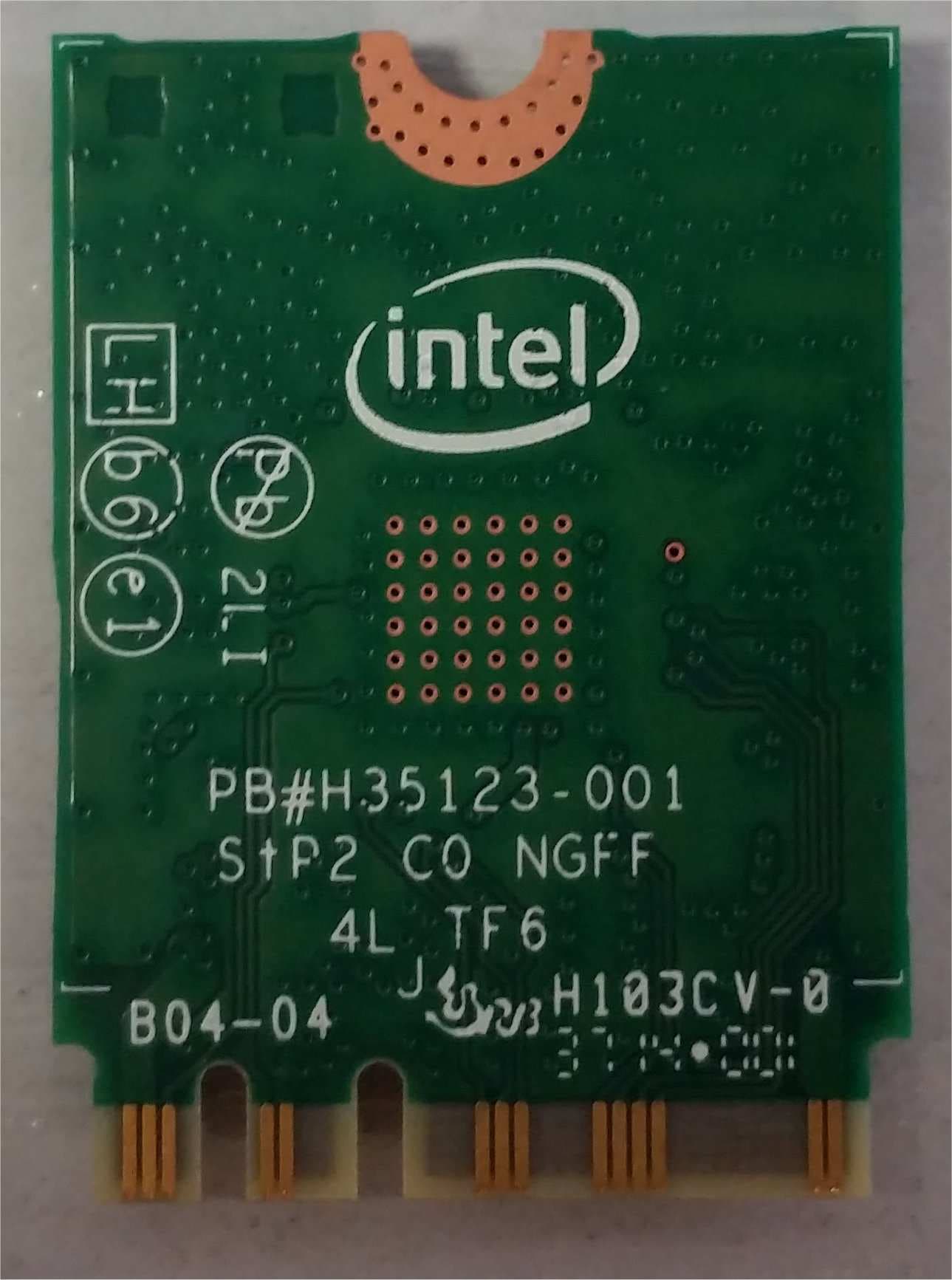
Click to zoom
Application Details
- Equipment Class
- NII - Unlicensed National Information Infrastructure TX
- Date of Grant
- Jan 22, 2015
- Application Purpose
- Original Equipment
- Date of Application
- Jan 22, 2015
- Equipment Note
- Wireless Network Adapter
- Frequency Range
- 5530.00000000 - 5690.00000000
- Company
- Intel Corporation
- Country
- France
Documents & Files
Document Text
Text extracted from the exhibit documents filed with the FCC. Open a document above to read the original.
Users Manual
Intel® WiFi Adapter Information Guide index.htm[12/16/2014 4:29:04 PM] Intel® WiFi Adapter Information Guide This version of Intel® PROSet/Wireless WiFi Software is compatible with the adapters listed below. However, note that newer features provided in this software release are generally not supported for older, legacy adapters. The following adapters are supported on this release for Windows* 8 and Windows* 8.1 with Windows* 7 drivers from Intel®: Intel® Centrino® Wireless-N 100 Intel® Centrino® Wireless-N 130 Intel® Centrino® Wireless-N 1000 Intel® Centrino® Wireless-N 1030 Intel® Centrino® Advanced-N 6200 Intel® Centrino® Advanced-N 6230 The following adapters are supported on this release for Windows* 8 with Windows* 8 drivers from Intel®: Intel® Centrino® Wireless-N 105 Intel® Centrino® Wireless-N 135 Intel® Centrino® Wireless-N 2200 Intel® Centrino® Wireless-N 2230 Intel® Centrino® Wireless-N + WiMAX 6150 Intel® Centrino® Advanced-N 6205 Intel® Centrino® Advanced-N 6235 Intel® Centrino® Advanced-N + WiMAX 6250 Intel® Centrino® Ultimate-N 6300 Intel® Dual Band Wireless-AC 7260 Intel® Dual Band Wireless-N 7260 Intel® Wireless-N 7260 Intel® Dual Band Wireless-AC 3160 Intel® Dual Band Wireless-AC 3165 Intel® Dual Band Wireless-AC 7265 Intel® Dual Band Wireless-N 7265 Intel® Wireless-N 7265 The following adapters are supported on this release for Windows* 8.1 with Windows* 8 drivers from Intel®: Intel® Centrino® Wireless-N 105 Intel® Centrino® Wireless-N 135 Intel® Centrino® Wireless-N 2200 Intel® Centrino® Wireless-N 2230 Intel® Centrino® Wireless-N + WiMAX 6150 Intel® Centrino® Advanced-N 6205 Intel® Centrino® Advanced-N 6235 Intel® Centrino® Advanced-N + WiMAX 6250 Intel® Centrino® Ultimate-N 6300 The following adapters are supported on this release for Windows* 8.1 with Windows* 8.1 drivers from Intel®: Intel® Dual Band Wireless-AC 7260 Intel® Dual Band Wireless-N 7260 Intel® Wireless-N 7260 Intel® Dual Band Wireless-AC 3160 Intel® Dual Band Wireless-AC 3165 Intel® Dual Band Wireless-AC 7265 Intel® Dual Band Wireless-N 7265 Intel® Wireless-N 7265 Intel® Tri-Band Wireless-AC 17260 With your WiFi network card, you can access WiFi networks, share files or printers, or even share your Internet Intel® WiFi Adapter Information Guide index.htm[12/16/2014 4:29:04 PM] connection. All of these features can be explored using a WiFi network in your home or office. This WiFi network solution is designed for both home and business use. Additional users and features can be added as your networking needs grow and change. This guide contains basic information about Intel adapters. It includes information about several adapter properties that you can set to control and enhance the performance of your adapter with your particular wireless network and environment. Intel® wireless adapters enable fast connectivity without wires for desktop and notebook PCs. Adapter Settings Regulatory Information Specifications Important Information Support Warranty Glossary Depending on the model of your Intel WiFi adapter, your adapter is compatible with 802.11a, 802.11b, 802.11g, and 802.11n (draft 2.0) wireless standards. Operating at 5GHz or 2.4GHz frequency at data rates of up to 450 Mbps, you can now connect your computer to existing high-speed networks that use multiple access points within large or small environments. Your WiFi adapter maintains automatic data rate control according to the access point location and signal strength to achieve the fastest possible connection. All of your wireless network connections are easily managed by the WiFi connection utility. Profiles that are set up through the WiFi connection utility provide enhanced security measures with 802.1X network authentication. Information in this document is subject to change without notice. © 2004–2014 Intel Corporation. All rights reserved. Intel Corporation, 5200 N.E. Elam Young Parkway, Hillsboro, OR 97124-6497 USA The copying or reproducing of any material in this document in any manner whatsoever without the written permission of Intel Corporation is strictly forbidden. Intel® is a trademark or registered trademark of Intel Corporation or its subsidiaries in the United States and other countries. Other trademarks and trade names may be used in this document to refer to either the entities claiming the marks and names or their products. Intel disclaims any proprietary interest in trademarks and trade names other than its own. Microsoft and Windows are registered trademarks of Microsoft Corporation. Windows Vista is either a registered trademark or trademark of Microsoft Corporation in the United States and/or other countries. *Other names and brands may be claimed as the property of others. Intel Corporation assumes no responsibility for errors or omissions in this document. Nor does Intel make any commitment to update the information contained herein. "IMPORTANT NOTICE FOR ALL USERS OR DISTRIBUTORS: Intel wireless LAN adapters are engineered, manufactured, tested, and quality checked to ensure that they meet all necessary local and governmental regulatory agency requirements for the regions that they are designated and/or marked to ship into. Because wireless LANs are generally unlicensed devices that share spectrum with radars, satellites, and other licensed and unlicensed devices, it is sometimes necessary to dynamically detect, avoid, and limit usage to avoid interference with these devices. In many instances Intel is required to provide test data to prove regional and local compliance to regional and governmental regulations before certification or approval to use the product is granted. Intel's wireless LAN's EEPROM, firmware, and software driver are designed to carefully control parameters that affect radio operation and to ensure electromagnetic compliance (EMC). These parameters include, without limitation, RF power, spectrum usage, channel scanning, and human exposure. For these reasons Intel cannot permit any manipulation by th…
Text truncated - open the document above for the full version.
Users Manual
Int Next-G 802.11a Experi PROD Intel® 802.1 el® Du Gen 802.11ac W ac, Dual Band, 80 Bluetooth 4.0® (Low Energy) Microsoft Insta ence the Intel Your Ultraboo Intel ® Wireless Always Ready Intel® Smart C Instant Interne Intel® WiFi Ho DUCT BRIEF Dual Band W 1ac, Dual Band ual Ba Wireless More Speed Better Cove Larger Capa 0MHz, 1x1 ® Smart Ready antGo* 2 Support Difference ok™ , On Your TV s Display 3 to Go onnect Technolo et Worldwide tspot Assistant 6 F Wireless-AC 3 d, 1x1 Wi-Fi + and W Excepti The Inte adapter higher c Intel ® C Band W work or d erage acity Delivers more use power co improve Dual mod your fam Maintain email, so Watch yo stunning upgrade experie n ogy 4 Stay curr your dev connect worldwid Delivers acceptin on auto - Combine social ne Inte 165 Bluetooth 4.0 Wireles ional Wi-Fi. Ex el® Dual Band W r lets you move capacity, broad Core™ processo Wireless-AC 316 r on the go. up to 3x faster W ers, broader cov onsumption). Ad channel reliabil de Bluetooth 4.0 miliar devices, suc ns network conne ocial networks, e our PC or Ultrab g image clarity an . Stream movies nce it all, bigger a rent with automa vice is asleep. Co to millions of fre de. instant Internet g a one-time on -pilot as you roam e it with Intel® Sm etworks, news, et l Confidential 0 ss-AC xceptional Fea Wireless-AC 31 e at the speed der coverage a ors and except 65 dramatically Wi-Fi speeds (up verage and bette dvanced optiona ity resulting in b 0® connects to th ch as headsets, k ectivity with very tc. when your sc ook™ content ins nd sound. Intel® s, videos, games, and better than e atic, no-wait upd ombine it with Int ee and paid hots connectivity at m ly terms and con m the Wi-Fi hots mart Connect Te tc.) is automatica C 3165 atures. Excepti 165 802.11ac, of life with fas nd longer batt ional Intel wire y reshapes you p to 433 Mbps 1 ) t r battery life (mo l 802.11ac speci better coverage a he newest low en keyboard, mice a y low power con creen is off in sta stantly without w Wireless Display photos, connec ever before. dates to your em tel® WiFi HotSpo spots to refresh y millions of free a nditions (T&C) lo spot universe—e echnology and yo ally refreshed as 5 onal Connecte dual band, 1x ster speeds (up tery life. Comb eless innovatio ur connected e than 802.11n, m ore data transmi ification feature s and performance nergy Bluetooth® and more. nsumption to ena andby mode. wires on the big y gives you a ser ct with friends, an mail and social ne ot Assistant and your content in and paid hotspo ogin, your Interne even as your mo our favorite clou s you roam. ed Experience x1 Wi-Fi + Bluet p to 433 Mbps 1 ined with 5 th G ons, the Intel® D experience at h more capacity for t efficiencies red s implemented t e. ® products as we able updates to y HD screen with rious entertainm nd more— etworks, even wh automatically more locations t worldwide. Aft et connections a bile device sleep ud content (emai e tooth® 1 ), Gen Dual home, r duce that ll as your ent hen er are ps. il, Intel Confidential Intel® Dual Band Wireless-AC 3165 Technical Specifications General Dimensions (H x W x D) M.2 2230: 22 mm x 30 mm x 2.4 mm [1.5mm Max (Top Side)/ 0.1mm Max (Bottom Side)] Weight M.2 2230: 2.4g Diversit y Supported Radio ON/OFF Control Supported in both hardware and software Connector interface M.2: PCIe, USB LED Output On/Off Operating Temperature (Adapter Shield) 0º to +80° C Humidity Non-Operating 50% to 90% RH non-condensing (at temperatures of 25°C to 35°C) Operating Systems Microsoft Windows 7*, Microsoft Windows 8.1*, Linux* (most features not available on Linux) Wi-Fi Alliance Wi-Fi CERTIFIED* for 802.11ac, Wi-Fi CERTIFIED* a/b/g, Wi-Fi CERTIFIED* n, WMM*, WPA*, WPA2*, and WPS, WPS 2.0, Protected Management Frames, Wi-Fi Direct* for peer to peer device connections Wi-Fi Miracast Source IEEE WLAN Standard IEEE 802.11abgn, 802.11ac, 802.11d, 802.11e, 802.11i, 802.11h, 802.11w Architecture Infrastructure and SoftAP; Supports simultaneous Client and SoftAP modes Roaming 11 Supports seamless roaming between respective access points (802.11b, 802.11g, 802.11a/b/g, 802.11a/b/g/n, and 802.11ac) Bluetooth® Dual Mode Bluetooth* 2.1, 2.1+EDR, 3.0, 4.0 (BLE) Security 12 Authentication WPA and WPA2, 802.1X (EAP-TLS, TTLS, PEAP, LEAP, EAP-FAST), EAP-SIM, EAP-AKA Authentication Protocols PAP, CHAP, TLS, GTC, MS-CHAP*, MS-CHAPv2 Encryption 64-bit and 128-bit WEP, AES-CCMP, TKIP Wi-Fi Direct* Encryption and Authentication WPA2, AES-CCMP Product Safety Management Frame Protection UL, C-UL, CB (IEC 60950-1) 802.11w (WFA- Protected Management Frames) Compliance Government FIPS 13 ,FISMA Product Name Model Number Version Intel ® Dual Band Wireless-AC 3165 3165NGW 802.11ac, 1x1, Bluetooth 4.0®, PCIe, USB, M.2 2230 For more information on Intel® Wireless products, visit intel.com/wireless 1 Based on the theoretical maximum bandwidth enabled by 2x2 802.11ac implementations. Actual wireless throughput and/or range will vary depending on your specific operating system, hardware and software configurations. Check with your PC manufacturer for details. 2 InstantGo is a Microsoft Windows OS feature in 8.1(known as Connected Standby in Microsoft Windows 8 and Microsoft Windows RT). 3 Intel® Wireless Display requires an Intel® Wireless Display enabled PC, tablet, or smartphone, a compatible adapter, and a TV. 1080p and Blu-Ray* or other protected content playback only available on select Intel® processors with built-in visuals enabled. Consult your PC manufacturer. For more information, see www.intel.com/go/widi 4 Intel® Smart Connect Technology requires a select Intel® processor, Intel® software and BIOS update, Intel® Wireless adaptor, and Internet connectivity. Solid state memory or drive equivalent may be required. Depending on system configuration, your results may vary. Contact your system manufacturer for more information. 5 Intel WiFi Hotspot Assistant requires an Intel wireless adapter, Intel® PROSet/Wireless WiFi Software v15.6 or later,…
Text truncated - open the document above for the full version.
Attestation Statements
Intel Corporation 100 Center Point Circle Columbia, SC 29210 January 12, 2015 Federal Communications Commission 7435 Oakland Mills Road Columbia, Maryland 21046 USA Subject: Model 3165NGW Wireless LAN mini-PCIe Card FCC ID: PD93165NG and PD93165NGU IC: 1000M-3165NG Gentlemen: Please be advised that the Model 3165NGW 802.11a/b/g/n/ac + BT Wireless LAN mini- PCIe card is manufactured for the global market but when marketed in the U.S. under FCC IDs PD93165NG & PD93165NGU and in Canada under IC: 1000M-3165NG. The non- volatile memory (NVM) will be programmed at the factory to only actively scan and operate on these specific channels during normal WLAN operation. During Wi-Fi Direct mode the device may act as a group owner (GO) to establish a peer-to-peer (P2P) network including conditions when no master device is present on these specific channels. Channels 1-11, 2412-2462MHz 802.11b mode Channels 1-11, 2412-2462MHz 802.11g mode Channels 1-11, 2412-2462MHz 802.11n mode (20MHz channel) Channels 3-9, 2422-2452MHz 802.11n mode (40MHz channel) The device operates as a client without radar detection capability and will be programmed at the factory to passively scan on the following dynamic frequency selection (DFS) channels and will only listen for a master device and cannot send a probe request to initiate communication on these DFS channels. Accordingly passive scanning provides protection for TDWR operations and preventing transmission in the 5600MHz – 5650MHz frequency band. Client software and drivers will never enable the device to act as a master or GO for operation in DFS frequency bands and therefore ad-hoc mode is always disabled on these passive scan DFS channels. Channels 52-64, 5260-5320MHz 802.11a mode Channels 52-64, 5260-5320MHz 802.11n mode (20 MHz channel) Channels 52-64, 5260-5320MHz 802.11ac mode (20 MHz channel) Channels 54-62, 5270-5310MHz 802.11n mode (40MHz channel) Channels 54-62, 5270-5310MHz 802.11ac mode (40MHz channel) Channel 58, 5290MHz 802.11ac mode (80MHz channel) Channels 100-140, 5500-5700MHz 802.11a mode Channels 100-140, 5500-5700MHz 802.11n mode (20 MHz channel) Intel Corporation 100 Center Point Circle Columbia, SC 29210 Channels 100-144, 5500-5720MHz 802.11ac mode (20 MHz channel) Channels 102-134, 5510-5670MHz 802.11n mode (40MHz channel) Channels 102-142, 5510-5710MHz 802.11ac mode (40MHz channel) Channels 106 &138, 5540 & 5690MHz 802.11ac mode (80MHz channel) This device meets the requirements of FCC Part 15.202 and accordingly will be programmed at the factory to passively scan on the following non-DFS channels and will only listen for a master device and cannot send a probe request to initiate communication during normal WLAN operation. When operating in Wi-Fi Direct mode on these non-DFS channels, it may operate as a P2P client device or GO to establish a P2P network if, and only if, a master device is present and network communication is maintained between a master device and the GO. Channels 12 &13, 2467 & 2472MHz 802.11b mode Channels 12 &13, 2467 & 2472MHz 802.11g mode Channels 12 &13, 2467 & 2472MHz 802.11n mode (20MHz channel) Channels 10 &11, 2457 & 2462MHz 802.11n mode (40MHz channel) Channels 36-48, 5180-5240MHz 802.11a mode Channels 36-48, 5180-5240MHz 802.11n mode (20 MHz channel) Channels 36-48, 5180-5240MHz 802.11ac mode (20 MHz channel) Channels 38-46, 5190-5230MHz 802.11n mode (40MHz channel) Channels 38-46, 5190-5230MHz 802.11ac mode (40MHz channel) Channel 42, 5210MHz 802.11ac mode (80MHz channel) Channels 149-165, 5745-5825MHz 802.11a mode Channels 149-165, 5745-5825MHz 802.11n mode (20 MHz channel) Channels 149-165, 5745-5825MHz 802.11ac mode (20 MHz channel) Channels151-159, 5755-5795MHz 802.11n mode (40MHz channel) Channels151-159, 5755-5795MHz 802.11ac mode (40MHz channel) Channel 155, 5775MHz 802.11ac mode (80MHz channel) This information when programmed into the NVM will not be accessible and cannot be changed by the end user. The transmitter is approved as a non-software defined radio and OEMs and third party system integrators do not have the ability through software to allow configuration controls that would permit the device to operate outside the grant conditions per FCC KDB 594280. Sincerely, Steven C. Hackett Wireless Regulatory Engineer Intel Corporation – Mobile Wireless Group
Cover Letter(s)
100 Center Point Circle Columbia, SC 29210 Authority to Act as Agent January 12, 2015 American Certification Body, Inc. 6731 Whittier Avenue Suite C110 McLean, VA 22101 To Whom It May Concern: AT4 Wireless is authorized to act on our behalf, until otherwise notified, for applications to American Certification Body, Inc. (ACB). Intel retains the rights to communicate or obtain information directly from ACB or AT4 Wireless at our discretion at any time regarding applications made on our behalf. We certify that we are not subject to denial of federal benefits, that includes FCC benefits, pursuant to Section 5301 of the Anti-Drug Abuse Act of 1988, 21 U.S.C. 862. Further, no party, as defined in 47 CFR 1.2002 (b), to the application is subject to denial of federal benefits, that includes FCC benefits. Thank you, Agency Agreement Expiration Date: January 12, 2015 By: Steven C. Hackett (Signature 1 ) (Print name) Title: Wireless Regulations Engineer On behalf of: Intel Mobile Communications (Company Name) Telephone: 803-216-2344
Cover Letter(s)
100 Center Point Circle Columbia, SC 29210 January 12, 2015 Subject: Confidentiality Request for FCC ID: PD93165NG and PD93165NGU Pursuant to FCC 47 CRF 0.457(d) and 0.459 the applicant requests that a part of the subject FCC application be held confidential. Type of Confidentiality Requested Exhibit Short Term Permanent Block Diagrams Short Term External Photos Short Term Permanent Internal Photos Short Term Permanent Operation Description/Antenna Specification Short Term Permanent Operation Description/HW Theory of Operation Short Term Permanent Operational Description/BT FHSS Description Short Term Permanent Operational Description/BiOS Lock Feature Short Term Permanent Schematics Short Term Test Setup Photos Short Term Permanent User’s Manual Intel Mobile Communications has spent substantial effort in developing this product and it is one of the first of its kind in industry. Having the subject information easily available to "competition" would negate the advantage they have achieved by developing this product. Not protecting the details of the design will result in financial hardship. Permanent Confidentiality: The applicant requests the exhibits listed above as permanently confidential be permanently withheld from public review due to materials that contain trade secrets and proprietary information not customarily released to the public. Short-Term Confidentiality: The applicant requests the exhibits selected above as short term confidential be withheld from public view for a period of 180 days from the date of the Grant of Equipment Authorization and prior to marketing. This is to avoid premature release of sensitive information prior to marketing or release of the product to the public. Applicant is also aware that they are responsible to notify ACB in the event information regarding the product or the product is made available to the public. ACB will then release the documents listed above for public disclosure pursuant to FCC Public Notice DA 04-1705. Sincerely, Steven C. Hackett By: __________________________ ________________________ (Signature/Title 1 ) (Print Name)
Cover Letter(s)
Intel Corporation 100 Center Point Circle Columbia, SC 29210 Modular Approval Requirements Attestation FCC ID: PD93165NG and PD93165NGU Modular Approval is being requested for this device under the ID’s listed above. This device is a self contained, physically delineated, component for which compliance was demonstrated independent of any host operating conditions and complies with all eight requirements of FCC Part 15.212(a)(1). The details of these requirements and the manner in which the devices meet them are summarized below. The module must have its own RF shielding. The module contains a metal shield which covers all RF components and circuitry; this shield is located on the top side of the board located next to the antenna connectors. All modulation and data input(s) are buffered. Data to the modulation circuit is buffered on the module; please refer to the “theory of operation” document filed with this application for full description. The module has its own power supply regulation and local reference oscillator. The module contains its own power supply regulation and the rf reference oscillator is contained within the module. Please refer to the schematics and “theory of operation” documents filed with this application for full description. The modular transmitter must comply with the antenna requirements of Section 15.203 and 15.204(c). The certification submission contains a detailed description of all antennas that will be used with the module. The module connects to its antenna via using an UFL type connector. This antenna connector is a non-standard connector. The antenna tested was a PIFA type and the data sheet is included in the application. The modular transmitter must be tested in a stand-alone configuration, i.e., the module must not be inside another device during testing. Test data contained in this application is for the device tested as a stand-alone device connected externally to a PC. See test set-up photographs filed with this application. For the FCC, the modular transmitter must be labeled with its own FCC ID number, and, if the FCC ID is not visible when the module is installed inside another device, then the outside of the device into which the module is installed must also display a label referring to the Intel Corporation 100 Center Point Circle Columbia, SC 29210 enclosed module. This exterior label can use wording such as the following: “Contains Transmitter Module FCC ID: XYZMODEL1” or “Contains FCC ID: XYZMODEL1.” For Industry Canada, the module meets certification labeling requirements for Category I Equipment. The module is appropriately labeled (refer to the label and label location drawings contained within this application). Information to the integrator of this device regarding the labeling requirements for the host system is contained in the instructions provided with the module. The modular transmitter must comply with any applicable RF exposure requirements. The module meets the requirements for a mobile/portable device that may be used at separation distances of more than 8mm from the human body. Refer to the RF Exposure test report submitted with this application.
ID Label/Location Info
3165NGW Label & Location
RF Exposure Info
802 N. Twin Oaks Valley Road, Suite 105 • San Marcos, CA 92069 • U.S.A. TEL (760) 471-2100 • FAX (760) 471-2121 http://www.rfexposurelab.com CERTIFICATE OF COMPLIANCE SAR EVALUATION Intel Mobile Communications Dates of Test: February 15-20, 2014 100 Center Point Circle, Suite 200 Test Report Number: SAR.20150103 Columbia, SC 29210 This wireless mobile and/or portable device has been shown to be compliant for localized specific absorption rate (SAR) for uncontrolled environment/general exposure limits specified in ANSI/IEEE Std. C95.1-1992 and had been tested in accordance with the measurement procedures specified in IEEE 1528-2013 and IEC 62209-2:2010 (See test report). I attest to the accuracy of the data. All measurements were performed by myself or were made under my supervision and are correct to the best of my knowledge and belief. I assume full responsibility for the completeness of these measurements and vouch for the qualifications of all persons taking them. RF Exposure Lab, LLC certifies that no party to this application is subject to a denial of Federal benefits that includes FCC benefits pursuant to Section 5301 of the Anti-Drug Abuse Act of 1988, 21 U.S.C. 853(a). Jay M. Moulton Vice President Testing Cert. # 2387.01 FCC ID: PD93165NG & PD93165NGU IC Certificate: 1000M-3165NG Model(s): 3165NGW Test Sample: Engineering Unit Same as Production MAC Address: 001500E6727E Equipment Type: Wireless Module Classification: Portable Transmitter Next to Body TX Frequency Range: 2412 – 2462 MHz; 5180 – 5320 MHz; 5500 – 5700 MHz; 5745 – 5825 MHz Frequency Tolerance: ± 2.5 ppm Maximum RF Output: 2450 MHz (b) – 17.50 dB, 2450 MHz (g) – 17.50 dB, 2450 MHz (n20) – 17.50 dB, 2450 MHz (n40) – 17.50 dB, 5250 MHz (a) – 16.00 dB, 5250 MHz (n20) – 16.00 dB, 5250 MHz (n40) – 16.50 dB, 5600 MHz (a) – 16.00 dB, 5600 MHz (n20) – 16.00 dB, 5600 MHz (n40) – 16.50 dB, 5800 MHz (a) – 16.00 dB, 5800 MHz (n20) – 16.00 dB, 5800 MHz (n40) – 16.50 dB Conducted Signal Modulation: DSSS, OFDM Antenna Type: SkyCross Electronics (Shenzhen) Co., Ltd., PIFA Antenna Application Type: Certification FCC Rule Parts: Part 2, 15C, 15E KDB Test Methodology: KDB 447498 D01 v05, KDB 248227 v01r02, KDB 616217 D04 v01 Industry Canada: RSS-102, Safety Code 6 Maximum SAR Value: 0.79 W/kg Reported Maximum Simultaneous SAR: 0.92 W/kg Reported Separation Distance: 8 mm © 2015 RF Exposure Lab, LLC This report shall not be reproduced except in full without the written approval of RF Exposure Lab, LLC. Report Number: SAR.20150103 Table of Contents 1. Introduction ........................................................................................................................ 3 SAR Definition [5] ................................................................................................................... 4 2. SAR Measurement Setup ................................................................................................... 5 Robotic System ...................................................................................................................... 5 System Hardware ................................................................................................................... 5 System Electronics ................................................................................................................. 6 Probe Measurement System .................................................................................................. 6 3. Probe and Dipole Calibration .............................................................................................14 4. Phantom & Simulating Tissue Specifications .....................................................................15 Head & Body Simulating Mixture Characterization ................................................................15 5. ANSI/IEEE C95.1 – 1992 RF Exposure Limits [2] ..............................................................16 Uncontrolled Environment .....................................................................................................16 Controlled Environment .........................................................................................................16 6. Measurement Uncertainty .................................................................................................17 7. System Validation..............................................................................................................18 Tissue Verification .................................................................................................................18 Test System Verification ........................................................................................................18 8. SAR Test Data Summary ..................................................................................................19 Procedures Used To Establish Test Signal ...........................................................................19 Device Test Condition ...........................................................................................................19 SAR Data Summary – 2450 MHz Body 802.11b ...................................................................30 SAR Data Summary – 5150 MHz Body 802.11a ...................................................................31 SAR Data Summary – 5250 MHz Body 802.11a ...................................................................32 SAR Data Summary – 5600 MHz Low Band Body 802.11a ..................................................33 SAR Data Summary – 5600 MHz High Band Body 802.11a ..................................................34 SAR Data Summary – 5800 MHz Body 802.11a ...................................................................35 SAR Data Summary – Simultaneous Evaluation BT ..............................................................36 9. Enhanced Energy Coupling ...........................................................................................…
Text truncated - open the document above for the full version.
RF Exposure Info
100 Center Point Circle Columbia, SC 29210 American Certification Body, Inc. 6731 Whittier Avenue Suite C110 McLean, VA 22101 Date: Jan 21, 2015 RF exposure analysis for the equipment FCC ID: PD93 165NG and FCC ID: PD93165NGU; IC: 1000M-3165NG The device (FCC ID: PD93165NG and FCC ID: PD93165NG U; IC: 1000M-3165NG) is designed as module to be in stalled in and used in a mixed mobile and portable exposure host platform. Portable exposure conditions are evaluated in a separate exhibit. The analysis provided in this document only covers mob ile exposure conditions and for that the antenna(s) use d for this transmitter must be installed to provide a separation distance of at least 20 cm from all t he persons and must not be co-located or operating in conjunct ion with any other antenna or transmitter except in the conditions described in this document. MPE exposure limits The table below is excerpted from Table 1B of 47 CF R 1.1310 titled Limits for Maximum Permissible Expo sure (MPE), Limits for General Population/Uncontrol led Exposure: Frequency Range (MHz) Power density (mW/cm 2 ) Averaging time (minutes) 300 – 1500 f (MHz) /1500 30 1500 – 100.000 1,0 30 The table below is excerpted from RSS-102, Issue 4, 4.2, titled “RF Limits for Devices used by the Gen eral Public”: Frequency Range (MHz) Power density (W/m…
Text truncated - open the document above for the full version.
Contact Information
Applicant
Benjamin Lavenant(Regulatory Engineer)
Technical Contact
Test Firm
DEKRA Testing and Certification, S.A.U.Rafael Lopez Martin
Technical Specifications
| # | Rule Parts | Frequency Range | Power Output |
|---|---|---|---|
| 11 | 15E | 5.53 GHz - 5.69 GHz | 45.00 mW |
Other Applications from Intel Corporation
PD9BE201D2P
Aug 20, 2024Intel BE201D2WP
Equipment Class
NII - Unlicensed National Information Infrastructure TXPD9AX411NG
Jul 02, 2024Intel WiFi 6E AX411
Equipment Class
6CD - 15E 6 GHz Low Power Dual ClientPD9AX211D2H
Jan 28, 2024Intel Wi-Fi 6E AX211
Equipment Class
DSS - Part 15 Spread Spectrum Transmitter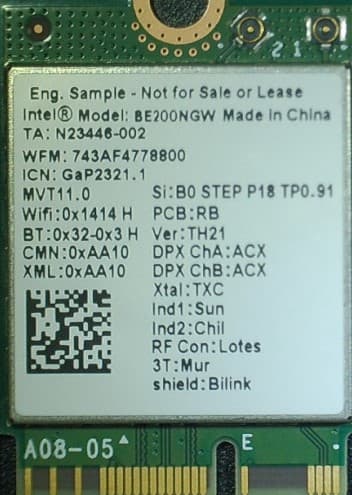
PD9BE200NG
Sep 13, 2023Intel BE200
Equipment Class
6CD - 15E 6 GHz Low Power Dual Client
PD9BE200D2
Sep 13, 2023Intel BE200
Equipment Class
6CD - 15E 6 GHz Low Power Dual Client