PPINPL-2GSM Mobile Phone
Microsoft Corporation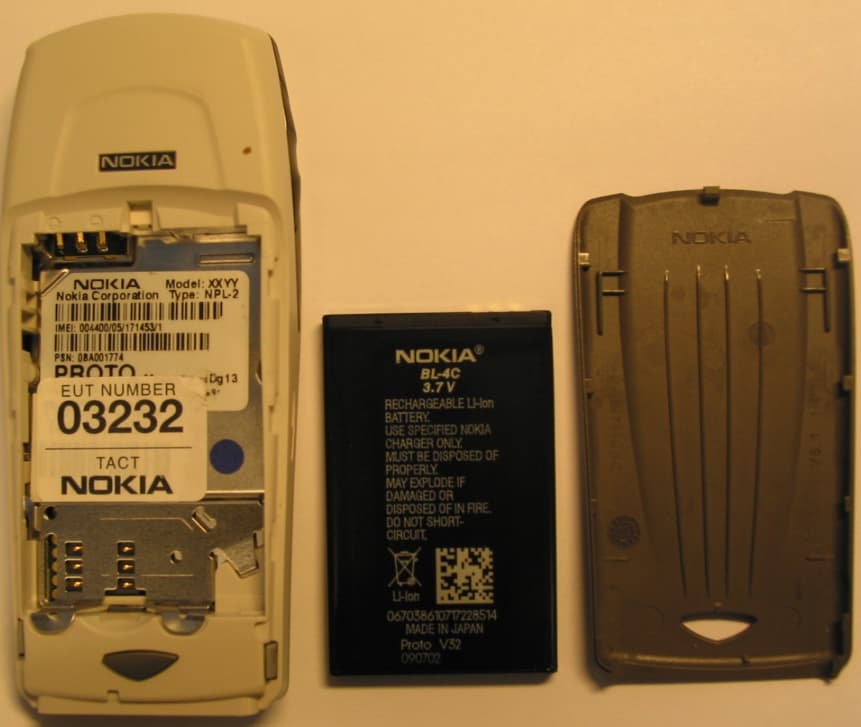
Click to zoom
Application Details
- Equipment Class
- PCE - PCS Licensed Transmitter held to ear
- Date of Grant
- Oct 06, 2002
- Application Purpose
- Original Equipment
- Date of Application
- Oct 06, 2002
- Equipment Note
- GSM Mobile Phone
- Frequency Range
- 1850.20000000 - 1909.80000000
- Company
- Microsoft Corporation
- Country
- United States
Documents & Files
Document Text
Text extracted from the exhibit documents filed with the FCC. Open a document above to read the original.
Users Manual
User’s Guide 9354993 Issue 1 DRAF T npl-2_en1_1.fm Page 1 Wednesday, August 7, 2002 10:18 AM The wireless phone described in this guide is approved for use in GSM 900, 1800 and 1900 networks. LEGAL INFORMATION Part No. 9354993 Issue No. 1 Copyright ©2002 Nokia. All rights reserved. Nokia is a registered trademark of Nokia Corporation. Nokia, Nokia Connecting People, Xpress-on, Pop-Port, the Original Accessories logos, Space Impact, Snake II, and Bumper are trademarks of Nokia Corporation and/or its affiliates. Printed in Canada 09/2002 US Patent No 5818437 and other pending patents. T9 text input software Copyright ©1999-2002. Tegic Communications, Inc. All rights reserved. Includes RSA BSAFE cryptographic or security protocol software from RSA Security. The information contained in this user guide was written for Nokia 6100 phone. Nokia operates a policy of continuous development. Nokia reserves the right to make changes and improvements to any of the products described in this document without prior notice. UNDER NO CIRCUMSTANCES SHALL NOKIA BE RESPONSIBLE FOR ANY LOSS OF DATA OR INCOME OR ANY SPECIAL, INCIDENTAL, AND CONSEQUENTIAL OR INDIRECT DAMAGES HOWSOEVER CAUSED. THE CONTENTS OF THIS DOCUMENT ARE PROVID ED “AS IS.” EXCEPT AS REQUIRED BY APPLICABLE LAW, NO WARRANTIES OF ANY KIND , EITHER EXPRESS OR IMPLIED, INCLUDING, BUT NOT LIMITED TO, THE IMPLIED WARRANTIES OF MERCHANTABILITY AND FITNESS FOR A PARTICULAR PURPOSE, ARE MADE IN RELATION TO THE ACCURACY AND RELIABILITY OR CONTENTS OF THIS DOCUMENT. NOKIA RESERVES THE RIGHT TO REVISE THIS DOCUMENT OR WITHDRAW IT AT ANY TIME WITHOUT PRIOR NOTICE. EXPORT CONTROLS This product contains commodities, technology or software exported from the United States in accordance with the Export Administration regulations. Diversion contrary to U.S. law is prohibited. FCC/INDUSTRY CANADA NOTICE Your phone may cause TV or radio interference (for example, when using a telephone in close proximity to receiving equipment). The FCC or Industry Canada can require you to stop using your telephone if such interference cannot be eliminated. If you require assistance, contact your local service facility. This device complies with part 15 of the FCC rules. Operation is subject to the condition that this device does not cause harmful interference. FCC_Layout.fm Page 91 Monday, September 2, 2002 2:52 PM Contents 3 Contents FOR YOUR SAFETY................... 5 General information 7 Stickers in the sales package ............. 7 Access codes ........................................... 7 Overview of the functions in the phone ........................................ 9 Multimedia messaging service (MMS)......................................... 9 Polyphonic sound (MIDI) ..................... 9 General Packet Radio Service (GPRS) 9 Loudspeaker .......................................... 10 MIDP JavaTM applications................ 10 Nokia OTA settings service ............... 10 Dynamic memory................................. 11 1. Your phone ......................... 12 Keys and connectors........................... 12 Standby mode....................................... 13 Screen saver....................................... 13 Wallpaper ........................................... 13 Essential indicators in standby mode ............................... 14 Putting on the wrist strap................. 15 2. Getting started................... 16 Installing the SIM card and the battery .................................... 16 Charging the battery .......................... 18 Switching the phone on and off ..... 18 Normal operating position................ 19 Keypad lock (Keyguard) ..................... 19 Changing the front cover.................. 20 3. Call functions ..................... 22 Making a call ........................................ 22 Speed dialling a phone number ... 22 Making a conference call .............. 23 Answering or rejecting an incoming call .................................. 23 Call waiting ....................................... 23 Options during a call .......................... 24 Loudspeaker ....................................... 24 4. Writing text ........................ 25 Setting predictive text input on or off ............................. 25 Using predictive text input ............... 25 Writing compound words .............. 26 Using traditional text input.............. 26 Tips for writing text ............................ 27 5. Phone book (Names) .......... 28 Selecting the phone book settings . 28 Saving names and phone numbers (Add name) .......................... 28 Saving multiple numbers and text items per name................ 29 Searching for a name in the phone book ............................... 30 Editing a name, number or text item ........................................... 30 Erasing names and numbers ............ 30 Copying phone books ......................... 30 Sending and receiving a business card..................................... 31 Speed dials ............................................ 32 Info numbers......................................... 32 Service numbers................................... 32 My numbers .......................................... 32 Caller groups......................................... 33 6. Using the menu .................. 34 Accessing a menu function .............. 34 List of menu functions ....................... 35 7. Menu functions .................. 38 Messages (Menu 1) ............................. 38 Text messages ................................... 38 Multimedia messages ..................... 43 Multimedia messages npl-2_en1_1.fm Page 3 Wednesday, August 7, 2002 1:56 PM Contents 4 memory full....................................... 46 Erasing messages............................. 47 Chat ..................................................... 47 Voice messages ................................ 48 Info messages ................................... 48 Message settings .....................…
Text truncated - open the document above for the full version.
Cover Letter(s)
From: [email protected] [mailto:[email protected]] Sent: Thursday, September 26, 2002 3:52 AM To: [email protected] Cc: [email protected]; [email protected] Subject: Application for FCCID PPINPL-2: changes in confidentiality status of three exhibits Importance: High Sensitivity: Confidential Dear recipient, We have just uploaded an application for FCCID PPINPL-2. We forgot to request three exhibits to be held confidential. They are as follows: - Description of frequency determining circuitry: NPL-2_Frequency_determining_part24_ex12.pdf - Description of frequency determining circuitry: NPL-2_Frequency range_ex12.pdf - Description of circuits limiting spurious emissions: NPL-2_Harmonics Emission_part24_ex12.pdf Could you please make them confidential? Regards, Vivian Kill
Cover Letter(s)
American Telecommunications Certification Body Inc. 6731 Whittier Ave, McLean, VA 22101 September 27, 2002 RE: FCC ID: Ppinpl-2 Attention: Vivian Kill / Tomi Vahatiitto I have a few comments on this Application. 1 Please provide a photo of the bottom of the main board. 2 Please note that EIRP and/or conducted power must be reported in both the EMC and SAR reports. Your reference to EIRP from TCC Tampere test laboratory may not be sufficient since it does not explicitly state that the power was measured during SAR testing even though the plots showing power drift are provided. Please verify that the EIRP listed in the SAR report is that which was measured during SAR testing and that the power drift applies to these power measurements. Alternately, please revise the SAR report to report the power measured of the specific device and at the time SAR testing was performed. 3 On page 7 of the SAR report you state that there are no body worn accessories available for this device, yet on page 99 of the manual you state that testing was done for body worn accessories containing no metal. Please make the documentation consistent (e.g. was there or was there not a body worn accessory available?) 4 In your list of equipment used, you specify the year 2002 as the calibration due for some of this equipment. However, it is not clear what day or month applies. Please provide objective evidence that all equipment critical to the accuracy of the measurement was in cal when used. 5 Please note, TCC Tampere is not listed in the FCC test firms. Please provide evidence that your test firm is either listed or accredited. Dennis Ward mailto:[email protected] The items indicated above must be submitted before processing can continue on the above referenced application. Failure to provide the requested information may result in application termination. Correspondence should be considered part of the permanent submission and may be viewed from the Internet after a Grant of Equipment Authorization is issued. Please do not respond to this correspondence using the email reply button. In order for your response to be processed expeditiously, you must submit your documents through the AmericanTCB.com website. Also, please note that partial responses increase processing time and should not be submitted. Any questions about the content of this correspondence should be directed to the sender.
Cover Letter(s)
1 Please provide a photo of the bottom of the main board. "Revised internal photographs" has been uploaded. 2 Please note that EIRP and/or conducted power must be reported in both the EMC and SAR reports. Your reference to EIRP from TCC Tampere test laboratory may not be sufficient since it does not explicitly state that the power was measured during SAR testing even though the plots showing power drift are provided. Please verify that the EIRP listed in the SAR report is that which was measured during SAR testing and that the power drift applies to these power measurements. Alternately, please revise the SAR report to report the power measured of the specific device and at the time SAR testing was performed. Power levels were not measured during SAR measurements and so such data is not available. The phone was packed carefully for transportation between the labs. If the package had shown signs of rough handling, the sample had not been used for SAR measurements. Power level setting is stored in digital format in memory and power level setting does not change due to environmental conditions. The phones have been designed to stand transportation e.g. from factory to consumer. The power levels have been the same in EIRP and SAR measurements. 3 On page 7 of the SAR report you state that there are no body worn accessories available for this device, yet on page 99 of the manual you state that testing was done for body worn accessories containing no metal. Please make the documentation consistent (e.g. was there or was there not a body worn accessory available?) The text in manual advices user to keep minimum 1.5 cm distance between body and handset. 1.5 cm distance was used also in SAR measurement. This is consistent with the example 2 on page 41 of Supplement C. 4 In your list of equipment used, you specify the year 2002 as the calibration due for some of this equipment. However, it is not clear what day or month applies. Please provide objective evidence that all equipment critical to the accuracy of the measurement was in cal when used. A list of SAR test equipment with updated calibration status has been uploaded. 5 Please note, TCC Tampere is not listed in the FCC test firms. Please provide evidence that your test firm is either listed or accredited. TCC Tampere is FCC listed test facility number 94436, the listing was renewed on 14th June 2002. TCC Tampere is also an accredited test facility under US -EU MRA, see https://gullfoss2.fcc.gov/prod/oet/index_ne.html
External Photos
FCC ID:PPINPL-21 (3) TCC Tampere P.O. Box 68 FIN -33721 Tampere FINLAND Tel. +358 7180 46800 Fax. +358 7180 46880 TCC Tampere Exhibit 1: External Photographs FCC ID:PPINPL-22 (3) TCC Tampere P.O. Box 68 FIN -33721 Tampere FINLAND Tel. +358 7180 46800 Fax. +358 7180 46880 TCC Tampere Exhibit 2: External Photographs FCC ID:PPINPL-23 (3) TCC Tampere P.O. Box 68 FIN -33721 Tampere FINLAND Tel. +358 7180 46800 Fax. +358 7180 46880 TCC Tampere Exhibit 3: External Photographs
ID Label/Location Info
Material Sheet 1 of 1 Original Scale Original Size A4 1:1 NMP Code Item Name Document Number Doc. Vers. Tool Vers. Name / Date Change Ref. Approved / Date Original Designer FUNCTIONAL CHARACTERISTICS KEY MAIN FUNCTIONAL CHARACTERISTIC MAIN FUNCTIONAL CHARACTERISTIC ( Proof of Process Capability Required ) Copyright c Nokia Mobile Phones. All rights reserved THIS DRAWING IS PROTECTED BY COPYRIGHT AS AN UNPUBLISHED WORK UNAUTHORIZED REPRODUCTION OF THIS DRAWING IS NOT PERMITTED THIS DRAWING CONTAINS PROPRIETARY AND CONFIDENTIAL INFORMATION This document is the property of Nokia Mobile Phones TYPE LABEL NPL-2, General DMP06539 Bar Code 128 Subset B/C, height 2.5 mm Module width 3 dots. Bar Code 128 Subset B , Module width 3 dots. height 2.5 mm Brady B-7575 thermal transfer printable tamper evident metallized polyester 65 um See table. Place tolerance of printing +/-0.3 Layout 2:1 TSchmitz 190602 0.2 0.1 Cangiano 030902 Cangiano 190602 Blank label material: To be printed in NMP production using (600dpi) Thermal Transfer Printer HDG13 BLANK LABEL 30,5 x 20 CONNECTIONTOPDMS FollowingitemsareprintedfromPDMSdatabase -IMEI““ -ProductCode“Code:” XXXXXX/xx/yyyyyy/0 XXXXXXX Artwork for production ( 1:1 pcx-file) ( 2 0 . 0 ) (30.5 ) Quiet Zone2.0 Type: NPL-2 Nokia Corporation 168 FCC ID: PPINPL-2 MADE IN GERMANY Model: 6100 IC: 661U-NPL2 Type: NPL-2 Nokia Corporation 168 FCC ID: PPINPL-2 MADE IN GERMANY Model: 6100 IC: 661U-NPL2 1 . 2 8 , 8 1 3 , 4 No. Part nameQty Drw no.Note 11 21 NMP CODE: DMD03291 9381149 See Data sheet 3 Thermal Transfer Ribbon R-7963 4 NMP CODE: 9730082 1 1 P06539XXdpi600.pcx P06539XXdpi300.pcx PRINTING FILE PRINTING FILE XX = Doc. Version Number XX = Doc. Version Number P r e l i m i n a r y Material Sheet 1 of 1 Original Scale Original Size A4 1:1 NMP Code Item Name Document Number Doc. Vers. Tool Vers. Name / Date Change Ref. Approved / Date Original Designer FUNCTIONAL CHARACTERISTICS KEY MAIN FUNCTIONAL CHARACTERISTIC MAIN FUNCTIONAL CHARACTERISTIC ( Proof of Process Capability Required ) Copyright c Nokia Mobile Phones. All rights reserved THIS DRAWING IS PROTECTED BY COPYRIGHT AS AN UNPUBLISHED WORK UNAUTHORIZED REPRODUCTION OF THIS DRAWING IS NOT PERMITTED THIS DRAWING CONTAINS PROPRIETARY AND CONFIDENTIAL INFORMATION This document is the property of Nokia Mobile Phones Type: NPL-2 Nokia Corporation 168 FCC ID: PPINPL-2 MADE IN GERMANY Model: 6100 IC: 661U-NPL2
Internal Photos
FCC ID:PPINPL-2 1 (5) TCC Tampere Picture 1. TCC Tampere P.O. Box 68 FIN -33721 Tampere FINLAND Tel. +358 7180 46800 Fax. +358 7180 46880 FCC ID:PPINPL-2 2 (5) TCC Tampere Picture 2. TCC Tampere P.O. Box 68 FIN -33721 Tampere FINLAND Tel. +358 7180 46800 Fax. +358 7180 46880 FCC ID:PPINPL-2 3 (5) TCC Tampere Picture 3. TCC Tampere P.O. Box 68 FIN -33721 Tampere FINLAND Tel. +358 7180 46800 Fax. +358 7180 46880 FCC ID:PPINPL-2 4 (5) TCC Tampere Picture 4. TCC Tampere P.O. Box 68 FIN -33721 Tampere FINLAND Tel. +358 7180 46800 Fax. +358 7180 46880 FCC ID:PPINPL-2 5 (5) TCC Tampere Picture 5. TCC Tampere P.O. Box 68 FIN -33721 Tampere FINLAND Tel. +358 7180 46800 Fax. +358 7180 46880
RF Exposure Info
TCC Copenhagen Reg. Nr. 416 ___________________________________________________________________________________________ ___________________________________________________________________________________________ CONTENTS 1. SUMMARY FOR SAR TEST REPORT....................................................................................................4 1.1 MAXIMUM RESULTS FOUND DURING SAR EVALUATION..........................................................................4 1.1.1 HEAD CONFIGURATION.................................................................................................................4 1.1.2 BODY WORN CONFIGURATION......................................................................................................4 1.1.3 BODY WORN CONFIGURATION, SAR VALUES DOUBLED, CORRESPONDING TO GPRS MODE............4 1.1.4 MEASUREMENT UNCERTAINTY......................................................................................................5 1.2 EIRP MEASUREMENTS........................................................................................................................5 2. DESCRIPTION OF THE DEVICE(S) UNDER TEST................................................................................6 2.1 DEVICE DESCRIPTION...........................................................................................................................6 2.2 PICTURE OF PPINPL-2 (NOKIA 6100)................................................................................................6 2.3 DESCRIPTION OF THE ANTENNA.............................................................................................................6 2.4 BATTERY.............................................................................................................................................7 2.5 ACCESSORY........................................................................................................................................7 2.6 BODY WORN ACCESSORIES.................................................................................................................7 3. DESCRIPTION OF THE TEST EQUIPMENT...........................................................................................8 3.1 MANUFACTURER OF DASY3.................................................................................................................8 3.2 ROBOT................................................................................................................................................8 3.3 ISOTROPIC E-FIELD PROBE ET3DV6R..................................................................................................9 3.4 DEVICE HOLDER...................................................................................................................................9 3.5 DIPOLE ANTENNAS FOR VALIDATION......................................................................................................9 3.6 PHANTOM..........................................................................................................................................10 3.7 LIQUID DEPTH....................................................................................................................................10 3.8 BASE STATION SIMULATOR.................................................................................................................10 3.9 TEST CONDITIONS..............................................................................................................................11 3.10 TEMPERATURE AND HUMIDITY............................................................................................................11 3.11 SAR MEASUREMENT SYSTEM VERIFICATION........................................................................................11 3.12 SYNTHETIC HEAD TISSUE SIMULATING LIQUID PARAMETERS, MEASURED VALUES:...................................12 3.13 SYNTHETIC MUSCLE TISSUE SIMULATING LIQUID PARAMETERS, MEASURED VALUES:...............................12 3.14 SYNTHETIC TISSUE SIMULATING LIQUID RECIPES..................................................................................12 3.14.1 1880 MHZ................................................................................................................................. 12 4. DEVICE POSITIONING...........................................................................................................................13 4.1 POSITIONING PROCEDURES................................................................................................................13 4.1.1 CHEEK/TOUCH POSITION............................................................................................................13 4.1.2 EAR/TILTED POSITION................................................................................................................14 4.1.3 PHOTOS OF SETUP.....................................................................................................................14 4.1.4 BODY WORN CONFIGURATION....................................................................................................15 4.2 SCAN PROCEDURE.............................................................................................................................16 4.3 SAR AVERAGING METHODS................................................................................................................16 5. MEASUREMENT UNCERTAINTY.......................................................................................................... 17 5.1 DESCRIPTION OF INDIVIDUAL MEASUREMENT UNCERTAINTY.................................................................17 5.2 SOURCE UNCERTAINTY......................................................................................................................17 5.3 ESTIMATION OF THE TOTAL MEASUREMENT UNCERTAINTY....................................................................18 6. RESULTS...........................…
Text truncated - open the document above for the full version.
Test Report
DOCUMENT NAME:NPL2_502.DOC 1 (26) The test results are valid for the tested unit(s) only. This report shall not be reproduced except in full, without the written permission of the testing laboratory. TCC Tampere Box 68 FIN-33721 TAMPERE FINLAND Tel. +358 7180 46800 Fax. +358 7180 46880 TCC Tampere FCC Part 24 Test Report for NPL-2 DOCUMENT NAME:NPL2_502.DOC 2 (26) The test results are valid for the tested unit(s) only. This report shall not be reproduced except in full, without the written permission of the testing laboratory. TCC Tampere Box 68 FIN-33721 TAMPERE FINLAND Tel. +358 7180 46800 Fax. +358 7180 46880 TCC Tampere CONTENTS 1LABORATORY INFORMATION................................................................................................................ 3 2CUSTOMER INFORMATION.................................................................................................................... 3 3SUMMARY OF TEST RESULTS .............................................................................................................. 4 4EUT INFORMATION ................................................................................................................................. 5 4.1EUT description.................................................................................................................................. 5 5EUT TEST SETUPS.................................................................................................................................. 5 6APPLICABLE STANDARDS ..................................................................................................................... 5 7CONDUCTED RF OUTPUT POWER ....................................................................................................... 6 7.1Test setup .......................................................................................................................................... 6 7.2EUT operation mode .......................................................................................................................... 6 7.3Results ............................................................................................................................................... 6 7.4Screen shots ...................................................................................................................................... 7 8RADIATED RF OUTPUT POWER............................................................................................................ 9 8.1Test setup .......................................................................................................................................... 9 8.2Test method ....................................................................................................................................... 9 8.3EUT operation mode ........................................................................................................................ 10 8.4Limit.................................................................................................................................................. 10 1.5Results ............................................................................................................................................. 10 299% OCCUPIED BANDWIDTH .............................................................................................................. 11 2.1Test setup ........................................................................................................................................ 11 2.2EUT operation mode ........................................................................................................................ 11 2.3Results ............................................................................................................................................. 11 2.4Screen shots .................................................................................................................................... 12 3BAND-EDGE COMPLIANCE .................................................................................................................. 14 3.1Test setup ........................................................................................................................................ 14 3.2EUT operation mode ........................................................................................................................ 14 3.3Limit.................................................................................................................................................. 14 3.4Results ............................................................................................................................................. 14 3.5Screen shots .................................................................................................................................... 15 4SPURIOUS EMISSIONS AT ANTENNA TERMINALS ........................................................................... 16 4.1Test setup ........................................................................................................................................ 16 4.2Test method ..................................................................................................................................... 16 4.3EUT operation mode ........................................................................................................................ 16 4.4Limit.................................................................................................................................................. 16 4.5Results ............................................................................................................................................. 17 5FIELD STRENGTH OF SPURIOUS RADIATION ................................................................................... 18 5.1Test setup ..........................…
Text truncated - open the document above for the full version.
Test Setup Photos
FCC ID: PPINPL-21 (2) TCC Tampere P.O. Box 68 FIN -33721 Tampere FINLAND Tel. +358 7180 46800 Fax. +358 7180 46880 TCC Tampere EUT test setup FCC ID: PPINPL-22 (2) TCC Tampere P.O. Box 68 FIN -33721 Tampere FINLAND Tel. +358 7180 46800 Fax. +358 7180 46880 TCC Tampere
Contact Information
Applicant
Hasnain Syed(Director, EMC, SI, and RF Compliance)
Technical Contact
Non-Technical Contact
Nokia GmbHTomi t Vahatiitto
[email protected]491732830836
Test Firm
TCC TampereJari Jantunen
Technical Specifications
| # | Rule Parts | Frequency Range | Power Output | Emission | Tolerance |
|---|---|---|---|---|---|
| 1 | 24E | 1.85 GHz - 1.91 GHz | 1.102 W | 242KGXW | 0.0210000000 ppm |
Other Applications from Microsoft Corporation

PPIRM-884
Jul 24, 2012GSM/WCDMA cellular phone w/BT and WLAN
Equipment Class
PCE - PCS Licensed Transmitter held to ear
PPIRM-714
Mar 31, 2012GSM/WCDMA Cellular phone w/BT and WLAN
Equipment Class
DTS - Digital Transmission System
PPIRM-813
Nov 20, 2011GSM/WCDMA cellular phone w/BT and WLAN
Equipment Class
DSS - Part 15 Spread Spectrum Transmitter
PPIRM-800
Nov 15, 2011GSM cellular phone w/BT
Equipment Class
PCE - PCS Licensed Transmitter held to ear
PPIRM-781
Oct 10, 2011GSM/WCDMA cellular phone w/BT
Equipment Class
DSS - Part 15 Spread Spectrum Transmitter