PPIRM-721GSM/WCDMA cellular phone w/BT
Microsoft Corporation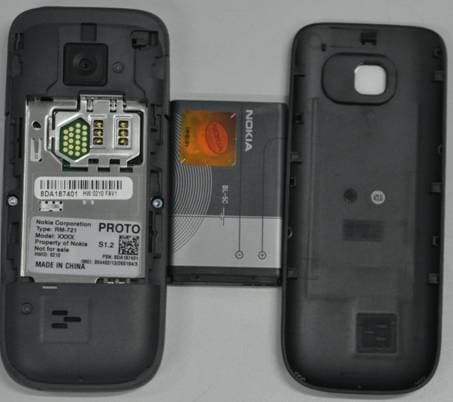
Click to zoom
Application Details
- Equipment Class
- PCE - PCS Licensed Transmitter held to ear
- Date of Grant
- Dec 16, 2010
- Application Purpose
- Original Equipment
- Date of Application
- Dec 16, 2010
- Equipment Note
- GSM/WCDMA cellular phone w/BT
- Frequency Range
- 1852.40000000 - 1907.60000000
- Company
- Microsoft Corporation
- Country
- United States
Documents & Files
Document Text
Text extracted from the exhibit documents filed with the FCC. Open a document above to read the original.
Users Manual
Nokia C2-01 User Guide 5555555 Issue 1 Contents Safety4 About your device5 Network services5 Get started7 Keys and parts7 Insert SIM card and battery7 Insert a memory card9 Remove the memory card9 Charge the battery10 Attach the wrist strap10 Switch the device on or off10 GSM antenna11 Headset11 Basic use12 Keypad lock12 Access codes12 PUK codes12 Volume control13 Standby mode 13 Indicators13 Navigate the menus14 Shortcuts14 Operator menu14 Use your device without a SIM card15 Write text15 Nokia account and Nokia's Ovi services16 About Ovi Store16 Contacts 16 Calls17 Make and answer a call17 Loudspeaker17 Dialling shortcuts18 Log18 Messaging18 Text and multimedia messages18 Mail20 Chat with your friends21 Flash messages21 Nokia Xpress audio messages 21 Voice messages21 Message settings22 Organiser22 Alarm clock22 Calendar and to-do list22 Web or Internet 23 Connect to a web service23 Media 23 Camera and video23 FM radio24 Voice recorder25 Music player25 Gallery26 Settings27 Profiles27 Tones28 Display28 Date and time28 Synchronisation and backup28 Connectivity29 Call and phone30 Restore factory settings31 Find more help31 Support31 About device software updates31 Update device software using your device32 Update device software using your PC33 2Contents Protect the environment33 Save energy33 Recycle33 Product and safety information34 Contents3 Safety Read these simple guidelines. Not following them may be dangerous or illegal. Read the complete user guide for further information. SWITCH ON SAFELY Do not switch the device on when wireless phone use is prohibited or when it may cause interference or danger. ROAD SAFETY COMES FIRST Obey all local laws. Always keep your hands free to operate the vehicle while driving. Your first consideration while driving should be road safety. INTERFERENCE All wireless devices may be susceptible to interference, which could affect performance. SWITCH OFF IN RESTRICTED AREAS Follow any restrictions. Switch the device off in aircraft, near medical equipment, fuel, chemicals, or blasting areas. QUALIFIED SERVICE Only qualified personnel may install or repair this product. ACCESSORIES AND BATTERIES Use only approved accessories and batteries. Do not connect incompatible products. WATER-RESISTANCE Your device is not water-resistant. Keep it dry. 4Safety About your device The wireless device described in this guide is approved for use on the (E)GSM 850, 900, 1800, and 1900 MHz networks, and UMTS 900/1900/2100 MHz networks. Contact your service provider for more information about networks. Your device may have preinstalled bookmarks and links for third-party internet sites and may allow you to access third-party sites. These are not affiliated with Nokia, and Nokia does not endorse or assume liability for them. If you access such sites, take precautions for security or content. Warning: To use any features in this device, other than the alarm clock, the device must be switched on. Do not switch the device on when wireless device use may cause interference or danger. When using this device, obey all laws and respect local customs, privacy and legitimate rights of others, including copyrights. Copyright protection may prevent some images, music, and other content from being copied, modified, or transferred. Make back-up copies or keep a written record of all important information stored in your device. When connecting to any other device, read its user guide for detailed safety instructions. Do not connect incompatible products. The images in this guide may differ from your device display. Refer to the user guide for other important information about your device. Network services To use the device you must have service from a wireless service provider. Some features are not available on all networks; other features may require that you make specific arrangements with your service provider to use them. Network services involve transmission of data. Check with your service provider for details about fees in your home network and when roaming on other networks. Your service provider can explain what charges will apply. Some networks may have limitations that affect how you can use some features of this device requiring network support such as support for specific technologies like WAP 2.0 protocols (HTTP and SSL) that run on TCP/IP protocols and language-dependent characters. Your service provider may have requested that certain features be disabled or not activated in your device. If so, these features will not appear on your device menu. Your device may also have customized items such as menu names, menu order, and icons. Safety5 During extended operation such as a high speed data connection, the device may feel warm. In most cases, this condition is normal. If you suspect the device is not working properly, take it to the nearest authorised service facility. 6Safety Get started Keys and parts 1 End/Power key 2Earpiece 3Display 4Selection keys 5Navi™ key (scroll key) 6Call key 7Keypad 8Charger connector 9Headset connector/Nokia AV Connector (3.5 mm) 10Camera lens 11Micro USB connector 12Loudspeaker 13Microphone 14Memory card slot 15Wrist strap hole Insert SIM card and battery Important: Do not use a mini-UICC SIM card, also known as a micro-SIM card, a micro-SIM card with an adapter, or a SIM card that has a mini-UICC cutout (see figure) in this device. A micro SIM card is smaller than the standard SIM card. This device does not support the use of micro-SIM cards and use of incompatible SIM cards may damage the card or the device, and may corrupt data stored on the card. Get started7 The SIM card and its contacts can be easily damaged by scratches or bending, so be careful when handling, inserting, or removing the card. 1Press and slide the back cover towards the bottom of the phone, and remove it (1). 2Remove the battery (2). 3Open the SIM card holder (3), insert the SIM card with the contact surface facing down (4), and close the holder (5). 4Insert the battery (6…
Text truncated - open the document above for the full version.
Cover Letter(s)
NOKIA GmbH Joensuunkatu 7 FIN-24100 SALO FINLAND Tel. +358 7180 08000 Fax +358 7180 45220 December 14, 2010 Federal Communications Commission, Authorization & Evaluation Division, 7435 Oakland Mills Road, Columbia, MD. 21046 Attention: Equipment Authorization Branch REQUEST FOR CONFIDENTIALITY Pursuant to Sections 0.457 (d) (l) (ii) and 0.459 of the Commission’s Rules, the Applicant hereby requests confidential treatment of some of the information accompanying this Application of FCC ID: PPIRM-721 and as outlined below: - Exhibit 4: Block Diagram - Exhibit 5: Schematic Diagrams - Exhibit 10: List of Active Devices and Tune-Up Procedure - Exhibit 12: Theory of Operation / Description of Circuitry These materials contain trade secrets and proprietary information not customarily released to the public and the public disclosure of these matters might be harmful to the Applicant and provide unjustified benefits to its competitors. The Applicant understands that pursuant to Rule 0.457 (d) (l) (ii) disclosure of this Application and all accompanying documentation will not be made before the date of the Grant for this Application. NOKIA CORPORATION Tero Lehtinen Product Certification Officer DQD/DCo, Salo
Cover Letter(s)
NOKIA GmbH Joensuunkatu 7 FIN-24100 SALO FINLAND Tel. +358 7180 08000 Fax +358 7180 45220 December 14, 2010 Federal Communications Commission, Authorization & Evaluation Division, 7435 Oakland Mills Road, Columbia, MD. 21046 Attention: Equipment Authorization Branch CHANGES IN DESIGN from HWID 0220 to HWID 0320 PPIRM-721 initial testing has been done with HWID 0220 and after that there was introduced new HWID 0320 and the change is to add the metal spring in A-cover to connect the UI shielding. Internal conclusion was to retest different equipment classes as follows: • 15.247(d) 15.209 Spurious radiated emissions (BT) • 15.247(d) Band edge compliance (BT) • §22.913(a) Radiated RF output power (GSM850, WCDMA850) • §22.917(a) Band edge compliance (GSM850, WCDMA850) • §22.917(a), §2.1053 Spurious radiated emissions (GSM850, WCDMA850) • §24.232(b) Radiated RF output power (GSM1900, WCDMA1900) • §24.238(a) Band edge compliance (GSM1900, WCDMA1900) • §24.238(a), §2.1053 Spurious radiated emissions (GSM1900, WCDMA1900) • SAR all tests on all bands NOKIA CORPORATION Tero Lehtinen Product Certification Officer DQD/DC, Salo
External Photos
CONFIDENTIAL 9 Sep 2010 Nokia Mobile Phones External photographs FCC ID: PPIRM-721 Exhibit 3 IC: 661U-RM721 Applicant: Nokia Corporation Copyright © 2010 Nokia. All rights reserved. 1. EXTERNAL PHOTOGRAPHS 1.1 Front and back CONFIDENTIAL 9 Sep 2010 Nokia Mobile Phones External photographs FCC ID: PPIRM-721 Exhibit 3 IC: 661U-RM721 Applicant: Nokia Corporation Copyright © 2010 Nokia. All rights reserved. 1.1 Disassembled 1.2 External interfaces CONFIDENTIAL 9 Sep 2010 Nokia Mobile Phones External photographs FCC ID: PPIRM-721 Exhibit 3 IC: 661U-RM721 Applicant: Nokia Corporation Copyright © 2010 Nokia. All rights reserved.
ID Label/Location Info
1 (1) NOKIA Corporation 11/09/2010 Type Label FCC ID: PPIRM-721 Exhibit 1 IC: 661U-RM721 Applicant: Nokia Corporation Copyright © 2010 Nokia. All rights reserved. TYPE LABEL FOR PPIRM-721 LABEL LOCATION FOR PPIRM-721
Internal Photos
09 Sep2010 Internal photographs FCC ID: PPIRM-721 Exhibit 9 IC: 661U-RM721 Applicant: Nokia Corporation Copyright © 2010 Nokia. All rights reserved. 1. INTERNAL PHOTOGRAPHS 1.1 Pwb back 09 Sep2010 Internal photographs FCC ID: PPIRM-721 Exhibit 9 IC: 661U-RM721 Applicant: Nokia Corporation Copyright © 2010 Nokia. All rights reserved. 1.2 Pwb front
RF Exposure Info
Nokia ____________________________________________________________________________ SAR Report FCC_RM-721_01 Applicant: Nokia Corporation Type: RM-721 Copyright © 2010 TCC Nokia 1/52 SAR Compliance Test Report Test report no.: FCC_RM-721_01 Date of report: 2010-11-18 Template version: 16.1 Number of pages: 52 Testing laboratory: TCC Nokia Salo Laboratory P.O.Box 86 Joensuunkatu 7H / Kiila 1B FIN-24101 SALO, FINLAND Tel. +358 (0) 7180 08000 Fax. +358 (0) 7180 45220 TCC Nokia Copenhagen Lab. Client: Nokia Corporation Lise Meitner Strasse 10 89081 ULM GERMANY Tel. +49 731 1754 0 Fax. +49 731 1754 6800 Responsible test engineer: Virpi Tuominen Product contact person: Tobias Cremer Measurements made by: Leif Klysner, Jesper Nielsen, Preben Runchel Tested device: RM-721 FCC ID: PPIRM-721 IC: 661U-RM721 Supplement reports: SAR_Photo_RM-721_02, FCC_RM-722_01 for RM-722 / FC ID: PPIRM-722 / IC: 661U-RM722 Testing has been carried out in accordance with: 47CFR §2.1093 Radiofrequency Radiation Exposure Evaluation: Portable Devices FCC OET Bulletin 65 (Edition 97-01), Supplement C (Edition 01-01) Evaluating Compliance with FCC Guidelines for Human Exposure to Radiofrequency Electromagnetic Fields RSS-102 Evaluation Procedure for Mobile and Portable Radio Transmitters with Respect to Health Canada’s Safety Code 6 for Exposure of Humans to Radio Frequency Fields IEEE 1528 - 2003 IEEE Recommended Practice for Determining the Peak Spatial-Average Specific Absorption Rate (SAR) in the Human Head from Wireless Communications Devices: Measurement Technique Documentation: The documentation of the testing performed on the tested devices is archived for 15 years at TCC Nokia. Test results: The tested device complies with the requirements in respect of all parameters subject to the test. The test results and statements relate only to the items tested. The test report shall not be reproduced except in full, without written approval of the laboratory. Date and signatures: For the contents: Nokia ____________________________________________________________________________ SAR Report FCC_RM-721_01 Applicant: Nokia Corporation Type: RM-721 Copyright © 2010 TCC Nokia 2/52 CONTENTS 1. SUMMARY OF SAR TEST REPORT ............................................................................................................................................. 3 1.1 TEST DETAILS ............................................................................................................................................................................. 3 1.2 MAXIMUM RESULTS .................................................................................................................................................................... 3 1.2.1 Head Configuration ........................................................................................................................................................ 3 1.2.2 Body Worn Configuration ............................................................................................................................................ 3 1.2.3 Maximum Drift ................................................................................................................................................................ 4 1.2.4 Measurement Uncertainty ........................................................................................................................................... 4 2. DESCRIPTION OF THE DEVICE UNDER TEST ........................................................................................................................... 4 2.1 DESCRIPTION OF THE ANTENNA .................................................................................................................................................. 5 3. TEST CONDITIONS ..................................................................................................................................................................... 5 3.1 TEMPERATURE AND HUMIDITY .................................................................................................................................................... 5 3.2 TEST SIGNAL, FREQUENCIES AND OUTPUT POWER ...................................................................................................................... 5 3.3 TEST CASES AND TEST MINIMISATION ........................................................................................................................................ 5 4. DESCRIPTION OF THE TEST EQUIPMENT ............................................................................................................................... 7 4.1 MEASUREMENT SYSTEM AND COMPONENTS ................................................................................................................................ 7 4.1.1 Isotropic E-field Probe Type ES3DV3 ......................................................................................................................... 8 4.2 PHANTOMS ................................................................................................................................................................................ 9 4.3 TISSUE SIMULANTS .................................................................................................................................................................... 9 4.3.1 Tissue Simulant Recipes ............................................................................................................................................... 9 4.3.2 System Checking .......................................................................................................................................................... 10 4.3.3 Tissue Simulants used in the Measurements ....................................................................................................... 10 5. DESCRIPTION OF THE TEST PROCEDURE ..............................................................…
Text truncated - open the document above for the full version.
RF Exposure Info
Nokia ____________________________________________________________________________ SAR Report FCC_RM-721_08 Applicant: Nokia Corporation Type: RM-721 Copyright © 2010 TCC Nokia 1/56 SAR Compliance Test Report Test report no.: FCC_RM-721_08 Date of report: 2010-12-10 Template version: 16.1 Number of pages: 56 Testing laboratory: TCC Nokia Salo Laboratory P.O.Box 86 Joensuunkatu 7H / Kiila 1B FIN-24101 SALO, FINLAND Tel. +358 (0) 7180 08000 Fax. +358 (0) 7180 45220 TCC Nokia Copenhagen Lab. Client: Nokia Corporation Lise Meitner Strasse 10 89081 ULM GERMANY Tel. +49 731 1754 0 Fax. +49 731 1754 6800 Responsible test engineer: Virpi Tuominen Product contact person: Bruno Ramelli Measurements made by: Preben Runchel, Leif Klysner, Jesper Nielsen Tested device: RM-721 FCC ID: PPIRM-721 IC: 661U-RM721 Supplement reports: SAR_Photo_RM-721_09, FCC_RM-722_07 for RM-722 / FCC ID: PPIRM-722 / IC: 661U-RM722 Testing has been carried out in accordance with: 47CFR §2.1093 Radiofrequency Radiation Exposure Evaluation: Portable Devices FCC OET Bulletin 65 (Edition 97-01), Supplement C (Edition 01-01) Evaluating Compliance with FCC Guidelines for Human Exposure to Radiofrequency Electromagnetic Fields RSS-102 Evaluation Procedure for Mobile and Portable Radio Transmitters with Respect to Health Canada’s Safety Code 6 for Exposure of Humans to Radio Frequency Fields IEEE 1528 - 2003 IEEE Recommended Practice for Determining the Peak Spatial-Average Specific Absorption Rate (SAR) in the Human Head from Wireless Communications Devices: Measurement Technique Documentation: The documentation of the testing performed on the tested devices is archived for 15 years at TCC Nokia. Test results: The tested device complies with the requirements in respect of all parameters subject to the test. The test results and statements relate only to the items tested. The test report shall not be reproduced except in full, without written approval of the laboratory. Date and signatures: For the contents: Nokia ____________________________________________________________________________ SAR Report FCC_RM-721_08 Applicant: Nokia Corporation Type: RM-721 Copyright © 2010 TCC Nokia 2/56 CONTENTS 1. SUMMARY OF SAR TEST REPORT ............................................................................................................................................. 3 1.1 TEST DETAILS ............................................................................................................................................................................. 3 1.2 MAXIMUM RESULTS .................................................................................................................................................................... 3 1.2.1 Head Configuration ........................................................................................................................................................ 3 1.2.2 Body Worn Configuration ............................................................................................................................................ 4 1.2.3 Maximum Drift ................................................................................................................................................................ 4 1.2.4 Measurement Uncertainty ........................................................................................................................................... 4 2. DESCRIPTION OF THE DEVICE UNDER TEST ........................................................................................................................... 5 2.1 DESCRIPTION OF THE ANTENNA .................................................................................................................................................. 5 3. TEST CONDITIONS ..................................................................................................................................................................... 6 3.1 TEMPERATURE AND HUMIDITY .................................................................................................................................................... 6 3.2 TEST SIGNAL, FREQUENCIES AND OUTPUT POWER ...................................................................................................................... 6 3.3 TEST CASES AND TEST MINIMISATION ........................................................................................................................................ 6 4. DESCRIPTION OF THE TEST EQUIPMENT ............................................................................................................................... 8 4.1 MEASUREMENT SYSTEM AND COMPONENTS ................................................................................................................................ 8 4.1.1 Isotropic E-field Probe Type ES3DV3 ...................................................................................................................... 10 4.2 PHANTOMS ............................................................................................................................................................................. 10 4.3 TISSUE SIMULANTS ................................................................................................................................................................. 11 4.3.1 Tissue Simulant Recipes ............................................................................................................................................ 11 4.3.2 System Checking .......................................................................................................................................................... 12 4.3.3 Tissue Simulants used in the Measurements ....................................................................................................... 13 5. DESCRIPTION OF THE TEST PROCEDURE .....................................................................…
Text truncated - open the document above for the full version.
Test Report
FCC Part 22/24 Compliance Test Report / Template Version 15.0 FCC22&24_RM-721_19.docx Copyright © TCC Nokia 1 (15) TCC Nokia Copenhagen Laboratory Frederikskaj 1790 COPENHAGEN V DENMARK Tel. +45 33 292929 Fax. +45 33 292934 FCC Part 22/24 Compliance Test Report Test Report no.: FCC22&24_RM-721_19.docx Date of Report: 10-Dec-2010 Number of pages: 15 Customer’s Contact person: Tobias Cremer Testing laboratory: TCC Nokia Copenhagen Laboratory Frederikskaj 1790 COPENHAGEN V DENMARK Tel. +45 33 292929 Fax. +45 33 292934 Customer: Nokia Corporation Lise Meitner Strasse 10 89081 ULM GERMANY Tel. +49 731 1754 0 Fax. +49 731 1754 6800 FCC listing no.: IC recognition no.: 99059 661AL-1 Tested devices/ accessories: Phone RM-721 / Battery BL-5C FCC ID: PPIRM-721 IC: 661U-RM721 Supplement reports: This report is copy of FCC22&24_RM-722_15.docx Testing has been carried out in accordance with: CFR 47, FCC rules Parts 22/24 , TIA-603-C-2004 and IC standards, RSS-GEN (Issue 2, June 2007), RSS-132 (Issue 2, September 2005), RSS-133 (Issue 5, February 2009). Deviations, modifications or clarifications (if any) to above mentioned documents are written in each section under "Test method and limit". Documentation: The test report must always be reproduced in full; reproduction of an excerpt only is subject to written approval of the testing laboratory. The documentation of the testing performed on the tested devices is archived for 15 years at TCC Nokia. Test Results: The EUT complies with the requirements in respect of all parameters subject to the test. The test results relate only to devices specified in this document Date and signature for the contents: Jari Jantunen, System Manager, EMC FCC Part 22/24 Compliance Test Report / Template Version 15.0 FCC22&24_RM-721_19.docx Copyright © TCC Nokia 2 (15) TCC Nokia Copenhagen Laboratory Frederikskaj 1790 COPENHAGEN V DENMARK Tel. +45 33 292929 Fax. +45 33 292934 1. Summary for FCC Part 22/24 Compliance Test Report Date of receipt 25-Nov-2010 Testing completed 09-Dec-2010 The customer's contact person 12-Nov-10 Test Plan referred to T:\Projects\RM-722\TestPlan\RS_testplan_RM-722_CR_HW0320.xls Notes - Document name T:\Projects\RM-722\EMC\FCC22&24_RM-722_15.docx 1.1. EUT and Accessory Information The EUT is a 8-band (GSM850/900/1800/1900) and WCDMA Band (I/II(1900)/VIII) mobile phone with GPRS, EGPRS and Bluetooth. The EUT is tested with maximum rated TX power, modulated with pseudo random bit sequence (PRBS9). Product Type SN HW MV SW DUT Phone RM-722 004402/13/348019/8 0320 - Vp jn09w09_10w41 23907 Battery BL-5C 0670400462040R293A12001751 - - - 23943 1.2. Summary of Test Results GSM850: Section in CFR 47 Section in RSS-GEN or RSS-132 Name of the test Result §2.1046(a), 22.913(a) 4.4 Conducted RF output power NP §22.913(a) 4.4 Radiated RF output power Passed §2.1049(h) 4.6.1 99 % occupied bandwidth NP §22.917(a) 4.5 Band edge compliance Passed §22.917(a), §2.1051 4.5 Spurious emissions at antenna terminals NP §22.917(a), §2.1053 4.5 Spurious radiated emissions NP §2.1055(a) 4.3 Frequency stability, temperature variation NP §2.1055(d) 4.3 Frequency stability, voltage variation NP GSM1900: Section in CFR 47 Section in RSS-GEN or RSS-133 Name of the test Result §2.1046(a) 6.4 Conducted RF output power NP §24.232(b) 6.4 Radiated RF output power Passed §2.1049(h) 4.6.1 99 % occupied bandwidth NP §24.238(a) 6.5 Band edge compliance Passed §24.238(a), §2.1051 6.5 Spurious emissions at antenna terminals NP §24.238(a), §2.1053 6.5 Spurious radiated emissions NP §2.1055(a) 6.3 Frequency stability, temperature variation NP §2.1055(d) 6.3 Frequency stability, voltage variation NP FCC Part 22/24 Compliance Test Report / Template Version 15.0 FCC22&24_RM-721_19.docx Copyright © TCC Nokia 3 (15) TCC Nokia Copenhagen Laboratory Frederikskaj 1790 COPENHAGEN V DENMARK Tel. +45 33 292929 Fax. +45 33 292934 WCDMA 1900 (Band II): Section in CFR 47 Section in RSS-GEN or RSS-133 Name of the test Result §2.1046(a) 6.4 Conducted RF output power NP §24.232(b) 6.4 Radiated RF output power Passed §2.1049(h) 4.6.1 99 % occupied bandwidth NP §24.238(a) 6.5 Band edge compliance Passed §24.238(a), §2.1051 6.5 Spurious emissions at antenna terminals NP §24.238(a), §2.1053 6.5 Spurious radiated emissions NP §2.1055(a) 6.3 Frequency stability, temperature variation NP §2.1055(d) 6.3 Frequency stability, voltage variation NP PASSED The EUT complies with the essential requirements in the standard. FAILED The EUT does not comply with the essential requirements in the standard. NP The test was not performed by the TCC Nokia Laboratory. The test results of PPIRM-722 are re-used for certification of the PPIRM-721. The table above indicates the results, which will be re-used. FCC Part 22/24 Compliance Test Report / Template Version 15.0 FCC22&24_RM-721_19.docx Copyright © TCC Nokia 4 (15) TCC Nokia Copenhagen Laboratory Frederikskaj 1790 COPENHAGEN V DENMARK Tel. +45 33 292929 Fax. +45 33 292934 CONTENTS 1. Summary for FCC Part 22/24 Compliance Test Report ............................................ 2 1.1. EUT and Accessory Information ........................................................................................... 2 1.2. Summary of Test Results ..................................................................................................... 2 2. Radiated RF output power (FCC §22.913(a), §24.232(b), RSS-132 4.4, RSS-133 6.4) ............................................... 5 2.2. Test method and limit ........................................................................................................... 5 2.3. GSM850 TX Test results ...................................................................................................... 7 2.4. GSM1900 TX Test results .................................................................................................... 7 2.5. WCDMA 1900 (Band II) TX Test results ...............................................................................…
Text truncated - open the document above for the full version.
Test Report
FCC Part 22/24 Compliance Test Report / Template Version 15.0 FCC22&24_RM-721_18.docx Copyright © TCC Nokia 1 (10) TCC Nokia Copenhagen Laboratory Frederikskaj 1790 COPENHAGEN V DENMARK Tel. +45 33 292929 Fax. +45 33 292934 FCC Part 22/24 Compliance Test Report Test Report no.: FCC22&24_RM-721_18.docx Date of Report: 14-Dec-2010 Number of pages: 10 Customer’s Contact person: Tobias Cremer Testing laboratory: TCC Nokia Copenhagen Laboratory Frederikskaj 1790 COPENHAGEN V DENMARK Tel. +45 33 292929 Fax. +45 33 292934 Customer: Nokia Corporation Lise Meitner Strasse 10 89081 ULM GERMANY Tel. +49 731 1754 0 Fax. +49 731 1754 6800 FCC listing no.: IC recognition no.: 99059 661AL-1 Tested devices/ accessories: Phone RM-721 / Headset WH-102 / AC-Charger AC-3E / Battery BL-5C FCC ID: PPIRM-721 IC: 661AD-RM721 Supplement reports: This report is copy of FCC22&24_RM-722_13.docx Testing has been carried out in accordance with: CFR 47, FCC rules Parts 22/24 , TIA-603-C-2004 and IC standards, RSS-GEN (Issue 2, June 2007), RSS-132 (Issue 2, September 2005), RSS-133 (Issue 5, February 2009). Deviations, modifications or clarifications (if any) to above mentioned documents are written in each section under "Test method and limit". Documentation: The test report must always be reproduced in full; reproduction of an excerpt only is subject to written approval of the testing laboratory. The documentation of the testing performed on the tested devices is archived for 15 years at TCC Nokia. Test Results: The EUT complies with the requirements in respect of all parameters subject to the test. The test results relate only to devices specified in this document Date and signature for the contents: Jari Jantunen, System Manager, EMC FCC Part 22/24 Compliance Test Report / Template Version 15.0 FCC22&24_RM-721_18.docx Copyright © TCC Nokia 2 (10) TCC Nokia Copenhagen Laboratory Frederikskaj 1790 COPENHAGEN V DENMARK Tel. +45 33 292929 Fax. +45 33 292934 1. Summary for FCC Part 22/24 Compliance Test Report Date of receipt 25-Nov-2010 Testing completed 03-Dec-2010 The customer's contact person Tobias Cremer Test Plan referred to T:\Projects\RM-722\TestPlan\RS_testplan_RM-722_CR_HW0320.xls Notes - Document name T:\Projects\RM-722\EMC\FCC22&24_RM-722_13.docx 1.1. EUT and Accessory Information The EUT is a 8-band (GSM850/900/1800/1900) and WCDMA Band (I/II(1900)/VIII) mobile phone with GPRS, EGPRS and Bluetooth. The EUT is tested with maximum rated …
Text truncated - open the document above for the full version.
Contact Information
Applicant
Hasnain Syed(Director, EMC, SI, and RF Compliance)
Technical Specifications
| # | Rule Parts | Frequency Range | Power Output | Emission | Tolerance |
|---|---|---|---|---|---|
| 5 | 24E | 1.85 GHz - 1.91 GHz | 415.00 mW | 4M20F9W | 0.1 ppm |
Other Applications from Microsoft Corporation

PPIRM-884
Jul 24, 2012GSM/WCDMA cellular phone w/BT and WLAN
Equipment Class
PCE - PCS Licensed Transmitter held to ear
PPIRM-714
Mar 31, 2012GSM/WCDMA Cellular phone w/BT and WLAN
Equipment Class
DTS - Digital Transmission System
PPIRM-813
Nov 20, 2011GSM/WCDMA cellular phone w/BT and WLAN
Equipment Class
DSS - Part 15 Spread Spectrum Transmitter
PPIRM-800
Nov 15, 2011GSM cellular phone w/BT
Equipment Class
PCE - PCS Licensed Transmitter held to ear
PPIRM-781
Oct 10, 2011GSM/WCDMA cellular phone w/BT
Equipment Class
DSS - Part 15 Spread Spectrum Transmitter