PY305200014Mobile Broadband Router
Netgear Incorporated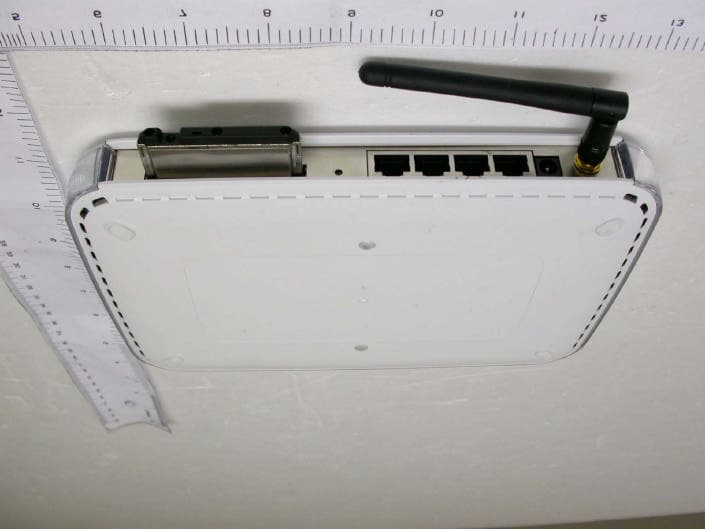
Click to zoom
Application Details
- Equipment Class
- DTS - Digital Transmission System
- Date of Grant
- Dec 19, 2005
- Application Purpose
- Original Equipment
- Date of Application
- Dec 19, 2005
- Equipment Note
- Mobile Broadband Router
- Frequency Range
- 2412.00000000 - 2462.00000000
- Company
- Netgear Incorporated
- Country
- United States
Documents & Files
Document Text
Text extracted from the exhibit documents filed with the FCC. Open a document above to read the original.
Users Manual
202-10005-05, June 2005 202-10005-05 June 2005 NETGEAR, Inc. 4500 Great America Parkway Santa Clara, CA 95054 USA Phone 1-888-NETGEAR Reference Manual for the Mobile Broadband Router MBR814X ii 202-10005-05, June 2005 © 2005 by NETGEAR, Inc. All rights reserved. Trademarks NETGEAR is a trademark of Netgear, Inc. Microsoft, Windows, and Windows NT are registered trademarks of Microsoft Corporation. Other brand and product names are registered trademarks or trademarks of their respective holders. Statement of Conditions In the interest of improving internal design, operational function, and/or reliability, NETGEAR reserves the right to make changes to the products described in this document without notice. NETGEAR does not assume any liability that may occur due to the use or application of the product(s) or circuit layout(s) described herein. Federal Communications Commission (FCC) Compliance Notice: Radio Frequency Notice This equipment has been tested and found to comply with the limits for a Class B digital device, pursuant to part 15 of the FCC Rules. These limits are designed to provide reasonable protection against harmful interference in a residential installation. This equipment generates, uses, and can radiate radio frequency energy and, if not installed and used in accordance with the instructions, may cause harmful interference to radio communications. However, there is no guarantee that interference will not occur in a particular installation. If this equipment does cause harmful interference to radio or television reception, which can be determined by turning the equipment off and on, the user is encouraged to try to correct the interference by one or more of the following measures: •Reorient or relocate the receiving antenna. •Increase the separation between the equipment and receiver. •Connect the equipment into an outlet on a circuit different from that to which the receiver is connected. •Consult the dealer or an experienced radio/TV technician for help. Federal Communications Commission (FCC) Radiation Exposure Statement This equipment complies with FCC radiation exposure limits set forth for an uncontrolled environment. In order to avoid the possibility of exceeding the FCC radio frequency exposure limits, human proximity to the antenna shall not be less than 20 cm (8 inches) during normal operation. EN 55 022 Declaration of Conformance This is to certify that the 54 Mbps Mobile Broadband Router MBR814 is shielded against the generation of radio interference in accordance with the application of Council Directive 89/336/EEC, Article 4a. Conformity is declared by the application of EN 55 022 Class B (CISPR 22). Bestätigung des Herstellers/Importeurs Es wird hiermit bestätigt, daß das 54 Mbps Mobile Broadband Router MBR814 gemäß der im BMPT-AmtsblVfg 243/ 1991 und Vfg 46/1992 aufgeführten Bestimmungen entstört ist. Das vorschriftsmäßige Betreiben einiger Geräte (z.B. 202-10005-05, June 2005 iii Testsender) kann jedoch gewissen Beschränkungen unterliegen. Lesen Sie dazu bitte die Anmerkungen in der Betriebsanleitung. Das Bundesamt für Zulassungen in der Telekommunikation wurde davon unterrichtet, daß dieses Gerät auf den Markt gebracht wurde und es ist berechtigt, die Serie auf die Erfüllung der Vorschriften hin zu überprüfen. Certificate of the Manufacturer/Importer It is hereby certified that the 54 Mbps Mobile Broadband Router MBR814 has been suppressed in accordance with the conditions set out in the BMPT-AmtsblVfg 243/1991 and Vfg 46/1992. The operation of some equipment (for example, test transmitters) in accordance with the regulations may, however, be subject to certain restrictions. Please refer to the notes in the operating instructions. Federal Office for Telecommunications Approvals has been notified of the placing of this equipment on the market and has been granted the right to test the series for compliance with the regulations. Voluntary Control Council for Interference (VCCI) Statement This equipment is in the second category (information equipment to be used in a residential area or an adjacent area thereto) and conforms to the standards set by the Voluntary Control Council for Interference by Data Processing Equipment and Electronic Office Machines aimed at preventing radio interference in such residential areas. When used near a radio or TV receiver, it may become the cause of radio interference. Read instructions for correct handling. Customer Support Refer to the Support Information Card that shipped with your 54 Mbps Mobile Broadband Router MBR814. World Wide Web NETGEAR maintains a World Wide Web home page that you can access at the universal resource locator (URL) http://www.netgear.com. A direct connection to the Internet and a Web browser such as Internet Explorer or Netscape are required. Product and Publication Details Model Number: MBR814X Publication Date:June 2005 Product Family:router Product Name: 54 Mbps Mobile Broadband Router MBR814X Home or Business Product:Business Language:English Publication Part Number:202-10005-05 Regulatory Approvals FCC Statement This equipment has been tested and found to comply with the limits for a Class B digital device, pursuant to Part 15 of the FCC Rules. These limits are designed to provide reasonable protection against harmful interference in a residential installation. This equipment generates, uses and can radiate radio frequency energy and, if not installed and used in accordance with the instructions, may cause harmful interference to radio communica- tions. However, there is no guarantee that interference will not occur in a particular installation. If this equipment does cause harmful interference to radio or television reception, which can be determined by turning the equipment off and on, the user is encouraged to try to correct the interference by one of the following measures: Reorient or relocate the receiving antenna. Increase the separation between the equipment and receiver. Connect the eq…
Text truncated - open the document above for the full version.
Cover Letter(s)
CONFIDENTIAL LETTER July 22, 2005 Federal Communications Commission Authorization and Evaluation Division FCC ID:PY305200014 Confidentiality Request Pursuant to Sections 0.457 and 0.459 of the Commission’s Rules, the Applicant Hereby requests confidential treatment of information accompaniment this Application As outlined below: 1. Block Diagram, 2. Schematic Diagram, The above materials contain trade secrets and proprietary information not customarily released to the public. The public disclosure of these matters might be harmful to the Applicant and provide unjustified benefits to its competitors. The Applicant understands that pursuant to Rule 0.457, disclosure of this Application and all accompanying documentation will not be made before the date of the Grant for this application Sincerely, ____________________________ Mark Gandler/Compliance Manager Applicant: Netgear, Inc. Address: 4500 Great America Parkway, Santa Clara, California 95054 USA TEL: +1-408-907-8000 FAX: +1-408-907-8097
Cover Letter(s)
Federal Communications Commission Dear Sir, We, the undersigned, hereby authorize Exclusive Certification Corp. to act on our behalf in all matters relating to application for Mobile Broadband Router (Model: MBR814X, FCC ID No.: PY305200014)” authorization, including the signing of all documents relating to these matters. Any and all carried out by Exclusive Certification Corp. on our behalf shall have the same effect as acts of our own. The applicant certifies that in the case of an individual applicant (e.g., corporation), no party to the applicant is subject to a denial of federal benefits, that includes FCC benefits, pursuant to section 5301 of the Anti-drug abuse Act of 1988.21 U.S.A. 862. For a definition of a “party” for these purposes See 47 C.F.R. 1.2002(b). By: By: Mark Gandler (Signature) (Printed) Title : Compliance Manager Applicant: Netgear Inc. Address: 4500 Great America Parkway, Santa Clara, California 95054 USA Tel: +1-408-907-8000 Fax: +1-408-907-8097 E-mail: [email protected] Date: July 22, 2005
Cover Letter(s)
Inquiry: We are reviewing an Access Point under 15.247 that also contains a PCMCIA slot. From review this application, it appears this slot is intended for co-location use with a licensed device, FCC ID: QZX99171001 (approved by a different manufacturer - also we are uploading a copy of this grant). The grant for the PCMCIA card was approved for portable use in laptops only and with a non-colocation requirements. The concern here is that in use with the Access point, the device would a) not be used in a laptop, b) is not mobile vs. portable use, c) is co-located. Even though this is to be co-located in a mobile device and will easily meet the limits, the concern comes from the fact that the use of the device is not in compliace with the limitations stated on the grant. We have told the manufacturer that ideally the previously approved PCMCIA card should have a Permissive Change application done to properly handle the new co-located, mobile, and host c! onditions. Alternatively we have stated that the the manufacturer of the access point may do a change of ID to the PCMCIA card, and then submit a Permissive Change application afterward to correct the new colocated, mobile and host conditions. These instances are usually more difficult for the manufacturer when they only have ownership of one of the 2 devices. While either of the above 2 conditions are valid, because of these owernship situations we have also seen where the FCC has accepted applications where the co-location is handled only in one of the 2 appications involved. We are inquiring to ask if this may be used in this instance, or will the FCC require that the PCMCIA device have a Permissive change (or alternatively a change of ID + Permissive Change to the new ID) be done. Please let us know. Response: The inquiry concerns certain desktop, wall-mount, etc. final-products (mo! bile RF exposure conditions where persons are normally 20 cm o! r more a way), which contain one built-in part 15 transmitter typically operating in 15.247 (2.4-2.482, 5.725-5.85 GHz) and/or 15.407 (5.15-5.35, 5.725-5.825 GHz), typically intended to serve gateway and/or backbone functions between 802.11abg-WLANs and WWANs (wireless wide area networks). For the WAN part, it is understood that such "gateway" products are intended always to be used with end-user-plug-in integral- antenna radio cards (e.g., PCMCIA, Cardbus, CompactFlash), operating in licensed radio services (e.g., parts 22 and/or 24, 27, 90; maybe some 21, 74), for which most presently-available cards have certification applications in accordance with the FCC Lab 3-host SAR test procedure to support use in certain portable RF exposure conditions. Grantee for part 15 gateway-device is responsible to ensure compliance with FCC rules for intended an! d expected end-use configurations. Certification applications should document configuration conditions and/or specific radio cards, including measurement data where appropriate, to ensure compliance with applicable part 15, licensed-service, and RF exposure (mobile condition) rules. For most typical integral-antenna radio cards meeting the preceding configuration and collocation conditions, FCC Lab at present is not requesting permissive change filings to amend the certification contents and grant notes. Do not reply to this message. Please select the Reply to an Inquiry Response link from the OET Inquiry System to add any additional information pertaining to this inquiry. From: Generic Office of Engineering Technology <[email protected]> Subject: Response to Inquiry to FCC (Tracking Number 127104) To: [email protected]
Cover Letter(s)
American Telecommunications Certification Body Inc. 6731 Whittier Ave, McLean, VA 22101 September 6, 2005 RE: Netgear Inc. FCC ID: PY30500014 After a review of the submitted information, I have a few comments on the above referenced Application. 1) The power output of this device appears to only be 14.72 dBm (29.7 mW) according to the test report. However the new operational description mentions up to 20 dBm (100 mW). The FCC expects the device to be tested at maximum output during EMC testing. Please confirm that the device was tested at maximum output power it will be manufactured at. If not, retesting may be necessary. Please review. 2) An external photograph of a PCMCIA was provided. However the label is not high enough resolution to easily read. Please re-provide. 3) Regarding the PCMCIA card that can be plugged into this device, information as to the intended use of this has not provided. It is uncertain if it operated simultaneously with other TX’s already in this device. It is uncertain how this device is designed such that only cards approved for use with it can be installed. Depending on its purpose and how it is used, the RF exposure or several other concerns may need to be addressed (co-location requirements – Documentation of TX). Please provide further information as to the purpose and technical nature of this card. 4) It is assumed that this device is intended to only be used with a certain PCMCIA Card as intended by the manufacturer. Please explain what precautions are built into the device so that the device will only function with the particular PCMCIA card(s) specified within this application. 5) If the devices will not transmit at the same time, please explain what precautions are built into to the device to keep this from occurring. 6) The users manual should address items 3 and 4 above and properly inform the user. 7) The PCMCIA card provided is for “FCC ID: QZX99171001”. This is approved for portable use in a laptop and excludes co-located conditions. Given questions above, it is still uncertain if a co- located condition will occur. To properly use this in the device being approved in this application, a Permissive Change to FCC ID: QZX99171001 covering the new RF exposure conditions would normally be required. Alternatively, a Change of ID of this device would be done to place the PCMCIA card under Netgears name and FCC ID, and then a Permissive change to Netgears own device to cover the new co-location issues could also be done. Additionally, we have noticed that the FCC sometimes has not required a Permissive change in some cases similar to this, but this has typically only been allowed when the secondary transmitter is much lower power than the primary (in this case, the PCMCIA card is much higher power). Until specific guidance is released from the FCC, we have to determine these paths on a case by case scenario. Please let us know if you want us to pursue this with the FCC to see if they will allow it without a Permissive Change. However to do this, we must fully understand the co-located conditions and if they transmit at the same time. Additionally to investigate this will take a few days with the FCC. Alternatively the Permissive Change to QZX99171001 can be done, or a Change in ID and Permissive Change to Netgears private labeled version could be done. Please let us know how you wish to proceed with this issue. z Page 2 September 6, 2005 8) Section 15.15(b) prohibits adjustments of any control by the user that will cause operation of a device in violation of the regulations. Accordingly, any proposal to allow the end user to choose extended channels on frequencies outside of an allowable frequency band in the USA is not acceptable. For example, a WLAN device operating according to Section 15.247 on channels 1-11 between 2.4 - 2.483.5 GHz must not have any user controls or software to allow the device to operate on channels 12 and 13 which are outside of the allowed USA band. For instance, the user should not be able to select alternative countries which would allow different channel plans outside of the allowed USA band. Please explain how this device is compliant to this requirement. 9) It is uncertain which power method was applied. Generally it appears that option 2, method 3 may have been applied. Please confirm. 10) FYI....In the future, please try to center the keyboard on the monitor per ANSI C63.4. If necessary for the mouse, please extend the surface, or consider placing the mouse to the other side of the keyboard. 11) FYI....This device is also subject to a DoC, but the manual should be updated to place the following specific information on a single page in the manual. COMPLIANCE INFORMATION (47CFR 2.1077) If a product is tested and authorized under a Declaration of Conformity, a compliance information statement shall be supplied with the product at the time of marketing or importation, containing the following information on a single page: (1) Identification of the product, i.e. name and model number. (2) A statement similar to that contained in Section 15.19(a)(3) that the product complies with Part 15 of the regulations. (3) The identification, by name, address and telephone number, of the responsible party. The responsible party is defined as either the manufacturer, or if the equipment is imported, the importer. The responsible party for a Declaration of Conformity must be located within the United States. Timothy R. Johnson Examining Engineer mailto: [email protected] The items indicated above must be submitted before processing can continue on the above referenced application. Failure to provide the requested information may result in application termination. Correspondence should be considered part of the permanent submission and may be viewed from the Internet after a Grant of Equipment Authorization is issued. Please do not respond to this correspondence using the email reply button. In order for your response to be processed e…
Text truncated - open the document above for the full version.
Cover Letter(s)
American Telecommunications Certification Body Inc. 6731 Whittier Ave, McLean, VA 22101 December 15, 2005 RE: Netgear Inc. FCC ID: PY30500014 After a review of the submitted information, I have a few comments on the above referenced Application. 1) As given in my email of 11/10/05 and per the FCC interpretation, the users manual should clearly document configuration conditions allowed and for use with specific radio cards to ensure compliance with applicable part 15, licensed-service, and RF exposure (mobile condition) rules. Information regarding specific use and limitations of the PCMCIA portion are not currently given in the manual. Please update. 2) Users manual mentions no co-location on page 4 several times. Please note that this is not true for this device. The manual should be modified to clearly identify co-located configurations that are allowable and specific any other co-located configurations are not allowed. Please adjust the users manual as necessary. 3) RF exposure for PCMCIA Card used ERP in calculations, while this should be EIRP ( 308 mW ERP – 505 mW EIRP). Additionally, please note that reference to SAR is not applicable and should be removed. 4) RF exposure exhibit should properly add ratio of power density/limit together and be < 1 to show compliance. For instance: 0.0090/1.0 + 0.1/0.474 = 0.22 which is < 1 Please adjust. Previous Comments Still to Address: 5) The power output of this device appears to only be 14.72 dBm (29.7 mW) according to the test report. However the new operational description mentions up to 20 dBm (100 mW). The FCC expects the device to be tested at maximum output during EMC testing. Please confirm that the device was tested at maximum output power it will be manufactured at. If not, retesting may be necessary. Please review and either provide new data or a corrected operational description as necessary. 6) It is assumed that this device is intended to only be used with a certain PCMCIA Cards as intended by the manufacturer. Please explain what precautions are built into the device so that the device will only function with the particular PCMCIA card(s) specified within this application. 7) Section 15.15(b) prohibits adjustments of any control by the user that will cause operation of a device in violation of the regulations. Accordingly, any proposal to allow the end user to choose extended channels on frequencies outside of an allowable frequency band in the USA is not acceptable. For example, a WLAN device operating according to Section 15.247 on channels 1-11 between 2.4 - 2.483.5 GHz must not have any user controls or software to allow the device to operate on channels 12 and 13 which are outside of the allowed USA band. For instance, the user should not be able to select alternative countries which would allow different channel plans outside of the allowed USA band. Please provide an explanation of how this device is compliant to this requirement. 8) FYI...It is uncertain which power method was applied for 802.11g. Since this may affect limits applied for non-restricted bands, specific methods should be identified per the FCC guidance document for DTS devices. Please consider this in the future. z Page 2 December 15, 2005 9) FYI....In the future, please try to center the keyboard on the monitor per ANSI C63.4. If necessary for the mouse, please extend the surface, or consider placing the mouse to the other side of the keyboard. 10) FYI....This device is also subject to a DoC, but the manual should be updated to place the following specific information on a single page in the manual. COMPLIANCE INFORMATION (47CFR 2.1077) If a product is tested and authorized under a Declaration of Conformity, a compliance information statement shall be supplied with the product at the time of marketing or importation, containing the following information on a single page: (1) Identification of the product, i.e. name and model number. (2) A statement similar to that contained in Section 15.19(a)(3) that the product complies with Part 15 of the regulations. (3) The identification, by name, address and telephone number, of the responsible party. The responsible party is defined as either the manufacturer, or if the equipment is imported, the importer. The responsible party for a Declaration of Conformity must be located within the United States. Timothy R. Johnson Examining Engineer mailto: [email protected] The items indicated above must be submitted before processing can continue on the above referenced application. Failure to provide the requested information may result in application termination. Correspondence should be considered part of the permanent submission and may be viewed from the Internet after a Grant of Equipment Authorization is issued. Please do not respond to this correspondence using the email reply button. In order for your response to be processed expeditiously, you must submit your documents through the AmericanTCB.com website. Also, please note that partial responses increase processing time and should not be submitted. Any questions about the content of this correspondence should be directed to the sender.
Cover Letter(s)
Dear Tim, For Q#1, I had added some description about PCMCIA card on page 4 in the revised manual. For Q#2, the mentions about no co-location on page 4 in the manual have been delete. And I'd also added some discretion about PCMCIA on the same page. For Q#3 and 4, please check the revised RF Exposure I'd uploaded today. For Q#5 and 6, I'd correct the 20dBm to 15dBm in the latest operational principle and added some statement about the PCMCIA Card. If there is any question please let me know ASAP. Thank you very much. Best Regards, Ivy Page 1 of 1In 12/19/2005Printed for "Timothy R. Johnson" <[email protected]>
Cover Letter(s)
Dear Tim, I had just uploaded some revised documents to your website, includes revised manual, operational principle, RF exposure and PCMCIA Card information, please take a look. And about Comment No. 7, we don't provide any controls or software to allow operation outside the USA frequency band when we sell this product in USA. Moreover, for this model different are only in housing color witch designed for marketing purpose. Thank you very much. Best Regards, Ivy Page 1 of 1In 12/19/2005Printed for "Timothy R. Johnson" <[email protected]>
External Photos
External Photos
ID Label/Location Info
(272-10264-02) v.4 This device complies with Part 15 of the FCC Rules. Operation is subject to the following two conditions: (1) This device may not cause harmful interference, and (2) This device must accept any interference received, including interference that may cause undesired operation.
Internal Photos
Internal Photos
Operational Description
© 2005 PCTEST Lab FCC ID SAMPLE LABEL & LOCATION LABELLING REQUIREMENTS The Label shown shall be permanently affixed at a conspicuous location on the device and be readily visible to the user at the time of purchase. (SEE NEXT PAGE) Flarion Technologies, Inc. FPC-1000 Wireless Network Card EUI64 –XXXXXXXXXX “Barcode” Serial No. –TBS “Barcode” Manufactured in USA FCC ID: QZX99171001 I.T.E. LISTED ACCESSORY 61EB
Operational Description
MBR814 OPERATION PRINCIPLE 1. CPU, U6, CN201-A has a unique systems architecture that provides high performance , this architecture includes a MIPS CPU, it can performs at a 170MHz pipeline frequency. It needs an external 25MHz crystal for reference frequency. This chip is responsible to control Switch (88E6060), Flash IC and LED. This chip also has MII interface integrated to communicate with 10/100 Ethernet Switch. 2. FLASH, U13, MX29LV320ABTC-90G, 32Mbits Flash, bottom sector, 90ns. It is used to store the normal and test firmware. 3. Integrated 2.4GHz ISM Band RF-Baseband Transceiver, U1, AR2413 which is integrated all RF-Baseband receive and Transmit function. On-Chip Power Amplifier,GP1214 ,U6,with up to +15 dBm output power at the antenna port. 4. 10/100 Ethernet Switch, U4, 88E6060 support automatic MDI/MDIX crossover for 100BASE-TX and 10 BASE-T ports. Each port works at 10Mbps or 100Mbps, full-duplex or half-duplex mode (forced or auto-negotiated). Flexible LED support for Link, Speed, and TX/RX Activities. 5. Power part: there are several regulators are used on the board. U2,U3,U15, AP1513 is used to transfer DC12V to DC3V3, DC1V8 and DC5V. The core of CPU is operate at 1.8V. 6. LED part: TABLE 7. Push button, S1, it is used to reset to soft reset and factory default configuration and reset to factory default (before power-on hold on reset button, until power up 5 seconds and then release reset button). 8. SWITCH PIN DIODES,S2,SMP1345-518, it’s very Low Insertion Loss. 9. SIRENZA ,Q3, SGA-8343,Low Noise High Gain SiGe HBT Amplifier. 10. This device will function by the setting of the software with this particular PCMCIA Wireless Network Card, model: FPC-1000 (FCC ID: QZX99171001) manufactured by FLARION TECHNOLOGIES, INC., Radio cards other than this PCMCIA Wireless Network Card, model: FPC-1000 will not work with this device.
RF Exposure Info
1.1. Test Result of RF Exposure Evaluation . Product: Mobile Broadband Router . Test Item: RF Exposure Evaluation Data . Test site: OATSI-SD . Test Mode: Normal Operation 1.1.1. Antenna Gain The maximum Gain is 2.0 dBi. 1.1.2. EUT Operation condition Software provided by client enabled the EUT to transmit and receive data at lowest, middle and highest channel individually. 1.1.3. Output Power into Antenna & RF Exposure Evaluation Distance (a) For the 802.11b/g device, the calculation is as follow: Modulation Standard: IEEE 802.11b (11Mbps) Test Date: Jul. 26, 2005 Temperature: 27 Humidity: 64 Channel Channel Frequency (MHz) Output Power to Antenna (dBm) Power Density (S) (mW/cm 2 ) 01 2412 13.58 0.0070 06 2437 14.72 0.0090 11 2462 13.60 0.0070 Modulation Standard: IEEE 802.11g Test Date: May. 18, 2004 Temperature: 25 Humidity: 58 Channel Channel Frequency (MHz) Output Power to Antenna (dBm) Power Density (S) (mW/cm 2 ) 01 2412 12.22 0.0050 06 2437 14.27 0.0080 11 2462 12.72 0.0060 (b) For the flash-OFDM device, the calculation is as follow: Modulation Standard: Flash-OFDM Test Date: Jul. 26, 2005 Temperature: 27 Humidity: 64 Channel Frequency (MHz) Output Power of ERP (dBm) Output Power of EIRP (mW) Power Density (S) (mW/cm 2 ) 710.96 24.773 492.4 0.098 713.03 24.883 505.0 0.100 715.05 24.883 505.0 0.100 Co-located MPE for the EUT with the flash-OFDM TX installed as well is calculated as 0.0090/1.0 + 0.1/0.474 = 0.22 < limit 1 mW / cm2. This meets with FCC RF exposure requirements for a mobile device.
Test Report
Exclusive Certification Corp. Tel:886-2-2792-3366 Fax:886-2-2792-1100 Issued date: Aug. 01, 2005 1 of 91 FCC Test Report: FI05062002-A FCC TEST REPORT according to FCC Rules and Regulations Part 15 Subpart C Laboratory Accreditation 1332 † The test result refers exclusively to the test presented test model / sample., † Without written approval of Exclusive Certification Corp. the test report shall not be reproduced except in full. † The EUT is also considered as a kind of computer peripheral, because the connection to computer is necessary for typical use. It has been verified to comply with the requirements of FCC Part 15, Subpart B, Class B (DoC). The test report has been issued separately. Applicant Netgear Inc. Address 4500 Great America Parkway Santa Clara California 95054 USA Equipment Mobile Broadband Router Model No. MBR814X FCC ID PY305200014 Trade Name SerComm Exclusive Certification Corp. Tel:886-2-2792-3366 Fax:886-2-2792-1100 Issued date: Aug. 01, 2005 2 of 91 FCC Test Report: FI05062002-A Contents 1. Report of Measurements and Examinations.............................................................................3 1.1. List of Measurements and Examinations............................................................................3 2. Test Configuration of Equipment under Test............................................................................3 2.1. Feature of Equipment under Test.......................................................................................3 Feature of Equipment under Test.................................................................................................3 RF Module Specifications............................................................................................................3 2.2. Test Mode and Test Software..............................................…
Text truncated - open the document above for the full version.
Contact Information
Applicant
David Kay
Technical Contact
Exclusive Certification Corp.Lily Chang
+886-2-2656-2055
4500 Great American Parkway · Santa Clara, California · United States
Test Firm
Cerpass Technology CorporationAnson Chou
Technical Specifications
| # | Rule Parts | Frequency Range | Power Output |
|---|---|---|---|
| 1 | 15C | 2.41 GHz - 2.46 GHz | 30.00 mW |
Other Applications from Netgear Incorporated
PY325100647
Aug 04, 2026BE5000 Dual-Band PoE 2.5G Insight Managed WiFi 7 Outdoor Access Point
Equipment Class
DTS - Digital Transmission SystemPY325300652
May 12, 2026BE5000 Dual-Band PoE 2.5G Insight Managed WiFi 7 Access Point
Equipment Class
NII - Unlicensed National Information Infrastructure TXPY325400656
Apr 16, 2026Orbi Outdoor Satellite
Equipment Class
DTS - Digital Transmission SystemPY324400640
Dec 12, 2025Orbi 11BE WiFi 7 Tri-band Router, Orbi 11BE WiFi 7 Tri-band Satellite
Equipment Class
NII - Unlicensed National Information Infrastructure TXPY324100618
Jul 31, 2024Nighthawk 5G Mobile Router
Equipment Class
PCB - PCS Licensed Transmitter