RGPBELLBluetooth Wireless Stereo Headset / Model: SH505
Southwing S.L.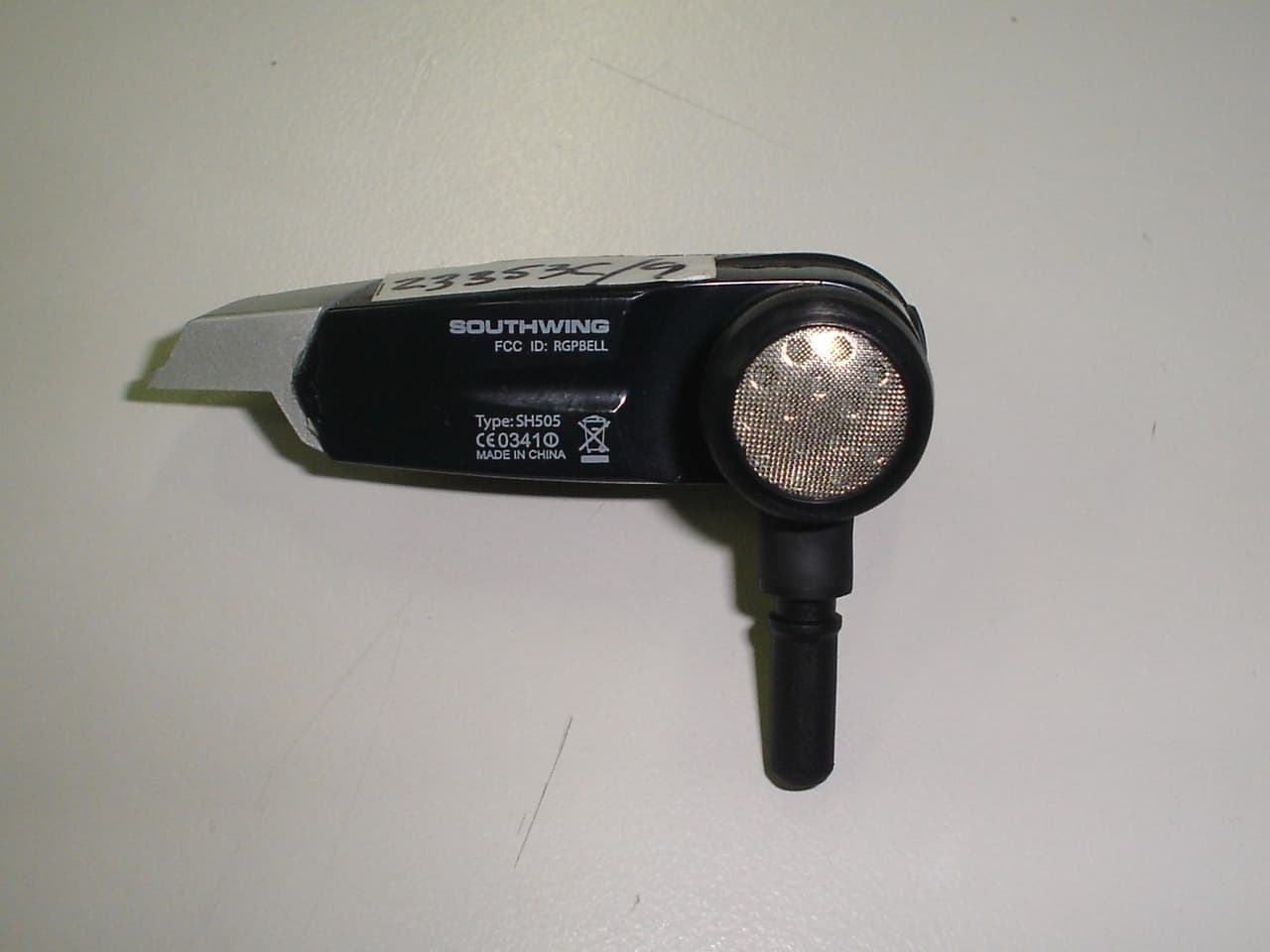
Click to zoom
Application Details
- Equipment Class
- DSS - Part 15 Spread Spectrum Transmitter
- Date of Grant
- Jun 14, 2006
- Application Purpose
- Original Equipment
- Date of Application
- Jun 14, 2006
- Equipment Note
- Bluetooth Wireless Stereo Headset / Model: SH505
- Frequency Range
- 2402.00000000 - 2480.00000000
- Company
- Southwing S.L.
- Country
- Spain
Documents & Files
Document Text
Text extracted from the exhibit documents filed with the FCC. Open a document above to read the original.
Users Manual
User Guide User Guide User Guide User Guide REV 1 REV 1 REV 1 REV 1 – –– – 26.04.05 26.04.05 26.04.05 26.04.05 English SouthWing SH505 Bluetooth ® Wireless Headset Index Introduction 1. Charging the Headset 2. Pairing the Headset 3. Wearing and Carrying the Headset 4. General Usage 5. Push4TM call* 6. 6. Managing multiple calls 7. Troubleshooting 8. Additional Information 9. Declaration of Conformity 10. FCC regulatory notices Note : Please read the “Safe Usage Guidelines” and “Limited Warranty” before using the Headset. 1. Introduction Thank you for choosing a Bluetooth® product from SouthWing. This user guide provides all the information you will need to use and care for your product. All relevant information regarding your SouthWing product can be found on the support section of our website: www.south-wing.com 1. Charging the Headset You will need to charge the battery of your Headset. To do so, follow these steps: 1. Plug the power supply into a power point 2. Plug the connector of the power supply into the USB Charging Socket [1]. The Indicator Light [2] will turn green to indicate the Headset battery is charging 3. Once the Indicator Light [2] turns off, the Headset is fully charged and can be removed from the power supply USB charging Thanks to its USB charging facility, the Headset battery can be charged from any USB port, such as those found on a PC or laptop, by using the SouthWing USB cable adaptor accessory. Please Note: • The Headset will not function while charging. • If the Indicator Light [2] remains off when charging, the battery is already fully charged and does not require further charging. • To maximise battery life, do not charge the Headset for extended periods of time. ® Bluetooth is a registered trademark owned by Bluetooth SIG, Inc. U.S.A. and licensed to SouthWing. • Full battery capacity will be achieved after two or three full charge/discharge cycles. • When your battery is flat, it takes up to four hours to completely charge your headset 2. Pairing the Headset Auto-pairing For added convenience, your headset has an auto-pairing function so that when you turn the headset on for the first time, it is already in pairing mode (you will also hear a series of high tones). Then, follow these steps: 1. Put the mobile phone into pairing mode (see the instructions which came with your phone). Ensure that the mobile phone is no more than 1 metre away from the headset. 2 Enter the PIN number: 1111. If pairing is successful, the Indicator Light [2] will begin flashing every 3 seconds. Normal pairing You will need to follow the steps below if you want to pair your Headset with another mobile phone. 1. Ensure the Headset is off 2. Press and hold the On/Off Button [3] for about 5 seconds until the Indicator Light [2] flashes red and green alternatively (you will also hear a series of high tones) Then complete normal pairing process by following point 1 and 2 of the auto-pairing section above. Pairing with more than one device You will be able to pair your Headset with up to 3 devices. If the Headset is paired with more than one device, it will connect to the last connected device. Should you desire to connect it to another paired device, then initiate connection from the device. If you pair with more than 3 devices, you will lose pairing with the first device that you paired your Headset to. 3. Wearing and carrying the Headset You can wear your Headset on either ear and carry it in different ways using the rotating Multi-function Arm [8]. Wearing the Headset without the Ear Hook You can wear the Headset without using the Ear Hook. To do so: 1. Rotate the Multi-function Arm [8] downwards, until it stays in your ear like a wired headset cable extension 2. Gently place the Speaker [6] into your ear canal 3. Finally find the most comfortable position by rotating the Headset forward and backward Wearing the Headset with the Ear Hook The Ear Hook may also be used for maximum comfort. To mount the ear hook, rotate the Multi-function Arm [8] upwards and slide it inside the Ear Hook [9] jack. To place it on your ear follow these steps: 1. Rotate the Ear Hook [9] slightly forwards 2. Gently place the Speaker [6] slightly into your ear canal 3. Rotate the Ear Hook [9] backwards and adjust it behind your ear 4. To switch from one ear to the other, simply rotate the Multi-function Arm [8] downwards and rotate the Ear Hook [9] to the opposite side Clipping your Headset to your clothes The Multi-function Arm can also be used to carry your Headset in several convenient ways (Ear Hook not mounted). To clip it to your clothes do the following 1. Rotate the Multi-function Arm [8] to the same direction of the microphone [7] 2. Use the Multi-function Arm [8] and Headset Body as a clip to attach the Headset to your clothes Using your Headset Cord to carry your Headset The Headset Cord [10] can also be used to carry your Headset (Ear Hook not mounted). To attach your Headset to the Headset Cord [10] follow these steps 1. Rotate the Multi-function Arm [8] until it is in opposite direction of the Headset microphone [7] 2. Attach the Multi-function Arm [8] to the Headset Cord [10] jack 4. General Usage Turning the Headset on and off To turn the Headset on, press and hold the On/Off Button [3] for about 2 seconds until a series of tones is heard. The Indicator Light [2] will flicker green for 1 second and start flashing. To turn the Headset off, press and hold the On/Off Button [3] for about 2 seconds until a series of tones is heard. The Indicator Light will flash red, before turning off. Changing Volume Your Headset features tact volume buttons that respond simply to finger contact. Volume adjustments will only be possible during calls. To increase the volume, with the Headset on, briefly touch Vol+ Sensor [4]. To decrease the volume, briefly touch the Vol- Sensor [5]. The Headset will remember all volume settings even when it is switched off. Accepting/rejecting * a call When the phone rings (ring …
Text truncated - open the document above for the full version.
Cover Letter(s)
15.247 (a) (1) Statement CETECOM S.A. – ITA team Page 1 of 1 Bluetooth devices 15.247 (a) (1) Statement Bluetooth devices Date: 27/01/2003 15.247 (a) (1) Statement CETECOM S.A. – ITA team Page 2 of 2 Bluetooth devices 1. Pseudorandom hop selection The generation of the hopping sequence in connection mode depends essentially on two input values: 1. LAP/UAP of the master of the connection 2. Internal master clock The LAP (lower address part) are the 24 LSB’s of the 48 BD_ADDRESS. The BD_ADDRESS is an unambiguous number of every Bluetooth unit. The UAP (upper address part) are the 24 MSB’s of the 48 BD_ADDRESS. The internal clock of a Bluetooth unit is derived from a free running clock which is never adjusted and is never turned off. For synchronisation with other units only offset are used. It has no relation to the time of the day. Its resolution is at least half the RX/TX slot length of 312.5 μs. The clock has a cycle of about one day (23h 30’). In most case it is implemented as 28 bit counter. For the deriving of the hopping sequence the entire LAP (24 bits), 4 LSB’s (4 bits) (Input 1) and the 27 MSB’s of the clock (Input 2) are used. With this input values different mathematical procedures (permutations, additions, XOR-operations) are performed to generate the sequence. This will be done at the beginning of every new transmission. The output constitutes a pseudorandom sequence covering 79 hop channels. The exact procedures for the generation of the pseudorandom hopping sequence can be found in “Bluetooth specification Version 1.1 – Part B – Baseband Specification – Chapter 11: Hop selection”. The following is a sample of a pseudorandom hopping sequence of 20 sec. 32000 hops): 34 72 31 69 28 66 25 63 22 60 19 57 16 54 13 51 10 48 07 45 04 42 01 39 77 36 74 33 71 30 68 27 65 24 62 21 59 18 12 20 09 17 61 20 58 17 00 08 76 05 49 08 46 05 67 75 64 72 37 75 34 72 55 63 52 60 25 63 22 60 43 51 40 48 13 51 10 48 31 39 28 36 01 39 77 36 19 27 16 24 68 27 65 24 70 29 55 14 64 23 49 08 58 17 43 02 52 11 37 75 34 72 43 02 28 66 37 75 20 09 17 06 14 03 11 00 22 60 07 45 16 54 01 39 76 65 73 62 70 59 67 56 78 37 63 22 72 31 57 16 66 25 51 10 60 19 45 04 42 01 51 10 36 74 45 04 28 17 25 14 22 11 19 08 30 68 15 53 24 62 09 47 18 56 03 41 12 50 76 35 73 32 03 41 67 26 76 35 59 48 56 45 53 42 50 39 61 20 46 05 55 14 40 78 49 08 34 72 43 02 28 66 25 63 34 72 19 57 28 66 52 62 49 59 46 56 43 53 40 50 37 47 34 44 31 41 28 38 25 35 22 32 19 29 12 50 09 47 61 48 58 45 77 08 09 19 47 06 58 17 67 26 64 23 37 24 34 21 53 63 64 74 23 61 34 72 31 69 14 52 49 59 32 42 19 57 02 40 37 47 20 30 72 31 04 42 11 21 22 32 62 49 59 46 01 39 77 36 58 45 41 28 52 39 35 22 59 69 56 66 29 67 26 64 47 57 44 54 17 55 14 52 35 45 32 42 05 43 02 40 23 33 20 30 72 31 69 28 11 21 08 18 60 19 57 16 78 09 75 06 48 07 45 04 66 76 63 73 36 74 33 71 38 76 21 59 32 70 15 53 26 64 09 47 20 58 03 41 00 38 11 49 73 32 05 43 69 56 66 53 63 50 60 47 69 28 52 11 63 22 46 05 78 37 75 34 44 33 41 30 72 01 77 06 38 76 43 02 60 68 65 73 26 64 31 69 56 64 45 53 22 60 11 49 30 68 27 65 75 64 72 61 24 32 29 37 69 28 74 33 12 20 17 25 57 16 62 21 63 22 60 19 57 16 54 13 37 26 42 31 31 20 36 25 39 77 36 74 33 71 30 68 13 02 18 07 07 75 12 01 15 53 12 50 09 47 06 44 14 52 11 49 59 48 56 45 08 16 13 21 53 12 58 17 75 04 01 09 41 00 46 05 71 00 60 68 37 75 26 64 45 04 42 01 11 00 08 76 39 47 44 52 05 43 10 48 27 35 32 40 72 31 77 36 78 37 75 34 72 31 69 28 52 41 57 46 46 35 51 40 54 13 51 10 48 07 45 04 28 17 33 22 22 11 27 16 30 68 27 65 24 62 21 59 35 73 32 70 29 67 26 64 27 37 32 42 21 31 26 36 15 25 20 30 09 19 14 24 13 51 02 40 56 43 45 32 01 39 69 28 44 31 33 20 60 19 65 24 24 11 29 16 60 70 57 67 24 62 21 59 18 56 15 53 42 52 39 49 73 60 78 65 18 56 23 61 73 32 70 29 18 28 15 25 49 36 54 41 73 32 78 37 51 38 48 35 45 32 42 29 14 52 11 49 38 48 35 45 02 40 78 37 26 36 23 33 69 28 66 25 14 24 11 21 59 46 56 43 53 40 50 37 59 18 48 07 53 12 42 01 35 22 32 19 29 16 26 13 35 73 24 62 29 67 18 56 09 47 06 44 33 43 30 40 76 35 73 32 21 31 18 28 64 23 61 20 09 19 06 16 52 11 49 08 76 07 73 04 42 29 39 26 36 23 33 20 77 06 66 74 43 02 32 70 57 65 62 70 23 61 28 66 39 77 36 74 05 73 02 70 41 49 30 38 07 45 75 34 29 37 15.247 (a) (1) Statement CETECOM S.A. – ITA team Page 3 of 3 Bluetooth devices 18 26 74 33 63 22 09 17 14 22 54 13 59 18 70 29 67 26 36 25 33 22 72 01 61 69 38 76 27 65 60 68 49 57 26 64 15 53 40 48 45 53 06 44 11 49 22 60 19 57 67 56 64 53 24 32 13 21 69 28 58 17 50 39 47 36 72 31 69 28 52 11 41 00 74 03 63 71 40 78 29 67 62 70 51 59 18 07 23 12 12 01 17 06 06 74 11 00 00 68 05 73 02 70 70 59 75 64 64 53 75 34 72 31 69 28 66 25 51 10 56 15 73 02 78 07 33 22 30 19 55 14 52 11 35 73 24 62 57 65 46 54 23 61 12 50 45 53 34 42 01 69 06 74 74 63 00 68 32 42 19 27 71 30 68 27 10 18 07 15 59 18 56 15 77 06 74 03 47 06 44 03 65 73 62 70 35 73 32 70 53 61 50 58 23 61 20 58 59 18 56 15 53 12 50 09 47 06 44 03 41 00 38 76 35 73 32 70 29 67 26 64 23 61 20 58 17 55 14 52 11 49 08 46 05 43 02 40 78 37 75 34 72 31 69 28 66 25 63 22 60 19 57 16 54 13 51 10 48 07 45 04 42 01 39 77 36 74 33 71 30 68 27 65 24 62 21 59 18 56 15 53 12 50 09 47 06 44 03 41 00 38 76 35 47 34 30 17 41 28 24 11 33 71 30 68 27 65 24 62 23 10 06 72 17 04 00 66 09 47 06 44 03 41 00 38 78 65 61 48 72 59 55 42 64 23 61 20 58 17 55 14 54 41 37 24 48 35 31 18 56 66 67 77 26 64 37 75 46 05 43 02 16 03 13 00 46 56 29 39 16 54 78 37 34 44 17 27 04 42 66 25 08 18 19 29 57 16 68 27 20 58 17 55 38 48 35 45 08 46 05 43 26 36 23 33 75 34 72 31 14 24 11 21 59 46 56 43 53 40 50 37 45 04 56 15 39 77 50 09 35 22 32 19 29 16 26 13 21 59 32 70 15 53 26 64 15 53 12 50 33 43 30 40 03 41 00 38 21 31 18 28 70 29 67 26 09 19 06 16 58 17 55 14 76 07 73 04 42 29 39 26 36 23 33 20 20 28 25 33 65 24 70 29 16 24 05 13 61 20 50 09 69 28 66 25 35 24 32 21 63 71 68 76 29 67 34 72 51 59 56 64 17 55 22 60 47 55 36 44 13 51 02 40 21 59 18 56 66 55 63 52 15 23 20 28 60 19 65 24 03 11 08 16 48 07 53 12 78 07 67 75 44 03 33…
Text truncated - open the document above for the full version.
Cover Letter(s)
15.247 (g) Statement CETECOM S.A. – ITA team Page 1 of 1 Bluetooth devices 15.247 (g) Statement – Bluetooth devices Date: 27/01/2003 According to Bluetooth specifications the channel hopping sequence which has a very long period length (23h 30’) does not show repetitive patterns over a short time interval, but distributes the hop frequencies equally over the 79 hopping channels during a short time interval. The generation of the hopping sequence in connection mode depends essentially on two input values: 1. LAP/UAP of the master of the connection 2. Internal master clock The LAP (lower address part) are the 24 LSB’s of the 48 BD_ADDRESS. The BD_ADDRESS is an unambiguous number of every Bluetooth unit. The UAP (upper address part) are the 24 MSB’s of the 48 BD_ADDRESS. The internal clock of a Bluetooth unit is derived from a free running clock which is never adjusted and is never turned off. For synchronisation with other units only offset are used. It has no relation to the time of the day. Its resolution is at least half the RX/TX slot length of 312.5 μs. The clock has a cycle of about one day (23h 30’). In most case it is implemented as 28 bit counter. For the deriving of the hopping sequence the entire LAP (24 bits), 4 LSB’s (4 bits) (Input 1) and the 27 MSB’s of the clock (Input 2) are used. With this input values different mathematical procedures (permutations, additions, XOR-operations) are performed to generate the sequence. This will be done at the beginning of every new transmission. The output constitutes a pseudorandom sequence covering 79 hop channels. For short transmissions the Bluetooth systems have the following behaviour: When the first connection between two devices is established, a hopping sequence is generated. If for transmitting the wanted data the complete hopping sequence is not used, the connection is ended. When a second connection is established. A new hopping sequence is generated. Due to the fact that the Bluetooth clock has a different value, because the period between the two transmission is longer (it cannot be shorter) than the minimum resolution of the clock (312,5 μs). The hopping sequence will always differ from the first one.
Cover Letter(s)
15.247 (h) Statement CETECOM S.A. – ITA team Page 1 of 1 Bluetooth devices 15.247 (h) Statement – Bluetooth devices Date: 27/01/2003 Bluetooth units which want to communicate with other units must be organised in an structure called piconet. This piconet consist of max. 8 Bluetooth units. One unit it the master of the other seven are the slaves. The master co- ordinates frequency occupation in this piconet for all units, the master determines the hopping sequence and the slave follows this sequence. Both devices shift between RX and TX time slot according to the clock of the master. As the master hop sequence is derived from its BD address which is unique for each Bluetooth device, additional masters intending to establish new piconets will allways use different hop sequence.
Cover Letter(s)
attn: Reviewing Engineer Federal Communications Commission 7435 Oakland Mills Road Columbia, MD 21046 RE: LETTER OF AGENT AUTHORIZATION July 9, 2006 To Whom It May Concern: We, the undersigned, hereby authorize MET Laboratories, Inc. to act on our behalf in all matters relating to application for equipment authorizations (FCC ID: RGPBELL), including the signing of all documents relating to these matters. We also hereby certify that no party to the application authorized hereunder is subject to the denial of benefits, including FCC benefits, pursuant to Section 5301 of the Anti-Drug Abuse Act of 1988,21 U.S.C.853(a). This agreement expires one year from the current date. Sincerely, P.A. Mr. Sergi Torrents CTO SouthWing Calle Ávila 48-50, 3ª, 08005 Barcelona, Spain Phone: +34 93 5307208 E-mail: [email protected]
Cover Letter(s)
Federal Communication Commission Equipment Authorization Division, Application Processing Branch 7435 Oakland Mills Road Columbia, MD 21048 July 9, 2006 TO WHOM IT MAY CONCERN Pursuant to Paragraphs §0.457 and 0.459 of the Commission’s Rules (47 C.F.R.) and Section §552(b)(4) of the Freedom of Information Act, SouthWing requests confidentiality for the following products: FCC ID Number Product Title/Model RGPBELL Bluetooth Wireless Stereo Headset / SH505 For the product stated above, we request that the following information be held confidential: 1) Circuit diagrams 2) Block Diagrams 3) Bill of materials 4) Operational Description No other items submitted as part of the equipment authorization filing process are deemed confidential. The above exhibits contain SouthWing trade secrets and proprietary information that could be of benefit to our competitors regarding the design of our Bluetooth devices. This material is not customarily available to the general public and we request that it be withheld from public inspection. If you have any questions, please feel free to contact me at the address shown below. Sincerely, P.A. Mr. Sergi Torrents Chief Technical Officier SouthWing Calle Ávila 48-50, 3ª, 08005 Barcelona, Spain Phone: +34 93 5307200 E-mail: [email protected]
Cover Letter(s)
Federal Communication Commission Equipment Authorization Division, Application Processing Branch 7435 Oakland Mills Road Columbia, MD 21048 July 9, 2006 RE: 15.19 Statement (FCC ID: RGPBELL) TO WHOM IT MAY CONCERN The statement: "This device complies with Part 15 of the FCC Rules. Operation is subject to the following two conditions: (1) this device may not cause harmful interference, and (2) this device must accept any interference received, including interference that may cause undesired operation” Is not placed in the engraved label of the equipment due to the following reasons: - Type label is too small (No room for this writing). - Required text is already included in the user guide This statement is placed in a prominent location in the instruction manual. Please contact me if there is any information you may need. If you have any questions, please feel free to contact me at the address shown below. Sincerely, P.A. Mr. Sergi Torrents Chief Technical Officer SouthWing Calle Ávila 48-50, 3ª, 08005 Barcelona, Spain Phone: +34 93 5307200 E-mail: [email protected]
Cover Letter(s)
MET TCB SERVICE AGREEMENT DOCJ-TCB002 11/24/04 Page 1 of 3 THIS AGREEMENT is made at Baltimore, Maryland this day of June 9, 2006, by and betwee n MET LABORATORIES, INC. (hereinafter referred to as MET) and the following: Applica nt: SouthWing (Hereinafter referred to as the "Responsible Party") Address : C/ Avila 48-50, 08005 Barcelona, Spain Manufacturer: (required for Part 68 only - (Hereinafter referred to as the "Manufacturer") Address: Only the product(s) designed and engineered by the Applicant/Responsible Party and manufactured by the Manufacturer at the Manufacturer's facility at the above address, which have been certified by MET are covered by this service Agreement. NOW, THEREFORE, in consideration of the premises set forth in this agreement, the above mentioned parties agree that; Upon successful evaluation, MET will issue the Applicant/Responsible Party a Grant of Equipment Authorization Certificate, granting the Applicant/Responsible Party permission to market the certified product(s). At a minimum the product's identification plate or label will include the FCC ID Number or the Registration/Certification Number as well as any other information as might be required bystatute. The FCC requires that MET perform random post-certification surveillance. Surveillance for continued certification compliance can be accomplished by the Applicant/Responsible Party providing production models of the product to MET at MET’s request or to other locations as approved by MET for the purpose of compliance testing. The Manufacturer agrees to allow free and unrestricted access to the Manufacturer's facility during normal working hours for the purpose of permitting supervision. The Applicant/Responsible Party or Manufacturer agrees to provide and deliver to MET or locations approved by MET models of the certified product at MET’s request. All costs associated with testing of the device will be borne by the Applicant/Responsible Party or the Manufacturer and paid within 30 days of notice. If required the Applicant/Responsible Party agrees to provide to MET for MET review certain identified technical documents or quality documents that provide for a review of product update and compliance. Acceptable Markings are found in 47 CFR 2.925, 2.926, 15.19, and part 68.300. Only products visually bearing the appropriate FCC identification label and identified as to model and type will be acknowledged as being an authorized product. The Applicant/Responsible Party is responsible for applying the label to the product in accordance with current FCC requirements. An Applicant/Responsible Party is required to submit to MET a sample of the label or plate showing the FCC ID Number or the Registration/Certification Number for approval prior to applying to the product. The Applicant/Responsible Party is required to submit to MET a label location drawing or photograph showing the location of the mark on the product. Any reference to MET certification shall not be permitted on any non-eligible product(s), packaging, or literature. If the Applicant/Responsible Party or the Manufacturer applies the FCC identification label to unauthorized products, then the Applicant/Responsible Party and the Manufacturer shall save, indemnify, and hold harmless MET LABORATORIES, INC. from any and all claims which may arise out of said unauthorized action. The label and/or references to MET are permitted on promotional, advertising, and packaging of Certified Product(s) provided that misrepresentation of results of the marking process and/or this agreement do not occur. Final judgment in the suitability of use of the label or the MET Laboratories name is reserved by MET. (continued, next page) MET TCB SERVICE AGREEMENT DOCJ-TCB002 11/24/04 Page 2 of 3 The Applicant/Responsible Party shall maintain or require the manufacturer to maintain a record of all complaints made known to them relating to the product's compliance with the requirements of the relevant standard and agrees to make these records available to MET when requested. The Aplicant/Responsible Party agrees to take appropriate action, or have the manufacturer take appropriate action with respect of such complaints and/or any deficiencies found in products or services that affect compliance with the requirements for certification. Compliance with all requirements and stipulations of the Certification Program and this agreement between MET and the Applicant/Responsible Party is required for program compliance. Non-compliance with all or part of this agreement may result in termination of the agreement and the notification to the FCC to withdraw certification of the product. The Applicant/Responsible Party assumes responsibility for complying with the requirements of the product's certification and this agreement regarding the application of the FCC identification label. The Applicant/Responsible Party understands that any violation of the requirements of this agreement can immediately, at MET's discretion, terminate this agreement. Upon notification by MET, the Applicant/Responsible Party shall immediately take action to correct non-conformance that may have been found during surveillance or during modification to the product by the Applicant/Responsible Party. The Applicant/Responsible Party understands that corrective actions must be immediate. The Applicant/Responsible Party also understands that MET is required to report to the FCC any noted non-compliance. MET will also report corrective actions taken and the status of corrective action. The FCC will determine if any certificate or grants will be withdrawn. Upon termination of this agreement, the Applicant/Responsible Party agrees to remove any references to MET Laboratories from all literature, stationary, packaging, or other promotional media as may have been used by the Applicant/Responsible Party. Additionally, upon termination of this agreement, MET Laboratories will inform the FCC of such termination. The observan…
Text truncated - open the document above for the full version.
RF Exposure Info
Attn: Reviewing Engineer Federal Communications Commission 7435 Oakland Mills Road Columbia, MD 21046 June 6, 2006 RE: RF exposure information FCC ID: RGPBELL FCC ID Number Product Title / Model RGPBELL Bluetooth Wireless Stereo Headset / SH505 TO WHOM IT MAY CONCERN The product stated above complies with the FCC limits for Human exposure to RF emissions. This device is categorically excluded from routine environmental, because it operates at very low power level. The equipment is deemed to comply with the SAR or MPE limits without testing due to its very low power level (EIRP < 1 mW). Sincerely, P.A. Mr. Sergi Torrents CTO SouthWing Calle Ávila 48-50, 3ª, 08005 Barcelona, Spain Phone: +34 93 5307200 E-mail: [email protected]
Test Report
Report No.: 23353RET.101 Date: 2006-05-23 Page: 2 of 7 FDT08_04 INDEX 1. COMPETENCE AND GUARANTEES..........................................................................................3 2. GENERAL CONDITIONS..............................................................................................................3 3. CHARACTERISTICS OF THE TEST............................................................................................3 3.1 TEST REQUESTED.................................................................................................................3 3.2 REQUIREMENTS AND METHOD........................................................................................3 4. IDENTIFICATION DATA SUPPLIED BY THE APPLICANT.....................................................4 4.1 APPLICANT.............................................................................................................................4 4.2 REPRESENTATIVE................................................................................................................4 4.3 TEST SAMPLES SUPPLIER...................................................................................................4 4.4 IDENTIFICATION OF ITEM/ITEMS TESTED.....................................................................5 5. USAGE OF SAMPLES, PERIOD OF TESTING AND ENVIRONMENTAL CONDITIONS.....5 5.1 USAGE OF SAMPLES............................................................................................................5 5.2 PERIOD OF TESTING............................................................................................................5 5.3 ENVIROMENTAL CONDITIONS..........................................................................................6 6. TEST RESULTS..............................................................................................................................7 7. REMARKS AND COMMENTS......................................................................................................7 8. SUMMARY......................................................................................................................................7 ANNEXES ANNEX A. TEST RESULTS ANNEX B. PHOTOGRAPHS Report No.: 23353RET.101 Date: 2006-05-23 Page: 3 of 7 FDT08_04 1. COMPETENCE AND GUARANTEES Centro de Tecnología de las Comunicaciones (CETECOM), S.A. is a laboratory with a measurement facility in compliance with the requirements of Section 2.948 of the FCC rules and has been added to the list of facilities whose measurements data will be accepted in conjuction with applications for Certification under Parts 15 or 18 of the Commission's Rules. Registration Number: 905266. Centro de Tecnología de las Comunicaciones (CETECOM), S.A. is a laboratory with a measurement site in compliance with the requirements of RSS 212, Issue 1 (Provisional) and has been added to the list of filed sites of the Canadian Certification and Engineering Bureau. Reference File Number: IC 4621. In order to assure the traceability to other national and international laboratories, CETECOM has a calibration and maintenance programme for its measuring equipment. CETECOM guarantees the reliability of the data presented in this report, which is the result of measurements and tests performed to the item under test on the date and under the conditions stated on the report and is based on the knowledge and technical facilities available at CETECOM at the time of execution of the test. CETECOM is liable to the client for the maintenance by its personnel of the confidentiality of all information related to the item under test and the results of the test. 2. GENERAL CONDITIONS 1. This report only refers to the item that has undergone the test. 2. This report does not constitute or imply by its own an approval of the product by the Certification Bodies or competent Authorities. 3. This document is only valid if complete; no partial reproduction can be made without written approval of CETECOM. 4. This test report cannot be used partially or in full for publicity and/or promotional purposes without previous written approval of CETECOM and the Accreditation Bodies. 3. CHARACTERISTICS OF THE TEST 3.1 TEST REQUESTED Measurements for frequency hopping spread spectrum equipment (Bluetooth) operating in the 2400 MHz -2483.5 MHz band and using, according to FCC Part 15.247. 3.2 REQUIREMENTS AND METHOD 1. FCC parts 15.33, 15.35, 15.247, 15.205, 15.209 and the document DA 00-705:"Filing and Measurement Guidelines for Frequency Hopping Spread Spectrum Systems". The testing was performed according to the procedure in ANSI C63.4: 2003. Radiated testing was performed in Cetecom's semi-anechoic chamber. This site has been fully described in a report submitted to the FCC and was accepted in a letter dated July 25, 2002. Report No.: 23353RET.101 Date: 2006-05-23 Page: 4 of 7 FDT08_04 The instrumentation used to perform the testing is listed below: 1. Semianechoic Absorber Lined Chamber IR 11. BS. 2. Control Chamber IR …
Text truncated - open the document above for the full version.
Contact Information
Applicant
Sergi Torrents(Chief Technical Officer)
Test Firm
DEKRA Testing and Certification, S.A.U.Rafael Lopez Martin
Technical Specifications
| # | Rule Parts | Frequency Range | Power Output |
|---|---|---|---|
| 1 | 15C | 2.40 GHz - 2.48 GHz | 2.00 mW |
Other Applications from Southwing S.L.
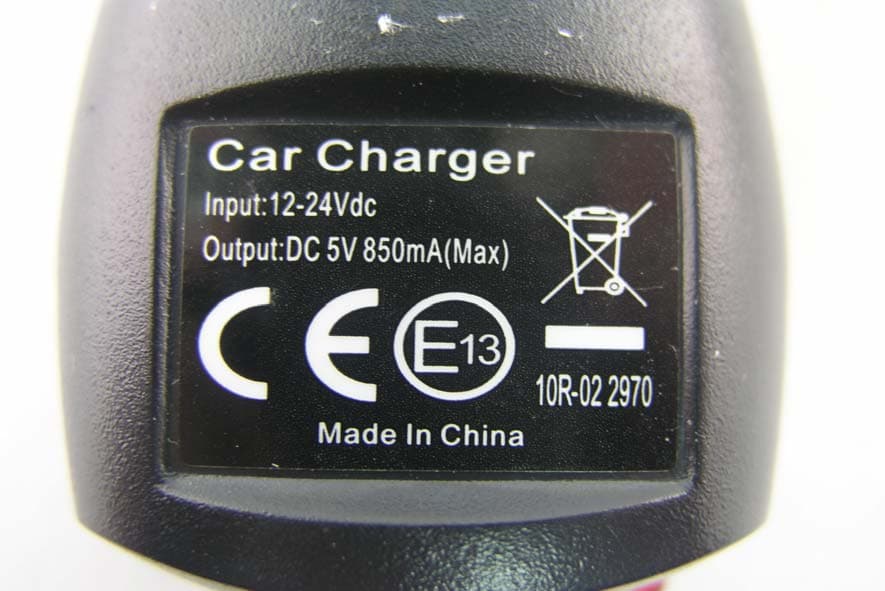
RGPBOROM
Nov 21, 2007Bluetooth Wireless Headset
Equipment Class
DSS - Part 15 Spread Spectrum Transmitter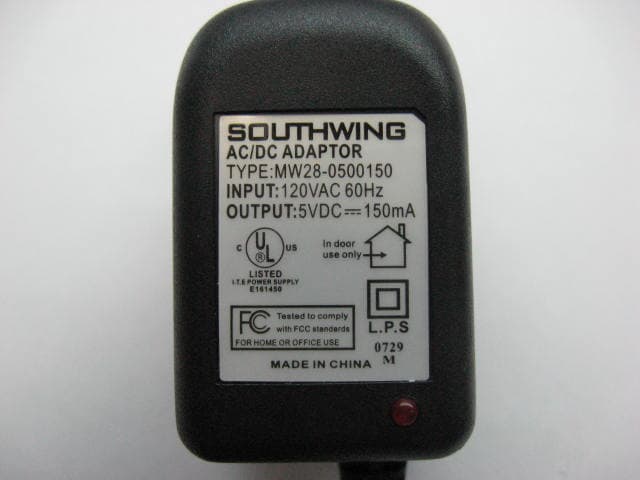
RGPBOFLX
Sep 26, 2007Bluetooth Wireless Headset
Equipment Class
DSS - Part 15 Spread Spectrum Transmitter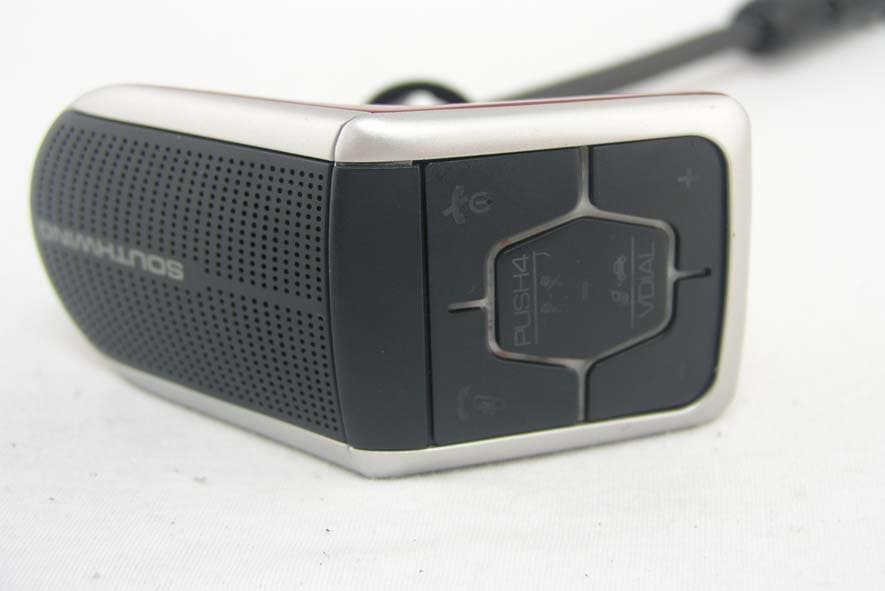
RGPTERE
May 17, 2006Bluetooth Hands free Car kit
Equipment Class
DSS - Part 15 Spread Spectrum Transmitter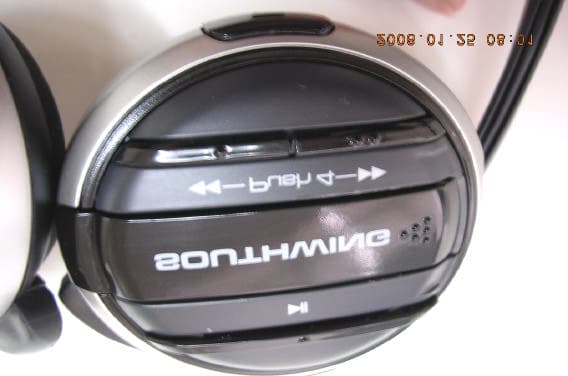
RGPCELL
Jan 25, 2006Bluetooth Stereo Headphones
Equipment Class
DSS - Part 15 Spread Spectrum Transmitter
RGPCATL
Oct 11, 2005Hands-Free Car Kit with Bluetooth
Equipment Class
DSS - Part 15 Spread Spectrum Transmitter