RYZ2070Digital Thermometer
K-jump Health Co.,Ltd.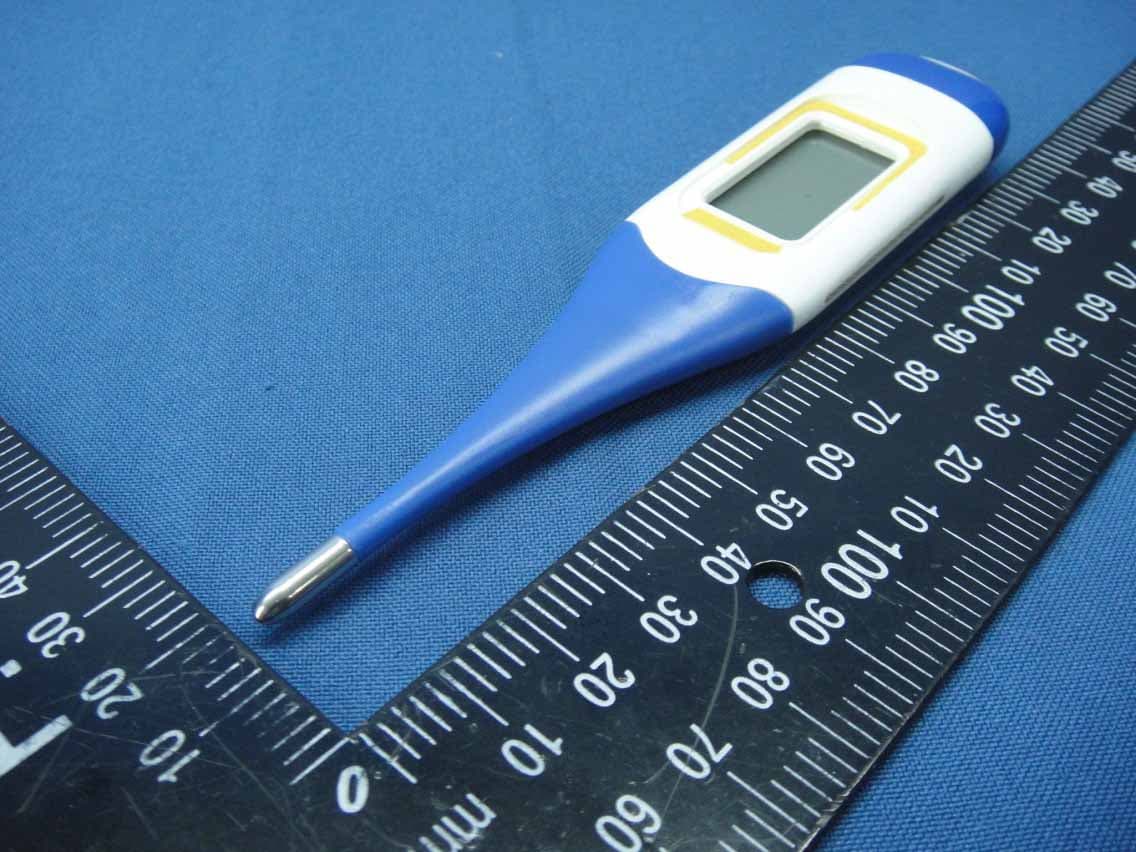
Click to zoom
Application Details
- Equipment Class
- DTS - Digital Transmission System
- Date of Grant
- May 13, 2015
- Application Purpose
- Original Equipment
- Date of Application
- May 13, 2015
- Equipment Note
- Digital Thermometer
- Frequency Range
- 2402.00000000 - 2480.00000000
- Company
- K-jump Health Co.,Ltd.
- Country
- Taiwan
Documents & Files
Document Text
Text extracted from the exhibit documents filed with the FCC. Open a document above to read the original.
Users Manual
1. Fast oral and rectal temperature measurements in around 5 seconds. 2. 20 sets memories, recall all memories with Bluetooth 4.0 (BLE). 3. Very sensitive unit, easy to read digital LCD (liquid crystal display). 4. Compact, accurate and durable LSI ( large scale integration ) unit. 5. Dual-display LCD, left-handed and right-handed display. 6. If the thermometer is inadvertently left on after temperature stabilization, it will automatically shut off in about 30 seconds . 7. ABS resin body presents no hazard compared to broken mercury /glass thermometers. 8. Low battery indicator: when the symbol " "appears, the battery needs to be replaced. 9. This unit is water resistant. 1. Do not boil the probe. Instead, clean the unit by wiping it with a dry cloth and disinfect the probe with ethyl (rubbing ) alcohol. See cleaning instructions for details. 2. Do not drop the thermometer or expose it to heavy shock. The unit is not shock-proof. 3. Do not bite or swallow the probe and the headset jack adaptor. 4. After using, clean the thermometer and place it into the carrier case. 5. Do not store the unit under direct sunlight, at a high temperature, in high humidity or dust. Performance may be degraded. 6. Stop using the thermometer if it operates erratically or if the display malfunctions. 7. Keep out of reach of unsupervised children. 8. Clean the thermometer probe before storing. 9. Do not attempt to disassemble the unit except to replace the battery. 10. If the thermometer has been stored at below-freezing temperatures, allow the thermom- eter to warm naturally to room temperature before using. 11. Performance of the thermometer may be degraded if: Operated or stored outside stated temperature and humidity ranges or if the patient's temperature is below the ambient (room) temperature. 12. Only use the thermometer indoors and do not use it near microwave ovens. In the case of thermometer whose maximum power exceeds 2 W, the minimum distance from thermometer should be 3.3 meters. This thermometer is guaranteed for one year from the date of purchase against manufac- turer's defect under normal, household use. Follow the directions closely will ensure years of dependable operation. WARRANTY EXCLUSIONS Device is not properly operated according to the instruction as described in this manual. Device shows any signs of tampering or attempted modification. Evidence of improper handling or storing, such as dropping, electric shock, heat, liquid or cleaner damage. Natural distance (i.e., fire, flood, earthquake, lightening) No receipt or proof of purchase showing date of purchase. FOLLOWING THE INSTRUCTION CLOSELY WILL ENSURE YEARS OF DEPENDABLE OPERATION. If the thermometer does not function properly, first check the battery (see battery replacement instructions).Replace it if necessary. THE TAKING OF BODY TEMPERATURES: Change in body temperature is one of the most important indicators of illness. It is important that accurate temperatures be taken. Even though the digital thermometer is used in similar manner to the glass thermometer, it is important that the simple instructions for use of this thermometer be followed closely and that the person taking the temperature understands body temperature. BODY TEMPERATURE: A person's body temperature will usually be several tenths to one full degree lower in the morning than it is in the late afternoon. Therefore, if your temperature is 36.60°C(97.88°F) in the morning, it could be 36.90°C(98.42°F) or more in the late afternoon and still be normal. To determine what your normal body temperature is you should take your temperature both in the early morning and in the late afternoon over several days. Children have the same normal temperature range as do adults. A fever for both children and adults is typically defined as a temperature over 37.50°C(99.50°F) (oral reading). Exercise, excessive clothing, hot bath, hot weather, warm food and drink can cause mild elevations of up to 38.00°C(100.40°F) to 38.40°C(101.12°F) in oral temperature. If you suspect one of these to be the cause of an elevated reading, eliminate the possible cause and retake the temperature in a half hour. ORAL USE Place the probe well under the patient's tongue. Instruct the patient to keep their mouth closed while the thermometer is reading. A normal temperature by this method is usually considered between 36.00°C to 37.50°C(96.80°F to 99.50°F). When Bluetooth connection is built up, LCD shows “con” date and time will be sync-up to thermometer automatically then LCD show date and time. Date is MMDD format and time is AM/PM format but the AM or PM won’t be shown. Here is an example, date is December-23 and time is 3:16. Read-back memories & write-in setting via Bluetooth4.0 When the unit is off, short press ON/OFF button twice, Bluetooth will be on then ready for data transmission and LCD shows bt and segment flashes clockwise in sequence, shown as below. If there is no operation within 30 seconds, the unit will auto turn off or user can turn off manually by pressing ON/OFF button. Switch the display mode: When the degree sign °C (°F) on the display is flashing, long press ON/OFF button for 2 seconds then release it , this operation can switch the display mode from right-handed to left-handed or from left-handed to right-handed. After switching the display mode, the unit will display accordingly for next turning on. For information and help in using this thermometer with your mobile device, refer to the enclosed Quick Start Guide. If there is no memory on the thermometer, LCD shows non. Normal Temperature Alarm: An alarm will sound when the peak temperature has registered and is ready-to-read. The "Normal Temperature" alarm (four quick beeps followed by a pause) will sound repeatedly for approximately 5 seconds. For Switchable Centigrade and Fahrenheit Models: After turning on or waking up the thermometer, the Centigrade or Fahrenheit mode can be switched within the first 2 seconds by pressing an…
Text truncated - open the document above for the full version.
External Photos
Report No.: 150430E03 Page 1 CONSTRUCTION PHOTOS OF EUT
ID Label/Location Info
FCC ID: RYZ2070 LABEL LOCATION Brad name : K-jump Model name : KD-2070 Diecut Scale 1:1 Scale 2:1 LOT MMYY FCC ID:RYZ2070 2070 LOT MMYY FCC ID:RYZ2070 2070
Internal Photos
Report No.: 150430E03 Page 2 Report No.: 150430E03 Page 3 Report No.: 150430E03 Page 4
Operational Description
FCC ID: RYZ2070 Report No.: RF150430E03 Operational Description This device is a Digital Thermometer. The transmitter of the EUT is powered by DC 3V from battery. The antenna is PCB antenna without antenna connector. For more detailed instruction, please take a look at the user’s manual.
RF Exposure Info
Report No.: SA150430E03A Page No. 1 / 6 Report Format Version: 6.1.1 Reference No.: 150513E01 RF Exposure Report Report No.: SA150430E03A FCC ID: RYZ2070 Test Model: KD-2070 Received Date: May 06, 2015 Test Date: May 06, 2015 Issued Date: May 13, 2015 Applicant: K-JUMP HEALTH CO., LTD. Address: No. 56 Wu Kung 5th Rd., New Taipei Industrial Park, New Taipei City 24890, Ta i w a n Issued By: Bureau Veritas Consumer Products Services (H.K.) Ltd., Taoyuan Branch Hsin Chu Laboratory Lab Address: No. 81-1, Lu Liao Keng, 9th Ling,Wu Lung Tsuen, Chiung Lin Hsiang, Hsin Chu Hsien 307, Taiwan R.O.C. Test Location (1): No. 81-1, Lu Liao Keng, 9th Ling,Wu Lung Tsuen, Chiung Lin Hsiang, Hsin Chu Hsien 307, Taiwan R.O.C. Test Location (2): No. 49, Ln. 206, Wende Rd., Shangshan Tsuen, Chiung Lin Hsiang, Hsin Chu Hsien 307, Taiwan R.O.C. This report is for your exclusive use. Any copying or replication of this report to or for any other person or entity, or use of our name or trademark, is permitted only with our prior written permission. This report sets forth our findings solely with respect to the test samples identified herein. The results set forth in this report are not indicative or representative of the quality or characteristics of the lot from which a test sample was taken or any similar or identical product unless specifically and expressly noted. Our report includes all of the tests requested by you and the results thereof based upon the information that you provided to us. You have 60 days from date of issuance of this report to notify us of any material error or omission caused by our negligence, provided, however, that such notice shall be in writing and shall specifically address the issue you wish to raise. A failure to raise such issue within the prescribed time shall constitute your unqualified acceptance of the completeness of this report, the tests conducted and the correctness of the report contents. Unless specific mention, the uncertainty of measurement has been explicitly taken into account to declare the compliance or non-compliance to the specification. The report must not be used by the client to claim product certification, approval, or endorsement by any government agenc Report No.: SA150430E03A Page No. 2 / 6 Report Format Version: 6.1.1 Reference No.: 150513E01 Table of Contents Release Control Record .................................................................................................................................. 3 1 Certificate of Conformity ...................................................................................................................... 4 2 Evaluation Result .................................................................................................................................. 5 3 SAR Test Exclusion Thresholds .......................................................................................................... 6 4 Conclusion ............................................................................................................................................ 6 Report No.: SA150430E03A Page No. 3 / 6 Report Format Version: 6.1.1 Reference No.: 150513E01 Release Control Record Issue No. Description Date Issued SA150430E03A Original release. May 13, 2015 Report No.: SA150430E03A Page No. 5 / 6 Report Format Version: 6.1.1 Reference No.: 150513E01 2 Evaluation Result Following FCC KDB 447498 D01 “General SAR test exclusion guidance” The corresponding SAR Exclusion Threshold condition, listed below: 1) The 1-g and 10-g SAR test exclusion thresholds for 100 MHz to 6 GHz at test separation distances ≤ 50 mm are determined by: [(max. power of channel, including tune-up tolerance, mW)/(min. test separation distance, mm)] ·[√f(GHz)] ≤ 3.0 for 1-g SAR and ≤ 7.5 for 10-g extremity SAR, where f(GHz) is the RF channel transmit frequency in GHz . Power and distance are rounded to the nearest mW and mm before calculation . The result is rounded to one decimal place for comparison The test exclusions are applicable only when the minimum test separation distance is ≤ 50 mm and for transmission frequencies between 100 MHz and 6 GHz. When the minimum test separation distance is < 5 mm, a distance of 5 mm is applied to determine SAR test exclusion. 2) At 100 MHz to 6 GHz and for test separation distances > 50 mm, the SAR test exclusion threshold is determined according to the following: a) [Threshold at 50 mm in step 1) + (test separation distance - 50mm)·( f(MHz)/150)] mW, at 100MHz to 1500 MHz b) [Threshold at 50 mm in step 1) + (test separation distance - 50 mm)·10] mW at > 1500 MHz and ≤ 6 GHz 3) At frequencies below 100 MHz, the following may be considered for SAR test exclusion. a) The threshold at the corresponding test separation distance at 100 MHz in step 2) is multiplied by [1 + log(100/f(MHz))] for test separation distances > 50 mm and < 200 mm. b) The threshold determined by the equation in a) for 50 mm and 100 MHz is multiplied by ½ for test separation distances ≤ 50 mm. c) SAR measurement procedures are not established below 100 MHz. When SAR test exclusion cannot be applied, a KDB inquiry is required to determine SAR evaluation requirements for any test results to be acceptable. Report No.: SA150430E03A Page No. 6 / 6 Report Format Version: 6.1.1 Reference No.: 150513E01 3 SAR Test Exclusion Thresholds Maximum measured transmitter power: BT-LE Frequency (GHz) Max. Power (mW) Min. test separation distance (mm) SAR test exclusion calculation value (NOTE 2) 1-g SAR test exclusion thresholds Result 2.402 ~ 2.480 0.2483 5 0.078204646 3 Pass NOTE: 1. The antenna type is PCB antenna with -4.52dBi gain. 2. Calculate SAR test exclusion thresholds from condition “1” formulas. 4 Conclusion Since Source-base time average power is below SAR test exclusion power thresholds, the SAR evaluation is not required. --- END ---
Test Report
Report No.: RF150430E03 Page No. 1 / 32 Report Format Version: 6.1.1 FCC Test Report (BT-LE) Report No.: RF150430E03 FCC ID: RYZ2070 Test Model: KD-2070 Received Date: Apr. 30, 2015 Test Date: May 06 to 07, 2015 Issued Date: May 12, 2015 Applicant: K-JUMP HEALTH CO., LTD. Address: No. 56 Wu Kung 5th Rd., New Taipei Industrial Park, New Taipei City 24890, Ta i w a n Issued By: Bureau Veritas Consumer Products Services (H.K.) Ltd., Taoyuan Branch Hsin Chu Laboratory Lab Address: No. 81-1, Lu Liao Keng, 9th Ling,Wu Lung Tsuen, Chiung Lin Hsiang, Hsin Chu Hsien 307, Taiwan R.O.C. Test Location (1): No. 81-1, Lu Liao Keng, 9th Ling,Wu Lung Tsuen, Chiung Lin Hsiang, Hsin Chu Hsien 307, Taiwan R.O.C. Test Location (2): No. 49, Ln. 206, Wende Rd., Shangshan Tsuen, Chiung Lin Hsiang, Hsin Chu Hsien 307, Taiwan R.O.C. This report is for your exclusive use. Any copying or replication of this report to or for any other person or entity, or use of our name or trademark, is permitted only with our prior written permission. This report sets forth our findings solely with respect to the test samples identified herein. The results set forth in this report are not indicative or representative of the quality or characteristics of the lot from which a test sample was taken or any similar or identical product specifically and expressly noted. Our report includes all of the tests requested by you and the results thereof based upon the information that you provided to us. You have 60 days from date of issuance of this report to notify us of any material error or omission caused by our negligence, provided, however, that such notice shall be in writing and shall specifically address the issue you wish to raise. A failure to raise such issue within the prescribed time shall constitute your unqualified acceptance of the completeness of this report, the tests conducted and the correctness of the report contents. Unless specific mention, the uncertainty of measurement has been explicitly taken into account to declare the compliance or non-compliance to the specification. The report must not be used by the client to claim product certification, approval, or endorsement by TAF or any government agenc Report No.: RF150430E03 Page No. 2 / 32 Report Format Version: 6.1.1 Table of Contents Release Control Record .................................................................................................................................. 4 1 Certificate of Conformity ...................................................................................................................... 5 2 Summary of Test Results ..................................................................................................................... 6 2.1 Measurement Uncertainty ................................................................................................................... 6 2.2 Modification Record ............................................................................................................................ 6 3 General Information .............................................................................................................................. 7 3.1 General Description of EUT (BT-LE) ................................................................................................... 7 3.2 Description of Test Modes ................................................................................................................... 8 3.2.1 Test Mode Applicability and Tested Channel Detail ............................................................................. 9 3.3 Description of Support Units ............................................................................................................. 10 3.3.1 Configuration of System under Test .................................................................................................. 10 3.4 Duty Cycle of Test Signal ................................................................................................................... 11 3.5 General Description of Applied Standards ........................................................................................ 12 4 Test Types and Results ...................................................................................................................... 13 4.1 Radiated Emission and Bandedge Measurement ............................................................................. 13 4.1.1 Limits of Radiated Emission and Bandedge Measurement .............................................................. 13 4.1.2 Test Instruments ................................................................................................................................ 14 4.1.3 Test Procedures ................................................................................................................................. 16 4.1.4 Deviation from Test Standard ............................................................................................................ 16 4.1.5 Test Setup .......................................................................................................................................... 17 4.1.6 EUT Operating Conditions ................................................................................................................. 18 4.1.7 Test Results ....................................................................................................................................... 19 4.2 6dB Bandwidth Measurement ........................................................................................................... 23 4.2.1 Limits of 6dB Bandwidth Measurement ............................................................................................. 23 4.2.2 Test Setup .......................................................................................................................................... 23 4.2.3 Test Instruments ....................…
Text truncated - open the document above for the full version.
Test Setup Photos
Report No.: 140717E01A-1 1 of 1 Reference No.: 140805E09 PHOTOGRAPHS OF THE TEST CONFIGURATION RADIATED EMISSION TEST
Contact Information
Applicant
Jun-Ming Lin(QA)
Test Firm
Bureau Veritas CPS (H.K.) Ltd., Taoyuan BranchRichard Chen
Technical Specifications
| # | Rule Parts | Frequency Range | Power Output |
|---|---|---|---|
| 1 | 15C | 2.40 GHz - 2.48 GHz | 200.00 µW |
Other Applications from K-jump Health Co.,Ltd.

RYZKP-7XXX-590
Apr 28, 2015Bluetooth Medical Device
Equipment Class
DTS - Digital Transmission System
RYZTEMPONITOR
Apr 14, 2004Clinic Patch Thermometer ( Temponitor )
Equipment Class
DXX - Part 15 Low Power Communication Device Transmitter