A4R-GG1Bluetooth & DTS/UNII a/b/g/n/ac Device
Google LLC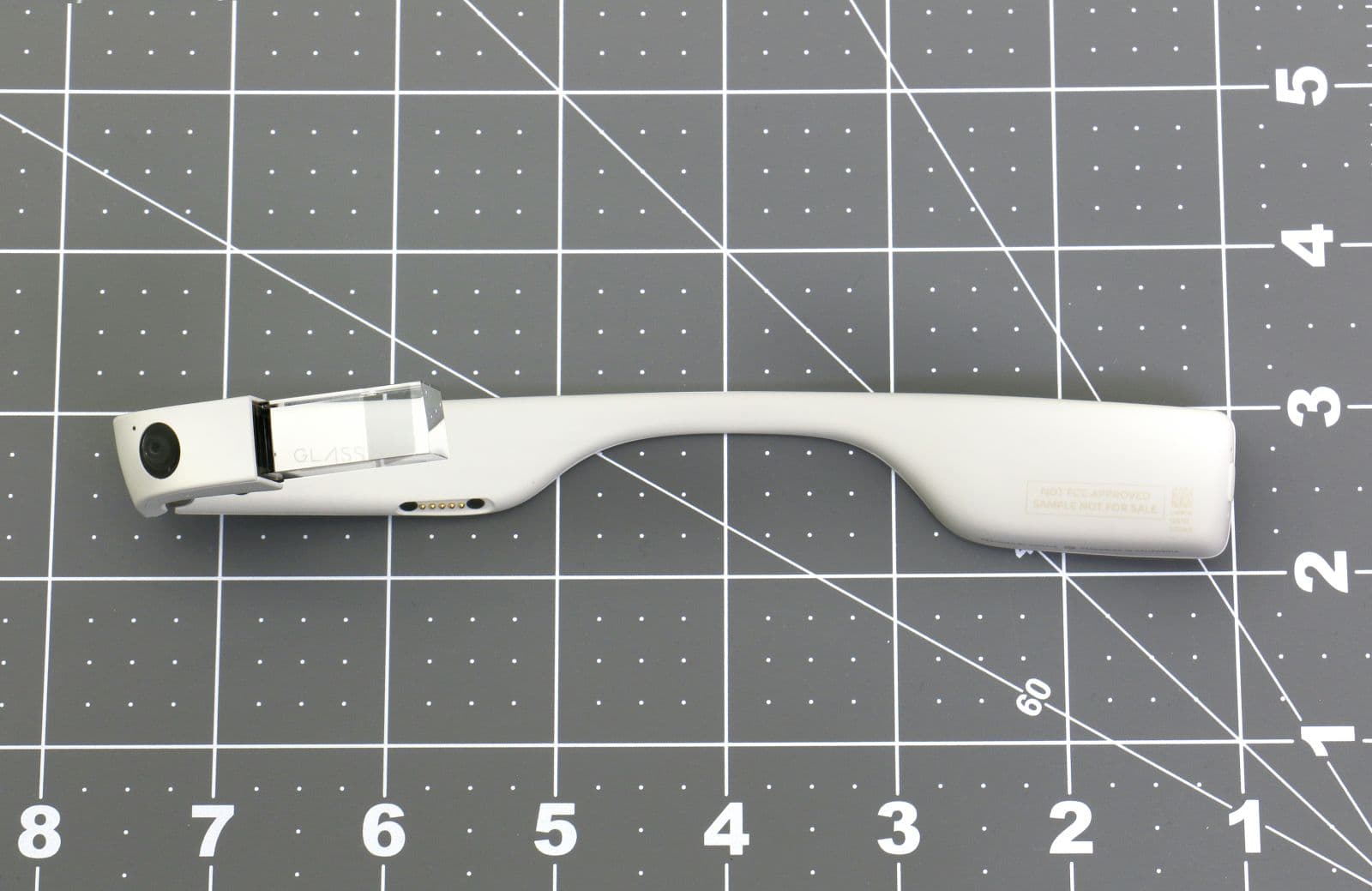
Click to zoom
Application Details
- Equipment Class
- NII - Unlicensed National Information Infrastructure TX
- Date of Grant
- Jun 30, 2015
- Application Purpose
- Original Equipment
- Date of Application
- May 28, 2015
- Equipment Note
- Bluetooth & DTS/UNII a/b/g/n/ac Device
- Frequency Range
- 5745.00000000 - 5825.00000000
- Company
- Google LLC
- Country
- United States
Documents & Files
Document Text
Text extracted from the exhibit documents filed with the FCC. Open a document above to read the original.
Users Manual
DRAFT Manual for Model: GG1 Quick Start Guide Step 1 GET TO KNOW YOUR DEVICE Before using your device, let’s get familiar with its key components. Power button The power button is located on the back of the device. Press it for one second to turn the device on or off. Display The plastic cube just above your right eye allows you to interact with the device. The Home Screen is your starting point. By default, the display shows you the current time. Camera The camera button is located on top of the device near the display. Press the camera button to take a photo. Hold it down to record a video. The green light shows when the camera is on. Touchpad The flat area on your device along the side is called the touchpad. You’ll use it to navigate different cards on the display. Step 2 USING YOUR DEVICE Charge your device Connect the power cable to the device to charge. The light pulses while charging and stays solid when fully charged. Turn on your device After the device is fully charged, the device is ready to use. Press and hold the power button to power on. Follow the onscreen instructions for setup by navigating through each screen using the touchpad. Here’s how: Tap Tap the touchpad to wake the display, or to select an action or open a card bundle. DRAFT Swipe forward or backward Slide one finger along the touchpad to scroll through the cards. Swipe with two fingers to zoom out and scroll through several cards at once. Swipe Down Swipe down on the touchpad with one finger to go back to a previous card. If you’re on the Home Screen, swipe down to turn off the display. Safety information [Safety text] Regulatory Notices Radio Frequency This device meets the U.S. Federal Communications Commission's (FCC) requirements for exposure to radio waves and is designed and manufactured not to exceed the FCC's emission limits for exposure to radiofrequency (RF) energy. The exposure standard for wireless devices employs a unit of measurement known as the Specific Absorption Rate, or SAR. The SAR limit set by the FCC is 1.6W/kg. This device complies with the European Union RF exposure limit set forth for an uncontrolled environment and is safe for intended operation as described in this manual. Elabel Information To access regulatory elabel information, using the device, navigate to the settings menu, select regulatory information, and then scroll left and right to view device elabels. US Regulatory Notices Note on interference in a residential installation This equipment has been tested and found to comply with the limits for a Class B digital device, pursuant to part 15 of the FCC Rules. These limits are designed to provide reasonable protection against harmful interference in a residential installation. This equipment generates, uses and can radiate radio frequency energy and, if not installed and used in accordance with the instructions, may cause harmful interference to radio communications. However, there is no guarantee that interference will not occur in a particular installation. If this equipment does cause harmful interference to radio or television reception, which can be determined by turning the equipment off and on, the user is encouraged to try to correct the interference by one or more of the following measures: ●Reorient or relocate the receiving antenna. ●Increase the separation between the equipment and receiver. ●Connect the equipment into an outlet on a circuit different from that to which the receiver is connected. DRAFT ●Consult the dealer or an experienced radio/TV technician for help. This device complies with parts 2 and 15 of the FCC Rules. Operation is subject to the following two conditions: (1) This device may not cause harmful interference, and (2) this device must accept any interference received, including interference that may cause undesired operation. Changes or modifications to this device without the manufacturer’s express approval may void the user’s authority to operate the equipment. Model number: GG1 FCC ID: A4RGG1 Responsible Party: Google Inc.,1600 Amphitheatre Parkway, Mountain View, California 94043, 650.253.0000. Industry Canada (IC) Notices This device complies with Industry Canada licenseexempt RSS standard(s). Operation is subject to the following two conditions: (1) this device may not cause interference, and (2) this device must accept any interference, including interference that may cause undesired operation of the device. Under Industry Canada regulations, the radio transmitter(s) in this device may only operate using an antenna of a type and maximum (or lesser) gain approved for the transmitter by Industry Canada. To reduce potential radio interference to other users, the antenna type and its gain should be so chosen that the equivalent isotropically radiated power (e.i.r.p.) is not more than that necessary for successful communication. The radiated output power of the Wireless Device is below the Industry Canada (IC) radio frequency exposure limits. The Wireless Device should be used in such a manner such that the potential for human contact during normal operation is minimized. CAN ICES3 (B)/NMB3(B) IC: 10395AGG1 Avis D’industry Canada (IC) Cet appareil est conforme aux normes CNR exemptes de licence d’Inustrie Canada. Le fonctionnement est soumis aux deus conditions suivantes: (1) cet appareil ne doit pa provoquer d’interferences et (2) cet appareil doit accepter toute interference, y compris celles susceptibles de provoquer un fonctionnement non souhaite de l’appareil. Conformément à la réglementation d'Industrie Canada, le présent émetteur radio peut fonctionner avec une antenne d'un type et d'un gain maximal (ou inférieur) approuvé pour l'émetteur par Industrie Canada. Dans le but de réduire les risques de brouillage radioélectrique à l'intention des autres utilisateurs, il faut choisir le type d'antenne et son gain de sorte que la puissance isotrope rayonnée équivalente (p.i.r.e.) ne dépasse pas l'intensité nécessaire à l'établissem…
Text truncated - open the document above for the full version.
Cover Letter(s)
Google Inc. 1600 Amphitheatre Parkway Mountain View, CA 94043 Main 650 253.0000 Fax 650 253.0001 www.google.com Federal Communications Commission Laboratory Division 7435 Oakland Mills Road Columbia, MD 21046 Date:May 15, 2015 Subject:Authority to Act as an Agent FCC ID:A4RGG1 To Whom It May Concern: I,theundersigned,herebyauthorizeULVerificationServicesInc.toactonourbehalfinall mannersrelatingtoapplicationforequipmentauthorization,includingsigningofalldocuments relatingtothesematters.AnyandallactscarriedoutbyULVerificationServicesInc.onour behalf shall have the same effect as acts of our own. I,theundersigned,herebycertifythatwearenotsubjecttoadenialoffederalbenefits,that includesFCCbenefits,pursuanttoSection5301oftheAntiDrugAbuseActof1988,21U.S.C. 853(a). InauthorizingULVerificationServicesInc.asouragent,westillrecognizethatweare responsible to: a)comply with the relevant provisions of the certification program; b)make all necessary arrangements for the conduct of the evaluation, including provision for examining documentation and access to all areas, records (including internal audit reports) and personnel for the purposes of evaluation (e.g. testing, inspection, assessment, surveillance, reassessment) and resolution of complaints; c)make claims regarding certification only in respect of the scope for which certification has been granted; d)do not use our product certification in such a manner as to bring the Certification Division into disrepute and not make any statement regarding our product certification which the Certification Division may consider misleading or unauthorized; e)upon suspension or cancellation of certification, discontinue use of all advertising matter that contains any reference thereto and return any certification documents as required by the Certification Division; Google Inc. 1600 Amphitheatre Parkway Mountain View, CA 94043 Main 650 253.0000 Fax 650 253.0001 www.google.com f)use certification only to indicate the products are certified as being in conformity with specified standards; g)endeavor to ensure that no certificate or report nor any part thereof is used in a misleading manner; h)ensure that any reference to our product certification in communication media such as documents, brochures or advertising, complies with the requirements of the Certification Division; i)keep a record of all complaints made known to the us relating to the product’s compliance with requirements of the relevant standard and to make these records available to the Certification Division when requested; j)take appropriate action with respect to such complaints and any deficiencies found in products or services that affect compliance with the requirements for certification; k)document the actions taken. This authorization is valid until further written notice from the applicant. Sincerely yours, __________________________________ Warwick Wong Regulatory Compliance Specialist Google Inc. 1600 Amphitheatre Parkway Mountain View, CA 94043 Tel 408.425.6290 Email [email protected] cc:UL Verification Services Inc.
Cover Letter(s)
Google Inc. 1600 Amphitheatre Parkway Mountain View, CA 94043 Main 650 253.0000 Fax 650 253.0001 www.google.com Federal Communications Commission Laboratory Division 7435 Oakland Mills Road Columbia MD 21046 Date: May 15, 2015 Subject:Request for Confidentiality FCC ID:A4RGG1 To Whom It May Concern: PursuanttotheprovisionsofSections0.457and0.459oftheCommission’srules(47CFR§§ 0.457,0.459),GoogleInc.requeststhattheCommissionwithholdthefollowingattachments associatedwiththecertificationapplicationfortheabovereferencedFCCIDfrompublic disclosure indefinitely. ●Block Diagram ●Schematics ●Theory of Operation ●Antenna Specification In support of this request, we provide the following information: 1.Identificationofthespecificinformationforwhichconfidentialtreatmentissought (§0.459(b)(1)):Werequestthatalloftheinformationcontainedintheabovereferenced exhibits to the certification application be withheld from routine public disclosure. 2.IdentificationoftheCommissionproceedinginwhichtheinformationwas submittedoradescriptionofthecircumstancesgivingrisetothesubmission(§ 0.459(b)(2)):Thematerialisbeingsubmittedinconnectionwithourcertification application for FCC ID A4RGG1 . 3.Explanationofthedegreetowhichtheinformationiscommercial,orfinancialor containsatradesecretorisprivileged(§0.459(b)(3)):Themarketforthetechnology thatisthesubjectofthecertificationapplicationishighlycompetitive,withnumerous companiescompetingforthebusinessofpotentialcustomers.Wereourcompetitorsto becomeawareofthefactssetforthintheabovereferencedexhibitstotheapplicationat thistime,itcouldhaveanadverseimpactonourcompetitivestandinganddepriveusof themarketplacebenefitweotherwisemightachievebyvirtueofhavingtheproduct availablebeforeothercompetitors.Ifanyoftheinformationforwhichconfidential treatmentissoughtweretobemadepubliclyavailable,ourcompetitorscouldreasonably determine the scope and status of our activities. 4.Explanationofthedegreetowhichtheinformationconcernsaservicethatis competitive(§0.459(b)(4)): Thetechnologythatisthesubjectofthecertification applicationissubjecttointensecompetitionfromothermanufacturersandservice providers that are developing competing services and technology. 5.Explanationofhowdisclosureoftheinformationcouldresultinsubstantial competitiveharm(§0.459(b)(5)):Asnotedabove,wereourcompetitorstobecome awareofthefactssetforthintheabovereferencedexhibitstotheapplication,itcould haveanadverseimpactonourcompetitivestandinganddepriveusofthemarketplace benefitweotherwisewouldachievebyvirtueofhavingtheproductavailablebefore other providers. 6.Identificationofanymeasurestakenbytherequestingpartytoprevent unauthorizeddisclosure(§0.459(b)(6)):Theinformationcontainedinthe abovereferencedexhibitstothecertificationapplicationhasbeenstrictlycontrolledby us,withdistributionlimitedtointernaluseonlyandforthespecificpurposeof conducting research, development, and testing of the technology. 7.Identificationofwhethertheinformationisavailabletothepublicandtheextentof anypreviousdisclosuresoftheinformationtoanythirdparties(§0.459(b)(7)):The informationthatwerequestbemaintainedasconfidentialisnotavailablepublicly.The informationhasbeenprotectedandkeptconfidentialbylimitingexternalcontactsto privileged and confidential communications. 8.Justificationoftheperiodduringwhichthesubmittingpartyassertsthatmaterial shouldnotbeavailableforpublicdisclosure(§0.459(h)(8)):Giventhecompetitive natureofthemarketplace,anydisclosurethatwehavedevelopedthetechnology discussedintheabovereferenceexhibitstothecertificationapplicationwouldharmour competitiveposition.Theinformationsubjecttothisrequestforconfidentialityshould not be made available for public disclosure at any time. In addition, pursuant to Public Notice DA 041705, and in order to comply with the marketing regulations in 47 C.F.R. § 2.803 and the importation rules in 47 C.F.R. § 2.1204 while ensuring that businesssensitive information remains confidential until the actual marketing of newly authorized devices, we also request that the Commission grant temporary confidential treatment and not release the following attachments for routine public disclosure until 180 days after the grant date . ●External Photos ●Internal Photos ●Test Setup Photos ●User Manual It is our understanding that test measurement reports and correspondence during the certification review process cannot be granted confidential treatment, and such information will be available for public review once the grant of equipment authorization is issued. 2 Sincerely yours, __________________________________ Warwick Wong Regulatory Compliance Specialist Google Inc. 1600 Amphitheatre Parkway Mountain View, CA 94043 Tel 408.425.6290 Email [email protected] 3
External Photos
Note: All the units are in inches
Internal Photos
Note: All the units are in inches
RF Exposure Info
NVLAP LAB CODE 200065-0 SAR EVALUATION REPORT FCC 47 CFR § 2.1093 IEEE Std 1528-2013 For BLUETOOTH & DTS/UNII a/b/g/n/ac FCC ID: A4R-GG1 Model Name: GG1 Report Number: 15U19985-S1B Issue Date: 5/18/2015 Prepared for GOOGLE INC. 1600 AMPHITHEATRE PARKWAY, MOUNTAIN VIEW, CA 94043 Prepared by UL VERIFICATION SERVICES INC. 47173 BENICIA STREET FREMONT, CA 94538, U.S.A. TEL: (510) 771-1000 FAX: (510) 661-0888 Report No.: 15U19985-S1B Issue Date: 5/18/2015 Page 2 of 23 UL Verification Services Inc. Doc. No.: 1.0 This report shall not be reproduced without the written approval of UL Verification Services Inc. Revision History Rev. Date Revisions Revised By -- 5/8/2015 Initial Issue -- A 5/15/2015 Updated Bluetooth target power Dave Weaver B 5/18/2015 Section 10.3 corrected body worn reference Dave Weaver Report No.: 15U19985-S1B Issue Date: 5/18/2015 Page 3 of 23 UL Verification Services Inc. Doc. No.: 1.0 This report shall not be reproduced without the written approval of UL Verification Services Inc. Table of Contents 1. Attestation of Test Results ......................................................................................................... 5 2. Test Specification, Methods and Procedures ............................................................................ 6 3. Facilities and Accreditation ........................................................................................................ 6 4. SAR Measurement System & Test Equipment .......................................................................... 7 SAR Measurement System ........................................................................................................ 7 4.1. SAR Scan Procedures ............................................................................................................... 8 4.2. Test Equipment ........................................................................................................................ 10 4.3. 5. Measurement Uncertainty ......................................................................................................... 10 6. Device Under Test (DUT) Information ...................................................................................... 11 DUT Description ...................................................................................................................... 11 6.1. Wireless Technologies ............................................................................................................. 11 6.2. Nominal and Maximum Output Power ...................................................................................... 11 6.3. 7. RF Exposure Conditions (Test Configurations) ...................................................................... 12 8. Dielectric Property Measurements & System Check .............................................................. 13 Dielectric Property Measurements ........................................................................................... 13 8.1. System Check.......................................................................................................................... 15 8.2. 9. Conducted Output Power Measurements ................................................................................ 17 Wi-Fi 2.4GHz (DTS Band) ....................................................................................................... 17 9.1. Wi-Fi 5GHz (U-NII Bands)........................................................................................................ 17 9.2. Bluetooth ................................................................................................................................. 18 9.3. 10. Measured and Reported (Scaled) SAR Results ....................................................................... 19 Wi-Fi (DTS Band) ................................................................................................................. 20 10.1. Wi-Fi (U-NII Band) ................................................................................................................ 20 10.2. Bluetooth .............................................................................................................................. 21 10.3. 11. SAR Measurement Variability ................................................................................................... 22 12. Simultaneous Transmission SAR Analysis ............................................................................. 22 Sum of the SAR for Wi-Fi & BT ............................................................................................ 22 12.1. Appendixes .......................................................................................................................................... 23 A_15U19985v0 SAR Photos & Ant. Locations .................................................................................... 23 B_15U19985v0 SAR System Check Plots .......................................................................................... 23 C_15U19985v0 SAR Highest Test Plots............................................................................................. 23 D_15U19985v0 SAR Tissue Ingredients ............................................................................................ 23 Report No.: 15U19985-S1B Issue Date: 5/18/2015 Page 4 of 23 UL Verification Services Inc. Doc. No.: 1.0 This report shall not be reproduced without the written approval of UL Verification Services Inc. E_15U19985v0 SAR Probe Cal. Certificates ...................................................................................... 23 F_15U19985v0 SAR Dipole Cal. Certificates ...................................................................................... 23 Report No.: 15U19985-S1B Issue Date: 5/18/2015 Page 5 of 23 UL Verification Services Inc. Doc. No.: 1.0 This report shall not be reproduced without the written approval of UL Verification Services Inc. 1. Attestati…
Text truncated - open the document above for the full version.
RF Exposure Info
Plot No. 1 Test Laboratory: UL Verification Services Inc., SAR Lab 1 Date/Time: 3/9/2015 3:20:39 PM 20150309 SystemPerformanceCheck-D5GHzV2 SN 1168 Frequency: 5200 MHz; Duty Cycle: 1:1; Room Ambient Temperature: 24.0°C; Liquid Temperature: 23.0°C Medium parameters used: f = 5200 MHz; σ = 4.594 S/m; ε r = 37.36; ρ = 1000 kg/m 3 DASY5 Configuration: - Area Scan Setting: Find Secondary Maximum Within: 2.0 dB and with a peak SAR value greater than 0.0012W/kg - Electronics: DAE4 Sn1352; Calibrated: 11/7/2014 - Probe: EX3DV4 - SN3902; ConvF(5.3, 5.3, 5.3); Calibrated: 5/19/2014; - Sensor-Surface: 1.4mm (Mechanical Surface Detection) - Phantom: SAM; Type: QD000P40CD; Serial: TP 1751 Head/5.2 GHz, Pin=100mW/Area Scan (7x7x1): Measurement grid: dx=10mm, dy=10mm Maximum value of SAR (measured) = 15.9 W/kg Head/5.2 GHz, Pin=100mW/Zoom Scan (8x8x7)/Cube 0: Measurement grid: dx=4mm, dy=4mm, dz=1.4mm Reference Value = 51.902 V/m; Power Drift = 0.09 dB Peak SAR (extrapolated) = 30.6 W/kg SAR(1 g) = 7.44 W/kg; SAR(10 g) = 2.12 W/kg Maximum value of SAR (measured) = 17.1 W/kg 0 dB = 17.1 W/kg = 12.33 dBW/kg Plot No. 2 Test Laboratory: UL Verification Services Inc., SAR Lab 1 Date/Time: 3/9/2015 3:43:10 PM 20150309 SystemPerformanceCheck-D5GHzV2 SN 1168 Frequency: 5200 MHz; Duty Cycle: 1:1 Head/5.2 GHz, Pin=100mW/Z Scan (1x1x21): Measurement grid: dx=20mm, dy=20mm, dz=5mm Maximum value of SAR (measured) = 11.3 W/kg Plot No. 3 Test Laboratory: UL Verification Services Inc., SAR Lab 1 Date/Time: 3/12/2015 9:26:44 PM 20150312 SystemPerformanceCheck-D2450V2 SN 748 Frequency: 2450 MHz; Duty Cycle: 1:1; Room Ambient Temperature: 24.0°C; Liquid Temperature: 23.0°C Medium parameters used: f = 2450 MHz; σ = 1.824 S/m; ε r = 39.12; ρ = 1000 kg/m 3 DASY5 Configuration: - Area Scan Setting: Find Secondary Maximum Within: 2.0 dB and with a peak SAR value greater than 0.0012W/kg - Electronics: DAE4 Sn1352; Calibrated: 11/7/2014 - Probe: EX3DV4 - SN3902; ConvF(7.29, 7.29, 7.29); Calibrated: 5/19/2014; - Sensor-Surface: 2.5mm (Mechanical Surface Detection) - Phantom: SAM; Type: QD000P40CD; Serial: TP 1751 Head/Pin=100 mW/Area Scan (8x8x1): Measurement grid: dx=12mm, dy=12mm Maximum value of SAR (measured) = 7.20 W/kg Head/Pin=100 mW/Zoom Scan (7x7x7)/Cube 0: Measurement grid: dx=5mm, dy=5mm, dz=5mm Reference Value = 61.332 V/m; Power Drift = -0.14 dB Peak SAR (extrapolated) = 11.8 W/kg SAR(1 g) = 5.46 W/kg; SAR(10 g) = 2.47 W/kg Maximum value of SAR (measured) = 7.91 W/kg 0 dB = 7.91 W/kg = 8.98 dBW/kg Plot No. 4 Test Laboratory: UL Verification Services Inc., SAR Lab 1 Date/Time: 3/12/2015 9:46:51 PM 20150312 SystemPerformanceCheck-D2450V2 SN 748 Frequency: 2450 MHz; Duty Cycle: 1:1 Head/Pin=100 mW/Z Scan (1x1x21): Measurement grid: dx=20mm, dy=20mm, dz=5mm Maximum value of SAR (measured) = 6.71 W/kg Plot No. 5 Test Laboratory: UL Verification Services Inc., SAR Lab 4 Date/Time: 4/8/2015 2:27:15 PM 20150408 SystemPerformanceCheck-D5GHzV2 SN 1168 Frequency: 5200 MHz; Duty Cycle: 1:1; Room Ambient Temperature: 24.0°C; Liquid Temperature: 23.0°C Medium parameters used: f = 5200 MHz; σ = 4.643 S/m; ε r = 37.774; ρ = 1000 kg/m 3 DASY5 Configuration: - Area Scan Setting: Find Secondary Maximum Within: 2.0 dB and with a peak SAR value greater than 0.0012W/kg - Electronics: DAE4 Sn1377; Calibrated: 8/27/2014 - Probe: EX3DV4 - SN3989; ConvF(5.3, 5.3, 5.3); Calibrated: 3/17/2015; - Sensor-Surface: 1.4mm (Mechanical Surface Detection) - Phantom: SAM with CRP; Type: SAM; Head/5.2 GHz, Pin=100mW/Area Scan (7x7x1): Measurement grid: dx=10mm, dy=10mm Maximum value of SAR (measured) = 15.2 W/kg Head/5.2 GHz, Pin=100mW/Zoom Scan (8x8x7)/Cube 0: Measurement grid: dx=4mm, dy=4mm, dz=1.4mm Reference Value = 49.43 V/m; Power Drift = 0.11 dB Peak SAR (extrapolated) = 34.6 W/kg SAR(1 g) = 8.19 W/kg; SAR(10 g) = 2.34 W/kg Maximum value of SAR (measured) = 19.1 W/kg 0 dB = 19.1 W/kg = 12.81 dBW/kg Plot No. 6 Test Laboratory: UL Verification Services Inc., SAR Lab 4 Date/Time: 4/8/2015 2:47:15 PM 20150408 SystemPerformanceCheck-D5GHzV2 SN 1168 Frequency: 5200 MHz; Duty Cycle: 1:1 Head/5.2 GHz, Pin=100mW/Z Scan (1x1x21): Measurement grid: dx=20mm, dy=20mm, dz=5mm Maximum value of SAR (measured) = 10.2 W/kg
RF Exposure Info
Head Tissue Simulating Liquids Head Tissue Parameters according to IEEE Std 1528-2013 / IEC 62209 / FCC KDB 865664 D01 Narrow- Band Solutions (±5% tolerance) Product HSL300V2 HSL450V2 HSL750V2 HSL900V2 HSL1450V2 HSL1750V2 HSL1800V2 HSL1900V2 HSL1950V2 HSL2450V2 Test Frequency (MHz) 300 450 750 835, 900 1450, 1500, 1640 1750 1800, 1900 1900 1950, 2000 2450, 2600 Main Ingredients Water, Sugar Water, Sugar Water, Sugar Water, Sugar Water, DGBE Water, DGBE Water, DGBE Water, DGBE Water, DGBE Water, DGBE Broad- Band Solutions (±5% tolerance) Product HBBL30-250V3 HBBL1350-1850V3 HBBL1550-1950V3 HBBL1900-3800V3 HBBL3500-5800V5 Test Frequency (MHz) 30-250 1400-1800 1750-1900 1950-3000 3500-5800 Main Ingredients Water, Tween Water, Tween Water, Tween Water, Tween Water, Oil Body Tissue Simulating Liquids Body Tissue (Muscle) Parameters according to FCC KDB 865664 D01 Narrow- Band Solutions (±5% tolerance) Product MSL300V2 MSL450V2 MSL750V2 MSL900V2 MSL1450V2 MSL1750V2 MSL1800V2 MSL1900V2 MSL1950V2 MSL2450V2 Test Frequency (MHz) 300 400, 450 750 835, 900 1450, 1500, 1640 1750 1800, 1900 1900 1950, 2100 2450, 2600 Main Ingredients Water, Sugar Water, Sugar Water, Sugar Water, Sugar Water, DGBE Water, DGBE Water, DGBE Water, DGBE Water, DGBE Water, DGBE Broad- Band Solutions (±5% tolerance) Product MBBL130-250V3 MBBL1350-1850V3 MBBL1550-1950V3 MBBL1900-3800V3 MBBL3500-5800V5 Test Frequency (MHz) 130-250 1350-1800 1550-1850 1950-3800 3500-5800 Main Ingredients Water, Tween Water, Tween Water, Tween Water, Tween Water, Oil
Test Report
FCC 47 CFR PART 15 SUBPART E CERTIFICATION TEST REPORT FOR BLUETOOTH & DTS/UNII a/b/g/n/ac MODEL NUMBER: GG1 FCC ID: A4R-GG1 REPORT NUMBER: 15U19985-E2 Revision A ISSUE DATE: MAY 27, 2015 Prepared for GOOGLE INC. 1600 AMPHITHEATRE PARKWAY MOUNTAIN VIEW, CA 94043, U.S.A. Prepared by UL VERIFICATION SERVICES INC. 47173 BENICIA STREET FREMONT, CA 94538, U.S.A. TEL: (510) 771-1000 FAX: (510) 661-0888 REPORT NO: 15U19985-E2A DATE: MAY 27, 2015 EUT: BLUETOOTH & DTS/UNII a/b/g/n/ac FCC ID: A4R- GG1 Page 2 of 342 UL VERIFICATION SERVICES INC. FORM NO: CCSUP4701J 47173 BENICIA STREET, FREMONT, CA 94538, USA TEL: (510) 771-1000 FAX: (510) 661-0888 This report shall not be reproduced except in full, without the written approval of UL Verification Services Inc. . Revision History Rev. Issue Date Revisions Revised By -- 05/15/2015 Initial Issue F. de Anda A 05/26/2015 Updated section 5.2 to show units of measurement F. de Anda REPORT NO: 15U19985-E2A DATE: MAY 27, 2015 EUT: BLUETOOTH & DTS/UNII a/b/g/n/ac FCC ID: A4R- GG1 Page 3 of 342 UL VERIFICATION SERVICES INC. FORM NO: CCSUP4701J 47173 BENICIA STREET, FREMONT, CA 94538, USA TEL: (510) 771-1000 FAX: (510) 661-0888 This report shall not be reproduced except in full, without the written approval of UL Verification Services Inc. . TABLE OF CONTENTS 1. ATTESTATION OF TEST RESULTS ................................................................................. 7 2. TEST METHODOLOGY ..................................................................................................... 8 3. FACILITIES AND ACCREDITATION ................................................................................. 8 4. CALIBRATION AND UNCERTAINTY ................................................................................ 8 4.1. MEASURING INSTRUMENT CALIBRATION .............................................................. 8 4.2. SAMPLE CALCULATION ............................................................................................ 8 4.3. MEASUREMENT UNCERTAINTY ............................................................................... 9 5. EQUIPMENT UNDER TEST ..............................................................................................10 5.1. DESCRIPTION OF EUT .............................................................................................10 5.2. MAXIMUM OUTPUT POWER.....................................................................................10 5.3. DESCRIPTION OF AVAILABLE ANTENNAS .............................................................10 5.4. SOFTWARE AND FIRMWARE ...................................................................................11 5.5. WORST-CASE CONFIGURATION AND MODE .........................................................11 5.6. DESCRIPTION OF TEST SETUP ...............................................................................12 6. TEST AND MEASUREMENT EQUIPMENT ......................................................................16 7. MEASUREMENT METHODS ............................................................................................17 8. ANTENNA PORT TEST RESULTS ...................................................................................18 8.1. ON TIME AND DUTY CYCLE .....................................................................................18 8.2. 802.11a MODE IN THE 5.2 GHz BAND ......................................................................21 8.2.1. 26 dB BANDWIDTH .............................................................................................21 8.2.2. 99% BANDWIDTH ...............................................................................................24 8.2.3. OUTPUT POWER AND PSD ...............................................................................27 8.3. 802.11n HT20 MODE IN THE 5.2 GHz BAND ............................................................31 8.3.1. 26 dB BANDWIDTH .............................................................................................31 8.3.2. 99% BANDWIDTH ...............................................................................................34 8.3.3. OUTPUT POWER AND PSD ...............................................................................37 8.4. 802.11n HT40 MODE IN THE 5.2 GHz BAND ............................................................41 8.4.1. 26 dB BAN…
Text truncated - open the document above for the full version.
Contact Information
Applicant
John McNulty
Test Firm
UL Verification Services Inc. (formerly UL CCS)Jay Kogoma
Technical Specifications
| # | Rule Parts | Frequency Range | Power Output |
|---|---|---|---|
| 4 | 15E | 5.75 GHz - 5.83 GHz | 15.90 mW |
Other Applications from Google LLC
A4RG4HCD
Jul 13, 2026Phone
Equipment Class
UWB - Ultra Wideband TransmitterA4RGM45K
Jul 13, 2026Phone
Equipment Class
TNB - Licensed Non-Broadcast Station TransmitterA4RGUJ0N
Jul 13, 2026Phone
Equipment Class
6CD - 15E 6 GHz Low Power Dual ClientA4RG7SWN
Jul 13, 2026Phone
Equipment Class
PCE - PCS Licensed Transmitter held to earA4RGBC0H
Jul 13, 2026Phone
Equipment Class
UWB - Ultra Wideband Transmitter