ATH24251125100 ES Series VHF Radio
E F Johnson Company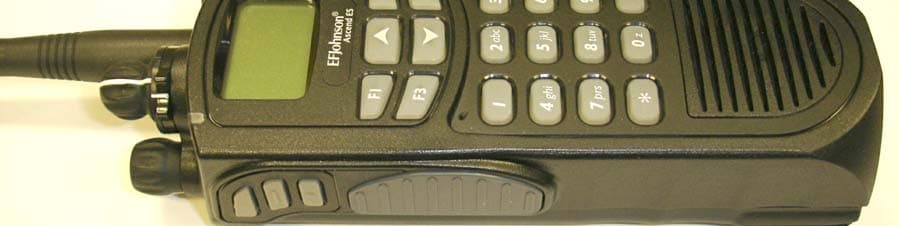
Click to zoom
Application Details
- Equipment Class
- TNF - Licensed Non-Broadcast Transmitter Held to Face
- Date of Grant
- Mar 17, 2008
- Application Purpose
- Original Equipment
- Date of Application
- Mar 16, 2008
- Equipment Note
- 5100 ES Series VHF Radio
- Frequency Range
- 136.00000000 - 174.00000000
- Company
- E F Johnson Company
- Country
- United States
Documents & Files
Document Text
Text extracted from the exhibit documents filed with the FCC. Open a document above to read the original.
Users Manual
Rhein Tech Laboratories, Inc. Client: E.F. Johnson 360 Herndon Parkway Model: 242-511B Suite 1400 FCC ID: ATH2425112 Herndon, VA 20170 Standard: Part 90 http://www.rheintech.com Report #: 2008024 Appendix K: User Manual Please refer to the following pages. 43 of 60 March 20085100 ES Models II/III Portable Radio Operating Manual ix Section 0Safety Requirements RF Energy Exposure Awareness and Control Information, and Operational Instructions for FCC Occupational Use Requirements Before using your portable two-way Radio, read this important RF Energy Awareness And Control Information And Operational Instructions to ensure compliance with the FCC’s RF exposure guidelines. NoteThis radio is intended for use in occupational/controlled conditions where users have full knowledge of their exposure and can exercise control over their exposure to meet FCC limits. This radio device is NOT authorized for general population, consumer, or any other use. This two-way radio uses electromagnetic energy in the radio frequency (RF) spectrum to provide communications between two or more users over a distance. It uses radio frequency (RF) energy or radio waves to send and receive calls. RF energy is one form of electromagnetic energy. Other forms include, but are not limited to, electric power, sunlight and x-rays. RF energy, however, should not be confused with these other forms of electromagnetic energy, which when used improperly can cause biological damage. Very high levels of x-rays, for example, can damage tissues and genetic material. Experts in science, engineering, medicine, health and industry work with organizations to develop standards for exposure to RF energy. These standards provide recommended levels of RF exposure for both workers and the general public. These recommended RF exposure levels include substantial margins of protection. All two-way radios marketed in North America are designed, manufactured and tested to ensure they meet government established RF exposure levels. In addition, manufacturers also recommend specific operating instructions to users of two-way radios. These instructions are important because they inform users about RF energy exposure and provide simple procedures on how to control it. Please refer to the following web sites for more information on what RF energy exposure is and how to control your exposure to assure compliance with established RF exposure limits. • http://www.fcc.gov/oet/rfsafety/rf-faqs.html • http://www.osha.gov/SLTC/radiofrequencyradiation/index.html Federal Communications Commission Regulations The FCC rules require manufacturers to comply with the FCC RF energy exposure limits for portable two-way radios before they can be marketed in the U.S. When two-way radios are used as a consequence of employment, the FCC requires users to be fully aware of and able to control their exposure to meet occupational requirements. Exposure awareness can be facilitated by the use of a product label directing users to specific user awareness x 5100 ES Models II/III Portable Radio Operating ManualMarch 2008 information. Your EFJohnson two-way radio has a RF exposure product label. Also, your EFJohnson user manual, or product manual, or separate safety booklet includes information and operating instructions required to control your RF exposure and to satisfy compliance requirements. Compliance with RF Exposure Standards Your EFJohnson two-way radio is designed and tested to comply with a number of national and international standards and guidelines (listed below) for human exposure to radio frequency electromagnetic energy. This radio complies with the IEEE and ICNIRP exposure limits for occupational/controlled RF exposure environment at operating duty factors of up to 50% transmitting and is authorized by the FCC for occupational use only. In terms of measuring RF energy for compliance with the FCC exposure guidelines, your radio radiates measurable RF energy only while it is transmitting (during talking), not when it is receiving (listening) or in standby mode. NoteThe approved batteries supplied with this radio are rated for a 5-5-90 duty factor (5% talk-5% listen - 90% standby), even though this radio complies with the FCC occupational RF exposure limits and may operate at duty factors of up to 50% talk. Your EFJohnson two-way radio complies with the following RF energy exposure standards and guidelines: • United States Federal Communications Commission, Code of Federal Regulations; 47 CFR §§ 1.1307, 1.1310, 2.1091 and 2.1093 • American National Standards Institute (ANSI) / Institute of Electrical and Electronic Engineers (IEEE) C95. 1-1992 • Institute of Electrical and Electronic Engineers (IEEE) C95.1-1999 Edition RF Exposure Compliance and Control Guidelines and Operating Instructions To control your exposure and ensure compliance with the occupational/controlled environment exposure limits, always adhere to the following procedures. Guidelines • Do not remove the RF Exposure Label from the device. • User awareness instructions should accompany the device when it is transferred to other users. • Do not use this device if the operational requirements described herein are not met. March 20085100 ES Models II/III Portable Radio Operating Manual xi Operating Instructions • Transmit no more than the rated duty factor of 50% of the time. To transmit (talk), push the Push-To-Talk (PTT) button. To receive calls, release the PTT button. Transmitting 50% of the time, or less, is important because this radio generates measurable RF energy exposure only when transmitting (in terms of measuring for standards compliance). • Hold the radio in a vertical position in front of face with the microphone (and the other parts of the radio, including the antenna) at least one inch (2.5 cm) away from the nose. Keeping the radio at the proper distance is important because RF exposures decrease with distance from the antenna. The antenna should be kept away from eyes. • When worn on …
Text truncated - open the document above for the full version.
Users Manual
5100 ES Models II/III Portable Radio Operating Manual VHF / UHF / 700/800 / 800 MHz Project 25 Conventional and Trunked Analog and Digital Conventional SMARTNET ® /SmartZone ® 7.2 VDC 5 Watt (VHF), 4 Watt (UHF), 2.5 Watt (700 MHz), 3 Watt (800 MHz) Part of Part Number 002-5100-70002CD March 2008 Copyright © 2006 - 2008 by EFJohnson The EFJohnson logo, PC Configure ™ , Trunked IP25 ™ , and Call Guard ® are trademarks of EFJohnson. All other company and/or product names used in this manual are trademarks and/or registered trademarks of their respective manufacturers. Information in this manual is subject to change without notice. 5100 ES Models II/III Portable Radio Operating Manual March 2008 March 20085100 ES Models II/III Portable Radio Operating Manual i Table of Contents 5100 ES Models II/III Portable Radio Operating Manual March 2008 Safety Requirements ix 1Features1-1 General Features . . . . . . . . . . . . . . . . . . . . . . . . . . . . . . . . . . . . . . . . . . . . . . . . . . . . . . . . . . . . . . . 1-1 Conventional Features . . . . . . . . . . . . . . . . . . . . . . . . . . . . . . . . . . . . . . . . . . . . . . . . . . . . . . . . . . . 1-2 SMARTNET / SmartZone Features . . . . . . . . . . . . . . . . . . . . . . . . . . . . . . . . . . . . . . . . . . . . . . . . . 1-3 Project 25 Trunked Features . . . . . . . . . . . . . . . . . . . . . . . . . . . . . . . . . . . . . . . . . . . . . . . . . . . . . . 1-3 2Controls and Display2-1 Front Panel Controls . . . . . . . . . . . . . . . . . . . . . . . . . . . . . . . . . . . . . . . . . . . . . . . . . . . . . . . . . . . . 2-1 Top Panel Controls . . . . . . . . . . . . . . . . . . . . . . . . . . . . . . . . . . . . . . . . . . . . . . . . . . . . . . . . . . . . . . 2-3 Side Controls . . . . . . . . . . . . . . . . . . . . . . . . . . . . . . . . . . . . . . . . . . . . . . . . . . . . . . . . . . . . . . . . . . 2-5 Display . . . . . . . . . . . . . . . . . . . . . . . . . . . . . . . . . . . . . . . . . . . . . . . . . . . . . . . . . . . . . . . . . . . . . . . . 2-6 Signaling Tones . . . . . . . . . . . . . . . . . . . . . . . . . . . . . . . . . . . . . . . . . . . . . . . . . . . . . . . . . . . . . . . . 2-7 3General Operation3-1 Turning Power On and Setting Volume . . . . . . . . . . . . . . . . . . . . . . . . . . . . . . . . . . . . . . . . . . . . . 3-1 Power Up . . . . . . . . . . . . . . . . . . . . . . . . . . . . . . . . . . . . . . . . . . . . . . . . . . . . . . . . . . . . . . . . . 3-1 Standard and Soft Power Down . . . . . . . . . . . . . . . . . . . . . . . . . . . . . . . . . . . . . . . . . . . . . . . . 3-2 Setting Volume Level . . . . . . . . . . . . . . . . . . . . . . . . . . . . . . . . . . . . . . . . . . . . . . . . . . . . . . . . 3-3 Power-Up Password . . . . . . . . . . . . . . . . . . . . . . . . . . . . . . . . . . . . . . . . . . . . . . . . . . . . . . . . . . . . . 3-3 Zone and Channel Select . . . . . . . . . . . . . . . . . . . . . . . . . . . . . . . . . . . . . . . . . . . . . . . . . . . . . . . . . 3-4 Zone Select . . . . . . . . . . . . . . . . . . . . . . . . . . . . . . . . . . . . . . . . . . . . . . . . . . . . . . . . . . . . . . . . 3-4 Channel Select . . . . . . . . . . . . . . . . . . . . . . . . . . . . . . . . . . . . . . . . . . . . . . . . . . . . . . . . . . . . . 3-5 Direct Zone / Channel Selection . . . . . . . . . . . . . . . . . . . . . . . . . . . . . . . . . . . . . . . . . . . . . . . . 3-5 Combined Zone and Channel . . . . . . . . . . . . . . . . . . . . . . . . . . . . . . . . . . . . . . . . . . . . . . . . . . 3-7 Dynamic Zone . . . . . . . . . . . . . . . . . . . . . . . . . . . . . . . . . . . . . . . . . . . . . . . . . . . . . . . . . . . . . . 3-7 ii 5100 ES Models II/III Portable Radio Operating ManualMarch 2008 Table of Contents (continued) Battery and Accessory Connector . . . . . . . . . . . . . . . . . . . . . . . . . . . . . . . . . . . . . . . . . . . . . . . . . 3-8 Battery Removal / Installation . . . . . . . . . . . . . . . . . . . . . . . . . . . . . . . . . . . . . . . . . . . . . . . . . . 3-8 Low Battery Indication. . . . . . . . . . . . . . . . . . . . . . . . . . . . . . . . . . . . . . . . . . . . . . . . . . . . . . . . 3-9 Battery Charging . . . . . . . . . . . . . . . . . . . . . . . . . . . . . . . . . . . . . . . . . . . . . . . . . . . . . . . . . . . . 3-9 Beltclip Installation . . . . . . . . . . . . . . . . . . . . . . . . . . . . . . . . . . . . . . . . . . . . . . . . . . . . . . . . . 3-10 Connecting an Accessory . . . . . . . . . . . . . . . . . . . . . . . . . . . . . . . . . . . . . . . . . . . . . . . . . . . . 3-10 Backlight . . . . . . . . . . . . . . . . . . . . . . . . . . . . . . . . . . . . . . . . . . . . . . . . . . . . . . . . . . . . . . . . . . . . . 3-11 Keypad Lock . . . . . . . . . . . . . . . . . . . . . . . . . . . . . . . . . . . . . . . . . . . . . . . . . . . . . . . . . . . . . . . . . . 3-11 Setting Squelch . . . . . . . . . . . . . . . . . . . . . . . . . . . . . . . . . . . . . . . . . . . . . . . . . . . . . . . . . . . . . . . 3-12 Transmit Disable . . . . . . . . . . . . . . . . . . . . . . . . . . . . . . . . . . . . . . . . . . . . . . . . . . . . . . . . . . . . . . . 3-12 Radio Operating Modes . . . . . . . . . . . . . . . . . . . . . . . . . . . . . . . . . . . . . . . . . . . . . . . . . . . . . . . . . 3-13 Conventional Mode . . . . . . . . . . . . . . . . . . . . . . . . . . . . . . . . . . . . . . . . . . . . . . . . . . . . . . . . . 3-13 SMARTNET / SmartZone Mode . . . . . . . . . . . . . . . . . . . . . . . . . . . . . . . . . . . . . . . . . . . . . . . 3-13 P25 Trunked Mode . . . . . . . . . . . . . . . . . . . . . . . . . . . . . . . . . . . . . . . . . . . . . . . . . . . . . . . . . 3-14 Systems, Channels, and Zones . . . . . . . . . . . . . . . . . . . . . . . . . . . . . . . . . . . . . . . . . . . . . . . 3-14 Systems . . . . . . . . . . . . . . . . . . . . . . . . . . . …
Text truncated - open the document above for the full version.
Users Manual
March 20085100 ES Models II/III Portable Radio Operating Manual 3-1 SECTION Section 3General Operation 3.1Turning Power On and Setting Volume 3.1.1Power Up Power is turned on and off by the top panel ON-OFF/Volume switch. When power is initially turned on, the following events occur: • The EFJohnson logo is displayed • The firmware version number is displayed. • A self test is performed. • If the Radio ID feature is enabled in PC Configure, the radio will display the Radio ID alias in place of the Self Test message during startup. Radio ID identifies the personality file used to program the radio, the service area for which the radio is programmed, or functional grouping for which the radio is programmed. The Radio ID alias display will be included with the Radio Info display items in both button/scroll and menu modes. If disabled, the Radio ID menu mode will display a blank line. • The currently selected zone is displayed. NoteThe zone/channel numeric display and the zone/channel select bars in all supported protocols and display operating modes can be inhibited if programmed in PC Configure. • The Individual (Unit/Unique) ID programmed for the currently selected system is displayed. • A tone sounds (if tones are enabled) and the alias of the selected talk group is displayed continuously. 3-2 5100 ES Models II/III Portable Radio Operating ManualMarch 2008 General Operation Programming determines if the radio powers up on the last selected zone or the pre- programmed home zone. Refer to Section 3.3 for information on the channel that is selected. The minimum volume level may be set by programming. This can prevent missed messages resulting from inadvertently turning the volume to an inaudible level. 3.1.2Standard and Soft Power Down To turn power off, rotate the ON-OFF/Volume control counterclockwise until a click occurs. Power may remain on for an instant after turn-off occurs. The soft power down feature prevents users from accidentally powering off the radio. A soft power down feature can be programmed to prevent radio power from being turned off by accidentally turning the on-off/volume control. Any side button can be programmed for this function in addition to its normal function. To turn power off, press this button during or after power is turned off in the normal manner (there is no time out). The soft power down feature prevents users from accidentally powering off the radio. Any side option button could be programmed to protect the power/volume knob. To power off the radio, the side button had to be pressed during or just after the knob was turned to the off position. The enhanced soft power down feature adds a “standby” mode which mutes audio, turns off lights, and can block a combination of buttons and switches. Enhanced Soft Power Down has two modes of operation: Normal Mode. If the power/volume knob is turned off nothing happens until the programmed side button is pressed. Standby Mode. When the power/volume knob is turned off, the radio displays “Standby”, audio is muted, and the indicator lights are turned off. The radio remains in “standby” until the power knob is turned back on or the user presses a button that has not been disabled. NoteNo hardware is shut down during standby. This means that power savings while in standby are negligible allowing the user to have immediate access to the system since they do not have to power components back up. The volume is set to half of maximum when the radio exits standby due to a button press or switch change. March 20085100 ES Models II/III Portable Radio Operating Manual 3-3 General Operation 3.1.3Setting Volume Level The volume level is adjusted by the top panel volume control knob or by option buttons programmed for the Up/Down volume function. When the buttons are used, the volume control function of the knob is disabled (it is still used to switch power). Volume buttons may be used instead of the knob, for example, if accidental turning of the volume knob is a problem. When the volume control buttons are used, the number of steps (ticks) required to change the volume from the minimum level to maximum level is programmable for 1-50. For example, if “20” is programmed, there are 20 adjustment steps from minimum to maximum volume. Only one volume control button can be programmed if desired and wrap-around then occurs after the maximum or minimum level is selected. The radio can also be programmed so that volume control is also be disabled by the Keypad Lock feature. The minimum volume level that the volume control can select can be programmed. This can be used to prevent missed messages caused by unintentionally turning the volume down too far. Relative levels of 0-255 can be set in steps of 1 (“0” sets the lowest minimum volume). NoteThis setting is applicable to 51xx and Ascend portable radios. The relative volume level can be determined by the position of the index on the volume knob or by a reference signal as follows: • If a key press tone is enabled, a short tone sounds when a key is pressed. Tones and audio can differ depending on how it is set in PC Configure. • If a conventional channel is selected and the Monitor option switch or menu parameter is programmed, pressing that switch unsquelches the receiver and either voice or background noise is heard (see Section 5.2). If a SMARTNET/SmartZone or P25 Trunked channel is selected, the receiver cannot be manually unsquelched. 3.2Power-Up Password The power-up password feature prevents unauthorized use of the radio by disabling it when power is turned on until the proper password is entered. This feature is enabled or disabled by programming. When this feature is enabled, “Enter Pswd” is briefly displayed when power is turned on. The password can be 1-8 digits in length, and consists of digits 0-9. It is entered as follows. If an incorrect password is entered, “Incorrect” is displayed and it must be re- entered. 3-4 5100 ES Models II/III Portable Radio Operating ManualMarch…
Text truncated - open the document above for the full version.
Users Manual
Rhein Tech Laboratories, Inc. Client: E.F. Johnson 360 Herndon Parkway Model: 242-511B Suite 1400 FCC ID: ATH2425112 Herndon, VA 20170 Standard: Part 90 http://www.rheintech.com Report #: 2008024 Appendix K: User Manual Please refer to the following pages. 43 of 60 March 20085100 ES Models II/III Portable Radio Operating Manual ix Section 0Safety Requirements RF Energy Exposure Awareness and Control Information, and Operational Instructions for FCC Occupational Use Requirements Before using your portable two-way Radio, read this important RF Energy Awareness And Control Information And Operational Instructions to ensure compliance with the FCC’s RF exposure guidelines. NoteThis radio is intended for use in occupational/controlled conditions where users have full knowledge of their exposure and can exercise control over their exposure to meet FCC limits. This radio device is NOT authorized for general population, consumer, or any other use. This two-way radio uses electromagnetic energy in the radio frequency (RF) spectrum to provide communications between two or more users over a distance. It uses radio frequency (RF) energy or radio waves to send and receive calls. RF energy is one form of electromagnetic energy. Other forms include, but are not limited to, electric power, sunlight and x-rays. RF energy, however, should not be confused with these other forms of electromagnetic energy, which when used improperly can cause biological damage. Very high levels of x-rays, for example, can damage tissues and genetic material. Experts in science, engineering, medicine, health and industry work with organizations to develop standards for exposure to RF energy. These standards provide recommended levels of RF exposure for both workers and the general public. These recommended RF exposure levels include substantial margins of protection. All two-way radios marketed in North America are designed, manufactured and tested to ensure they meet government established RF exposure levels. In addition, manufacturers also recommend specific operating instructions to users of two-way radios. These instructions are important because they inform users about RF energy exposure and provide simple procedures on how to control it. Please refer to the following web sites for more information on what RF energy exposure is and how to control your exposure to assure compliance with established RF exposure limits. • http://www.fcc.gov/oet/rfsafety/rf-faqs.html • http://www.osha.gov/SLTC/radiofrequencyradiation/index.html Federal Communications Commission Regulations The FCC rules require manufacturers to comply with the FCC RF energy exposure limits for portable two-way radios before they can be marketed in the U.S. When two-way radios are used as a consequence of employment, the FCC requires users to be fully aware of and able to control their exposure to meet occupational requirements. Exposure awareness can be facilitated by the use of a product label directing users to specific user awareness x 5100 ES Models II/III Portable Radio Operating ManualMarch 2008 information. Your EFJohnson two-way radio has a RF exposure product label. Also, your EFJohnson user manual, or product manual, or separate safety booklet includes information and operating instructions required to control your RF exposure and to satisfy compliance requirements. Compliance with RF Exposure Standards Your EFJohnson two-way radio is designed and tested to comply with a number of national and international standards and guidelines (listed below) for human exposure to radio frequency electromagnetic energy. This radio complies with the IEEE and ICNIRP exposure limits for occupational/controlled RF exposure environment at operating duty factors of up to 50% transmitting and is authorized by the FCC for occupational use only. In terms of measuring RF energy for compliance with the FCC exposure guidelines, your radio radiates measurable RF energy only while it is transmitting (during talking), not when it is receiving (listening) or in standby mode. NoteThe approved batteries supplied with this radio are rated for a 5-5-90 duty factor (5% talk-5% listen - 90% standby), even though this radio complies with the FCC occupational RF exposure limits and may operate at duty factors of up to 50% talk. Your EFJohnson two-way radio complies with the following RF energy exposure standards and guidelines: • United States Federal Communications Commission, Code of Federal Regulations; 47 CFR §§ 1.1307, 1.1310, 2.1091 and 2.1093 • American National Standards Institute (ANSI) / Institute of Electrical and Electronic Engineers (IEEE) C95. 1-1992 • Institute of Electrical and Electronic Engineers (IEEE) C95.1-1999 Edition RF Exposure Compliance and Control Guidelines and Operating Instructions To control your exposure and ensure compliance with the occupational/controlled environment exposure limits, always adhere to the following procedures. Guidelines • Do not remove the RF Exposure Label from the device. • User awareness instructions should accompany the device when it is transferred to other users. • Do not use this device if the operational requirements described herein are not met. March 20085100 ES Models II/III Portable Radio Operating Manual xi Operating Instructions • Transmit no more than the rated duty factor of 50% of the time. To transmit (talk), push the Push-To-Talk (PTT) button. To receive calls, release the PTT button. Transmitting 50% of the time, or less, is important because this radio generates measurable RF energy exposure only when transmitting (in terms of measuring for standards compliance). • Hold the radio in a vertical position in front of face with the microphone (and the other parts of the radio, including the antenna) at least one inch (2.5 cm) away from the nose. Keeping the radio at the proper distance is important because RF exposures decrease with distance from the antenna. The antenna should be kept away from eyes. • When worn on …
Text truncated - open the document above for the full version.
Cover Letter(s)
Rhein Tech Laboratories, Inc. Client: E.F. Johnson 360 Herndon Parkway Model: 242-511B Suite 1400 FCC ID: ATH2425112 Herndon, VA 20170 Standard: Part 90 http://www.rheintech.com Report #: 2008024 Appendix C: FCC Confidentiality Request Letter Please refer to the following page. 35 of 60 Waseca Office: E.F. Johnson Company • 123 N. State Street • Waseca, MN 56093 • 507-837-5116 • Fax 507-837-5120 www.efjohnson.com February 4, 2008 Federal Communications Commission 7435 Oakland Mills Road Columbia, MD 21046 To Whom It May Concern: The following information is to be held confidential pursuant of 47 CFR Part 0 §0.457 and Section 552(b)(4) of the Freedom of Information Act, because the information provided contains trade secrets and proprietary. If made public, the information might be used to the disadvantage of the applicant in the market place. • Schematics • Product Description • Block Diagram • Bill of Materials (Parts List) Sincerely, John Oblak VP Standards and Regulatory Affairs E. F. Johnson Co.
Cover Letter(s)
Rhein Tech Laboratories, Inc. Client: E.F. Johnson 360 Herndon Parkway Model: 242-511B Suite 1400 FCC ID: ATH2425112 Herndon, VA 20170 Standard: Part 90 http://www.rheintech.com Report #: 2008024 Appendix B: Agency Authorization Please refer to the following page. 34 of 60 Waseca Office: E.F. Johnson Company • 123 N. State Street • Waseca, MN, 56093 • 507-837-5116 • Fax 507-837-5120 www.efjohnson.com February 4, 2008 Federal Communications Commission EQUIPMENT AUTHORIZATION BRANCH 7435 Oakland Mills Road Columbia, MD 21046 Re: Agent Authorization To Whom It May Concern: E. F. Johnson Co. hereby authorizes Rhein Tech Laboratories, Inc. (RTL), 360 Herndon Parkway, Suite 1400, Herndon, VA 20170 to act as agent. APPLICANT ANTI-DRUG ABUSE CERTIFICATION: In signing this letter, Applicant certifies that, in the case of an individual applicant, he or she is not subject to a denial of federal benefits, that includes: FCC benefits, pursuant to Section 5301 of the Anti-Drug Abuse Act of 1988, 21 U.S.C. 853(a), or, in the case of a non-individual applicant. No party to the application is subject to a denial of federal benefits, that includes FCC benefits, pursuant to that section. For the definition of a “party” for these purposes, see 47 CFR 1.2002(b). Sincerely, John Oblak VP Standards and Regulatory Affairs E.F. Johnson Co.
Cover Letter(s)
Rhein Tech Laboratories, Inc. Client: E.F. Johnson 360 Herndon Parkway Model: 242-511B Suite 1400 FCC ID: ATH2425112 Herndon, VA 20170 Standard: Part 90 http://www.rheintech.com Report #: 2008024 Appendix D: Extended Frequency Listing Request Please refer to the following page. 36 of 60 Waseca Office: E.F. Johnson Company • 123 N. State Street • Waseca, MN 56093 • 507-837-5116 • Fax 507-837-5120 www.efjohnson.com February 18, 2008 Federal Communications Commission EQUIPMENT AUTHORIZATION BRANCH 7435 Oakland Mills Road Columbia, MD 21046 Re: Frequency Listing Dear FCC Representative; EF Johnson Company requests extended frequency listing for certification ATH2425112 based on the following marketing targets: 138 - 144 MHz Federal and US Military Customers 148 - 149.9 MHz Federal and US Military Customers 150.05 - 150.8 MHz Federal and US Military Customers 150.8 - 156.575 MHz FCC Part 90 Frequencies 157.0375 MHz - 161.575 MHz FCC Part 90 Frequencies 161.775 - 173.4 MHz FCC Part 90 Frequencies 173.4 - 174 MHz Federal and US Military Customers Based on the above, and the allowable frequency gaps of less than 1 MHz, we request the following frequency limits: 138 - 144 MHz 148 - 174 MHz Sincerely, John Oblak VP Standards and Regulatory Affairs E.F. Johnson Co.
Cover Letter(s)
Rhein Tech Laboratories, Inc. Client: E.F. Johnson 360 Herndon Parkway Model: 242-511B Suite 1400 FCC ID: ATH2425112 Herndon, VA 20170 Standard: Part 90 http://www.rheintech.com Report #: 2008024 Appendix E: Part 90.203(e) Frequency Programming Capability Attestation Please refer to the following page. 37 of 60 Waseca Office: E.F. Johnson Company • 123 N. State Street • Waseca, MN 56093 • 507-837-5116 • Fax 507-837-5120 www.efjohnson.com February 4, 2008 Federal Communications Commission EQUIPMENT AUTHORIZATION BRANCH 7435 Oakland Mills Road Columbia, MD 21046 Re: Programming Capability Dear FCC Representative; Reference part 90.203(e), frequency programming capability. The end user will not be able to program the channel frequencies. A service shop or authorized agent using a special programming cable and computer software can program the allowed TX/RX frequencies. The end user can only select from the preprogrammed channels using the channel select knob. The software and programming cable are not available to the end user. Sincerely, John Oblak VP Standards and Regulatory Affairs E.F. Johnson Co.
External Photos
Rhein Tech Laboratories, Inc. Client: E.F. Johnson 360 Herndon Parkway Model: 242-511B Suite 1400 FCC ID: ATH2425112 Herndon, VA 20170 Standard: Part 90 http://www.rheintech.com Report #: 2008024 Appendix N: External Photographs Photograph 5: Radio Front 48 of 60 Rhein Tech Laboratories, Inc. Client: E.F. Johnson 360 Herndon Parkway Model: 242-511B Suite 1400 FCC ID: ATH2425112 Herndon, VA 20170 Standard: Part 90 http://www.rheintech.com Report #: 2008024 Photograph 6: Radio Back 49 of 60 Rhein Tech Laboratories, Inc. Client: E.F. Johnson 360 Herndon Parkway Model: 242-511B Suite 1400 FCC ID: ATH2425112 Herndon, VA 20170 Standard: Part 90 http://www.rheintech.com Report #: 2008024 Photograph 7: Radio Accessory Connector Side 50 of 60 Rhein Tech Laboratories, Inc. Client: E.F. Johnson 360 Herndon Parkway Model: 242-511B Suite 1400 FCC ID: ATH2425112 Herndon, VA 20170 Standard: Part 90 http://www.rheintech.com Report #: 2008024 Photograph 8: Radio Top 51 of 60 Rhein Tech Laboratories, Inc. Client: E.F. Johnson 360 Herndon Parkway Model: 242-511B Suite 1400 FCC ID: ATH2425112 Herndon, VA 20170 Standard: Part 90 http://www.rheintech.com Report #: 2008024 Photograph 9: Radio PTT Side 52 of 60
ID Label/Location Info
Rhein Tech Laboratories, Inc. Client: E.F. Johnson 360 …
Text truncated - open the document above for the full version.
Contact Information
Applicant
Karthik Rangarajan(SR VP Engineering)
Technical Specifications
| # | Rule Parts | Frequency Range | Power Output | Emission | Tolerance |
|---|---|---|---|---|---|
| 4 | 9 | 136 MHz - 174 MHz | 6.4 W | 8K10F1E | 1.5 ppm |
Other Applications from E F Johnson Company
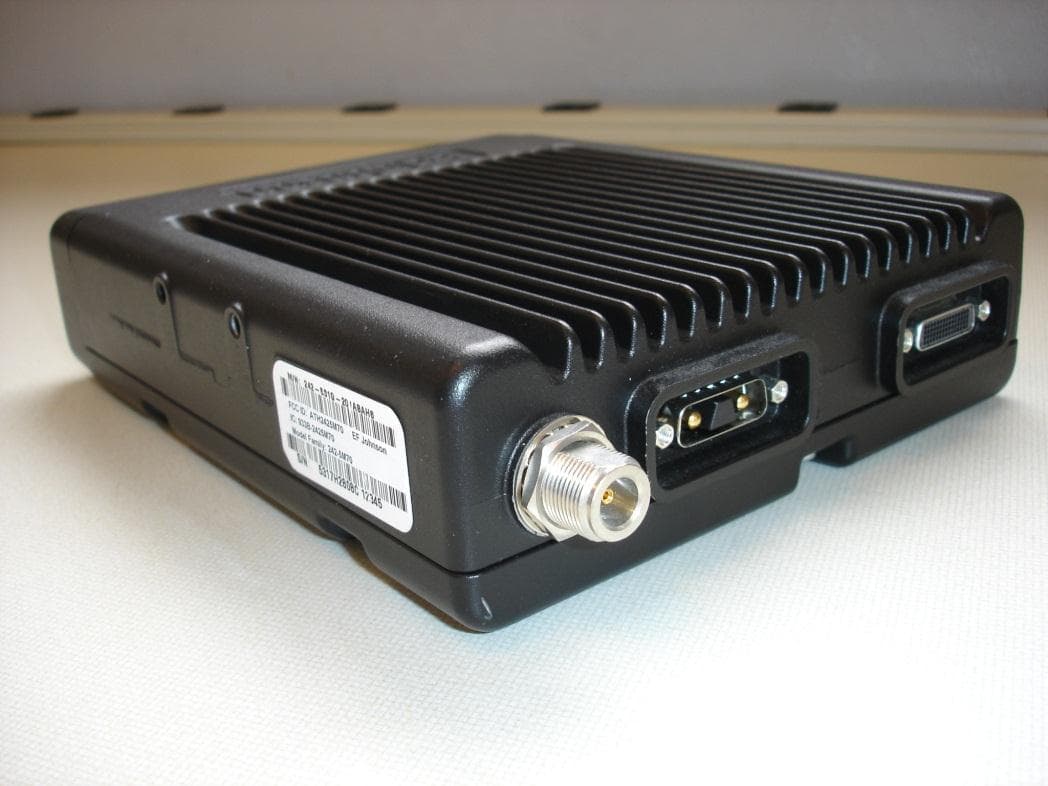
ATH2425M80
Nov 19, 2015DUAL BAND VHF AND 700/800 MHz MOBILE TRANSCEIVER
Equipment Class
TNB - Licensed Non-Broadcast Station Transmitter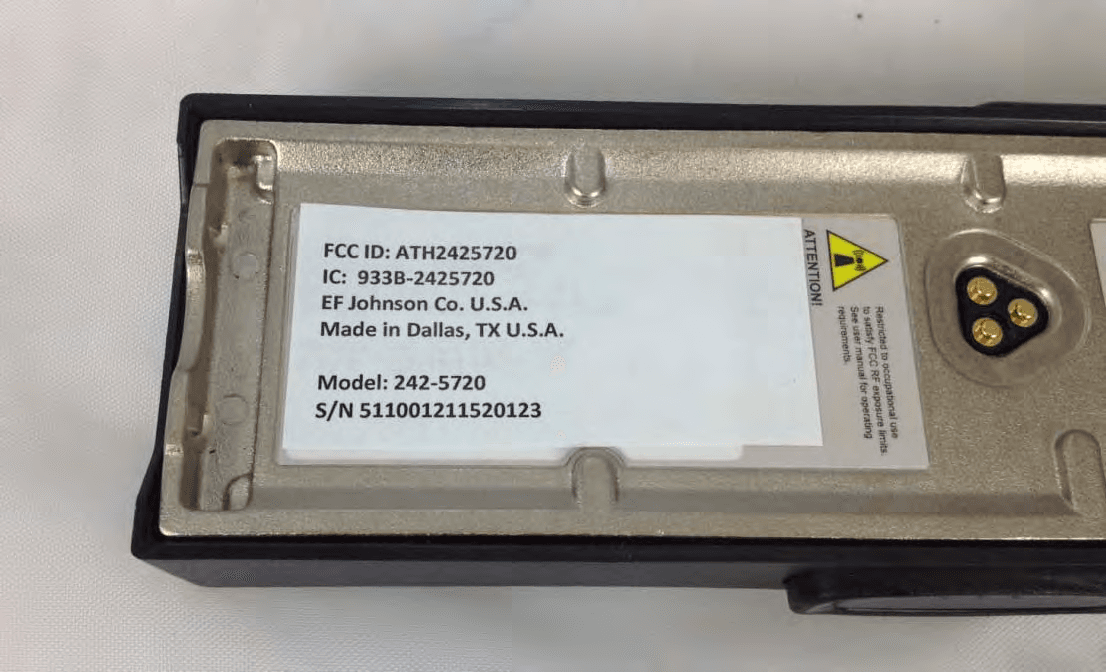
ATH2425720
Sep 30, 2012VP 600 UHF Land Mobile Radio Transceiver
Equipment Class
TNF - Licensed Non-Broadcast Transmitter Held to Face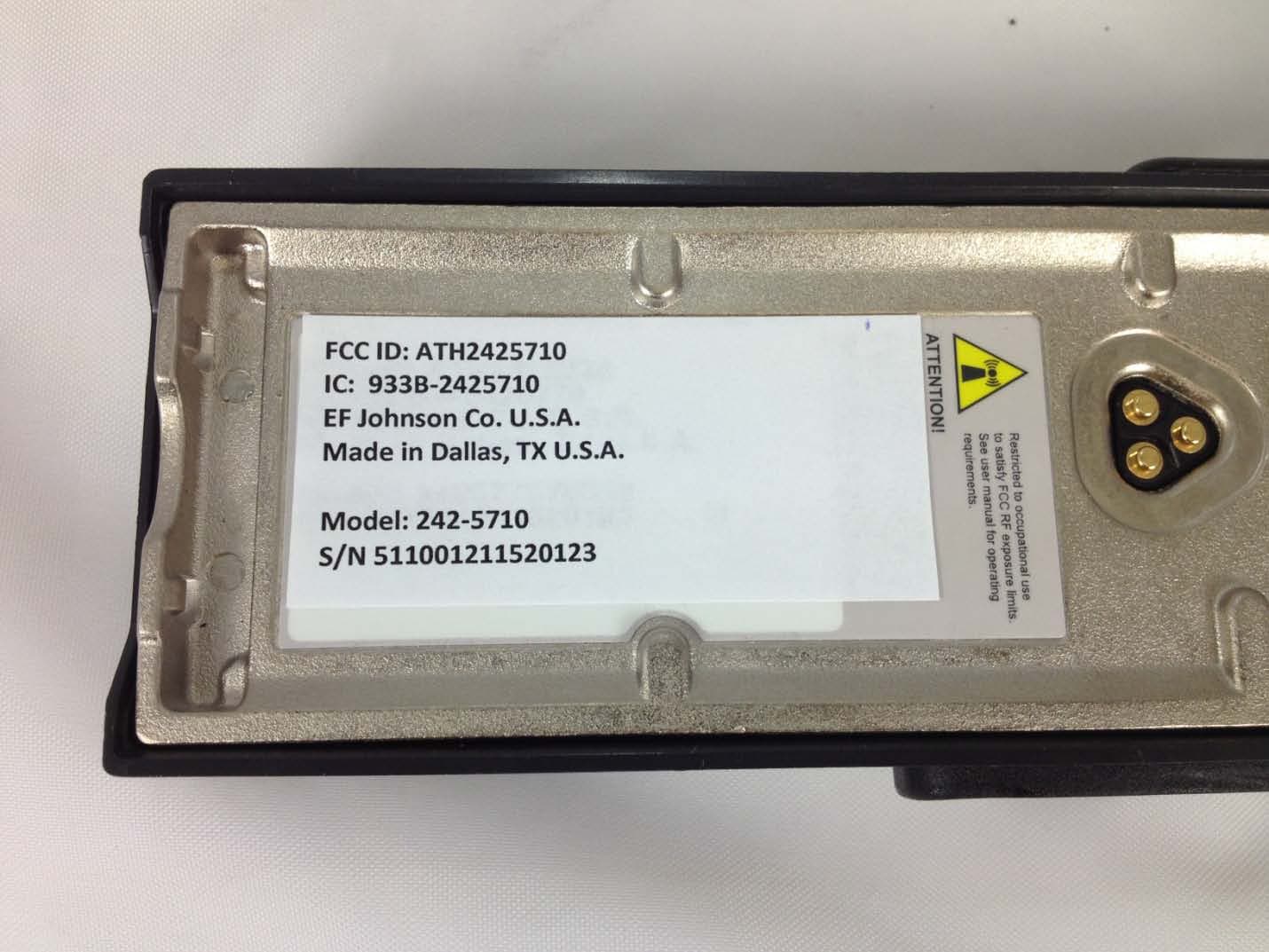
ATH2425710
Sep 16, 2012Portable VHF Push-To-Talk (PTT) Radio Transceiver
Equipment Class
TNF - Licensed Non-Broadcast Transmitter Held to Face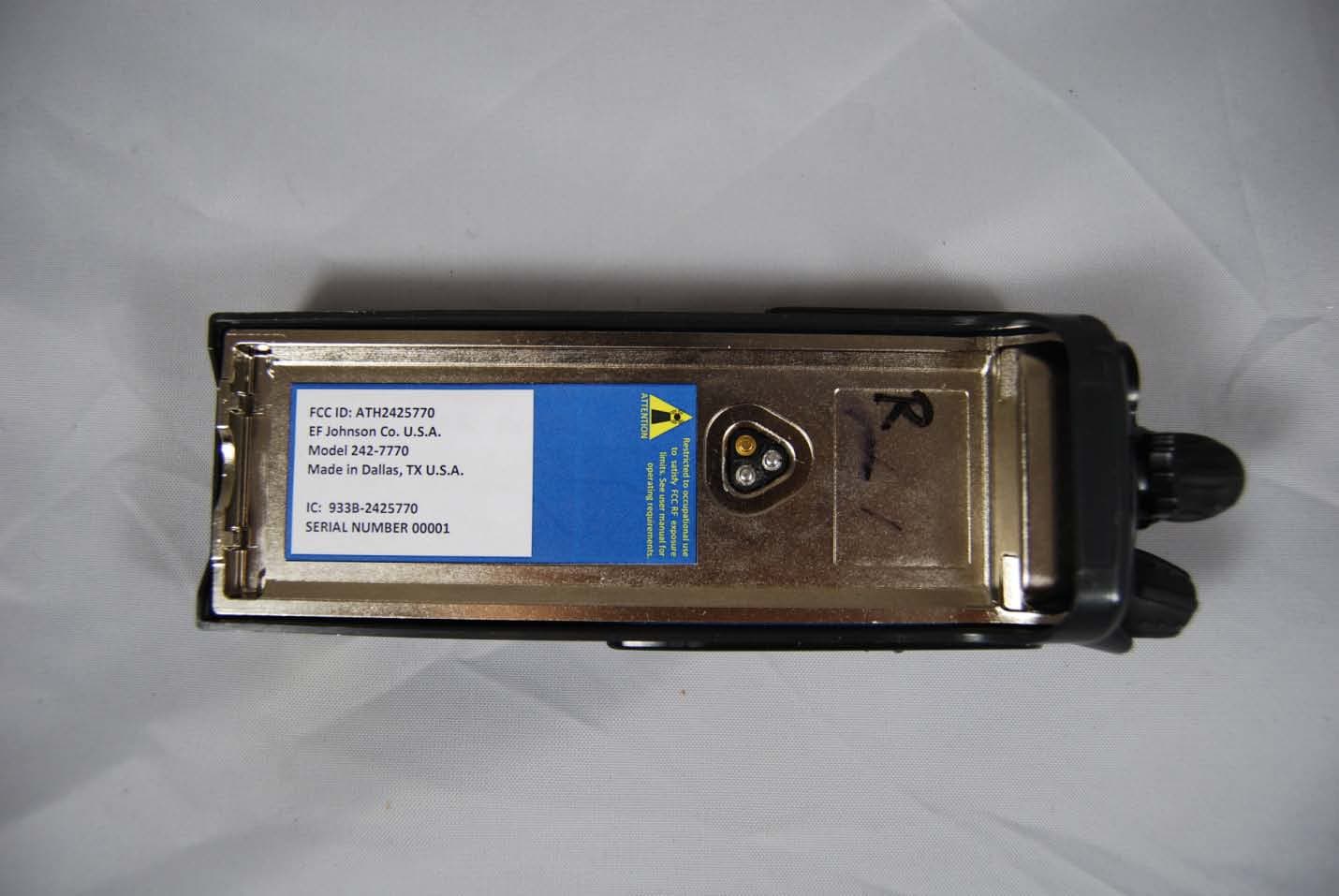
ATH2425770
Feb 09, 2012Vantage 700/800 MHz Portable Radio
Equipment Class
TNF - Licensed Non-Broadcast Transmitter Held to Face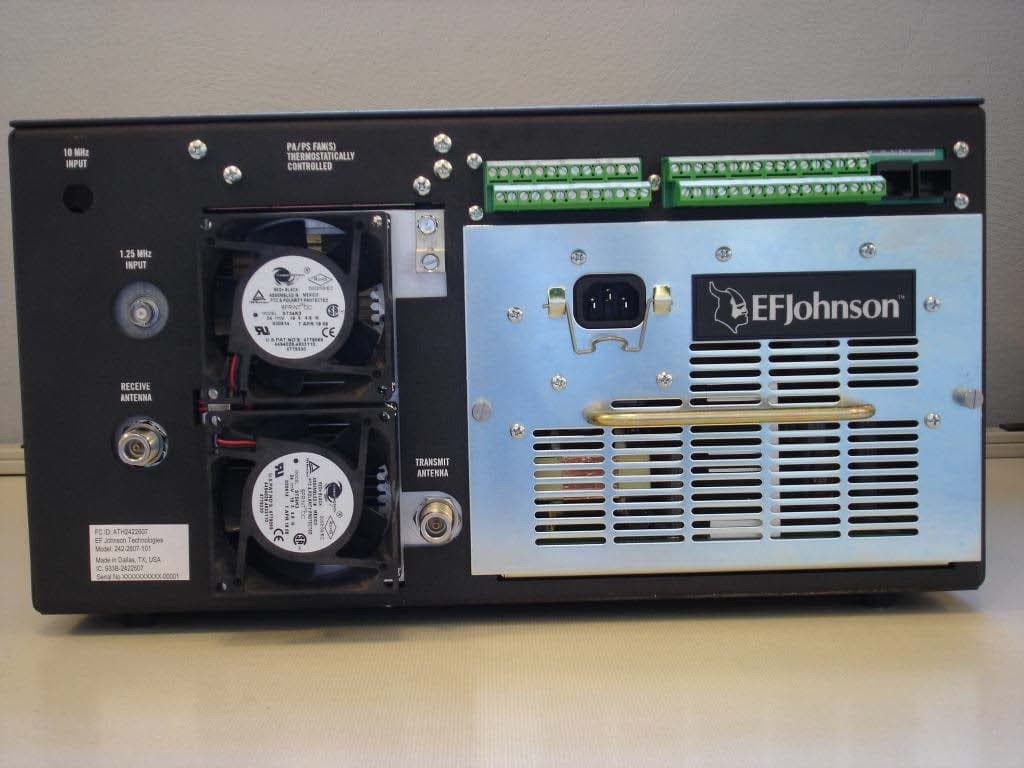
ATH2422607
Mar 07, 2010700 MHz LAND MOBILE REPEATER
Equipment Class
TNB - Licensed Non-Broadcast Station Transmitter