AZ489FT3811ELB VHF 2-Way Radio (RLD1036A)
Motorola Solutions, Inc.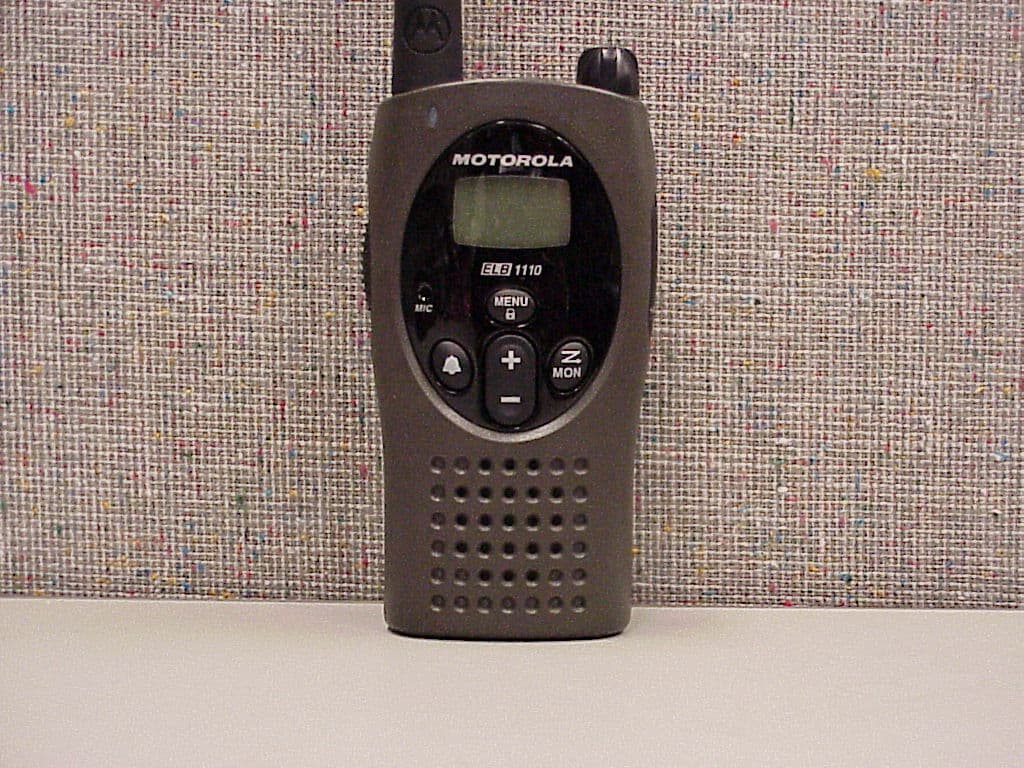
Click to zoom
Application Details
- Equipment Class
- TNF - Licensed Non-Broadcast Transmitter Held to Face
- Date of Grant
- Nov 08, 2005
- Application Purpose
- Original Equipment
- Date of Application
- Sep 15, 2005
- Equipment Note
- ELB VHF 2-Way Radio (RLD1036A)
- Frequency Range
- 151.62500000 - 158.40750000
- Company
- Motorola Solutions, Inc.
- Country
- United States
Documents & Files
Document Text
Text extracted from the exhibit documents filed with the FCC. Open a document above to read the original.
Users Manual
ELB Series Two-Way Radio's User Guide 6864110w15oTOC.fm Page 2 Wednesday, August 17, 2005 11:20 AM 1 Contents FCC Licensing Information .......... 2Product Safety and RF Exposure Compliance............................... 4 Introduction ................................... 5Radio Controls .............................. 6 Reading the Display .................... 7 Getting Started .............................. 8 Installing the Nicke l-Metal Hydride Battery ...................................... 9 Charging using the 53xxx Drop-In Charging Tray......................... 10 Battery Meter ............................. 11Attaching the Belt Clip ............... 11Turning the Radio On and Off ... 12Adjusting the Volume................. 12 Talking and Receiving ................ 13 Basic Radio Operation............... 13Signal Strength Indicator ........... 13 Programming Mode .................... 14 Entering Programming Mode..... 14 Features........................................ 17 Call Tone.................................... 17Hands-Free Use/VOX (ELB1210 Only) ....................................... 18 Locking the Keypad ................... 19End-of-Transmission Tone......... 19Time-Out Timer .......................... 19 Frequency and Code Charts....... 20Troubleshooting ......................... 26Limited Warranty ......................... 29 TOC.fm Page 1 Tuesday, August 30, 2005 12:03 PM FCC Licensing Information 2 FCC Licensing InformationELB Series professional two-way radios operate on radio frequencies that are regulated by the Federal Communications Commission (FCC). In order to transmit on these frequencies, you are required to have a license issued by the FCC.Application is made available on FCC Forms 601, schedules D and H, and remittance form 159. If ordering the forms by mail, phone, or from the FCC website, please request document number 000601 , which includes all forms and instructions. If using the FCC Fax-on-Demand system, use the 7-digit order numbers listed below. To obtain the required forms, please use the following contact information: Before filling out your application, you must decide which frequency(ies) you can operate on. See Frequency and Code Charts on page 20. For questions on determining your radio frequency, please call Motorola Product Services at 1-800-448-6686.Changes or modifications not expressly approved by Motorola may void the user’s authority granted by the FCC to operate this radio and should not be made. To comply with FCC requirements, transmitter adjustments Faxed contact the Fax-On-Demand system at: Mailed call the FCC forms hotline at: By Phone or Web or for questions regarding FCC license contact the FCC at: 1-202-418-0177 1-800-418-FORM 1-800-418-3676 1-888-CALL-FCC 1-888-225-5322 or: http://www.fcc.gov Request forms 3060001, 3060003, and 3060006 Request document 000601 Request document 000601 fcc.fm Page 2 Tuesday, August 30, 2005 12:03 PM FCC Licensing Information 3 should be made only by or under the supervision of a person certified as technically qualified to perform transmitter maintenance and repairs in the private land mobile and fixed services as certified by an organization representative of the user of those services. Replacement of any transmitter component (crystal, semiconductor, etc.) not authorized by the FCC equipment authorization for this radio could violate FCC rules.Note: Use of this radio outside the country where it was intended to be distributed is subject to government regulations and may be prohibited. fcc.fm Page 3 Tuesday, August 30, 2005 12:03 PM Product Safety and RF Exposure Compli- 4 Product Safety and RF Exposure Compliance ATTENTION! This radio is restricted to occupational use only to satisfy FCC RF energy exposure requirements. Before using this product, read the RF energy awareness information and operating instructions in the Product Safety and RF Exposure booklet enclosed with your radio (Motorola Publication part number 68P81095C98) to ensure compliance with RF energy exposure limits. For a list of Motorola-approved antennas, ba tteries, and other accessories, visit the following web site which lists approved accessories: http:/ /www.motorola.com/ cgiss/index.shtml. Before using this product, read the operating instructions for safe usage contained in the Product Safety and RF Exposure booklet enclosed with your radio. ! C a u t i o n safety.fm Page 4 Tuesda y, August 30, 2005 12:04 PM Introduction 5 Introduction Thank you for purchasing a Motorola ELB Series two-way radio product. The Motorola ELB Series two-way radio models are products of Motorola’s 75-plus years of experience as a world l eader in designing and manufacturing communications equipment. The ELB Series two-way radios are a perfect cost-effective communications solution for all of today’s fast-paced businesses and industries.Product registration is an important st ep. Registering helps facilitate warranty service and permits us to contact you should your Motorola product require an update or other service.To register your product on-line, visit www.motorola.com/warranty/radios . Please retain your original dated sales receipt for your record s. For warranty service of your Motorola product, you will need to provide a copy of your dated sales receipt to confirm warranty status. Registration is not required for warranty coverage. Note: Please be sure to save th is programming instructio ns for further reference. intro.fm Page 5 Tuesday, August 30, 2005 12:04 PM Radio Controls 6 Radio Controls MENU MON ELB1210 MIC Use P to: Turn radio on/offAdjust radio volume Use Push to Talk to: Ta l k Exit a menu Use to: Lock the keypad Scroll through menus MENU Use to: Monitor the frequency MON Microphone Accessory Jack Speaker Use and to: Change channelsChange menu settings LED Display Use to: Transmit a Call Tone getstart.fm Page 6 Friday, September 2, 2005 2:34 PM Radio Controls 7 Reading the DisplayNote: The radio display shown here is for icon locati…
Text truncated - open the document above for the full version.
Users Manual
English Product Safety and RF Energy Exposure Booklet for Portable Two-Way Radios The information provided in this document supersedes the general safety information contained in user guides published prior to February 2002. BEFORE USING THIS RADIO, READ THIS BOOKLET WHICH CONTAINS IMPORTANT OPERATING INSTRUCTIONS FOR SAFE USAGE AND RF ENERGY AWARENESS AND CONTROL INFORMATION AND OPERATIONAL INSTRUCTIONS FOR COMPLIANCE WITH RF ENERGY EXPOSURE LIMITS IN APPLICABLE NATIONAL AND INTERNATIONAL STANDARDS. ALSO READ THE OPERATIONAL INSTRUCTIONS FOR SAFE USAGE. FOR RADIOS THAT HAVE BEEN APPROVED AS INTRINSICALLY SAFE, READ THE INSTRUCTIONS AND INFORMATION ON INTRINSIC SAFETY ON PAGE 10 OF THIS BOOKLET. ! C a u t i o n © Motorola, Inc. 2004 8000 W. Sunrise Blvd., Ft. Lauderdale, FL 33322 68P81095C98 68P81095C98-C 95C98-C.book Page 1 Wednesday, October 27, 2004 11:59 AM 2 English RF Energy Exposure Awareness and Control Information and Operational Instructions for Occupational Use NOTICE: This radio is intended for use in occupational/controlled conditions where users have full knowledge of their exposure and can exercise control over their exposure to meet the occupational limits in FCC and International standards. This radio device is NOT authorized for general population consumer use. This two-way radio uses electromagnetic energy in the radio frequency (RF) spectrum to provide communications between two or more users over a distance. It uses radio frequency (RF) energy or radio waves to send and receive calls. RF energy is one form of electromagnetic energy. Other forms include, but are not limited to, sunlight and x-rays. RF energy, however, should not be confused with these other forms of electromagnetic energy, which when used improperly, can cause biological damage. Very high levels of x-rays, for example, can damage tissues and genetic material. Experts in science, engineering, medicine, health, and industry work with organizations to develop standards for safe exposure to RF energy. These standards provide recommended levels of RF exposure for both workers and the general public. These recommended RF exposure levels include substantial margins of protection. All Motorola two-way radios are designed, manufactured, and tested to ensure they meet government-established RF exposure levels. In addition, manufacturers also recommend specific operating instructions to users of two-way radios. These instructions are important because they inform users about RF energy exposure and provide simple procedures on how to control it. 95C98-C.book Page 2 Wednesday, October 27, 2004 11:59 AM 3 English Please refer to the following websites for more information on what RF energy exposure is and how to control your exposure to assure compliance with established RF exposure limits: http://www.fcc.gov/oet/rfsafety/rf-faqs.html http://www.osha.gov/SLTC/radiofrequencyradiation/index.html Federal Communication Commission (FCC) Regulations The FCC rules require manufacturers to comply with the FCC RF energy exposure limits for portable two-way radios before they can be marketed in the U.S. When two-way radios are used as a consequence of employment, the FCC requires users to be fully aware of and able to control their exposure to meet occupational requirements. Exposure awareness can be facilitated by the use of a product label directing users to specific user awareness information. Your Motorola two-way radio has a RF Exposure Product Label. Also, your Motorola user manual, or separate safety booklet includes information and operating instructions required to control your RF exposure and to satisfy compliance requirements. Compliance with RF Exposure Standards Your Motorola two-way radio is designed and tested to comply with a number of national and International standards and guidelines (listed below) for human exposure to radio frequency electromagnetic energy. This radio complies with the IEEE (FCC) and ICNIRP exposure limits for occupational/controlled RF exposure environments at operating duty factors of up to 50% talk-50% listen and is authorized by the FCC for occupational use only. In terms of measuring RF energy for compliance with these exposure guidelines, your radio generates measurable RF energy only while it is transmitting (during talking), not when it is receiving (listening) or in standby mode. NOTE:The approved batteries, supplied with this radio, are rated for a 5-5-90 duty factor (5% talk-5% listen-90% standby) even though this radio complies with FCC occupational exposure limits and may operate at duty factors of up to 50% talk. 95C98-C.book Page 3 Wednesday, October 27, 2004 11:59 AM 4 English Your Motorola two-way radio complies with the following RF energy exposure standards and guidelines: • United States Federal Communications Commission, Code of Federal Regulations; 47CFR part 2 sub-part J • American National Standards Institute (ANSI) / Institute of Electrical and Electronic Engineers (IEEE) C95. 1-1992 • Institute of Electrical and Electronic Engineers (IEEE) C95.1-1999 Edition • International Commission on Non-Ionizing Radiation Protection (ICNIRP) 1998 • Ministry of Health (Canada) Safety Code 6. Limits of Human Exposure to Radiofrequency Electromagnetic Fields in the Frequency Range from 3 kHz to 300 GHz, 1999 • Australian Communications Authority Radiocommunications (Electromagnetic Radiation – Human Exposure) Standard, 2003 • ANATEL ANNEX to Resolution No. 303 of July 2, 2002 "Regulation of limitation of exposure to electrical, magnetic and electromagnetic fields in the radio frequency range between 9 KHz and 300 GHz" and "Attachment to resolution # 303 from July 2, 2002" RF Exposure Compliance and Control Guidelines and Operating Instructions To control your exposure and ensure compliance with the occupational/controlled environment exposure limits, always adhere to the following procedures. Guidelines: • Do not remove the RF Exposure Label from the device. • User awareness i…
Text truncated - open the document above for the full version.
Attestation Statements
FCC ID: AZ489FT3811 STATEMENT OF CERTIFICATION The technical data supplied with this application, having been taken under my supervision is hereby duly certified. The following is a statement of my qualifications: 1) B.S.E.E. University of Miami. 2) M.E University Of Florida. 3) 7 years of Design and Development experience in the field of two-way radio communications. Name: Wayne Phang Signature: /s/ Wayne Phang (signed) Date: August 31, 2005 Position: Lead Electrical Dev. Engineer I hereby certify that the above application was prepared under my direction and that to the best of my knowledge and belief, the facts set forth in the application and accompanying technical data are true and correct: Name: Lorenzo Cruger Signature:/s/ Lorenzo Cruger (signed) Date: August 31, 2005 Position: Engineering Manager EXHIBIT 2
Cover Letter(s)
FCC ID: AZ489FT3811 Motorola Inc., 8000 W. Sunrise Blvd., Plantation, FL 33322 Page: 13- 1 16 th September 2005 Authorization & Evaluation Division Federal Communications Commission Laboratory 7435 Oakland Mills Road Columbia, MD 21046 Subject: Application for Certification of transmitter with FCC ID: AZ489FT3811, ELB. Gentlemen; Motorola Inc., 8000 West Sunrise Boulevard, Fort Lauderdale, Florida 33322, herein submits its application for Certification of the transmitter with FCC ID: AZ489FT3811. This transmitter is primarily intended for use in a portable radio application with capabilities for clear communications with transmit output power of 1.2 Watts or 30.8 dBm. Two model numbers are available and are described as ELB1110 (VHF grey in color), and ELB1210 (VHF black in color). The subject transmitter complies with Section 90.203 of the rules in that the operator cannot directly program transmit frequencies using only the unit’s normally accessible external controls. Enclosed is a complete Certification application comprised of 14 Exhibits. Contact me at (954) 723-5793 if you require any additional information. Sincerely, /s/ Mike Ramnath (signed) Manager, Regulatory Compliance Email: [email protected]
Cover Letter(s)
FCC ID: AZ489FT3811 ______________________________________________________________________________ Motorola Inc, 8000 West Sunrise Boulevard, Fort Lauderdale, Florida 33322. CONFIDENTIALITY REQUESTED 16 th September 2005 Authorization & Evaluation Division Federal Communications Commission Laboratory 7435 Oakland Mills Road Columbia, MD 21046 Subject: Confidentiality Request for Transmitter with FCC ID: AZ489FT3811. Dear Sir or Madam: Motorola is requesting that Exhibit 4 (Circuit Descriptions), Exhibit 5 (Schematic Diagrams), Exhibit 10 (Parts List and Tune-Up Procedures), and Exhibit 12 (Operational Description) not be made routinely available for public inspection. Motorola considers the information in these exhibits to be classified as trade secrets, pursuant to 47 CFR Section 0.457(d) and Section 552(b)(4) of the Freedom Of Information Act. We are also requesting that the FCC mark Exhibit 3 (External Photos) and Exhibit 9, (Internal Photos) as Temporary Confidentiality as outlined in Public Notice DA 04-1705, dated June 15, 2004. This provision will give Motorola temporary confidentiality prior to product launch. Please mark Exhibits 4, 5, 10, and 12 as “Confidential” And Exhibit 3 and 9 as “Temporary Confidential”. Please contact me if you require any additional information. Sincerely, /s/ Mike Ramnath (signed) Manager, Regulatory Compliance Tel: (954) 723-5793 E-mail: [email protected] EXHIBIT 13a
External Photos
FCC ID: AZ489FT3811 Temporary Confidentiality Requested EXTERNAL PHOTOGRAPHS: 1 Front view of Radio 2 Rear view of Radio with battery cover. 3 Rear view of radio without battery cover. 4 Magnified view of FCC Label. EXHIBIT 3 FCC ID: AZ489FT3811 EXHIBIT 3-A FCC ID: AZ489FT3811 EXHIBIT 3-B FCC ID: AZ489FT3811 EXHIBIT 3-C FCC ID: AZ489FT3811 EXHIBIT 3-D
ID Label/Location Info
FCC ID: AZ489FT3811 LIST OF EXHIBITS DESCRIPTION EXHIBIT REFERENCE I. Identification label information 1 2.983-(f) & General Information 1a 1. Production Plans 2.981-(a) 2. Application References 2.1061 3. Data Submittal Procedure 4. Similar Applications II. Certification of Data 2 III. External Photographs 3 2.983-(g) IV. Block Diagrams 4 1. Frequency stabilizing 4A 2. Modulation Limiting 4B and Post Limiter Filter 3. Harmonic Suppression 4C 4. Power Limiting 4D V. Schematic Diagrams 5 2.983-(d)-7 VI. Test Report 6 1. Data Index 6 2. RF Output Data 6A 2.985 3. Modulation Characteristics 2.987 A. Audio Response 6B B. Modulation Limiting 6C 4. Occupied Bandwidth 6D 2.989 5. Radiated Spurious Emissions 6E 2.991 6. Frequency Stability (Temperature & Supply Voltage) 6F 2.995 7. Transient Frequency Behavior 6G 90.214 VII. Test Set-up Procedures 7 2.999 VIII. Instruction Manual 8 2.983-(d)-8 IX. Internal Photographs. 9 2.983-(g) X. Parts List and Tune-Up procedures 10 2.983-(d)-6, 9 XI. RF Exposure Information 11 2.1093 XII. Operational Description 12 2.983- (d)1,2,3,4,5 1. Technical Characteristics 2. Application XIII. Cover Letter 13 FCC ID: AZ489FT3811 IDENTIFICATION LABEL LOCATION X See the attached Photograph, and Exhibit 3-D for the location of the Label on the device. Back of Radio Back of Radio under Belt Clip TYPE X The label is a paper polyester film laminate with a pressure sensitive adhesive backing. The adhesive is a permanent type acrylic with minimum peel strength of 40 oz/ inch. The label is laser etched into the Urethane paint, exposing the Nickel plating on the Zamak casting substrate. Since no adhesive is required, the label is permanent and tamper- proof. (** - NOTE- The label attached below is a paper polyester film laminate, as described above. This is just for sample purposes, as the actual label is laser etched into the casting) MARKINGS (TEXT) See Photograph, Exhibit 1. EXHIBIT 1 FCC ID: AZ489FT3811 GENERAL INFORMATION I. Production Plans—Pursuant 2.983 (c). Quantity production is planned. II. Application References -- Pursuant 2.1061 Reference is made to the following Motorola “Application References” 1. Portable Products and their application. 2. Portable Products Transmitter Modulations Methods. III. Data Submittal Procedure: Data is supplied in accordance with Part 2, Sub-part J of the Commissions’ Rules. EXHIBIT 1A
Internal Photos
FCC ID: AZ489FT3811 Temporary Confidentiality Requested INTERNAL PHOTOGRAPHS: Printed Circuit Board. 1. Component. (Front) 2. No components. (Rear) EXHIBIT 9 FCC ID: AZ489FT3811 EXHIBIT 9-A FCC ID: AZ489FT3811 EXHIBIT 9-B
RF Exposure Info
FCC ID: AZ489FT3811 SR2738 GEMS EME Form-SAR-Rpt-Rev. 4.00 Page 1 of 25 Certificate Number: 1449-01 FCC ID: AZ489FT3811 DECLARATION OF COMPLIANCE SAR ASSESSMENT Part 1 of 2 Government & Enterprise Mobility Solutions EME Test Laboratory 8000 West Sunrise Blvd Fort Lauderdale, FL. 33322 Date of Report: August 29, 2005 Report Revision: Rev. O Report ID: FCC rpt_RLD1036A_Rev O_050829 SR2738 Responsible Engineer: Deanna Zakharia (Elect. Principal Staff Eng.) Date/s Tested: 8/12/05, 8/15/05, & 8/24/05 Manufacturer/Location: Motorola - China Sector/Group/Div.: CPD Date submitted for test: 8/9/05 DUT Description: ELB1110 1 watt radiated output VHF, 1 channel 12.5KHz, Display, Fixed antenna Test TX mode(s): CW Max. Power output: 1.2 watts Nominal Power: 1.0 watt Tx Frequency Bands: 151.6250MHz – 158.4075MHz Signaling type: FM Model(s) Tested: RLD1036A Model(s) Certified: RLD1036A Serial Number(s): S/N003, S/N004 Classification: Occupational/Controlled Rule Part(s): 90 Approved Accessories: Antenna(s): Fixed antenna (UHF Helical 151.6250-158.4075MHz ¼ λ -2.0dBi gain) Battery(ies): IXNN4001A (3.6V rechargeable battery) Body worn accessory(ies): 1564019V01 (Spring belt clip); 428038W44 (standard belt clip) Audio/Data cable accessory(ies): HMN9026C (Remote speaker microphone); NTN9159E (light headset); HMN9025C (Ear bud w/PTT microphone); HCSN4000C (Ear bud w/ PTT microphone); HCSN4001B (Earpiece w/ boom microphone); HMN9039D (Earpiece w/ boom microphone) Max. Calc. 1-g/10-g Avg. SAR: 0.42/0.25 mW/g (Body) Max. Calc. 1-g/10-g Avg. SAR: 0.25/0.19 mW/g (Face) Based on the information and the testing results provided herein, the undersigned certifies that when used as stated in the operating instructions supplied, said product complies with the national and international reference standards and guidelines listed in section 2.0 of this report. This report shall not be reproduced without written approval from an officially designated representative of the Motorola EME Laboratory. This reporting format is consistent with the test report guidelines of the TIA TSB-150 December 2004 The results and statements contained in this report pertain only to the device(s) evaluated. Signature on File Ken Enger GEMS EME Lab Senior Resource Manager, Laboratory Director, Approval Date: 8/30/05 Certification Date: 8/30/05 Certification No.: L1050832P FCC ID: AZ489FT3811 SR2738 GEMS EME Form-SAR-Rpt-Rev. 4.00 Page 2 of 25 Part 1 of 2 1.0 Introduction and Overview .......................................................................................... 3 2.0 References, Standards, and Guidelines ........................................................................ 3 2.1 SAR Limits ............................................................................................................... 4 3.0 Description of Device Under Test (DUT).................................................................... 4 4.0 Description of Test System .......................................................................................... 5 4.1 Description of Robotics/Probes/Readout Electronics ............................................... 5 4.2 Description of Phantom(s) ........................................................................................ 5 4.3 Description of Equivalent Tissues ............................................................................ 5 5.0 Additional Test Equipment ......................................................................................... 7 6.0 SAR Measurement System Verification ..................................................................... 7 6.1 Equivalent Tissue Test results.................................................................................. 7 6.2 System Check Test results ....................................................................................... 8 7.0 DUT Test Strategy and Methodology ......................................................................... 8 7.1 Test Plan................................................................................................................... 8 7.2 Device Positioning Procedures ................................................................................ 9 8.0 Environmental Test Conditions................................................................................. 10 9.0 Test Results Summary............................................................................................... 10 9.1 Highest S.A.R. results calculation methodology.................................................... 14 10.0 Conclusion ...............................................................................................................14 APPENDICES A Measurement Uncertainty...............................................................15 B Probe Calibration Certificates...........................................................18 Part 2 of 2 C. Dipole Calibration Certificates..........................................................2 D. Test System Verification Scans.........................................................7 E. DUT Scans (Shortened scans & highest SAR configurations).....................2 F. DUT Supplementary Data (e.g. Power Slump).......................................10 G. DUT Test Position Photos................................................................12 H. DUT & Accessory Photos...............................................................15 I. DUT Body-worn Separation Distances................................................16 REVISION HISTORY Date Revision Comments 8/29/05 O Original release FCC ID: AZ489FT3811 SR2738 GEMS EME Form-SAR-Rpt-Rev. 4.00 Page 3 of 25 1.0 Introduction and Overview This report details the utilization, test setup, test equipment, and test results of the Specific Absorption Rate (S.A.R.) measurements performed at the GEMS EME Test Lab for the model number RLD1036A of FCC ID: AZ489FT3811. The test results presented herein clearly demonstrate compliance wit…
Text truncated - open the document above for the full version.
RF Exposure Info
FCC ID: AZ489FT3811 SR2738 CGISS EME Form-SAR-Rpt-Rev. 4.00 Page 1 of 22 Certificate Number: 1449-01 FCC ID: AZ489FT3811 DECLARATION OF COMPLIANCE SAR ASSESSMENT Part 2 of 2 Government & Enterprise Mobility Solutions EME Test Laboratory 8000 West Sunrise Blvd Fort Lauderdale, FL. 33322 Date of Report: August 29, 2005 Report Revision: Rev. O Report ID: FCC rpt_RLD1036A_Rev O_050829 SR2738 Responsible Engineer: Deanna Zakharia (Elect. Principal Staff Eng.) Date/s Tested: 8/12/05, 8/15/05, & 8/24/05 Manufacturer/Location: Motorola - China Sector/Group/Div.: CPD Date submitted for test: 8/9/05 DUT Description: ELB1110 1 watt radiated output VHF, 1 channel 12.5KHz, Display, Fixed antenna Test TX mode(s): CW Max. Power output: 1.2 watts Nominal Power: 1.0 watt Tx Frequency Bands: 151.6250MHz – 158.4075MHz Signaling type: FM Model(s) Tested: RLD1036A Model(s) Certified: RLD1036A Serial Number(s): S/N003, S/N004 Classification: Occupational/Controlled Rule Part(s): 90 Approved Accessories: Antenna(s): Fixed antenna (UHF Helical 151.6250-158.4075MHz ¼ λ -2.0dBi gain) Battery(ies): IXNN4001A (3.6V rechargeable battery) Body worn accessory(ies): 1564019V01 (Spring belt clip); 428038W44 (standard belt clip) Audio/Data cable accessory(ies): HMN9026C (Remote speaker microphone); NTN9159E (light headset); HMN9025C (Ear bud w/PTT microphone); HCSN4000C (Ear bud w/ PTT microphone); HCSN4001B (Earpiece w/ boom microphone); HMN9039D (Earpiece w/ boom microphone) Max. Calc. 1-g/10-g Avg. SAR: 0.42/0.25 mW/g (Body) Max. Calc. 1-g/10-g Avg. SAR: 0.25/0.19 mW/g (Face) Based on the information and the testing results provided herein, the undersigned certifies that when used as stated in the operating instructions supplied, said product complies with the national and international reference standards and guidelines listed in section 2.0 of this report. This report shall not be reproduced without written approval from an officially designated representative of the Motorola EME Laboratory. This reporting format is consistent with the test report guidelines of the TIA TSB-150 December 2004 The results and statements contained in this report pertain only to the device(s) evaluated. Signature on file Ken Enger GEMS EME Lab Senior Resource Manager, Laboratory Director, Approval Date: 8/30/05 Certification Date: 8/30/05 Certification No.: L1050832P FCC ID: AZ489FT3811 SR2738 CGISS EME Form-SAR-Rpt-Rev. 4.00 Page 2 of 22 Appendix C Dipole Calibration Certificates FCC ID: AZ489FT3811 SR2738 CGISS EME Form-SAR-Rpt-Rev. 4.00 Page 3 of 22 FCC ID: AZ489FT3811 SR2738 CGISS EME Form-SAR-Rpt-Rev. 4.00 Page 4 of 22 FCC ID: AZ489FT3811 SR2738 CGISS EME Form-SAR-Rpt-Rev. 4.00 Page 5 of 22 FCC ID: AZ489FT3811 SR2738 CGISS EME Form-SAR-Rpt-Rev. 4.00 Page 6 of 22 FCC ID: AZ489FT3811 SR2738 CGISS EME Form-SAR-Rpt-Rev. 4.00 Page 7 of 22 Appendix D Test System Verification Scans Note: Dipole validation scans at the head from SPEAG are provided in Appendix D. The GEMS EME lab validated the dipole to the applicable IEEE system performance targets. Within the same day system validation was performed using FCC body tissue parameters to generate the system performance target values for body at the applicable frequency. The results of the GEMS EME system performance validation are provided herein. To assess the isotropic characteristics of the measurement probe, two system performance zoom scans (0 and 90 degrees) were measured. The results were averaged together and adjusted to account for the power drift in order to obtain the final calculated 1 gram results. FCC ID: AZ489FT3811 SR2738 CGISS EME Form-SAR-Rpt-Rev. 4.00 Page 8 of 22 Motorola GEMS EME Lab SPEAG 300 MHz Dipole; Model D300V2, SN 1002; Test Date: 8/12/05 Run #: ErC-SYSP-300B-050812-01 Sim.Tissue Temp: 21.3 (C) TX Freq: 300 (MHz) Start power: 250 (mW) Target: 2.79 mW/g for 1g SAR 1.83 mW/g for 10g SAR 2.74 mW/g calculated 1g-SAR; -1.81% from target (including drift) 1.83 mW/g calculated 10g-SAR; -0.27% from target (including drift) Probe: ET3DV6 - SN1393, Calibrated: 5/20/2005, ConvF(7.7, 7.7, 7.7), Duty Cycle: 1:1, Medium: 300 MHz Body, Medium parameters used: σ = 0.89 mho/m, ε r = 57.9; ρ = 1000 kg/m3 ; Electronics: DAE3 Sn363, Calibrated: 5/24/2005 System Performance Check/0-Degree 5x5x7 Cube (5x5x7)/Cube 0: Measurement grid: dx=7.5mm, dy=7.5mm, dz=5mm; Reference Value = 27.5 V/m; Power Drift = -0.012 dB SAR(1 g) = 0.660 mW/g; SAR(10 g) = 0.439 mW/g Maximum value of SAR (measured) = 0.697 mW/g System Performance Check/90-Degree 5x5x7 Cube (5x5x7)/Cube 0: Measurement grid: dx=7.5mm, dy=7.5mm, dz=5mm; Reference Value = 27.5 V/m; Power Drift = -0.012 dB SAR(1 g) = 0.705 mW/g; SAR(10 g) = 0.471 mW/g FCC ID: AZ489FT3811 SR2738 CGISS EME Form-SAR-Rpt-Rev. 4.00 Page 9 of 22 Motorola GEMS EME Lab SPEAG 300 MHz Dipole; Model D300V2, SN 1002; Test Date: 8/15/05 Run #: ErC-SYSP-300B-050815-01 Sim.Tissue Temp: 21.6 (C) TX Freq: 300 (MHz) Start power: 250 (mW) Target: 2.79 mW/g for 1g SAR 1.83 mW/g for 10g SAR 2.82 mW/g calculated 1g-SAR; 0.91% from target (including drift) 1.86 mW/g calculated 10g-SAR; 1.84% from target (including drift) Probe: ET3DV6 - SN1393, Calibrated: 5/20/2005, ConvF(7.7, 7.7, 7.7), Duty Cycle: 1:1, Medium: 300 MHz Body, Medium parameters used: σ = 0.91 mho/m, ε r = 57.8; ρ = 1000 kg/m3 ; Electronics: DAE3 Sn363, Calibrated: 5/24/2005 System Performance Check/0-Degree 5x5x7 Cube (5x5x7)/Cube 0: Measurement grid: dx=7.5mm, dy=7.5mm, dz=5mm; Reference Value = 27.9 V/m; Power Drift = 0.00 dB SAR(1 g) = 0.682 mW/g; SAR(10 g) = 0.452…
Text truncated - open the document above for the full version.
Contact Information
Applicant
Arine Lee(Certification Manager)
Technical Specifications
| # | Rule Parts | Frequency Range | Power Output | Emission | Tolerance |
|---|---|---|---|---|---|
| 2 | 90.21 | 151.625 MHz - 158.4075 MHz | 1.2 W | 11K0F3E | 2.5 ppm |
Other Applications from Motorola Solutions, Inc.
AZ489FT4980
Sep 08, 2026Portable two way radio
Equipment Class
TNF - Licensed Non-Broadcast Transmitter Held to FaceAZ489FT4981
Aug 14, 2026Handheld Portable - TANAPA BPR 45 400-470 MHZ 4W NKP
Equipment Class
TNF - Licensed Non-Broadcast Transmitter Held to Face
AZ489FT7187
Jul 13, 2026Portable 2-Way Radio with Bluetooth, Bluetooth LE, WIFI 2.4GHz, WIFI 5GHz, LTE
Equipment Class
DSS - Part 15 Spread Spectrum TransmitterAZ499FT6031
May 11, 2026Operation Critical Wireless Earpiece PTT
Equipment Class
DSS - Part 15 Spread Spectrum Transmitter
AZ499FT5879
Dec 19, 20252-way Portable Radio with BT, BTLE, WIFI, NFC and LTE
Equipment Class
DSS - Part 15 Spread Spectrum Transmitter