AZ489FT4912Portable 2-Way Radio
Motorola Solutions, Inc.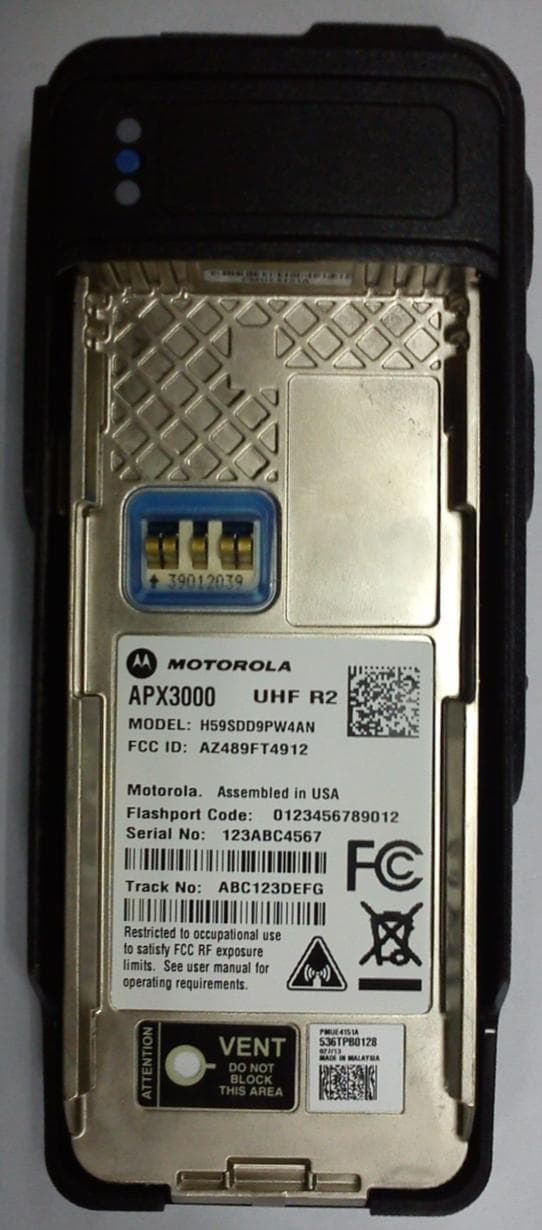
Click to zoom
Application Details
- Equipment Class
- TNF - Licensed Non-Broadcast Transmitter Held to Face
- Date of Grant
- Jun 17, 2013
- Application Purpose
- Original Equipment
- Date of Application
- Jun 05, 2013
- Equipment Note
- Portable 2-Way Radio
- Frequency Range
- 470.00000000 - 520.00000000
- Company
- Motorola Solutions, Inc.
- Country
- United States
Documents & Files
Document Text
Text extracted from the exhibit documents filed with the FCC. Open a document above to read the original.
Users Manual
APX 3000 User Guide 68012007043-B English mASTRO ® APX™ 3000 Digital Portable RadiosQuick Reference Card RF ENERGY EXPOSURE AND PRODUCT SAFETY GUIDE FOR PORTABLE TWO-WAY RADIOS ATTENTION! This radio is restricted to oc cupational use only to satisfy FCC RF energy exposure requirements. Before using this product, read the guide enclosed with your radio which contains important operating instructions for safe usage and RF energy awareness and control for compliance with applicable standards and regulations. Radio Controls Turning Radio On/OffControl Buttons for Channels, Zone or Volume * MFB can be programmed to Top, Top Side and Middle Side button. It can be configured to support two features out of Volume, Channel or Zone mode. Making a Call You may hear Channel Voice Announcement upon entering channel or zone mode if preprogrammed. Sending an Emergency Alarm ***Default emergency button press timer is set to 1 second. This timer is programmable, see page 40 in the user guide for details. To exit emergency at any time, press and hold the Emergency button. Before using this product, read the operating instructions for safe usage contained in the Product Safety and RF Exposure booklet enclosed with your radio. ! C a u t i o n Top Button*_______________Up Arrow Button**____________ Antenna Top Side Button*______________ Middle Side Button*______________Down Arrow Button**____________On/Off Switch IMPORTANT! You must connect a speaker microphone, earpiece or headset to hear the audio indicators; and a GCAI DRSM to see the strings and icons of your radio. • On – Push the On/Off Switch downwards. You see a Green Dot. • Off – Push the On/Off Switch upwards. • Multi-Functional Button (MFB)* – To toggle between Volume , Channel or Zone mode. • Up Arrow Button ** – To increase volume; to toggle the channels or zones up. Side Connector Cover Battery Connector Transmit/Receive LED BatteryBluetooth Pairing Spot Bluetooth LED • Down Arrow Button ** – To decrease volume; to toggle the channels or zones down. 1 Press the Multi-Functional Button* to the desirable channel or zone mode. 2 Press the Up/Down Arrow Button to change the channel/zone. 3 Adjust volume, if necessary. 4 Press the PTT button to transmit; release to receive. 1 Press and release the Emergency button***. 2 When acknowledgment is received, you hear four beeps; alarm ends; and radio exits emergency. *PMLN6407A* PMLN6407A MOTOROLA, MOTO, MOTOROLA SOLUTIONS and the Stylized M logo are trademarks or registered trademarks of Motorola Trademark Holdin gs, LLC and are used under license. All other trademarks are the property of their respective owners. © 2012 by Motorola Solutions, Inc. All Rights Reserved. 03/13. 1303 East Algonquin Road., Schaumburg, Illinois 60196, U.S.A. English Sending an Emergency Call To exit emergency at any time, press and hold the Emergency button. Sending a Silent Emergency Alarm To exit emergency at any time, press and hold the Emergency button. LED Indicator Bluetooth Pairing with Mission Critical Wireless PodAudio indications incl ude alert tones and Voice Announcement (feature enabled via CPS). Bluetooth Pairing with Mission Critical Wireless Remote Control Unit (RCU) PMLN6233_ Discreet Missi on Critical Wireless RCU is recommended to use with your APX 3000 as it provides additional functionality to this radio. Connecting to Display Remote Speaker Microphone (DRSM)Only DRSM supports the APX 3000 display capability. 1 Press the Emergency button. 2 Press and hold the PTT button. Speak clearly with the microphone near your mouth. 3 Release the PTT button to end call. 4 Press and hold Emergency button to exit emergency. 1 Press the Emergency button. 2 The LED does not light up, and there is no tone. 3 Silent emergency continues until you press and hold the Emergency button to exit emergency state.ORPress and release the PTT button to exit the Silent Emergency Alarm mode and enter regular dispatch or Emergency Call mode. Solid red Radio is transmitting. Blinking red Radio is transmitting at low battery condition. Rapid blinking red Power-Up failure. Solid green Radio has completed power up. Blinking blue (3 Blinks) Bluetooth is powering On/Off. Slow blinking blue Bluetooth is ready to pair.Rapid blinking blue for two seconds Bluetooth fails to connect or disconnect from a device. Solid blue for two seconds Bluetooth device is connected or disconnected. Solid blue Bluetooth error. Blinking blue at heartbeat pace Radio is connected with at least one Bluetooth accessory device. 1 To hear audio indications, plug the earpiece into the Wireless Pod. ORTo function as a Standalone PTT Device, remove the earpiece. 2 Power on both your radio and Pod. 3 Ensure the Bluetooth feature of your radio and Pod are enabled. Ensure the Pod is in pairing mode. 4 Place the Bluetooth pairing spot of your Pod within one inch from the Bluetooth pairing spot on your radio. 1 Verify that both your radio and your RCU are powered ON and in pairing mode. 2 To enter pairing mode on your RCU, press and hold the Trunk button while powering up the RCU. 3 Place the Bluetooth pairing spot on your RCU within one inch of the Bluetooth pairing spot on your radio. 4 Radio LED turns solid blue for two seconds and then blinking blue at heartbeat pace to indicate connection is successfully established. 1 Turn off your Radio. 2 Align and attach the RSM’s connector to your radio’s side connector. 3 Secure by tightening the screw on the lower end of the connector. Declaration of Conformity English i Declaration of Conformity This declaration is applicable to your radio only if your radio is labeled with the FCC logo shown below. DECLARATION OF CONFORMITYPer FCC CFR 47 Part 2 Section 2.1077(a)Responsible Party Name: Motorola Solutions, Inc.Address: 1303 East Algonquin Road, Schaumburg, Illinois 60196, U.S.A.Phone Number: 1-800-927-2744Hereby declares that the product: Model Name: APX 3000 conforms to the following regulations: FCC Part 15, subpart B, section 15.1…
Text truncated - open the document above for the full version.
Users Manual
English RF ENERGY EXPOSURE AND PRODUCT SAFETY GUIDE FOR PORTABLE TWO-WAY RADIOS APX3000 Before using this radio, read this guide which contains important operating instructions for safe usage and RF energy awareness and control for compliance with applicable standards and regulations. ATTENTION! Motorola Solutions, Inc. 1303 E. Algonquin Rd., Schaumburg, IL 60196, U.S.A. *68012007006* 68012007006-A *PMLN6300A* PMLN6300A MOTOROLA, MOTO, MOTOROLA SOLUTIONS and the Stylized M logo are trademarks or registered trademarks of Motorola Trademark Holdings, LLC and are used under license. All other trademarks are the property of their respective owners. © 2012 Motorola Solutions, Inc. All rights reserved. 68012007006-A_Covert_SafetyManual.fm Page 1 Thursday, November 22, 2012 11:29 AM 2 English RF Energy Exposure Awareness and Control Information and Operational Instructions for Occupational Use NOTICE: This radio is intended for use in occupational/controlled conditions where users have full knowledge of their exposure and can exercise control over their exposure to meet the occupational limits in FCC and International standards. This radio device is NOT authorized for general population consumer use. This two-way radio uses electromagnetic energy in the radio frequency (RF) spectrum to provide communications between two or more users over a distance. It uses radio frequency (RF) energy or radio waves to send and receive calls. RF energy is one form of electromagnetic energy. Other forms include, but are not limited to, sunlight and x-rays. RF energy, however, should not be confused with these other forms of electromagnetic energy, which when used improperly, can cause biological damage. Very high levels of x-rays, for example, can damage tissues and genetic material. Experts in science, engineering, medicine, health, and industry work with organizations to develop standards for safe exposure to RF energy. These standards provide recommended levels of RF exposure for both workers and the general public. These recommended RF exposure levels include substantial margins of protection. All Motorola two-way radios are designed, manufactured, and tested to ensure they meet government-established RF exposure levels. In addition, manufacturers also recommend specific operating instructions to users of two-way radios. These instructions are important because they inform users about RF energy exposure and provide simple procedures on how to control it. 68012007006-A_Covert_SafetyManual.fm Page 2 Thursday, November 22, 2012 11:29 AM 3 English Please refer to the following websites for more information on what RF energy exposure is and how to control your exposure to assure compliance with established RF exposure limits: http://www.fcc.gov/oet/rfsafety/rf-faqs.html www.who.int/en/ www.motorolasolutions.com/rfhealth Federal Communication Commission (FCC) Regulations When two-way radios are used as a consequence of employment, the FCC requires users to be fully aware of and able to control their exposure to meet occupational requirements. Exposure awareness can be facilitated by the use of a product label directing users to specific user awareness information. Your Motorola two-way radio has a RF Exposure Product Label. Also, your Motorola user manual, or separate safety booklet includes information and operating instructions required to control your RF exposure and to satisfy compliance requirements. Compliance with RF Exposure Standards Your Motorola two-way radio is designed and tested to comply with a number of national and International standards and guidelines (listed below) for human exposure to radio frequency electromagnetic energy. This radio complies with the IEEE (FCC) and ICNIRP exposure limits for occupational/controlled RF exposure environments at operating duty factors of up to 50% talk-50% listen and is approved for occupational use only. In terms of measuring RF energy for compliance with these exposure guidelines, your radio generates measurable RF energy only while it is transmitting (during talking), not when it is receiving (listening) or in standby mode. 68012007006-A_Covert_SafetyManual.fm Page 3 Thursday, November 22, 2012 11:29 AM 4 English NOTE:The approved batteries, supplied with this radio, are rated for a 5-5-90 duty factor (5% talk-5% listen-90% standby) even though this radio complies with FCC occupational exposure limits and may operate at duty factors of up to 50% talk. Your Motorola two-way radio complies with the following RF energy exposure standards and guidelines: • United States Federal Communications Commission (FCC), Code of Federal Regulations; 47 CFR et seq. & FCC, OET Bulletin 65 • Institute of Electrical and Electronic Engineers (IEEE) C95.1 • International Commission on Non-Ionizing Radiation Protection (ICNIRP) • Ministry of Health (Canada) Safety Code 6 & Industry Canada RSS-102 • Australian Communications Authority Radiocommunications Standard et seq. • ANATEL ANNEX to Resolution No. 303 et seq. RF Exposure Compliance and Control Guidelines and Operating Instructions for Two-Way Radio Operations To control your exposure and ensure compliance with the occupational/controlled environment exposure limits, always adhere to the following procedures. • DO NOT remove the RF Exposure Label from the device. • User awareness instructions should accompany device when transferred to other users. 68012007006-A_Covert_SafetyManual.fm Page 4 Thursday, November 22, 2012 11:29 AM 5 English Two-Way Radio Operation • Transmit no more than the rated duty factor of 50% of the time. To transmit (talk), push the Push-To-Talk (PTT) button. To receive calls, release the PTT button. Transmitting 50% of the time, or less, is important because this radio generates measurable RF energy exposure only when transmitting (in terms of measuring for standards compliance). NOTE:RF exposures decrease with increasing distance from the antenna. • Body Worn Operation. When worn on the body, always …
Text truncated - open the document above for the full version.
Cover Letter(s)
Federal Communications CommissionDA 12-642 Before the Federal Communications Commission Washington, D.C. 20554 In the Matter of Implementation of Sections 309(j) and 337 of the Communications Act of 1934 as Amended Promotion of Spectrum Efficient Technologies on Certain Part 90 Frequencies ) ) ) ) ) ) ) WT Docket No. 99-87 RM-9332 ORDER Adopted: April 25, 2012Released: April 26, 2012 By the Chief, Wireless Telecommunications Bureau, Chief, Public Safety and Homeland Security Bureau, and Chief, Office of Engineering and Technology: I.INTRODUCTION 1.In this Order, we waive, on our own motion, the January 1, 2013 deadline for private land mobile radio (PLMR) licensees in the 470-512 MHz band to migrate to narrowband (12.5 kHz or narrower) technology. 1 We also waive a related rule pertaining to manufacture and importation of PLMR equipment.We take this action in light of recent legislation directing the Commission to reallocate spectrum in the 470-512 MHz band. II. BACKGROUND 2.In 1995, the Commission adopted rule changes to promote the efficient use of the PLMR service and facilitate the introduction of advanced technologies. 2 To promote the transition to a more efficient narrowband channel plan, the Commission provided, inter alia, that “only increasingly efficient equipment” would be approved. 3 The Commission did not set a date after which it would no longer approve equipment with a wideband (25 kHz) mode, or after which such equipment could no longer be manufactured or used. 4 The Commission contemplated that, as systems reached the end of their service life and new radios were needed, users would migrate to the narrower bandwidth multi-mode radios in 1 See Implementation of Sections 309(j) and 337 of the Communications Act of 1934 as Amended,Second Report and Order and Second Further Notice of Proposed Rulemaking, WT Docket No. 99-87, 18 FCC Rcd 3034 (2003) (Second R&O); Implementation of Sections 309(j) and 337 of the Communications Act of 1934 as Amended,Third Memorandum Opinion and Order, Third Further Notice of Proposed Rule Making and Order, WT Docket No. 99- 87, 19 FCC Rcd 25045 (2004) (Third MO&O). Specifically, these narrowbanding deadlines apply to frequencies in the 150.8-162.0125 MHz, 173.2-173.4 MHz, and 421-512 MHz bands. Narrowbanding in the 150.05-150.8 MHz, 162-174 MHz, and 406.1-420 MHz bands, which are allocated primarily for Federal Government use, is governed by a different schedule. See Amendment of Parts 2 and 90 of the Commission’s Rules to Provide for Narrowband Private Land Mobile Radio Channels in the 150.05-150.8 MHz, 162-174 MHz, and 406.1-420 MHz Bands that Are Allocated for Federal Government Use, Report and Order, ET Docket No. 04-243, 20 FCC Rcd 5793 (2005); 47 C.F.R. § 90.265. Similarly, the narrowbanding requirements for 700 MHz public safety narrowband systems are subject to a different schedule, and are not affected by this proceeding. See47 C.F.R. §§ 90.203(m), (n), 90.535. 2 SeeReplacement of Part 90 by Part 88 to Revise the Private Land Mobile Radio Services and Modify the Policies Governing Them, Report andOrder and Further Notice of Proposed Rule Making, PR Docket No. 92-235, 10 FCC Rcd 10076, 10077 ¶ 1 (1995). 3 Id.at 10081 ¶ 7. 4 Id.at 10100 ¶ 40. Federal Communications CommissionDA 12-642 2 order to avoid the adjacent-channel interference that could occur from systems using the adjacent narrowband channels. 5 3.Subsequently,the Commission determined that the 1995 rules failed to provide adequate incentive to realize the Commission’s spectrum efficiency goals in these bands, and stronger measures would be required to bring about a timely transition to narrowband technology. 6 The Commission therefore amended the rules to provide that, by January 1, 2013, Industrial/Business and Public Safety Radio Pool licensees in the 150-174 MHz and 421-512 MHz bands must migrate to 12.5 kHz channel bandwidth or utilize a technology that achieves equivalent efficiency. 7 In addition, beginning January 1, 2013, the manufacture or import of equipment capable of operating with only one voice path per 25kHz of spectrum, i.e., equipment that includes a 25 kHz mode, will be prohibited. 8 4.Congressrecently enacted the Middle Class Tax Relief and Job Creation Act of 2012. 9 Section 6103 of the legislation provides that, not later than nine years after the date of enactment, the Commission shall “reallocate the spectrum in the 470-512 MHz band (referred to in this section as the ‘T- Band spectrum’) currently used by public safety eligibles as identified in section 90.303 of title 47, Code of Federal Regulations” and “begin a system of competitive bidding under section 309(j) of the Communications Act of 1934 (47 U.S.C. 309(j)) to grant new initial licenses for the use of the spectrum.” 10 Italso provides that “relocation of public safety entities from the T-Band spectrum” shall be completed not later than two years after completion of the system of competitive bidding. 11 III. DISCUSSION 5.Pursuant to Section 1.925(b)(3) of our Rules, we may waive specific requirements of the Commission’s Rules if it is shown that (a) the underlying purpose of the rules would not be served or would be frustrated by application to the instant case, and that a grant of the requested waiver would be in the public interest; or (b) in view of unique or unusual factual circumstances, application of the rules would be inequitable, unduly burdensome or contrary to the public interest, or the applicant has no reasonable alternative. 12 In the instant case, Section 6103 of the legislation specifically requires the eventual relocation of public safety entities from the 470-512 MHz band, and also raises issues about the disposition of theband generally. Pending further action by the Commission, however, there is substantial uncertainty regarding whether application of the narrowbanding deadline in the T-Band would continue to serve its original purpose. Continuing to require narrowbanding cou…
Text truncated - open the document above for the full version.
Cover Letter(s)
FCC ID: AZ489FT4912 Motorola Solutions Inc, 8000 West Sunrise Blvd., Plantation, FL 33322. EXHIBIT 13A SHEET 1 May 21 st , 2013 Office of Engineering and Technology Laboratory Division Equipment Authorization Branch FCC Laboratory 7435 Oakland Mills Road Columbia, MD 21046 Subject: Application for Certification of Transmitter with FCC ID: AZ489FT4912, APX3000. Gentlemen: Motorola Solutions, 8000 West Sunrise Boulevard, Fort Lauderdale, Florida, herein submits application for Certification of the subject transmitter. This transmitter is intended for use in a Portable Radio environment with capabilities for clear and coded communications with a variable transmit power operating within the following frequency ranges: 450 - 520 MHz: 1-5.0 Watts (Nominal) To aid equipment authorization in foreign countries which accept United States FCC Grant for equipment authorization, Motorola Solutions is requesting that the FCC lists 450-520 MHz on the FCC Grant for equipment authorization. We are requesting Certification under Part 90.210 and 90.210(e) of the Commission’s Rules to allow operation of this equipment. The subject transmitter complies with Section 90.203 of the Rules in that the operator cannot directly program transmit frequencies using the unit's normally accessible external controls. In addition, this transmitter is intended for work-related occupational use only under Part 90 of the FCC rules. Additionally, the radio is equipped with a Bluetooth transmitter capable of clear communication with fixed power operating within the following frequency ranges: 2.402-2.480 GHz: 5-10 mW The Bluetooth transmitter complies with the requirements of FCC Part 15 subpart C. A complete Certification application is enclosed. If you require any additional information, please contact me at (954) 723-5793. Sincerely, Mike Ramnath Manager, Regulatory Compliance Email: [email protected]
Cover Letter(s)
FCC ID: AZ489FT4912 Motorola Solutions Inc, 8000 West Sunrise Blvd., Plantation, FL 33322. EXHIBIT 13B SHEET 1 CONFIDENTIALITY REQUEST May 21 st , 2013 Office of Engineering and Technology Laboratory Division Equipment Authorization Branch FCC Laboratory 7435 Oakland Mills Road Columbia, MD 21046 Subject: Request for Confidentiality for Transmitter with FCC ID:AZ489FT4912 Dear Sir / Madam, Motorola Solutions Inc is requesting that Exhibit 4 (Circuit Descriptions), Exhibit 5 (Schematic Diagrams), Exhibit 10 (Parts List and Tune Up Procedures), and Exhibit 12 (Transmitter Description) not be made routinely available for public inspection. Motorola Solutions considers the information in these exhibits to be classified as trade secrets, pursuant to 47 CFR Section 0.457(d), 0.459 and Section 552(b)(4) of the Freedom of Information Act. Please mark Exhibits 4, 5, 10, and 12 as “Confidential”. Please contact me if you require any additional information. Sincerely, Mike Ramnath (signed above) Manager, Regulatory Compliance Tel: (954) 723-5793 E-mail: [email protected]
Cover Letter(s)
FCC ID: AZ489FT4912 EXHIBITS 13C _________________________________________________________________________________ Motorola Solutions Inc. 8000 West Sunrise Boulevard, Fort Lauderdale, Florida 33322. May 21 st , 2013 Office of Engineering and Technology Laboratory Division Equipment Authorization Branch FCC Laboratory 7435 Oakland Mills Road Columbia, MD 21046 Subject: Extended Frequencies Justification. Gentlemen: The APX3000 Portable 2-Way radio was designed to operate in the frequency band 450-520 MHz. To aid equipment authorization in other countries which accept the United States FCC Grant for Certification, Motorola is requesting that the FCC lists the frequencies 450-520 MHz under FCC Rule Parts 90.210 and 90.210e on the FCC Grant. For the FCC’s Rule Parts 90 applications, this radio is used in systems by Federal and Public Safety agencies including Police, Fire, and Emergency Medical Services, etc. as indicated in the table below. Equipment programming is the responsibility of Authorized Service Personnel. Also, the radio complies with 47 CFR Part 90.203(e), in that the operator cannot directly program the transmit frequencies using the normally accessible external controls. Per the FCC’s KDB634817 guidance, as an alternative to listing the exact frequencies, we acknowledge that it’s a violation of the FCC Rules if this device operates on unauthorized frequencies. Frequency Range (MHz) Part 90 Federal Emission Designator 450-454 x 11K0F3E, 8K10F1D, 8K10F1E, 8K10F1W, 16K0F3E*, 20K0F1E* 454-456* 456-460 x “”” 460-462.5375 x x “”” 462.7375-467.5375 x “”” 467.7375-470 x “”” 470-512 x “”” 512-520 x “”” * For Canada ** FCC Part95 is not included in this application Sincerely, Mike Ramnath Manager, Regulatory Compliance Email: [email protected]
External Photos
Applicant: Motorola Solutions Inc. FCC ID: AZ489FT4912 EXHIBIT 3 SHEET 1 OF 7 EXHIBIT 3 The following photographs are attached. Exhibit 1. Back View with Battery 3A 2. Front View 3B 3. Back View (FCC label location) 3C 4. Side view (Right) 3D 5. Side view (Left) 3E 6. Top view (Controls) 3F Applicant: Motorola Solutions Inc. FCC ID: AZ489FT4912 EXHIBIT 3 SHEET 2 OF 7 Exhibit 3A – Back View with Battery Applicant: Motorola Solutions Inc. FCC ID: AZ489FT4912 EXHIBIT 3 SHEET 3 OF 7 Exhibit 3B – Front View Applicant: Motorola Solutions Inc. FCC ID: AZ489FT4912 EXHIBIT 3 SHEET 4 OF 7 Exhibit 3C – Back View (FCC Label) Applicant: Motorola Solutions Inc. FCC ID: AZ489FT4912 EXHIBIT 3 SHEET 5 OF 7 Exhibit 3D – Side View (RIGHT) Applicant: Motorola Solutions Inc. FCC ID: AZ489FT4912 EXHIBIT 3 SHEET 6 OF 7 Exhibit 3E – Side View (LEFT) Applicant: Motorola Solutions Inc. FCC ID: AZ489FT4912 EXHIBIT 3 SHEET 7 OF 7 Exhibit 3F – Top View
ID Label/Location Info
Applicant: Motorola Solutions Inc. FCC ID: AZ489FT4912 EXHIBIT 1 SHEET 1 OF 1 Identification Label LOCATION See the Attached Photograph or Sketch X Back of Radio Back of Radio under Belt Clip TYPE X The label is a paper polyester film laminate with a pressure sensitive adhesive backing. The adhesive is a permanent type acrylic with minimum peel strength of 40 oz/inch. MARKINGS (TEXT) X See the Attached Photograph and Exhibit 3C for the actual location of the FCC label on the device. Label Attached Below. See Attached Drawing. FCC Label
Internal Photos
Applicant: Motorola Solutions Inc. FCC ID: AZ489FT4912 EXHIBIT 9 SHEET 1 OF 5 EXHIBIT 9 Internal Photographs The following photographs are attached. Exhibit 1. RF board without & with Shields (Top). 9A 2. RF board without & with Shields (Bottom). 9B 3. RF board with chassis and housing (front side). 9C 4. RF Board with chassis and housing (back side). 9D Applicant: Motorola Solutions Inc. FCC ID: AZ489FT4912 EXHIBIT 9A SHEET 2 OF 5 RF board without & with Shields (Top) Bluetooth Antenna Applicant: Motorola Solutions Inc. FCC ID: AZ489FT4912 EXHIBIT 9B SHEET 3 OF 5 RF board without & with Shields (Bottom) Applicant: Motorola Solutions Inc. FCC ID: AZ489FT4912 EXHIBIT 9C SHEET 4 OF 5 RF board with chasis and housing (front side) Applicant: Motorola Solutions Inc. FCC ID: AZ489FT4912 EXHIBIT 9D SHEET 5 OF 5 Chassis and Housing (back side)
RF Exposure Info
FCC ID: AZ489FT4912 SR 11193 Motorola Solutions Inc. EME Form-SAR-Rpt-Rev. 12.01 Page 1 of 54 TESTING CERT # 2518.01 DECLARATION OF COMPLIANCE SAR ASSESSMENT Part 1 of 2 Motorola Solutions Inc. EME Test Laboratory 8000 West Sunrise Blvd Fort Lauderdale, FL. 33322 Date of Report: 5/15/2013 Report Revision: O Report ID: SR11193 APX3000 U2 Rev O 130515 Responsible Engineer: Michael Sailsman( Senior Staff EME Engineer) Report Author: Michael Sailsman (Senior Staff EME Engineer) Date/s Tested: 2/15/13-2/26/13; 4/23/13 Manufacturer/Location: Motorola, Penang Sector/Group/Div.: AESS – Astro Engineering Subscriber Solutions Date submitted for test: 2/5/13 DUT Description: 450-520MHz, 5.0W rated power, 6.25kHz/12.5kHz/25kHz, Capable of digital and analog FM transmission. Also capable of TDMA and Bluetooth transmissions Test TX mode(s): CW (PTT); CW (Bluetooth) Max. Power output: 5.6W (450-520 MHz); 10 mW Bluetooth Nominal Power: 5.0W (450-520 MHz); 10 mW Bluetooth Tx Frequency Bands: 450-520 MHz; 2.402-2.480 GHz (Bluetooth) Signaling type: FM, TDMA, FHSS (Bluetooth) Model(s) Tested: H59SDD9PW4AN Model(s) Certified: H59SDD9PW4AN Serial Number(s): 536TPB0026, 536TPB0097 Classification: Occupational/Controlled FCC ID: AZ489FT4912; Rule Part 90 (450-512 MHz); Rule Part 15 (2402 – 2480 MHz) Results outside FCC bands are not applicable for FCC compliance demonstration. * Refer to section 15 of part 1 for highest SAR summary results. The test results clearly demonstrate compliance with FCC Occupational/Controlled RF Exposure limits of 8 W/kg averaged over 1 gram per the requirements of 47 CFR 2.1093(d). The 10 grams result is not applicable to FCC filing. The test results clearly demonstrate compliance with ICNIRP (1998) Guidelines for limiting exposure in time-varying electric, magnetic, and electromagnetic fields (up to 300 GHz), Health Physics 74, 494-522 RF Exposure limits of 10 W/kg averaged over 10grams of contiguous tissue. Based on the information and the testing results provided herein, the undersigned certifies that when used as stated in the operating instructions supplied, said product complies with the national and international reference standards and guidelines listed in section 3.0 of this report. This report shall not be reproduced without written approval from an officially designated representative of the Motorola Solutions Inc EME Laboratory. I attest to the accuracy of the data and assume full responsibility for the completeness of these measurements. This reporting format is consistent with the suggested guidelines of the TIA TSB-150 December 2004. The results and statements contained in this report pertain only to the device(s) evaluated. Deanna Zakharia EMS EME Lab Senior Resource Manager, Laboratory Director Approval Date: 5/20/2013 Certification Date: 5/20/2013 Certification No.: L1130513P FCC ID: AZ489FT4912 SR 11193 Motorola Solutions Inc. EME Form-SAR-Rpt-Rev. 12.01 Page 2 of 54 Part 1 of 2 1.0 Introduction ................................................................................................................................. 4 2.0 Abbreviations / Definitions ......................................................................................................... 4 3.0 Referenced Standards and Guidelines ........................................................................................ 4 4.0 SAR Limits ................................................................................................................................. 5 5.0 SAR Result Scaling Methodology .............................................................................................. 6 6.0 Description of Device Under Test (DUT) .................................................................................. 6 7.0 Optional Accessories and Test Criteria....................................................................................... 7 7.1 Antennas ......................................................................................................................... 7 7.2 Batteries .......................................................................................................................... 7 7.3 Body worn Accessories ................................................................................................... 8 7.4 Audio Accessories .......................................................................................................... 8 8.0 Description of Test System ....................................................................................................... 10 8.1 Descriptions of Robotics/Probes/Readout Electronics ................................................. 10 8.2 Description of Phantom(s) ............................................................................................ 11 8.3 Description of Simulated Tissue ................…
Text truncated - open the document above for the full version.
Contact Information
Applicant
Arine Lee(Certification Manager)
Test Firm
Motorola Solutions Malaysia Sdn BhdSze Khian Ho
Technical Specifications
| # | Rule Parts | Frequency Range | Power Output | Emission | Tolerance |
|---|---|---|---|---|---|
| 7 | 9 | 470 MHz - 520 MHz | 5 W | 20K0F1E | 2 ppm |
Other Applications from Motorola Solutions, Inc.
AZ489FT4980
Sep 08, 2026Portable two way radio
Equipment Class
TNF - Licensed Non-Broadcast Transmitter Held to FaceAZ489FT4981
Aug 14, 2026Handheld Portable - TANAPA BPR 45 400-470 MHZ 4W NKP
Equipment Class
TNF - Licensed Non-Broadcast Transmitter Held to Face
AZ489FT7187
Jul 13, 2026Portable 2-Way Radio with Bluetooth, Bluetooth LE, WIFI 2.4GHz, WIFI 5GHz, LTE
Equipment Class
DSS - Part 15 Spread Spectrum TransmitterAZ499FT6031
May 11, 2026Operation Critical Wireless Earpiece PTT
Equipment Class
DSS - Part 15 Spread Spectrum Transmitter
AZ499FT5879
Dec 19, 20252-way Portable Radio with BT, BTLE, WIFI, NFC and LTE
Equipment Class
DSS - Part 15 Spread Spectrum Transmitter