AZ489FT5827I285 PHONE
Motorola Solutions, Inc.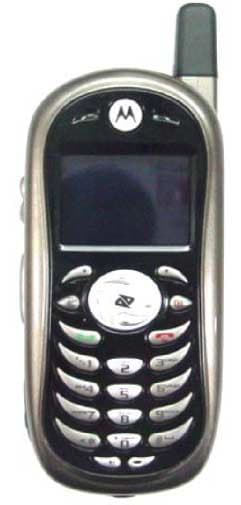
Click to zoom
Application Details
- Equipment Class
- TNE - Licensed Non-Broadcast Transmitter Held to Ear
- Date of Grant
- Mar 01, 2004
- Application Purpose
- Original Equipment
- Date of Application
- Mar 01, 2004
- Equipment Note
- I285 PHONE
- Frequency Range
- 896.00000000 - 901.00000000
- Company
- Motorola Solutions, Inc.
- Country
- United States
Documents & Files
Document Text
Text extracted from the exhibit documents filed with the FCC. Open a document above to read the original.
Users Manual
i 285 Boost Mobile TM Phone User’s Guide EME DRAFT @NNTN5321A@NNTN5521A i ContentsIntroduction ................................................... 1 WelcometoBoostMobile TM - Wireless for a New Generation ........................................................... 1 Getting Started .............................................. 2 Opening the Battery Door .................................... 3Battery.................................................................. 5Powering On and Off ........................................... 7Enabling Over-the-Air Security ............................ 8Finding Your Phone Number ............................... 8Phone Basics ....................................................... 9SIM Security....................................................... 12Locking the Keypad ........................................... 14Accessories........................................................ 15Boost Mobile Customer Care............................. 15 Making Calls ................................................ 17 Receiving Calls .................................................. 17Call Icons ........................................................... 18Entering the Number to Call............................... 18Using Mute......................................................... 20Making Emergency Phone Calls........................ 20 Call Alerts .................................................... 22 Sending Call Alerts............................................. 22Receiving Call Alerts .......................................... 22Using the Call Alert Queue................................. 22 Recent Calls ................................................ 24 Storing Recent Calls to Contacts ....................... 24Deleting Recent Calls......................................... 25 Entering Text............................................... 26 Using Alpha Mode.............................................. 26Using Word Mode .............................................. 26Special Function Keys........................................ 27Using Numeric Mode.......................................... 28Using Symbols Mode ......................................... 28 Contacts ...................................................... 29 Viewing Contacts ............................................... 30Creating Entries ................................................. 31Storing Numbers Faster ..................................... 32Editing Entries .................................................... 33Deleting Entries.................................................. 33Checking Capacity ............................................. 33Creating Pauses and Waits................................ 33 ii International Numbers........................................ 34 Memo ............................................................ 35Message Center........................................... 36 Accessing the Message Center ......................... 36Message Center Options ................................... 36 Receiving Messages ................................... 37 Message Notifications........................................ 37Message Center................................................. 38 Voice Mail Messages................................... 39 Receiving a Message......................................... 39Accessing Voice Mail fromthe Message Center........................................... 39Sending Unanswered Calls to Voice Mail .......... 39 Boost Mobile Voice Mail ............................. 40 Setting Up Your Voice Mail Box......................... 40Changing Your Password .................................. 41Recording Your Name ....................................... 41Advanced Voice Mail Features .......................... 42 MMS Messages ........................................... 47 Composing and Sending Messages .................. 47Drafts.................................................................. 52Sent Items .......................................................... 53Receiving a Message ......................................... 54Viewing Received Messagesfrom the Message Center................................... 54Actions for Received Messages......................... 55Customizing MMS .............................................. 58Managing Memory ............................................. 59 SMS and Boost Mobile TM Text and Numeric Messages..................................................... 61 SMS Messages .................................................. 61Boost Mobile TM Text Messages and Web Alerts62 Boost Mobile TM Numeric Messages .................. 63 Boost Mobile Wireless Web Services ....... 65 Starting the Microbrowser .................................. 65 Call Forwarding........................................... 67 Forwarding All Calls ........................................... 67Turning Off Call Forwarding ............................... 67Forwarding Missed Calls.................................... 68 iii Viewing Call Forwarding Settings ...................... 68 Java ® Applications...................................... 57 Running Applications ......................................... 57Suspending Applications.................................... 57Resuming Applications ...................................... 57Ending Applications ........................................... 58Downloading Applications.................................. 58Installing Applications ........................................ 58Deleting Applications ......................................... 58Managing Memory ............................................. 59Shortcuts on the Main Menu .............................. 59Java Applications and GPS Enabled ................. 60 Ring Tones................................................... 62 Setting Your Phone to Vibrate ........................... 62Assigning Ring Tones to Contacts..................... 63Ring and Vib…
Text truncated - open the document above for the full version.
Cover Letter(s)
______________________________________________________________________________ 8000 West Sunrise Boulevard, Fort Lauderdale, Florida 33322. Confidentiality Request Date: 24th February 2004 Authorization & Evaluation Division Federal Communications Commission Laboratory 7435 Oakland Mills Road Columbia, MD 21046 Subject: Application for Certification of Transmitter with FCC ID: AZ489FT5827. Dear Sir or Madam: Motorola is requesting that Exhibit 4 (Circuit Descriptions), Exhibit 5 (Schematic Diagrams), Exhibit 10 (Parts List and Tune Up Procedures), and Exhibit 12 (Operational Description) not be made routinely available for public inspection. Motorola considers the information in these exhibits to be classified as trade secrets, pursuant to 47 CFR Section 0.457(d) and Section 552(b)(4) of the Freedom of Information Act. Please mark Exhibits 4, 5, 10, and 12 as “Confidential.” Please contact me if you require any additional information. Sincerely, /s/ Mike Ramnath Manager, Regulatory Compliance Tel: (954) 723-5793 E-mail: [email protected] EXHIBIT 13b
Cover Letter(s)
Applicant: Motorola Inc FCC ID: AZ489FT5827 iDEN, Motorola Inc., 8000 W. Sunrise Blvd., Plantation, FL 33322 www.mot.com/iDEN Page: 13- 1 24 th February 2004 Authorization & Evaluation Division Federal Communications Commission Laboratory 7435 Oakland Mills Road Columbia, MD 21046 Subject: Application for Certification of transmitter with FCC ID: AZ489FT5827. Gentlemen; Motorola Inc., 8000 West Sunrise Boulevard, Fort Lauderdale, Florida 33322, herein submits its application for Certification of the transmitter with FCC ID: AZ489FT5827. This variable output power (0.062 to 700 milliwatt) transmitter is part of a handheld transceiver used in a SMR and EA SMR trunking system operating in the United States 806-821/851-866MHz and 896-901/935-940 MHz frequency band. Certification is sought for this transceiver, and performance data is provided for that purpose. This transceiver is of the receive-first type described in International Telecommunications Union Recommendation ITU-R M.1221 entitled Technical And Operational Requirements For Cellular Multimode Mobile Radio Stations. It must first find, acquire and lock onto a control channel from a predefined set of control channel frequencies assigned to a companion Authorized base station (e.g. – FCC ID: ABZ89FC5792). Transmission is not possible until lock to a base station control channel has been achieved, then transmission is limited to digitally modulated service request bursts on the reverse control channel. Upon recognition of a proper request, the control channel base station transmitter will then assign the transceiver a traffic channel for transmission of digital voice or circuit-switched data from the set of frequencies for which the trunking system is licensed. Attached Exhibit 12.1 provides additional descriptive details. It is expected that this handheld time division multiplexed transceiver marketed in the United States will also be used for itinerant operation with companion Authorized Base Stations by users requesting trunked radio and telephone interconnect service while roaming outside the United States. In some countries the companion base stations are licensed to operate at frequencies in the 821-825/866-870 MHz band in addition to some of those in the 806-821/851- 866 MHz band normally used in United States SMR systems. Consequently, this transmitter has been designed to meet FCC requirements for operation in the 806-821 MHz band over the more global band of 806 - 825 MHz when used with a companion Authorized Base Station. Thus, performance data is provided to substantiate FCC compliant operation with a Companion Base Station over the broader 806 to 825 MHz band expected for global use of this handheld transceiver. Applicant: Motorola Inc FCC ID: AZ489FT5827 iDEN, Motorola Inc., 8000 W. Sunrise Blvd., Plantation, FL 33322 www.mot.com/iDEN Page: 13- 2 To facilitate global roaming it is kindly requested that a note be provided in the Grant for Equipment Authorization, which states that this ‘receive first’ type of equipment is compliant for transmitter operation over the broader range 806-825 MHz when used with a compatible Authorized Base Station. This will aid equipment authorization in foreign countries, which accept a United States FCC Grant for Equipment Authorization, yet not jeopardize United States public safety or cellular systems licensed to operate in the 821-825 MHz frequency band since no compatible base station may be authorized on those frequencies in the United States. It is also expected that this transceiver type will be marketed outside the United States and brought into the United States for itinerant “roaming” operation on compatible 806 - 821 MHz base stations located within the United States. Consequently, upon receipt of Authorization, only those units of this equipment type authorized for marketing in countries outside the United States will also bear a label with the specified FCC identifier. In accordance with 47 CFR 2.1093(c) this transmitter may be used in “covered” SMR service so it has been subjected to routine environmental evaluation for RF exposure and found to be compliant with the limits specified in 47 CFR 2.1093(d)(2). The subject transmitter complies with 47 CFR 90.203 of the rules in that the operator cannot directly program transmit frequencies using only the unit's normally accessible external controls. This transceiver can function as a Part 15.3(r) computer peripheral device when functioning as an RF modem when connected to a computer via a data cable (ref: Exhibit 12.1). For this reason a Declaration of Conformity has been prepared and is provided on Page 5 of the user Manual in the Exhibit 8. Enclosed is a complete Certification Application comprised of 12 Exhibits. Contact me at (954) 723-5793 if you require any additional information. Regards, /s/ Mike Ramnath (signed) Manager, Regulatory Compliance Email: [email protected]
External Photos
FCC Filing Package for Motorola i285 Transceiver FCC ID: AZ489FT5827 IDEN, Motorola Inc., 8000 W. Sunrise Blvd., Plantation, FL 33322, USA WWW.MOT.COM/iDEN Page: 3 - 1 Exhibit 3. External Photographs -- Pursuant to 47 CFR 2.1033(c)12 The radio product shapes, colors and housing/bezel vary. Photograph 3-1: Front view Photograph 3-2: Back view, battery cover attached. FCC Filing Package for Motorola i285 Transceiver FCC ID: AZ489FT5827 IDEN, Motorola Inc., 8000 W. Sunrise Blvd., Plantation, FL 33322, USA WWW.MOT.COM/iDEN Page: 3 - 2 Photograph 3-3: Button side view, battery cover attached. Photograph 3-4: Antenna side view, battery cover attached. FCC Filing Package for Motorola i285 Transceiver FCC ID: AZ489FT5827 IDEN, Motorola Inc., 8000 W. Sunrise Blvd., Plantation, FL 33322, USA WWW.MOT.COM/iDEN Page: 3 - 3 Photograph 3-5: Back view, battery cover attached. Photograph 3-6: Back view, battery cover removed. FCC Filing Package for Motorola i285 Transceiver FCC ID: AZ489FT5827 IDEN, Motorola Inc., 8000 W. Sunrise Blvd., Plantation, FL 33322, USA WWW.MOT.COM/iDEN Page: 3 - 4 Photograph 3 – 7: Model Number
ID Label/Location Info
FCC Filing Package for Motorola i285 Transceiver FCC ID: AZ489FT5827 IDEN, Motorola Inc., 8000 W. Sunrise Blvd., Plantation, FL 33322, USA WWW.MOT.COM/iDEN Page 1-2 Exhibit 1. Identification Label -- Pursuant to 47 CFR 2.925, 2.1065 and 2.1033(c)11 1.1 Location Back side of the radio product unit chassis (Photograph 1.1). 1.2 Type The label is a white polyester film laminate with a pressure sensitive adhesive backing. The adhesive is a permanent type acrylic with minimum peel strength of 5 lbs/in. 1.3 Markings (Text) Enlarged view of label (showing FCC ID and manufacturer type number): Photograph 1.1: Location of label on back of unit’s housing (battery cover removed). FCC Filing Package for Motorola i285 Transceiver FCC ID: AZ489FT5827 IDEN, Motorola Inc., 8000 W. Sunrise Blvd., Plantation, FL 33322, USA WWW.MOT.COM/iDEN Page 2-2 Photograph 1.2a: Zoom view of labels containing FCC ID and FCC Logo Photograph 1.2b: Zoom view of labels containing FCC ID and FCC Logo FCC Filing Package for Motorola i285 Transceiver FCC ID: AZ489FT5827 IDEN, Motorola Inc., 8000 W. Sunrise Blvd., Plantation, FL 33322, USA WWW.MOT.COM/iDEN Page 2-2 Exhibit 1A. General Information 1A.1 Production Plans Quantity production is planned. 1A.2 Application References -- Pursuant to 47 CFR 2.948 and 2.1061 Reference is made to the following Motorola "Application References" 1. Open Area Test Site “OATS” (FCC Registration: 91932 / Industry of Canada: IC3679) 1A.3 Data Submittal Procedure Data located in Exhibit 6 is supplied in accordance with 47CFR2, Sub-part J and Part 90, Sub-parts I and Sub-part S of the Commission’s rules. 1A.4 Similar, currently Certified Transceiver FCC ID: AZ489FT5825 1A.5 Additional Considerations This radio product also integrates a receiver that will receive and process signals from Global Positioning System satellites. The radio product can also function as a Part 15.3(r) computer peripheral device when functioning as an RF modem when connected to a computer via a data cable accessory (Exhibit 12). A Declaration of Conformity in accordance with 47CFR2.1077(a) is provided in Exhibit 8 as evidence of compliance with Part 15 requirements for these additional Class B digital device functionalities per 47CFR15.101(a). Compliance with Part 15 requirements for the Direct-Conversion (zero IF superheterodyne) receiver has been determined by verification in accordance with 47CFR15.1.
Internal Photos
FCC Filing Package for Motorola i285 Transceiver FCC ID: AZ489FT5827 IDEN, Motorola Inc., 8000 W. Sunrise Blvd., Plantation, FL 33322, USA WWW.MOT.COM/iDEN Page: 9- 1 Exhibit 9. Internal Photographs -- Pursuant to 47 CFR 2.1033(c)12 Photograph 9-1: Front side view of radio PCB. Photograph 9-2: Back side view of radio PCB. Photograph 9.5: Back side view of keyboard. Photograph 9-3: Front side view of radio PCB without shields. Photograph 9-4: Back side view of radio PCB without shields. Photograph 9.6: Front side view of keyboard.
RF Exposure Info
CGISS EME Form-SAR-Rpt-Rev. 2.00 Page 1 of 23 CGISS EME Test Laboratory 8000 West Sunrise Blvd Fort Lauderdale, FL. 33322 S.A.R. EME Compliance Test Report Part 1 of 2 Note: Based on the information and the testing results provided herein, the undersigned certifies that when used as stated in the operating instructions supplied, said product complies with the national and international reference standards and guidelines listed in section 2.0 of this report. Deanna Zakharia Signature on File for Ken Enger 1/30/04 ____________________________________________________________ _________________________ Ken Enger Date Approved Senior Resource Manager, Laboratory Director, CGISS EME Lab Note: This report shall not be reproduced without written approval from an officially designated representative of the Motorola EME Laboratory. Date of Report: January 29, 2004 Report Revision: Rev. A Manufacturer: Motorola Product Description: 1:6, 1:3, 81:120, 1:12 TDM; 64 QAM, 16 QAM & QPSK Modulation; 0.6 W Pulse average FCC ID: AZ489FT5827 Device Model: H75XAH6RR3AN/NUF3790A Certificate Number: 1449-02 Test Period: 12/29/03-01/13/04 EME Tech: Ed Church EME Eng.: Stephen Whalen (Sr. EME Eng.) Author: Michael Sailsman Global EME Regulatory Affairs Liaison CGISS EME Form-SAR-Rpt-Rev. 2.00 Page 2 of 23 TABLE OF CONTENTS Part 1 of 2 1.0 Introduction 2.0 Reference Standards and Guidelines 3.0 Description of Test Sample 3.1 Test Signal 3.2 Test Output Power 4.0 Description of Test Equipment 4.1 Description of S.A.R Measurement System 4.2 Description of Phantom 4.2.1 Flat Phantom 4.2.2 SAM phantom 4.3 Simulated Tissue Properties 4.3.1 Type of Simulated Tissue 4.3.2 Simulated Tissue Composition 4.4 Test conditions 5.0 Description of Test Procedure 5.1 Device Test Positions 5.1.1 Body 5.1.2 Head 5.1.3 Face 5.2 Test Position Photographs 5.3 Probe Scan Procedures 6.0 Measurement Uncertainty 7.0 S.A.R. Test Results 7.1 S.A.R. results 7.2 Peak S.A.R. location 7.3 Highest S.A.R. results calculation methodology 8.0 Conclusion Part 2 of 2 Appendix A: Power Slump Data/Shortened scan Appendix B: Data Results Appendix C: Dipole System Performance Check Results Appendix D: Calibration Certificates Appendix E: Illustration of Body-worn Accessories Appendix F: Accessories and options test status and separation distances CGISS EME Form-SAR-Rpt-Rev. 2.00 Page 3 of 23 REVISION HISTORY Date Revision Comments 1/20/04 O Release of Pilot results 1/29/04 A Revised antenna gain information in section 3.0 CGISS EME Form-SAR-Rpt-Rev. 2.00 Page 4 of 23 1.0 Introduction This report details the utilization, test setup, test equipment, and test results of the Specific Absorption Rate (S.A.R.) measurements performed at the CGISS EME Test Lab for model number H75XAH6RR3AN/NUF3790A, FCC ID: AZ489FT5827. The applicable exposure environment is General Population/Uncontrolled. 2.0 Reference Standards and Guidelines This product is designed to comply with the following national and international standards and guidelines. • United States Federal Communications Commission, Code of Federal Regulations; 47CFR part 2 sub-part J • IEEE 1528, 2003 "Recommended Practice for Determining the Peak Spatial-Average Specific Absorption Rate (SAR) in the Human Head from Wireless Communications Devices: Measurement Techniques" • American National Standards Institute (ANSI) / Institute of Electrical and Electronic Engineers (IEEE) C95. 1-1992 • Institute of Electrical and Electronic Engineers (IEEE) C95.1-1999 Edition • International Commission on Non-Ionizing Radiation Protection (ICNIRP) 1998 • Ministry of Health (Canada) Safety Code 6. Limits of Human Exposure to Terminal frequency Electromagnetic Fields in the Frequency Range from 3 kHz to 300 GHz, 1999 • Australian Communications Authority Radiocommunications (Electromagnetic Radiation - Human Exposure) Standard 2003 • ANATEL, Brazil Regulatory Authority, Resolution 256 (April 11, 2001) "additional requirements for SMR, cellular and PCS product certification." CGISS EME Form-SAR-Rpt-Rev. 2.00 Page 5 of 23 3.0 Description of Test Sample FCC ID: AZ489FT5827 is a digital multi-service data capable device that employs time division multiplexing transmission technology with a duty cycle ranging from 16.67% to 33.33% using 16-QAM modulation for voice or circuit data transmission. There is a Split 1:3 mode that operates using a 16.67% transmission duty cycle. Two 7.5ms pulses occur during the six time slots within the 90-msec frame format. This mode is available in both the 806-825MHz and 896-902MHz bands in the telephone interconnect mode only. Packet data transmission is also supported up to a maximum duty cycle of 67.5% using quad QPSK modulation. This device will be marketed to and used by the general population. This device may be used while held against the head in voice mode, in front of the face in PTT mode, and against the body in voice, PTT and data modes. FCC ID: AZ489FT5827 is capable of operating in the 806-825 MHz and 896-902MHz bands. Packet data transmission is not available while transmitting in the 896-902 MHz band. The rated power is 0.6 watts pulsed averaged. The maximum output is 0.7 watts pulsed average as defined by the upper limit of the production line final test station. CGISS EME Form-SAR-Rpt-Rev. 2.00 Page 6 of 23 FCC ID: AZ489FT5827 is offered with the following options and accessories: Antenna Description 8585522F01 Stubby ¼ wave antenna; 806-941 MHz; -2.8dBd (813MHz), -0.1dBd (896MHz) Batteries SNN5705B 750 mAH Lithium Ion SNN5704A 600 mAH Lithium Ion NNTN5508A Slim battery cover (600mAh) NNTN5507A Standard size battery cover (750mAh) Body-worn Accessories NNTN4756A Unique Cashew Holster NNTN4747A Belt clip Applicable Audio accessories SYN8390B Privacy Earpiece and Mic NNTN4033A Privacy earpiece and Mic w/ PTT NSN6066A Remote speaker Mic NNTN4620A Silver Earbud SYN8146C Lightweight over the ear headset w/boom Mic SYN7875C Hearing Aid Neck loop NTN8496A Lightweight Headset w/mic NTN8513B Li…
Text truncated - open the document above for the full version.
RF Exposure Info
CGISS EME Form-SAR-Rpt-Rev. 2.00 Page 1 of 47 CGISS EME Test Laboratory 8000 West Sunrise Blvd Fort Lauderdale, FL. 33322 S.A.R. EME Compliance Test Report Part 2 of 2 Note: Based on the information and the testing results provided herein, the undersigned certifies that when used as stated in the operating instructions supplied, said product complies with the national and international reference standards and guidelines listed in section 2.0 of this report. Deanna Zakharia signature on file for Ken Enger 1/30/04 ____________________________________________________________ _________________________ Ken Enger Date Approved Senior Resource Manager, Laboratory Director, CGISS EME Lab Note: This report shall not be reproduced without written approval from an officially designated representative of the Motorola EME Laboratory. Certificate Number: 1449-02 Date of Report: January 29, 2004 Report Revision: Rev. A Manufacturer: Motorola Product Description: 1:6, 1:3, 81:120, 1:12 TDM; 64 QAM, 16 QAM & QPSK Modulation; 0.6 W Pulse average FCC ID: AZ489FT5827 Device Model: H75XAH6RR3AN/NUF3790A Test Period: 12/29/03-01/13/04 EME Tech: Ed Church EME Eng.: Stephen Whalen (Sr. EME Eng.) Author: Michael Sailsman Global EME Regulatory Affairs Liaison CGISS EME Form-SAR-Rpt-Rev. 2.00 Page 2 of 47 APPENDIX A Power Slump Data/Shortened Scan CGISS EME Form-SAR-Rpt-Rev. 2.00 Page 3 of 47 DUT Power versus time data CGISS EME Form-SAR-Rpt-Rev. 2.00 Page 4 of 47 Shortened Scan Results FCC ID: AZ489FT5827; Test Date: 1/13/04 Motorola CGISS EME Laboratory Run #: LEAR-R1-040113-12 Model #: H75XAH6RR3AN / NUF3790A SN: 364VDW1Q9F TX Freq: 824.9875 Tissue Temp: 20.0 (Celsius) Start Power: 0.706 W Antenna: Fixed Battery Kit: SNN5704A Belt clip: NONE Audio/Data Acc.: NONE Shortened scan reflect highest S.A.R. producing configuration; Run time 7 minutes. Representative “normal” scan run time was 27 minutes “Shortened” scan max calculated S.A.R. using S.A.R. drift: 1-g Avg. = 1.42 mW/g; 10-g Avg. = 1.00mW/g “Normal” scan max calculated S.A.R. using S.A.R. drift: 1-g Avg. = 1.39 mW/g; 10-g Avg. = 0.97 mW/g (see section 7.1 run # EC-Lear-R1-031229-11) DUT in cheek touch position Left Ear SAM Phantom; Left Hand Section; Position: (90°,59°); Probe: ET3DV6 - SN1384(Cal Date 05-15-2003); ConvF(6.60,6.60,6.60); Probe cal date: 15/05/03; Crest factor: 3.0; IEEE Head 813 MHz: σ = 0.93 mho/m ε = 42.4 ρ = 1.00 g/cm3; DAE3: 363V1 DAE Cal Date: 05/13/2003 Cube 5x5x7: SAR (1g): 1.41 mW/g, SAR (10g): 0.988 mW/g, (Worst-case extrapolation) Coarse: Dx = 15.0, Dy = 15.0, Dz = 10.0; Max at 97.5, 25.5, 4.7 Power Drift: -0.03 dB CGISS EME Form-SAR-Rpt-Rev. 2.00 Page 5 of 47 FCC ID: AZ489FT5827; Test Date: 1/13/04 Motorola CGISS EME Laboratory Run #: Ab-R1-040113-08 Model #: H75XAH6RR3AN / NUF3790A SN: 364VDW1Q4Q TX Freq: 824.9875 MHz Sim Tissue Temp: 20.5 (Celsius) Start Power: 0.696 W Antenna: Fixed Battery Kit: SNN5704A Belt clip: NNTN4747A Audio/Data Acc.: None Shortened scan reflect highest S.A.R. producing configuration; Run time 7 minutes. Representative “normal” scan run time was 22 minutes “Shortened” scan max calculated S.A.R. using S.A.R. drift: 1-g Avg. = 1.36 mW/g; 10-g Avg. = 0.98 mW/g “Normal” scan max calculated S.A.R. using S.A.R. drift: 1-g Avg. = 1.38 mW/g; 10-g Avg. = 0.98 mW/g (see section 7.1 run # EC-Ab-R1-040109-14) DUT w/ belt clip against phantom Flat Phantom; Device Section; Position: (90°,90°); Probe: ET3DV6 - SN1384(Cal Date 05-15-2003); ConvF(6.50,6.50,6.50); Probe cal date: 15/05/03; Crest factor: 1.5; FCC Body 813 MHz: σ = 0.93 mho/m ε = 53.5 ρ = 1.00 g/cm3; DAE3: 363V1 DAE Cal Date: 05/13/2003 Cube 5x5x7: SAR (1g): 1.35 mW/g, SAR (10g): 0.970 mW/g, (Worst-case extrapolation) Coarse: Dx = 15.0, Dy = 15.0, Dz = 10.0; Max at 24.0, 97.5, 4.7 Power Drift: 0.80 dB CGISS EME Form-SAR-Rpt-Rev. 2.00 Page 6 of 47 APPENDIX B Data Results CGISS EME Form-SAR-Rpt-Rev. 2.00 Page 7 of 47 FCC ID: AZ489FT5827; Test Date: 1/13/04 Motorola CGISS EME Laboratory Run #: LEAR-R1-040113-11 Model #: H75XAH6RR3AN / NUF3790A SN: 364VDW1Q9F TX Freq: 824.9875 Tissue Temp: 20.0 (Celsius) Start Power: 0.707 W Antenna: Fixed Battery Kit: SNN5704A Carry case: NONE Audio/Data Acc.: NONE DUT at left ear in cheek touch position SAM Phantom; Left Hand Section; Position: (90°,59°); Probe: ET3DV6 - SN1384(Cal Date 05-15-2003); ConvF(6.60,6.60,6.60); Probe cal date: 15/05/03; Crest factor: 3.0; IEEE Head 813 MHz: σ = 0.93 mho/m ε = 42.4 ρ = 1.00 g/cm3; DAE3: 363V1 DAE Cal Date: 05/13/2003 Cube 7x7x7: SAR (1g): 1.34 mW/g, SAR (10g): 0.950 mW/g * Max outside, (Worst-case extrapolation) Coarse: Dx = 15.0, Dy = 15.0, Dz = 10.0; Max at 96.0, 27.0, 4.7 Power Drift: -0.26 dB Note: “Max outside” has been identified by SPEAG as an unresolved intermittent occurrence with the DASY 3 application even when the entire peak area is captured. CGISS EME Form-SAR-Rpt-Rev. 2.00 Page 8 of 47 FCC ID: AZ489FT5827; Test Date: 12/30/03 Motorola CGISS EME Laboratory Run #: Face-R1-031230-08 Model #: H75XAH6RR3AN / NUF3790A SN: 364VDW1Q4Q TX Freq: 806.0125 MHz Sim Tissue Temp: 20.3 (Celsius) Start Power: 0.703 W Antenna: Fixed Battery Kit: SNN5705B Carry case: NONE Audio/Data Acc.: NONE DUT front towards phantom w/ 2.5 cm separation SAM Phantom; Flat Section; Position: (90°,90°); Probe: ET3DV6 - SN1384(Cal Date 05-15-2003); ConvF(6.60,6.60,6.60); Probe cal date: 15/05/03; Crest factor: 6.0; IEEE Head 813 MHz: σ = 0.93 mho/m ε = 43.1 ρ = 1.00 g/cm3; DAE3: 363V1 DAE Cal Date: 05/13/2003 Cube 7x7x7: SAR (1g): 0.198 mW/g, SAR (10g): 0.142 mW/g, (Worst-case extrapolation) Coarse: Dx = 15.0, Dy = 15.0, Dz = 10.0; Max at 34.5, 90.0, 4.7 Power Drift: 0.04 dB CGISS EME Form-SAR-Rpt-Rev. 2.00 Page 9 of 47 FCC ID: AZ489FT5827; Test Date: 12/30/03 Motorola CGISS EME Laboratory Run #: Lear-R1-031230-13 Model #: H75XAH6RR3AN / NUF3790A SN: 364VDW1Q4Q TX Freq: 896.01875 MHz Sim Tissue Temp: 20.4 (Celsius) Start Power: 0.697 W Antenna: Fixed Battery Kit: SNN5704A Carry case: NONE Audio/Data A…
Text truncated - open the document above for the full version.
Test Report
FCC Filing Package for Motorola i285 Transceiver FCC ID: AZ489FT5827 IDEN, Motorola Inc., 8000 W. Sunrise Blvd., Plantation, FL 33322, USA WWW.MOT.COM/iDEN Page: 6- 1 Exhibit 6. Measured Data -- Pursuant 47 CFR. 2.1041 6.1 Transmitter Power The transmitter is a variable power type used in a SMR trunking system. Output power (as defined in 47 CFR 90.7) is dynamically controlled as described in Exhibit 12. 6.1.1 Maximum Output Power Rating -- Pursuant 47 CFR 2.1033(c)7 and 90.635(d)) Maximum output power rating: 700 milliwatts (28.45 dBm), pulse average power Note 1: Nominal output power rating: 600 milliwatts (27.78 dBm) (Pulse average power). Note 2: These ratings are compliant with the FCC maximum of 100 watts (50 dBm) for Mobile stations Note 3: The term pulse average power is used to specify the power that would be measured during the intervals of recurrent TDM transmission pulses by an average responding RF power meter. Power expressed in this manner is independent of the TDM duty cycle, and facilitates RF system coverage analysis. 6.1.2 Operating output power range -- Pursuant 47 CFR 2.1033(c)6) Maximum tuned output power will vary over a range of 700 to 500 milliwatts (maximum plus average power) to a minimum power of 39 dB below maximum tuned output power. 6.1.3 DC power used by final amplifier device -- Pursuant 47 CFR 2.1033(c)8) In order to prevent the malfunctions that can occur due to directly measuring the DC characteristics of the final RF amplifying stage, data was obtained by measuring the entire radio DC current and is reported herein for the entire radio. The DC current and the RF output power was measured with a special RF/DC test fixture set to supply the radio with the nominal battery voltage of 4.0 V. The characteristics were measured during a transmission pulse and are listed in the Table 6-1 and Table 6-2: 800MHz band 900MHz band Characteristics At the maximum power sett…
Text truncated - open the document above for the full version.
Contact Information
Applicant
Deanna Zakharia(Regulatory Compliance Manager)
Test Firm
MotorolaWilliam Elliott
Technical Specifications
| # | Rule Parts | Frequency Range | Power Output | Emission | Tolerance |
|---|---|---|---|---|---|
| 2 | 9 | 896 MHz - 901 MHz | 700.00 mW | 18K3D7W | 0.5 ppm |
Other Applications from Motorola Solutions, Inc.
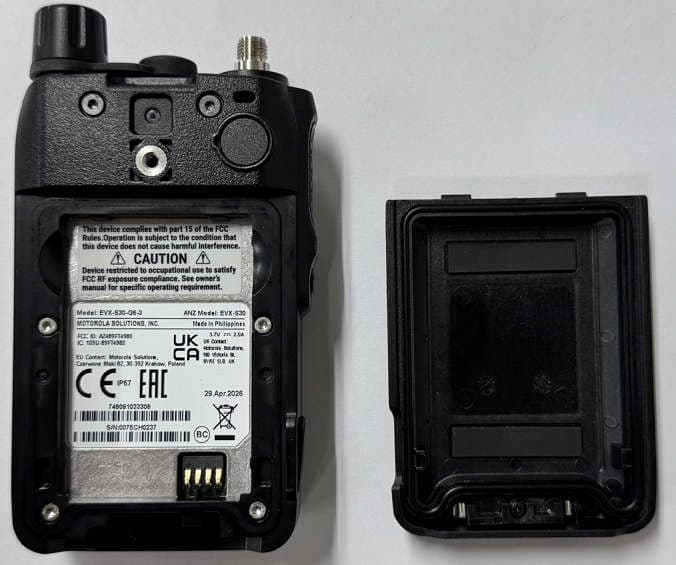
AZ489FT4980
Sep 08, 2026Portable two way radio
Equipment Class
TNF - Licensed Non-Broadcast Transmitter Held to FaceAZ489FT4981
Aug 14, 2026Handheld Portable - TANAPA BPR 45 400-470 MHZ 4W NKP
Equipment Class
TNF - Licensed Non-Broadcast Transmitter Held to Face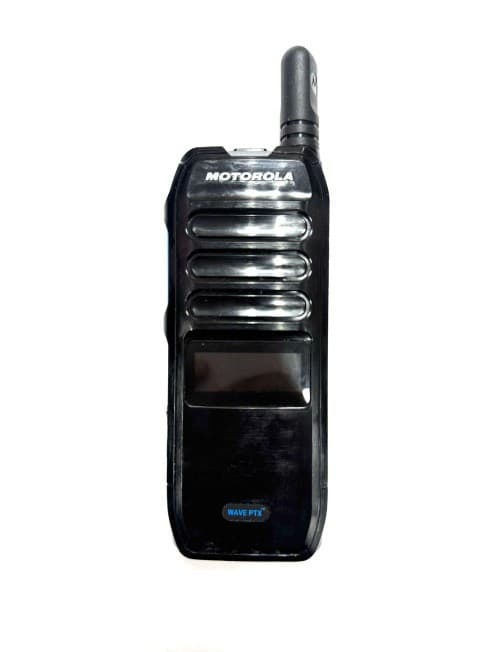
AZ489FT7187
Jul 13, 2026Portable 2-Way Radio with Bluetooth, Bluetooth LE, WIFI 2.4GHz, WIFI 5GHz, LTE
Equipment Class
DSS - Part 15 Spread Spectrum TransmitterAZ499FT6031
May 11, 2026Operation Critical Wireless Earpiece PTT
Equipment Class
DSS - Part 15 Spread Spectrum Transmitter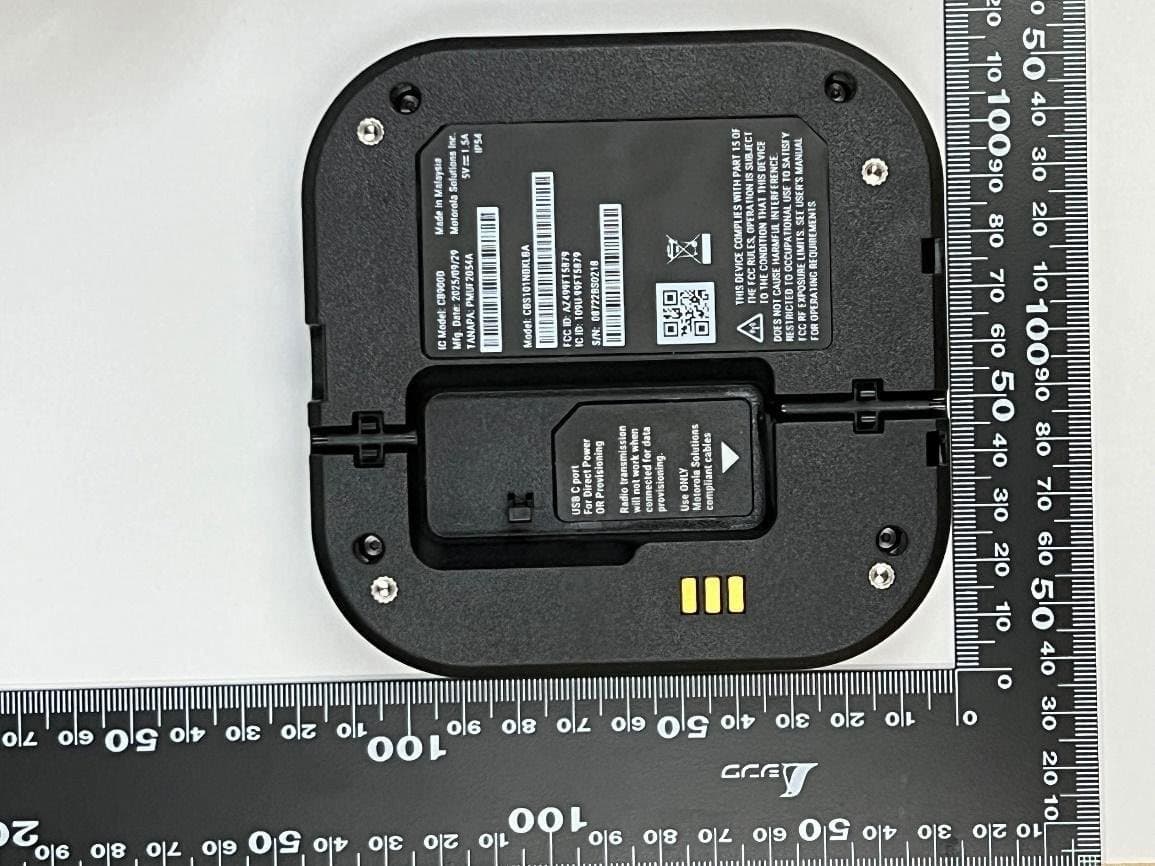
AZ499FT5879
Dec 19, 20252-way Portable Radio with BT, BTLE, WIFI, NFC and LTE
Equipment Class
DSS - Part 15 Spread Spectrum Transmitter