AZ489FT5838iDEN i605
Motorola Solutions, Inc.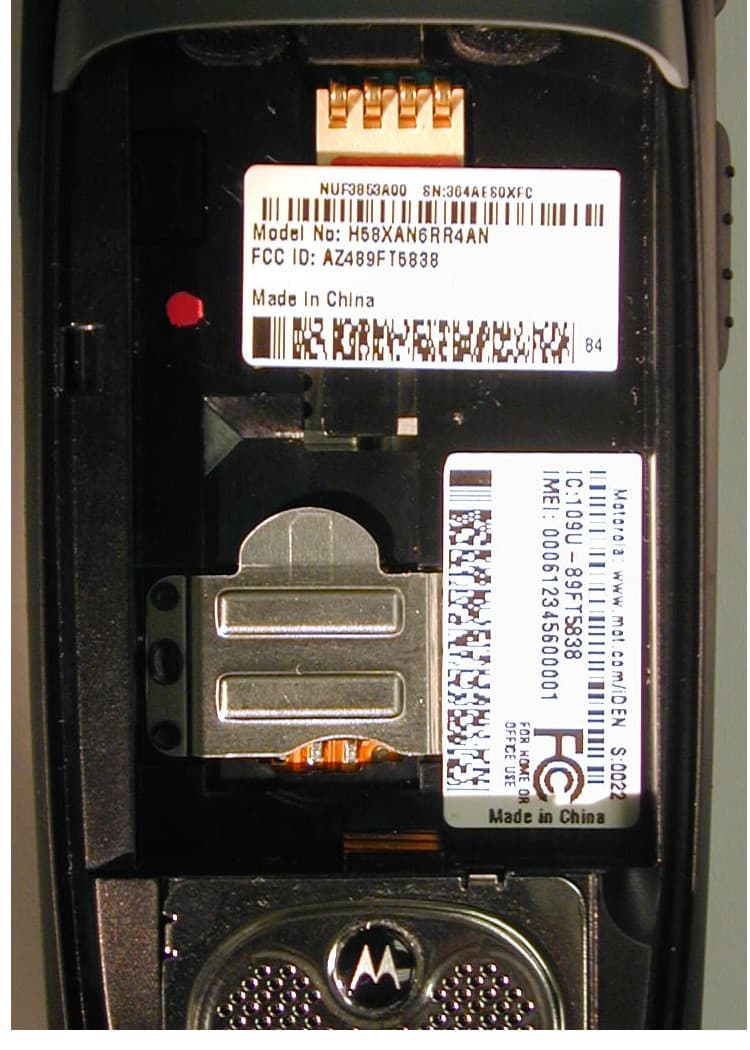
Click to zoom
Application Details
- Equipment Class
- DSS - Part 15 Spread Spectrum Transmitter
- Date of Grant
- Oct 31, 2004
- Application Purpose
- Original Equipment
- Date of Application
- Oct 31, 2004
- Equipment Note
- iDEN i605
- Frequency Range
- 2402.00000000 - 2480.00000000
- Company
- Motorola Solutions, Inc.
- Country
- United States
Documents & Files
Document Text
Text extracted from the exhibit documents filed with the FCC. Open a document above to read the original.
Users Manual
Motorola iDEN Digital Multi-service Data-capable Phone i 605 Phone User’s Guide APPROVAL DRAFT @NNTN6007A@NNTN6007A i ContentsGetting Started........................................... 1 Locating Your SIM Card ....................................2Battery ...............................................................3Activating Service ..............................................5Powering On and Off.........................................6Enabling Over-the-Air Security..........................6Phone Programming .........................................7Finding Your Phone Number and Private ID .....7Phone Basics ....................................................7SIM Card Security ...........................................12Antenna ...........................................................15Accessories .....................................................16For More Information .......................................16 Making Calls ............................................. 17 Phone Calls .....................................................17Private Calls ....................................................17Receiving Calls................................................17Choosing a Number to Call .............................18Missed Phone Calls.........................................19 Using Speakerphone.......................................19Using Mute ......................................................20Making Emergency Phone Calls .....................20 Call Alerts..................................................21 Sending Call Alerts..........................................21Receiving Call Alerts .......................................21Using the Call Alert Queue..............................21 Recent Calls ..............................................23 Calls and Call Alerts ........................................23My Info From Other Phones ............................23Contact Information From Other Phones ........24Viewing the Recent Calls List..........................24Storing Items to Contacts ................................25Deleting Items .................................................25Making Calls From the Recent Calls List ........25 Contacts ....................................................27 Accessing Contacts.........................................28Creating Entries ..............................................28Storing Numbers From the Idle Screen...........30Editing Entries .................................................30 ii Viewing Entries................................................31Deleting Entries ...............................................33Checking Capacity ..........................................33Creating Pauses and Waits.............................33International Numbers .....................................34Making Calls From Contacts ...........................34Accessing Contacts with GSM Phones ...........35 Call Forwarding........................................ 36 Forwarding All Calls ........................................36Turning Off Call Forwarding ............................36Forwarding Missed Calls .................................37Viewing Call Forwarding Settings....................37 Advanced Calling Features..................... 38 Call Waiting .....................................................38Switching Between Calls .................................38Putting a Call on Hold......................................39Calling 2 People ..............................................39Creating Pauses and Waits While Dialing.......40Making International Calls ...............................40One Touch PTT ...............................................40Call Timers ......................................................41 Using Your Phone as a Modem ......................42Making TTY Calls ............................................43 Group Calls and Selective Dynamic Group Calls ...........................46Group Calls .....................................................46Selective Dynamic Group (SDG) Calls ...........47 Memo .........................................................53Ring Tones ................................................54 Setting Your Phone to Vibrate.........................54Ring and Vibrate .............................................55Assigning Ring Tones to Contacts ..................55Viewing Ring Tone Assignments ....................55Downloading More Ring Tones .......................56Managing Memory ..........................................56Deleting Custom Ring Tones ..........................56About DRM Items ............................................56 Entering Text ............................................57 Using Word Mode ...........................................57Special Function Keys.....................................58 iii Messages ................................................. 59 Message Notifications .....................................59Message Center ..............................................60 Voice Mail Messages ............................... 61 Receiving a Message ......................................61Accessing Voice Mail From the Message Center ...................................61 Sending Unanswered Calls to Voice Mail ...................................................61 MOSMS Messages ................................... 62 Setting Up........................................................62Receiving a Message ......................................62Reading from the Message Center .................63Creating and Sending Messages ....................63Sorting Messages............................................66Managing Memory...........................................66 Media Center ............................................ 67 Viewing the Media Center ...............................67Forward Locked Items.....................................68DRM Items ......................................................69Pictures ..........…
Text truncated - open the document above for the full version.
Cover Letter(s)
Applicant: Motorola Inc FCC ID: AZ489FT5838 iDEN, Motorola Inc., 8000 W. Sunrise Blvd., Plantation, FL 33322 www.mot.com/iDEN Page: 13- 1 29 th October 2004 Authorization & Evaluation Division Federal Communications Commission Laboratory 7435 Oakland Mills Road Columbia, MD 21046 Subject: Application for Certification of transmitter with FCC ID: AZ489FT5838. Gentlemen; Motorola Inc., 8000 West Sunrise Boulevard, Fort Lauderdale, Florida 33322, herein submits its application for Certification of the transmitter with FCC ID: AZ489FT5838. This variable output power (0.062 to 640 milliWatts) transmitter is part of a handheld transceiver used in a SMR and EA SMR trunking system operating in the United States 806-821/851-866MHz and 896- 901/935-940 MHz frequency band. Certification is sought for this transceiver, and performance data is provided for that purpose. This transceiver is of the receive-first type described in International Telecommunications Union Recommendation ITU-R M.1221 entitled Technical and Operational Requirements for Cellular Multimode Mobile Radio Stations. It must first find, acquire and lock onto a control channel from a predefined set of control channel frequencies assigned to a companion Authorized base station (e.g. – FCC ID: ABZ89FC5794). Transmission is not possible until lock to a base station control channel has been achieved, then transmission is limited to digitally modulated service request bursts on the reverse control channel. Upon recognition of a proper request, the control channel base station transmitter will then assign the transceiver a traffic channel for transmission of digital voice or circuit-switched data from the set of frequencies for which the trunking system is licensed. Attached Exhibit 12.1 provides additional descriptive details. It is expected that this handheld time division multiplexed transceiver marketed in the United States will also be used for itinerant operation with companion Authorized Base Stations by users requesting trunked radio and telephone interconnect service while roaming outside the United States. In some countries the companion base stations are licensed to operate at frequencies in the 821-825/866-870 MHz band in addition to some of those in the 806-821/851- 866 MHz band normally used in United States SMR systems. Consequently, this transmitter has been designed to meet FCC requirements for operation in the 806-821 MHz band over the more global band of 806 - 825 MHz when used with a companion Authorized Base Station. Thus, performance data is provided to substantiate FCC compliant operation with a Companion Base Station over the broader 806 to 825 MHz band expected for global use of this handheld transceiver. Applicant: Motorola Inc FCC ID: AZ489FT5838 iDEN, Motorola Inc., 8000 W. Sunrise Blvd., Plantation, FL 33322 www.mot.com/iDEN Page: 13- 2 To facilitate global roaming it is kindly requested that a note be provided in the Grant for Equipment Authorization, which states that this ‘receive first’ type of equipment is compliant for transmitter operation over the broader range 806-825 MHz when used with a compatible Authorized Base Station. This will aid equipment authorization in foreign countries, which accept a United States FCC Grant for Equipment Authorization, yet not jeopardize United States public safety or cellular systems licensed to operate in the 821-825 MHz frequency band since no compatible base station may be authorized on those frequencies in the United States. It is also expected that this transceiver type will be marketed outside the United States and brought into the United States for itinerant “roaming” operation on compatible 806 - 821 MHz base stations located within the United States. Consequently, upon receipt of Authorization, only those units of this equipment type authorized for marketing in countries outside the United States will also bear a label with the specified FCC identifier. In accordance with 47 CFR 2.1093(c) this transmitter may be used in “covered” SMR service so it has been subjected to routine environmental evaluation for RF exposure and found to be compliant with the limits specified in 47 CFR 2.1093(d)(2). The subject transmitter complies with 47 CFR 90.203 of the rules in that the operator cannot directly program transmit frequencies using only the unit's normally accessible external controls. This transceiver can function as a Part 15.3(r) computer peripheral device when functioning as an RF modem when connected to a computer via a data cable (ref: Exhibit 12.1). For this reason a Declaration of Conformity has been prepared and is provided on Page VI of the user Manual in the Exhibit 8. A Bluetooth (BT) antenna of CLASS 2 type device of rated power +4 to –6 dBm, with a typical of 0 dBm is implemented on the back side, lower corner of the board on the PTT side of the phone. This was done to separate the Bluetooth antenna as much as possible from the other antennas of the phone (which are at the top, right side of the phone). BT supports both voice and data for short range wireless communications. BT Band of Operation is 2.4 - 2.4835 GHz (1MHz channel bandwidth). The BT device was test at TIMCO Engineering Lab at Newberry, FL 32669 and it complies 15.247 (c), 15.205 and 15.209 (b). Enclosed is a complete Certification Application comprised of 12 Exhibits. Contact me at (954) 723-5793 if you require any additional information. Regards, /s/ Mike Ramnath (signed) Manager, Regulatory Compliance Email: [email protected]
Cover Letter(s)
FCC ID: AZ489FT5838 ______________________________________________________________________________ iDEN, Motorola Inc , 8000 West Sunrise Boulevard, Fort Lauderdale, Florida 33322. CONFIDENTIALITY REQUESTED Date: 29 th October 2004 Authorization & Evaluation Division Federal Communications Commission Laboratory 7435 Oakland Mills Road Columbia, MD 21046 Subject: Confidentiality Request for Transmitter with FCC ID: AZ489FT5838. Dear Sir or Madam: Motorola is requesting that Exhibit 4 (Circuit Descriptions), Exhibit 5 (Schematic Diagrams), Exhibit 10 (Parts List and Tune-Up Procedures), and Exhibit 12 (Operational Description) not be made routinely available for public inspection. Motorola considers the information in these exhibits to be classified as trade secrets, pursuant to 47 CFR Section 0.457(d) and Section 552(b)(4) of the Freedom of Information Act. We are also requesting that the FCC mark Exhibit 3 (External Photos) and Exhibit 9, (Internal Photos) as Temporary Confidentiality as outlined in Public Notice DA 04-1705, dated June 15, 2004. This provision will give Motorola temporary confidentiality prior to product launch. Please mark Exhibits 4, 5, 10, and 12 as “Confidential” And Exhibit 3 and 9 as “Temporary Confidential”. Please contact me if you require any additional information. Sincerely, /s/ Mike Ramnath (signed) Manager, Regulatory Compliance Tel: (954) 723-5793 E-mail: [email protected] EXHIBIT 13b
External Photos
FCC Filing Package for Motorola i605 Transceiver FCC ID: AZ489FT5838 IDEN, Motorola Inc., 8000 W. Sunrise Blvd., Plantation, FL 33322, USA WWW.MOT.COM/iDEN Page: 3 - 1 Exhibit 3. External Photographs -- Pursuant to 47 CFR 2.1033(c) 12 The radio product shapes, colors, Graphics and housing/bezel styling may vary. Photograph 3-1: Front view, antenna retracted. Photograph 3-2: Back view, antenna retracted, battery cover attached. FCC Filing Package for Motorola i605 Transceiver FCC ID: AZ489FT5838 IDEN, Motorola Inc., 8000 W. Sunrise Blvd., Plantation, FL 33322, USA WWW.MOT.COM/iDEN Page: 3 - 2 Photograph 3-3: Front view, antenna extended. Photograph 3-4: Back view, antenna extended. FCC Filing Package for Motorola i605 Transceiver FCC ID: AZ489FT5838 IDEN, Motorola Inc., 8000 W. Sunrise Blvd., Plantation, FL 33322, USA WWW.MOT.COM/iDEN Page: 3 - 3 Photograph 3-5: Button side view, antenna retracted. Photograph 3-6: Antenna side view, antenna retracted. FCC Filing Package for Motorola i605 Transceiver FCC ID: AZ489FT5838 IDEN, Motorola Inc., 8000 W. Sunrise Blvd., Plantation, FL 33322, USA WWW.MOT.COM/iDEN Page: 3 - 4 Photograph 3-7: Button side view, antenna extended. Photograph 3-8: Antenna side view, antenna extended. FCC Filing Package for Motorola i605 Transceiver FCC ID: AZ489FT5838 IDEN, Motorola Inc., 8000 W. Sunrise Blvd., Plantation, FL 33322, USA WWW.MOT.COM/iDEN Page: 3 - 5 Photograph 3.9: Location of label on back of unit’s housing (battery cover removed). Photograph 3.10: Zoom view of labels containing FCC ID and FCC Logo.
Internal Photos
FCC Filing Package for Motorola i605 Transceiver FCC ID: AZ489FT5838 IDEN, Motorola Inc., 8000 W. Sunrise Blvd., Plantation, FL 33322, USA WWW.MOT.COM/iDEN Page: 9 - 1 Exhibit 9. Internal Photographs -- Pursuant to 47 CFR 2.1033(c) 12 Temporary Confidentiality Requested Photograph 9-1: Back side view of radio product PCB. Photograph 9-2: Back side view of radio PCB without shields FCC Filing Package for Motorola i605 Transceiver FCC ID: AZ489FT5838 IDEN, Motorola Inc., 8000 W. Sunrise Blvd., Plantation, FL 33322, USA WWW.MOT.COM/iDEN Page: 9 - 2 Photograph 9.3: Front side view of keyboard. Photograph 9-4: Front side view of radio PCB.
Operational Description
FCC Filing Package for Motorola i605 Transceiver FCC ID: AZ489FT5838 IDEN, Motorola Inc., 8000 W. Sunrise Blvd., Plantation, FL 33322, USA WWW.MOT.COM/iDEN Page: 12- 1 Confidentiality Requested Exhibit 12. Transmitter Description -- Pursuant 47 CFR 2.1033(c) 12.1 Transmitter Technical Characteristics --2.1033(c) 4, 5, 6, 7, 8 This handheld trunked TDM radio transceiver is of the receive first type, meaning it must first find, acquire and lock onto a control channel from a predefined set of control channel frequencies assigned to a compatible base station. Transmission is inhibited until control channel acquisition and lock has been achieved, then it is limited to transmission of service request bursts on the digitally modulated reverse control channel. Upon recognition of a proper request, the control channel base station transmitter will then assign the transceiver a traffic channel for transmission of digital voice, circuit-switched data, or packet-switched data from the set of frequencies for which the trunking system is licensed. The technical capability of the transceiver exceeds FCC emissions requirements for the 806 – 821 and 896 – 901 MHz range for which companion base stations are authorized in the United States. It is expected that this handheld transceiver marketed in the United States will also be used for itinerant roaming operation outside the United States with companion base stations that may operate anywhere within the broader frequency range the 806 – 825 and 896 – 901 MHz. It is also expected that this transceiver type will be marketed outside the United States and brought into the United States for itinerant “roaming” operation on compatible the 806 – 821 and 896 – 901 MHz base stations located in the United States. Thus performance data is provided to substantiate FCC compliant operation with a companion base station over the broader international the 806 – 825 and 896 – 901 MHz band expected in use of this handheld transceiver outside the United States. When the transceiver is operating in the 896-901 MHz frequencies, the transceiver will be operated on frequencies midway between those of the channels given in table 4B of 47CFR90.617(d). The trunking system basic protocol uses a 90ms frame divided into six 15 ms time slots. The base station allocates the number of 15 ms time division multiplex (TDM) time slots in which the transceiver transmits that depend on the user requested transmission mode. Packet data transmission uses 15ms time slots in a 1.8 second frame. These slot allocations are summarized in Table 12-1. In addition to controlling the assigned frequency to which the transceiver will be slaved, the compatible base station frequency serves as an accurate, stable reference for the transceiver local reference oscillator by virtue of a transceiver AFC function inherent in the acquisition and lock process. The RF output power of the transceiver also is dynamically controlled by the radio, which senses the received signal strength and adjusts transmitter output power in approximately 1dB steps over the range from rated power to 39 dB cutback. FCC Filing Package for Motorola i605 Transceiver FCC ID: AZ489FT5838 IDEN, Motorola Inc., 8000 W. Sunrise Blvd., Plantation, FL 33322, USA WWW.MOT.COM/iDEN Page: 12- 2 Transmission Service Mode Time Slots Allocated Modulation 1.) Dispatch (push-to-talk) One 15 ms slot Quad-16MQAM 2.) Telephone Interconnect One or two 15 ms slots, (or 2 half 15 ms slots) ## (Service provider selectable) Quad-16MQAM 3.) Circuit-Switched Data* Two 15 ms slots Quad-4MQAM, Quad- 16MQAM, Quad-64MQAM 4.) Packet-Switched Data* # One to six 15 ms slots in any particular frame (up to a maximum of 81 slots in 20 contiguous frames) Quad-4MQAM, Quad- 16MQAM, Quad-64MQAM Table 12-1: TDM Time Slot Allocation * via a buffered serial port at an input rate of 115.2 Kbps maximum for RS-232 cable or a maximum of 12,000 Kbps for USB cable. * # via an internal world wide Web browser. ## Split 3:1 TDM interleaving format 12.1.1 800 MHz Band Operation: A. Output Power 0.135 to 640 milliWatts (Pulse average) B. Maximum Antenna Gain -1.5 dBd C. Maximum ERP 454.5 milliWatts (Pulse average) D. Frequency Range 806-825 MHz** E. Frequency Stability ≤ 0.4PM * F. Emission Designator 18K3D7W G. Spurious Emissions < -15 dBm H. Maximum DC Voltage and 4.0V in transmit slot # Current during a transmit slot <1.214 A in transmit slot # (at nominal battery voltage) 12.1.2 900 MHz Band Operation: A. Output Power 0.142 to 640 milliWatts (Pulse average) B. Maximum Antenna Gain 0.4 dBd C. Maximum ERP 695.2 milliWatts (Pulse average) D. Frequency Range 896 – 901 MHz** E. Frequency Stability ≤ 0.4 PPM * F. Emission Designator 18K3D7W G. Spurious Emissions < -15 dBm H. Maximum DC Voltage and 4.0 V in transmit slot # Current into the final RF <1.118 A in transmit slot # Amplifier stage (at nominal Battery voltage) ** See Exhibit 12.1 * See Exhibit 6e # See Exhibit 6.1.3 FCC Filing Package for Motorola i605 Transceiver FCC ID: AZ489FT5838 IDEN, Motorola Inc., 8000 W. Sunrise Blvd., Plantation, FL 33322, USA WWW.MOT.COM/iDEN Page: 12- 3 12.2 Bluetooth Application The i605 is a monolith product based on the i860 and is the first iDEN Bluetooth enabled handset. Bluetooth is used for short range wireless communications that do not require high data rates. The pico-net is the term used for a connection between a “master” and one or more “slaves”. The “master” sets up and maintains the pico-net that the “slaves” are part of. A pico-net has a maximum of 7 “slaves” and only one “master”. Members of a pico-net typically are not shared between pico-nets. The sharing of members can be done (called “scatter-net”) but will not be supported by our implementation. At this time, the i605 project will only support a “point to point” connection (only one slave at a time). There are two different types of links: Asynchronous Connection-Less (ACL) and Synchronous Connection Oriented (SCO). The ACL is used fo…
Text truncated - open the document above for the full version.
RF Exposure Info
Certificate Number: 1449-01 CGISS EME Form-SAR-Rpt-Rev. 3.00 Page 1 of 28 CGISS EME Test Laboratory 8000 West Sunrise Blvd Fort Lauderdale, FL. 33322 S.A.R. EME Compliance Test Report Part 1 of 2 Note: This report shall not be reproduced without written approval from an officially designated representative of the Motorola EME Laboratory. Based on the information and the testing results provided herein, the undersigned certifies that when used as stated in the operating instructions supplied, said product complies with the national and international reference standards and guidelines listed in section 2.0 of this report. “Signature on file” 10/15/04 ____________________________________________________________ _________________________ Ken Enger Date Approved Senior Resource Manager, Laboratory Director, CGISS EME Lab Date of Report: October 14, 2004 Report Revision: Rev. O Manufacturer: Motorola Product Description: iDEN i605; 1:6, 1:3, 81:120, 1:12 TDMA; 64 QAM, 16 QAM & QPSK Modulation; 0.6 W Pulse average; GPS and Bluetooth capable FCC ID: AZ489FT5838 Device Model: H58XAN6RR4AN/NUF3853A Test Period: 9/22/04 – 10/6/04 Technician: Clint Miller (EME Technician Electronics II) Responsible Eng: Jim Fortier (Elect. Principle Staff Eng.) Author: Michael Sailsman (Global EME Regulatory Affairs Liaison) Certificate Number: 1449-01 CGISS EME Form-SAR-Rpt-Rev. 3.00 Page 2 of 28 TABLE OF CONTENTS Part 1 of 2 1.0 Introduction 2.0 Reference Standards and Guidelines 3.0 Description of Test Sample 3.1 Test Signal 3.2 Test Output Power 4.0 Description of Test Equipment 4.1 Description of S.A.R Measurement System 4.2 Description of Phantom 4.2.1 Flat Phantom 4.2.2 SAM phantom 4.3 Simulated Tissue Properties 4.3.1 Type of Simulated Tissue 4.3.2 Simulated Tissue Composition 4.4 Test conditions 5.0 Probe Scan Procedures 5.1 Shortened scan rationale 5.2 Description of Test Procedure 5.3 Device Test Positions 5.3.1 Body 5.3.2 Head 5.3.3 Face 5.4 Test Position Photographs 6.0 Measurement Uncertainty 7.0 S.A.R. Test Results 7.1 S.A.R. results 7.2 Peak S.A.R. location 7.3 Highest S.A.R. results calculation methodology 8.0 Conclusion Part 2 of 2 Appendix A: Power Slump Data/Shortened scan Appendix B: Data Results Appendix C: Dipole System Performance Check Results Appendix D: Probe/Dipole Calibration Certificates Appendix E: Illustration of Body-worn Accessories Appendix F: Accessories and options test status and separation distances Certificate Number: 1449-01 CGISS EME Form-SAR-Rpt-Rev. 3.00 Page 3 of 28 REVISION HISTORY Date Revision Comments 10/14/04 O Release of Prototype results Certificate Number: 1449-01 CGISS EME Form-SAR-Rpt-Rev. 3.00 Page 4 of 28 1.0 Introduction This report details the utilization, test setup, test equipment, and test results of the Specific Absorption Rate (S.A.R.) measurements performed at the CGISS EME Test Lab for model number H58XAN6RR4AN/NUF3853A, FCC ID: AZ489FT5838. The applicable exposure environment is General Population/Uncontrolled. 2.0 Reference Standards and Guidelines This product is designed to comply with the following national and international standards and guidelines. • United States Federal Communications Commission, Code of Federal Regulations; 47CFR part 2 sub-part J • IEEE 1528, 2003 "Recommended Practice for Determining the Peak Spatial-Average Specific Absorption Rate (SAR) in the Human Head from Wireless Communications Devices: Measurement Techniques" • American National Standards Institute (ANSI) / Institute of Electrical and Electronic Engi- neers (IEEE) C95. 1-1992 • Institute of Electrical and Electronic Engineers (IEEE) C95.1-1999 Edition • International Commission on Non-Ionizing Radiation Protection (ICNIRP) 1998 • Ministry of Health (Canada) Safety Code 6. Limits of Human Exposure to Terminal frequency Electromagnetic Fields in the Frequency Range from 3 kHz to 300 GHz, 1999 • Australian Communications Authority Radiocommunications (Electromagnetic Radiation - Human Exposure) Standard 2003 • ANATEL, Brazil Regulatory Authority, Resolution No. 303 of July 2, 2002 "Regulation of the limitation of exposure to electrical, magnetic, and electromagnetic fields in the radio frequency range between 9KHz and 300 GHz." and “Attachment to resolution # 303 from July 2, 2002” Certificate Number: 1449-01 CGISS EME Form-SAR-Rpt-Rev. 3.00 Page 5 of 28 3.0 Description of Test Sample (Horizontal and vertical reference lines intersecting at the acoustic output are marked on the DUT) FCC ID: AZ489FT5838 is a digital multi-service data capable device that employs time division multiplexing transmission technology with a duty cycle ranging from 16.67% to 33.33% using M16- QAM modulation for voice or circuit data transmission. There is a Split 1:3 mode that operates using a 16.67% transmission duty cycle. Two 7.5ms pulses occur during the six time slots within the 90-msec frame format. This mode is available in both the 806-825MHz and 896-902MHz bands in the telephone interconnect mode only. Packet data transmission is supported up to a maximum duty cycle of 67.5% using quad QPSK modulation. 12:1 mode is intended as a future software change which will be a 6:1 split mode used in PTT applications. This device incorporates a class II Bluetooth transceiver. The Bluetooth operation is governed by 47 CFR 15.247 and employs digital modulation with frequency hopping spread spectrum techniques. This device will be marketed to and used by the general population. This device may be used while held against the head in voice mode, in front of the face in PTT mode, and against the body in voice, PTT and data modes. FCC ID: AZ489FT5838 is capable of operating in the 806-825 MHz and 896-902MHz bands. Packet data transmission is not available while transmitting in the 896-902 MHz band. Bluetooth operates in the 2.400-2.4835 GHz band. The rated power is 0.60 watts pulse average in 806-825MHz and 896-902MHz bands and 1mW in the Bluetooth band. The maximum output is 0.64 watts pulse average…
Text truncated - open the document above for the full version.
RF Exposure Info
Certificate Number: 1449-01 CGISS EME Form-SAR-Rpt-Rev. 3.00 Page 1 of 44 CGISS EME Test Laboratory 8000 West Sunrise Blvd Fort Lauderdale, FL. 33322 S.A.R. EME Compliance Test Report Part 2 of 2 Note: This report shall not be reproduced without written approval from an officially designated representative of the Motorola EME Laboratory. Based on the information and the testing results provided herein, the undersigned certifies that when used as stated in the operating instructions supplied, said product complies with the national and international reference standards and guidelines listed in section 2.0 of this report. “Signature on file” 10/15/04 ____________________________________________________________ _________________________ Ken Enger Date Approved Senior Resource Manager, Laboratory Director, CGISS EME Lab Date of Report: October 14, 2004 Report Revision: Rev. O Manufacturer: Motorola Product Description: iDEN i605; 1:6, 1:3, 81:120, 1:12 TDMA; 64 QAM, 16 QAM & QPSK Modulation; 0.6 W Pulse average; GPS and Bluetooth capable FCC ID: AZ489FT5838 Device Model: H58XAN6RR4AN/NUF3853A Test Period: 9/22/04 – 10/6/04 Technician: Clint Miller (EME Technician Electronics II) Responsible Eng: Jim Fortier (Elect. Principle Staff Eng.) Author: Michael Sailsman (Global EME Regulatory Affairs Liaison) Certificate Number: 1449-01 CGISS EME Form-SAR-Rpt-Rev. 3.00 Page 2 of 44 APPENDIX A Power Slump Data/Shortened Scan Certificate Number: 1449-01 CGISS EME Form-SAR-Rpt-Rev. 3.00 Page 3 of 44 DUT Power versus time data Certificate Number: 1449-01 CGISS EME Form-SAR-Rpt-Rev. 3.00 Page 4 of 44 Shortened Scan Results FCC ID: AZ489FT5838; Test Date: 10/6/04 Motorola CGISS EME Laboratory Run #: REAR-R3-041006-06 Model #: H58XAN6RR4AN/NUF3853A SN: 364AES0499 TX Freq: 896.01875 MHz Sim Tissue Temp: 21.7 (Celsius) Start Power: 0.667 W Antenna: In Battery Kit: SNN5705C Carry Accy: NONE Audio/Data Acc.: NONE Shortened scan reflect highest S.A.R. producing configuration; Run time 11 minutes. Representative “normal” scan run time was 20 minutes “Shortened” scan max calculated S.A.R. using S.A.R. drift: 1-g Avg. = 1.20mW/g; 10-g Avg. = 0.84mW/g “Normal” scan max calculated S.A.R. using S.A.R. drift: 1-g Avg. = 1.25mW/g; 10-g Avg. = 0.88mW/g (see section 7.1 run # CM-REAR-R3-041001-05) DUT at right ear in cheek touch position SAM - Expanded (new) Phantom; Right Hand Section; Position: (90°,301°); Probe: ET3DV6 - SN1383(Cal Date 25 Feb 2004); ConvF(6.30,6.30,6.30); Probe cal date: 25/2/04; Crest factor: 3.0; IEEE Head 899 MHz: σ = 1.00 mho/m εr = 40.3 ρ = 1.00 g/cm3; DAE3: 401V1 DAE Cal Date: 8/25/2004 Cube 5x5x7: SAR (1g): 1.20 mW/g, SAR (10g): 0.844 mW/g, (Worst-case extrapolation) Cube 5x5x7: Dx = 8.0, Dy = 8.0, Dz = 5.0; SAR (1g): 1.20 mW/g, SAR (10g): 0.844 mW/g Powerdrift: 0.26 dB C…
Text truncated - open the document above for the full version.
Contact Information
Applicant
Arine Lee(Certification Manager)
Test Firm
MotorolaWilliam Elliott
Technical Specifications
| # | Rule Parts | Frequency Range | Power Output |
|---|---|---|---|
| 1 | 15C | 2.40 GHz - 2.48 GHz | 2.50 mW |
Other Applications from Motorola Solutions, Inc.
AZ489FT4980
Sep 08, 2026Portable two way radio
Equipment Class
TNF - Licensed Non-Broadcast Transmitter Held to FaceAZ489FT4981
Aug 14, 2026Handheld Portable - TANAPA BPR 45 400-470 MHZ 4W NKP
Equipment Class
TNF - Licensed Non-Broadcast Transmitter Held to Face
AZ489FT7187
Jul 13, 2026Portable 2-Way Radio with Bluetooth, Bluetooth LE, WIFI 2.4GHz, WIFI 5GHz, LTE
Equipment Class
DSS - Part 15 Spread Spectrum TransmitterAZ499FT6031
May 11, 2026Operation Critical Wireless Earpiece PTT
Equipment Class
DSS - Part 15 Spread Spectrum Transmitter
AZ499FT5879
Dec 19, 20252-way Portable Radio with BT, BTLE, WIFI, NFC and LTE
Equipment Class
DSS - Part 15 Spread Spectrum Transmitter