AZ489FT7031Voice Over WLAN Phone with Bluetooth
Motorola Solutions, Inc.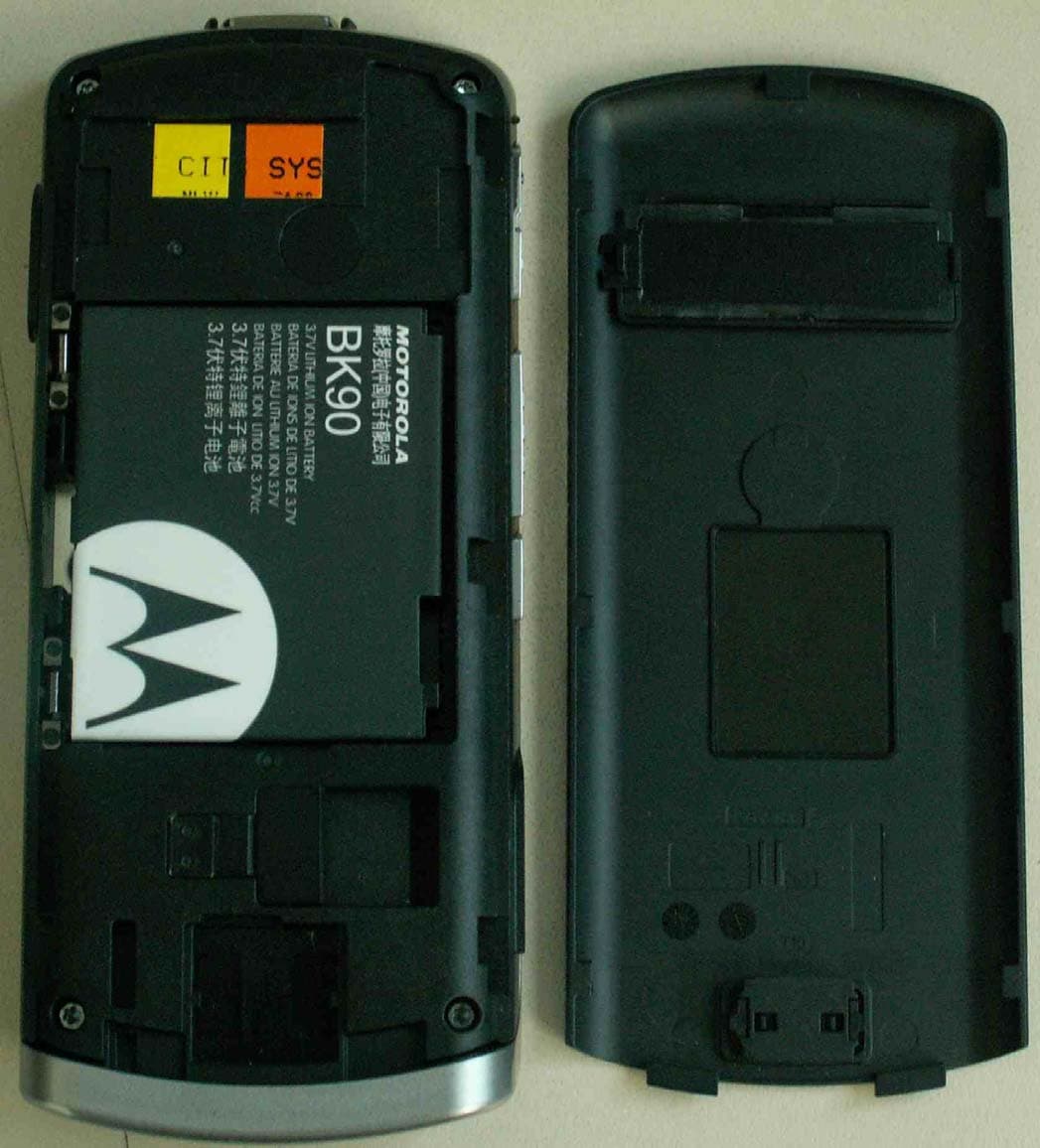
Click to zoom
Application Details
- Equipment Class
- NII - Unlicensed National Information Infrastructure TX
- Date of Grant
- Mar 11, 2008
- Application Purpose
- Original Equipment
- Date of Application
- Mar 11, 2008
- Equipment Note
- Voice Over WLAN Phone with Bluetooth
- Frequency Range
- 5745.00000000 - 5805.00000000
- Company
- Motorola Solutions, Inc.
- Country
- United States
Documents & Files
Document Text
Text extracted from the exhibit documents filed with the FCC. Open a document above to read the original.
Users Manual
about this guideThis guide introduces you to the operation and features of your new handset. It’s divided into ten main sections: Throughout this guide, you will find tips that highlight special shortcuts and timely reminders to help you make the most of your new phone and service. The Table of Contents and Index also help you quickly locate specific information. You will get the most out of your handset if you read each section. To get right to a specific feature, simply locate that section in the Table of Contents and go directly to that page. Follow the instructions in that section and you will swiftly be ready to use your handset. • Section 1: “essentials” • Section 2: “tips & tricks” • Section 3: “basics” • Section 4: “customize” • Section 5: “managing calls” • Section 6: “e-mail & messages” • Section 7: “connections” • Section 8: “entertainment” • Section 9: “other features” • Section 10: “troubleshooting” 1 basic handset featuresTechnology promised to make your work environment easier... but then it gave you more to do—phone calls, e-mails, schedules, messaging, managing of documents, the Internet, and more features. It’s time to take back control. It is time to meet the Normandy Handset. Your handset includes: Smartphone with voice recognition for hands-free dialing, Walkie-talkie call button for dispatch and private calls (including private talkgroups), Two way SMS and Instant Text Messaging , Email , Contacts , Calendar , Tasks etc. - including viewing mail attachments and many other built-in tools to help you manage your busy work style. Normandy also includes access to your enterprise applications, standard mobile internet browser, and the ability to pair with Bluetooth headsets and other Bluetooth devices such as personal computers.The Normandy handset is available in two models; the ruggedized and the office models. Both modelss have identical functional and operation features and differ slightly by shape. The handset is designed to work only within the wireless network coverage of your enterprise environment.This manual covers the basic and advanced operations of your handset. Inclusive understanding of your Windows applications can be fully achieved by referring to Microsoft® Windows® Mobile 6.1 documentation and on-screen help. 2Introducing your new wireless LAN Normandy handset ! Here is a quick anatomy lesson. 12 3 4 56 7 89 0 * # _,@ GHI PQRS + TUVJKL ABC DEF MNO WXYZ X Home key Hold to open a quick list of options ( S ) Navigation key Navigate menus a Speaker key Press & hold for Voice Recognition or switch to speakerphone during a call. Left soft key Right soft key Call/Answer key Make & answer calls s Center key Select highlighted items O Power/End key Turn on & off, hang up, exit menus. Back key Microphone Speakerphone &Audio/PT T Jack Lanyard attach point Charger contac t (ruggedized handset only ) Display light sensor Ear piece P rotective rubber suit (ruggedized handset only) 3 To avoid damaging your handset, carry it in an approved holster or case rather than a pocket, purse, or bag. Volum e up/down keys (See page 33) PTT walkie-talkie button (See page 22) Programmable key (See page 79) ID label window Battery door release (See page 16) R Mini USB port Charge battery & connect handset to accessories Holster latches (ruggedized handset only) 4From the Home screen, select the Status, Programs or Callers screen. 12 3 4 56 7 89 0 * # _,@ GHI PQRS + TUVJKL ABC DEF MNO WXYZ Programs Callers 3 2 14 Profile: Silent Tomorrow: Jack design review 1:00 - 3:30PM (Park Av 2002) Start Contacts Status Phone: on 11:00 pmThu 27 12 3 4 56 7 89 0 * # _,@ GHI PQRS + TUVJKL ABC DEF MNO WXYZ Programs Callers Status 1 Calendar2 Contacts3 Call History4 Settings5 Messaging H ptt Programs Callers Status Adam SmithAlexandra Brown(057) 184-9622Marketing GroupMacy Sall HH W hH h h 5 . Press the left /right soft keys to open the screen menus. The menu label of the soft key is displayed at the bottom of the screen. 1 . Press and hold the Power key O to turn on your headset. 2 . Press the Navigation key - up, down, left, or right ( S ) to highlight a menu feature. 3 . Press the Center key s to select the highlighted feature. Tip: Press the Back key to go back one menu. Press the Power key O to exit any menu or view without saving changes. At any time, press the Home key X to return to the Home screen. Home Screen Programs Screen 4 . Use the Navigation key ( S ) to explore today’s status screen, your recently used programs and the incoming calls history. Callers Screen 5 If you need help while using your handset, see the Motorola Support Web site at www.TBD.com . Motorola, Inc.Consumer Advocacy Office1307 East Algonquin RoadSchaumburg, IL 60196Certain handset features are dependent on the capabilities and settings of your organization network. Additionally, certain features may not be activated by your organization, and/or the organization's network settings may limit the feature’s functionality. Always contact your network management about feature availability and functionality. All features, functionality, and other product specifications, as well as the information contained in this user's guide are based upon the latest available information and are believed to be accurate at the time of printing. Motorola reserves the right to change or modify any information or specifications without notice or obligation.MOTOROLA and the Stylized M Logo are registered in the US Patent & Trademark Office. All other product or service names are the property of their respective owners. The Bluetooth trademarks are owned by their proprietor and used by Motorola, Inc. under license. Java and all other Java-based marks are trademarks or registered trademarks of Sun Microsystems, Inc. in the U.S. and other countries. Microsoft, Windows and Windows Me are registered trademarks of Microsoft Corporation; and Windows XP is a trademark of Microsoft Corporation. © Motorola, Inc., 2007. Caution: Changes or modificatio…
Text truncated - open the document above for the full version.
Users Manual
6802983C1 6 -A @6802983C16@ Ab Mobile Office VoWLAN Single Mode Smartphone Product Safet y and RF Exposure for VoWLAN Smartphone. BEFORE USING T H IS VoWLAN SMARTPHONE, READ THIS BOOKLET WHICH CONTAINS IMPO RT AN T OPER ATI N G I N ST R U C TIO N S F O R SAFE US AG E AN D RF ENERG Y AW ARE NESS AN D CO NTR O L IN FO RM ATIO N AN D OPERA T IONA L IN STRUCTION S FOR CO MPLI AN CE WIT H R F ENERGY EX POSURE LIMITS IN APPLICABLE NATIONAL AND INTER NATI O N A L ST AN DA R D S. ALS O RE AD TH E OPERA T IONA L IN STRUCTION S FOR SA FE US AGE. RF Energy Exposur e This Vo WLAN Sma r tpho ne is intended fo r use in gener a l p o pul ati o n/unc on tr olled en viron ment. This VoWL AN Sm artphone uses electrom a gnetic e n ergy i n t h e ra di o fre que ncy (R F) s p ect r u m t o pr o v i d e com m uni cat i ons bet w ee n t w o or m o re use r s o v er a di st ance. It use s ra di o fre q u en cy (R F) ene r gy o r ra di o wave s to send and recei ve cal ls. RF e n ergy i s one form of el ect rom a gnet i c ene r gy . Ot he r f o rm s i n cl ude , b u t a r e not l i m i t e d t o , s u nl i ght a n d x -ray s . R F e n er gy , h o we ve r, sho u l d not be c o n f used wi t h t h ese ot he r fo r m s of el ect rom a gnet i c ene r gy , w h i c h whe n use d i m properl y , ca n cause bi ol ogi c a l dam a ge. Ve r y hi g h l e vel s o f x- ray s , fo r exam ple, can da m a ge tissues and ge netic m a terial. Experts i n sci e nce , e n g i neeri n g, m e dici ne, heal t h , an d i n d u st ry wo rk wi t h or ga ni zat i ons t o de vel o p st a nda rd s f o r safe exp o s u re t o R F ene r gy . The s e st anda rd s pr ovi de recom m ended l e vel s o f R F ex pos u r e fo r bot h w o r k ers a n d t h e ge ne ral p u b l i c . T h ese rec o m m e nded R F ex po su re lev e ls in clud e su bstan tial m a r g in s of p r o t ectio n. All Mo toro la rad i o produ cts a r e designed, manufactured, and tested t o e n sure t h ey m e e t gove rnm e nt-e stablished RF exp o s u re l e vel s . I n a d di t i on, m a nufact ure r s al so recomm end specific operating instru ction s to u s ers of pr o duct s wi t h r a di os . These i n st r u ct i ons are i m port a nt beca use t h e y i n f o rm users abo u t R F ene r gy ex p o s u re a n d pr o v i d e si m p l e pr oce d u r es o n how to con t ro l it. Please re fer t o the f o llo win g websites f o r m o re inf o rm ation on w h at R F en ergy e x pos u r e i s an d ho w t o c ont rol y o u r ex po su re to assu re co m p lian ce with estab lished RF ex po su re li m its : http://www.fcc .gov/ oet/rfsa f et y/rf-fa qs .htm l h ttp ://www.o sh a.g o v / SLTC/rad iofreq u e n c yrad iatio n / i nde x. ht m l Compliance with RF Exposure Standards Yo ur M o t o r o l a V o WLA N Sm art p ho ne i s des i gne d a n d tested to co m p ly with a nu m b er o f n a tion a l an d In tern ation a l st an d a rd s an d guid e lin es (listed b e low) fo r hum an ex p o s u r e t o radi o f r e q u e ncy el ect rom a gnet i c energy. This Vo WLAN Sma r tpho ne co mplies with the IEEE (FCC) and ICNIRP ex po sure limits fo r g e nera l po pula ti o n /unco n tro lled enviro nments. Your M o torola VoWLAN Smartphone complies with the following RF energy exposure standards and guidelines: • Uni t e d St at es Fede ral C o m m uni cat i ons C o m m i ssi on, C ode o f Fe de r a l R e gul at i o ns; 4 7 C F R pa rt 2 su b- pa rt J • Am erican Natio n a l Stand a rds In stitu te (ANSI) / In stitu te of Electrical and El ect r oni c E ngi neers ( I EEE ) C 9 5. 1 - 19 9 2 • In stitu te o f El ectrical an d El ectron i c En g i neers (IEEE) C9 5.1- 199 9 Editio n • In stitu te o f El ectrical an d El ectron i c En g i neers (IEEE) C9 5.1- 200 5 Editio n • Int e r n at i o nal C o m m i ssi on o n No n- I o ni zi n g R a di at i on Protectio n (IC NIRP ) 19 9 8 • M i ni st ry of H eal t h (C an ada ) Safet y C o de 6. Li m i t s of Hum a n E x p o s u re t o R a di o fr eque ncy El ect r o m a gnet i c Fi el ds i n t h e Fr eque ncy R a nge fr om 3 k H z t o 30 0 G H z, 1 999 • Aust ral i a n C o m m uni cat i ons A u t h ori t y R a di oc om m uni cat i ons ( E l ect r o m a gnet i c R a d i at i on – Hum a n E x p o s u re ) St a nda r d , 20 0 3 • AN ATE L A NNE X t o Res o lution N o . 3 0 3 of July 2, 2 0 0 2 "Reg u l ation o f li mitatio n o f ex po su re to electrical, m a gnet i c an d e l ect rom a gnet i c fi el ds i n t h e ra di o fre q u ency range betwee n 9 KHz and 300 GHz" a n d "At t achm e nt to r e so l u tio n # 303 f r o m Ju ly 2 , 2 002 " RF E x pos u re O p er ating I n st ructions To con t ro l y o ur ex po su re and en su re co m p lian ce with th e gene ral po p u l a t i on/ u n co nt r o l l e d e nvi ro nm ent exp o s u re li mits, always ad h e re t o th e fo llo wi n g pro c ed ures: Operating Instructions • W h en wo rn on th e bod y, al w a ys p l ace th e V o W L A N Sm artp h o n e in a Mo toro la-app rov e d clip , hold e r, ho lster, case, or b ody h a rnes s f o r t h i s pr o duct . Usi n g ap pr o v ed bo dy - w o r n acc essori es i s i m port a nt beca use t h e u s e of non-Motorola-approve d acces sori es m a y result in e x pos u re levels, whic h e x ceed the IEE E /ICNIR P general po p u l a t i on/ unc ont rol l e d en vi r onm ent R F e x pos u r e l i m i t s . • If y o u are not usi n g a body -worn access o ry and are not usi n g t h e Vo W L AN Sm art p h one i n t h e i n t e nde d use p o s ition , alon g sid e t h e h ead in th e pho n e mo d e , in fron t o f your face in t h e ha nd hel d m ode, t h en ensure the Vo WL AN Sm art p ho ne i s ke p t 2. 5 cm (o ne i n ch ) fr om t h e bo dy whe n t r a n sm i t t i ng. Kee p i n g t h e V o W L AN Sm artphone at a proper dist a n ce i s i m port a nt beca use R F expos u re s decrease with incr e a si ng di st anc e fr om t h e Vo WL AN Sm artp ho ne. Phone M o de - Ope r ating Ins t ructions • W h e n placing or receivi ng a phone call, hold t h e product as you wou…
Text truncated - open the document above for the full version.
Attestation Statements
Motorola Inc. FCC ID: AZ489FT7031 Exhibit 2 Exhibit 2: Statement of Certification — Pursuant to 47 CFR 2.907 The technical data supplied with this application, having been taken under my supervision is hereby duly certified. The following is a statement of my qualifications: B.Sc in Electrical Engineering, TEL-AVIV UNIVERSITY, TEL-AVIV, ISRAEL 20 years experience in RF design and measurement techniques NAME: Teddy Neeman SIGNATURE: /s/ Teddy Neeman (signed) DATE: 2 Dec 2007 POSITION: Senior RF Engineer I hereby certify that the above application was prepared under my direction and that to the best of my knowledge and belief, the facts set forth in the application and accompanying technical data are true and correct. NAME: Gadi Shirazi SIGNATURE: /s/ Gadi Shirazi (signed) DATE: 2 Dec 2007 POSITION: Senior HW Development Manager
Cover Letter(s)
8000 West Sunrise Boulevard, Fort Lauderdale, Florida 33322. USA Date: 24 th January 2008 Authorization & Evaluation Division Federal Communications Commission Laboratory 7435 Oakland Mills Road Columbia, MD 21046 Subject: Application for Certification of Transmitters with FCC ID: AZ489FT7031, F2977A. Dear Sir: Motorola is requesting that Exhibit 4 (Block Diagram), Exhibit 5 (Schematic Diagrams), Exhibit 10 (Parts List and Tune-Up Procedures), and Exhibit 12 (Operational Description) not be made routinely available for public inspection. Motorola considers the information in these exhibits to be classified as trade secrets, pursuant to 47 CFR Section 0.457(d) and Section 552(b)(4) of the Freedom of Information Act. We are also requesting that the FCC mark Exhibit 3 (External Photos), Exhibit 8 (Users Manual) Exhibit 9 (Internal Photos) and Exhibit 11B (RF Exposure Photos) as Temporary Confidentiality as outlined in Public Notice DA 04-1705, dated June 15, 2004. This provision will give Motorola temporary confidentiality prior to product launch. Please mark Exhibits 4, 5, 10, and 12 as “Confidential” And Exhibit 3, 8, 9 and11B as “Temporary Confidential”. Please contact me if you require any additional information. Sincerely, /s/ Mike Ramnath (signed) Manager, Regulatory Compliance Tel: (954) 723-5793 E-mail: [email protected] EXHIBIT 13b
Cover Letter(s)
FCC ID: AZ489FT7031 Date: 24 th January 2008 Gregory Czumak PCTEST Engineering Laboratory, Inc. 6660-B Dobbin Road Columbia, MD 21045 Re: Correspondence Number AZ471050 with FCC ID: AZ489FT7031. Confirmation Number: 712181050-53 Dear Mr. Czumak; Motorola Inc., 8000 West Sunrise Boulevard, Fort Lauderdale, Florida 33322, herein submits its response to the 20 th December 2007 request for information in Correspondence Number AZ471050. Q1. Please verify that the FCC ID label will be visible at the time of purchase. R1. Please note that Motorola complies with FCC Rule Part 2.925 (d) that the label is permanently affixed and is readily visible to the purchaser at the time of purchase. We have amended and attached Exhibit 1 by adding the above text. Q2. The user’s manual does not contain the required RF exposure body-worn warning statement. Please resubmit the manual, including this statement. R2. User Manual at page 13 has a pointer to RF Safety Booklet. RF exposure body-worn warning statement is part of the RF Safety Booklet. See Exhibit 8a, RF Safety Booklet, attached. Q3. Please submit an Operational Description (technical description) that describes the RF function (carrier generation, power control, spurious emission attenuation, modulation, etc.) for the DSS transmitter (Bluetooth), the DTS transmitter (WLAN) and the NII transmitter (WLAN). R3. See revised Ex12, attached. Q4. Please address the requirements of Section 15.247(a) (1) for the Bluetooth transmitter: R4. See the answers below: A) Is the hopping sequence pseudorandom? Yes B) Are all channels are used equally on average? Yes C) Does the receiver input bandwidth equal the transmit bandwidth? Yes D) Does the receiver hop in sequence with the transmit signal? Yes FCC ID: AZ489FT7031 Q5. Please address Sections 15.247(g) and (h) for the Bluetooth transmitter. R5. See the answers below: 15.247(g): In accordance with the Bluetooth Industry Standard, the system is designed to comply with all of the regulations in Section 15.247 when the transmitter is presented with a continuous data (or information) stream. We comply. 15.247(h): In accordance with the Bluetooth Industry Standard, the system does not coordinate its channel selection/hopping sequence with other frequency hopping systems for the express purpose of avoiding the simultaneous occupancy of individual hopping frequencies by multiple transmitters. We comply. BT radio is hopping independently and randomly. See the attached BQ approval. Q6. Please provide radiated emission data (peak and average) for Bluetooth harmonic emissions in Restricted Bands, as well as peak field strength data for those emissions reported on p.35/166 of the test report (only average data was provided for these). R6. Exhibit 6 is revised with the requested measurement data has been added on section: 4.8. Radiated Spurious Emissions, Restricted Bands (see test report part1; page#35) Q7. Please address Section 15.407(e) – this is typically done by inserting a statement in the user’s manual cautioning the user to not operate in this band when outside. R7. Exhibit 8 -User manual is revised. (See page 13) Q8. Please address Section 15.407(g). This is typically done by providing frequency stability data. R8. Exhibit 6 is revised. Requested measurement data has been added on section. 6.7. Frequency Stability (see test report part 3) Q9. Please address Section 15.407(c). R9. Our product is a VOIP WLAN-system phone based on IEEE 802.11a/b/g standards. The WLAN subscriber is a non-continuous transceiver that means that only when data exists, will the WLAN processor prepare the data for transmission and turn on the transmitter. The transmission ceases after the sending of information data packets has been completed, according to the IEEE 802.11a/b/g protocols. Regarding operational failure scenario, one possibility would be high temperature which might hypothetically cause the radio to transmit unexpectedly. However, our product has a temperature sensing mechanism that turns the WLAN section completely off if a temperature limit is exceeded. This could also protect from unintentional transmission due to any other failure mode that would produce long continuous transmission causing the transmitter to heat up. FCC ID: AZ489FT7031 Q10. Please submit the DFS 30 minute non-occupancy test results for the NII transmitter (15.407(h) (2)(iv)). R10. This requirement is for master devices or client devices with in-service monitoring but not for a client w/o in-service monitoring. VoWLAN Client's S/W guarantees that the client will never transmit before having received appropriate control signals from the master device. See table 1 and sec. 5.1.1 & 5.12 of FCC 06- 96. Q11. The 5150 – 5250 MHz and 5250 – 5350 MHz NII bands are separate bands. The FCC now requires that data be provided in each band for 3 channels (low, mid and hi, per Section 15.31(m)). Please submit complete mid-channel EMC data for each band. R11. Exhibit 6 is revised. Requested measurement data has been added on following sections: (see test report part 3) 6.1. Emission Bandwidth (26dB BW ) 6.2. Maximum Conducted Output Power, 5180-5250 MHz, 5.25–5.35 GHz and 5.47- 5.725 GHz 6.3. Peak Power Spectral Density. 6.4. Peak Excursion. 6.5. Conducted Spurious Emissions. Q12. The conducted output power levels listed on p.6/166 of the test report, as well as in other documents (e.g., IC documents, SAR report) do not match the actual measured levels for the WLAN. Test data shows the following (rounded data): a. DSS (BT): 0.003 W b. DTS (WLAN): 2412 – 2462: 0.074 W c. NII (WLAN): 5180 – 5240: 0.036 W d. NII (WLAN): 5260 – 5320: 0.075 W e. NII (WLAN): 5500 – 5700: 0.073 W f. NII (WLAN): 5745 – 5805: 0.076 W Please correct all of the documentation in the applications to show the actual measured levels (listed above). R12. Peak output power of additional channels in the ranges 2.4GHz and 5GHz show higher power readings and therefore fulfilling the 5% tolerance. See channel…
Text truncated - open the document above for the full version.
Cover Letter(s)
FCC ID: AZ489FT7031 19 th February 2008 Gregory Czumak PCTEST Engineering Laboratory, Inc. 6660-B Dobbin Road Columbia, MD 21045 Re: Follow-up Correspondence Number AZ471050 with FCC ID: AZ489FT7031. Confirmation Number: 712181050-53 Dear Mr. Czumak; Motorola Inc., 8000 West Sunrise Boulevard, Fort Lauderdale, Florida 33322, herein submits its response to the 20 th December 2007 request for information in Correspondence Number AZ471050. Q1. Regarding your answer to question #10 (DFS 30 minute non-occupancy test), the newest FCC requirements include requiring this test for ALL client devices (see the attached slide form the October 2007 FCC/TCB Workshop). Please perform this test, and submit the data. Please note that the FCC has Dismissed at least 5 applications in the past 2 months for failure to perform this particular test. R1. Exhibit 6 is revised. The requested tests were performed. The data is shown on section (see test report part 3) 2.4 test procedure (page 8) and 4.9 Dynamic Frequency Selection (DFS) plots 4.9.5 and 4.9.6 Q2. Regarding your response to question #12, the 5.18 - 5.24 GHz RF powers for SAR (19 mW - 30 mW) vary significantly from the levels in the specifications and EMC results (39 mW). Please reconcile. R2. Further investigation revealed that the EMC data and factory setups use (d) a 20dB pad just prior to the power meter's sensor. The EME power measurements were taken without a 20dB pad. The EME lab re-measured the output powers for the 5GHz frequency bands reported in the EME report in order to be consistent with the EMC and factory setups. AN A-B test comparison was done with and without an additional pad (loss). In summary the 5.18-5.24GHz band showed a significant increase with the use of an additional pad. The remaining 5GHz bands only showed a delta as high as 3.9% with the use of an additional pad. 3.9% is within the power sensor’s measurement uncertainty. Because the initial power measurement setup did not change the performance of the radio during the SAR measurement and the FCC ID: AZ489FT7031 delta of 3.9% for the middle and upper 5GHz bands the revised SAR report only reflects the new initial power measurements in the 5.18-5.24GHz band. Please refer to the revised SAR report for the updated initial power measurements for 5.18-5.24GHz band. The new initial power measurements did not change the final reported SAR results nor did it change the radio’s performance during SAR testing. Q3. Regarding your response to question #13, the FCC has generally accepted SAR tests within manufacturer specified tolerances of calibration (i.e. above 0.3GHz, typically SAR needs to be measured within 100 MHz of calibration points). According to the SAR probe calibration certificate, the manufacturer has only provided CF's valid between 5.1-5.3 GHz and 5.7-5.9 GHz. Please provide a manufacturer statement (on manufacturer letterhead) stating acceptance of the calculation method proposed for usage of CFs for SAR measurements between 5.2 GHz and 5.8 GHz. Alternatively, you may wish to re-test with a SAR probe calibrated for the intended ranges. R3. Per your request the manufacturer has issued a statement confirming the the probe calibration rational that was used. Please see attached file CF022008. Q4. Regarding your response to question #14, please provide a description of the support equipment used in Part 15B testing (model/manufacturer and FCC ID/DoC for pc and second peripheral). R4. Exhibit 6 is revised. Please see test report Part 4 section 2.3. Configurations for measurements and section 5 Appendix B for Doc. Q5. Regarding your response to question #15, the new test reports for 15B, 15C (WLAN) and 15E do not include the required signatures, test procedures, test facility description, test dates, etc. (all listed in the opening pages of the Bluetooth test report). Please resubmit these reports, including this required information in each. R5. Exhibit 6 is revised respectively. Please see the enclosed test report (four parts) Q6. FYI: in the future, please be sure that the individual test reports only reference the applicable Rule Sections (e.g., the current 15B report references Sections in 15C and 15E, when it should only reference 15B). Contact me at (954) 723-5793 if you require any additional information. Sincerely, /s/ Mike Ramnath (signed) Manager, Regulatory Compliance Email: [email protected]
Cover Letter(s)
From: Ramnath Mike-EMR003 Sent: Monday, March 03, 2008 10:04 AM To: PCTEST - Gregory Czumak Subject: RE: Additional Follow-Up Questions Regarding FCC ID: AZ489FT7031 Greg, Please see the response and the attachment for the questions below. Best Rgds, Mike Ramnath From: PCTEST TCB [mailto:[email protected]] Sent: Friday, February 29, 2008 2:31 PM Subject: Additional Follow-Up Questions Regarding FCC ID: AZ489FT7031 Dear Mike, Thank you for your response to the referenced application. Please see below follow- up question pertaining to your submittal. Follow-Up RT: 1. Thank you for your response. We note that the revised 15B test report still does not describe the support equipment used (model/manufacturer and FCC ID/DoC for pc and second peripheral). Please provide this information. R1 Support Equipment (PC) description was added; Pease see Test Report Part 4, Appendix B p.22. For the second peripheral: please refer to Sec. 2.3 and Appendix B p.21 on Test Report. Model and manufacturer are shown on DoC at appendix B. 2. The Part 15E test report equipment list does not appear to include the equipment used for the Part 15E DFS testing. Please revise the equipment list and resubmit it. R2 The equipment list has been updated with the equipment used for the Part 15E DFS testing. Please refer to Test Report Part 3, Appendix A, p.106 The items indicated above must be submitted before processing can continue on the above referenced application. Sincerely, Gregory Czumak Senior Certification Engineer Quality Manager PCTEST Engineering Laboratory, Inc. 6660-B Dobbin Road Columbia, MD 21045 410-290-6652 410-290-6654 (Fax) [email protected] This communication and its attachments contain information from PCTEST Engineering Laboratory, Inc., and is intended for the exclusive use of the recipient (s) named above. It may contain information that is confidential and/or legally privileged. Any unauthorized use that may compromise that confidentiality via distribution or disclosure is prohibited. Please notify the sender immediately if you receive this communication in error, and delete it from your computer system. Usage of PCTEST email addresses for non-business related activities is strictly prohibited. No warranty is made that the e-mail or attachment(s) are free from computer virus or other defect. Thank you.
Cover Letter(s)
From: Babaladze Alex-CAB011 Sent: Tuesday, March 11, 2008 11:42 AM Subject: FW: Additional Follow-Up Questions Regarding FCC ID: AZ489FT7031 Hello Greg, Pursuant to our call from today, please find (in blue) reply on the below shown Follow -Up question. I will be thankful to have an approval at your earliest. Thanks&Regards Alex Babaladze Motorola Israel QUALITY ASSURANCE MANAGER From: PCTEST TCB [mailto:[email protected]] Sent: Monday, March 10, 2008 2:44 PM Subject: Additional Follow-Up Questions Regarding FCC ID: AZ489FT7031 DearMike, Thank you for your response to the referenced application. Please see below follow- up question pertaining to your submittal. Follow-Up RT: 1. It appears from the test report, however, that the EUT was not tested in accordance with ANSI C63.4. That procedure requires that the minimum test set up include a pc and 2 different peripheral devices connected to the pc. The EUT is one peripheral, but the second peripheral that appears to be referenced in the test report is a charger. A charger is not a pc peripheral, as there must be data transfer between a peripheral and the pc, b y definition. It also appears that the charger was connected to the EUT, and not the pc. If this is the case, please retest the EUT for Part 15B compliance, using a test set up that meets the requirements of ANSI C63.4, and submit the new test report. R1. Please be notice that FCC approved Microsoft Mouse was connected to the IBM Laptop and used as a second peripheral. Attached please find revised Ex7 (photos 15 and 16 are added) - see photographs 9 and 12 at pages 6 and 7 respectively - for setup - see photographs 15 and 16 - for Mouse information. The items indicated above must be submitted before processing can continue on the above referenced application. Sincerely, Gregory Czumak Senior Certification Engineer Quality Manager PCTEST Engineering Laboratory, Inc. 6660-B Dobbin Road Columbia, MD 21045 410-290-6652 410-290-6654 (Fax) [email protected] This communication and its attachments contain information from PCTEST Engineering Laboratory, Inc., and is intended for the exclusive use of the recipient (s) named above. It may contain information that is confidential and/or legally privileged. Any unauthorized use that may compromise that confidentiality via distribution or disclosure is prohibited. Please notify the sender immediately if you receive this communication in error, and delete it from your computer system. Usage of PCTEST email addresses for non-business related activities is strictly prohibited. No warranty is made that the e-mail or attachment(s) are free from computer virus or other defect. Thank you.
External Photos
Motorola Inc. FCC ID: AZ489FT7031 Exhibit 3 Page 1 of 8 EXTERNAL PHOTOGRAPHS This document contains 8 photographs Motorola Inc. FCC ID: AZ489FT7031 Exhibit 3 Page 2 of 8 Photograph No. 1 F2977A Front View Motorola Inc. FCC ID: AZ489FT7031 Exhibit 3 Page 3 of 8 Photograph No. 2 F2977A Rear View Motorola Inc. FCC ID: AZ489FT7031 Exhibit 3 Page 4 of 8 Photograph No.…
Text truncated - open the document above for the full version.
Contact Information
Applicant
Arine Lee(Certification Manager)
Technical Contact
PCTEST Engineering Laboratory, Inc.Randy Ortanez
[email protected]410-290-6652
6660-B Dobbin Road · Columbia, Maryland · United States
Test Firm
MotorolaWilliam Elliott
Technical Specifications
| # | Rule Parts | Frequency Range | Power Output |
|---|---|---|---|
| 4 | 15E | 5.75 GHz - 5.80 GHz | 78.00 mW |
Other Applications from Motorola Solutions, Inc.
AZ489FT4980
Sep 08, 2026Portable two way radio
Equipment Class
TNF - Licensed Non-Broadcast Transmitter Held to FaceAZ489FT4981
Aug 14, 2026Handheld Portable - TANAPA BPR 45 400-470 MHZ 4W NKP
Equipment Class
TNF - Licensed Non-Broadcast Transmitter Held to Face
AZ489FT7187
Jul 13, 2026Portable 2-Way Radio with Bluetooth, Bluetooth LE, WIFI 2.4GHz, WIFI 5GHz, LTE
Equipment Class
DSS - Part 15 Spread Spectrum TransmitterAZ499FT6031
May 11, 2026Operation Critical Wireless Earpiece PTT
Equipment Class
DSS - Part 15 Spread Spectrum Transmitter
AZ499FT5879
Dec 19, 20252-way Portable Radio with BT, BTLE, WIFI, NFC and LTE
Equipment Class
DSS - Part 15 Spread Spectrum Transmitter