AZ489FT71252-Way Portable Radio (with Bluetooth, Bluetooth LE and WIFI)
Motorola Solutions, Inc.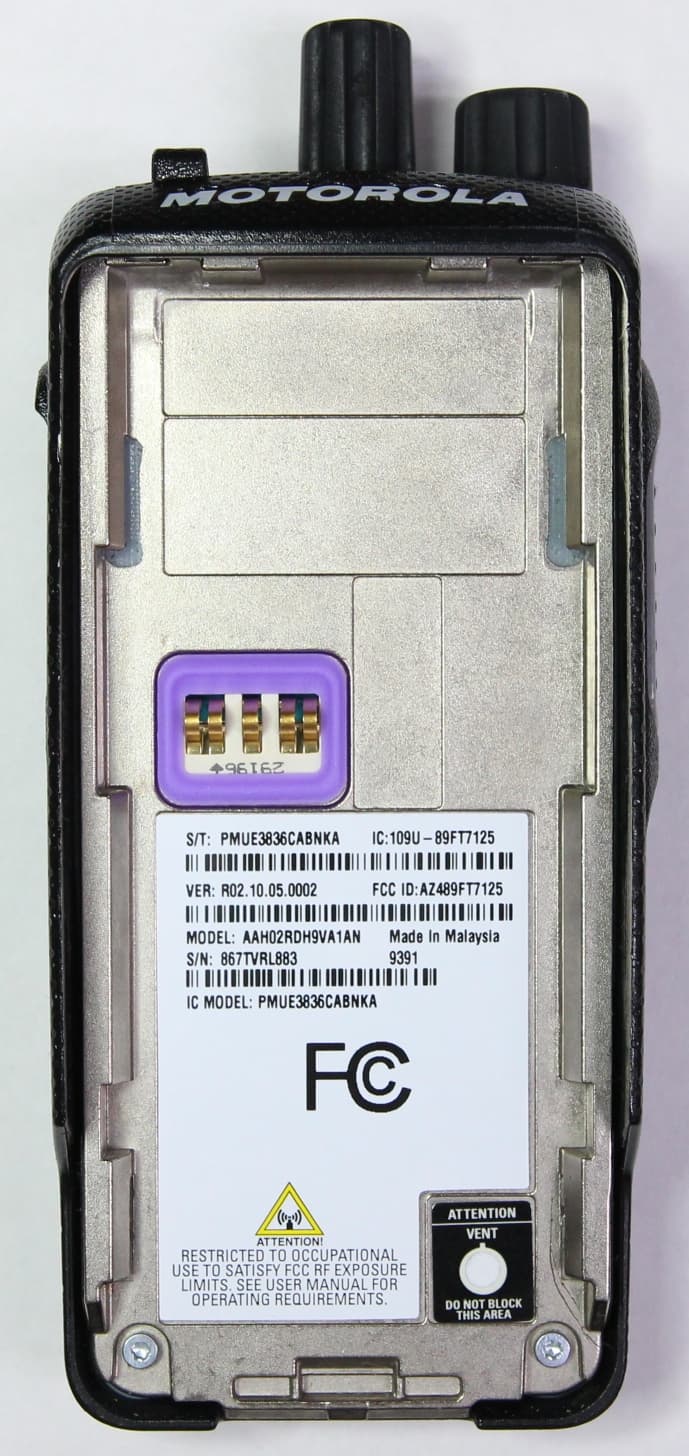
Click to zoom
Application Details
- Equipment Class
- TNF - Licensed Non-Broadcast Transmitter Held to Face
- Date of Grant
- Feb 17, 2020
- Application Purpose
- Original Equipment
- Date of Application
- Feb 04, 2020
- Equipment Note
- 2-Way Portable Radio (with Bluetooth, Bluetooth LE and WIFI)
- Frequency Range
- 520.00000000 - 527.00000000
- Company
- Motorola Solutions, Inc.
- Country
- United States
Documents & Files
Document Text
Text extracted from the exhibit documents filed with the FCC. Open a document above to read the original.
Users Manual
PROFESSIONAL DIGITAL TWO-WAY RADIO MOTOTRBO™ USER GUIDE AUGUST 2019 © 2019 Motorola Solutions, Inc. All rights reserved. 68009512001-EN @68009512001@ en-US fr-CA XPR 3500/XPR 3500e LIMITED KEYPAD PORTABLE RADIO Declaration of Conformity Declaration of Conformity Per FCC CFR 47 Part 2 Section 2.1077(a) Responsible Party Name: Motorola Solutions, Inc. Address: 1303 East Algonquin Road, Schaumburg, IL 60196-1078, U.S.A. Phone Number: 1-800-927-2744 Hereby declares that the product: Model Name: XPR 3500/XPR 3500e conforms to the following regulations: FCC Part 15, subpart B, section 15.107(a), 15.107(d), and section 15.109(a) Class B Digital Device As a personal computer peripheral, this device complies with Part 15 of the FCC Rules. This device complies with Industry Canada licence-exempt RSS standard(s). Operation is subject to the following two conditions: English 2 1This device may not cause harmful interference, and 2This device must accept any interference received, including interference that may cause undesired operation. NOTICE: This equipment has been tested and found to comply with the limits for a Class B digital device, pursuant to part 15 of the FCC Rules. These limits are designed to provide reasonable protection against harmful inter- ference in a residential installation. This equipment generates, uses and can radiate radio frequency energy and, if not installed and used in accordance with the instructions, may cause harmful interference to radio communications. However, there is no guarantee that interference will not occur in a particular installation. If this equipment does cause harmful interference to radio or television reception, which can be determined by turning the equipment off and on, the user is encouraged to try to correct the interference by one or more of the following measures: • Reorient or relocate the receiving antenna. • Increase the separation between the equipment and receiver. • Connect the equipment into an outlet on a circuit different from that to which the receiver is connected. • Consult the dealer or an experienced radio or TV technician for help. English 3 Contents Declaration of Conformity............................................... 2 Important Safety Information........................................10 Notice to Users (FCC and Industry Canada)................11 Software Version..........................................................12 Copyrights....................................................................13 Computer Software Copyrights....................................15 Handling Precautions...................................................16 Chapter 1: Introduction.................................................17 Icon Information.................................................17 Chapter 2: Basic Operations........................................18 Charging the Battery..........................................18 Attaching the Battery.........................................18 Attaching the Antenna.......................................19 Attaching the Carry Holster............................... 20 Attaching the Universal Connector Cover (Dust Cover)......................................................21 Attaching the Accessory Connector.................. 21 Turning the Radio On........................................22 Turning the Radio Off........................................22 Adjusting the Volume.........................................22 Chapter 3: Radio Controls ............................................23 Programmable Buttons......................................24 Assignable Radio Functions...................24 Assignable Settings or Utility Functions..26 Accessing Programmed Functions.........27 Push-To-Talk Button..........................................27 Conventional Analog and Digital Modes............28 IP Site Connect .................................................28 Capacity Plus–Single-Site.................................29 Capacity Plus–Multi-Site ...................................29 Chapter 4: Status Indicators.........................................31 Icons..................................................................31 LED Indicators ..................................................34 Tones.................................................................36 Audio Tones............................................36 Indicator Tones.......................................36 Chapter 5: Zone and Channel Selections.................... 37 Selecting Zones ................................................37 Selecting Channels............................................37 Chapter 6: Calls............................................................38 English 4 Group Calls........................................................39 Making Group Calls................................ 39 Responding to Group Calls.....................39 Private Calls .................................................40 Making Private Calls ..........................40 Responding to Private Calls ..............41 All Calls.............................................................. 42 Receiving All Calls..................................42 Making All Calls......................................43 Selective Calls ..............................................43 Making Selective Calls............................ 43 Responding to Selective Calls ...........44 Stopping Radio Calls ....................................44 Broadcast Voice Calls....................................... 45 Making Broadcast Voice Calls................45 Receiving Broadcast Voice Calls............46 Unaddressed Calls............................................46 Making Unaddressed Calls.....................47 Responding to Unaddressed Calls.........47 Open Voice Channel Mode (OVCM).................48 Making OVCM Calls............................... 48 Responding to OVCM Calls....................48 Chapter 7: Advanced Features..............................…
Text truncated - open the document above for the full version.
Users Manual
PROFESSIONAL DIGITAL TWO-WAY RADIO MOTOTRBO™ USER GUIDE AUGUST 2019 © 2019 Motorola Solutions, Inc. All rights reserved. 68009563001-EN @68009563001@ en-US fr-CA XPR 3300/XPR 3300e NON-KEYPAD PORTABLE RADIO Declaration of Conformity Declaration of Conformity Per FCC CFR 47 Part 2 Section 2.1077(a) Responsible Party Name: Motorola Solutions, Inc. Address: 1303 East Algonquin Road, Schaumburg, IL 60196-1078, U.S.A. Phone Number: 1-800-927-2744 Hereby declares that the product: Model Name: XPR 3300/XPR 3300e conforms to the following regulations: FCC Part 15, subpart B, section 15.107(a), 15.107(d), and section 15.109(a) Class B Digital Device As a personal computer peripheral, this device complies with Part 15 of the FCC Rules. This device complies with Industry Canada licence-exempt RSS standard(s). Operation is subject to the following two conditions: English 2 1This device may not cause harmful interference, and 2This device must accept any interference received, including interference that may cause undesired operation. NOTICE: This equipment has been tested and found to comply with the limits for a Class B digital device, pursuant to part 15 of the FCC Rules. These limits are designed to provide reasonable protection against harmful inter- ference in a residential installation. This equipment generates, uses and can radiate radio frequency energy and, if not installed and used in accordance with the instructions, may cause harmful interference to radio communications. However, there is no guarantee that interference will not occur in a particular installation. If this equipment does cause harmful interference to radio or television reception, which can be determined by turning the equipment off and on, the user is encouraged to try to correct the interference by one or more of the following measures: • Reorient or relocate the receiving antenna. • Increase the separation between the equipment and receiver. • Connect the equipment into an outlet on a circuit different from that to which the receiver is connected. • Consult the dealer or an experienced radio or TV technician for help. English 3 Contents Declaration of Conformity............................................... 2 Important Safety Information..........................................8 Notice to Users (FCC and Industry Canada)..................9 Software Version..........................................................10 Copyrights....................................................................11 Computer Software Copyrights....................................13 Handling Precautions...................................................14 Chapter 1: Introduction.................................................15 Icon Information.................................................15 Chapter 2: Basic Operations........................................16 Charging the Battery..........................................16 Attaching the Battery.........................................16 Attaching the Antenna.......................................17 Attaching the Carry Holster............................... 18 Attaching the Universal Connector Cover (Dust Cover)......................................................19 Attaching the Accessory Connector.................. 19 Turning the Radio On........................................20 Turning the Radio Off........................................20 Adjusting the Volume.........................................20 Chapter 3: Radio Controls ............................................21 Programmable Buttons......................................21 Assignable Radio Functions...................22 Assignable Settings or Utility Functions..23 Push-To-Talk Button..........................................23 Conventional Analog and Digital Modes............24 IP Site Connect .................................................24 Capacity Plus–Single-Site.................................25 Capacity Plus–Multi-Site ...................................25 Chapter 4: Status Indicators.........................................27 LED Indicators ..................................................27 Tones.................................................................28 Audio Tones............................................28 Indicator Tones.......................................29 Chapter 5: Zone and Channel Selections.................... 30 Selecting Zones ................................................30 Selecting Channels............................................30 Chapter 6: Calls............................................................31 Group Calls........................................................31 Making Group Calls................................31 English 4 Responding to Group Calls.....................32 Private Calls .................................................32 Making Private Calls ..........................32 Responding to Private Calls ..............33 All Calls.............................................................. 34 Receiving All Calls..................................34 Making All Calls......................................34 Selective Calls ..............................................35 Making Selective Calls............................ 35 Responding to Selective Calls ...........36 Stopping Radio Calls ....................................36 Broadcast Voice Calls....................................... 36 Making Broadcast Voice Calls................37 Receiving Broadcast Voice Calls............37 Unaddressed Calls............................................38 Making Unaddressed Calls.....................38 Responding to Unaddressed Calls.........38 Open Voice Channel Mode (OVCM).................39 Making OVCM Calls............................... 39 Responding to OVCM Calls....................40 Chapter 7: Advanced Features.................................... 41 Bluetooth........................................................... 41 Connecting to Bluetooth Devices......…
Text truncated - open the document above for the full version.
Users Manual
en-US es-LA fr-CA pt-BR RF Energy Exposure Training and Product Safety Information for Portable Two-Way Radios Formation sur l’exposition aux RF et information sur la sécurité du produit pour radios bidirectionnelles portatives Capacitación sobre la exposición a energía de radiofrecuencia e información de protección del producto para radios de dos vías portátiles Treinamento sobre a Exposição à Energia de RF e Informações de Segurança do Produto para Rádios Portáteis Bidirecionais https://learning.motorolasolutions.com/User_Documentation 2 Caution Before using this radio, read this booklet which contains important operating instructions. For information on product details, brochures, user manuals and approved accessories. Please refer to www.motorolasolutions.com. Compliance with RF Exposure Standards National and international regulations require manufacturers to comply with the RF energy exposure limits for portable two-way radios before they can be marketed. Your Motorola Solutions two-way radio is designed, manufactured, and tested to comply with all applicable national and international regulations for human exposure to radio frequency electromagnetic energy. When two-way radios are used as a consequence of employment, applicable regulations may require users to be fully aware of and able to control their exposure to meet occupational requirements. RF Energy Exposure Awareness and Control Information and Operational Instructions for Occupational Use Notice: This radio is intended for use in occupational/controlled conditions where users are aware of their exposure and can exercise control over their exposure to meet the requirements in national and international regulations. This radio device is not authorized for general population, consumer use. For more information on what RF energy exposure is, and how to control your exposure to ensure compliance with established RF exposure limits, consult the following websites: •https://www.fcc.gov/ •https://www.osha.gov/ •https://osha.europa.eu/en •http://www.who.int/peh-emf/project/en/ For additional user training information on exposure requirements, consult the following websites: •https://www.motorolasolutions.com/en_us/about/company-overview/ corporate-responsibility/governance-and-policies/wireless- communication-and-health-faqs.html •http://learning.motorolasolutions.com/ RF Exposure Compliance and Control Guidelines To control your exposure, and ensure compliance with the relevant RF exposure limits, always adhere to the following guidelines: • Do not remove any of the RF Exposure Labels if present from this device or its related accessories. • Attach these instructions to the device when you transfer it to other users. • Do not use this device if the operational requirements described herein are not met. Operating Instructions • Transmit no more than 50% of the time. To transmit (talk), press the Push-To-Talk (PTT) button. To receive calls, release the PTT button. Transmitting more than 50% of the time may cause RF exposure compliance requirements to be exceeded. • Hold the radio in a vertical position in front of the face with the microphone (and other parts of the radio including the antenna) at least 1 in. (2.5 cm) away from the nose or lips. Antenna should be kept away from the eye. • When worn on the body, always place the radio in a Motorola Solutions-approved clip, holder, holster, case, or body harness for this product. • DO NOT hold the antenna when the radio is transmitting. • DO NOT use any portable radio that has a damaged antenna. If a damaged antenna comes into contact with your skin, a minor burn can result. • To ensure continued compliance with applicable RF exposure limits, use only Motorola Solutions approved, supplied or replacement antennas, batteries, and accessories. • For a list of Motorola Solutions approved accessories please refer to your user manual or visit www.motorolasolutions.com Notice to Users (FCC and Industry Canada) This device complies with Part 15 of the FCC rules and Industry Canada's license-exempt RSS's per the following conditions: • This device may not cause harmful interference. • This device must accept any interference received, including interference that may cause undesired operation. English 3 • Changes or modifications made to this device, not expressly approved by Motorola Solutions, could void the authority of the user to operate this equipment. Acoustic Safety Exposure to loud noises from any source for extended periods of time may temporarily or permanently affect your hearing. The louder the volume of the radio, the sooner your hearing will be affected. Hearing damage from loud noise is sometimes undetectable at first, and can have a cumulative effect. To protect your hearing: • Use the lowest volume necessary to do your job. • Turn up the volume only if you are in noisy surroundings. • Turn down the volume before adding headset or earpiece. • Limit the amount of time you use headsets or earpieces at high volume. • When using the radio without a headset or earpiece, do not place the radio's speaker directly against your ear. Medical Devices If you use a personal medical device, such as a pacemaker or hearing aid, consult the manufacturer of your device to determine if it is adequately shielded from RF energy. Your physician may be able to assist you in obtaining this information. Holsters Incorporating Magnets Some Motorola Solutions holsters incorporate strong, neodymium magnets. If you use a personal medical device, such as a pacemaker or hearing aid, consult the manufacturer of your device to determine if it can be used in close proximity to magnets. Your physician may be able to assist you in obtaining this information. Also be aware that magnets can damage other products, including cell phones, computers, hard drives, and other electronic devices, as well as credit cards and magnetic media. Keep the holster away from any mechanical device that could be affected by a magnet…
Text truncated - open the document above for the full version.
Attestation Statements
Applicant: Motorola Solutions Inc FCC ID: AZ489FT7125/ IC: 109U-89FT7125 EXHIBIT 2 SHEET 1 OF 2 EXHIBIT 2 Statement of Certification (Pursuant to FCC Part 2.907, 2.908 and RSP 100 Sec 4) 2.1 Statement of Certification Transceiver type described herein (AZ489FT7125/109U-89FT7125) is in compliance with all applicable parts of the FCC rules and ISED RSS standards. Each unit manufactured, imported, or marketed will conform to the samples tested herein, within the statistical variations that can be expected due to high volume production and test measurement error. NAME: TAI WEN QI SIGNATURE: DATE: 4 th Nov 2019 TITLE: Electrical Engineer Applicant: Motorola Solutions Inc FCC ID: AZ489FT7125/ IC: 109U-89FT7125 EXHIBIT 2 SHEET 2 OF 2 2.2 Attestation Statement (Equipment Class DTS and DSS – Bluetooth/WiFi) This device contains an embedded Bluetooth device and WiFi device that are compliant with the applicable FCC Part 15C and ISED RSS 247 regulations. Part 15.247 (a)(1) / RSS 247 Section 5.1 • The hopping sequence must be pseudo random. • Each frequency must be used equally on the average by each transmitter • The receivers input bandwidth is approximately equal to the transmit bandwidth • The receiver hops in sequence with the transmitted signal Part 15.247 (g) / RSS 247 Section 5.1 • The system is designed to comply with all of the regulations in this section when the transmitter is presented with a continuous data (or information) Part 15.247(h) / RSS 247 Section 5.1 • The system does not coordinate its channel selection/hopping sequence with other frequency hopping systems for the express purpose of avoiding the simultaneous occupancy of individual hopping frequencies by multiple transmitters. NAME: TAI WEN QI SIGNATURE: DATE: 4 th Nov 2019 TITLE: Electrical Engineer
Cover Letter(s)
FCC ID: AZ489FT7125 ___________________________________________________________________________________________________________ Motorola Solutions Inc. 8000 West Sunrise Boulevard, Fort Lauderdale, Florida 33322 EXHIBIT 13A Date: January 10, 2020 Office of Engineering and Technology Laboratory Division Equipment Authorization Branch Federal Communications Commission Laboratory 7435 Oakland Mills Road Columbia, MD 21046 Subject: Application for Certification of Transmitter with FCC ID: AZ489FT7125 Dear Sir/Madam, Motorola Solutions, Inc (8000 West Sunrise Boulevard, Fort Lauderdale, Florida) herein submits application for Certification of the subject transmitter. This transmitter is intended for use in a portable radio application with capabilities for clear and coded communications with a variable transmit power operating within the following frequency ranges: Product Name (PMN) Model Numbers Frequency Range RF Power FCC Rules Part XPR 3500e XPR 3300e AAH02RDH9VA1AN AAH02RDH9VA7AN-AMA AAH02RDC9VA1AN 403-527 MHz 1 - 4W (Rated), Max = 4.8W 22, 74, 90 467.75– 467.825MHz Max = 2W 80 BT / BT LE : 2402-2480 MHz BT: 9.1 mW (max measured); 10mW (max declared) BTLE : 9.59 mW (max measured); 10mW (max declared) 15C 802.11b,g,n : 2412-2462 MHz 802.11b: 58.3 mW (max measured) 70.8 mW (max declared) 802.11g: 17.43 mW (max measured) 20 mW (max declared) 802.11n: 10.35 mW (max measured) 12.6 mW (max declared) 15C We are requesting certification under Part(s) of the Commission’s Rules listed above to allow operation of this equipment. FCC ID: AZ489FT7125 ___________________________________________________________________________________________________________ Motorola Solutions Inc. 8000 West Sunrise Boulevard, Fort Lauderdale, Florida 33322 EXHIBIT 13A The subject transmitter complies with Section 90.203 and 80.203(b) of the Rules in that the operator cannot directly program transmit frequencies using the unit's normally accessible external controls. The transmitter also complies to 80.203(n) as it meets all performance requirements listed in IEC62238. This product in the 470-512MHz will be utilizing the T-band waiver allocation. The waiver is included in this filing and noted as Exhibit 13d. A complete Certification application is enclosed. If you require any additional information, please contact me at (954) 723-4707. Sincerely, Deanna Zakharia Regulatory Compliance Manager E-mail : [email protected]
Cover Letter(s)
FCC ID: AZ489FT7125 ___________________________________________________________________________________________________ Motorola Solutions Inc. 8000 West Sunrise Boulevard, Fort Lauderdale, Florida 33322 EXHIBIT 13B CONFIDENTIALITY REQUEST January 10, 2020 Office of Engineering and Technology Laboratory Division Equipment Authorization Branch FCC Laboratory 7435 Oakland Mills Road Columbia, MD 21046 Subject: Confidentiality Request for Transmitter with FCC ID: AZ489FT7125 Dear Sir / Madam, Motorola Solutions Inc is requesting that Exhibit 4 (Circuit Descriptions), Exhibit 5 (Schematic Diagrams), Exhibit 10 (Parts List and Tune Up Procedures), and Exhibit 12 (Operational Description) not be made routinely available for public inspection. Motorola Solutions considers the information in these exhibits to be classified as trade secrets, pursuant to 47 CFR Section 0.457(d), 0.459 and Section 552(b)(4) of the Freedom of Information Act. Please mark Exhibits 4, 5, 10, and 12 as “Confidential”. Please contact me if you require any additional information. Sincerely, Deanna Zakharia Regulatory Compliance Manager E-mail : [email protected]
Cover Letter(s)
FCC ID: AZ489FT7125 _______________________________________________________________________________________________ Motorola Solutions Inc. 8000 West Sunrise Boulevard, Fort Lauderdale, Florida 33322 EXHIBIT 13C January 10, 2020 Authorization & Evaluation Division Federal Communications Commission Laboratory 7435 Oakland Mills Road Columbia, MD 21046 Subject: Extended Frequencies Justification for Certification of Transmitter with FCC ID: AZ489FT7125. Dear Sir/Madam: This transmitter is designed to operate in the following frequency ranges: Band/Mode Frequency ranges FCC rule parts UHF 403 - 527 MHz 22, 74, 90 UHF 467.75 - 467.825 MHz 80 Bluetooth 2402 – 2480 MHz 15C Bluetooth LE 2402 – 2480 MHz 15C Wi-Fi/ WLAN 2400 – 2462 MHz 15C To aid equipment authorization in other countries which accept the United States FCC Grant for Certification, Motorola Solutions is requesting that the FCC lists the above applicable frequencies range under FCC Rule Parts 22, 74, 80, and 90 on the FCC Grant. For the FCC’s Rule Parts 22, 74, 80 and 90 applications, this radio is used in systems by Federal and Public Safety agencies including Police, Fire, and Emergency Medical Services, etc. as indicated in the table below. Equipment programming is the responsibility of Authorized Service Personnel. Also, the radio complies with 47 CFR Part 90.203(e) and 80.203(b), in that the operator cannot directly program the transmit frequencies using the normally accessible external controls. Per the FCC’s KDB634817 guidance, as an alternative to listing the exact frequencies, we acknowledge that it’s a violation of the FCC Rules if this device operates on unauthorized frequencies. Frequency Range (MHz) Part 22 Part 24D Part 74 Part 80 Part 90 Federal Other Regions 380-406.1 x 406.1-450 x 450-454 x x 454-456 x 456-460 x x x 460-462.5375 x 462.5375-462.7375* x x 462.7375-467.5375 x x 467.75-467.825 x 467.7375-470 x x 470-512 x x x 512-527 x x *Canada Please contact me if you required any additional information. Sincerely, Deanna Zakharia Regulatory Compliance Manager E-mail : [email protected]
Cover Letter(s)
Federal Communications CommissionDA 12-642 Before the Federal Communications Commission Washington, D.C. 20554 In the Matter of Implementation of Sections 309(j) and 337 of the Communications Act of 1934 as Amended Promotion of Spectrum Efficient Technologies on Certain Part 90 Frequencies ) ) ) ) ) ) ) WT Docket No. 99-87 RM-9332 ORDER Adopted: April 25, 2012Released: April 26, 2012 By the Chief, Wireless Telecommunications Bureau, Chief, Public Safety and Homeland Security Bureau, and Chief, Office of Engineering and Technology: I.INTRODUCTION 1.In this Order, we waive, on our own motion, the January 1, 2013 deadline for private land mobile radio (PLMR) licensees in the 470-512 MHz band to migrate to narrowband (12.5 kHz or narrower) technology. 1 We also waive a related rule pertaining to manufacture and importation of PLMR equipment.We take this action in light of recent legislation directing the Commission to reallocate spectrum in the 470-512 MHz band. II. BACKGROUND 2.In 1995, the Commission adopted rule changes to promote the efficient use of the PLMR service and facilitate the introduction of advanced technologies. 2 To promote the transition to a more efficient narrowband channel plan, the Commission provided, inter alia, that “only increasingly efficient equipment” would be approved. 3 The Commission did not set a date after which it would no longer approve equipment with a wideband (25 kHz) mode, or after which such equipment could no longer be manufactured or used. 4 The Commission contemplated that, as systems reached the end of their service life and new radios were needed, users would migrate to the narrower bandwidth multi-mode radios in 1 See Implementation of Sections 309(j) and 337 of the Communications Act of 1934 as Amended,Second Report and Order and Second Further Notice of Proposed Rulemaking, WT Docket No. 99-87, 18 FCC Rcd 3034 (2003) (Second R&O); Implementation of Sections 309(j) and 337 of the Communications Act of 1934 as Amended,Third Memorandum Opinion and Order, Third Further Notice of Proposed Rule Making and Order, WT Docket No. 99- 87, 19 FCC Rcd 25045 (2004) (Third MO&O). Specifically, these narrowbanding deadlines apply to frequencies in the 150.8-162.0125 MHz, 173.2-173.4 MHz, and 421-512 MHz bands. Narrowbanding in the 150.05-150.8 MHz, 162-174 MHz, and 406.1-420 MHz bands, which are allocated primarily for Federal Government use, is governed by a different schedule. See Amendment of Parts 2 and 90 of the Commission’s Rules to Provide for Narrowband Private Land Mobile Radio Channels in the 150.05-150.8 MHz, 162-174 MHz, and 406.1-420 MHz Bands that Are Allocated for Federal Government Use, Report and Order, ET Docket No. 04-243, 20 FCC Rcd 5793 (2005); 47 C.F.R. § 90.265. Similarly, the narrowbanding requirements for 700 MHz public safety narrowband systems are subject to a different schedule, and are not affected by this proceeding. See47 C.F.R. §§ 90.203(m), (n), 90.535. 2 SeeReplacement of Part 90 by Part 88 to Revise the Private Land Mobile Radio Services and Modify the Policies Governing Them, Report andOrder and Further Notice of Proposed Rule Making, PR Docket No. 92-235, 10 FCC Rcd 10076, 10077 ¶ 1 (1995). 3 Id.at 10081 ¶ 7. 4 Id.at 10100 ¶ 40. 4213 Federal Communications CommissionDA 12-642 order to avoid the adjacent-channel interference that could occur from systems using the adjacent narrowband channels. 5 3.Subsequently,the Commission determined that the 1995 rules failed to provide adequate incentive to realize the Commission’s spectrum efficiency goals in these bands, and stronger measures would be required to bring about a timely transition to narrowband technology. 6 The Commission therefore amended the rules to provide that, by January 1, 2013, Industrial/Business and Public Safety Radio Pool licensees in the 150-174 MHz and 421-512 MHz bands must migrate to 12.5 kHz channel bandwidth or utilize a technology that achieves equivalent efficiency. 7 In addition, beginning January 1, 2013, the manufacture or import of equipment capable of operating with only one voice path per 25kHz of spectrum, i.e., equipment that includes a 25 kHz mode, will be prohibited. 8 4.Congressrecently enacted the Middle Class Tax Relief and Job Creation Act of 2012. 9 Section 6103 of the legislation provides that, not later than nine years after the date of enactment, the Commission shall “reallocate the spectrum in the 470-512 MHz band (referred to in this sec…
Text truncated - open the document above for the full version.
Contact Information
Applicant
Deanna Zakharia(Regulatory Compliance Manager)
Test Firm
Motorola Penang Advanced Communication LaboratoryMohd Azuan Shah Yaakap
Technical Specifications
| # | Rule Parts | Frequency Range | Power Output | Emission | Tolerance |
|---|---|---|---|---|---|
| 18 | 22,74,9 | 520 MHz - 527 MHz | 4.8 W | 16K0F3E | 0.5 ppm |
Other Applications from Motorola Solutions, Inc.
AZ489FT4980
Sep 08, 2026Portable two way radio
Equipment Class
TNF - Licensed Non-Broadcast Transmitter Held to FaceAZ489FT4981
Aug 14, 2026Handheld Portable - TANAPA BPR 45 400-470 MHZ 4W NKP
Equipment Class
TNF - Licensed Non-Broadcast Transmitter Held to Face
AZ489FT7187
Jul 13, 2026Portable 2-Way Radio with Bluetooth, Bluetooth LE, WIFI 2.4GHz, WIFI 5GHz, LTE
Equipment Class
DSS - Part 15 Spread Spectrum TransmitterAZ499FT6031
May 11, 2026Operation Critical Wireless Earpiece PTT
Equipment Class
DSS - Part 15 Spread Spectrum Transmitter
AZ499FT5879
Dec 19, 20252-way Portable Radio with BT, BTLE, WIFI, NFC and LTE
Equipment Class
DSS - Part 15 Spread Spectrum Transmitter