AZ492FT7138Mobile 2-way Radio
Motorola Solutions, Inc.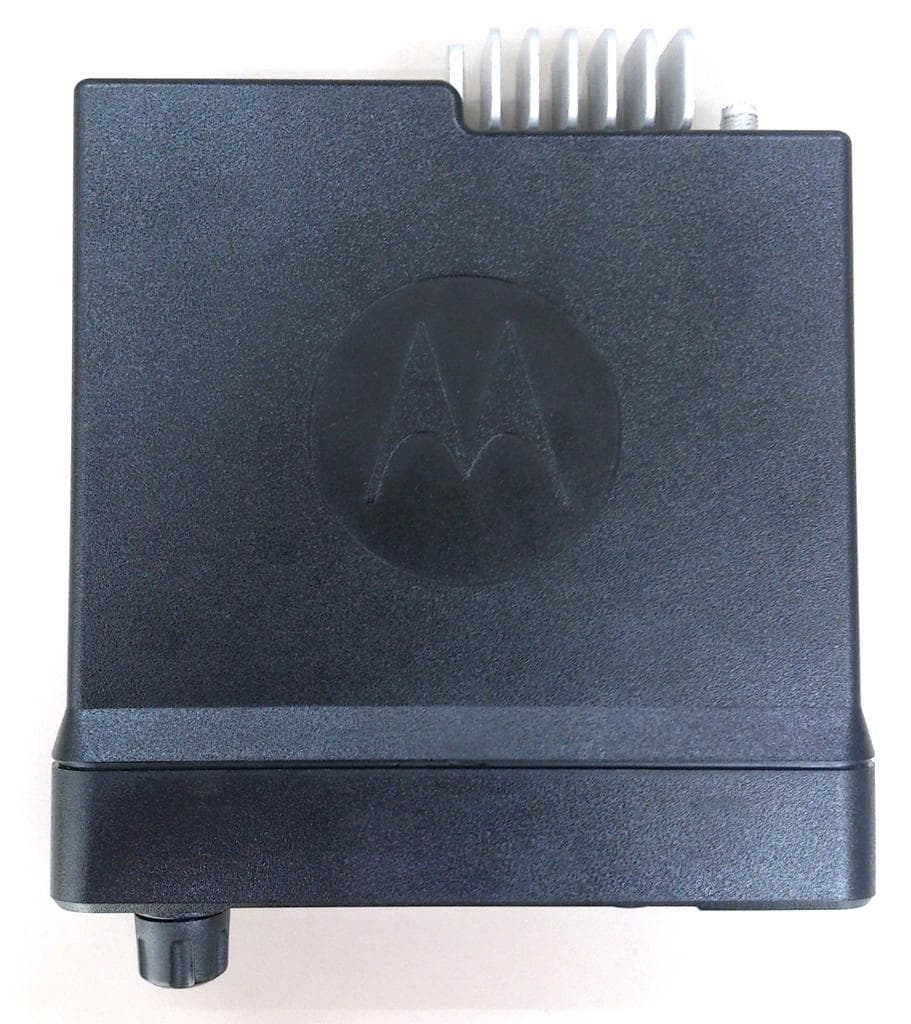
Click to zoom
Application Details
- Equipment Class
- DTS - Digital Transmission System
- Date of Grant
- May 09, 2021
- Application Purpose
- Original Equipment
- Date of Application
- Mar 15, 2021
- Equipment Note
- Mobile 2-way Radio
- Frequency Range
- 2412.00000000 - 2462.00000000
- Company
- Motorola Solutions, Inc.
- Country
- United States
Documents & Files
Document Text
Text extracted from the exhibit documents filed with the FCC. Open a document above to read the original.
Users Manual
PROFESSIONAL DIGITAL TWO-WAY RADIO MOTOTRBO™ USER GUIDE AUGUST 2020 © 2020 Motorola Solutions, Inc. All rights reserved. MN003680A01-AG *MN003680A01* en-US XPR 5350/XPR 5350e, XPR 5380/XPR 5380e NUMERIC DISPLAY MOBILE RADIO fr-CA Supplier's Declaration of Conformity Supplier's Declaration of Conformity Per FCC CFR 47 Part 2 Section 2.1077(a) Responsible Party Name: Motorola Solutions, Inc. Address: 2000 Progress Pkwy, Schaumburg, IL. 60196 Phone Number: 1-800-927-2744 Hereby declares that the product: Model Name: XPR 5350/XPR 5380/XPR 5350e/XPR 5380e conforms to the following regulations: FCC Part 15, subpart B, section 15.107(a), 15.107(d), and section 15.109(a) Class B Digital Device As a personal computer peripheral, this device complies with Part 15 of the FCC Rules. Operation is subject to the following two conditions: English 2 1This device may not cause harmful interference, and 2This device must accept any interference received, including interference that may cause undesired operation. NOTICE: This equipment has been tested and found to comply with the limits for a Class B digital device, pursuant to part 15 of the FCC Rules. These limits are designed to provide reasonable protection against harmful inter- ference in a residential installation. This equipment generates, uses and can radiate radio frequency energy and, if not installed and used in accordance with the instructions, may cause harmful interference to radio communications. However, there is no guarantee that interference will not occur in a particular installation. If this equipment does cause harmful interference to radio or television reception, which can be determined by turning the equipment off and on, the user is encouraged to try to correct the interference by one or more of the following measures: • Reorient or relocate the receiving antenna. • Increase the separation between the equipment and receiver. • Connect the equipment into an outlet on a circuit different from that to which the receiver is connected. • Consult the dealer or an experienced radio or TV technician for help. For country code selection usage (WLAN devices) NOTICE: The country code selection is for non-US model only and is not available to all US models. Per FCC regula- tion, all Wi-Fi products marketed in the US must be fixed to US operation channels only. English 3 Contents Supplier's Declaration of Conformity..............................2 Important Safety Information........................................16 Notice to Users (FCC)..................................................17 Notice to Users (Industry Canada)...............................18 Software Version..........................................................19 Copyrights....................................................................20 Computer Software Copyrights....................................22 Radio Care...................................................................23 Chapter 1: Getting Started........................................... 25 1.1 Turning the Radio On..................................25 1.2 Turning the Radio Off..................................25 1.3 Adjusting the Volume...................................25 Chapter 2: Radio Controls............................................26 2.1 Volume/Channel Knob.................................26 Chapter 3: WAVE.........................................................27 3.1 WAVE OnCloud/OnPremise........................27 3.1.1 Switching from Radio Mode to WAVE Mode...........................................27 3.1.2 Making WAVE Group Calls............28 3.1.3 Receiving and Responding to WAVE Group Calls.................................28 3.1.4 Receiving and Responding to WAVE Private Calls................................28 3.1.5 Switching from WAVE Mode to Radio Mode ........................................... 29 Part I: Capacity Max.....................................................30 4.1 Push-To-Talk (PTT) Button......................... 30 4.2 Programmable Buttons................................30 4.3 Assignable Radio Functions........................31 4.4 Assignable Settings or Utility Functions...... 32 4.5 Status Indicators..........................................33 4.5.1 LED Indicator.................................33 4.5.2 Tones.............................................34 4.5.2.1 Audio Tones.....................34 4.5.2.2 Indicator Tones................34 4.6 Registration................................................. 35 4.7 Zone and Channel Selections..................... 36 4.7.1 Selecting Zones ............................36 4.7.2 Selecting a Call Type.....................36 4.7.3 Selecting a Site..............................37 4.7.4 Roam Request...............................37 English 4 4.7.5 Site Lock On/Off............................ 38 4.7.6 Site Restriction...............................38 4.7.7 Site Trunking .................................38 4.8 Calls.............................................................39 4.8.1 Group Calls....................................39 4.8.1.1 Making Group Calls......... 39 4.8.1.2 Responding to Group Calls.............................................40 4.8.2 Broadcast Call .............................. 41 4.8.2.1 Making Broadcast Calls ..41 4.8.2.2 Receiving Broadcast Calls ............................................41 4.8.3 Private Call.................................... 42 4.8.3.1 Making Private Calls........42 4.8.3.2 Making a Private Call with a One Touch Call Button .....43 4.8.3.3 Receiving Private Calls....44 4.8.3.4 Accepting Private Calls ...44 4.8.3.5 Declining Private Calls ....44 4.8.4 All Calls .........................................45 4.8.4.1 Making All Calls .............. 45 4.8.4.2 Receiving All Calls ..........45 4.8.5 Phone Calls................................... 46 4.8.5.1 Making Phone Calls.........46 4.8.5.2 Making Phone Calls with the Programmable Button ...........47 4.8.5.3 Responding to Phone Calls as All Cal…
Text truncated - open the document above for the full version.
Users Manual
PROFESSIONAL DIGITAL TWO-WAY RADIO SYSTEM MOTOTRBO™ MOBILE INSTALLATION GUIDE XPR™ 4000/5000/5000e SERIES 0 i Foreword This manual is intended for use by experienced technicians familiar with similar types of equipment. Specifically, it contains installation information required for the XPR Series Mobile Radios. For information related to the service of the XPR Series Mobile Radios, refer to Related Publications on page v for the list of applicable manuals available separately. Product Safety and RF Exposure Compliance See Installation Requirements for Compliance with Radio Frequency (RF) Energy Exposure Safety Standards on page ii. Manual Revisions Changes which occur after this manual is printed are described in PMRs (Publication Manual Revisions). These PMRs provide complete replacement pages for all added, changed, and deleted items. To obtain PMRs, go to: https://businessonline.motorolasolutions.com Parts Ordering See Appendix A : Replacement Parts Ordering for information on how to obtain replacement parts. For part numbers, refer to the service manuals listed in Related Publications on page v. Computer Software Copyrights The Motorola products described in this manual may include copyrighted Motorola computer programs stored in s emiconductor memories or other media. Laws in the United States and other countries preserve for Motorola certain exclusive rights for copyrighted computer programs, including, but not limited to, the exclusive right to copy or reproduce in any form the copyrighted computer program. Accordingly, any copyrighted Motorola computer programs contained in the Motorola products described in this manual may not be copied, reproduced, modified, reverse-engineered, or distributed in any manner without the express written permission of Motorola. Furthermore, the purchase of Motorola products shall not be deemed to grant either directly or by implication, estoppel, or otherwise, any license under the copyrights, patents or patent applications of Motorola, except for the normal non-exclusive license to use that arises by operation of law in the sale of a product. Document Copyrights No duplication or distribution of this docum ent or any portion thereof shall take place without the express written permission of Motorola. No part of this manual may be reproduced, distributed, or transmitted in any form or by any means, electronic or mechanical, for any purpose without the express written permission of Motorola. Disclaimer The information in this document is carefully examined, and is believed to be entirely reliable. However, no responsibility is assumed for inaccuracies. Furthermore, Motorola reserves the right to make changes to any products herein to improve readability, function, or design. Motorola does not assume any liability arising out of the applications or use of any product or circuit described herein; nor does it cover any license under its patent rights nor the rights of others. Trademarks MOTOROLA, MOTO, MOTOROLA SOLUTIONS and the Stylized M logo are trademarks or registered trademarks of Motorola Trademark Holdings, LLC and are used under license. All other trademarks are the property of their respective owners. © 2006 – 2016 Motorola Solutions, Inc. All rights reserved. ii Installation Requirements for Compliance with Radio Frequency (RF) Energy Exposure Safety Standards ATTENTION! This radio is intended for use in occupational/controlled conditions, where users have full knowledge of their exposure and can exercise control over their exposure to meet FCC limits. This radio device is NOT authorized for general population, consumer, or any other use. To ensure compliance to RF Energy Safety Standards: •Install only Motorola approved antennas and accessories. •Be sure that antenna installation is per Antenna Installation on page 2-12 of this manual. •Be sure that Product Safety and RF Safety Booklet enclosed with this radio is available to the end user upon completion of the installation of this radio. Before using this product, the operator must be familiar with the RF energy awareness information and operating instructions in the Product Safety and RF Exposure booklet enclosed with each radio (Motorola publication part number 6881095C99_) to ensure compliance with Radio Frequency (RF) energy exposure limits. This radio has a transmitter Time-out Timer that disables the transmitter during a transmission after a pre- defined time period, which by default is set to 60 seconds. For a list of Motorola-approved antennas and other accessories, visit the following web site, which lists approved accessories for your radio model: http://www.motorolasolutions.com For radios installed in vehicles fuelled by liquefied petroleum gas, refer to the (U.S.) National Fire Protection Association standard, NFPA58, for storage, handling, and/or container information. It is recommended NOT to change the default 60 seconds time period for the Time-out Timer as the radio is intended for intermittent duty cycle operation. ! W A R N I N G ! C a u t i o n Table of Contentsiii Table of Contents Foreword ..........................................................................................................i Product Safety and RF Exposure Compliance .............................................................................................i Manual Revisions .........................................................................................................................................i Parts Ordering ..............................................................................................................................................i Computer Software Copyrights ....................................................................................................................i Document Copyrights ...................................................................................................................................i Disclaimer.......................…
Text truncated - open the document above for the full version.
Users Manual
MN002330A01-AC @MN002330A01@ QUICK REFERENCE GUIDE XPR 5000/XPR 5000e SERIES MOBILE RADIOS en -US fr-CA PROFESSIONAL DIGITAL TWO-WAY RADIO MOTOTRBO™ JULY 2017 © 2017 Motorola Solut ions, Inc. All rights reserved. Your Quick Reference Guide This Quick Reference Guide covers the basic operation of the radio. Check with your dealer or system administrator because your radio may have been customized for your specific needs. For more operational details and information on warnings and safety, refer to the following User Guides: Alphanumeric Display MobileMN003677A01 Numeric Display MobileMN003680A01 Important Safety Information RF Energy Exposure and Product Safety Guide for Mobile Two-Way Radios Product Safety and RF Exposure Compliance Caution: Before using this product, read the operating instructions for safe usage contained in the Product Safety and RF Exposure booklet enclosed with your radio. ATTENTION! This radio is restricted to Occupational use only. Before using the radio, read the RF Energy Exposure and Product Safety Guide for Mobile Two-Way Radios which contains important operating instructions for safe usage and RF energy awareness and control for Compliance with applicable standards and Regulations. For a list of Motorola Solutions-approved antennas and other accessories, visit the following website: http://www.motorolasolutions.com Any modification to this device, not expressly authorized by Motorola Solutions, may void the user's authority to operate this device. Under Industry Canada regulations, this radio transmitter may only operate using an antenna of a type and maximum (or lesser) gain approved for the transmitter by Industry Canada. To reduce potential radio interference to other users, the antenna type and its gain should be so chosen that the equivalent isotropically radiated power (e.i.r.p.) is not more than that necessary for successful communication. This radio transmitter has been approved by Industry Canada to operate with Motorola Solutions-approved antenna with the maximum permissible gain and required antenna impedance for each antenna type indicated. Antenna types not included in this list, having a gain greater than the maximum gain indicated for that type, are strictly prohibited for use with this device. Computer Software Copyrights The Motorola Solutions products described in this manual may include copyrighted Motorola Solutions computer programs stored in semiconductor memories or other media. Laws in the United States and other countries preserve for Motorola Solutions certain exclusive rights for copyrighted computer programs including, but not limited to, the exclusive right to copy or reproduce in any form the copyrighted computer program. Accordingly, any copyrighted Motorola Solutions computer programs contained in the Motorola Solutions products described in this manual may not be copied, reproduced, modified, reverse-engineered, or distributed in any manner without the express written permission of Motorola Solutions. Furthermore, the purchase of Motorola Solutions products shall not be deemed to grant either directly or by implication, estoppel, or otherwise, any license under the copyrights, patents or patent applications of Motorola Solutions, except for the normal non- exclusive license to use that arises by operation of law in the sale of a product. Radio Controls 1 23465 9 10 78 1. On/Off/Information Button 2. Volume/Channel Knob 7. Return/Home Button 1 8. Front Programmable Buttons English 1 3. Display 4. Menu/OK Button 1 5. Scroll Up/Down Buttons 1 6. Speaker 9. Accessory Connector 10. LED Indicators Powering On/Off the Radio Press the On/Off button. Adjusting the Volume Rotate the On/Off/Volume Control Knob clockwise or counterclockwise. LED Indicators Blinking Red Radio has failed the self-test upon powering up, has moved out of range if Auto-Range Transponder System is configured, has Mute mode enabled, is receiving an emergency transmission, or is trans- mitting in low battery state. Solid Green Radio is powering up, is transmitting, or is sending a Call Alert or an emergency transmission. Blinking Green Radio is receiving a call or data, is detecting activity over the air, or is retrieving Over-the-Air Programming transmissions. Double Blinking Green Radio is receiving a privacy-enabled call or data. Solid Yellow Radio is monitoring a conventional channel, or is in Bluetooth Discov- erable Mode. Blinking Yellow Radio is scanning for activity, is receiving a Call Alert, has Flexible Receive List enabled, or all Capacity Plus-Multi-Site channels are busy. Double Blinking Yellow Radio has Auto Roaming enabled, has yet to respond to a Group Call Alert, is actively searching for a new site, is not connected to the re- peater while in Capacity Plus, is locked, or all Capacity Plus channels are busy. Display Icons The following icons appear on the status bar at the top of the radio display. The icons are arranged left most in order of appearance or usage, and are channel-specific. Emergency Scan 2 High Volume Data Mute Mode Tones Disabled 1 Not for Numeric Display models. 2 Not available for Capacity Max. English 2 Ring Only Notification Secure Unsecure Site Roaming Option Board Sign In Sign Out English 3 Guide de référence rapide Ce guide de référence rapide décrit le fonctionnement de base de la radio. Vérifiez auprès de votre revendeur ou de l'administrateur de votre système si votre radio a été personnalisée pour répondre à vos besoins spécifiques. Pour plus de détails sur le fonctionnement et d'information sur les avertissements et la sécurité, consultez les guides d'utilisation suivants : Radio mobile à affichage alphanumérique MN003677A01 Radio mobile à affichage numérique MN003680A01 Consignes de sécurité importantes Radios bidirectionnelles mobiles : exposition aux radiofréquences et sécurité du produit Sécurité du produit et respect des normes relatives à l'exposition aux radiofréquences Mise en garde: Avant d'utiliser ce produ…
Text truncated - open the document above for the full version.
Users Manual
en-US es-LA fr-CA pt-BR RF Energy Exposure Training and Product Safety Information for Mobile Two-Way Radios installed in Vehicles or as Fixed Site Control Stations Formation sur l’exposition aux RF et information sur la sécurité du produit pour radios bidirectionnelles mobiles installées dans des v éhicules ou comme stations de contrôle à emplacements fixes Capacitación sobre la exposición a energía de radiofrecuencia e información de protección del producto para radios de dos vías móviles instalados en vehículos o como estaciones de control fijas Treinamento sobre a Exposição à Energia de RF e Informações de Segurança do Produto para Rádios Portáteis Bidirecionais Instalados em Veículos ou como Estações de Controle de Site Fixo https://learning.motorolasolutions.com/User_Documentation Caution Before using this radio, read this booklet which contains important operating instructions. For information on product details, brochures, user manuals and approved accessories. Please refer to www.motorolasolutions.com. Compliance with RF Exposure Standards National and international regulations require manufacturers to comply with the RF energy exposure limits for mobile two-way radios before they can be marketed. Your Motorola Solutions two-way radio is designed, manufactured, and tested to comply with all applicable national and international regulations for human exposure to radio frequency electromagnetic energy. When two-way radios are used as a consequence of employment, applicable regulations may require users to be fully aware of and able to control their exposure to meet occupational requirements. RF Energy Exposure Awareness and Control Information and Operational Instructions for Occupational Use Notice: This radio is intended for use in occupational/controlled conditions where users are aware of their exposure and can exercise control over their exposure to meet the requirements in national and international regulations. This radio device is not authorized for general population, consumer use. For more information on what RF energy exposure is, and how to control your exposure to ensure compliance with established RF exposure limits, consult the following websites: •https://www.fcc.gov/ •https://www.osha.gov/ •https://osha.europa.eu/en •http://www.who.int/peh-emf/project/en/ •http://www.ic.gc.ca/eic/site/smt-gst.nsf/eng/sf11467.html •http://www.ic.gc.ca/eic/site/smt-gst.nsf/eng/sf01904.html For additional user training information on exposure requirements, consult the following websites: •https://www.motorolasolutions.com/en_us/about/company-overview/corporate- responsibility/governance-and-policies/wireless-communication-and-health- faqs.html •http://learning.motorolasolutions.com/ English 1 RF Exposure Compliance and Control Guidelines To control exposure to yourself and others, and to ensure compliance with the relevant RF exposure limits, always adhere to the following guidelines: • Do not remove any of the RF Exposure Labels if present from this device or its related accessories. • Attach these instructions to the device when you transfer it to other users. •Do not use this device if the operational requirements described herein are not met. Operating Instructions • Transmit no more than 50% of the time. To transmit (talk), press the Push-To- Talk (PTT) button. To receive calls, release the PTT button. Transmitting more than 50% of the time may cause RF exposure compliance requirements to be exceeded. • Transmit only when people (bystanders) outside the vehicle are at least at the recommended minimum lateral distance (as shown in Tables 1 and 2) away from the vehicle body. This separation will ensure that there is sufficient distance from a properly installed (according to the installation instructions) externally-mounted antenna to satisfy the relevant RF exposure limits. • To ensure continued compliance with applicable RF exposure limits, use only Motorola Solutions approved, supplied or replacement antennas, batteries, and accessories. • For a list of Motorola Solutions approved accessories please refer to your user manual or visit www.motorolasolutions.com Table 1 lists the recommended lateral distance for bystanders from the body of a vehicle (For example, truck, van, car, motorcycle) equipped with an approved, properly installed single-band mobile radio and associated antenna(s). These lateral distances, for single-band radios, depend on the radio rated power. Table 1: Rated Power of Vehicle-Installed Single-Band Mobile Radio and Recommended Minimum Lateral Distance from Vehicle Body Single-Band Mobile Radio Rated Power (see Notice) Minimum Lateral Distance of By- standers from Vehicle Body Less than 7 W8 in. (20 cm) 7 to 14 W1 ft (30 cm) 15 to 39 W2 ft (60 cm) 40 to 110 W3 ft (90 cm) English 2 Notice: If you are not sure of the rated power of your single-band radio, contact your Motorola Solutions representative or dealer and supply the radio model number found on the radio model label. If you cannot determine the rated power, then assure 3 ft (90 cm) separation for bystanders from the body of the vehicle. Table 2 lists the recommended lateral distance for bystanders from the body of a vehicle (For example, truck, van, car, motorcycle) equipped with an approved, properly installed multi-band mobile radio and associated antenna(s). These lateral distances, for multi-band radios, depend on whether the radio is installed on a motorcycle, or on other kinds of vehicles. Table 2: Rated Power of Vehicle-Installed Multi-Band Mobile Radio and Recommended Minimum Lateral Distance from Vehicle Body Type of Vehicle Minimum Lateral Distance of By- standers from Vehicle Body Motorcycle2 ft (60 cm) Other vehicles3 ft (90 cm) Mobile Antenna Installation Guidelines • Make sure to follow the antenna installation guidelines that are provided in this mobile radio installation manual. • Use only Motorola Solutions approved supplied antenna, or a Motorola Solutions approved replacement antenna…
Text truncated - open the document above for the full version.
Cover Letter(s)
Applicant: Motorola Solutions Inc FCC ID: AZ492FT7138/ IC: 109U-92FT7138 EXHIBIT 2 SHEET 1 OF 2 EXHIBIT 2 Statement of Certification (Pursuant to FCC Part 2.907, 2.908 and RSP 100 Sec 4) 2.1 Statement of Certification Transceiver type described herein (AZ492FT7138/109U-92FT7138) is in compliance with all applicable parts of the FCC rules and ISED RSS standards. Each unit manufactured, imported, or marketed will conform to the samples tested herein, within the statistical variations that can be expected due to high volume production and test measurement error. NAME: Jeff Linn SIGNATURE: DATE: 13 th Nov 2020 TITLE: Engineering Manager Applicant: Motorola Solutions Inc FCC ID: AZ492FT7138/ IC: 109U-92FT7138 EXHIBIT 2 SHEET 2 OF 2 2.2 Attestation Statement (Equipment Class DTS and DSS – Bluetooth/WiFi) This device contains an embedded Bluetooth device and WiFi device that are compliant with the applicable FCC Part 15C and ISED RSS 247 regulations. Part 15.247 (a)(1) / RSS 247 Section 5.1 The hopping sequence must be pseudo random. Each frequency must be used equally on the average by each transmitter The receivers input bandwidth is approximately equal to the transmit bandwidth The receiver hops in sequence with the transmitted signal Part 15.247 (g) / RSS 247 Section 5.1 The system is designed to comply with all of the regulations in this section when the transmitter is presented with a continuous data (or information) Part 15.247(h) / RSS 247 Section 5.1 The system does not coordinate its channel selection/hopping sequence with other frequency hopping systems for the express purpose of avoiding the simultaneous occupancy of individual hopping frequencies by multiple transmitters. NAME: Nur Ayuni SIGNATURE: DATE: 13 th Nov 2020 TITLE: Electrical Engineer
Cover Letter(s)
FCC ID: AZ492FT7138 _______________________________________________________________________________________________________________________ Motorola Solutions Malaysia Sdn Bhd, Plot 2A, Medan Bayan Lepas, Mukim 12SWD, 11900 Bayan Lepas, Penang, Malaysia EXHIBIT 13A Date: 22-Feb-2021 Office of Engineering and Technology Laboratory Division Equipment Authorization Branch Federal Communications Commission Laboratory 7435 Oakland Mills Road Columbia, MD 21046 Subject: Application for Certification of Transmitter with FCC ID: AZ492FT7138 Dear Sir/Madam, Motorola Solutions Malaysia Sdn Bhd herein submits application for Certification of the subject transmitter. This transmitter is intended for use in a mobile radio application with capabilities for clear and coded communications with a variable transmit power operating within the following frequency ranges: Product Name Model Numbers Frequency Range RF Power FCC Rules Part XPR 5350e XPR 5550e AAM28JQN9WA1AN AAM28JQC9RA1AN AAM28JQN9RA1AN 136-174MHz 25-45W; Max=54W 22, 74, 90 BT / BT LE : 2402-2480 MHz BT: 2.87 mW (max measured) BTLE: 3.77 mW(max measured) 15C 802.11b,g,n : 2412-2462 MHz 802.11b: 17.45 mW (max measured) 802.11g: 12.61 mW (max measured) 802.11n: 7.84 mW(max measured) We are requesting certification under Part(s) of the Commission’s Rules listed above to allow operation of this equipment. The subject transmitter complies with Section 90.203 of the Rules in that the operator cannot directly program transmit frequencies using the unit's normally accessible external controls. A complete Certification application is enclosed. If you require any additional information, please contact me at +604 224 0258. Sincerely, ____________________ Arine Lee FCC/IC Certification Manager E-mail: [email protected]
Cover Letter(s)
FCC ID: AZ492FT7138 _______________________________________________________________________________________________________________________ Motorola Solutions Malaysia Sdn Bhd, Plot 2A, Medan Bayan Lepas, Mukim 12SWD, 11900 Bayan Lepas, Penang, Malaysia EXHIBIT 13B CONFIDENTIALITY REQUEST 22-Feb-2021 Office of Engineering and Technology Laboratory Division Equipment Authorization Branch FCC Laboratory 7435 Oakland Mills Road Columbia, MD 21046 Subject: Confidentiality Request for Transmitter with FCC ID: AZ492FT7138 Dear Sir / Madam, Motorola Solutions Malaysia Sdn Bhd is requesting that Exhibit 4 (Circuit Descriptions), Exhibit 5 (Schematic Diagrams), Exhibit 10 (Parts List and Tune Up Procedures), and Exhibit 12 (Operational Description) not be made routinely available for public inspection. Motorola Solutions Inc considers the information in these exhibits to be classified as trade secrets, pursuant to 47 CFR Section 0.457(d), 0.459 and Section 552(b)(4) of the Freedom of Information Act. Please mark Exhibits 4, 5, 10, and 12 as “Confidential.” Please contact me if you require any additional information. Sincerely, ____________________ Arine Lee FCC/IC Certification Manager E-mail: [email protected]
Cover Letter(s)
FCC ID: AZ492FT7138 _______________________________________________________________________________________________________________________ Motorola Solutions Malaysia Sdn Bhd, Plot 2A, Medan Bayan Lepas, Mukim 12SWD, 11900 Bayan Lepas, Penang, Malaysia EXHIBIT13C 22-Feb-2021 Authorization & Evaluation Division Federal Communications Commission Laboratory 7435 Oakland Mills Road Columbia, MD 21046 Subject: Extended Frequencies Justification for Certification of Transmitter with FCC ID: AZ492FT7138. Dear Sir/Madam: This transmitter is designed to operate in the following frequency ranges: Band/Mode Frequency ranges FCC rule parts VHF 136-174 MHz 22, 74, 90 Bluetooth 2402 – 2480 MHz 15C Bluetooth LE 2402 – 2480 MHz 15C Wi-Fi/ WLAN 2412 – 2462 MHz 15C To aid equipment authorization in other countries which accept the United States FCC Grant for Certification, Motorola Solutions is requesting that the FCC lists the above applicable frequencies range under FCC Rule Parts 22, 74, and 90 on the FCC Grant. For the FCC’s Rule Parts 22, 74 and 90 applications, this radio is used in systems by Federal and Public Safety agencies including Police, Fire, and Emergency Medica…
Text truncated - open the document above for the full version.
Contact Information
Applicant
Arine Lee(Certification Manager)
Test Firm
Motorola Penang Advanced Communication LaboratoryMohd Azuan Shah Yaakap
Technical Specifications
| # | Rule Parts | Frequency Range | Power Output |
|---|---|---|---|
| 2 | 15C | 2.41 GHz - 2.46 GHz | 17.45 mW |
Other Applications from Motorola Solutions, Inc.
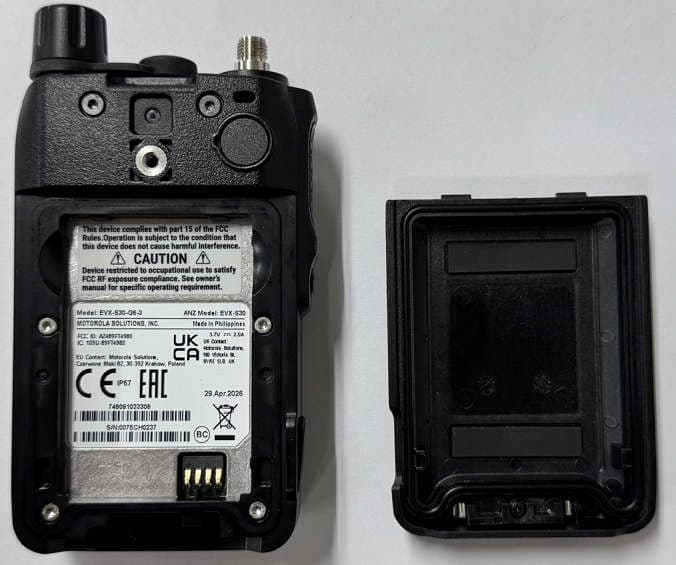
AZ489FT4980
Sep 08, 2026Portable two way radio
Equipment Class
TNF - Licensed Non-Broadcast Transmitter Held to FaceAZ489FT4981
Aug 14, 2026Handheld Portable - TANAPA BPR 45 400-470 MHZ 4W NKP
Equipment Class
TNF - Licensed Non-Broadcast Transmitter Held to Face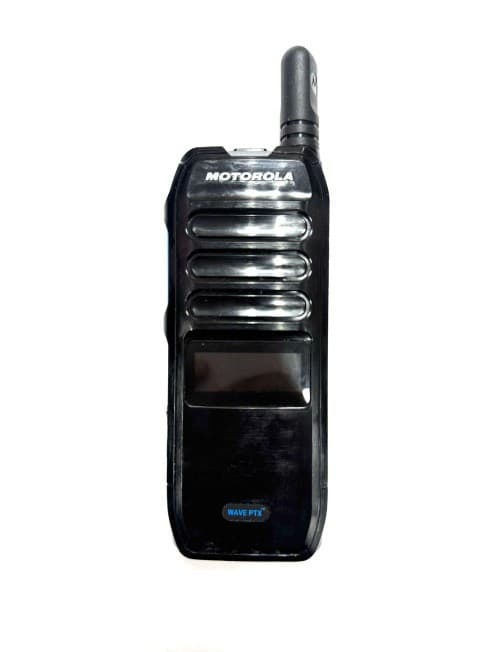
AZ489FT7187
Jul 13, 2026Portable 2-Way Radio with Bluetooth, Bluetooth LE, WIFI 2.4GHz, WIFI 5GHz, LTE
Equipment Class
DSS - Part 15 Spread Spectrum TransmitterAZ499FT6031
May 11, 2026Operation Critical Wireless Earpiece PTT
Equipment Class
DSS - Part 15 Spread Spectrum Transmitter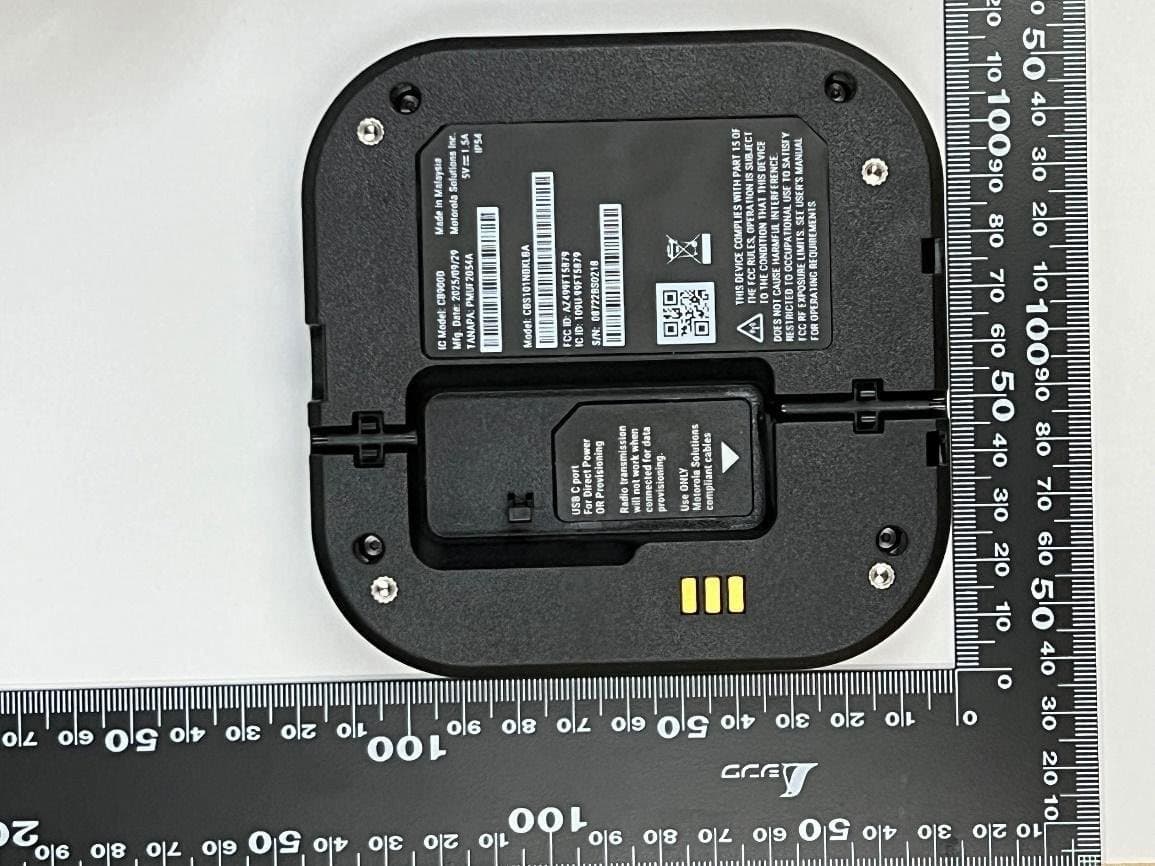
AZ499FT5879
Dec 19, 20252-way Portable Radio with BT, BTLE, WIFI, NFC and LTE
Equipment Class
DSS - Part 15 Spread Spectrum Transmitter