CB2CSHL3Universal Garage Door Opener
Johnson Controls Interiors L.L.C.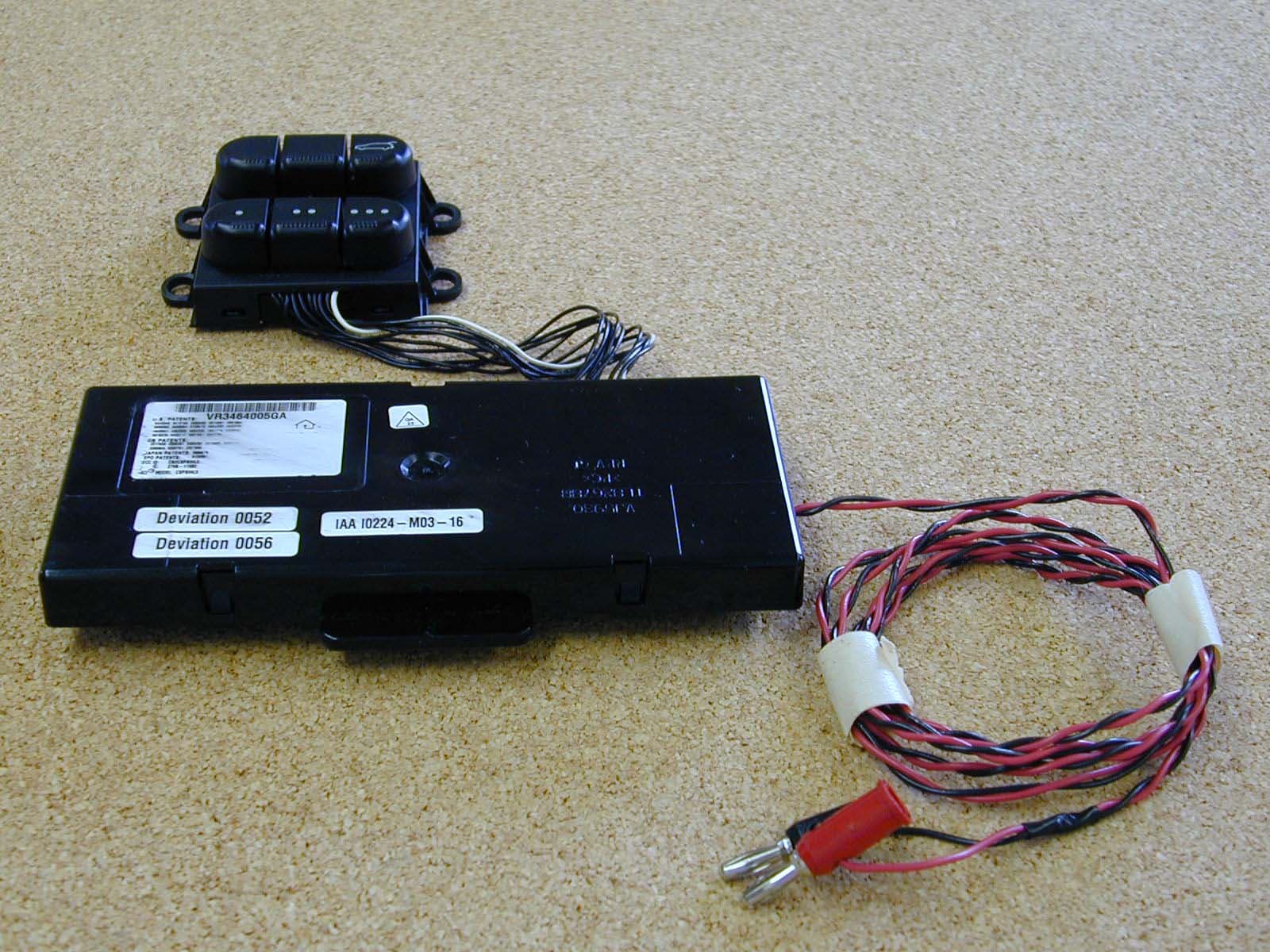
Click to zoom
Application Details
- Equipment Class
- DSC - Part 15 Security/Remote Control Transmitter
- Date of Grant
- May 22, 2003
- Application Purpose
- Original Equipment
- Date of Application
- Apr 26, 2003
- Equipment Note
- Universal Garage Door Opener
- Frequency Range
- 288.00000000 - 418.00000000
- Country
- United States
Documents & Files
Document Text
Text extracted from the exhibit documents filed with the FCC. Open a document above to read the original.
Users Manual
Re: Certification for JCI CSHL3 Transmitter Model: CSHL3 FCC ID: CB2CSHL3 IC: 279B-CSHL3 USER'S MANUAL INFORMATION (PRELIMINARY) The User's Manual is in preparation. The following material will be contained in the manual: FCC ID: CB2CSHL3 IC: 279B-CSHL3 This device complies with Part 15 of the FCC Rules and with RSS-210 of Industry Canada. Operation is subject to the following two conditions: (1) This device may not cause harmful interference, and (2) This device must accept any interference received, including interference that may cause undesired operation. WARNING: Changes or modifications not expressively approved by the party responsible for compliance could void the user's authority to operate the equipment. The term “IC:” before the radio certification number only signifies that Industry Canada technical specifications were met.
Attestation Statements
Re: Certification for JCI CSHL3 Transmitter Model: CSHL3 FCC ID: CB2CSHL3 IC: 279B-CSHL3 POWER OF ATTORNEY A letter granting Valdis V. Liepa the Power of Attorney is on file and can be provided when so requested. Re: Certification for JCI CSHL3 Transmitter Model: CSHL3 FCC ID: CB2CSHL3 IC: 279B-CSHL3 REQUEST FOR CONFIDENTIALITY Pursuant to 47 CRF 0.459, JCI requests that a part of the subject application be held confidential. This comprises Exhibits (5) Schematics (10) Parts List (Part of Exhibit only) JCI has spent substantial effort in developing this product and it is one of the first of its kind in industry. Having the subject information easily available to "competition" would negate the advantage they have achieved by developing this product. Not protecting the details of the design will result in financial hardship. If there are any questions regarding this request, please contact me at the above address or call 734-483-4211, fax 734-647-2106 or e-mail [email protected]. Sincerely, Valdis V. Liepa Research Scientist University of Michigan April 27, 2003 Re: Certification for JCI CSHL3 Transmitter Model: CSHL3 FCC ID: CB2CSHL3 IC: 279B-CSHL3 STATEMENT OF MODIFICATIONS There were no modifications made to the DUT by this test laboratory. (Also see Section 3.1 of the attached Test Report). _____________________ Valdis V. Liepa Research Scientist Re: Certification for JCI CSHL3 Transmitter Model: CSHL3 FCC ID: CB2CSHL3 IC: 279B-CSHL3 GENERAL PRODUCT INFORMATION The device, for which certification is pursued, has been designed by: Johnson Controls Interiors L.L.C. One Prince Center Holland, MI 49423 Jeremy Bos Tel: (616) 394-6076 Fax: 616-394-6100 It will be manufactured by: Johnson Controls Interiors L.L.C. One Prince Center Holland, MI 49423 Jeremy Bos Tel: (616) 394-6076 Fax: 616-394-6100 Canadian Contact: Lakeshore Plant 477 Jutras Drive South Tecumseh, ON N8N 5C4 Tel: 519-727-2341 Fax: 519-727-4750
Block Diagram
ASIC HLIII EEPROM HLIII/PSI CORE INFO MICRO CONTROLLER RF FUNCTIONS HLIII/PSI MICRO CONTROLLER SYSTEM FUNCTIONS J1850 HL USER INTERFACE DIAGNOSTICS J1850 TRANCIEVER POWER SUPPLY & TRANSIENT PROTECTION SWITCH INTERFACE Dot Matrix Display C O N N E C T O R BATT IGNITION GROUND CLASSII/J1850 Homelink Antenna INTEGRATED HOMELINK/PSI SYSTEM J1850 INTERFACE PACKAGE PROTECTED COMPASS ASIC S 1 S 2 Antenna Tunning 433.92MHz PSI Antenna Low Noise Amplifier DUTY CYCLE WAKEUP CIRCUIT LOW CURRENT POWER SUPPLY Switch Battery to Ignition when Ignition is off and Homelink is activated. SAW BAND PASS FILTER High Accuracey and Low Current VCO
Cover Letter(s)
April 27, 2003 Federal Communications Commission Equipment Approval Services P.O. Box 358315 Pittsburgh, PA 15251-5315 Re: Certification for JCI CSHL3 Transmitter Model: CSHL3 FCC ID: CB2CSHL3 IC: 279B-CSHL3 Please find enclosed application materials for certification of JCI CSHL3 Transmitter. We tested it and found it to comply with FCC Part 15. If there are any questions regarding the application or testing performed, please contact me at the above address or call 734-483-4211, fax 734-647-2106, or e-mail [email protected]. Sincerely, Valdis V. Liepa Research Scientist April 27, 2003 Certification and Engineering Bureau Industry Canada 3701 Carling Avenue, Bldg. 94 Ottawa, Ontario K2H 8S2 Re: Certification for JCI CSHL3 Transmitter Model: CSHL3 FCC ID: CB2CSHL3 IC: 279B-CSHL3 Please find enclosed application materials for certification of JCI CSHL3 Transmitter. We tested the device and found it to comply with RSS-210. The product is identified by: IC: 279B-CSHL3 If there are any questions, suggestions, etc., regarding the application or testing performed, please contact me at the above address or call 734-483-4211, fax 734-647- 2106; e-mail: [email protected]. Sincerely, Valdis V. Liepa Research Scientist
ID Label/Location Info
AC U.S. PATENTS: JAPAN PATENTS: GB PATENTS: EPO PATENTS:
Operational Description
CS Compass Mini-Trip Computer Module Description of Operation The CS module consists of two basic sections: the Compass Mini-Trip Computer (CMTC) section, and the Homelink section. The CMTC section provides data to the vehicle via the bus, the vehicle then displays the information on the instrument panel. There are three switches on board, which allow the user to select Homelink operation. The CMTC microprocessor powers up the Homelink section, and communicates to the Homelink microprocessor which channel has been selected. The CMTC sends messages out on the J-1850 bus and then a display in the IP provides the information to the driver. The Homelink transmitter is a radio frequency transceiver device whose primary function is to determine both frequency and bit code format of typical garage door remote control devices and identically re-transmit them to the original garage door opener receiver. The on-board microcontroller maintains the operational frequency band as 288Mhz to 418Mhz excluding forbidden bands of 240MHz to 285MHz, 322MHz to 335.4MHz and 399.9MHz to 410 MHz. The “training” operation is performed by scanning the legal frequencies with a single conversion superheterodyne receiver, looking for valid garage door opener bit code formats. In addition to being frequency and data format adaptive the Homelink transmitter is also RF amplitude adaptive. During the training sequence, the duty factor of the incoming bit code format is evaluated by the microcontroller determining the greatest amount of on-time in a 100 mS window. The duty factor is then used to mathematically adjust the output power in a range of 80% (1.9dB) to an upper limit of 30% (10.5dB) duty cycle. A 9 bit attenuator is adjusted by a closed loop power control algorithm in the microcontroller. After the training sequence the frequency bit code format and attenuator setting is stored in Non Volatile Memory (NVM) and retrieved on subsequent power ups. The VCO is set on the desired RF carrier frequency stored in NVM. The antenna is fine-tuned by sweeping twice around the expected tuning point. The voltage-controlled oscillator (VCO) is then modulated with the appropriate bit code information from the NVM.
Test Report
JCI CSHL3 on OATS JCI CSHL3 on OATS (close-up)
Contact Information
Applicant
Rick Markiewicz(Electronics Engineering Manager)
Technical Contact
University of Michigan/EECSValdis V Liepa
[email protected]734 � 483 � 4211
1301 Beal Ave. · Ann Arbor, Michigan · United States
Non-Technical Contact
University of Michigan/EECSValdis V Liepa
[email protected]734 - 483 - 4211
Test Firm
University of MichiganValdis Liepa
Technical Specifications
| # | Rule Parts | Frequency Range | Power Output |
|---|---|---|---|
| 1 | 15.231(e) | 288 MHz - 418 MHz | - |
Other Applications from Johnson Controls Interiors L.L.C.

CB2-BLUE15M-TCU
Mar 20, 2014Automotive Telematics Module with Handsfree Bluetooth
Equipment Class
DSS - Part 15 Spread Spectrum Transmitter
CB2-BLUE15M
Jan 19, 2014Bluetooth Telematics Device
Equipment Class
DSS - Part 15 Spread Spectrum Transmitter
CB262932
Jul 15, 2013Automotive Electronics Infotainment Head Unit with Bluetooth and WLAN
Equipment Class
DTS - Digital Transmission System
CB2775AHL5
Apr 29, 2013Universal Garage Door Opener w/ FHSS TX
Equipment Class
DSR - Part 15 Remote Control/Security Device Transceiver
CB2440AHL5
Feb 24, 2013Universal Garage Door TX w/ FHSS TX
Equipment Class
DSS - Part 15 Spread Spectrum Transmitter