CCTH6723-05H6743 STAR STATION
Fisher-Price Inc.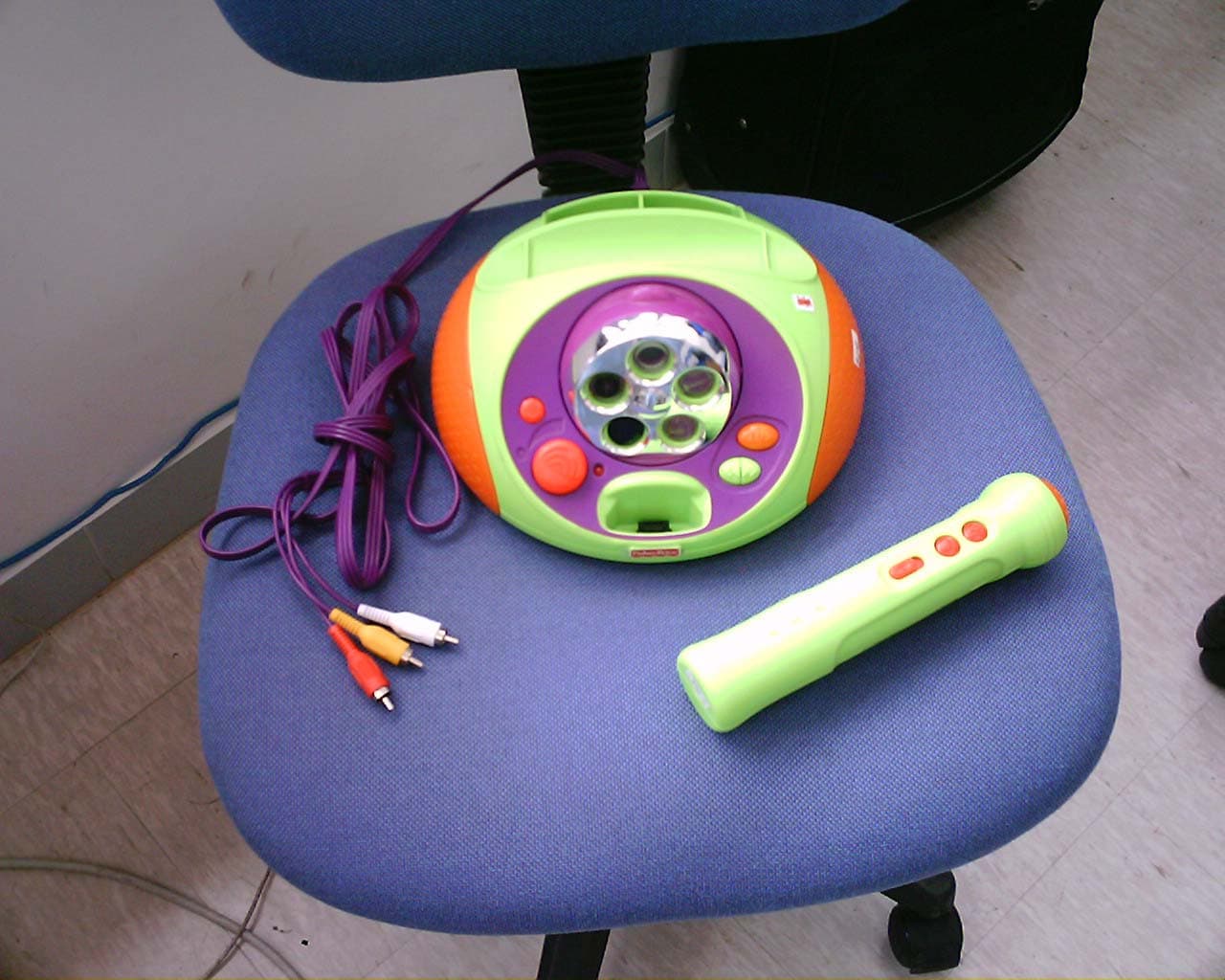
Click to zoom
Application Details
- Equipment Class
- DXX - Part 15 Low Power Communication Device Transmitter
- Date of Grant
- May 24, 2005
- Application Purpose
- Original Equipment
- Date of Application
- May 24, 2005
- Equipment Note
- H6743 STAR STATION
- Frequency Range
- 916.50000000 - 916.50000000
- Company
- Fisher-Price Inc.
- Country
- United States
Documents & Files
Document Text
Text extracted from the exhibit documents filed with the FCC. Open a document above to read the original.
Users Manual
1 H6723 Instructions Please keep this instruction sheet for future reference, as it contains important information. Requires six “C” (LR14) and three “AAA” (LR03) alkaline batteries (not included). An adult must install batteries and set-up this system for use. Tool required for battery installation: Phillips screwdriver (not included). Today’s most popular songs sung by kids for kids ™ TV not included. F e a t u r i n g h i t m u s i c f r o m 2 Battery Installation Base Unit • Locate the battery compartment on the bottom of the base unit. • Loosen the screws in the battery compartment door with a Phillips screwdriver. Remove the battery compartment door. • Insert six “C” (LR14) alkaline batteries, as indicated inside the battery compartment. Hint: We recommend using alkaline batteries for longer life. • Replace the battery compartment door and tighten the screws with a Phillips screwdriver. Do not over-tighten. • When images on your TV screen appear grainy or lose color, it's time for an adult to change the batteries! 1.5V x 6 “C” (LR14) Shown Actual Size Microphone • Locate the battery compartment on the microphone. • Loosen the screw in the battery compartment door with a Phillips screwdriver. Remove the battery compartment door. • Insert three “AAA” (LR03) alkaline batteries, as indicated inside the battery compartment. Hint: We recommend using alkaline batteries for longer life. • Replace the battery compartment door and tighten the screw with a Phillips screwdriver. Do not over-tighten. It's time for an adult to change the batteries in the microphone when: • Power light on microphone becomes dim. • Sounds from the microphone become faint or stop. • Lenses stop rotating. 1.5V x 3 “AAA” (LR03) Shown Actual Size 3 Battery Safety Information In exceptional circumstances, batteries may leak fl uids that can cause a chemical burn injury or ruin your product. To avoid battery leakage: • Do not mix old and new batteries or batteries of different types: alkaline, standard (carbon-zinc) or rechargeable (nickel-cadmium). • Insert batteries as indicated inside the battery compartment. • Remove batteries during long periods of non-use. Always remove exhausted batteries from the product. Dispose of batteries safely. Do not dispose of batteries in a fi re. The batteries may explode or leak. • Never short-circuit the battery terminals. • Use only batteries of the same or equivalent type, as recommended. • Do not charge non-rechargeable batteries. • Remove rechargeable batteries from the product before charging. • If removable, rechargeable batteries are used, they are only to be charged under adult supervision. FCC Note (United States Only) Note: This equipment has been tested and found to comply with the limits for a Class B digital device, pursuant to Part 15 of the FCC Rules. These limits are designed to provide reasonable protection against harmful interference in a residential installation. This equipment generates, uses and can radiate radio frequency energy and, if not installed and used in accordance with the instructions, may cause harmful interference to radio communications. However, there is no guarantee that interfer- ence will not occur in a particular installation. If this equipment does cause harmful interference to radio or television reception, which can be determined by turning the equipment off and on, the user is encouraged to try to correct the interference by one or more of the following measures: • Reorient or relocate the receiving antenna. • Increase the separation between the equipment and receiver. • Consult the dealer or an experienced radio/TV technician for help. Note: Changes or modifi cations not expressly approved by the manufacturer responsible for compliance could void the user's authority to operate the equipment. StarStation™ Entertainment System Model Number: H6723 This device complies with Part 15 of the FCC Rules. Operation is subject to the following two conditions: (1) This device may not cause harmful interference and (2) this device must accept any interference received, including interference that may cause undesired operation. Consumer Relations Department, 636 Girard Avenue, East Aurora, New York 14052 4 Connecting Your Star Station ™ to Your TV or VCR Power/Volume Reset ROM Cartridge Special Effects Lenses Power/Volume Rotate Effect Lens Select Track Forward/Back Play/Pause Audio/Video Cable Important! Your TV or VCR must have audio and video input jacks. 5 • Position Star Station ™ near your TV (or VCR) or on the fl oor in front of your TV. Important! Do not place Star Station ™ on top of your TV. Keep excess cable off the fl oor and out of the way. • Make sure the power/volume dial on Star Station ™ is off. The power light should be off. • Turn your TV or VCR off. Power/Volume Dial Power Light 1 2 • Locate the audio/video cable on the back of Star Station ™ . • Plug the audio/video pins into the matching colored input jacks on your TV or VCR (Yellow for VIDEO IN, White for LEFT AUDIO IN and Red for RIGHT AUDIO IN). Note: We've included a detailed illustration to show how to connect Star Station ™ to a TV or TV and VCR. Please refer to page 11. 3 Note: The photo above sho ws a combination TV/VCR/DVD with input jacks on the fr ont. Your TV or VCR may have input jacks on the back. 6 • Rotate the power/volume dial to turn power on. The power light turns on. • Turn your TV or VCR on. Power/Volume Dial 5 • To fi nd the picture transmitted on your TV screen, set your TV's or VCR's mode selector to INPUT or VIDEO IN. • Have your child stand about 4 or 5 feet from Star Station ™ . • Move the lens up or down until your child is visible on the TV screen. 6 • Insert the ROM cartridge into the slot in Star Station ™ . Note: For proper function, turn the Star Station ™ off before inserting ROM cartridges. 4 4 to 5 Feet 7 No Image? If you do not see an image on your TV screen transmitted from Star Station ™ , try the following: 1. Verify that your audio and vid…
Text truncated - open the document above for the full version.
Internal Photos
Fisher-Price H6723 Receiver with Shielding Can – Top View Fisher-Price H6723 Receiver with Shielding Can removed – Top View Fisher-Price H6723 Receiver with Small Shielding Can – Bottom View Fisher-Price H6723 Receiver with Small Shielding Can removed– Bottom View Fisher-Price H6723 Transmitter with Shielding Can – Top View Fisher-Price H6723 Transmitter with Shielding Can Removed – Top View Fisher-Price H6723 Transmitter – Bottom View
Test Report
• P.O. Box 489 • 1350 Tolland Road • Rollinsville, CO 80474 • Phone: (303) 258-0100 • FAX: (303) 258-0775 • • www.criteriontech.com • CONFIDENTIAL AND PROPRIETARY NVLAP LAB CODE 100396-0 EMC QUALIFICATION TEST REPORT FISHER-PRICE, INC STAR STATION, H6723 TESTED TO CONFORM WITH: Emissions Standards for INFORMATION TECHNOLOGY EQUIPMENT (ITE) TEST REPORT NUMBER: 050429-893 DATE OF ISSUE: MAY 17, 2005 DATE OF TEST COMPLETION: APRIL 30, 2005 MANUFACTURER’S ADDRESS: 636 GIRARD AVENUE EAST AURORA, NEW YORK 14052 PHONE: (716)687-3835 Approved by: Laboratory Director Sheet 2 of 20 EMC QUALIFICATION TEST REPORT CRITERION TECHNOLOGY 050429-893 FOR Fisher-Price, Inc CONFIDENTIAL AND PROPRIETARY DISCLAIMERS This report is the confidential property of the client. For the protection of our clients and ourselves, extracts from this test report cannot be produced without prior written approval from Criterion Technology. Reproduction of the complete report can be performed at the client’s discretion. The client is aware that Criterion Technology has performed testing in accordance with the applicable standard(s). Test data is accurate within ANSI parameters for Emissions testing, unless a specific level of accuracy has been defined in writing prior to testing, by Criterion Technology and the client. Criterion Technology reports apply only to the specific Equipment Under Test (EUT) sample(s) tested under the test conditions described in this report. If the manufacturer intends to use this report as a document demonstrating compliance of this model, additional models of this product must have electrical and mechanical characteristics identical to the device tested for this report. Criterion Technology shall have no liability for any deductions, inferences, or generalizations drawn by the client or others from Criterion Technology issued reports. Total liability is limited to the amount invoiced for the testing of this EUT and the contents of this report are not warranted. Compliance with the appropriate governmental standards is the responsibility of the manufacturer. Any questions regarding this report should be directed to: Laboratory Director Criterion Technology Corp. P.O. Box 489 1350 Tolland Road Rollinsville, Colorado 80474 Phone: (303) 258-0100 Fax: (303) 258-0775 mailto:[email protected] NVLAP Note: Criterion Technology is accredited by the National Voluntary Laboratory Accreditation Program (NVLAP) for the specific scope of accreditation under Lab Code 100396-0. Test methods included in Lab Code 100396-0 are: 12/CIS22 - IEC/CISPR22 (1997) and En 55022 (1998) 12/CIS22a - IEC/CISPR22 (1993), Amendment 1:1995 & Amendment 2: 1996 12/CIS22b - CNS13438 (1997) 12/EM02a – IEC 61000-3-2, Edition 2.1 (2001-10) and EN 61000-3-2 (2000) 12/EM03 – EN 61000-3-3 (1995) and IEC 61000-3-3 (1995) 12/F01 – ANSI C63.4 (2001) – cited in FCC Method - 47 CFR Part 15 - Digital Devices 12/F01a - Conducted Emissions, Power Lines, 150 kHz to 30 MHz 12/F01b - Radiated Emissions 12/T51 - AS/NZS 3548 12/I01 – IEC 61000-4-2 (1995) and Amendment 1 (1998) 12/I02 – IEC 61000-4-3 (1995) and Amendment 1 (1998) 12/I03 – IEC 61000-4-4 (1995) 12/I04 – IEC 61000-4-5 (1995) 12/I05 – IEC 61000-4-6 (1996) 12/I06- - IEC 61000-4-8 (1993) 12/I07 – IEC 61000-4-11 (1994) The NVLAP Logo on the front cover of this report applies only to data taken for the above test methods. This report may contain data which is not covered by the NVLAP accreditation. This report must not be used by the client to claim product endorsement by NVLAP or any agency of the U.S. Government. Criterion Technology has been accredited by the following groups: NVLAP, BSMI, NMi (EU Competent Body Accreditation) and Industry Canada. The National Institute for Standards and Technology (NIST) has designated Crite- rion Technology a Conformity Assessment Body (CAB) for Taiwan (BSMI # SL2-IN-E-007R). ALL CRITERION TECHNOLOGY INSTRUMENTATION AND ACCESSORIES USED TO TEST PRODUCTS FOR COMPLIANCE TO THE INDICATED STANDARDS ARE CALIBRATED REGULARLY IN ACCORDANCE WITH ISO 9001, ISO GUIDE 25, ANSI/NCSL Z540-I-1994 AND ARE TRACEABLE TO NATIONAL STANDARDS. CRITERION TECHNOLOGY EMC QUALIFICATION TEST REPORT Sheet 3 of 20 050429-893 FOR Fisher-Price, Inc CONFIDENTIAL AND PROPRIETARY TABLE OF CONTENTS 1.0 EXECUTIVE SUMMARY....................................................................................................................................................4 1.1 PURPOSE................................................................................................................................................................................4 1.2 CONFORMITY......................................................................................................................................................................4 1.3 EQUIPMENT UNDER TEST (EUT).................................................................................................................................4 2.0 EMISSIONS TEST STANDARDS......................................................................................................................................5 2.1 UNINTENTIONAL RADIATED EMISSIONS – 30 MHZ TO 1000 MHZ...............................................................5 2.2 INTENTIONAL RADIATOR..............................................................................................................................................6 3.0 APPENDIX A: EUT PHOTOGRAPHS...........................................................................................................................7 3.1 UNINTENTIONAL RADIATED EMISSIONS...............................................................................................................7 3.2 INTENTIONAL RADIATOR..............................................................................................................................................8 3.3 INTENTIONAL RADIATOR..................................................…
Text truncated - open the document above for the full version.
Test Setup Photos
CRITERION TECHNOLOGY EMC QUALIFICATION TEST REPORT Sheet 7 of 20 050429-893 FOR Fisher-Price, Inc CONFIDENTIAL AND PROPRIETARY 3.0 APPENDIX A: EUT PHOTOGRAPHS 3.1 UNINTENTIONAL RADIATED EMISSIONS Sheet 8 of 20 EMC QUALIFICATION TEST REPORT CRITERION TECHNOLOGY 050429-893 FOR Fisher-Price, Inc CONFIDENTIAL AND PROPRIETARY 3.2 INTENTIONAL RADIATOR CRITERION TECHNOLOGY EMC QUALIFICATION TEST REPORT Sheet 9 of 20 050429-893 FOR Fisher-Price, Inc CONFIDENTIAL AND PROPRIETARY 3.3 INTENTIONAL RADIATOR
Contact Information
Applicant
Jerry Miller(Quality Staff Engineer)
Test Firm
Criterion Technology Corp.Lou Schornack
Technical Specifications
| # | Rule Parts | Frequency Range | Power Output |
|---|---|---|---|
| 1 | 15C | 916.5 MHz - 916.5 MHz | - |
Other Applications from Fisher-Price Inc.

CCT-DNV31-15
Sep 29, 2015Smart Toy Bear (DNV31), Smart Toy Panda (DNV30), Smart Toy Monkey (DNV32)
Equipment Class
DXX - Part 15 Low Power Communication Device Transmitter
CCT-CBV76-14
Jun 22, 2014Mattel Bluetooth Low Energy Module
Equipment Class
DTS - Digital Transmission System
CCTT4841T-10
Jul 27, 2010Digital Audio Monitor (Baby Unit)
Equipment Class
DSS - Part 15 Spread Spectrum Transmitter
CCTT4256T-10
Jul 22, 2010Digital Video Monitor (Baby Unit)
Equipment Class
DSS - Part 15 Spread Spectrum Transmitter
CCTT4256R-10
Jul 21, 2010Digital Video Monitor (Parent Unit)
Equipment Class
DSS - Part 15 Spread Spectrum Transmitter