M3N32297200Auto Ignition Immobolizer Transmitter
Continental Automotive Systems, Inc.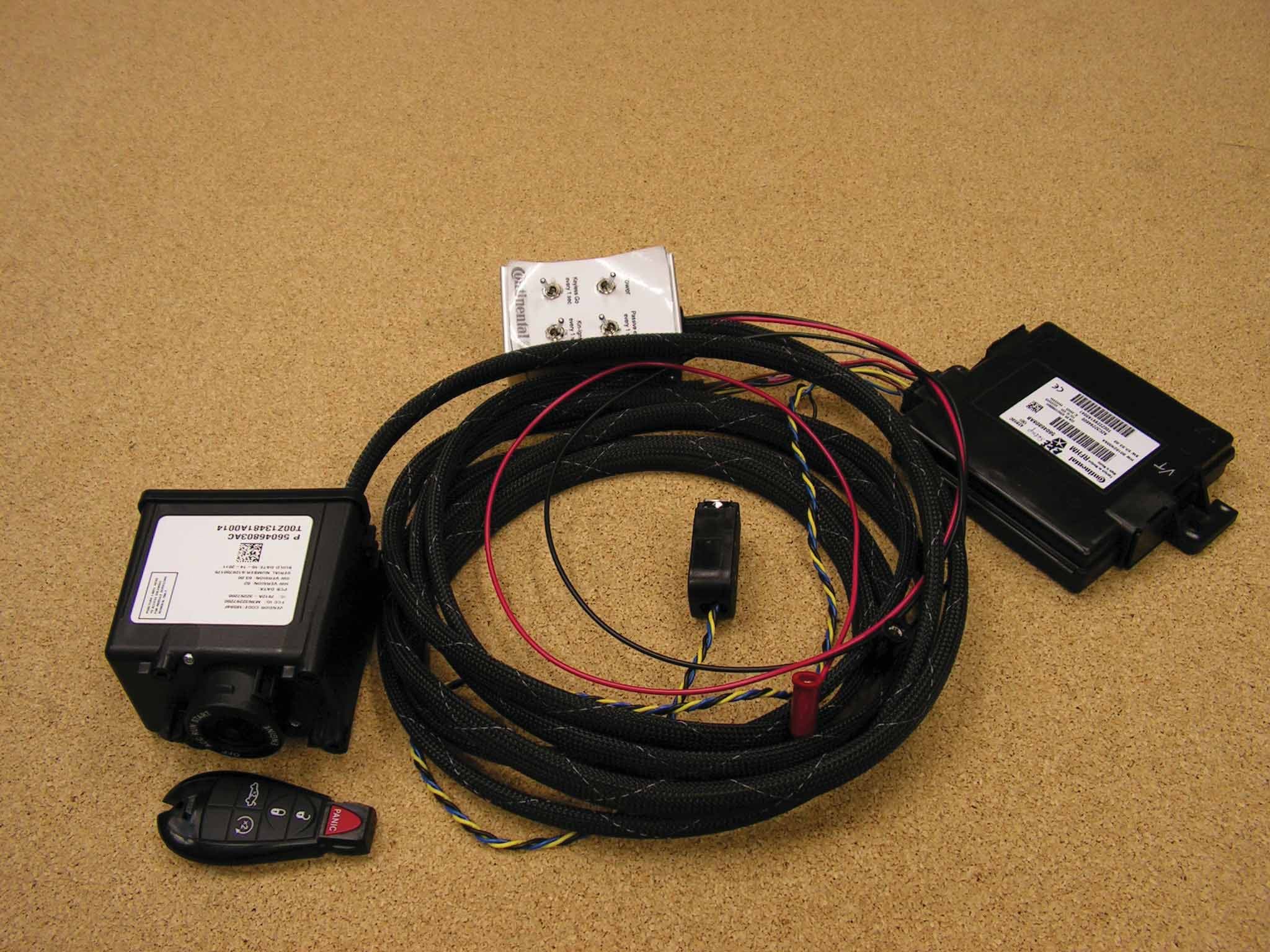
Click to zoom
Application Details
- Equipment Class
- DCD - Part 15 Low Power Transmitter Below 1705 kHz
- Date of Grant
- Apr 01, 2012
- Application Purpose
- Original Equipment
- Date of Application
- Apr 01, 2012
- Equipment Note
- Auto Ignition Immobolizer Transmitter
- Frequency Range
- 0.12500000 - 0.12500000
- Country
- United States
Documents & Files
Document Text
Text extracted from the exhibit documents filed with the FCC. Open a document above to read the original.
Users Manual
February 23, 2012 Continental 4685 Investment Dr. Troy, MI 48098 Phone: 248-764 -6712 Fax: 248-764- 7226 Re: Certification for Chrysler CUSW IGNM FCC ID: M3N32297200 IC: 7812A-32297200 PN: 56046803AD The device under test is manufactured by the grantee Continental and sold as an OEM product. Per 47 CFR 2.909, 2.927, 2.931, 2.1033, 15.15(b) etc..., the grantee must ensure the end-user has all applicable / appropriate operating instructions. When end-user instructions are required, as is the case with this product, the grantee must notify the OEM to notify the end-user. Continental will supply the following information to the reseller/distributor dictating what must be included in the end user’s manual for the commercial product. INFORMATION TO BE INCLUDED IN THE END USER'S MANUAL The following information (in blue) must be included in the end product user’s manual to ensure continued FCC and Industry Canada regulatory compliance. The ID numbers must be included in the manual if the device label is not readily accessible to the end user. The compliance paragraphs (in blue) below must be included in the user's manual. ************************************************************************ FCC ID: M3N32297200 IC : 7812A-32297200 Thi s device complies with Part 15 of the FCC Rules and with Industry Canada license-exempt RSS standard(s). Operation is subject to the following two conditions: (1) This device may not cause harmful interference, and (2) This device must accept any interference received, including interference that may cause undesired operation. Le présent appareil est conforme aux CNR d'Industrie Canada applicables aux appareils radio exempts de licence. L'exploitation est autorisée aux deux conditions suivantes: (1) l'appareil ne doit pas produire de brouillage, et (2) l'utilisateur de l 'appareil doit accepter tout brouillage radioélectrique subi, même si le brouillage est susceptible d'en compromettre le fonctionnement. Note: Changes or modifications not expressively approved by the party responsible for compliance could void the user's authority to operate the equipment. The term “IC:” before the radio certification number only signifies that Industry Canada technical specifications were met.
Cover Letter(s)
March 30, 2012 Federal Communications Commission Equipment Approval Services P.O. Box 358315 Pittsburgh, PA 15251-5315 Re: Certification for Continental Transmitter Model/PN(s): 56046803AD FCC ID: M3N32297200 IC: 7812A-32297200 Please find enclosed application materials for certification of Continental Transmitter. We tested it and found it to comply with FCC Part 15. If there are any questions regarding the application or testing performed, please contact me at the above address or call 734-483-4211, fax 734-647-2106, or e-mail [email protected]. Sincerely, Valdis V. Liepa Research Scientist
Cover Letter(s)
[email protected] [email protected] 248 764 6522 248 764 7281
Cover Letter(s)
Re: Certification for Continental Transmitter FCC ID: M3N32297200 IC: 7812A-32297200 REQUEST FOR CONFIDENTIALITY Pursuant to FCC 47 CRF 0.457(d) and 0.459 and IC RSP-100, Section 10, Continental requests that a part of the subject application be held confidential. Continental has spent substantial effort in developing this product and it is one of the first of its kind in industry. Having the subject information easily available to "competition" would negate the advantage they have achieved by developing this product. Not protecting the details of the design will result in financial hardship. Type of Confidentiality Requested Exhibit Short Term Permanent (1) ID Label & Location Short Term Permanent (3) External Photos Short Term Permanent 1 (4) Block Diagram Short Term Permanent (5) Schematics Short Term Permanent (7) Test Setup Photos Short Term Permanent (8) User’s Manual Short Term Permanent (9) Internal Photos Short Term Permanent (10) Parts List & Placement Short Term Permanent (11) RF Exposure Short Term Permanent (12) Description of Operation 1. Block Diagram includes internal oscillator frequency information that the manufacturer considers to be proprietary. Permanent Confidentiality: Continental requests the exhibits listed above as permanently confidential be permanently withheld from public review. Short-Term Confidentiality (FCC Only): Continental requests the exhibits selected above as short term confidential be withheld from public view for a period of 45 days from the date of the Grant of Equipment Authorization and prior to marketing. If there are any questions regarding this request, please contact me at the above address or call 734-483-4211, fax 734-647-2106 or e-mail [email protected]. Sincerely, Valdis V. Liepa, Research Scientist University of Michigan
Operational Description
The Ignition Node Module (IGNM) contains the customer interface for the vehicle ignition switch activation. The IGNM interfaces with the FOBIK by way of LF and interfaces with the Radio Frequency Hub Module (RFHM) via KIN LINE using LIN 2.1 base protocol for Immobilizer activation. Additionally, the IGNM communicates ignition switch status – Key-In, Accessory, RUN, and Start to the RFHM via the KIN LINE. The RFHM then communicates the ignition switch status to the rest of the vehicle over the CAN C bus. The IGNM prevents the rotation of the ignition switch to the Lock/OFF position when commanded via the KIN LINE by the RFHM. The IGNM module does not contain any CAN driver components, only LIN 2.1 base protocol to communicate directly to the RFHM. The IGNM module provides the following functions: 1. FOBIK Validation and Vehicle Immobilization. 2. Provide the ignition Run-Start signal to the RFHM module when the Ignition switch is in RUN or START position. 3. Provide ignition switch status and immobilizer data via KIN LINE to the RFHM. 4. Prevents the rotation of the ignition switch to the Lock/OFF position when commanded via the KIN LINE by the RFHM.
Test Report
University of Michigan Radiation Laboratory FCC Part 15, IC RSS-210/Gen - Test Report No. 417124-622 Page 1 of 13 The University of Michigan Radiation Laboratory 3228 EECS Building Ann Arbor, MI 48109-2122 Tel: (734) 764-0500 Fax: (734) 647-2106 Measured Radio Frequency Emissions From Continental Automotive Systems US Inc. Transmitter FCC ID: M3N32297200 IC: 7812A-32297200 Test Report No. 417124-622 March 30, 2012 Copyright © 2012 For: Continental Automotive Systems US Inc. 2400 Executive Hills Drive Auburn Hills Michigan 48326-2980 Contact: Andrew Martin [email protected] Phone: (248) 764-6522 Fax: (248) 764-7281 Testing supervised by: Measurements made by: Valdis V. Liepa Report Approved by:__________________________ Valdis V. Liepa Test report written by: Valdis V. Liepa Research Scientist Summary Tests for compliance with FCC Regulations, CFR 47, Part 15 and with Industry Canada RSS-210/Gen, were performed on a Continental, FCC ID: M3N32297200, IC: 7812A-32297200. This device under test (DUT) is subject to the rules and regulations as a Transmitter. In testing completed on February 10, 2012, the DUT tested met the allowed specifications for radiated emissions by 35.7 dB. AC Mains conducted emissions are not subject to regulation as the DUT is powered by a 12 VDC vehicular system. University of Michigan Radiation Laboratory FCC Part 15, IC RSS-210/Gen - Test Report No. 417124-622 Page 2 of 13 Table of Contents 1. Introduction ...................................................................................................................................... 3 2. Equipment Used ............................................................................................................................... 3 3. Device Under Test ........................................................................................................................... 4 3.1 Description & Block Diagram .............................................................................................. 4 3.2 Samples & Variants .............................................................................................................. 4 3.3 Modes of Operation .............................................................................................................. 4 3.4 Exemptions ........................................................................................................................... 4 3.5 EMC Relevant Modifications ............................................................................................... 4 4. Emissions Limits .............................................................................................................................. 5 4.1 Radiated Emissions Limits .................................................................................................... 5 5. Measurement Procedures ................................................................................................................. 6 5.1 Semi-Anechoic Chamber Radiated Emissions ...................................................................... 6 5.2 Outdoor Radiated Emissions ................................................................................................. 6 5.3 Radiated Field Computations ................................................................................................ 6 5.4 Indoor Power Line Conducted Emissions ............................................................................. 6 5.5 Supply Voltage Variation ...................................................................................................... 7 6. Test Results ...................................................................................................................................... 7 6.1 Radiated Emissions ............................................................................................................... 7 6.1.1 Correction for Pulse Operation ......................................................................................... 7 6.1.2 Emission Spectrum ........................................................................................................... 7 6.1.3 Emission Bandwidth ......................................................................................................... 7 6.1.4 Supply Voltage and Supply Voltage Variation ................................................................. 7 6.2 Conducted Emissions ............................................................................................................ 7 University of Michigan Radiation Laboratory FCC Part 15, IC RSS-210/Gen - Test Report No. 417124-622 Page 3 of 13 1. Introduction This Continental Transmitter was tested for compliance with FCC Regulations, Part 15, adopted under Docket 87-389, April 18, 1989 as subsequently amended, and with Industry Canada RSS-210/Gen, Issue 8. Tests were performed at the University of Michigan Radiation Laboratory Willow Run Test Range following the procedures described in ANSI C63.4-2003 "Methods of Measurement of Radio-Noise Emissions from Low-Voltage Electrical and Electronic Equipment in the Range of 9 kHz to 40 GHz". The Site description and attenuation characteristics of the Open Site facility are on file with FCC Laboratory, Columbia, Maryland (FCC Reg. No: 91050) and with Industry Canada, Ottawa, ON (File Ref. No: IC 2057A-1). 2. Equipment Used The test equipment commonly used in our facility is listed in Table 2.1. Except where indicated as a pre- test, monitoring, or support device; all equipment listed below is a part of the University of Michigan Radiation Laboratory (UMRL) quality system. This quality system has been established to ensure all equipment has a clearly identifiable classification, calibration expiry date, and that all calibrations are traceable to national standards. Table 2.1 Test Equipment. Test Instrument Used Manufacturer/Model Q Number Spectrum Analyzer (9kHz-26GHz) Hewlett-Packar…
Text truncated - open the document above for the full version.
Contact Information
Applicant
Mark Kenney
Technical Contact
University of Michigan/EECSValdis V. Liepa
[email protected]734-483-4211
1301 Beal Avenue · Ann Arbor · United States
Test Firm
University of MichiganValdis Liepa
Technical Specifications
| # | Rule Parts | Frequency Range | Power Output |
|---|---|---|---|
| 1 | 15C | 0.125 MHz - 0.125 MHz | - |
Other Applications from Continental Automotive Systems, Inc.
M3NA2C786860
Dec 03, 2023LF Transmitter
Equipment Class
DCD - Part 15 Low Power Transmitter Below 1705 kHz
M3NRHT433
Jul 04, 2022KeyFob
Equipment Class
DSC - Part 15 Security/Remote Control Transmitter
M3NRCKF2B
Apr 25, 2021RCKF2B
Equipment Class
DSC - Part 15 Security/Remote Control Transmitter
M3NWXRFHM1
Jan 28, 2021FCA WL/WS PASE System MY 2021
Equipment Class
DCD - Part 15 Low Power Transmitter Below 1705 kHz
M3NMAS433
Jan 20, 2021Car Key
Equipment Class
DSR - Part 15 Remote Control/Security Device Transceiver