NIYMWP19Wireless Optical Mouse
Dexin Corp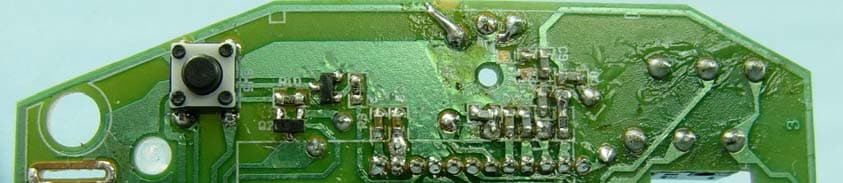
Click to zoom
Application Details
- Equipment Class
- DXX - Part 15 Low Power Communication Device Transmitter
- Date of Grant
- Jul 18, 2004
- Application Purpose
- Original Equipment
- Date of Application
- Jul 18, 2004
- Equipment Note
- Wireless Optical Mouse
- Frequency Range
- 27.04500000 - 27.04500000
- Company
- Dexin Corp
- Country
- Taiwan
Documents & Files
Document Text
Text extracted from the exhibit documents filed with the FCC. Open a document above to read the original.
Users Manual
Wireless Optical Mouse USER’S MANUAL Model #: DC-19 System Requirement Mouse compatible with standard Microsoft mode 3 rd button and wheel function require Win98/2000/ME/NT/XP Before you begin Keep this installation guide for future reference! It contains Important Troubleshooting Information. Keep your old PS/2 mouse as a back-up device. Getting Started Congratulations on your purchase of an 800dpi (or 400dpi) WIRELESS OPTICAL MOUSE. By using the advanced RF technology a 360operation is possible and no line-of-sight is required between the receiver and the mouse. The 800dpi high resolution will bring users the best operation accuracy and efficiency, especially for a display of 1024*768 or higher. It operates at twice the speed and only requires 1/4 of the space in comparison to a 400dpi mouse. Package Contains Your DC-19 Mouse package includes the following: 1. Optical Mouse 2. Receiver 3. User’s manual 4. CD-ROM Driver for Windows 98/2000/ME/NT/XP(Optional) 5. 2 AA size alkaline batteries NoteIf any part is missing, please contact your dealer for a replacement immediately. Precaution The optical mouse cannot work on a glass or mirror surface. Avoid operating this mouse on a glossy surface. Otherwise, this mouse may not operate normally. For consideration of saving battery power, it is strongly recommended to operate 1 an optical mouse on a bright surface with fine texture to obtain lower power consumption of the high illumination LED. A very dark surface will cause higher power consumption. For optimal performance, place the receiver at least 8 inches or 20 centimeters away from other electrical devices, such as the computer, the computer monitor, speakers or other external storage drives. For a better transmission distance, avoid using this device on a metal plate or desktop because a large surface of iron, aluminum, copper and other metal will act as a shield or ground to the RF antenna of the mouse and receiver. Operating on a metal surface may shorten the transmission distance. If your notebook computer has a metal (contains Al or Mg) case, the metal housing of the LCD panel will isolate partial radiation of the RF signal from the mouse. This could possibly result in reducing the distance of transmission when you operate the mouse right in front of the notebook and when the receiver is connected on the back of the notebook. However, the RF mouse should work properly while you are operating the mouse just beside your desktop computer. Installation Guide (Mouse) Step 1. Inserting the Batteries 1. Remove the battery cover by pushing down the Tab and the battery cover will spring off. 2. There are signs to indicate the polarity of the batteries. Carefully follow the signs to place the batteries. Don’t reverse the polarity! 3. Put the cover back and make sure it is firmly closed. 2 Step 2. Synchronize the RF Mouse If the mouse is in sleep mode click the mouse button once to wake it up. 1. Plug the receiver into the notebook Computer’s USB ports or into the keyboard’s USB port. 2. Bring the mouse within 1 ft range from the receiver, Hold the mouse upside-down and use a pointed object, such as a pen tip, to click the “CONNECT” button once. Do Not depress the CONNECT button longer then 1.5 seconds. (The red sensor light will go off when the “CONNECT” button is pressed down.) ! Please poke the Mouse Connect button first, and then click the receiver’s button! 2. Click 3. Click 1. Plug into USB Port 3. Click the receiver’s connect button once (located on the back of the receiver) within 5 seconds of clicking the connect button on the mouse. The LED will start blinking, when the connection is established. 4. Move the mouse around to test if it was successful. 5. If the synchronization is not successful for some reason please (1) Remove the batteries and unplug the receivers (2) Wait for 20 sec then to try the step 1 to 4 again. Note: * During normal use, please make sure that the mouse is no more than 3 ft away from the receiver in order to have reliable connection. ** The LED on the receiver will light up or blink while the mouse is being used. Operation Guide Battery low indication When the voltage level of the battery goes down under the preset level, the scrolling wheel will flash at least three times on moving or clicking the mouse. Although the mouse can still work for a while, the user, at this time, should have a new set of 3 batteries ready for replacement. Or, if the user has a companion charger base, and Two re-chargeable batteries are inside the mouse, charge the mouse as soon as possible. Power off the mouse 1. Be sure the mouse is NOT in sleep mode. If it is, press any key to wake it up. 2. Press and hold the Connect button on the bottom of the mouse for more than 2 seconds. (The red light will go off while the Connect button is depressed.) 3. Wait until the red light flash once. Release the Connect button. 4. Now, the mouse is in power off mode. No operation can be done. Power on the mouse To activate the mouse again, press the Connect button on the bottom of the mouse once. (DO NOT depress the Connect button for more than 1.5 seconds when resuming the mouse from power off mode.) The red light will turn on, and the mouse is ready for normal operation. Note: Be sure to press the connect button firmly in procedure, if the connect button is not depressed steadily the red light will be on before 2 seconds expire. This will result in a change of channel and ID. Don’t panic, just re-connect the mouse to the receiver, and follow step 4 again. Operations on power saving mode In order to conserve battery power, the mouse is designed to reduce power consumption gradually from standby mode to sleep mode, if it is not being used. Standby mode – Around 2 seconds after the mouse stops moving, it enter into standby mode. Sleep mode – If the mouse is left intact for around 8 minutes, it goes to sleep mode and shuts down the optical sensor to maintain minimum power consumption. No moving operati…
Text truncated - open the document above for the full version.
External Photos
Page 1 CONSTRUCTION PHOTO Page 2
ID Label/Location Info
~0246825 (1600x2972x16M jpeg) ~7381490 (1600x2975x16M jpeg)
Internal Photos
Page 3 Page 4 Page 5
Operational Description
FCC ID: NIYMWP19 Report No.RF930618L01 Operational Description The transmitter of the EUT (Wireless Optical Mouse) is powered by 3V Battery. The type of antenna is Internal copper trace Antenna. The output power of this device is very low. Under normal use condition, the transmitter and the receiver are quite close, so high EIRP power is neither necessary nor allowed because of interference.
Parts List/Tune Up Info
Sheet1 Part TypeDesignatorFootprint 0C6603 0.47UFC1603 0.82UHL4R10.1 2N3904Q1SOT-23 2N3906Q2SOT-23 3.3UHL1R10.1 3PC8603 4.7KR9603 4.7MR5603 4PC4603 6PC5603 10KR1603 15PC9603 22PC12603 22PC11603 27.042MX127MHZ 27PC3603 47PCx603 68R6603 76.8KHZX276.8KHZ 100KR4603 100UFC17DR 100UHL3R10.1 104C15603 104C2603 104C16603 104C13603 220KR10603 220UFC14LED 270KR3603 ATA1060U1ATA1060 EncoderZBMQ NCC7603 NCR7603 NCC10603 NCR2603 RB421D2RB421 RED LEDD1LED Page 1
Test Report
FCC ID: NIYMWP19 Report No.: RF930618L011Issued: July 06, 2004 FCC TEST REPORT REPORT NO.: RF930618L01 MODEL NO.: MWP19 RECEIVED: June 17, 2004 TESTED: June 24 ~ July 02, 2004 APPLICANT: DEXIN Corporation ADDRESS: 14F-8, No 258,Lian Cheng Rd., Chung Ho City, Taipei Hsien, Taiwan, R.O.C ISSUED BY: Advance Data Technology Corporation LAB LOCATION: No. 19, Hwa Ya 2nd rd., Kueishan, Taoyuan, Taiwan, R.O.C. This test report consists of 14 pages in total. It may be duplicated completely for legal use with the approval of the applicant. It should not be reproduced except in full, without the written approval of our laboratory. The client should not use it to claim product endorsement by CNLA or any government agencies. The test results in the report only apply to the tested sample. 0528 ILAC MRA FCC ID: NIYMWP19 Report No.: RF930618L012Issued: July 06, 2004 Table of Contents 1CERTIFICATION ......................................................................................................... 3 2SUMMARY OF TEST RESULTS................................................................................. 4 3GENERAL INFORMATION ......................................................................................... 5 3.1GENERAL DESCRIPTION OF EUT............................................................................ 5 3.2DESCRIPTION OF TEST MODES.............................................................................. 6 3.3GENERAL DESCRIPTION OF APPLIED STANDARDS ............................................. 6 3.4DESCRIPTION OF SUPPORT UNITS........................................................................ 6 3.5 CONFIGURATION OF SYSTEM UNDER TEST.......................................................... 6 4TEST PROCEDURE AND RESULT ............................................................................ 7 4.1CONDUCTED EMISSION MEASUREMENT .............................................................. 7 4.2RADIATED EMISSION MEASUREMENT ................................................................... 7 4.2.1LIMITS OF RADIATED EMISSION MEASUREMENT ................................................ 7 4.2.2TEST INSTRUMENT................................................................................................... 8 4.2.3TEST PROCEDURE ................................................................................................... 9 4.2.4DEVATION FROM TEST STANDARD ........................................................................ 9 4.2.5TEST SETUP ............................................................................................................ 10 4.2.6EUT OPERATING CONDITION ................................................................................ 10 4.2.7TEST RESULTS ........................................................................................................ 11 5PHOTOGRAPHS OF THE TEST CONFIGURATION ............................................... 13 6INFORMATION ON THE TESTING LABORATORIES .............................................. 14 FCC ID: NIYMWP19 Report No.: RF930618L013Issued: July 06, 2004 1 CERTIFICATION PRODUCT NAME : Wireless Optical Mouse BRAND NO: DEXIN MODEL NO. : MWP19 APPLICANT : DEXIN Corporation TESTED: June 24 ~ July 02, 2004 TEST ITEM : Engineering Sample STANDARDS : FCC Part 15, Subpart C(15.227) ANSI C63.4-2001 The above equipment has been tested by Advance Data Technology Corporation, and found compliance with the requirement of the above standards. The test record, data evaluation & Equipment Under Test (EUT) configurations represented herein are true and accurate accounts of the measurements of the sample’s EMC characteristics under the conditions specified in this report. FCC ID: NIYMWP19 Report No.: RF930618L014Issued: July 06, 2004 2 SUMMARY OF TEST RESULTS The EUT has been tested according to the following specifications: APPLIED STANDARD: FCC Part 15, Subpart C STANDARD PARAGRAPH TEST TYPERESULTREMARK 15.207Conducted Emission TestN/A Power supply is 3Vdc from batteries 15.227 15.209 Radiated Emission TestPASS Minimum passing margin is –9.36dB at 432.38MHz NOTE: The receiver part to communicate with the EUT has been verified to comply with FCC Part 15, Subpart B, Class B (DoC). The test report can be provided upon request. FCC ID: NIYMWP19 Report No.: RF930618L015Issued: July 06, 2004 3 GENERAL INFORMATION 3.1 GENERAL DESCRIPTION OF EUT PRODUCT Wireless Optical Mouse MODEL NO. MWP19 POWER SUPPLY 3.0Vdc for Mouse from AA Battery x 2 MODULATION TYPE FSK CARRIER FREQUENCY OF EACH CHANNEL 27.045MHz BANDWIDTH OF EACH CHANNEL NA NUMBER OF CHANNEL 1 ANTENNA TYPE Internal copper trace antenna DATA CABLE NA I/O PORTS NA ASSOCIATED DDVCES NA NOTE: 1. The EUT is the transmitter part of a wireless mouse. 2. The above EUT information was declared by manufacturer and for more detailed features description, please refer to the manufacturer's specifications or User's Manual. FCC ID: NIYMWP19 Report No.: RF930618L016Issued: July 06, 2004 3.2 DESCRIPTION OF TEST MODES One channel was provided in this EUT. CHENNELFREQUENCY 127.045MHz 3.3 GENERAL DESCRIPTION OF APPLIED STANDARDS The EUT is the transmitter part of a Wireless Optical Mouse. According to the specifications of the manufacturer, it must comply with the requirements of the following standards: FCC Part 15, Subpart C (15.227) ANSI C63.4-2001 All test items have been performed and recorded as per the above standards. 3.4 DESCRIPTION OF SUPPORT UNITS NA 3.5 CONFIGURATION OF SYSTEM UNDER TEST Mouse (Tx) FCC ID: NIYMWP19 Report No.: RF930618L017Issued: July 06, 2004 4 TEST PROCEDURE AND RESULT 4.1 CONDUCTED EMISSION MEASUREMENT NA 4.2 RADIATED EMISSION MEASUREMENT 4.2.1 LIMITS OF RADIATED EMISSION MEASUREMENT According to 15.227 the field strength of Emissions from intentional radiators operated under these frequencies bands shall not exceed the following: Fundamental Frequency (MHz) Field Strength of Fundamental (dBuV/m) PeakAverage 26.96-27.28 10080 Field strength limi…
Text truncated - open the document above for the full version.
Test Setup Photos
FCC ID: NIYMWP19 Report No.: RF930618L0113Issued: July 06, 2004 5 PHOTOGRAPHS OF THE TEST CONFIGURATION RADIATED EMISSION TEST
Contact Information
Applicant
Lu Ho Lung(Manager)
Technical Contact
Advance Data Technology Corp.Ellis Wu
[email protected]+886-3-318-3232
No.19, Hwa Ya 2nd Rd. · Kueishan Taoyuan · Taiwan
Test Firm
Advance Data Technology CorporationStephen Chen
Technical Specifications
| # | Rule Parts | Frequency Range | Power Output |
|---|---|---|---|
| 1 | 15C | 27.045 MHz - 27.045 MHz | - |
Other Applications from Dexin Corp

NIYP707TX
Feb 24, 2021Optical Gaming Mouse
Equipment Class
DXX - Part 15 Low Power Communication Device Transmitter
NIYP707RX
Feb 22, 2021Optical Gaming Mouse Dock
Equipment Class
DXX - Part 15 Low Power Communication Device Transmitter
NIY-VENGEANCEM90
Nov 29, 2011USB Gaming Mouse
Equipment Class
JBP - Part 15 Class B Computing Device Peripheral
NIY-VENGEANCEM60
Nov 29, 2011USB Gaming Mouse
Equipment Class
JBP - Part 15 Class B Computing Device Peripheral
NIYMWP177P6S
Jun 13, 20112.4G Wireless mouse
Equipment Class
DXX - Part 15 Low Power Communication Device Transmitter