P7QRHV-8Quad Band GSM Cell Phone with Bluetooth
Vertu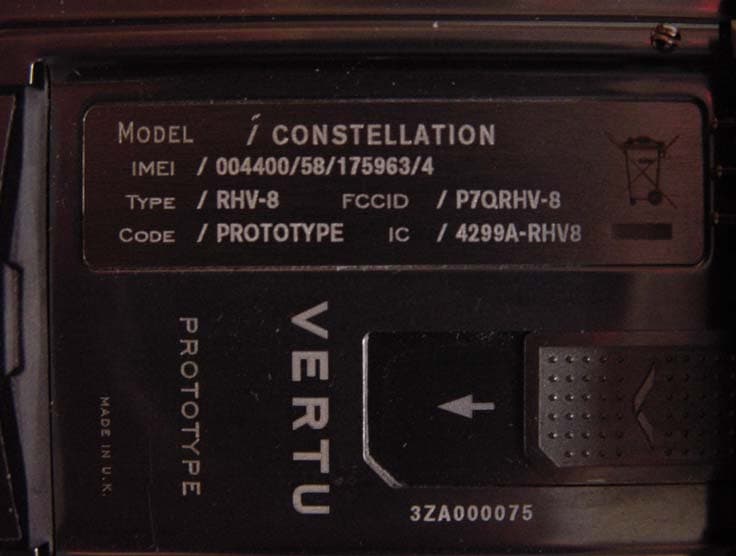
Click to zoom
Application Details
- Equipment Class
- DSS - Part 15 Spread Spectrum Transmitter
- Date of Grant
- Jul 16, 2006
- Application Purpose
- Original Equipment
- Date of Application
- Jul 16, 2006
- Equipment Note
- Quad Band GSM Cell Phone with Bluetooth
- Frequency Range
- 2402.00000000 - 2480.00000000
- Company
- Vertu
- Country
- United Kingdom
Documents & Files
Document Text
Text extracted from the exhibit documents filed with the FCC. Open a document above to read the original.
Users Manual
n ual USER GUIDE DRAFT FEBRUARY 2006 userguide.book Page 3 Friday, February 17, 2006 11:08 AM userguide.book Page 4 Friday, February 17, 2006 11:08 AM DRAFT FEBRUARY 20061 CONTENTS 3 >Register your Vertu Phone 3 >Vertu Package Contents 3 >Conventions in this Guide 4 >Safety Points 4 >Vertu Phone Layout 5 >inserting the Battery and SIM Card 6 >Switching on your Vertu Phone 6 >Setting the Time and Date 7 >Display Icons and Indicators 7 >Making Calls 7 >Answering Calls 8 >Emergency Calls 8 >Keypad Lock 8 >Menu Navigation 11 >Contacts 11 >Text Messages 12 >Accessories 14 >CD-ROM 15 >Care and Maintenance 16 >Safety Information 17 >Specifications 21 >SAR Notice – RHV-8 22 >Notices 22 >Declaration of Conformity 22 >EU Recycling Notice 23 >Vertu Concierge Terms & Conditions userguide.book Page 1 Friday, February 17, 2006 11:08 AM 2DRAFT FEBRUARY 2006 userguide.book Page 2 Friday, February 17, 2006 11:08 AM DRAFT FEBRUARY 063 Register your Vertu Phone REGISTER YOUR VERTU PHONE Vertu aims to provide you with the very best service possible. To enable us to do this, please register your Vertu phone by visiting www.verturegistration.com or by calling Vertu Concierge using the dedicated key on the side of your handset. VERTU PACKAGE CONTENTS The packaging contents may vary slightly in accordance with regional regulations. REFERENCE MANUAL Throughout this guide we mention the Reference Manual which contains additional information about your Vertu phone’s functionality. There is an electronic copy on the CD-ROM supplied with your Vertu phone but if you do not have access to a compatible computer, contact Vertu Concierge for a printed copy. The Reference Manual may not be available in your language. IMPORTANT INFORMATION The wireless phone described in this guide is approved for use on GSM 850/900/1800/1900 networks. Contact your service provider for more information about networks. CONVENTIONS IN THIS GUIDE GLOSSARY NETWORK SERVICES To use the phone you must have service from a wireless service provider. Your service provider will be able to tell you about the services that are available and the charges that apply. 1Vertu Phone 1 Vertu Embossed Leather Case (optional) 1Certificate of Authenticity 1Microfibre Polishing Cloth (optional) 1User Guide 1CD-ROM 1Battery 1Charger 1Connection Adaptor Lead 1Back Cover Release Key Menu Represents text that appears on your Vertu phone’s display, for example, “From the stand-by display, press Menu.” SENDRepresents a Vertu phone key, for example, “Press the SEND key to make the call.” Important information relating to safety. Represents useful information or a quick way to access or operate a feature. Represents points to be aware of when using your Vertu phone. Number keysThe keys that are used to enter (key in) text or numbers. DefaultInitial product setting as supplied by Vertu when it leaves our manufacturing facility. SIM cardSubscriber Identity Module. This is a small card supplied by your service provider to insert into your Vertu phone for a network connection. Service providerThe provider of your SIM card and all associated network services. Network serviceA feature which is made available at the discretion of your service provider. Stand-by display The display that appears when your Vertu phone is switched on, with Menuand Go to at the bottom. userguide.book Page 3 Friday, February 17, 2006 11:08 AM Safety Points 4DRAFT FEBRUARY 06 SAFETY POINTS For full safety instructions refer to “Safety Information” on page 16. VERTU PHONE LAYOUT Read the following simple guidelines. Not following them may be dangerous or illegal. Read the complete user guide for further information. ROAD SAFETY COMES FIRST Obey all local laws. Always keep your hands free to operate the vehicle while driving. Your first consideration while driving should be road safety. INTERFERENCE All wireless phones may be susceptible to interference which could affect performance. SWITCH OFF IN HOSPITALS Follow any restrictions. Switch phone off near medical equipment. SWITCH OFF IN AIRCRAFT Follow any restrictions. Wireless devices can cause interference in aircraft. SWITCH OFF WHEN REFUELLING Do not use the phone at a refuelling point. Do not use near fuel or chemicals. SWITCH OFF NEAR BLASTING Follow any restrictions. Do not use the phone where blasting is in progress. USE SENSIBLY Use only in normal position. Do not touch the antenna unnecessarily. QUALIFIED SERVICE Only qualified personnel may repair this phone. ACCESSORIES AND BATTERIES Use only approved accessories and batteries. Do not connect incompatible products. WATER RESISTANCE Your Vertu phone is not water resistant. Keep it dry. BACK-UP COPIES Remember to make back-up copies or keep a written record of any important information stored in your phone. CONNECTING TO OTHER DEVICES When connecting to any other device, read its user guide for detailed safety instructions. Do not connect incompatible devices. EMERGENCY CALLS Ensure your Vertu phone is switched on and in service. Press the END key as many times as needed to return to the stand-by display. Enter the emergency number, then press the SEND key. Give your location. Do not end the call until told to do so. >01POWER key – press and hold for a few seconds to switch on and switch off. >02Earpiece. >03CONCIERGE key – press and hold until Concierge is displayed. Press SEND to call. >04VOLUME key – press the top of the key to increase the volume. Press the bottom of the key to decrease the volume. >05SELECTION keys – press to perform the action or access the feature shown on the display above the key. >06SCROLL keys – press to move, for example through a list of names or features. >07SEND key – press to make or answer a call. >08END key – press to end a call. >09VOICEMAIL key – press and hold to call your voice mailbox (a network service). >10 and keys – special function keys. >11Microphone. >12Accessories connector. 3 0505 06 06 0708 09 1010 userguide.book Page 4 Friday, February 17, 20…
Text truncated - open the document above for the full version.
External Photos
16 June 2006 Product Pictures (External) Exhibit 3 Company Confidential FCC: P7QRHV-8 IC: 4299A-RHV8 Copyright © Vertu (NOKIA Corp). PRODUCT PICTURES (EXTERNAL) 16 June 2006 Product Pictures (External) Exhibit 3 Company Confidential FCC: P7QRHV-8 IC: 4299A-RHV8 Copyright © Vertu (NOKIA Corp). 16 June 2006 Product Pictures (External) Exhibit 3 Company Confidential FCC: P7QRHV-8 IC: 4299A-RHV8 Copyright © Vertu (NOKIA Corp). 16 June 2006 Product Pictures (External) Exhibit 3 Company Confidential FCC: P7QRHV-8 IC: 4299A-RHV8 Copyright © Vertu (NOKIA Corp).
ID Label/Location Info
14 July 2006 Label Revision 14 July 06 Exhibit 1A Company Confi dential FCC: P7QRHV-8 IC : 4299A-RHV8 Co pyright© Vertu (NOKIA Corp). PRODUCTLABEL Label This is the European / US label X/XXXXXX/XX/XXXXXX / 8-VHR / XXXXXXX / IEMI epyT edoC N O ITALLETSNOC / ledoM 8-VHRQ7P : 8VH R -A9 9 24 : DI C C F CI Above Label shown scale 2:1
Internal Photos
20 June 2006 Product Pictures (Internal) Exhibit 9 Company Confidential FCC: P7QRHV-8 IC: 4299A-RHV8 Copyright © Vertu (NOKIA Corp). PRODUCT PICTURES (INTERNAL) 20 June 2006 Product Pictures (Internal) Exhibit 9 Company Confidential FCC: P7QRHV-8 IC: 4299A-RHV8 Copyright © Vertu (NOKIA Corp). 20 June 2006 Product Pictures (Internal) Exhibit 9 Company Confidential FCC: P7QRHV-8 IC: 4299A-RHV8 Copyright © Vertu (NOKIA Corp). 20 June 2006 Product Pictures (Internal) Exhibit 9 Company Confidential FCC: P7QRHV-8 IC: 4299A-RHV8 Copyright © Vertu (NOKIA Corp).
RF Exposure Info
Nokia ____________________________________________________________________________ SAR Report Salo_SAR_0623_04 Applicant: Nokia Corporation Type: RHV-8 Copyright © 2006 TCC Nokia 1/38 SAR Compliance Test Report Test report no.: Salo_SAR_0623_04 Date of report: 2006-06-08 Template version: 5 Number of pages: 38 Testing laboratory: TCC Nokia Salo Laboratory P.O.Box 86 Joensuunkatu 7H / Kiila 1B FIN-24101 SALO, FINLAND Tel. +358 (0) 7180 08000 Fax. +358 (0) 7180 45220 Client: Vertu Ltd. Beacon Hill Road, Church Crookham, Hampshire United Kingdom, GU52 8DY Tel. +44-1252-611000 Fax. +44-1252-611300 Responsible test engineer: Virpi Tuominen Product contact person: Tero Huhtala Measurements made by: Ari Orte, Janne Hirsimäki Tested device: RHV-8 FCC ID: P7QRHV-8 IC: 4299A-RHV8 Supplement reports: Testing has been carried out in accordance with: 47CFR §2.1093 Radiofrequency Radiation Exposure Evaluation: Portable Devices FCC OET Bulletin 65 (Edition 97-01), Supplement C (Edition 01-01) Evaluating Compliance with FCC Guidelines for Human Exposure to Radiofrequency Electromagnetic Fields RSS-102 Evaluation Procedure for Mobile and Portable Radio Transmitters with Respect to Health Canada’s Safety Code 6 for Exposure of Humans to Radio Frequency Fields IEEE 1528 - 2003 IEEE Recommended Practice for Determining the Peak Spatial-Average Specific Absorption Rate (SAR) in the Human Head from Wireless Communications Devices: Measurement Techniques Documentation: The documentation of the testing performed on the tested devices is archived for 15 years at TCC Nokia. Test results: The tested device complies with the requirements in respect of all parameters subject to the test. The test results and statements relate only to the items tested. The test report shall not be reproduced except in full, without written approval of the laboratory. Date and signatures: For the contents: Nokia ____________________________________________________________________________ SAR Report Salo_SAR_0623_04 Applicant: Nokia Corporation Type: RHV-8 Copyright © 2006 TCC Nokia 2/38 CONTENTS 1. SUMMARY OF SAR TEST REPORT............................................................................................................................................. 3 1.1 TEST DETAILS.............................................................................................................................................................................3 1.2 MAXIMUM RESULTS....................................................................................................................................................................3 1.2.1 Head Configuration........................................................................................................................................................ 3 1.2.2 Body Worn Configuration............................................................................................................................................ 3 1.2.3 Maximum Drift................................................................................................................................................................ 4 1.2.4 Measurement Uncertainty........................................................................................................................................... 4 2. DESCRIPTION OF THE DEVICE UNDER TEST........................................................................................................................... 4 2.1 PICTURE OF THE DEVICE..............................................................................................................................................................5 2.2 DESCRIPTION OF THE ANTENNA..................................................................................................................................................5 3. TEST CONDITIONS..................................................................................................................................................................... 5 3.1 TEMPERATURE AND HUMIDITY....................................................................................................................................................5 3.2 TEST SIGNAL, FREQUENCIES AND OUTPUT POWER......................................................................................................................5 4. DESCRIPTION OF THE TEST EQUIPMENT...............................................................................................................................6 4.1 MEASUREMENT SYSTEM AND COMPONENTS................................................................................................................................6 4.1.1 Isotropic E-field Probe Type ET3DV6......................................................................................................................... 8 4.2 PHANTOMS................................................................................................................................................................................8 4.3 TISSUE SIMULANTS....................................................................................................................................................................9 4.3.1 Tissue Simulant Recipes............................................................................................................................................... 9 4.3.2 System Checking............................................................................................................................................................. 9 4.3.3 Tissue Simulants used in the Measurements....................................................................................................... 10 5. DESCRIPTION OF THE TEST PROCEDURE............................................................................................................................. 11 5.1 DEVICE HOLDER........................................…
Text truncated - open the document above for the full version.
Test Report
Flom Test Labs 3356 N. San Marcos Place, Suite 107 Chandler, Arizona 85225-7176 FCC ID: P7QRHV-8 (866) 311-3268 phone, (480) 926-3598 fax MFA p0660017, d0660027 Transmitter Certification of FCC ID: P7QRHV-8 Model: Type RHV-8 to Federal Communications Commission Rule Parts 22H, 24E, 15.247 Date Of Report: June 28, 2006 On the Behalf of the Applicant: Vertu At the Request of: Vertu Beacon Hill Road Church Crookham, Hampshire GU52 8DY UK Attention of: Mark Pope, Certification and Compliance Manager +44 1252 611135; FAX: -611302 Mobile: +44 7774 8158594 [email protected] Supervised By: Fred Chastain Flom Test Labs 3356 N. San Marcos Place, Suite 107 Chandler, Arizona 85225-7176 FCC ID: P7QRHV-8 (866) 311-3268 phone, (480) 926-3598 fax MFA p0660017, d0660027 List of Exhibits (FCC Certification (Cellular Transmitters) - Revised 9/28/98) Applicant: Vertu FCC ID: P7QRHV-8 By Applicant: 1. Letter of Authorization 2. Identification Drawings, 2.1033(c)(11) Label Location of Label Compliance Statement Location of Compliance Statement 3. Photographs, 2.1033(c)(12) 4. Confidentiality Request: 0.457 And 0.459 5. Documentation: 2.1033(c) (3) User Manual (9) Tune Up Info (10) Schematic Diagram (10) Circuit Description Block Diagram Parts List Active Devices 6. Attestation: ESN: Section 22.919 7. Attestation: OET: Section 22.933 8. SAR Report By M.F.A. Inc. A. Testimonial & Statement of Certification Flom Test Labs 3356 N. San Marcos Place, Suite 107 Chandler, Arizona 85225-7176 FCC ID: P7QRHV-8 (866) 311-3268 phone, (480) 926-3598 fax MFA p0660017, d0660027 The applicant has been cautioned as to the following: 15.21 Information to User. The users manual or instruction manual for an intentional radiator shall caution the user that changes or modifications not expressly approved by the party responsible for compliance could void the user's authority to operate the equipment. 15.27(a) Special Accessories. Equipment marketed to a consumer must be capable of complying with the necessary regulations in the configuration in which the equipment is marketed. Where special accessories, such as shielded cables and/or special connectors are required to enable an unintentional or intentional radiator to comply with the emission limits in this part, the equipment must be marketed with, i.e. shipped and sold with, those special accessories. However, in lieu of shipping or packaging the special accessories with the unintentional or intentional radiator, the responsible party may employ other methods of ensuring that the special accessories are provided to the consumer, without additional charge. Information detailing any alternative method used to supply the special accessories for a grant of equipment authorization or retained in the verification records, as appropriate. The party responsible for the equipment, as detailed in § 2.909 of this chapter, shall ensure that these special accessories are provided with the equipment. The instruction manual for such devices shall include appropriate instructions on the first page of text concerned with the installation of the device that these special accessories must be used with the device. It is the responsibility of the user to use the needed special accessories supplied with the equipment. Flom Test Labs 3356 N. San Marcos Place, Suite 107 Chandler, Arizona 85225-7176 FCC ID: P7QRHV-8 (866) 311-3268 phone, (480) 926-3598 fax MFA p0660017, d0660027 Table of Contents Rule Description Page . Test Report 2 . Standard Test Conditions and Engineering Practices 3 2.1033(c) General Information Required 4 2.1033(c)(14) Rule Summary 7 2.1053(a) Field Strength of Spurious Radiation 8 Flom Test Labs 3356 N. San Marcos Place, Suite 107 Page 2 of 13 Chandler, Arizona 85225-7176 FCC ID: P7QRHV-8 (866) 311-3268 phone, (480) 926-3598 fax MFA p0660017, d0660027 Required information per ISO/IEC Guide 25-1990, paragraph 13.2: a) Test Report b) Laboratory: (FCC: 31040/SIT) (Canada: IC 2044) M. Flom Associates, Inc. 3356 N. San Marcos Place, Suite 107 Chandler, AZ 85225 c) Report Number: d0660027 d) Client: Vertu Beacon Hill Road Church Crookham, Hampshire GU52 8DY UK e) Identification: Type RHV-8 FCC ID: P7QRHV-8 Description: Quad Band GSM cell phone with Bluetooth, supporting 850 and 1900 Bands in USA f) EUT Condition: Not required unless specified in individual tests. g) Report Date: June 28, 2006 EUT Received: 2006-Jun-26 h, j, k): As indicated in individual tests. i) Sampling method: No sampling procedure used. l) Uncertainty: In accordance with MFA internal quality manual. m) Supervised by: Fred Chastain n) Results: The results presented in this report relate only to the item tested. o) Reproduction: This report must not be reproduced, except in full, without written permission from this laboratory. Accessories Used During Testing: Type Quantity Manufacturer Model Serial No FCC ID: Battery Headset Data Cable AC Charger DC Charger Adapter Cable 1 1 1 1 1 1 Vertu Vertu Vertu Vertu Vertu Vertu BL--5V HS-32V CA-61DV ACP-12UV LCV-A CAV-B none Prototype 108382528401 001476 02095A none Flom Test Labs 3356 N. San Marcos Place, Suite 107 Page 3 of 13 Chandler, Arizona 85225-7176 FCC ID: P7QRHV-8 (866) 311-3268 phone, (480) 926-3598 fax MFA p0660017, d0660027 Standard Test Conditions and Engineering Practices Except as noted herein, the following conditions and procedures were observed during the testing. In addition, the EUT was configured to operate GSM with the bluetooth transmitter. In accordance with ANSI C63.4-2003 Draft, section 6.1.9, and unless otherwise indicated in the specific measurement results, the ambient temperature of the actual EUT was maintained within the range of 10° to 40°C (50° to 104 °F) unless the particular equipment requirements specify testing over a different temperature range. Also, unless otherwise indicated, the humidity levels were in the range of 10% to 90% relative humidity. Prior to testing, the EUT was tuned up in accordance with the manufacturer's alignment …
Text truncated - open the document above for the full version.
Test Report
FCC Part 15C Compliance Test Report / Template Version 2.0 T:\Projects\RM-70\results\emc\FCC\Cph_FCC_0536_03.doc Copyright © TCC Nokia 1 (34) TCC Nokia Copenhagen Laboratory Frederikskaj 1790 COPENHAGEN V DENMARK Tel. +45 33 292929 Fax. +45 33 292934 FCC Part 15C Compliance Test Report Test Report no.: Cph_FCC_0536_03.doc Date of Report: 15-09-2005 Number of pages: 34 Customer’s Contact person: Thomas Reitmayer Testing laboratory: TCC Nokia Copenhagen Laboratory Frederikskaj 1790 COPENHAGEN V DENMARK Tel. +45 33 292929 Fax. +45 33 292934 FCC listing no.: IC recognition no.: 99059 4820 and 4820-1 Client: Nokia Corporation Lise Meitner Strasse 10 89081 ULM GERMANY Tel. +49 731 1754 0 Fax. +49 731 1754 6800 Tested devices/ accessories: Phone; RM-70 (HW: 4031), Battery; BL-4B, AC-Charger; AC-3E, Headset; HS-31 FCC ID: PPIRM-70 IC: 661U-RM70 Supplement reports: Testing has been carried out in accordance with: CFR 47, FCC rules Part 15 Subpart C, ANSI C63.4 (2003) and IC standard RSS-210. Deviations, modifications or clarifications (if any) to above mentioned documents are written in each section under "Test method and limit". Documentation: The test report must always be reproduced in full; reproduction of an excerpt only is subject to written approval of the testing laboratory. The documentation of the testing performed on the tested devices is archived for 15 years at TCC Nokia. Test Results: The EUT complies with the requirements in respect of all parameters subject to the test. The test results relate only to devices specified in this document. Date and signature for the contents: Allan F. Henriksen, Engineer FCC Part 15C Compliance Test Report / Template Version 2.0 T:\Projects\RM-70\results\emc\FCC\Cph_FCC_0536_03.doc Copyright © TCC Nokia 2 (34) TCC Nokia Copenhagen Laboratory Frederikskaj 1790 COPENHAGEN V DENMARK Tel. +45 33 292929 Fax. +45 33 292934 1. Summary for FCC Part 15C Compliance Test Report Date of receipt 09-06-2005 Testing completed 13-09-2005 The customer's contact person Thomas Reitmayer Test Plan referred to \EMC\TESTPLAN\ Notes None Document name T:\Projects\RM-70\results\emc\FCC\Cph_FCC_0536_03.doc 1.1. EUT and Accessory Information The EUT is a triple band (GSM900/1800/1900) mobile phone with GPRS, EGPRS and Bluetooth. Bluetooth is tested with maximum rated TX power. Product Type SN HW MV SW DUT Phone RM-70 004400/56/170841/1 4031 - 3.01.1 28396 Phone RM-70 004400/56/170758/7 4031 - 3.01.1 28400 Phone RM-70 004400/56/170861/9 4031 - 3.01.1 28386 Battery BL-4B 0670491363563M203110200078 - - - 28392 Battery BL-4B 0670491363563M203110200104 - - - 28395 Battery BL-4B 0670491363563M203110200118 - - - 28394 AC-Charger AC-3E 4090495276921002523;0675370 - - - 28389 AC Charger AC-3E 4090495276921002518;0675370 - - - 28388 AC-Charger AC-3E 4090495276921002519;0675370 - - - 28387 Headset HS-31 - - - - 28384 Headset HS-31 - - - - 28385 Headset HS-31 - - - - 28428 1.2. Summary of Test Results Bluetooth: Section in CFR 47 Section in RSS-210 Name of the test Result 15.247(b)(1) 6.2.2(o)(a3) Peak output power Passed 15.247(c) 6.2.2 (o)(e1) Band edge compliance of RF emissions Passed 15.247(c) 6.2.2 (o)(e1) Spurious RF conducted emissions Passed 15.247(c), 15.209 6.2.2 (o)(e1) Spurious radiated emissions Passed 15.207 6.6 AC power line conducted emissions Passed 15.247(a)(1) 6.2.2(o)(a3) 20 dB bandwidth Passed 15.247(a)(1) 6.2.2(o)(a1) Carrier frequency separation Passed 15.247(a)(1)(iii) Amend I(ii) Number of hopping frequencies Passed 15.247(a)(1)(iii) Amend I(ii) Time of occupancy Passed PASSED The EUT complies with the essential requirements in the standard. FAILED The EUT does not comply with the essential requirements in the standard. NP The test was not performed by the TCC Nokia Copenhagen Laboratory. FCC Part 15C Compliance Test Report / Template Version 2.0 T:\Projects\RM-70\results\emc\FCC\Cph_FCC_0536_03.doc Copyright © TCC Nokia 3 (34) TCC Nokia Copenhagen Laboratory Frederikskaj 1790 COPENHAGEN V DENMARK Tel. +45 33 292929 Fax. +45 33 292934 CONTENTS 1. Summary for FCC Part 15C Compliance Test Report ............................................2 1.1. EUT and Accessory Information.........................................................................................2 1.2. Summary of Test Results ...................................................................................................2 2. Test setups ................................................................................................................5 2.1. Conducted RF test setup....................................................................................................5 2.2. AC powerline conducted emissions test setup...................................................................5 2.3. Spurious radiated emissions test setup .............................................................................5 3. Peak output power (FCC §15.247(b)(1), RSS-210 6.2.2(o)(a3)).........................................6 3.1. Test method and limit .........................................................................................................6 3.2. Bluetooth Test results ........................................................................................................7 3.2.1 GSFK modulation, PRBS packet type ........................................................................................7 4. Band edge compliance of RF emissions (FCC §15.247(c), RSS-210 6.2.2(o)(e1)).........9 4.1. Test method and limit .........................................................................................................9 4.2. Bluetooth Test results ......................................................................................................10 4.2.1 GFSK modulation, PRBS packet type ......................................................................................10 4.2.1.1 Phone Slide open.............................................................................................…
Text truncated - open the document above for the full version.
Contact Information
Applicant
Mark Pope(Certification and Compliance Manager)
Test Firm
Compliance Testing, LLCMichael Schafer
Technical Specifications
| # | Rule Parts | Frequency Range | Power Output |
|---|---|---|---|
| 1 | 15C | 2.40 GHz - 2.48 GHz | 1.00 mW |
Other Applications from Vertu

P7QVM-03
Sep 13, 2015Cellular Telephone
Equipment Class
NII - Unlicensed National Information Infrastructure TX
P7QVM-01T
Jan 15, 2015Cellular Telephone
Equipment Class
DXX - Part 15 Low Power Communication Device Transmitter
P7QVM-01
Aug 12, 2014CELLULAR TELEPHONE
Equipment Class
PCE - PCS Licensed Transmitter held to ear
P7QRM-980V
May 29, 2014Cellular Telephone
Equipment Class
PCE - PCS Licensed Transmitter held to ear
P7Q-SP1V
Apr 29, 2014BLUETOOTH TRAVEL SPEAKER
Equipment Class
DSS - Part 15 Spread Spectrum Transmitter