PQCM4841AMedical Telemetry Patient Worn Device
Philips Medical Systems North America Co.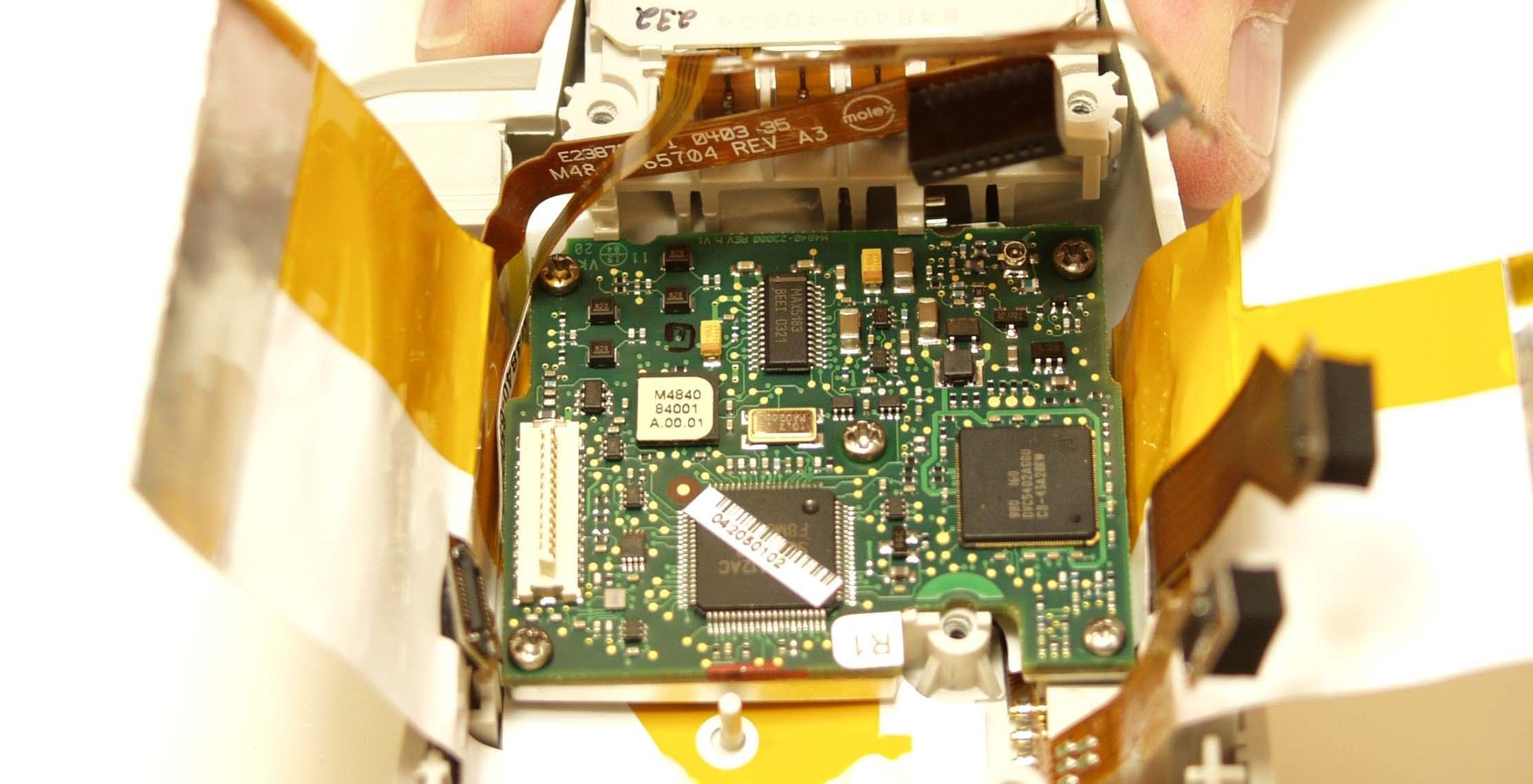
Click to zoom
Application Details
- Equipment Class
- TNT - Licensed Non-Broadcast Transmitter Worn on Body
- Date of Grant
- Nov 09, 2004
- Application Purpose
- Original Equipment
- Date of Application
- Aug 25, 2004
- Equipment Note
- Medical Telemetry Patient Worn Device
- Frequency Range
- 1395.00000000 - 1432.00000000
- Country
- United States
Documents & Files
Document Text
Text extracted from the exhibit documents filed with the FCC. Open a document above to read the original.
Users Manual
Instructions for Use IntelliVue TRx/TRx + Transceivers for the Philips IntelliVue Telemetry System with Smart-Hopping Technology Part Number: M4841-91001 Printed in the U.S.A. November 2004 First Edition Notice Operation of this equipment in the United States re- quires the prior coordindation with a frequency coor- dinator designated by the Federal Communications Commission (FCC) for the Wireless Medical Teleme- try Service. Printing History ii NoticeEquipment specifications are subject to alteration without notice. All changes will be in compliance with regulations governing manufacture of medical equipment. Printed in the USA. Document number: M4841-91001 © Copyright 2004 Koninklijke Philips Electronics N.V. All Rights Reserved. OxiCliq and OxiMax are registered trademarks of Nellcor® Incorporated. Printing History New editions of this document will incorporate all material updated since the previous edition. Update packages can be issued between editions and contain replacement and additional pages to be merged by a revision date at the bottom of the page. Note that pages which are rearranged due to changes on a previous page are not considered revised. The documentation printing date and part number indicate its current edition. The printing date changes when a new edition is printed. (Minor corrections and updates which are incorporated at reprint do not cause the date to change.) The document part number changes when extensive technical changes are incorporated. First Edition ...............................................................................November 2004 Philips IntelliVue Telemetry System with Smart Hopping Technology is compatible with: Philips Information Center, software revision F.00 Philips TeleMon Companion Monitor, #A02/A03 About this Book iii About this Book This book contains operating instructions for use of the IntelliVue TRx and TRx + Transceivers as used with the Philips IntelliVue Telemetry System with Smart-hopping Technology. It also includes operational information for the Telemetry functions of the IntelliVue Information Center. The intended audience is the clinician who uses and/or teaches others to use the equipment in a healthcare environment. For operating information on other functionality of the Information Center, see IntelliVue Information Center Instructions for Use. For preventive maintenance, repair, and test methods for verification of device performance, refer to the Philips IntelliVue Telemetry System Service Kit. This book does not address the Philips M2601B Transmitter or the M2600B Philips Telemetry System. For information on those products, refer to the manual Philips Telemetry System Instructions for Use. Note—Use this product in conjunction with Philips IntelliVue Information Center Instructions for Use and Online Help, and with Philips TeleMon A02/ A03 Companion Monitor Instructions for Use. See also the Philips IntelliVue Telemetry Training Program. Document Conventions Warnings WarningWarning Warnings are information you should know to avoid injuring patients and personnel. Cautions Caution Cautions are information you should know to avoid damaging your equipment and software. Product Safety Information iv Notes Note—Notes contain additional information on use of the Philips IntelliVue Telemetry System. Procedures Procedures are indicated in text by the heading “Task Summary” followed by the following table: Bold Typeface Objects of actions in procedures appear in bold typeface. Note the following example: Select the Standby button. Product Safety Information The following general warnings and cautions apply to use of the Philips IntelliVue Transceivers in a Philips IntelliVue Wireless Network. Additional warnings and cautions specific to a particular feature are provided in the appropriate section. General WarningWarning For continued safe use of this equipment, it is necessary that the listed instructions are followed. Instructions in this manual in no way supersede established medical procedures. Step Action 1 2 3 Product Safety Information v WarningWarning Do not touch the patient, or table, or instruments, during defibrillation. The battery door must be closed during defibrillation. These steps protect the clinician from high defibrillator voltage. WarningWarning This device is not to be used in the vicinity of electrosurgical units because use may interrupt or interfere with the transmission of signals from the transceiver. WarningWarning This equipment is not suitable for use in the presence of a flammable anesthetic mixture with air or with oxygen or nitrous oxide WarningWarning Do not use patient cables with detachable lead wires that have exposed male pins. Electrocution could result if these pins are plugged into AC power. WarningWarning Use of product accessories (e.g., ECG leadsets, SpO 2 sensors) other than those prescribed by Philips could lead to patient injury. WarningWarning To avoid strangulation, do not tie a pouch solely around the patient’s neck. Product Safety Information vi ECG/ Arrhythmia - All Patients WarningWarning ECG SAFETY FOR ALL PATIENTS Always confirm Information Center observations with clinical observation of the patient before administering interventions. Every lead must be secured to an electrode on the patient. Conductive parts of electrodes must not contact earth or other conductive parts. Philips recommends that you change the lead label only to reflect the physical placement of electrodes. This will ensure a match between the monitored lead and the label, and prevent any possible confusion. When switching between EASI and standard monitoring, there is a loss of data for 30 seconds. Product Safety Information vii WarningWarning ST/AR ARRHYTHMIA SAFETY FOR ALL PATIENTS During complete heart block or pacemaker failure (to pace or capture), tall P-waves (greater than 1/5 of the average R-wave height) can be erroneously counted by the arrhythmia algorithm, resulting in missed detection of c…
Text truncated - open the document above for the full version.
Cover Letter(s)
Page 1 of 2 To: Federal Communications Commission, Washington, DC 20554 Attention: Ms. Diane Poole Date: October 18, 2004 From: Barry Wyshogrod, Philips Medical Systems, Andover, MA Subject: Reply to Correspondence Reference #27731 731 Application #EA936855 Dear Ms. Poole and FCC Reviewers, On 1-Oct-04, you e-mailed me the following observations/requests: 1. Please resubmit the confidentiality request letter. Note that the Part 95 Test Report exhibit cannot be held confidential. 2. You have requested the Internal Device Photographs to be confidential. Please explain how you prevent the public from seeing the inside of the equipment (any special tool to open the device), and give a special justification why we have to keep it confidential. 3. Please submit a formal special 45 day confidentiality request letter. Note that the Artwork for Product Labels and the External Device Photographs exhibits cannot be held confidential (the External Device Photographs and the ID label are identical; we can not give the Label Exhibit confidential status). Philips Medical Systems’ response to Item #1 above: With appreciation to you, Diane, for helping me over the phone last week, I hereby attach a new Request for Confidentiality. This request consists of two parts; a request for Indefinite Confidentiality for certain deliverables, and second, a request for 45-day Limited Confidentiality for other submitted items. I understand that the Part 95 Test Report cannot be granted either type of confidentiality, and it no longer appears as part of the Request for Confidentiality. This Request for Confidentiality supercedes my initial requests (Cover Letter, and Cover Letter– Request for Confidentiality) dated 25-Aug-04. Philips Medical Systems’ response to Item #2 above: Philips is no longer requesting Indefinite Confidentiality for the Internal Device Photograph; only 45-day Limited Confidentiality, as listed in the attached, new Request for Confidentiality. Limited Confidentiality is important for Philips Medical Systems from a commercial perspective. It enables the company to complete its development and regulatory efforts prior to introducing the product to the marketplace. Releasing information on the product via the FCC website prior to formal market introduction can be confusing to our customers and to the medical community, and places the company at a competitive disadvantage. Philips Medical Systems’ response to Item #3 above: I hereby attach the revised Request for Confidentiality, which includes the appropriate section on 45-day Limited Confidentiality. As agreed with you, Diane, Philips Medical Systems will request the 45-day protection for the Internal and External Photographs, and for the Instructions for Use, but not for the FCC ID Label. Philips Medical Systems Page 2 of 2 Therefore, I hereby attach two new attachments to our EA936855 submission: 1. Revised Request for Confidentiality. 2. Revised FCC ID label artwork showing relevant FCC labeling and placement. It is understood that this will not be held confidential. Please delete the previous attachment submitted for the FCC ID Label. Diane, thank you in advance for all your help and patience; it is much appreciated. For any further issues, I can be reached at (978) 659-7383 or by e-mail to: [email protected] . If I am not available, please contact Ms. Denise Haley at (978) 659-4358 or by e-mail to: [email protected]. Sincerely yours, Barry Wyshogrod, Regulatory Engineer Signature already on-file at the FCC
Cover Letter(s)
To: Federal Communications Commission, Washington, DC 20554 Date: October 18, 2004 From: Barry Wyshogrod, Philips Medical Systems, Andover, MA Subject: Application for Radio Grant for M4841A, 731 Confirmation Number: EA936855 REVISED REQUEST FOR CONFIDENTIALITY – Replaces 25-Aug-04 version Dear Sir or Madam, Philips Medical Systems has submitted an application for Equipment Authorization under 47 CFR Part 95, Subpart H for a wireless medical telemetry transmitter, Model M4841A. The filing includes: 1. Block Diagram 2. Functional Description 3. Schematics 4. Bill of Material 5. Internal Device Photograph 6. External Device Photograph 7. Instructions for Use 8. Part 95 Test Report 9. FCC ID Label Under the provisions of Section 0.457(d) of the Commission’s Rules, and Section 552(b)(4) of the Freedom of Information Act, Philips Medical Systems hereby requests that items 1-4 listed above be granted Indefinite Confidentiality from public disclosure, as this information is deemed to represent trade secrets: Under the provisions of FCC Public Notice DA 04-1705, dated 15-Jun-04, Philips Medical Systems hereby requests that items 5-7 listed above be granted 45-day Limited Confidentiality from public disclosure. Limited Confidentiality is important for Philips Medical Systems from a commercial perspective. It enables the company to complete its development and regulatory efforts prior to introducing the product to the marketplace. Releasing information on the product via the FCC website prior to formal market introduction can be confusing to our customers and to the medical community, and places the company at a competitive disadvantage. To summarize: Indefinite Confidentiality 45-day Limited Confidentiality No Confidentiality Block Diagram Internal Device Photograph Part 95 Test Report Functional Description External Device Photograph FCC ID Label Schematics Instructions for Use Bill of Material Thank you in advance for your consideration of this application. I can be reached at (978) 659- 7383 or by e-mail to: [email protected] . If I am not available, please contact Ms. Denise Haley at (978) 659-4358 or by e-mail to: [email protected]. Sincerely yours, Barry Wyshogrod, Regulatory Engineer Signature already on-file at the FCC Philips Medical Systems
Cover Letter(s)
Page 1 of 1 To: Federal Communications Commission, Washington, DC 20554 Attention: Ms. Diane Poole Date: October 28, 2004 From: Barry Wyshogrod, Philips Medical Systems, Andover, MA Subject: Reply to Correspondences, References #27856, #27857 731 Application #EA936855 Dear Ms. Poole and FCC Reviewers, On 25-Oct-04, you e-mailed me the following request: Please add the FCC statement on the label as in 15.19 (a) of the FCC rules to the product. Philips Medical Systems’ response: The PQCM4841A device is relatively small, about the size of an adult hand. It includes numerous regulatory markings (product identification, safety, emissions, consult product documentation, etc.). In addition, it includes controls and connector labels, and clinical graphics reminding the user how to correctly connect and use the device. These labels and graphics are very important for the clinical user. However, the regulatory markings are not important to the clinical user; rather, they are important to the bioengineering and installation professional. Therefore, so as to optimize the use of the limited space on the device, Philips Medical Systems hereby requests that the PQCM4841A device itself be exempted from bearing the FCC Part 15.19(a)(1) statement *. Instead, we have placed the statement on the cover page of both the Instructions For Use (IFU) and the Service Guide. As such, we believe that we have targeted the message to the appropriate professional, while simplifying the markings on the device itself, thus making a small contribution to reducing potential confusion in the clinical environment. Diane, I hope that this will be acceptable to the FCC. For any further discussion or issues, I can be reached at (978) 659-7383 or by e-mail to: [email protected] . If I am not available, please contact Ms. Denise Haley at (978) 659-4358 or by e-mail to: [email protected]. Sincerely yours, Barry Wyshogrod, Regulatory Engineer Signature already on-file at the FCC * “This device complies with part 15 of the FCC Rules. Operation is subject to the condition that this device does not cause harmful interference.” Philips Medical Systems
Cover Letter(s)
Page 1 of 1 To: Federal Communications Commission, Washington, DC 20554 Attention: Ms. Diane Poole Date: October 29, 2004 From: Barry Wyshogrod, Philips Medical Systems, Andover, MA Subject: Reply to Correspondences, References #27907, #27910, #27911 731 Application #EA936855 Dear Ms. Poole and FCC Reviewers, On 29-Oct-04, you e-mailed me the following request: Please address compliance with 2.1093(c) and 95.1125. Philips Medical Systems’ response: Philips Medical Systems hereby asserts compliance to 47 CFR Parts 2.1093(c) and 95.1125, based on analysis performed by the TCB, Cetecom Inc. (Milpitas, CA). The summary statement from Cetecom is hereby attached as part of this reply. Diane, thank you for your help. For any further issues, I can be reached at (978) 659-7383 or by e-mail to: [email protected] . If I am not available, please contact Ms. Denise Haley at (978) 659-4358 or by e-mail to: [email protected]. Sincerely yours, Barry Wyshogrod, Regulatory Engineer Signature already on-file at the FCC Philips Medical Systems
Cover Letter(s)
Page 1 of 1 To: Federal Communications Commission, Washington, DC 20554 Attention: Ms. Diane Poole Date: November 3, 2004 From: Barry Wyshogrod, Philips Medical Systems, Andover, MA Subject: Revised Reply to Correspondences, Ref. #27907, #27908, #27910, #27911 731 Application #EA936855 Dear Ms. Poole and FCC Reviewers, On 29-Oct-04, you e-mailed me the following request: Please address compliance with 2.1093(c) and 95.1125. Philips Medical Systems’ response: Philips Medical Systems hereby asserts compliance to 47 CFR Parts 2.1093(c) and 95.1125, as per the attached RF Exposure statement. This cover letter and associated statement replace and supersede our previous cover letter and statement submitted on 29-Oct-04. Diane, thank you for your help. For any further issues, I can be reached at (978) 659-7383 or by e-mail to: [email protected] . If I am not available, please contact Ms. Denise Haley at (978) 659-4358 or by e-mail to: [email protected]. Sincerely yours, Barry Wyshogrod, Regulatory Engineer Signature already on-file at the FCC Philips Medical Systems
Cover Letter(s)
Page 1 of 1 To: Federal Communications Commission, Washington, DC 20554 Attention: Ms. Diane Poole Date: November 9, 2004 From: Barry Wyshogrod, Philips Medical Systems, Andover, MA Subject: Reply to Correspondences, Ref. #27910 and #27911 731 Application #EA936855 Dear Ms. Poole and FCC Reviewers, On 29-Oct-04, you e-mailed me the following request: Please address compliance with 2.1093(c) and 95.1125. Philips Medical Systems’ response: Please note that Correspondences #27910 and #27911 are the same as #27907 and #27908. Please refer to our response to #27907 and #27908, previously submitted on 3-Nov-04. I apologize for any confusion. For any further issues, I can be reached at (978) 659-7383 or by e- mail to: [email protected] . If I am not available, please contact Ms. Denise Haley at (978) 659-4358 or by e-mail to: [email protected]. Sincerely yours, Barry Wyshogrod, Regulatory Engineer Signature already on-file at the FCC Philips Medical Systems
Cover Letter(s)
Page 1 of 1 To: Federal Communications Commission, Washington, DC 20554 Attention: Ms. Diane Poole Date: November 9, 2004 From: Barry Wyshogrod, Philips Medical Systems, Andover, MA Subject: Reply to Correspondence #28006 731 Application #EA936855 Dear Ms. Poole and FCC Reviewers, Today, 9-Nov-04, you e-mailed me the following request: Please resubmit the statement of compliance with 2.1093(c) and 95.1125. Philips Medical Systems’ response: I believe that this request was already addressed in responses to Correspondences #27907/#27908 (3-Nov-04), and #27910/#27911 (9-Nov-04). For any further issues, I can be reached at (978) 659-7383 or by e-mail to: [email protected] . If I am not available, please contact Ms. Denise Haley at (978) 659-4358 or by e-mail to: [email protected]. Sincerely yours, Barry Wyshogrod, Regulatory Engineer Signature already on-file at the FCC Philips Medical Systems
RF Exposure Info
Page 1 of 1 RF Exposure Statement Philips Medical Systems hereby declares that the Wireless Medical Telemetry Device, M4841A (FCC ID: PQCM4841A) is compliant to 47 CFR Part 95H, §95.1125 and §2.1093 of the FCC rules. As per the FCC/TCB training of October 15, 2004, this statement of compliance is sufficient for devices with sourced based time average power of less than 1 mW. This applies to both TCB and FCC filings. The output power for this device based on sourced based time average power is less than 0.1 mW. The duty cycle is 1/64. Barry Wyshogrod, Regulatory Engineer Signature already on-file at the FCC Submitted 3-November-2004 Philips Medical Systems
Test Report
TEST NUMBER - 114-04 TEST REPORT TO FEDERAL COMMUNICATIONS COMMISSION CFR47 PART95 Low Power Licensed Radio communication Devices Medical Telemetry Service Transceiver In the bands 1395-1400 and 1427-1432 MHz for Philips Medical Systems Cardiac and Monitoring Systems 3000 Minuteman Drive Andover, MA 01810 978-659-2800 of Patient Worn Device ECG/SpO2 Transceiver Model M4841A on 1/21/2004 Reviewed by fri~~~~ ~k This report may not be duplicated, except in full without written permission from Compliance Worldwide, Inc. Compliance Worldwide, Ioc. - 357 Main Street - Sandown, NH 03873 (603) 8873903 Fax 887 6445 httno//wwwrw-inc-com Page 2 of 32 Compliance Worldwide, Inc. – 357 Main Street – Sandown, NH 03873 (603) 887 3903 Fax 887 6445 http://www.cw-inc.com TEST NUMBER - 114-04 TABLE OF CONTENTS • Test Description • Test Results and Conclusions • Test Procedures • Part 95 Test Limits • Test Facility Description • Test Setup and Connection Information • Test Measurements and Results Radiated Measurements Radiated Output Power & Occupied Bandwidth Conducted Measurements • Notes and Comments Page 3 of 32 Compliance Worldwide, Inc. – 357 Main Street – Sandown, NH 03873 (603) 887 3903 Fax 887 6445 http://www.cw-inc.com TEST NUMBER - 114-04 TEST DESCRIPTION 1. TEST OBJECTIVE To test the Patient Worn Device with ECG and SpO2 transceiver Model M4841A to FCC Part 95 Rules and write a report. 2. E.U.T. DESCRIPTION GENERAL The Patient Worn Device with ECG and SpO2 Transceiver Model M4841A is an ECG and SpO2 monitoring device that provides an RF link to a monitoring station via Philips telemetry infrastructure including the Access Point transceiver. FREQUENCIES USED: 1395.9, 1397.5, 1399.1, 1427.9, 1429.5, 1431.1 MHz MODULATION SCHEME: FSK with Root Raised Cosine Filtering SERIAL NUMBERS: US1100227 Page 4 of 32 Compliance Worldwide, Inc. – 357 Main Street – Sandown, NH 03873 (603) 887 3903 Fax 887 6445 http://www.cw-inc.com TEST NUMBER - 114-04 TEST RESULTS AND CONCLUSIONS Rule Section Requirement Notes Pass Fail 95.1109(b) Labeling See Exhibits FCC Label Sample and Label Location. 1 95.115(a)(2) Field Strength Limits X 95.115(b) Undesired Emissions Limits X 95.115(c) Emission Type Transmits Data and ECG Waveform X 95.115(e) Frequency Stability Data Provided By Philips Medical 1 95.1125 RF Safety Statement and Technical Basis 1 Note 1.) Exhibits provided by Philips for approval submission. Page 5 of 32 Compliance Worldwide, Inc. – 357 Main Street – Sandown, NH 03873 (603) 887 3903 Fax 887 6445 http://www.cw-inc.com TEST NUMBER - 114-04 TEST RESULTS AND CONCLUSIONS PRODUCT TESTED - Patient Worn Device ECG/SpO2 Transceiver MODEL NUMBER - M4841A RADIATED TEST RESULTS The test results show that the emissions radiated from this equipment are in compliance with FCC Rules Part 95. OCCUPIED BANDWIDTH & OUTPUT POWER The test results show that the occupied bandwidth and output power of this equipment are in compliance with FCC Rules Part 95 . CONDUCTED TEST RESULTS N/A ANALYSIS AND CONCLUSIONS Based upon the radiated and conducted measurements we find that this equipment is within the limits of the FCC Rules Part 95. All results are based on a test of one sample, and represent other production units, only in as much as a sample represents other production units. If any significant changes are made to the unit, the changes shall be evaluated and a retest may be required. NOTES (Special conditions unique to this test) The EUT is battery Powered; no power line conducted testing applies. A full investigation of the spectrum of this devices digital circuitry and it’s associated equipment can be found in Test reports #114-04b, 120-04, 135-04 and 146-04. Page 6 of 32 Compliance Worldwide, Inc. – 357 Main Street – Sandown, NH 03873 (603) 887 3903 Fax 887 6445 http://www.cw-inc.com TEST NUMBER - 114-04 TEST PROCEDURES 1. TEST EQUIPMENT A. HP 8546A (9 kHz - 6.5 GHz) EMI Receiver w/ RF Filter Section, S/N 3704A00323 / 3650A00360. Calibration Date 1-16-2004, calibrated annually. B. HP 8593E (9 kHz - 26.5 GHz) Spectrum Analyzer, S/N 3829A03887. Calibration Date 11-21-2003, calibrated annually. B. Com-Power Biconilog Antenna, Model AC220, S/N 25509. Calibration Date 3-11-2003, calibrated annually. C. Electro-Metrics Double Ridged Guide Antenna, Model EM-6961, S/N 6337. Calibration Date: 6-24-2003, calibrated annually. D. HP 1 - 26.5 GHz Preamplifier, Model 08449B, S/N 3008A01323. Calibration Date: 2-19-2003, calibrated annually. E. EMCO LISN, Model EM 3825/2, S/N 9109-1860. Calibration Date: 3-9-2003, calibrated annually. 2. FREQUENCY RANGE TO BE SCANNED. A. Radiated Test from 30 MHz to 40 GHz (or the 10 th harmonic of the highest frequency whichever is lower). B. Conducted Test from 450 kHz to 30 MHz. Page 7 of 32 Compliance Worldwide, Inc. – 357 Main Street – Sandown, NH 03873 (603) 887 3903 Fax 887 6445 http://www.cw-inc.com TEST NUMBER - 114-04 3. TEST PROCEDURES. Radiated test procedure: The EUT, associated cables and peripheral devices are placed on the supporting table and any support equipment is placed off the site. The EUT is turned on and any necessary operating or test software installed and allowed to warm up. The EUT is pre-scanned in our ferrite tile lined chamber where it is rotated 360 degrees and examined in both horizontal and vertical polarization, all emission frequencies are identified and recorded. The EUT is then moved to the OATS and the frequency band from 30 MHz to 40 GHz is scanned, all frequencies identified in the chamber are investigated, as well as harmonic frequencies of the EUT. When an emission is found the emission is maximized by varying the bundle position of the connecting cables, the antenna height, the antenna polarization (vertical and horizontal) and the table orientation (360 degrees). The maximum reading is recorded and the next signal is searched for. Conducted test procedure: The power line of the EUT is connected to the LISN (Line Impedance Stabilization Network). A measurement of…
Text truncated - open the document above for the full version.
Contact Information
Applicant
Delroy Smith(Principal Architect)
Technical Contact
Philips Medical SystemsBarry Wyshogrod
[email protected]978-659-7383
3000 Minuteman Road · Andover, Massachusetts · United States
Non-Technical Contact
Philips Medical SystemsBarry Wyshogrod
[email protected]978-659-7383
Test Firm
Compliance Worldwide, Inc.Robert McCall
Technical Specifications
| # | Rule Parts | Frequency Range | Power Output | Emission | Tolerance |
|---|---|---|---|---|---|
| 1 | 95H | 1.40 GHz - 1.43 GHz | 6.30 mW | 1M60Q7D | 15000.0000000000 Hz |
Other Applications from Philips Medical Systems North America Co.
PQC-AIM
Apr 14, 2024AIM
Equipment Class
DTS - Digital Transmission System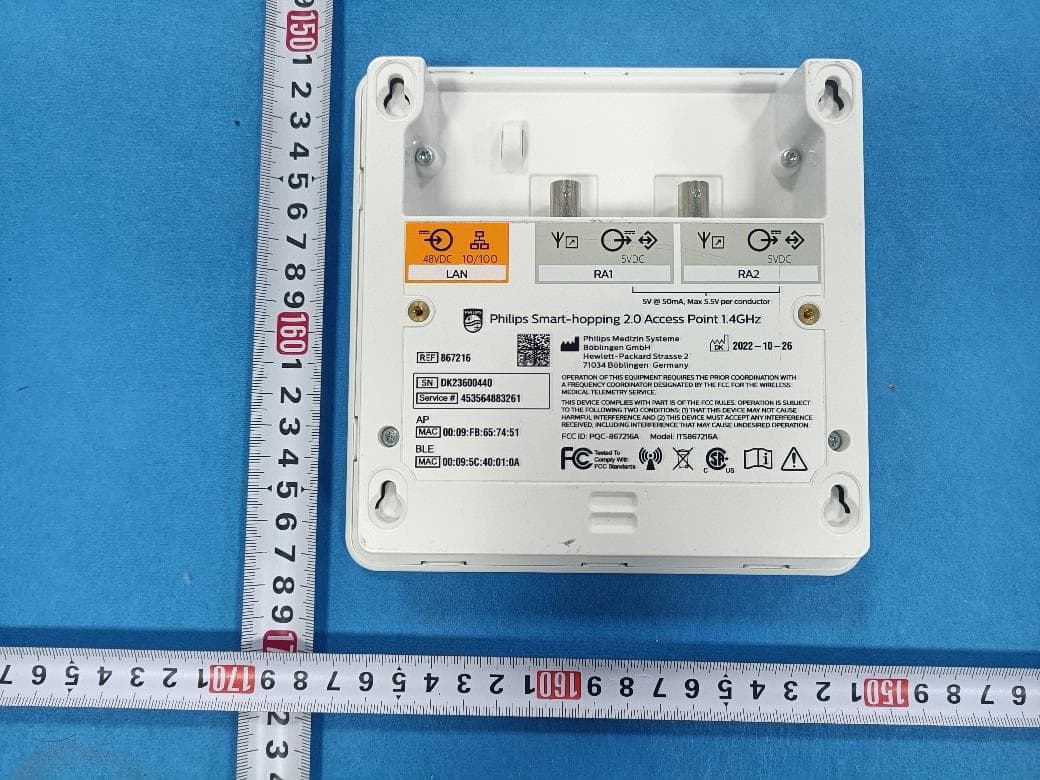
PQC-867216A
Jan 15, 2023Access Point
Equipment Class
DTS - Digital Transmission System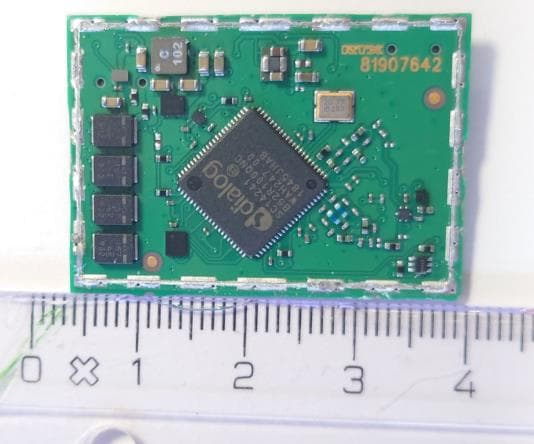
PQC-IITBV1
Mar 08, 20212.4G Radio Module
Equipment Class
DTS - Digital Transmission System
PQC-MX40SH1C4
Mar 31, 2014Intellivue MX40 1.4 GHz Patient Worn Device
Equipment Class
NII - Unlicensed National Information Infrastructure TX
PQC-OBRBSBV1
Nov 17, 2013CTG Base Station
Equipment Class
TNB - Licensed Non-Broadcast Station Transmitter