Q9S02042108VPortable FM VHF PTT Radio Transceiver
Northfield Telecommunications, Inc. d/b/a Advanced Wireless Communications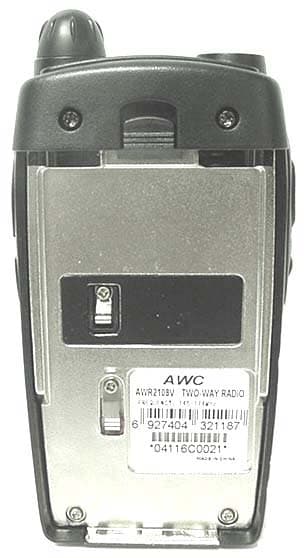
Click to zoom
Application Details
- Equipment Class
- TNF - Licensed Non-Broadcast Transmitter Held to Face
- Date of Grant
- Oct 13, 2004
- Application Purpose
- Original Equipment
- Date of Application
- Jul 15, 2004
- Equipment Note
- Portable FM VHF PTT Radio Transceiver
- Frequency Range
- 150.00000000 - 174.00000000
- Country
- United States
Documents & Files
Document Text
Text extracted from the exhibit documents filed with the FCC. Open a document above to read the original.
Users Manual
1 THANK YOU! We are grateful for your purchase of Advanced Wireless Communications product. We believe this easy–to-use radio will provide you with dependable and reliable communications. This Advanced Wireless Communications portable two-way radio is a precision device. Treat it with care, and you will enjoy years of reliable operation. MODELS COVERED IN THIS MANUAL AWR2108V: VHF 150-174MHz 2 Product Safety and RF Exposure for Portable Two-Way Radios Compliance with RF Energy Exposure Standards NOTICE: This radio is intended for use in occupational/controlled applications where users have been made aware of the potential for exposure and can exercise control over their exposure. This radio device is NOT authorized for general population, consumer or similar use. BEFORE USING THIS RADIO, READ THE TRAINING MATERIAL BELOW WHICH CONTAINS IMPORTANT OPERATING INSTRUCTIONS FOR SAFE USAGE AND RF ENERGY AWARENESS AND CONTROL INFORMATION FOR COMPLIANCE WITH RF ENERGY EXPOSURE LIMITS IN APPLICABLE NATIONAL AND INTERNATIONAL STANDARDS. Federal Communication Commission (FCC) Regulations The FCC has established limits for safe exposure to radio frequency (RF) emissions from portable two-way radios. The FCC requires manufacturers to demonstrate compliance with RF exposure limits before portable two-way radios can be marketed in the U.S. When two-way radios are approved for occupational/controlled environment exposure limits, the FCC requires users to be fully aware of, and exercise control over, their exposure. Awareness and control of RF exposure can be accomplished by the use of labels, or by education and training through appropriate means, such as information and instructions in user manuals or safety booklets. Your Advanced Wireless two-way radio has an RF exposure information label in the battery compartment. The training material below includes useful information about RF exposure and helpful instructions on how to control your RF exposure. Your Advanced Wireless two-way radio is designed and tested to comply with a number of national and international standards and guidelines (listed below) regarding human exposure to RF electromagnetic energy. In terms of measuring RF energy for compliance with FCC exposure guidelines, your radio radiates measurable RF energy only while it is transmitting (during talking), not when it is receiving (listening) or in standby mode. Compliance and Control Guidelines and Operating Instructions for Portable Two-Way Radios To control your exposure and ensure compliance with the occupational/controlled environment exposure limits, always adhere to the following procedures: * Transmit no more than 50% of the time. To transmit (talk), push the Push-To-Talk (PTT) button. To receive calls, release the PTT button. Transmitting 50% of the time or less is important since the radio generates measurable RF energy exposure only when transmitting (in terms of measuring standards compliance). *Hold the radio in a vertical position in front of the face with the microphone positioned at least one inch (2.5 cm) away from the lips. Keeping the radio at the proper distance is important since RF exposure decreases with increasing distance from the antenna. * For body-worn operation, always place the radio in an AWC approved belt-clip or similar accessory that contains no metallic components and provides a minimum separation distance of 1.3 cm between the back of the radio and the user’s body. AWC-approved accessories, antennas, and device combinations have been tested and comply with the occupational/controlled environment RF exposure limits. The use of non–AWC approved accessories may result in exposure levels which may exceed the FCC’s occupational/controlled environment RF exposure limits. * If you are not using a body-worn accessory and are not using the radio held in front of the face, 3 ensure the radio is kept a minimum of 1.3 cm from the body when transmitting. Keeping the radio at a proper distance is important since RF exposure decreases with increasing distance from the antenna. FCC license Information Your Advanced Wireless Communications radio operates on communications frequencies which are subject to FCC (Federal Communications Commission) Rules & Regulations. FCC Rules require that all operators using Private Land Mobile radio frequencies obtain a radio license before operating their equipment. Application for license must be made on FCC form 601, and schedules D, E, and G. FAX: Forms can be obtained by fax from the FCC Fax-On-Demand system. Call 1-202-418-0177 from your fax machine and request document number 000600 for the form, schedules, and instructions. MAIL: Forms can be ordered by telephone, and will be sent to you by first class mail. Call the FCC Forms Hotline at 1-800-418-FORM (1-800-418-3676). INTERNET: Form 601 and instructions can be downloaded from the FCC Forms website at: http://www.fcc.gov/Forms/Form601/601.html Questions? Call the FCC for license application questions at 1-888-CALL-FCC (1-888-225-5322). If you have any questions, call Advanced Wireless Communications: 1-800-475-5852 Notices to The User This device complies with Part 15 of the FCC Rules. Operation is subject to the following two conditions: (1) this device may not cause harmful interference, and (2) this device must accept any interference received, including interference that may cause undesired operation. One or more of the following statements may be applicable: FCC WARNING This equipment generates or uses radio frequency energy. Changes or modifications to this equipment may cause harmful interference unless the modifications are expressly approved in the instruction manual. The user could lose the authority to operate this equipment if an unauthorized change or modification is made. 4 SAFETY INFORMATION: Your wireless portable two-way radio has been designed using a low power transmitter. When the PTT switch is pressed, the radio generates radio frequency (RF) electromagnetic e…
Text truncated - open the document above for the full version.
Users Manual
1 Scope This manual is intended for use by service technicians familiar with similar types of equipment. It contains service information required for the equipment described and is current as of the printing date. 2 Product Safety and RF Exposure for Portable Two-Way Radios Compliance with RF Energy Exposure Standards NOTICE: This radio is intended for use in occupational/controlled applications where users have been made aware of the potential for exposure and can exercise control over their exposure. This radio device is NOT authorized for general population, consumer or similar use. BEFORE USING THIS RADIO, READ THE TRAINING MATERIAL BELOW WHICH CONTAINS IMPORTANT OPERATING INSTRUCTIONS FOR SAFE USAGE AND RF ENERGY AWARENESS AND CONTROL INFORMATION FOR COMPLIANCE WITH RF ENERGY EXPOSURE LIMITS IN APPLICABLE NATIONAL AND INTERNATIONAL STANDARDS. Federal Communication Commission (FCC) Regulations The FCC has established limits for safe exposure to radio frequency (RF) emissions from portable two-way radios. The FCC requires manufacturers to demonstrate compliance with RF exposure limits before portable two-way radios can be marketed in the U.S. When two-way radios are approved for occupational/controlled environment exposure limits, the FCC requires users to be fully aware of, and exercise control over, their exposure. Awareness and control of RF exposure can be accomplished by the use of labels, or by education and training through appropriate means, such as information and instructions in user manuals or safety booklets. Your Advanced Wireless two-way radio has an RF exposure information label in the battery compartment. The training material below includes useful information about RF exposure and helpful instructions on how to control your RF exposure. Your Advanced Wireless two-way radio is designed and tested to comply with a number of national and international standards and guidelines (listed below) regarding human exposure to RF electromagnetic energy. In terms of measuring RF energy for compliance with FCC exposure guidelines, your radio radiates measurable RF energy only while it is transmitting (during talking), not when it is receiving (listening) or in standby mode. Compliance and Control Guidelines and Operating Instructions for Portable Two-Way Radios To control your exposure and ensure compliance with the occupational/controlled environment exposure limits, always adhere to the following procedures: * Transmit no more than 50% of the time. To transmit (talk), push the Push-To-Talk (PTT) button. To receive calls, release the PTT button. Transmitting 50% of the time or less is important since the radio generates measurable RF energy exposure only when transmitting (in terms of measuring standards compliance). * Hold the radio in a vertical position in front of the face with the microphone positioned at least one inch (2.5 cm) away from the lips. Keeping the radio at the proper distance is important since RF exposure decreases with increasing distance from the antenna. * For body-worn operation, always place the radio in an AWC approved belt-clip or similar accessory that contains no metallic components and provides a minimum separation distance of 1.3 cm between the back of the radio and the user’s body. AWC-approved accessories, antennas, and device combinations have been tested and comply with the occupational/controlled environment RF exposure limits. The use of non–AWC approved accessories may result in exposure levels that may 3 exceed the FCC’s occupational/controlled environment RF exposure limits. * If you are not using a body-worn accessory and are not using the radio held in front of the face, ensure the radio is kept a minimum of 1.3 cm from the body when transmitting. Keeping the radio at a proper distance is important since RF exposure decreases with increasing distance from the antenna. FCC license Information Your Advanced Wireless Communications radio operates on communications frequencies that are subject to FCC (Federal Communications Commission) Rules & Regulations. FCC Rules require that all operators using Private Land Mobile radio frequencies obtain a radio license before operating their equipment. Application for license must be made on FCC form 601, and schedules D, E, and G. FAX: Forms can be obtained by fax from the FCC Fax-On-Demand system. Call 1-202-418-0177 from your fax machine and request document number 000600 for the form, schedules, and instructions. MAIL: Forms can be ordered by telephone, and will be sent to you by first class mail. Call the FCC Forms Hotline at 1-800-418-FORM (1-800-418-3676). INTERNET: Form 601 and instructions can be downloaded from the FCC Forms website at: http://www.fcc.gov/Forms/Form601/601.html Before filling out your Form 601 application Technical Data section, you must decide which frequency (or frequencies) you will operate on. Refer to the frequency chart on page 26. Questions? Call the FCC for license application questions at 1-888-CALL-FCC (1-888-225-5322). If you have any questions, call Advanced Wireless Communications: 1-800-475-5852 Notices to The User This device complies with Part 15 of the FCC Rules. Operation is subject to the following two conditions: (1) this device may not cause harmful interference, and (2) this device must accept any interference received, including interference that may cause undesired operation. One or more of the following statements may be applicable: FCC WARNING This equipment generates or uses radio frequency energy. Changes or modifications to this equipmen t may cause harmful interference unless the modifications are expressly approved in the instruction manual. The user could lose the authority to operate this equipment if an unauthorized change or modification is made. 4 SAFETY INFORMATION: Your wireless portable two-way radio has been designed using a low power transmitter. When the PTT switch is pressed, the radio generates radio frequency (RF) electromagnetic ener…
Text truncated - open the document above for the full version.
Users Manual
1 THANK YOU! We are grateful for your purchase of Advanced Wireless Communications product. We believe this easy–to-use radio will provide you with dependable and reliable communications. This Advanced Wireless Communications portable two-way radio is a precision device. Treat it with care, and you will enjoy years of reliable operation. MODELS COVERED IN THIS MANUAL AWR2108V: VHF 150-174MHz 2 Product Safety and RF Exposure for Portable Two-Way Radios Compliance with RF Energy Exposure Standards NOTICE: This radio is intended for use in occupational/controlled applications where users have been made aware of the potential for exposure and can exercise control over their exposure. This radio device is NOT authorized for general population, consumer or similar use. BEFORE USING THIS RADIO, READ THE TRAINING MATERIAL BELOW WHICH CONTAINS IMPORTANT OPERATING INSTRUCTIONS FOR SAFE USAGE AND RF ENERGY AWARENESS AND CONTROL INFORMATION FOR COMPLIANCE WITH RF ENERGY EXPOSURE LIMITS IN APPLICABLE NATIONAL AND INTERNATIONAL STANDARDS. Federal Communication Commission (FCC) Regulations The FCC has established limits for safe exposure to radio frequency (RF) emissions from portable two-way radios. The FCC requires manufacturers to demonstrate compliance with RF exposure limits before portable two-way radios can be marketed in the U.S. When two-way radios are approved for occupational/controlled environment exposure limits, the FCC requires users to be fully aware of, and exercise control over, their exposure. Awareness and control of RF exposure can be accomplished by the use of labels, or by education and training through appropriate means, such as information and instructions in user manuals or safety booklets. Your Advanced Wireless two-way radio has an RF exposure information label in the battery compartment. The training material below includes useful information about RF exposure and helpful instructions on how to control your RF exposure. Your Advanced Wireless two-way radio is designed and tested to comply with a number of national and international standards and guidelines (listed below) regarding human exposure to RF electromagnetic energy. In terms of measuring RF energy for compliance with FCC exposure guidelines, your radio radiates measurable RF energy only while it is transmitting (during talking), not when it is receiving (listening) or in standby mode. Compliance and Control Guidelines and Operating Instructions for Portable Two-Way Radios To control your exposure and ensure compliance with the occupational/controlled environment exposure limits, always adhere to the following procedures: * Transmit no more than 50% of the time. To transmit (talk), push the Push-To-Talk (PTT) button. To receive calls, release the PTT button. Transmitting 50% of the time or less is important since the radio generates measurable RF energy exposure only when transmitting (in terms of measuring standards compliance). *Hold the radio in a vertical position in front of the face with the microphone positioned at least one inch (2.5 cm) away from the lips. Keeping the radio at the proper distance is important since RF exposure decreases with increasing distance from the antenna. * For body-worn operation, always use the radio with the AWC Belt-Clip Part No.: 420855203393. AWC-approved accessories, antennas, and device combinations have been tested and comply with the occupational/controlled environment RF exposure limits. The use of non–AWC approved accessories may result in exposure levels that may exceed the FCC’s occupational/controlled environment RF exposure limits. 3 FCC license Information Your Advanced Wireless Communications radio operates on communications frequencies that are subject to FCC (Federal Communications Commission) Rules & Regulations. FCC Rules require that all operators using Private Land Mobile radio frequencies obtain a radio license before operating their equipment. Application for license must be made on FCC form 601, and schedules D, E, and G. FAX: Forms can be obtained by fax from the FCC Fax-On-Demand system. Call 1-202-418-0177 from your fax machine and request document number 000600 for the form, schedules, and instructions. MAIL: Forms can be ordered by telephone, and will be sent to you by first class mail. Call the FCC Forms Hotline at 1-800-418-FORM (1-800-418-3676). INTERNET: Form 601 and instructions can be downloaded from the FCC Forms website at: http://www.fcc.gov/Forms/Form601/601.html Before filling out your Form 601 application Technical Data section, you must decide which frequency (or frequencies) you will operate on. Refer to the frequency chart on page 26. Questions? Call the FCC for license application questions at 1-888-CALL-FCC (1-888-225-5322). If you have any questions, call Advanced Wireless Communications: 1-800-475-5852 Notices to The User This device complies with Part 15 of the FCC Rules. Operation is subject to the following two conditions: (1) this device may not cause harmful interference, and (2) this device must accept any interference received, including interference that may cause undesired operation. One or more of the following statements may be applicable: FCC WARNING This equipment generates or uses radio frequency energy. Changes or modifications to this equipment may cause harmful interference unless the modifications are expressly approved in the instruction manual. The user could lose the authority to operate this equipment if an unauthorized change or modification is made. 4 SAFETY INFORMATION: Your wireless portable two-way radio has been designed using a low power transmitter. When the PTT switch is pressed, the radio generates radio frequency (RF) electromagnetic energy (EME). This radio is designed to comply with the FCC Report and Order FCC 96-326 (August, 1996). User Safety Information PLEASE READ THIS IMPORTANT INFORMATION BEFORE USING YOUR Advanced Wireless Communications PORTABLE TWO-WAY RADIO. Only qualified technicians…
Text truncated - open the document above for the full version.
Users Manual
1 Scope This manual is intended for use by service technicians familiar with similar types of equipment. It contains service information required for the equipment described and is current as of the printing date. 2 Product Safety and RF Exposure for Portable Two-Way Radios Compliance with RF Energy Exposure Standards NOTICE: This radio is intended for use in occupational/controlled applications where users have been made aware of the potential for exposure and can exercise control over their exposure. This radio device is NOT authorized for general population, consumer or similar use. BEFORE USING THIS RADIO, READ THE TRAINING MATERIAL BELOW WHICH CONTAINS IMPORTANT OPERATING INSTRUCTIONS FOR SAFE USAGE AND RF ENERGY AWARENESS AND CONTROL INFORMATION FOR COMPLIANCE WITH RF ENERGY EXPOSURE LIMITS IN APPLICABLE NATIONAL AND INTERNATIONAL STANDARDS. Federal Communication Commission (FCC) Regulations The FCC has established limits for safe exposure to radio frequency (RF) emissions from portable two-way radios. The FCC requires manufacturers to demonstrate compliance with RF exposure limits before portable two-way radios can be marketed in the U.S. When two-way radios are approved for occupational/controlled environment exposure limits, the FCC requires users to be fully aware of, and exercise control over, their exposure. Awareness and control of RF exposure can be accomplished by the use of labels, or by education and training through appropriate means, such as information and instructions in user manuals or safety booklets. Your Advanced Wireless two-way radio has an RF exposure information label in the battery compartment. The training material below includes useful information about RF exposure and helpful instructions on how to control your RF exposure. Your Advanced Wireless two-way radio is designed and tested to comply with a number of national and international standards and guidelines (listed below) regarding human exposure to RF electromagnetic energy. In terms of measuring RF energy for compliance with FCC exposure guidelines, your radio radiates measurable RF energy only while it is transmitting (during talking), not when it is receiving (listening) or in standby mode. Compliance and Control Guidelines and Operating Instructions for Portable Two-Way Radios To control your exposure and ensure compliance with the occupational/controlled environment exposure limits, always adhere to the following procedures: * Transmit no more than 50% of the time. To transmit (talk), push the Push-To-Talk (PTT) button. To receive calls, release the PTT button. Transmitting 50% of the time or less is important since the radio generates measurable RF energy exposure only when transmitting (in terms of measuring standards compliance). * Hold the radio in a vertical position in front of the face with the microphone positioned at least one inch (2.5 cm) away from the lips. Keeping the radio at the proper distance is important since RF exposure decreases with increasing distance from the antenna. * For body-worn operation, always use the radio with the AWC Belt-Clip Part No.: 420855203393. AWC-approved accessories, antennas, and device combinations have been tested and comply with the occupational/controlled environment RF exposure limits. The use of non–AWC approved accessories may result in exposure levels that may exceed the FCC’s occupational/controlled environment RF exposure limits. 3 * If you are not using a body-worn accessory and are not using the radio held in front of the face, ensure the radio is kept a minimum of 1.3 cm from the body when transmitting. Keeping the radio at a proper distance is important since RF exposure decreases with increasing distance from the antenna. FCC license Information Your Advanced Wireless Communications radio operates on communications frequencies which are subject to FCC (Federal Communications Commission) Rules & Regulations. FCC Rules require that all operators using Private Land Mobile radio frequencies obtain a radio license before operating their equipment. Application for license must be made on FCC form 601, and schedules D, E, and G. FAX: Forms can be obtained by fax from the FCC Fax-On-Demand system. Call 1-202-418-0177 from your fax machine and request document number 000600 for the form, schedules, and instructions. MAIL : Forms can be ordered by telephone, and will be sent to you by first class mail. Call the FCC Forms Hotline at 1-800-418-FORM (1-800-418-3676). INTERNET: Form 601 and instructions can be downloaded from the FCC Forms website at: http://www.fcc.gov/Forms/Form601/601.html Before filling out your Form 601 application Technical Data section, you must decide which frequency (or frequencies) you will operate on. Refer to the frequency chart on page 26. Questions? Call the FCC for license application questions at 1-888-CALL-FCC (1-888-225-5322). If you have any questions, call Advanced Wireless Communications: 1-800-475-5852 Notices to The User This device complies with Part 15 of the FCC Rules. Operation is subject to the following two conditions: (1) this device may not cause harmful interference, and (2) this device must accept any interference received, including interference that may cause undesired operation. One or more of the following statements may be applicable: FCC WARNING This equipment generates or uses radio frequency energy. Changes or modifications to this equipmen t may cause harmful interference unless the modifications are expressly approved in the instruction manual. The user could lose the authority to operate this equipment if an unauthorized change or modification is made. 4 SAFETY INFORMATION: Your wireless portable two-way radio has been designed using a low power transmitter. When the PTT switch is pressed, the radio generates radio frequency (RF) electromagnetic energy (EME). This radio is designed to comply with the FCC Report and Order FCC 96-326 (August, 1996). User Safety Information PLEASE READ THIS IMP…
Text truncated - open the document above for the full version.
Cover Letter(s)
Celltech Labs Inc. 1955 Moss Court, Kelowna, B.C. Canada V1Y 9L3 Tel. 250-448-7047 • Fax. 250-448-7046 • e-mail: [email protected] www.celltechlabs.com July 16, 2004 Federal Communications Commission Equipment Approval Services 7435 Oakland Mills Road Columbia, MD 21046 SUBJECT: ADVANCED WIRELESS CORPORATION FCC ID: Q9S02042108V Part 90 Certification On behalf of Advanced Wireless Corporation is an application for Part 90 Certification of AWR2108V 5-Watt Portable FM VHF PTT Radio Transceiver. Attached is the applicant’s change of grantee address request, confidentiality request, Part 90 EMC measurement report data and photographs (Timco), SAR RF exposure measurement report data & photographs (Celltech), FCC ID label and location, internal and external device photographs, block diagram (confidential), schematic diagram (confidential), circuit description (confidential), operational description (confidential), parts list (confidential), tune-up procedure (confidential), service manual and user manual with RF exposure warning statement(s). If you have any questions or comments concerning the above, please contact the undersigned. Sincerely, Jonathan Hughes General Manager Celltech Labs Inc. cc: Advanced Wireless Corporation
Cover Letter(s)
Celltech Labs Inc. 1955 Moss Court, Kelowna, B.C. Canada V1Y 9L3 Tel. 250-448-7047 • Fax. 250-448-7046 • e-mail: [email protected] www.celltechlabs.com September 28, 2004 Federal Communications Commission Equipment Approval Services 7435 Oakland Mills Road Columbia, MD 21046 Attn: Stan Lyles SUBJECT: ADVANCED WIRELESS CORPORATION FCC ID: Q9S02042108V 731 Confirmation No.: EA465727 Correspondence Reference No.: 27525 Dear Stan: On behalf of Advanced Wireless Corporation is our response to your e-mail dated September 8, 2004 requesting additional information for the subject application. 1. The Form 731 was submitted in error and should be listed as 5.0 Watts (Hi) and 1.5 Watts (Lo). Please note that the 0.5 Watt low power specification listed in the Operational Description exhibit was also submitted in error. Attached is the revised Operational Description. Also attached is the Part 90 EMC test report data for the 1.5 Watt low power setting. 2. The belt-clip does contain a metal spring component. Please see attached revised user manual and service manual exhibits with updated RF exposure statements. 3. During the body-worn evaluations we observed the significant difference in the SAR results between the speaker- microphone accessory and the other accessories. We re-tested each body-worn accessory with the same radio sample and then again with a second radio sample. The subsequent test results showed that the SAR evaluations of the speaker-microphone and other accessories were consistent with both radio samples. There were no unusual changes in the measured RF conducted output power before, during, or after each of the tests and there were no changes to the power level settings of the radios tested. The worst-case results were reported for each configuration. If you have any further questions or comments concerning the above, please contact the undersigned. Sincerely, Jonathan Hughes General Manager Celltech Labs Inc. cc: Advanced Wireless Corporation Timco Engineering Inc.
External Photos
© 2004 Celltech Labs Inc. Advanced Wireless Communications FCC ID: Q9S02042108V AWR2108V Portable FM VHF PTT Radio Transceiver (150-174 MHz) Front of DUT Back of DUT Back of DUT with Belt-Clip EXTERNAL DUT PHOTOGRAPHS © 2004 Celltech Labs Inc. Advanced Wireless Communications FCC ID: Q9S02042108V AWR2108V Portable FM VHF PTT Radio Transceiver (150-174 MHz) Bottom of DUT Top of DUT Left Side of DUT & Belt-Clip Right Side of DUT & Belt-Clip Plastic Belt-Clip Accessory EXTERNAL DUT PHOTOGRAPHS © 2004 Celltech Labs Inc. Advanced Wireless Communications FCC ID: Q9S02042108V AWR2108V Portable FM VHF PTT Radio Transceiver (150-174 MHz) DUT Battery Compartment Li-ion Battery Pack Li-ion Battery Pack EXTERNAL DUT PHOTOGRAPHS Stubby Antenna © 2004 Celltech Labs Inc. Advanced Wireless Communications FCC ID: Q9S02042108V AWR2108V Portable FM VHF PTT Radio Transceiver (150-174 MHz) DUT with Ear-Loop Microphone Accessory (P/N: 420855203065) DUT with Ear-Bud Microphone Accessory (P/N: 420855203041) EXTERNAL DUT PHOTOGRAPHS © 2004 Celltech Labs Inc. Advanced Wireless Communications FCC ID: Q9S02042108V AWR2108V Portable FM VHF PTT Radio Transceiver (150-174 MHz) DUT with Speaker-Microphone Accessory (P/N: 420855202945) EXTERNAL DUT PHOTOGRAPHS
ID Label/Location Info
© 2004 Celltech Labs Inc. ADVANCED WIRELESS CORPORATION FCC ID: Q9S02042108V AWR2108V Portable FM VHF PTT Radio Transceiver (150-174 MHz) TRSN: 021804-480Q9S FCC ID LABEL & LOCATION LABELING REQUIREMENTS PER §2.925 The label shall be permanently affixed at a conspicuous location on the device
Internal Photos
© 2004 Celltech Labs Inc. Advanced Wireless Communications FCC ID: Q9S02042108V AWR2108V Portable FM VHF PTT Radio Transceiver (150-174 MHz) INTERNAL DUT PHOTOGRAPHS © 2004 Celltech Labs Inc. Advanced Wireless Communications FCC ID: Q9S02042108V AWR2108V Portable FM VHF PTT Radio Transceiver (150-174 MHz) INTERNAL DUT PHOTOGRAPHS © 2004 Celltech Labs Inc. Advanced Wireless Communications FCC ID: Q9S02042108V AWR2108V Portable FM VHF PTT Radio Transceiver (150-174 MHz) INTERNAL DUT PHOTOGRAPHS © 2004 Celltech Labs Inc. Advanced Wireless Communications FCC ID: Q9S02042108V AWR2108V Portable FM VHF PTT Radio Transceiver (150-174 MHz) INTERNAL DUT PHOTOGRAPHS © 2004 Celltech Labs Inc. Advanced Wireless Communications FCC ID: Q9S02042108V AWR2108V Portable FM VHF PTT Radio Transceiver (150-174 MHz) INTERNAL DUT PHOTOGRAPHS © 2004 Celltech Labs Inc. Advanced Wireless Communications FCC ID: Q9S02042108V AWR2108V Portable FM VHF PTT Radio Transceiver (150-174 MHz) INTERNAL DUT PHOTOGRAPHS
RF Exposure Info
© 2004 Celltech Labs Inc. 1 of 20 Test Report S/N: 021804-480Q9S Test Date(s): February 25, 2004 Test Type: FCC/IC SAR Evaluation Celltech Labs Inc. declares under its sole responsibility that this wireless porta…
Text truncated - open the document above for the full version.
Contact Information
Applicant
Kenneth J Coons(President)
Technical Contact
Non-Technical Contact
Celltech Labs, Inc.Jon Hughes
[email protected]250-448-7047
Test Firm
Timco Engineering, Inc.Bruno Clavier
Technical Specifications
| # | Rule Parts | Frequency Range | Power Output | Emission | Tolerance |
|---|---|---|---|---|---|
| 4 | 9 | 150 MHz - 174 MHz | 1.5 W | 13K8F3E | 5 ppm |
Other Applications from Northfield Telecommunications, Inc. d/b/a Advanced Wireless Communications

Q9SRB5000DU
Aug 21, 2026Base Station
Equipment Class
CSR - Scanning Receiver
Q9SAWR4002DU
Feb 17, 2024Two-way radio
Equipment Class
JAV - Other Non-Digital SDoC Devices
Q9SCMB307
Dec 12, 2023Two-way radio
Equipment Class
DTS - Digital Transmission System
Q9SAWRD5500
Jul 20, 2023Two Way Radio
Equipment Class
TNF - Licensed Non-Broadcast Transmitter Held to Face
Q9SAWRDRP9050S
Oct 02, 2022Digital Repeater
Equipment Class
TNB - Licensed Non-Broadcast Station Transmitter