SJC-ETERNA1802.15.4 Wireless Mesh Mote
Analog Devices LLC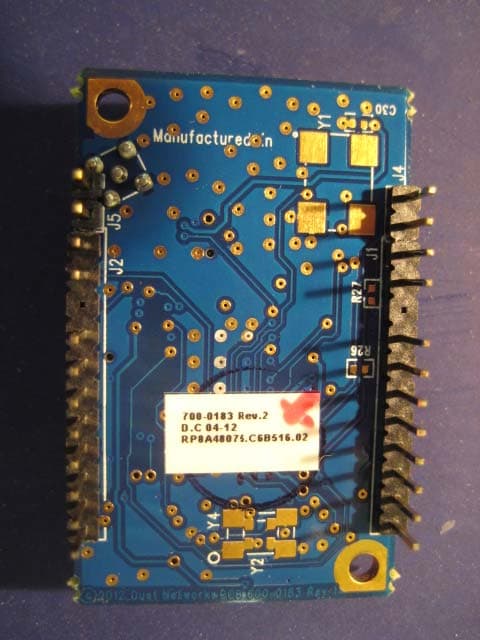
Click to zoom
Application Details
- Equipment Class
- DTS - Digital Transmission System
- Date of Grant
- Jan 17, 2013
- Application Purpose
- Original Equipment
- Date of Application
- Dec 21, 2012
- Equipment Note
- 802.15.4 Wireless Mesh Mote
- Frequency Range
- 2405.00000000 - 2475.00000000
- Company
- Analog Devices LLC
- Country
- Ireland
Documents & Files
Document Text
Text extracted from the exhibit documents filed with the FCC. Open a document above to read the original.
Users Manual
ETERNA1 Regulatory User Guide 023-0001 rev 1 November 1, 2012 Trademarks SmartMesh Industrial and Eterna are trademarks of Dust Networks, Inc. The Dust Networks logo, Dust, Dust Networks, and SmartMesh are registered trademarks of Dust Networks, Inc. All third-party brand and product names are the trademarks of their respective owners and are used solely for informational purposes. Copyright This documentation is protected by United States and international copyright and other intellectual and industrial property laws. It is solely owned by Dust Networks, Inc. and its licensors and is distributed under a restrictive license. This product, or any portion thereof, may not be used, copied, modified, reverse assembled, reverse compiled, reverse engineered, distributed, or redistributed in any form by any means without the prior written authorization of Dust Networks, Inc. RESTRICTED RIGHTS: Use, duplication, or disclosure by the U.S. Government is subject to restrictions of FAR 52.227-14(g) (2)(6/87) and FAR 52.227-19(6/87), or DFAR 252.227-7015 (b)(6/95) and DFAR 227.7202-3(a), and any and all similar and successor legislation and regulation. Disclaimer This documentation is provided “as is” without warranty of any kind, either expressed or implied, including but not limited to, the implied warranties of merchantability or fitness for a particular purpose. This documentation might include technical inaccuracies or other errors. Corrections and improvements might be incorporated in new versions of the documentation. Dust Networks does not assume any liability arising out of the application or use of any products or services and specifically disclaims any and all liability, including without limitation consequential or incidental damages. Dust Networks products are not designed for use in life support appliances, devices, or other systems where malfunction can reasonably be expected to result in significant personal injury to the user, or as a critical component in any life support device or system whose failure to perform can be reasonably expected to cause the failure of the life support device or system, or to affect its safety or effectiveness. Dust Networks customers using or selling these products for use in such applications do so at their own risk and agree to fully indemnify and hold Dust Networks and its officers, employees, subsidiaries, affiliates, and distributors harmless against all claims, costs, damages, and expenses, and reasonable attorney fees arising out of, directly or indirectly, any claim of personal injury or death associated with such unintended or unauthorized use, even if such claim alleges that Dust Networks was negligent regarding the design or manufacture of its products. Dust Networks reserves the right to make corrections, modifications, enhancements, improvements, and other changes to its products or services at any time and to discontinue any product or service without notice. Customers should obtain the latest relevant information before placing orders and should verify that such information is current and complete. All products are sold subject to Dust Network's terms and conditions of sale supplied at the time of order acknowledgment or sale. Dust Networks does not warrant or represent that any license, either express or implied, is granted under any Dust Networks patent right, copyright, mask work right, or other Dust Networks intellectual property right relating to any combination, machine, or process in which Dust Networks products or services are used. Information published by Dust Networks regarding third-party products or services does not constitute a license from Dust Networks to use such products or services or a warranty or endorsement thereof. Use of such information may require a license from a third party under the patents or other intellectual property of the third party, or a license from Dust Networks under the patents or other intellectual property of Dust Networks. Dust Networks, Inc is a wholly owned subsidiary of Linear Technology Corporation. © Dust Networks, Inc. 2012. All Rights Reserved. 2 Dust Networks ETERNA1 Regulatory User Guide Contents Contents.......................................................................................................................2 1 Introduction .............................................................................................................4 1.1 Purpose ............................................................................................................. 4 1.2 Scope................................................................................................................ 4 1.3 References ......................................................................................................... 4 1.4 Definitions ......................................................................................................... 4 1.5 General Description ............................................................................................. 4 1.6 Operational Description........................................................................................ 4 1.7 Block Diagram .................................................................................................... 5 2 Command and Response...........................................................................................5 2.1 CLI UART ........................................................................................................... 5 2.2 API UART ........................................................................................................... 6 3 Test Configurations ..................................................................................................6 3.1 Radiated Immunity.............................................................................................. 6 3.2 Emissions and Conducted Measurements ................................................................ 6 4 Tests…
Text truncated - open the document above for the full version.
Block Diagram
ETERNA1 Block Diagram November 1, 2012 Trademarks SmartMesh Industrial and Eterna are trademarks of Dust Networks, Inc. The Dust Networks logo, Dust, Dust Networks, and SmartMesh are registered trademarks of Dust Networks, Inc. All third-party brand and product names are the trademarks of their respective owners and are used solely for informational purposes. Copyright This documentation is protected by United States and international copyright and other intellectual and industrial property laws. It is solely owned by Dust Networks, Inc. and its licensors and is distributed under a restrictive license. This product, or any portion thereof, may not be used, copied, modified, reverse assembled, reverse compiled, reverse engineered, distributed, or redistributed in any form by any means without the prior written authorization of Dust Networks, Inc. RESTRICTED RIGHTS: Use, duplication, or disclosure by the U.S. Government is subject to restrictions of FAR 52.227-14(g) (2)(6/87) and FAR 52.227-19(6/87), or DFAR 252.227-7015 (b)(6/95) and DFAR 227.7202-3(a), and any and all similar and successor legislation and regulation. Disclaimer This documentation is provided “as is” without warranty of any kind, either expressed or implied, including but not limited to, the implied warranties of merchantability or fitness for a particular purpose. This documentation might include technical inaccuracies or other errors. Corrections and improvements might be incorporated in new versions of the documentation. Dust Networks does not assume any liability arising out of the application or use of any products or services and specifically disclaims any and all liability, including without limitation consequential or incidental damages. Dust Networks products are not designed for use in life support appliances, devices, or other systems where malfunction can reasonably be expected to result in significant personal injury to the user, or as a critical component in any life support device or system whose failure to perform can be reasonably expected to cause the failure of the life support device or system, or to affect its safety or effectiveness. Dust Networks customers using or selling these products for use in such applications do so at their own risk and agree to fully indemnify and hold Dust Networks and its officers, employees, subsidiaries, affiliates, and distributors harmless against all claims, costs, damages, and expenses, and reasonable attorney fees arising out of, directly or indirectly, any claim of personal injury or death associated with such unintended or unauthorized use, even if such claim alleges that Dust Networks was negligent regarding the design or manufacture of its products. Dust Networks reserves the right to make corrections, modifications, enhancements, improvements, and other changes to its products or services at any time and to discontinue any product or service without notice. Customers should obtain the latest relevant information before placing orders and should verify that such information is current and complete. All products are sold subject to Dust Network's terms and conditions of sale supplied at the time of order acknowledgment or sale. Dust Networks does not warrant or represent that any license, either express or implied, is granted under any Dust Networks patent right, copyright, mask work right, or other Dust Networks intellectual property right relating to any combination, machine, or process in which Dust Networks products or services are used. Information published by Dust Networks regarding third-party products or services does not constitute a license from Dust Networks to use such products or services or a warranty or endorsement thereof. Use of such information may require a license from a third party under the patents or other intellectual property of the third party, or a license from Dust Networks under the patents or other intellectual property of Dust Networks. Dust Networks, Inc is a wholly owned subsidiary of Linear Technology Corporation. © Dust Networks, Inc. 2012. All Rights Reserved. 2 Dust Networks ETERNA1 Block Diagram 1 Block Diagram Cortex-M3 Timers Sched. Auto MAC AES Flash 512 KB Flash Controller 802.15.4 Framing DMA 802.15.4 Mod 802.15.4 Demod API UART (6-pin) IPCS SPI Slave PTAT PMU / Clock Control Bat. Load SRAM 72 KB Code System LNA PA BPFPPF PLL RSSI LPF 20 MHz Analog Regulator Clock Regulator Core Regulator Voltage Reference Primary DC/DC Converter PA Regulator PoR 32 kHz ADC Ctrl. 10-bit ADC Relaxation Oscillator 32 kHz, 20 MHz 4-bit DAC VGA CLI UART (2 pin) LimitterADC AGC DAC Microprocessor Clock 1.8432 to 18.432 MHz Rx VCO out = fc – 2.5 MHz Tx VCO out = fc MHz Timer Clocks 32.768 kHz & 20 MHz Note that fc = 2405 + n*5 MHz, where n = 0, 1, 2, ... 14.
Cover Letter(s)
phone: 510. 400. 2900 | fax: 510. 489. 3799 |30695 Huntwood Avenue, Hayward, California 94544 | www.dustnetworks.com November 9, 2012 Federal Communications Commission 7435 Oakland Mills Road Columbia, MD 21046 Dear Sir/Madam, This letter is to comply with Section 0.457 and 0.459 pertaining to confidential material. Dust Networks would like the following documents regarding this submission for FCC ID: SJC‐ ETERNA1 to be kept confidential. 1. Schematics 2. Bill of Materials, 800‐0183.xls The above material contains trade secrets or technical data, which would customarily be guarded from competitors. We do not want these documents to be accessible to the general public. Sincerely, Gordon Charles Director of VLSI / Hardware Dust Networks, Inc.
Cover Letter(s)
phone: 510. 400. 2900 | fax: 510. 489. 3799 |30695 Huntwood Avenue, Hayward, California 94544 | www.dustnetworks.com December 2, 2012 Federal Communications Commission 7435 Oakland Mills Road Columbia, MD 21046 Dear Sir/Madam, This letter is to request single modular approval of the ETERNA1 2.4 GHz Wireless Mote per part 15.212. Dust Networks certifies the following requirements described in part 15.212: I. The ETERNA1 module has it’s own RF Shielding II. No direct access is provided to the modulator / up converter and as such ETERNA1 can not be stimulated to over‐modulate or modify the transmitters data rate III. The transmitter has it’s own power supply regulation. IV. The ETERNA1 module provides a unique antenna coupler, MMCX. V. The ETERNA1 module has been tested in a configuration with supporting hardware will the sole purpose of providing power and a control mechanism. VI. The ETERNA1 module is labeled with its own FCC ID number, see document 895‐0123 rev1 LABEL SPEC EXT APPROVALS LTP5900IPC.pdf. VII. The ETERNA1 module complies with all specific rules applicable to the transmitter. No option is provided to the integrator to modify the operation of the transmitter in this regard. VIII. The ETERNA1 complies with all RF exposure requirements by specification. The ETERNA1 module is not designed to be used so the radiating structure is within 20 cm of the body of the user. As such the module does not fall under the definition of a portable device per FCC Rules in Section 2.1093. While the ETERNA1 module qualifies as a mobile device per FCC Rules in Section 2.1091, the module has a maximum radiated output power of 0.01 Watts EIRP. As such, the module is below the 3 W power limit that would necessitate environmental evaluation for RF exposure. The ETERNA1 radio does not operate in the bands specified by 15.319(i), 15.407(f), 15.253(g) and 15.255(g). Sincerely, Gordon Charles Director of VLSI / Hardware Dust Networks, Inc.
Cover Letter(s)
phone: 510. 400. 2900 | fax: 510. 489. 3799 |30695 Huntwood Avenue, Hayward, California 94544 | www.dustnetworks.com October 7, 2012 Federal Communications Commission 7435 Oakland Mills Road Columbia, MD 21046 Ref: Eterna Maximum Duty Cycle over a 100 ms window Dear Examiner, Dust radios operate on a TDMA time schedule consisting of a continuous sequence of a minimum of 7.25 ms timeslots. In each timeslot radio’s will do one of the following: 1) Remain inactive 2) Transmit a packet and potentially receive an acknowlege 3) Potentially receive a packet and transmit an acknowlege When transmitting a packet, transmission duration during a timeslot varies as a function of the payload, with a maximum of 128 bytes. When receiving a packet the transmitted acknowledgement will be a maxium of 27 bytes. During network operation radios receive three times, for every transmit slot, and as a result the maximum possible duty cycle is created with the following sequence: 1) Transmit 2) Acknowledge 3) Acknowledge 4) Acknowledge 5) Transmit 6) Acknowledge 7) Acknowledge 8) Acknowledge 9) Transmit 10) Acknowledge 11) Acknowledge 12) Acknowledge 13) Transmit A radio transmit consists of 4 stages: 1) Initialization: radio is prepared for transmit (transmitter is off) 2) Ramp up: transmitter is ramped to peak power 3) Transmit: from 0 to 128 bytes of data maximum + 5 bytes preamble/SFD 4) Ramp down: radio transmitter is turned off, Where the data rate is 250 kbps +/‐ 40 ppm, or 32 us/byte. Ramp up and ramp down of the takes 77 us. Given the frequency of the messages the maximum duty time the radio can be transmitting over a 100 ms is: page 2 Max Tx on = 4*Transmit [128 bytes] + 12*Acknowledge = 4*[(128+5)*32us + 77us] + 9*[(24+5)*32us + 77us] = 4*[4.333 ms] + 12*[1.101 ms] = 27.241 ms Maximum duty cycle is therefore: 27.241 ms on / 100 ms = 27.241 % For reference a zero span capture of a 128 byte packet followed by three acknowledges and a 2 nd 128 byte packet is shown in Figure 1:. Figure 1: Eterna Radio Timeslot transmision sequence Tx, Ack, Ack, Ack, Tx Sincerely yours, Gordon Charles Director of VLSI / Hardware Dust Networks, Inc.
ID Label/Location Info
Document Number: 895-0123 Page 1 of 3 Dust Networks Proprietary A printed copy of this document is an uncontrolled copy. Hayward, California LABEL DRAWING LABEL, SPEC, EXT. APPROVALS, LTP5900IPC SERIES Document Number: 895-0123 Revision: 1 Effective Date: Effective on ECO Release Date (See Arena) Revision history Revision ECO Notes Date 1 INITIAL RELEASE The complete revision and approval history of this document may be found in the Arena vault under the document number Document Number: 895-0123 Page 2 of 3 Dust Networks Proprietary A printed copy of this document is an uncontrolled copy. 895-0123 LABEL, SPEC, EXT. APPROVALS, LTP5900IPC SERIES (Picture of actual product) LTP5900IPC Mote Label Requirements Line 1: MODEL: ETERNA1 Line 2: LTC Ordering Code LTP5900IPC- Line 3: LTC Ordering Code (cont’d) WHMAYYY#PBFES Ordering Codes for the existing LTP5900IPC are: LTP5900IPC-WHMAYYY#PBFES LTP5900IPC-WHMA1A1#PBF Line 4: Lot Code: ddd-yy.lotcode L.C. 172-12.A dd = day of the year, yy=year, lotcode= A, B, C Line 5: Assembled in USA Line 6: FCC ID (Future) FCC ID: SJC-ETERNA1 Line 7: Industry Canada ID (Future) IC: 5853A-ETERNA1 Overall Dimensions: 0.5“ x 0.5” Font: Arial Font size: 2.5pt Label material: DPN 890-0032 Printer: Brother P-Touch Pro-XL LTP5900IPC Label Mac Addr Label Document Number: 895-0123 Page 3 of 3 Dust Networks Proprietary A printed copy of this document is an uncontrolled copy. Mac Addr Label Requirements Line 1: 2D Bar Code 2D Bar Code Line 2: MAC Addr xxxxxx Overall Dimensions: 0.25” x 0.3” Font: Arial Font size: 2.5pt Label material: DPN 890-0031 Printer: Brother P-Touch Pro-XL
Operational Description
ETERNA1 Operational Description November 1, 2012 Trademarks SmartMesh Industrial and Eterna are trademarks of Dust Networks, Inc. The Dust Networks logo, Dust, Dust Networks, and SmartMesh are registered trademarks of Dust Networks, Inc. All third-party brand and product names are the trademarks of their respective owners and are used solely for informational purposes. Copyright This documentation is protected by United States and international copyright and other intellectual and industrial property laws. It is solely owned by Dust Networks, Inc. and its licensors and is distributed under a restrictive license. This product, or any portion thereof, may not be used, copied, modified, reverse assembled, reverse compiled, reverse engineered, distributed, or redistributed in any form by any means without the prior written authorization of Dust Networks, Inc. RESTRICTED RIGHTS: Use, duplication, or disclosure by the U.S. Government is subject to restrictions of FAR 52.227-14(g) (2)(6/87) and FAR 52.227-19(6/87), or DFAR 252.227-7015 (b)(6/95) and DFAR 227.7202-3(a), and any and all similar and successor legislation and regulation. Disclaimer This documentation is provided “as is” without warranty of any kind, either expressed or implied, including but not limited to, the implied warranties of merchantability or fitness for a particular purpose. This documentation might include technical inaccuracies or other errors. Corrections and improvements might be incorporated in new versions of the documentation. Dust Networks does not assume any liability arising out of the application or use of any products or services and specifically disclaims any and all liability, including without limitation consequential or incidental damages. Dust Networks products are not designed for use in life support appliances, devices, or other systems where malfunction can reasonably be expected to result in significant personal injury to the user, or as a critical component in any life support device or system whose failure to perform can be reasonably expected to cause the failure of the life support device or system, or to affect its safety or effectiveness. Dust Networks customers using or selling these products for use in such applications do so at their own risk and agree to fully indemnify and hold Dust Networks and its officers, employees, subsidiaries, affiliates, and distributors harmless against all claims, costs, damages, and expenses, and reasonable attorney fees arising out of, directly or indirectly, any claim of personal injury or death associated with such unintended or unauthorized use, even if such claim alleges that Dust Networks was negligent regarding the design or manufacture of its products. Dust Networks reserves the right to make corrections, modifications, enhancements, improvements, and other changes to its products or services at any time and to discontinue any product or service without notice. Customers should obtain the latest relevant information before placing orders and should verify that such information is current and complete. All products are sold subject to Dust Network's terms and conditions of sale supplied at the time of order acknowledgment or sale. Dust Networks does not warrant or represent that any license, either express or implied, is granted under any Dust Networks patent right, copyright, mask work right, or other Dust Networks intellectual property right relating to any combination, machine, or process in which Dust Networks products or services are used. Information published by Dust Networks regarding third-party products or services does not constitute a license from Dust Networks to use such products or services or a warranty or endorsement thereof. Use of such information may require a license from a third party under the patents or other intellectual property of the third party, or a license from Dust Networks under the patents or other intellectual property of Dust Networks. Dust Networks, Inc is a wholly owned subsidiary of Linear Technology Corporation. © Dust Networks, Inc. 2012. All Rights Reserved. 2 Dust Networks ETERNA1 Operational Description 1 Operational Description ETERNA1 provides a IEEE 802.15.4 compliant radios that modulate a DSSS OQPSK set of symbols at a chip rate of 2 Mcps. Dust radios operate on a TDMA time schedule that uses either 7.25 or 10 ms timeslots. A transmit timeslot consists of 5 stages: 1. Initialization: radio is prepared for transmit (transmitter is off) 2. Ramp: transmitter is ramped to peak power 3. Transmit: 128 bytes of data maximum + 5 bytes preamble/SFD 4. Turnaround: radio is set to receive 5. Receive: radio waits in receive for ACK, then turns off Total transmit time for a 128 byte packet plus all overhead (SFD / Preamble / Ramp) is 4.33ms. A receive timeslot consists of 5 stages: 1. Initialization: radio is prepared for receive 2. Check for start of packet – if no packet is received within a guard time the radio is disabled and no further action is taken 3. Receive the packet: up to 128 bytes of data maximum + 5 bytes preamble/SFD 4. Turnaround: radio waits 1 ms and then is set to transmit 5. Transmit: radio sends an ACK (21 bytes of data + 5 bytes preamble/SFD), then turns off Total transmit time for an ACK is plus all overhead (SFD / Preamble / Ramp) is 1.101 ms. Measured records and calculations of ETERNA1 radio transmit duty cycling are included in “ETERNA Duty cycle.pdf”. When the radio is not in operation, the CPU is occasionally (every few seconds for a few milliseconds) operating, monitoring temperature and voltage. The remainder of the time the ETERNA1 in a low power mode operating solely from a 32 kHz crystal source.
RF Exposure Info
Page 1 of 7 Report No: 93690-20A RADIO FREQUENCY EXPOSURE ADDENDUM TO TEST REPORT 93690-20 FOR THE Device: 802.15.4 Wireless Mesh Mote* Model: ETERNA1 Report No.: 93690-20A Date of issue: December 5, 2012 PREPARED FOR: Dust Networks 30695 Huntwood Avenue Hayward, CA 94544 PREPARED BY: Eddie Wong CKC Laboratories, Inc. 5046 Sierra Pines Drive Mariposa, CA 95338 Page 2 of 7 Report No: 93690-20A Revision History Original: To demonstrate compliance of device 802.15.4 Wireless Mesh Mote*, ETERNA1 with United States, Canada and/or European Union RF Exposure requirements for Portable equipment (devices used ≤20cm from the body) or Mobile equipment (devices used >20cm from the body) with power output below exemption levels and Mobile equipment, where Maximum Permissible Exposure (MPE) Calculations apply. Addendum A: To add one row for European Union to the table on page 6. United States Compliance Requirements (1.1310): RF Exposure Evaluation Limits Occupational / Controlled Exposure Frequency Range (MHz) Electric Field Strength (V/m) Magnetic Field Strength (A/m) Power Density (mW/cm 2 ) Averaging Time (minutes) 0.3-3.0 614 1.63 *(100) 6 3.0-30 1842/f 4.89/f *(900/f 2 ) 6 30-300 61.4 0.163 1 6 300-1500 --- --- f/300 6 1500-100,000 --- --- 5.0 6 RF Exposure Evaluation Limits General Population / Uncontrolled Exposure Frequency Range (MHz) Electric Field Strength (V/m) Magnetic Field Strength (A/m) Power Density (mW/cm 2 ) Averaging Time (minutes) 0.3-1.34 614 1.63 *(100) 30 1.34-30 824/f 2.19/f *(180/f 2 ) 30 30-300 27.5 0.073 0.2 30 300-1500 --- --- f/1500 30 1500-100,000 --- --- 1.0 30 * Plane wave equivalent power density Limit is calculated based on the mid-band frequency used in the operating frequency range. Exemption Level: Power output <60/f GHz (mW) Page 3 of 7 Report No: 93690-20A Canadian Compliance Requirements (RSS-102): RF Exposure Evaluation Limits Occupational / Controlled Exposure: Frequency Range (MHz) Electric Field Strength (V/m) Magnetic Field Strength (A/m) Power Density (W/m 2 ) Averaging Time (minutes) 0.003-1.0 600 4.9 --- 6 1.0-10 600/f 4.9/f --- 6 10-30 60 4.9/f --- 6 30-300 60 0.163 10 6 300-1500 3.54 f 0.5 0.0094*f 0.5 f/3 6 1500-15,000 137 0.364 50 6 15,000-150,000 137 0.364 50 616000/f 1.2 RF Exposure Evaluation Limits General Population / Uncontrolled Exposure Frequency Range (MHz) Electric Field Strength (V/m) Magnetic Field Strength (A/m) Power Density (W/m 2 ) Averaging Time (minutes) 0.003-1.0 280 2.19 --- 6 1.0-10 280/f 2.19/f --- 6 10-30 28 2.19/f --- 6 30-300 28 0.073 2 6 300-1500 1.585 * f 0.5 0.0042 * f 0.5 f/150 6 1500-15,000 61.4 0.163 10 6 15,000-150,000 61.4 0.163 10 616000/f 1.2 *Power density limit applicable >100MHz Exemption Level: Frequency Range (MHz) Maximum Output Power (Conducted or EIRP) 0.003-1000 ≤ 200 mW 1000-2200 ≤ 100 mW 2200-3000 ≤ 20 mW 3000-6000 ≤ 10 mW Page 4 of 7 Report No: 93690-20A European Union Compliance Requirements (ICNIRP): RF Exposure Evaluation Limits Occupational / Controlled Exposure: Frequency Range (MHz) Electric Field Strength (V/m) Magnetic Field Strength (A/m) Power Density (W/m 2 ) Averaging Time (minutes) 0.00082-0.065 610 24.4 --- 6 0.065-1.0 610 1.6/f --- 1.0-10 610/f 1.6/f --- 6 10-400 61 0.16 10 6 400-2000 3.0 * f 0.5 0.008 * f 0.5 f/40 6 2000-300,000 137 0.36 50 6 RF Exposure Evaluation Limits General Population / Uncontrolled Exposure Frequency Range (MHz) Electric Field Strength (V/m) Magnetic Field Strength (A/m) Power Density (W/m 2 ) Averaging Time (minutes) 0.003-0.150 87 5.0 --- 6 0.150-1.0 87 0.73/f -- 6 1.0-10 87/f 0.5 0.73/f --- 6 10-400 28 0.073 2 6 400-2000 1.375 f 0.5 0.0037*f 0.5 f/200 6 2000-300,000 61 0.16 10 6 *Power density limit applicable >100MHz Exemption Level: Power output < 20mW 1 1 May vary by product type Page 5 of 7 Report No: 93690-20A Device and Antenna Operating Configuration: Device operating at maximum output power with continuous transmission of modulated data. Antenna gain : not to exceed 6.6 dBi Modulation: 802.15.4 Firmware power setting = 8dBm Measurement procedure In Accordance With FCC document KDB558074 D01 DTS Meas Guidance V02 , 8.1.1 15.31(e) compliance: the supply voltage was varied between 85% and 115% of the nominal rated supply voltage, the following change in the Fundamental signal level was observed. 2405MHz 2445 MHz 2475MHz 3.45V 8.46 dBm 0.0070W 8.68 dBm 0.0074W 8.79dBm 0.0076W 3.00V 8.03 dBm 0.0063W 8.00 dBm 0.0063W 7.99dBm 0.0063W 2.55V 6.06 dBm 0.0040W 6.29 dBm 0.0043W 6.35dBm 0.0043W Test Procedure: This equipment is evaluated in accordance with the guidelines set forth in OET Guide 65 & ANSI C95.1 for the US and Health Canada Safety Code 6 & RSS 102 for Canada. Other Considerations: None or Delete “none & Insert specific Page 6 of 7 Report No: 93690-20A MPE Calculations Applicability: Limit Used X General Population / Uncontrolled Exposure Occupational / Controlled Exposure RF Exposure Exemption x United States x Canada X European Union Equipment operational details: Config # Operating Frequency (MHz) Measured Output Power (dBm) Antenna Gain (dBi) Antenna Type / Configuration EIRP (dBm) 1 2412-2472 8.79 6.6 Ant1 15.39 Measurements based from EMC Test Report(s): 93690-12 MPE Calculation: 2 4d EIRP DensityPower Given: EIRP in mW or W and d in cm or m Config # Distance (cm) US (1.1310) Canada (RSS-102) ICNIRP Power Density (mW/cm 2 ) Limit (mW/cm 2 ) Power Density (W/m 2 ) Limit (W/m 2 ) Power Density (W/m 2 ) Limit (W/m 2 ) 1 20 0.0068 1 0.068 10 0.068 10 Page 7 of 7 Report No: 93690-20A Summary: MPE Calculation Results: In the case the equipment meets compliance by MPE Calculations the product is approved for use under mobile conditions without further testing under the condition that any additional collocation or simultaneous transmission requirements (including necessary separation distances) have been met. It is assumed that the manufacturer shall design the equipment such that the minimum separation distance of 20cm (or greater, as listed above) …
Text truncated - open the document above for the full version.
Test Report
This report contains a total of 44 pages and may be reproduced in full only. Partial reproduction may only be done with the written consent of CKC Laboratories, Inc. Dust Networks TEST REPORT FOR 802.15.4 Wireless Mesh Mote Model: ETERNA1 Tested To The Following Standards: FCC Part 15 Subpart C Sections 15.207, 15.247 and RSS 210 Issue 8 Report No.: 93690-12 Date of issue: October 23, 2012 This test report bears the accreditation symbol indicating that the testing performed herein meets the test and reporting requirements of ISO/IEC 17025 under the applicable scope of EMC testing for CKC Laboratories, Inc. We strive to create long-term, trust based relationships by providing sound, adaptive, customer first testing services. We embrace each of our customers’ unique EMC challenges, not as an interruption to set processes, but rather as the reason we are in business. Page 2 of 44 Report No.: 93690-12 TABLE OF CONTENTS Administrative Information ...........................................................................…
Text truncated - open the document above for the full version.
Contact Information
Applicant
David Bourke(Director of Hardware Engineering)
Technical Contact
Dust NetworksGordon Charles
[email protected]510-400-2919
30695 Huntwood Avenue · Hayward · United States
Test Firm
CKC Laboratories, Inc.Steve Behm
Technical Specifications
| # | Rule Parts | Frequency Range | Power Output |
|---|---|---|---|
| 1 | 15C | 2.40 GHz - 2.48 GHz | 6.40 mW |
Other Applications from Analog Devices LLC
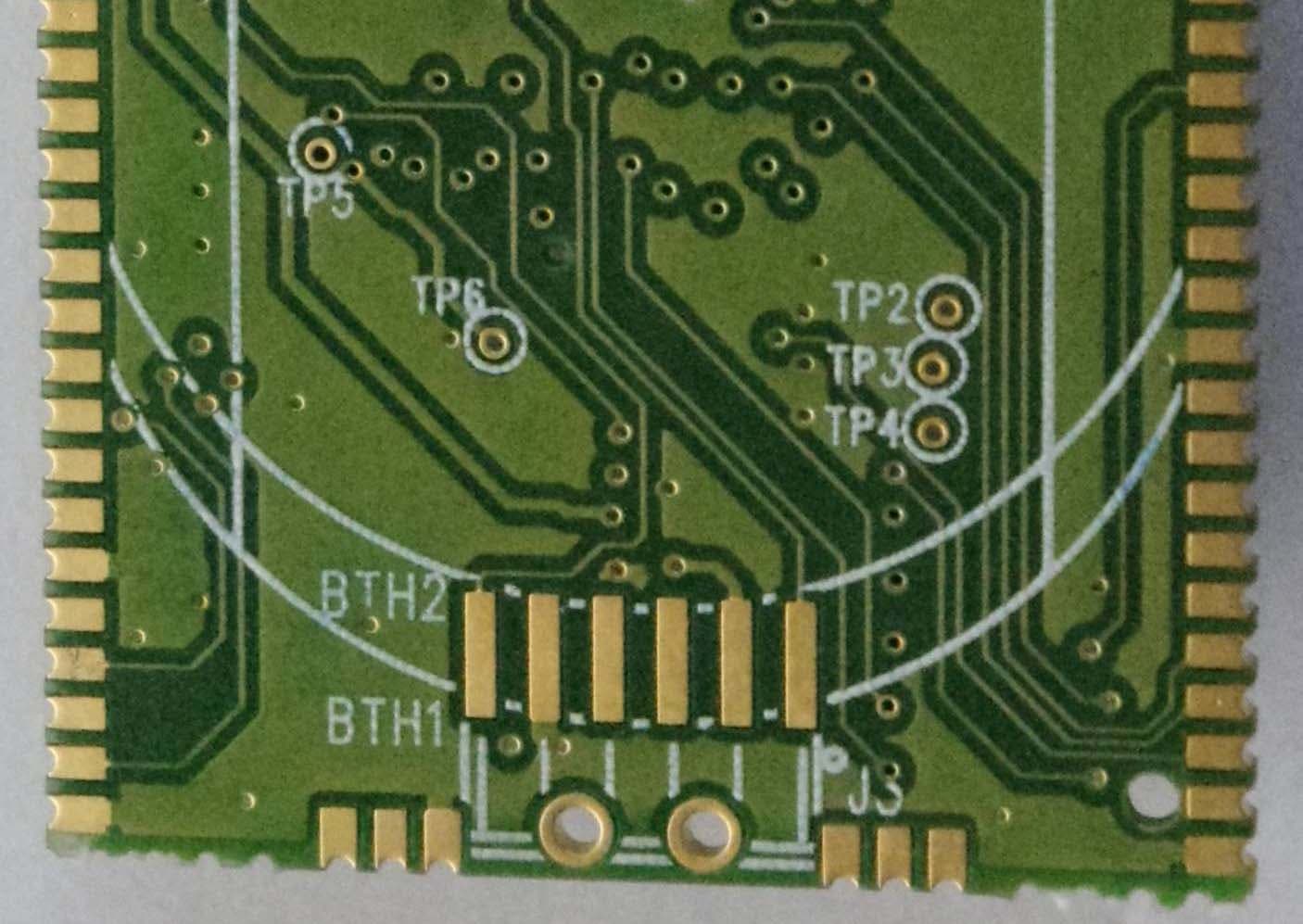
SJC-ETERNA2
Jan 17, 2013802.15.4 Wireless Mesh Mote
Equipment Class
DTS - Digital Transmission System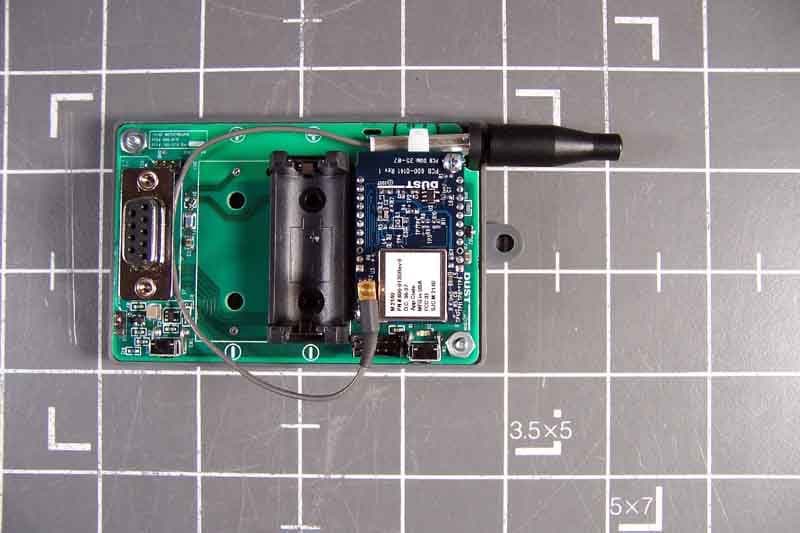
SJC-M2140
Dec 20, 2007Smart Mesh Wireless Mote
Equipment Class
DTS - Digital Transmission System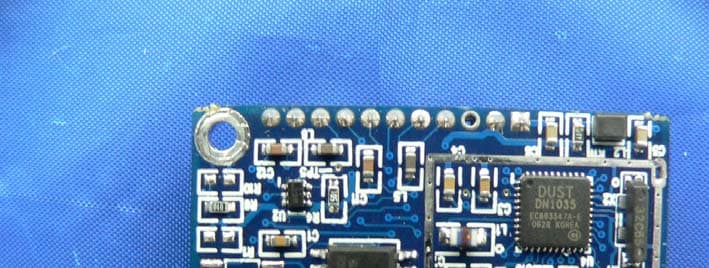
SJC-M1310
Apr 12, 2007900 MHz Mote Frequency Hopping System Module
Equipment Class
DSS - Part 15 Spread Spectrum Transmitter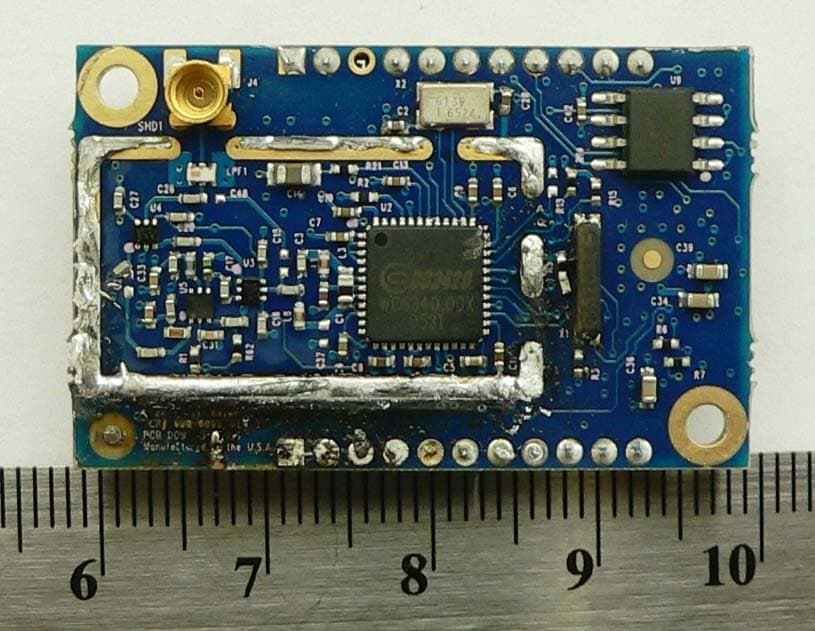
SJC-M2030
Dec 15, 2006SmartMesh M2030 2.4GHz Mote
Equipment Class
DSS - Part 15 Spread Spectrum Transmitter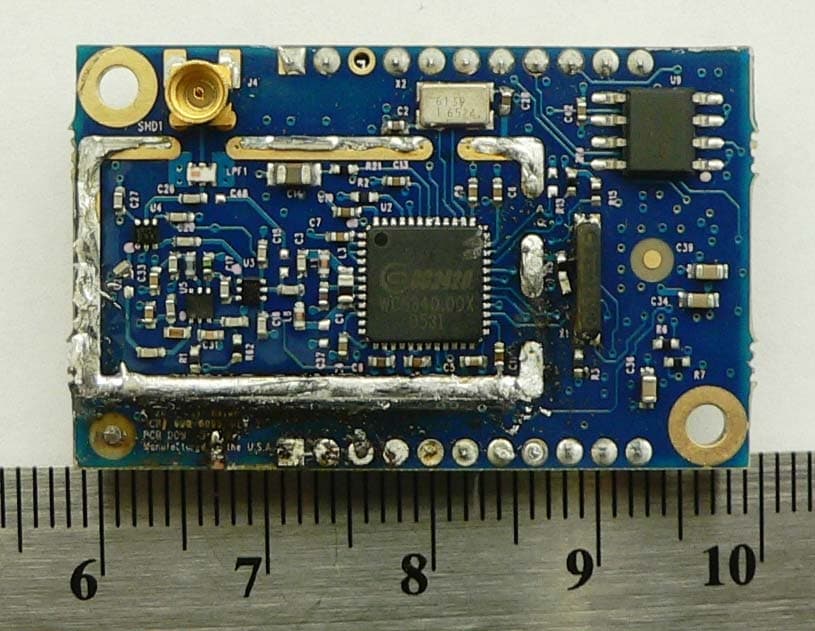
SJC-M2135
Dec 15, 2006SmartMesh M2135 2.4GHz Mote
Equipment Class
DSS - Part 15 Spread Spectrum Transmitter