SKJ-M5001Bluetooth Speaker
Shenzhen Heui Xint Technology Co., Ltd
Click to zoom
Application Details
- Equipment Class
- DSS - Part 15 Spread Spectrum Transmitter
- Date of Grant
- Jul 28, 2013
- Application Purpose
- Original Equipment
- Date of Application
- Jul 28, 2013
- Equipment Note
- Bluetooth Speaker
- Frequency Range
- 2402.00000000 - 2480.00000000
- Country
- China
Documents & Files
Document Text
Text extracted from the exhibit documents filed with the FCC. Open a document above to read the original.
Users Manual
Shenzhen Heui Xint Technology Co., Ltd Model: M5B Product: Bluetooth Speaker Notices: 1.if at the first time using the product can not turn on, it’s perhaps not enough power for the battery please try to charge the battery then open again 2. please close the machine when the battery charging, it’s good for the life of battery, also please use the dedicated equipment for battery charging in the package attached. 3. please charge at least 4hours in the first time using, next time could be 2-3 hours. 4. long time no using product please remember to charge the battery firstly 5. please don’t put product under hot sunshine, near the temperature 45’c and nor can fire, in case the damage happened. 6. please don’t tear open the machine if you are not professional for this machine 7. input voltage of player if too high will be damaged the product, too low will not work please don’t put the product on wet and raining side when use. product function 1. hand free 2. Bluetooth 3. LINE IN Aux in 4. support sound notice for the function process 5 ROHS silicone sleeve product size : D75xH50mm appearance and button function introduction Aux in Mini USB : connect with USB jack on/off hang ring hole last/VOL- play/stop next/VOL+ mode indicator charge power If low power thee is notice”DUDU”sound, first time use we suggest to charge the product, please connect with the micro USB between product and computer, charge when off is red indictor, charge when on it flash red and blue. This micro USB port can not communication with computer. Bluetooth function and use Our Bluetooth speaker is stereo Bluetooth Chipset, so we require the Bluetooth mobile phone or Bluetooth adapter are supported the A2DP . Please turn product “on”( in the same time Please ensure the battery power is full.) After turn on product it’s flash blue for 15-30seconds,then you will hear: you enter Bluetooth mode, please wait for the connection. Now the blue flash per second, it means now is connecting status. Connect mobile phone first step open the Bluetooth in your mobile phone, the phone will show the symbol of Bluetooth, IPHONE will enter research the Bluetooth mode automatically. second step Research the equipment third step If mobile phone show “M5B”, your phone now already found with the Bluetooth speaker, then you will enter the matching status. the fourth step During match please input password ‘0000’ if needed fifth step 。Matching is automatically no need setting, if success, the Bluetooth symbol of your phone will change color or other shape. if have coming call, Please press” ”then you could hand free to pick up the phone connect computer If your computer is with Bluetooth function then you no need set up the Bluetooth, if no pls set up the Bluetooth driver firstly and insert the Bluetooth adapter first step Pls choose Bluetooth symbol, chose “add device”. second step The adaptor is searching the Bluetooth, until it display ”M5B” third step Double click “M5B”, it will set up the driver until it set up successfully. fourth step If you would like to control last and next song please choose the media player of computer attached itself. If Bluetooth is not ok pls check if it change to Bluetooth mode, if it already is Bluetooth model, pls confirm again the Bluetooth speaker and computer is connected. Pls also check the equipment Manager. matching and connecting Mobile phone matching---- if last time you did not connect with Bluetooth then Bluetooth enter matching status, if speaker have been connected, it will connect the equipment same as last time, if not successfully, after 15-30 seconds it will enter the matching status. Connecting mode---- start to enter the matching mode Matching status will keep 20-30seconds Aux-in Insert the 3.5mm audio cable to AUX and another connecter to PC or mobile phone of PSP, then play the music technical data speaker 45mm 3Ω output power 2.5W frequency response 80Hz-15KHz sensitive 80db±2db S/N ≥80db distortion THD<1% USB size USB2.0,compatible with USB1.1 product size 75x50mm power Build-in lithium battery, USB cable for rechargeable power included 1. speaker 2. 3.5mm audio cable 3. USB cable 4. manual FCC NOTE: This device complies with Part 15 of the FCC Rules.Operation is subject to the following two conditions: (1) this device may not cause harmful interference, and (2) this device must accept any interference received, including interference that may cause undesired operation. THE MANUFACTURER IS NOT RESPONSIBLE FOR ANY RADIO OR TV INTERFERENCE CAUSED BY UNAUTHORIZED MODIFICATIONS OR CHANGE TO THIS EQUIPMENT. SUCH MODIFICATIONS OR CHANGE COULD VOID THE USER’S AUTHORITY TO OPERATE THE EQUIPMENT. This equipment has been tested and found to comply with the limits for a Class B digital device, pursuant to part 15 of the FCC Rules. These limits are designed to provide reasonable protection against harmful interference in a residential installation. This equipment generates, uses and can radiate radio frequency energy and, if not installed and used in accordance with the instructions, may cause harmful interference to radio communications. However, there is no guarantee that interference will not occur in a particular installation. If this equipment does cause harmful interference to radio or television reception, which can be determined by turning the equipment off and on, the user is encouraged to try to correct the interference by one or more of the following measures: -- Reorient or relocate the receiving antenna. -- Increase the separation between the equipment and receiver. -- Connect the equipment into an outlet on a circuit different from that to which the receiver is connected. -- Consult the dealer or an experienced radio/TV technician for help.
External Photos
Shenzhen Heui Xint Technology Co., Ltd Model: M5B REPORT NO.: STR13078232I FCC PART 15.247 EXHIBIT 2 - EUT EXTERNAL PHOTOGRAPHS EUT View 1 EUT View 2 Shenzhen Heui Xint Technology Co., Ltd Model: M5B REPORT NO.: STR13078232I FCC PART 15.247 EUT View 3 EUT View 4 Shenzhen Heui Xint Technology Co., Ltd Model: M5B REPORT NO.: STR13078232I FCC PART 15.247 EUT View 5 EUT View 6 Shenzhen Heui Xint Technology Co., Ltd Model: M5B REPORT NO.: STR13078232I FCC PART 15.247 EUT View 7
ID Label/Location Info
Shenzhen Heui Xint Technology Co., Ltd Model: M5B REPORT NO.: STR13078232I FCC PART 15.247 EXHIBIT 1- PRODUCT LABELING Proposed FCC ID Label Format FCC ID: SKJ-M5001 Specifications: Text is Black in color and justified. Labels are printed in indelible ink on permanent adhesive silk-screened onto the EUT or shall be affixed at a conspicuous location on the EUT. FCC ID Label Location
Internal Photos
Shenzhen Heui Xint Technology Co., Ltd Model: M5B REPORT NO.: STR13078232I FCC PART 15.247 EXHIBIT 3 - EUT INTERNAL PHOTOGRAPHS EUT Housing and Board View 1 EUT Housing and Board View 2 Battery placement Shenzhen Heui Xint Technology Co., Ltd Model: M5B REPORT NO.: STR13078232I FCC PART 15.247 Solder Board-Component View 1 Solder Board-Component View 2 Shenzhen Heui Xint Technology Co., Ltd Model: M5B REPORT NO.: STR13078232I FCC PART 15.247 Antenna View Bluetooth Module View1 Bluetooth Antenna Shenzhen Heui Xint Technology Co., Ltd Model: M5B REPORT NO.: STR13078232I FCC PART 15.247 Bluetooth Module View2 Bluetooth Module View3
RF Exposure Info
Shenzhen Heui Xint Technology Co., Ltd Model: M5B REPORT NO.: STR13078232I PAGE 1 OF 1 FCC PART 15.247 RF Exposure Requirements According to Part 2.1093 and KDB 447498 D01 Section 4.3.1 4.3.1. Standalone SAR test exclusion considerations Unless specifically required by the published RF exposure KDB procedures, standalone 1-g head or body and 10-g extremity SAR evaluation for general population exposure conditions, by measurement or numerical simulation, is not required when the corresponding SAR Exclusion Threshold condition, listed below, is satisfied. These test exclusion conditions are based on source-based time-averaged maximum conducted output power of the RF channel requiring evaluation, adjusted for tune-up tolerance, and the minimum test separation distance required for the exposure conditions.15 The minimum test separation distance is determined by the smallest distance from the antenna and radiating structures or outer surface of the device, according to the host form factor, exposure conditions and platform requirements, to any part of the body or extremity of a user or bystander (see section 4.1). To qualify for SAR test exclusion, the test separation distances applied must be fully explained and justified by the operating configurations and exposure conditions of the transmitter and applicable host platform requirements, typically in the SAR measurement or SAR analysis report, according to the required published RF exposure KDB procedures. When no other RF exposure testing or reporting is required, a statement of justification and compliance must be included in the equipment approval, in lieu of the SAR report, to qualify for the SAR test exclusion. When required, the conditions of other published RF exposure KDB procedures must also be applied in conjunction with the SAR test exclusion provisions; for example, handheld PTT two-way radios, handsets, laptops & tablets etc. 1) The 1-g and 10-g SAR test exclusion thresholds for 100 MHz to 6 GHz at test separation distances ≤ 50 mm are determined by: [(max. power of channel, including tune-up tolerance, mW)/(min. test separation distance, mm)] · [√f(GHz)] ≤ 3.0 for 1-g SAR and ≤ 7.5 for 10-g extremity SAR,16 where f(GHz) is the RF channel transmit frequency in GHz Power and distance are rounded to the nearest mW and mm before calculation17 The result is rounded to one decimal place for comparison The test exclusions are applicable only when the minimum test separation distance is ≤ 50 mm and for transmission frequencies between 100 MHz and 6 GHz. When the minimum test separation distance is < 5 mm, a distance of 5 mm is applied to determine SAR test exclusion. 2) At 100 MHz to 6 GHz and for test separation distances > 50 mm, the SAR test exclusion threshold is determined according to the following, and as illustrated in Appendix B:18 a) [Threshold at 50 mm in step 1) + (test separation distance - 50 mm)·( f(MHz)/150)] mW, at 100 MHz to 1500 MHz b) [Threshold at 50 mm in step 1) + (test separation distance - 50 mm)·10] mW at > 1500 MHz and≤ 6 GHz Shenzhen Heui Xint Technology Co., Ltd Model: M5B REPORT NO.: STR13078232I PAGE 1 OF 1 FCC PART 15.247 3) At frequencies below 100 MHz, the following may be considered for SAR test exclusion, and as illustrated in Appendix C:19 a) The threshold at the corresponding test separation distance at 100 MHz in step 2) is multiplied by [1 + log(100/f(MHz))] for test separation distances > 50 mm and < 200 mm b) The threshold determined by the equation in a) for 50 mm and 100 MHz is multiplied by ½ for test separation distances ≤ 50 mm c) SAR measurement procedures are not established below 100 MHz. When SAR test exclusion cannot be applied, a KDB inquiry is required to determine SAR evaluation requirements for any test results to be acceptable. Product Description: Bluetooth Speaker Model No.: M5B FCC ID: SKJ-M5001 According to the KDB-447498, the following RF exposure evaluation shall to demonstrate RF exposure compliance. Tx frequency range: 2402~2480MHz Device category: Portable device (Distance: 5mm) Maximum Conducted Output Power: -0.36 dBm (at the 2441MHz channel of GFSK mode) Maximum Antenna Gain: 0 dBi Maximum EIRP Output Power: 0.92 mW (at the 2441MHz channel of GFSK mode) Limit: [(max. power of channel, including tune-up tolerance, mW)/(min. test separation distance, mm)]·[√f(GHz)] ≤ 3.0 ( 0.92mW max power / 5mm separation ) x (2.441 )½ So = 0.287 < 3.0 So the transmitter complies with the RF exposure requirements and the SAR is not required.
Test Report
Shenzhen Heui Xint Technology Co., Ltd Model: M5B REPORT NO.: STR13078232I PAGE 1 OF 52 FCC PART 15.247 FCC Part 15C Measurement and Test Report For Shenzhen Heui Xint Technology Co., Ltd 2/F,E Building, Huafeng Industry, Hangcheng Road, Xixiang Town, Baoan District, Shenzhen, China FCC ID: SKJ-M5001 FCC Rules: FCC Part 15.247 Product Description: Bluetooth Speaker Tested Model: M5B Report No.: STR13078232I Tested Date: 2013-07-18 to 2013-07-23 Issued Date: 2013-07-23 Tested By: Zero Zhou / Engineer Reviewed By: Lahm Peng / EMC Manager Approved & Authorized By: Jandy so / PSQ Manager Prepared By: SEM.Test Compliance Service Co., Ltd 3/F, Jinbao Commerce Building, Xin'an Fanshen Road, Bao'an District, Shenzhen, P.R.C.(518101) Tel.: +86-755-33663308 Fax.: +86-755-33663309 Website: www.semtest.com.cn Note: This test report is limited to the above client company and the product model only. It may not be duplicated without prior permitted by SEM.Test Compliance Service Co., Ltd Shenzhen Heui Xint Technology Co., Ltd Model: M5B REPORT NO.: STR13078232I PAGE 2 OF 52 FCC PART 15.247 TABLE OF CONTENTS 1. GENERAL INFORMATION ...................................................................................................................................4 1.1 PRODUCT DESCRIPTION FOR EQUIPMENT UNDER TEST (EUT)...............................................................................4 1.2 TEST STANDARDS...................................................................................................................................................5 1.3 TEST METHODOLOGY.............................................................................................................................................5 1.4 TEST FACILITY.......................................................................................................................................................5 1.5 EUT SETUP AND TEST MODE.................................................................................................................................6 2. SUMMARY OF TEST RESULTS ...........................................................................................................................7 3. ANTENNA REQUIREMENT ..................................................................................................................................8 3.1 STANDARD APPLICABLE.........................................................................................................................................8 3.2 EVALUATION INFORMATION..................................................................................................................................8 4. FREQUENCY HOPPING SYSTEM REQUIREMENTS .....................................................................................9 4.1 STANDARD APPLICABLE.........................................................................................................................................9 4.2 FREQUENCY HOPPING SYSTEM...............................................................................................................................9 4.3 EUT PSEUDORANDOM FREQUENCY HOPPING SEQUENCE....................................................................................10 5. QUANTITY OF HOPPING CHANNELS AND CHANNEL SEPARATION ...................................................11 5.1 STANDARD APPLICABLE.......................................................................................................................................11 5.2 TEST EQUIPMENT LIST AND DETAILS...................................................................................................................11 5.3 TEST PROCEDURE.................................................................................................................................................11 5.4 ENVIRONMENTAL CONDITIONS............................................................................................................................11 5.5 SUMMARY OF TEST RESULTS/PLOTS....................................................................................................................12 6. DWELL TIME OF HOPPING CHANNEL ..........................................................................................................16 6.1 STANDARD APPLICABLE.......................................................................................................................................16 6.2 TEST EQUIPMENT LIST AND DETAILS...................................................................................................................16 6.3 TEST PROCEDURE.................................................................................................................................................16 6.4 ENVIRONMENTAL CONDITIONS............................................................................................................................16 6.5 SUMMARY OF TEST RESULTS/PLOTS....................................................................................................................17 7. 20DB BANDWIDTH ...............................................................................................................................................27 7.1 STANDARD APPLICABLE.......................................................................................................................................27 7.2 TEST EQUIPMENT LIST AND DETAILS...................................................................................................................27 7.3 TEST PROCEDURE.................................................................................................................................................27 7.4 ENVIRONMENTAL CONDITIONS............................................................................................................................27 7.5 SUMMARY OF TEST RESULTS/PLOTS............................................................................…
Text truncated - open the document above for the full version.
Test Setup Photos
Shenzhen Heui Xint Technology Co., Ltd Model: M5B REPORT NO.: STR13078232I FCC PART 15.247 EXHIBIT 4 - TEST SETUP PHOTOGRAPHS Conducted Emission Test Setup Spurious Radiation Test Setup (Below 30MHz) Transmitting: Shenzhen Heui Xint Technology Co., Ltd Model: M5B REPORT NO.: STR13078232I FCC PART 15.247 Spurious Radiation Test Setup (30MHz to 1G) Transmitting: Charging: Shenzhen Heui Xint Technology Co., Ltd Model: M5B REPORT NO.: STR13078232I FCC PART 15.247 Spurious Radiation Test Setup (Above1G) Transmitting:
Contact Information
Applicant
Grace Chen
Test Firm
SEM.Test Compliance Service Co., Ltd.Jandy So
Technical Specifications
| # | Rule Parts | Frequency Range | Power Output | Emission |
|---|---|---|---|---|
| 1 | 15C | 2.40 GHz - 2.48 GHz | 920.00 µW | 1M36F7D |
Other Applications from Shenzhen Heui Xint Technology Co., Ltd

SKJ-Q5
Jan 20, 2014BLUETOOTH SPEAKER
Equipment Class
DSS - Part 15 Spread Spectrum Transmitter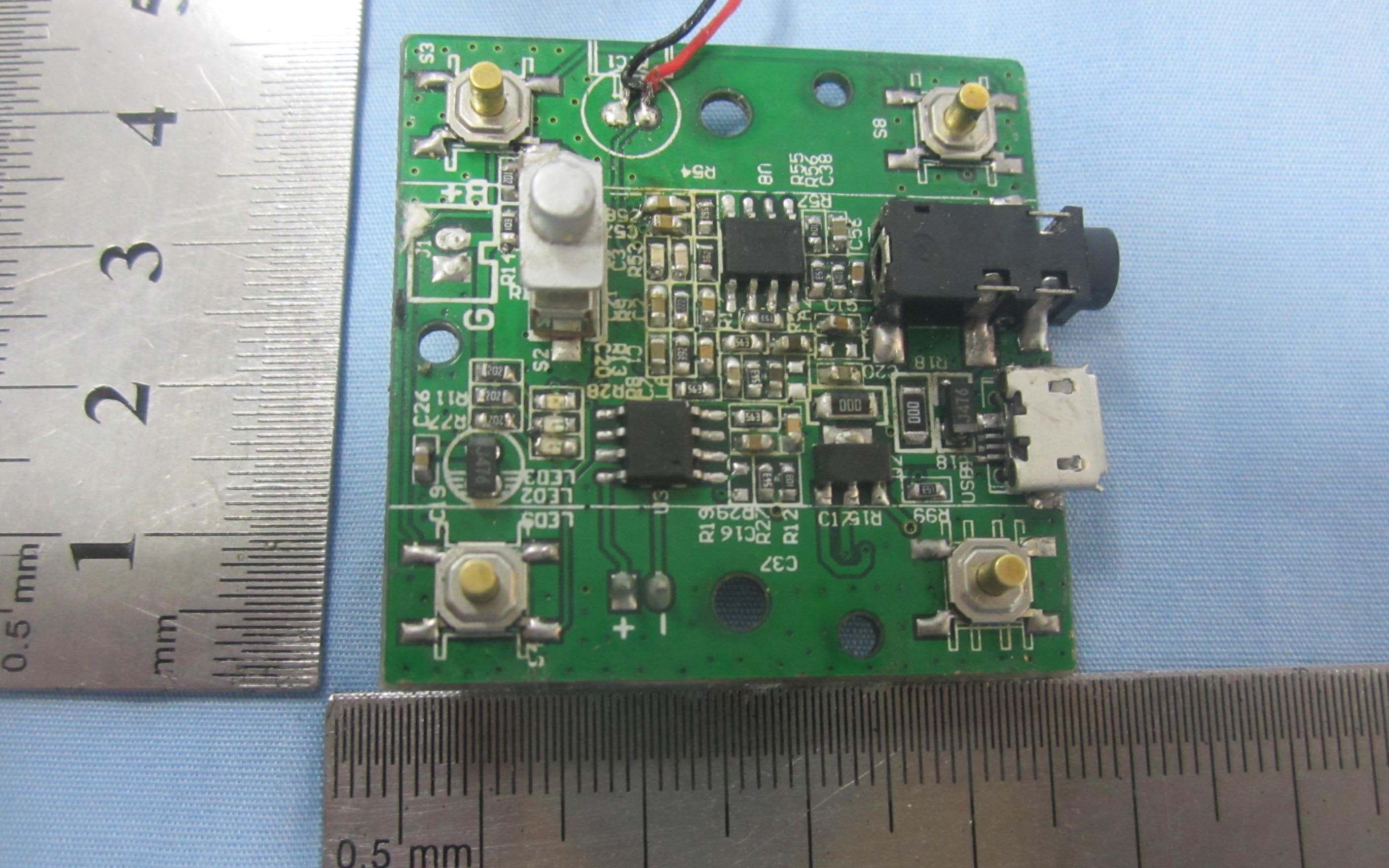
SKJ-M0
Oct 24, 2013BLUETOOTH SPEAKER
Equipment Class
DSS - Part 15 Spread Spectrum Transmitter
SKJ-M7001
Apr 09, 2013MULTIFUNCTIONAL BLUETOOTH SPEAKER
Equipment Class
DSS - Part 15 Spread Spectrum Transmitter