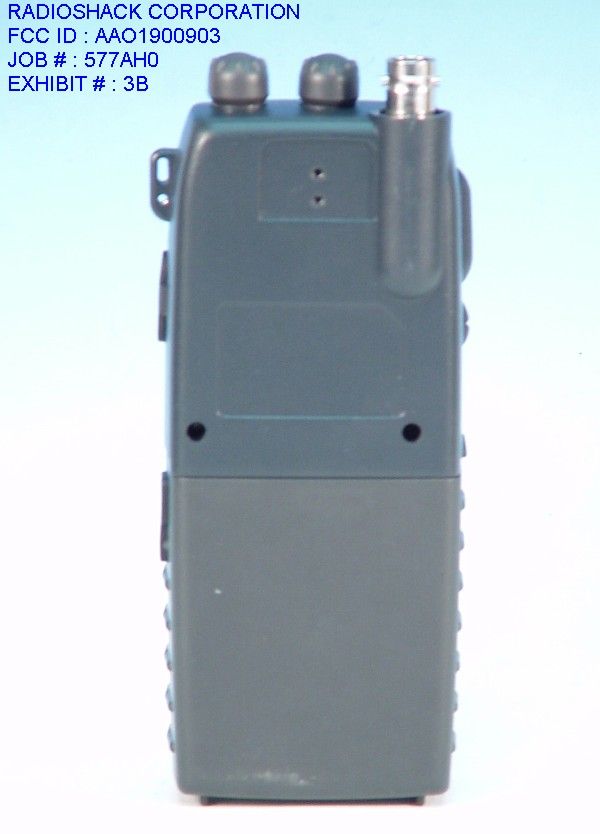
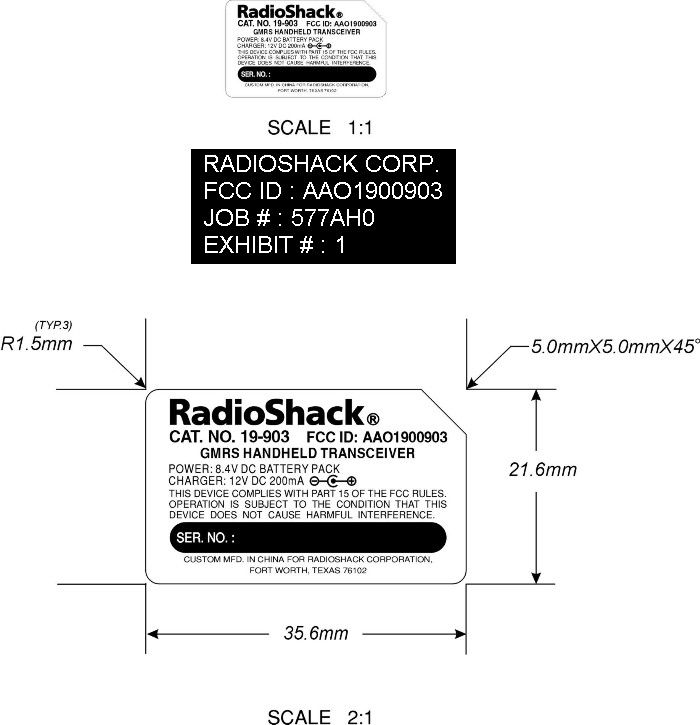
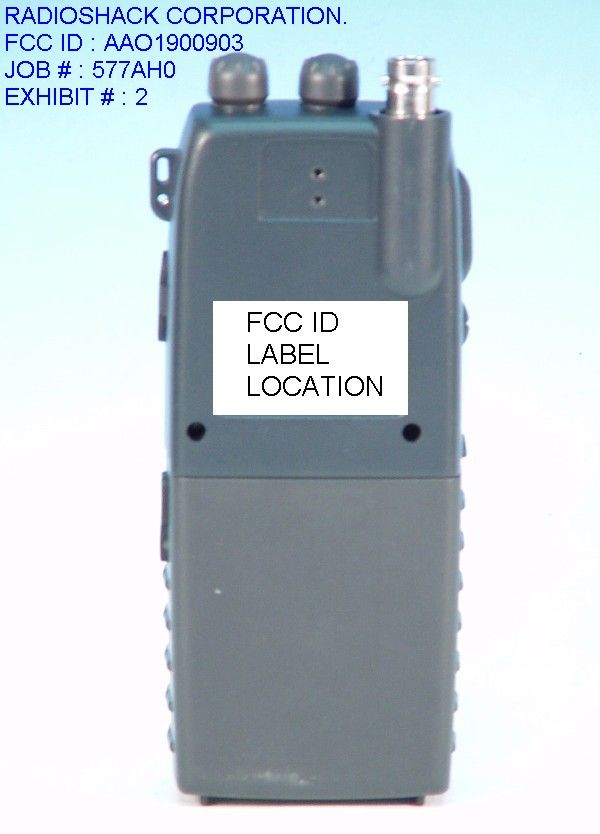
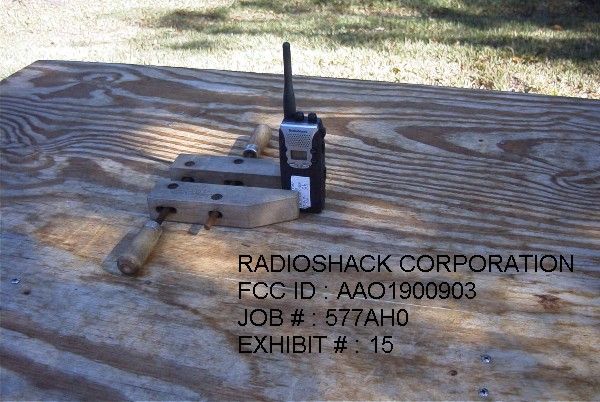
AAO1900903GMRS handheld transceiver
RadioShack Corporation
Click to zoom
Application Details
- Equipment Class
- TNF - Licensed Non-Broadcast Transmitter Held to Face
- Date of Grant
- Oct 02, 2001
- Application Purpose
- Original Equipment
- Date of Application
- Jan 31, 2001
- Equipment Note
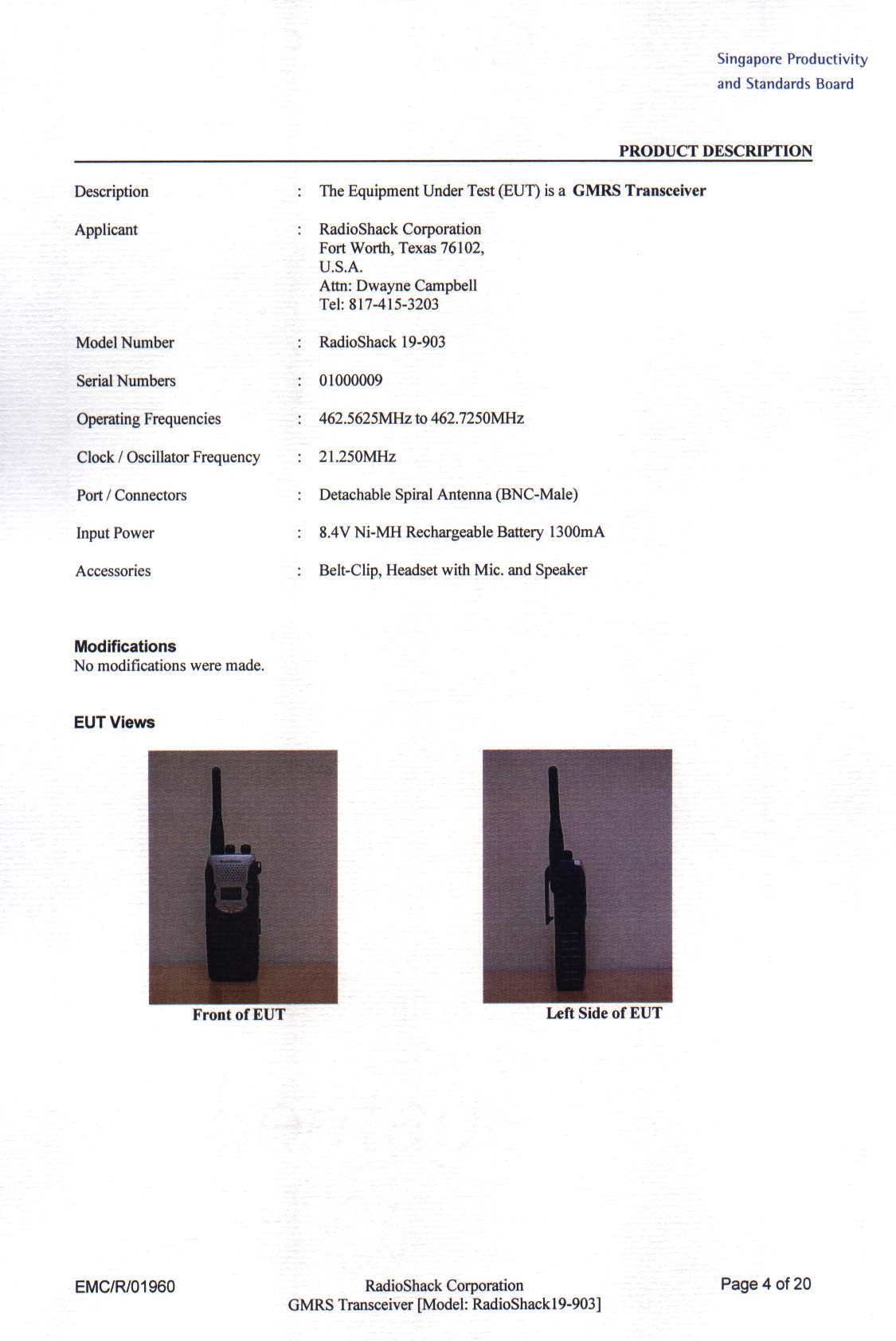
- GMRS handheld transceiver
- Frequency Range
- 462.55000000 - 462.72500000
- Company
- RadioShack Corporation
- Country
- United States
Documents & Files
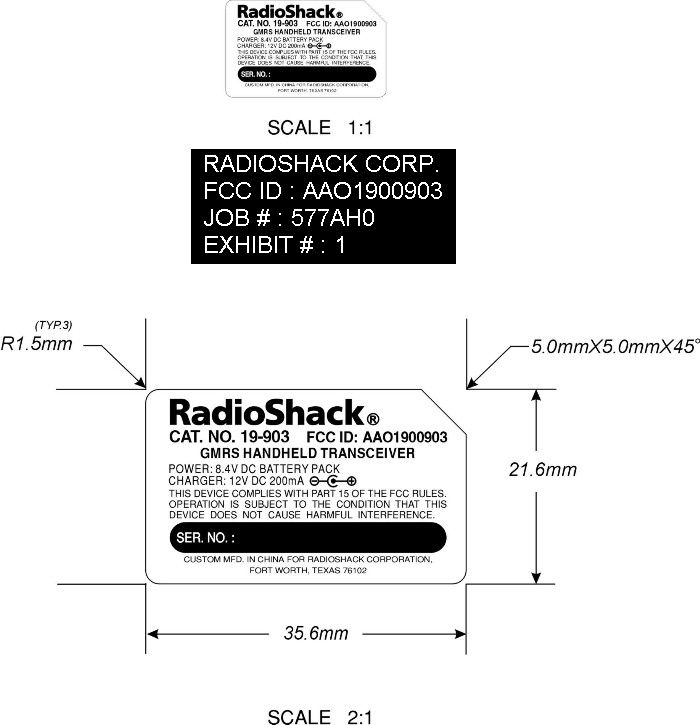
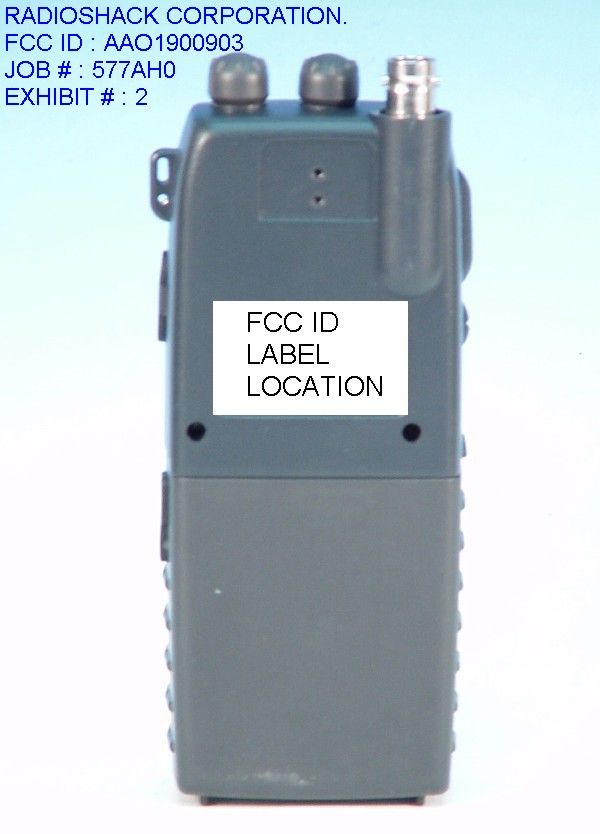
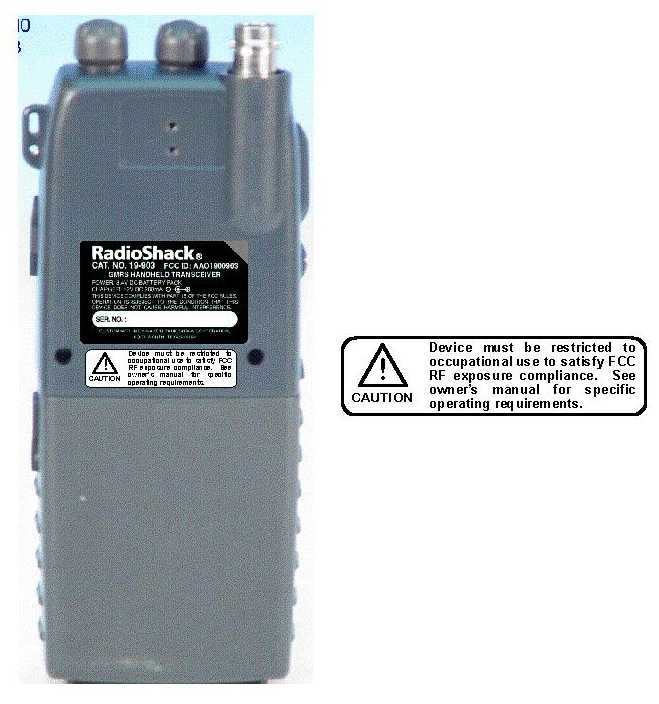
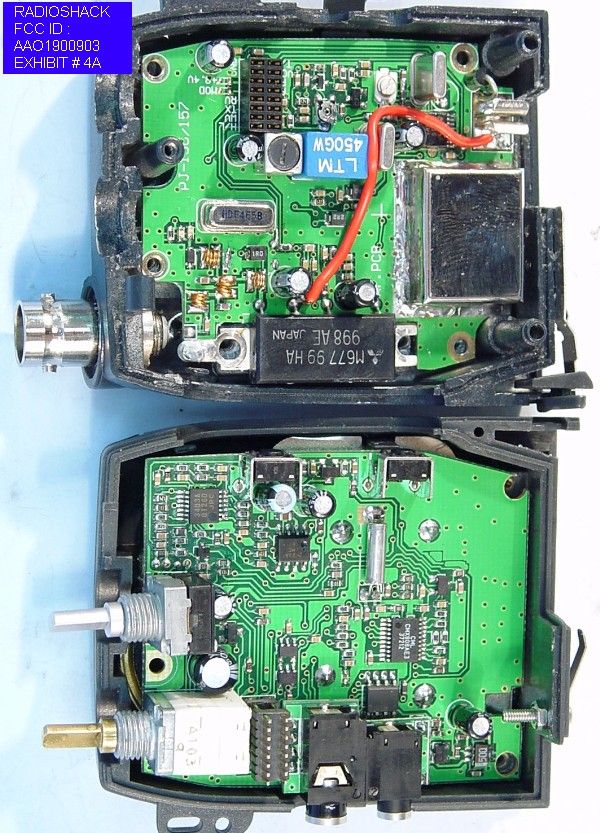
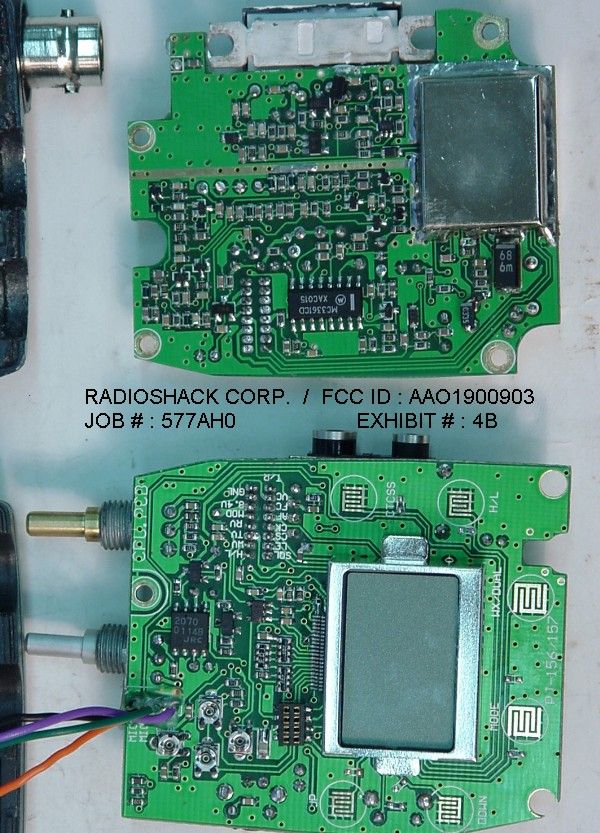
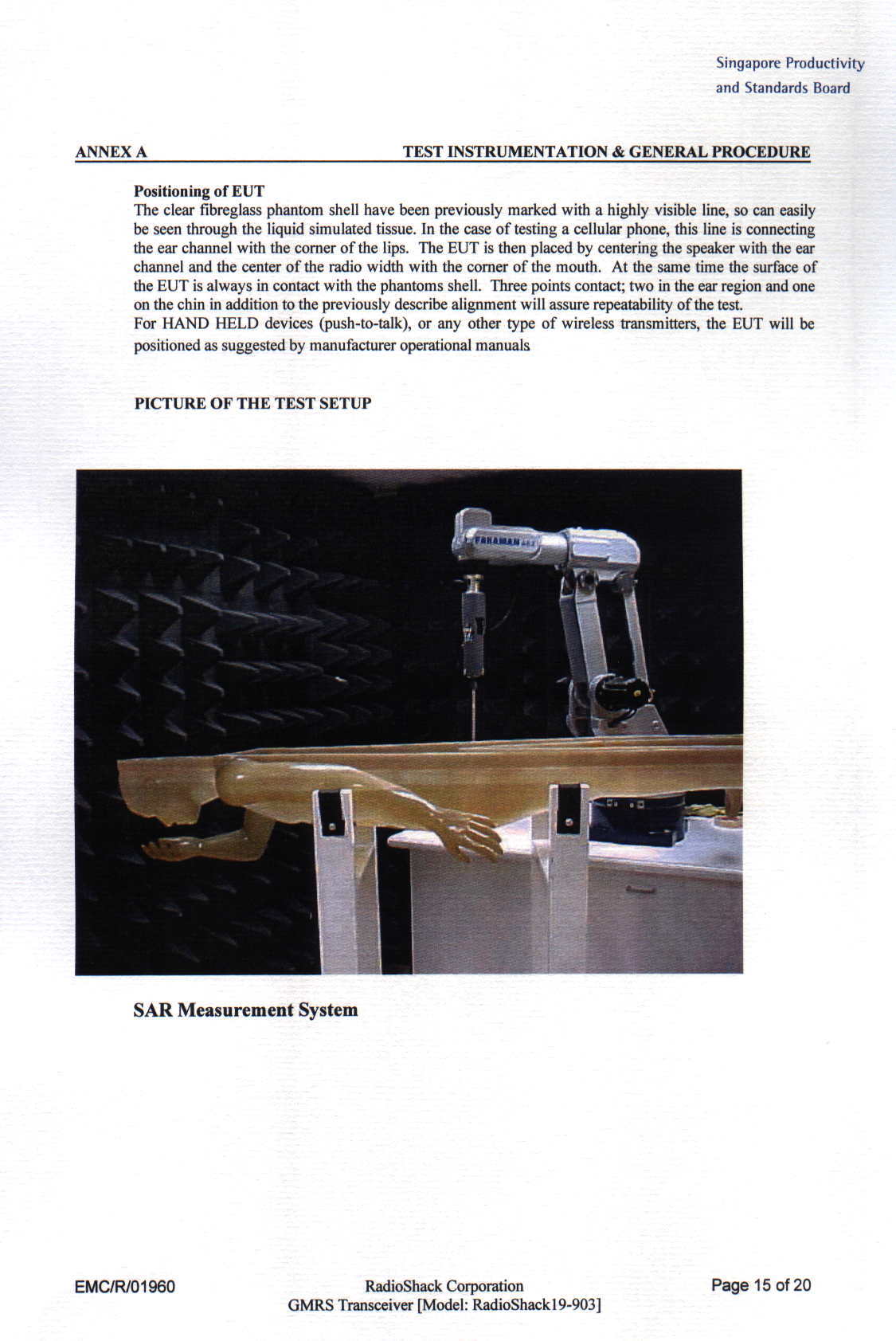
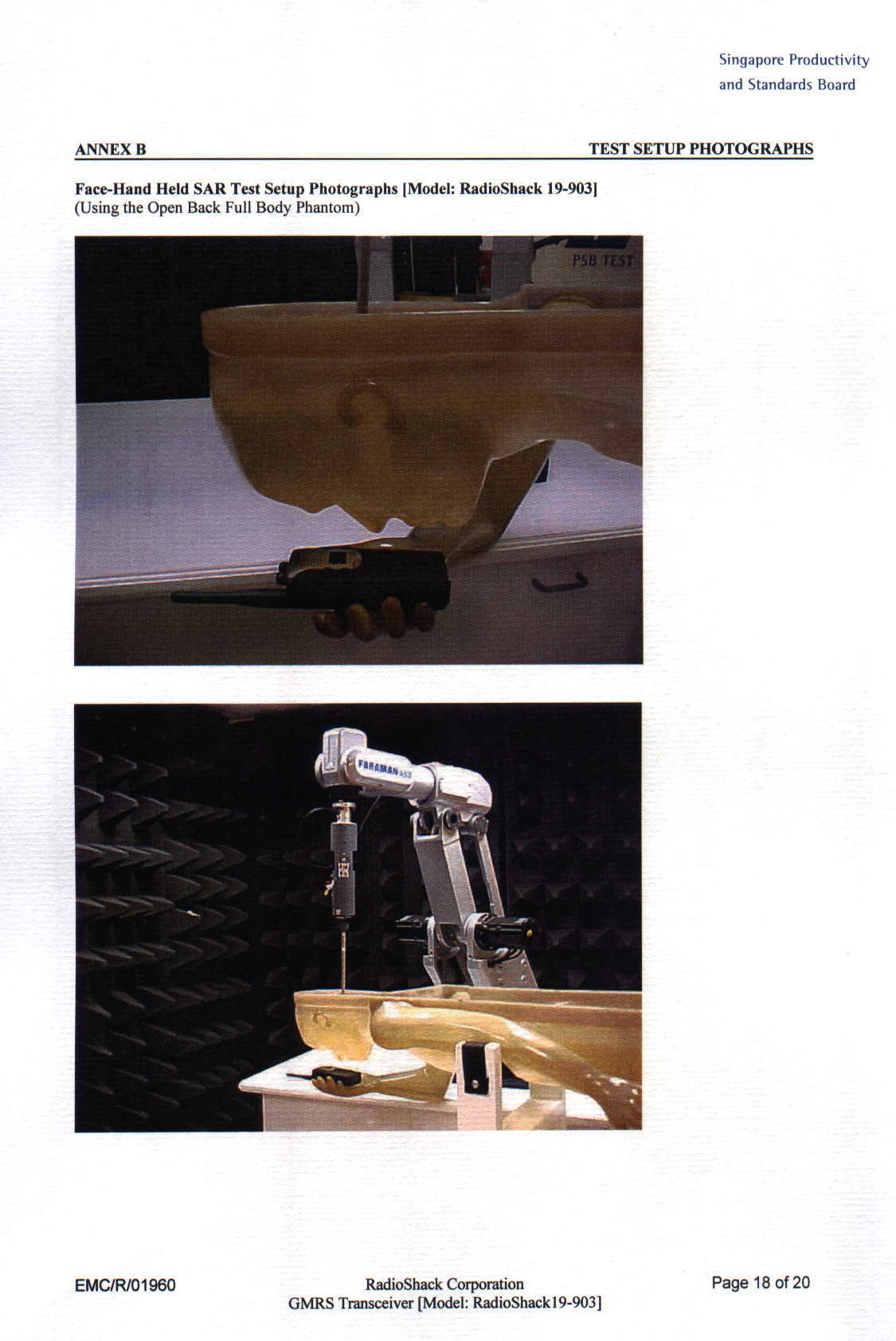
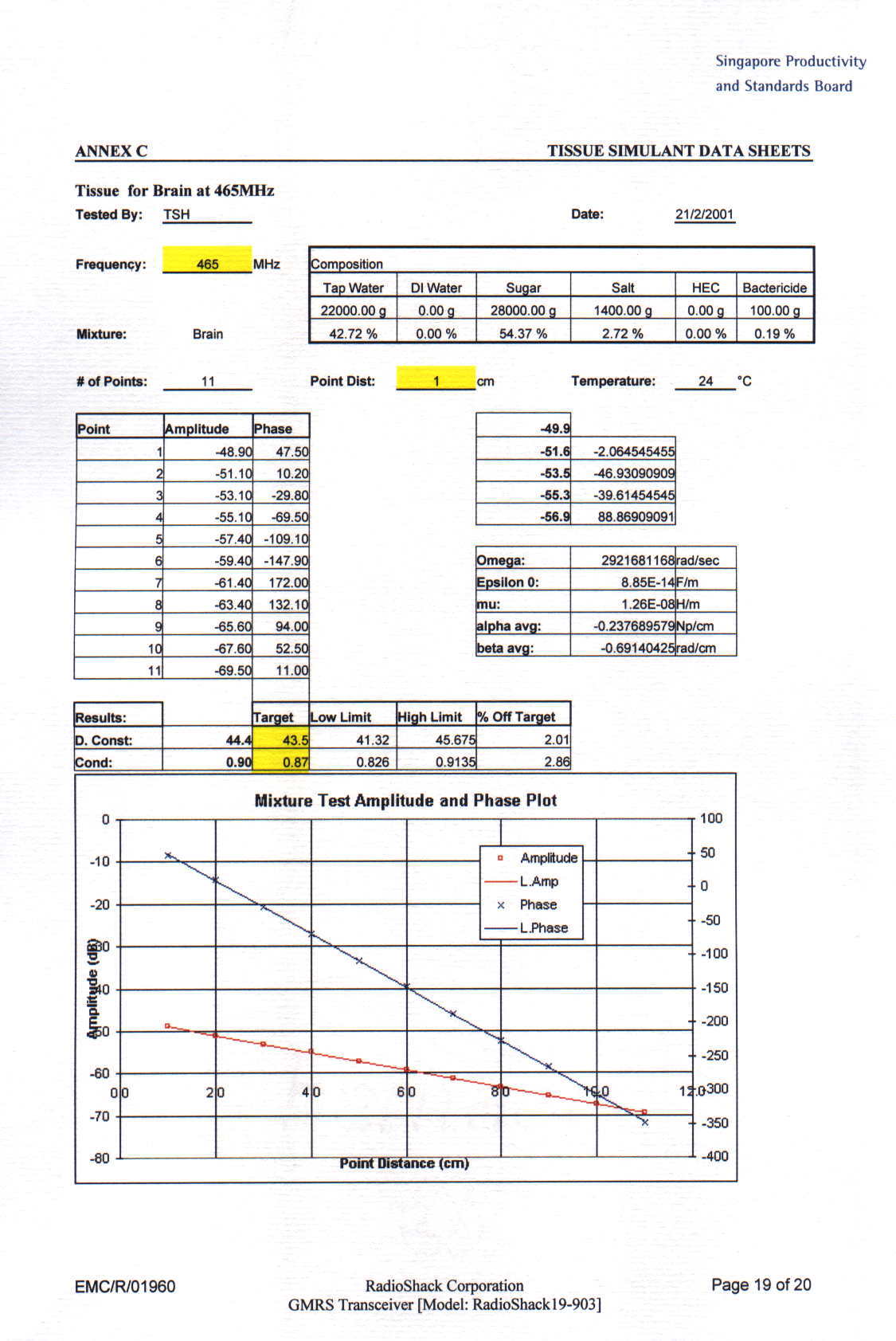
Document Text
Text extracted from the exhibit documents filed with the FCC. Open a document above to read the original.
Users Manual
1 OWNER’S MANUAL 19-903 ! INTRODUCTION Your Radio Shack 19-903 GMRS band transceiver is a portable, easy-to-use, two-way radio that you can carry almost anywhere. It is approved with commercial-grade standards to give you clear and reliable communication. This transceiver consists of 15 channels – 7 GMRS Channels, 1 Emergency Channel and 7 Interstitial Channels. Your 19-903 transceiver operates in the General Mobile Radio Service, which is a personal radio service available for personal communications with family members or other licenses. You can use the 19-903 for recreational communications while you hike, ski, or fish. You can even use the 19-903 to coordinates your personal or business activities with other family members. When you get a license to operate the radio, you can let other members of your family living in the same household operate the radio. Your transceiver is equipped with the following features: PLL-Controlled Circuitry ---- provides accurate and stable channel selection. Adjustable Squelch ---- helps eliminate noise between transmissions. 38 CTCSS (Continuous Tone Control Squelch System) ---- helps reduce interference from other systems in the area operating on the same frequency. Built-in Modulation Limiter Circuit ---- automatically adjusts for a wide range of voice levels to ensure an effective transmission. High/Low Power ---- helps you save power by choosing a suitable transmitting power for different range of distance. Battery Low and Transmit Indicator ---- indicates the battery pack’s current condition and the backlight is on when you transmit or receive. Supplied Battery Charger ---- conveniently recharges your transceiver’s battery pack. Flexible Antenna with BNC Connector ---- provides excellent reception. The BNC connector is designed in a way that you can easily attach and remove the supplied antenna or an optional one. Earphone Jack and External Microphone Jack ---- let you use an earphone or external microphone to help ensure effective communications in noisy areas. Belt Clip ---- let you attach the transceiver to your belt or waistband. JIS lev el 4 ---- offers you with excellent water-resistance. W e recommend you to drop down the transceiver’s serial number here for your record. For the number, please refer to the transceiver’s back panel. Serial Number_______________________ ! USING THE RADIO A. DISPLAY Your radio comes with a multifunctional display and backlight. By pressing any button except the PTT, the backlight will appear for 5 seconds. The liquid crystal display has been enlarged in the followings to show all of the operating modes. RADIOSHACK CORPORATION FCC ID : AAO1900903 EXHIBIT # : 7 2 1. Shows the selected channel number. 2. Shows the selected privacy code number. 3. “FUNC ”: Displays when the secondary function is enabled. 4. “SCAN ”: Displays when the scan mode is activated. 5. “TX” : Displays when your radio is transmitting. 6. “BUSY ”: Displays when a call is being received. 7. “DUAL ”: Displays when the dual-watch function is activated. 8. “LOCK” : Displays when the keypad lock is activated. 9. “ QUIET ”: Displays when the QUIET mode is enabled. 10. “ EMERG ”: Displays when the Emergency channel is selected. 11. “ C-TONE ”: Displays when the Roger Beep function is activated. 12. “HI LO” : Displays when the Hi/Lo transmit power is toggled. 13. “WX” : Displays when the weather broadcast is listened. 14. “ALT” : Displays when the WX alert signal is received. 15. “ ” : Displays when WX MUTE mode is enabled. 16. “ ”: Indicates the batteries are low. Replace the batteries when this signal is on. 17. “ ” : Displays when the working channel is set to be skipped. 18. “ ” : Displays when the key tone function is activated. 3 B. FUNCTION AND LOCATION OF THE CONTROLS 1. “ON/OFF” Volume Control. Your transceiver is off whenever the knob points to the ‘OFF’ position. Rotate this control clockwise to turn on your radio and adjust the volume. 2. SQL Knob Rotate the VOL/SW Knob to obtain the squelch sensitivity at threshold. 3. CH /Key Tone Button Press CH to select a channel upwardly. Press and hold CH continuously for more than 1.5sec to enter into the scan upwardly mode. Press CH will change the scanning direction downwardly. During the scanning, press any key will exit the scanning mode. Key Tone Press and hold FUNC key, then press CH key to activate or deactivate the Key Tone function. Icon “ ” will be shown if activated. 4. CH / Skip Press CH to move one channel down. Press and hold CH for more than 1.5sec to enter into the scan downwardly mode. Press CH will change the scanning direction upwardly. During the scanning, press any key will exit the scanning mode. 4 Skip User can choose a desired channel from being scanned. Press CH or to go to the desired channel. Press and hold FUNC key for, then press CH key to skip this channel from scanning. Icon “ ” is on to indicate this working channel is set to be skipped. Repeat the above steps will cancel the skip function of the channel. 5. Hi/Low / Automatic Power Off Button Press this button to toggle the high or low RF power. Automatic Power off Button Press and hold FUNC/MON button, then press HI/LO button to enable or disable the auto power off function. The display will show “ AP ON ” or “ AP OF ” for one second, when the timer is activated/deactivated. The timer automatically turns off the unit when it is idle for 2 hours. 6. QUIET /QUIET Scan Button / Reset Press QUIET button to enable or disable the QUIET privacy mode operation. a) Hold down QUIET button for 1.5 seconds until QUIET is displayed and the quiet code flashes. b) Repeatedly press (or hold down) CH or CH until you see the code number you want to use. c) Press QUIET button to store the code. To turn on the quiet feature, press QUIET until QUIET appears. To turn off the feature, press QUIET until QUIET disappears. Note: W e recommend you to select a quiet code from the range 7-30. If you select a code below or above that range, y…
Text truncated - open the document above for the full version.
Users Manual
© 2001 RadioShack Corporation. All Rights Reserved. RadioShack and RadioShack.com are trademarks used by RadioShack Corporation. OWNER’S MANUAL — Please read before using this equipment. 5W 15 Channel 2-Way GMRS Radio Your RadioShack 5W Compact GMRS Handheld Transceiver is a portable, two-way, General Mobile Radio Service (GMRS) transceiver that you can carry almost anywhere. It meets commercial-grade standards for clear and reliable communication. The transceiver has fifteen operation channels — seven GMRS channels, one emergency channel, seven interstitial channels, and ten weather channels with alert. 38 Quiet-Tone CTCSS (Continuous Tone Control Squelch System) — helps reduce interference from other systems in the area operating on the same frequency. Built-in Modulation Limiter Circuit — automatically adjusts for a wide range of voice levels to ensure an effective transmission. High/Low Power — saves power by choosing a suitable transmitting power for different ranges. Flexible Antenna with BNC Connector — provides excellent reception and is easy to attach and remove, so you can use an external antenna to extend the range and performance. Splash Proof (JIS Level 4) — offers water resistance. FCC INFORMATION FCC License Required Warning: There is a penalty for any unlicensed operation of a GMRS radio. The Federal Communications Commission (FCC) requires you to have a GMRS license before you operate this transceiver. To obtain a license, you must be at least 18 years of age, and cannot be a representative of a foreign government. You must complete FCC Forms 605 and 159 (Fee Remittance Advice) and return them with the applicable fees and Payment/ Fee Type Code (PAZR) to the FCC. To obtain the necessary forms, contact the FCC at: Federal Communications Commission Wireless Bureau Applications P.O. Box 358130 Pittsburgh, PA 15251-5130 1-888-CALLFCC (1-888-225-5322) To obtain instructions on filing form 605 electronically, go to http://www.fcc.gov.wtb/ uls . This radio is intended for communications from base-to-mobile or mobile-to-mobile stations. Base-to-base communication is not permitted. 19-903.fm Page 1 Wednesday, September 5, 2001 4:30 PM 2 When you receive your license from the FCC, you are assigned a call sign. You must give your call sign at the end of every communication exchange or once every 15 minutes during a continuous communication. We recommend you record the radio’s serial number and your call sign in the space provided, and keep this manual and a copy of your GMRS license with your important records. The serial number is on the transceiver’s back panel. Serial Number Call Sign The Personal Radio Steering Group (PRSG) is the national user-advocacy organization for the GMRS. The PRSG provides assistance with licensing and other information about the GMRS, including how to contact and communicate with other GMRS licensees. Personal Radio Steering Group P.O. Box 2851 Ann Arbor, MI. 48106 www.provide.net/ ~ prsg/ Your RadioShack radio generates RF electromagnetic energy during transmit mode. This radio is designed for and classified as “ Occupational Use Only ”, meaning it must be used only during the course of employment by individuals aware of the hazards, and the ways to minimize such hazards. This radio is NOT intended for use by the “General Population” in an uncontrolled environment. This radio has been tested and complies with the FCC RF exposure limits for “Occupational Use Only.” In addition, your RadioShack radio complies with the following Standards and Guidelines with regard to RF energy and electromagnetic energy levels and evaluation of such levels for exposure to humans: • FCC OET Bulletin 65 Edition 01-01 Supplement C, Evaluating Compliance with FCC Guidelines for Human Exposure to Radio Frequency Electromagnetic Fields. • American National Standards Institute (ANSI) (C95.1—1992), IEEE Standard for Safety Levels with Respect to Human Exposure to Radio Frequency Electromagnetic Fields, 3 kHz to 300 GHz. • American National Standards Institute (C95.3—1999), IEEE Recommended Practice for the Measurements of Potentially Hazardous Electromagnetic Fields — RF and Microwave. To ensure that your exposure to RF electromagnetic energy is within the FCC allowable limits for occupational use, always adhere to the following guidelines: DO NOT operate the radio without a proper antenna attached, as this may damage the radio and may also cause you to exceed FCC RF exposure limits. A proper antenna is the antenna supplied with the radio by the manufacturer or an antenna specifically SAFETY TRAINING INFORMATION WARNING CAUTION ! 19-903.fm Page 2 Wednesday, September 5, 2001 4:30 PM 3 authorized by the manufacturer for use with this radio. DO NOT transmit for more than 50% of total radio use time (“50% duty cycle”). Transmitting more than 50% of the time can cause FCC RF exposure compliance requirements to be exceeded. The radio is transmitting when 7; 7;7; 7; appears on the LCD. ALWAYS keep the antenna at least 1cm ( 1 / 2 inch) away from the body when transmitting and only use the belt-clip supplied with your radio when attaching the radio to your belt, etc., to ensure FCC RF exposure compliance requirements are not exceeded. To provide the recipients of your transmission the best sound quality, hold the antenna at least 2.5 cm (1 inch) from your mouth. USE ONLY RadioShack authorized accessories (speaker/microphones, handstraps, etc.) with your radio. Use of unauthorized accessories can cause the FCC RF exposure compliance requirements to be exceeded. The information listed above provides the user with the information needed to make him or her aware of RF exposure, and what to do to assure that this radio operates within the FCC RF exposure limits of the radio. ELECTROMAGNETIC INTERFERENCE/COMPATIBILITY During transmissions, your RadioShack radio generates RF energy that can possibly cause interference with other devices or systems. To avoid such interference, turn off the ra…
Text truncated - open the document above for the full version.
Cover Letter(s)
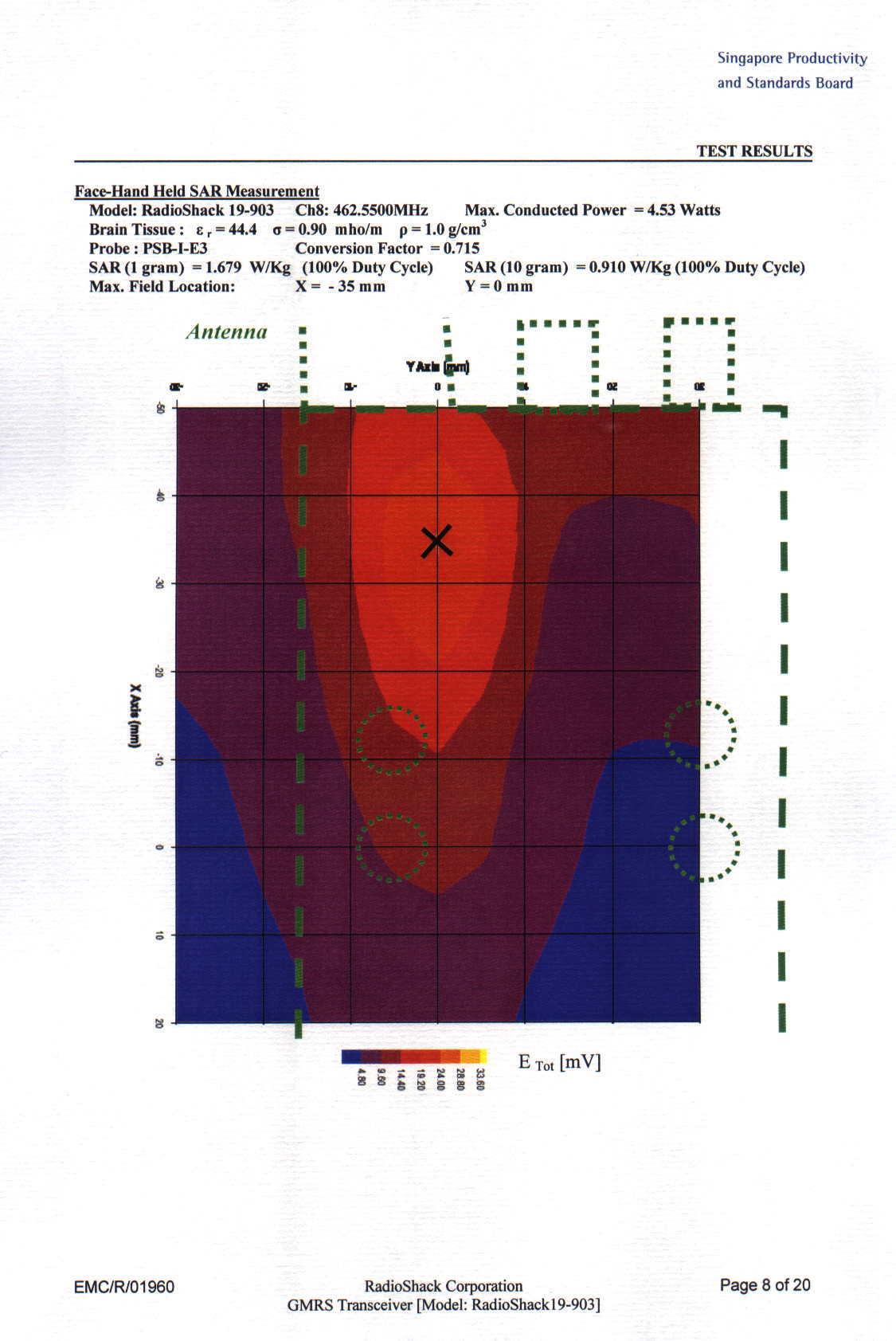
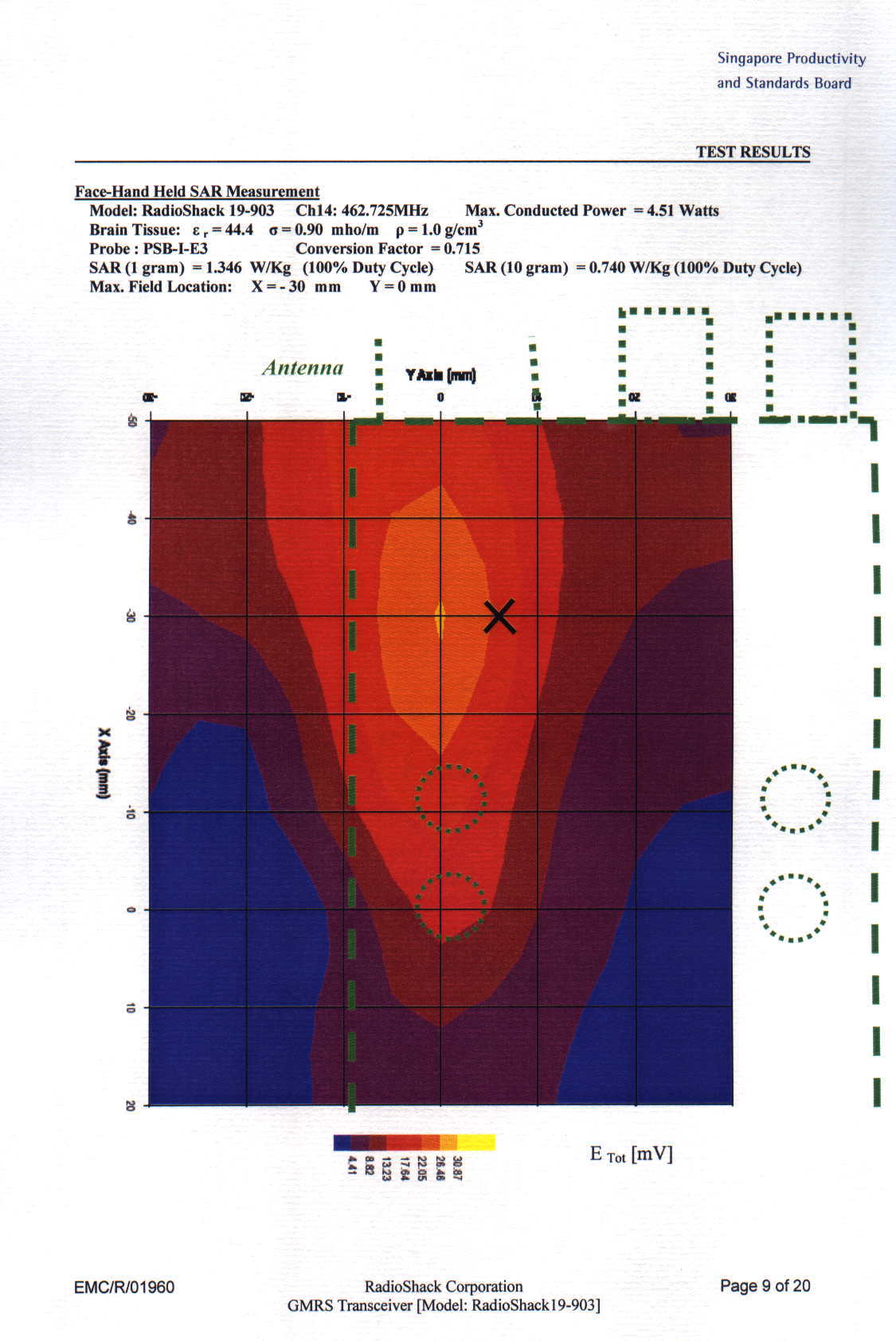
Reply FCC SAR question for Model: 19-903 1) The sample of SAR testing is tested in the maximum power 4.5 W although the rated power is 5W. This difference in the maximum output power is only 0.46dB. This difference may be caused by equipment of difference Laboratory. And then, this difference is also within the manufacturer specification +/- 1dB. 2) In the use manual, it shows to the user that the belt clip is used for storage only. The user must unclip it from the body before transmitting with a distance at least 5cm from the body. Therefore, the device would not use the body worn configuration for transmission. In this case, the SAR test for body worn configuration is not necessary. 3) Yes, it has a bit output reduced after a long test time. And you are right that we need to scaling the SAR to maximum power. Therefore the scaled maximum power is 0.9929W/kg and 0.7849W.kg for 462.550MHz and 462.725MHz respectively. They still are compliance the requirement 1.6W/kg. 4) In the SAR report, it showed that the peak SAR location with respect to the device is 35mm and 30mm below the antenna for 462.550MHz and 462.752MHz respectively. 5) The distance between the surface of the hand and the surface of head of phantom is 5cm. When the device is placed in the hand, the antenna and the device must be less than 5cm from the surface of the head of phantom. In user manual, the user is alerted hold the device 5cm from the face. Therefore, the measured result must be the worst case that manufacturer specified. 6) Please find the attached the re-do SAR Report and the missing page 17 for FCC evaluation. 7) The frequency range of the device is less than 1MHz. Therefore, I think that there is enough to choose the lowest frequency, 462.550MHz and the highest frequency, 462.725MHz for SAR measurement and the mid-band frequency is not necessary. And then, the device is no body worn transmission, so it is not necessary to perform the SAR test with belt-clip. 8) The SAR test result is compared the limit of uncontrolled environment and is compliance. Therefore, it means the device can be used in controlled/uncontrolled environment. And then, the user is alerted by caution statement in user manual. 9) In user manual, 50% duty cycle is stated in the user for RF exposure compliance.
Cover Letter(s)
Celltech Research Inc. 1955 Moss Court, Kelowna, B.C. Canada V1Y 9L3 Tel. 250-860-3130 •• Fax. 250-860-3110 •• e-mail: [email protected] www.celltechlabs.com September 18, 2001 Federal Communications Commission Equipment Approval Services 7435 Oakland Mills Road Columbia, MD 21046 Attn: Joe Dichoso SUBJECT: RadioShack Corporation FCC ID: AAO1900903 731 Confirmation No.: EA99930 Correspondence Ref. No.: 20583 Dear Joe: On behalf of RadioShack Corporation we hereby submit our response to Item #1 of your e-mail dated September 12, 2001 requesting additional information for the subject application. We have retested the device at 5.0 Watts conducted power and with a muscle conductivity level of 0.94 mho/m. Due to the recent reported increase in the thickness of the phantom from the required 2.0mm to 3.2mm, the manufacturer reported new system validation target values for our newly calibrated 1800MHz and 900MHz dipoles. At 1800MHz with a separation distance of 10mm from the center of the dipole axis to the fluid and at 900MHz with separation distances of 15mm, the new target values are lower then expected by 12% and 8% respectively. As the frequency is reduced further, the error due to the increased phantom thickness becomes less significant. Since the manufacturer has not given target values for other frequencies, it is estimated by extrapolation that at 450MHz the actual measured SAR values are approximately 5% lower then required. This would cause both face-held and body-worn RF exposure evaluations to be approximately 5% lower then reported since they were both performed in the planar section of the phantom. Please find attached the new SAR test report reflecting the appropriate conducted power level (5.0 Watts) and conductivity level for muscle (0.94 mho/m), with the extrapolated SAR values and reported increase in phantom thickness from the system manufacturer. If you have any questions or comments concerning the above, please do not hesitate to contact me. Sincerely, Shawn McMillen General Manager Celltech Research Inc. Testing & Engineering Lab cc: RadioShack Corporation Timco Engineering
RF Exposure Info
REF: RADIOSHACK CORPOORATION’S FCC ID: AAO1900903 The following statement will be included on the last page of the user’s manual to cover the RF exposure requirements: "Caution: To maintain compliance with the FCC's RF exposure guidelines, hold the transmitter and antenna at least 2 inches (5 cm) from your face and speak in a normal voice, with the antenna pointed up and away from the face. If you wear the handset on your body while using the headset accessory, use only the supplied belt clip for this product and when transmitting take it out of the belt to ensure that the antenna is at least 1 inch (2.5 cm) from your body."
RF Exposure Info
1 OWNER’S MANUAL 19-903 ! INTRODUCTION Your Radio Shack 19-903 GMRS band transceiver is a portable, easy-to-use, two-way radio that you can carry almost anywhere. It is approved with commercial-grade standards to give you clear and reliable communication. This transceiver consists of 15 channels – 7 GMRS Channels, 1 Emergency Channel and 7 Interstitial Channels. Your 19-903 transceiver operates in the General Mobile Radio Service, which is a personal radio service available for personal communications with family members or other licenses. You can use the 19-903 for recreational communications while you hike, ski, or fish. You can even use the 19-903 to coordinates your personal or business activities with other family members. When you get a license to operate the radio, you can let other members of your family living in the same household operate the radio. Your transceiver is equipped with the following features: PLL-Controlled Circuitry ---- provides accurate and stable channel selection. Adjustable Squelch ---- helps eliminate noise between transmissions. 38 CTCSS (Continuous Tone Control Squelch System) ---- helps reduce interference from other systems in the area operating on the same frequency. Built-in Modulation Limiter Circuit ---- automatically adjusts for a wide range of voice levels to ensure an effective transmission. High/Low Power ---- helps you save power by choosing a suitable transmitting power for different range of distance. Battery Low and Transmit Indicator ---- indicates the battery pack’s current condition and the backlight is on when you transmit or receive. Supplied Battery Charger ---- conveniently recharges your transceiver’s battery pack. Flexible Antenna with BNC Connector ---- provides excellent reception. The BNC connector is designed in a way that you can easily attach and remove the supplied antenna or an optional one. Earphone Jack and External Microphone Jack ---- let you use an earphone or external microphone to help ensure effective communications in noisy areas. Belt Clip ---- let you attach the transceiver to your belt or waistband. JIS lev el 4 ---- offers you with excellent water-resistance. W e recommend you to drop down the transceiver’s serial number here for your record. For the number, please refer to the transceiver’s back panel. Serial Number_______________________ 2 FCC Information FCC License required This Transceiver is intended for use in the operation of commercial activities, in educational, philanthropic, or ecclesiastical institutions, and hospitals, clinics, or medical associations. The Federal Communications commission (FCC) requires you to be licensed before you operate this transceiver. Unless you are already licensed to operate on one of the preset frequencies, you must apply for a frequency through the PCIA (Personal Communication Industry Association), a non-profit organization that assigns frequencies nationwide to help prevent conflicts between different businesses using transceivers in the same area. For more information about getting a license, contact the PCIA at 800-759-0300, extension 3068 (in Virginia 703-739-0300, extension 3068) For other questions concerning the license application, contact the FCC at 717-337-1212, or wirte: FCC P.O.Box 1040 Gettysburg, PA 17325 For the latest FCC application form and instructions, call the FCC’s fax-on-demand service at 1-202-418-0177 from a fax machine and request one or more of the following documents: All forms and instructions ........................000600 Form 600 instructions only........................006001 Main Form 600 only.................................006002 Form 600 schedules only...........................006003 If you do not have a fax machine, you can call the Government Forms Distribution Center at 1-800-418-FORM and request that the form and instructions be mailed to you. FCC Part 95 Rules You must be familiar with Part 95 of FCC Rules before you operate your transceiver. The operation instructions in this manual conform to Part 95, but do not cover all items in Part 95. Overall, Part 95 states that: ! You must have a valid license before you use the transceiver. 3 ! As licensee, you are responsible for proper operation of all transceivers operating under your license’s authority. ! You can let unlicensed persons operate transmitter, as long as you take precautions to prevent unauthorized transmissions. ! You must use this transceiver only for commercial use of your business, and only when other commercial channels (such as the telephone) are either not available or not practical. ! You must always yield the operating frequency to communications that involve the safety of life or property. ! You must take reasonable precautions to prevent harmful interference to other services operating on the same frequency. ! You must not transmit program material of any kind used in connection with commercial broadcasting. ! You must not provide a service that is normally handles by telephone or telegraph unless such broadcasts involve the safety of life and property or in emergencies such as an earthquake, hurricane, flood or a similar disaster where normal communications channels are disrupted. ! During each transmissions or exchange of transmissions, you must identify your station with the call sign issued to you by the FCC, or once each 15 minutes during periods of continuous operation. ! You must keep a written record of any maintenance or modifications made to the transceiver, and you must make this record available for inspection upon demand by the FCC. Violating any of the provisions of Part 95 can result in fines and/or confiscation of equipment. Your transceiver might cause TV or Radio interference even when it is operating properly. To determine whether your transceiver is causing the interference, turn off your transceiver. If the interference goes away, your transceiver us causing it. Try to eliminate the interference by: ! Moving your transceiver away from…
Text truncated - open the document above for the full version.
RF Exposure Info
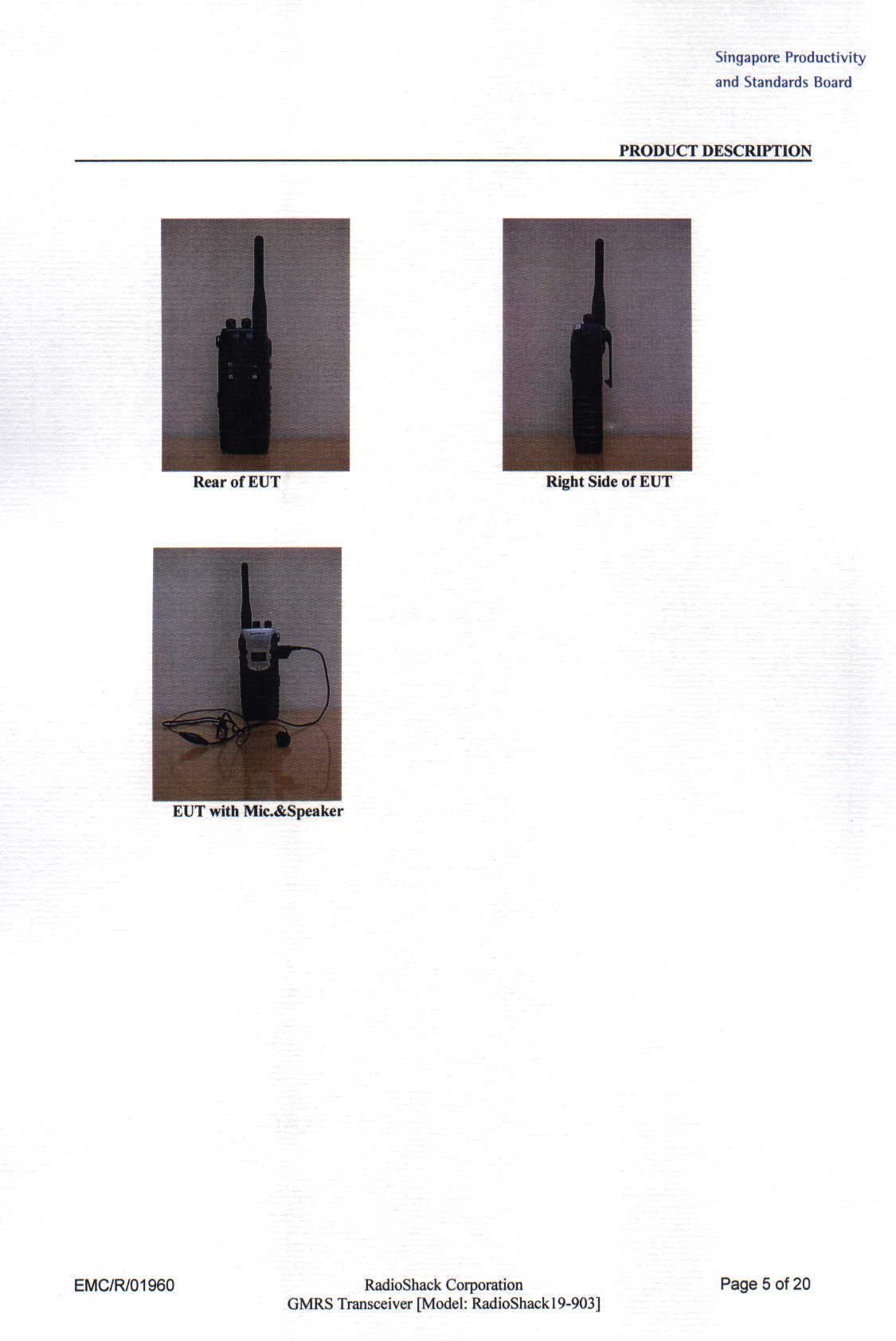
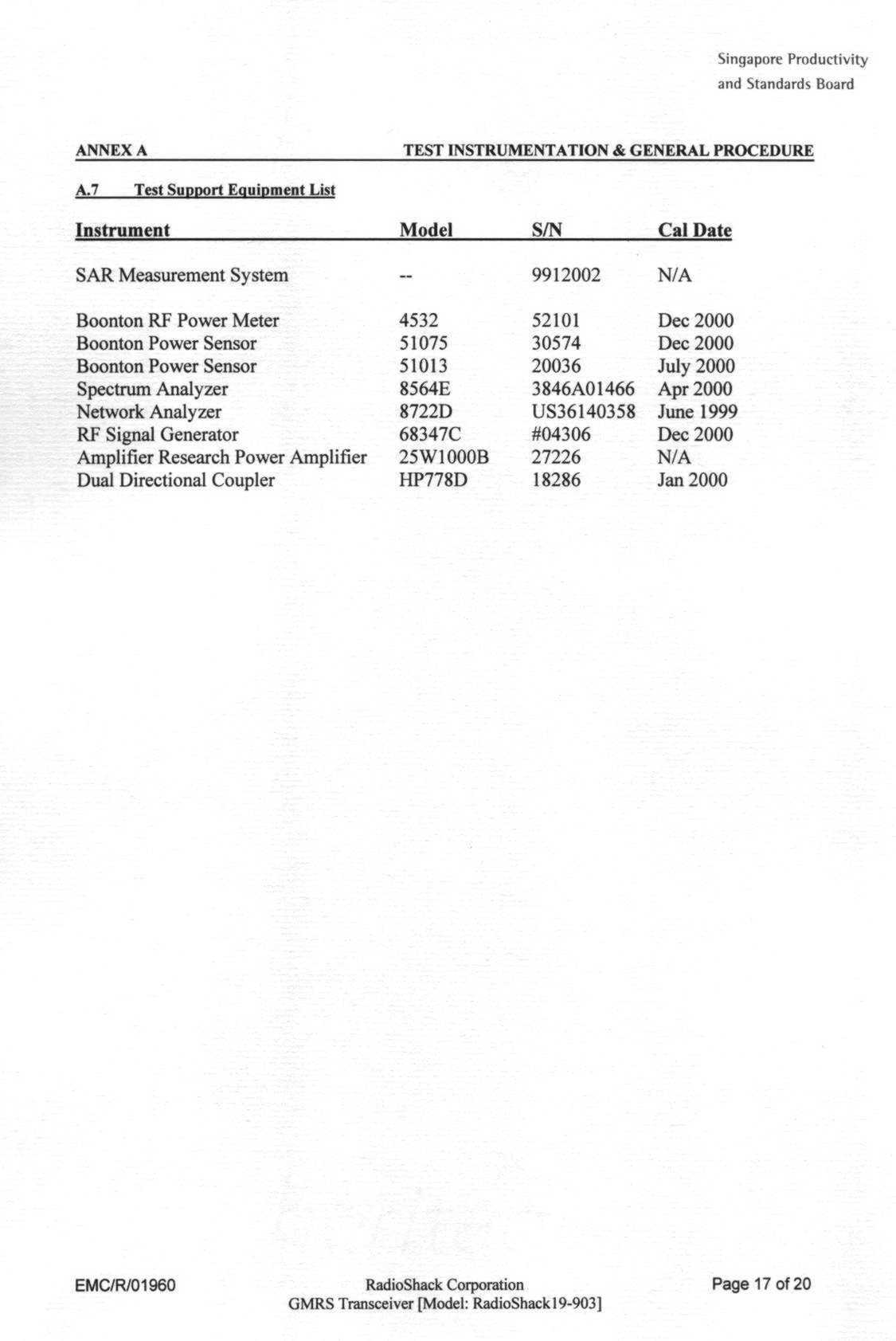
CELLTECH RESEARCH INC. Test Report S/N: 080801-147AAO 1955 Moss Court, Kelowna Date(s) of Tests: August 10, 2001 B.C. Canada V1Y 9L3 FCC SAR Measurements _________________________________________________________________________________________________________ © 2001 Celltech Research Inc. CERTIFICATE OF COMPLIANCE SAR EVALUATION This wireless portable device has been shown to be compliant for localized Specific Absorption Rate (SAR) for controlled environment / occupational exposure limits specified in ANSI/IEEE Std. C95.1-1992 and has been tested in accordance with the measurement procedures specified in ANSI/IEEE Std. C95.3-1999. I attest to the accuracy of data. All measurements were performed by me or were made under my supervision and are correct to the best of my knowledge and belief. I assume full responsibility for the completeness of these measurements and vouch for the qualifications of all persons taking them. Celltech Research Inc. certifies that no party to this application has been denied FCC benefits pursuant to Section 5301 of the Anti-Drug Abuse Act of 1988, 21 U.S.C. 853(a). Shawn McMillen General Manager Celltech Research Inc. Test Lab: CELLTECH RESEARCH INC. Testing and Engineering Lab 1955 Moss Court Kelowna, B.C. Canada V1Y 9L3 Phone: 250 - 860-3130 Fax: 250 - 860-3110 Toll Free: 1-877-545-6287 e-mail: [email protected] web site: www.celltechlabs.com Applicant Information: RADIOSHACK CORPORATION 100 Throckmorton St., Suite 1300 Fort Worth, TX 76102-2802 FCC ID: AAO1900903 Trade / Model(s): RadioShack 19-903 EUT Type: Portable GMRS PTT Radio Transceiver Modulation: FM Tx Frequency Range: 462.5625 - 462.7250 MHz RF Output Power Tested: 4.7 Watts (Conducted) No. of Channels: 15 FCC Rule Part(s): 2.1093; ET Docket 96-326 IC Rule Part(s): RSS-102 Issue 1 CELLTECH RESEARCH INC. Test Report S/N: 080801-147AAO 1955 Moss Court, Kelowna Date(s) of Tests: August 10, 2001 B.C. Canada V1Y 9L3 FCC SAR Measurements _________________________________________________________________________________________________________ © 2001 Celltech Research Inc. TABLE OF CONTENTS 1.0 INTRODUCTION.................................................................. 1 2.0 DESCRIPTION OF EUT.......................................................... 1 3.0 SAR MEASUREMENT SYSTEM ............................................. 2 4.0 MEASUREMENT SUMMARY.................................................. 3-4 5.0 DETAILS OF SAR EVALUATION............................................ 5 6.0 EVALUATION PROCEDURES................................................. 5 7.0 SIMULATED EQUIVALENT TISSUES...................................... 6 8.0 TISSUE PARAMETERS......................................................... 6 9.0 SAR LIMITS........................................................................ 7 10.0 SYSTEM VALIDATION.......................................................... 7 11.0 SYSTEM SPECIFICATIONS.................................................... 8 12.0 PROBE SPECIFICATION....................................................... 9 13.0 GENERIC TWIN PHANTOM................................................... 9 14.0 DEVICE HOLDER................................................................. 9 15.0 TEST EQUIPMENT LIST........................................................ 10 16.0 MEASUREMENT UNCERTAINTIES........................................ 11 17.0 REFERENCES...................................................................... 12 APPENDIX A - SAR MEASUREMENT DATA........................................ 13 APPENDIX B - DIPOLE VALIDATION................................................ 14 APPENDIX C - PROBE CALIBRATION............................................... 15 APPENDIX D - SAR TEST SETUP PHOTOGRAPHS............................... 16 CELLTECH RESEARCH INC. Test Report S/N: 080801-147AAO 1955 Moss Court, Kelowna Date(s) of Tests: August 10, 2001 B.C. Canada V1Y 9L3 FCC SAR Measurements _________________________________________________________________________________________________________ © 2001 Celltech Research Inc. RADIOSHACK FCC ID: AAO1900903 (Model: 19-903) 1 Portable GMRS PTT Radio Transceiver (462.5625-462.7250MHz) 1.0 INTRODUCTION This measurement report shows compliance of the RADIOSHACK Model: 19-903 Portable GMRS PTT Radio Transceiver FCC ID: AAO1900903 with the regulations and procedures specified in FCC Part 2.1093, ET Docket 96-326 Rules (controlled exposure), and RSS-102 Issue 1 of Industry Canada for mobile and portable devices. The test procedures, as described in American National Standards Institute C95.1-1992 (1), FCC OET Bulletin 65, Supplement C (Edition 01-01) were employed. A description of the product and operating configuration, detailed summary of the test results, methodology and procedures used in the evaluation, equipment used, and the various provisions of the rules are included within this test report. 2.0 DESCRIPTION of Equipment Under Test (EUT) Modulation FM Rule Part(s) FCC 2.1093; ET Docket 96.326 IC RSS-102 Issue 1 No. of Channels 15 EUT Type Portable GMRS PTT Radio Transceiver Tx Frequency Range (MHz) 462.5625 - 462.7250 FCC ID AAO1900903 RF Output Power Tested 4.7 Watts (Conducted) Model No.(s) 19-903 Antenna Type λ/4 Serial No. Pre-production Power Supply 8.4V, 1300mAh Ni-MH Battery Pack Front of EUT Back of EUT Left Side of EUT Right Side of EUT EUT with ear/mic CELLTECH RESEARCH INC. Test Report S/N: 080801-147AAO 1955 Moss Court, Kelowna Date(s) of Tests: August 10, 2001 B.C. Canada V1Y 9L3 FCC SAR Measurements _________________________________________________________________________________________________________ © 2001 Celltech Research Inc. RADIOSHACK FCC ID: AAO1900903 (Model: 19-903) 2 Portable GMRS PTT Radio Transceiver (462.5625-462.7250MHz) 3.0 SAR MEASUREMENT SYSTEM Celltech Research SAR measurement facility utilizes the Dosimetric Assessment System (DASY™) manufactured by Schmid & Partner Engineering AG (SPEAG™) of Zurich, Switzerlan…
Text truncated - open the document above for the full version.
RF Exposure Info
CELLTECH RESEARCH INC. Test Report S/N: 080801-147AAO 1955 Moss Court, Kelowna Date(s) of Retest: Sept. 17, 2001 B.C. Canada V1Y 9L3 FCC SAR Measurements _________________________________________________________________________________________________________ © 2001 Celltech Research Inc. CERTIFICATE OF COMPLIANCE SAR EVALUATION This wireless portable device has been shown to be compliant for localized Specific Absorption Rate (SAR) for controlled environment / occupational exposure limits specified in ANSI/IEEE Std. C95.1-1992 and has been tested in accordance with the measurement procedures specified in ANSI/IEEE Std. C95.3-1999. I attest to the accuracy of data. All measurements were performed by me or were made under my supervision and are correct to the best of my knowledge and belief. I assume full responsibility for the completeness of these measurements and vouch for the qualifications of all persons taking them. Celltech…
Text truncated - open the document above for the full version.
Contact Information
Applicant
Elizabeth Granados(Regulatory Affairs Manager)
Technical Contact
Timco Engineering, Inc.Sharon A Hoffman
[email protected]888-472-2424
P.O. Box 370 · Newberry, Florida · United States
Non-Technical Contact
Timco Engineering, Inc.Sharon A Hoffman
[email protected]888-472-2424
Test Firm
Timco Engineering, Inc.S Sanders
Technical Specifications
| # | Rule Parts | Frequency Range | Power Output | Emission | Tolerance |
|---|---|---|---|---|---|
| 2 | 95A | 462.55 MHz - 462.725 MHz | 1 W | 11K4F3E | 0.00025 % |
Other Applications from RadioShack Corporation
AAO2302500
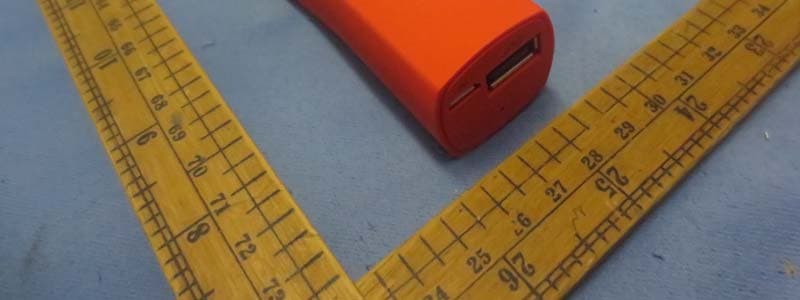
Feb 10, 2015Bluetooth Power Bank
Equipment Class
DXX - Part 15 Low Power Communication Device Transmitter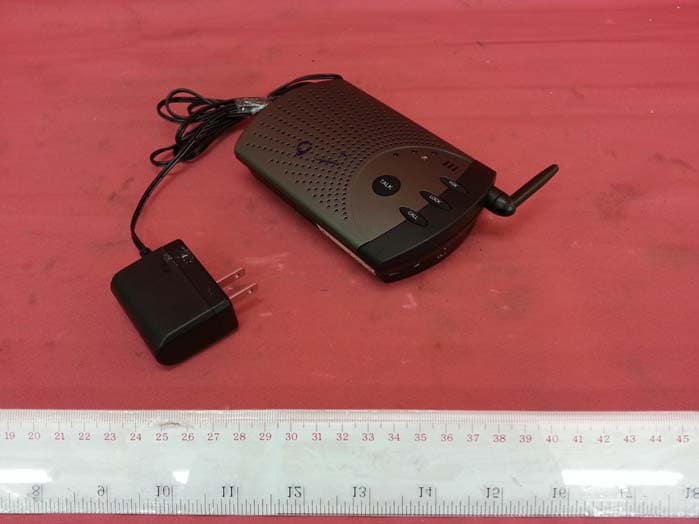
AAO4300124C
May 02, 2013900MHz Wireless Intercom
Equipment Class
DXT - Part 15 Low Power Transceiver, Rx Verified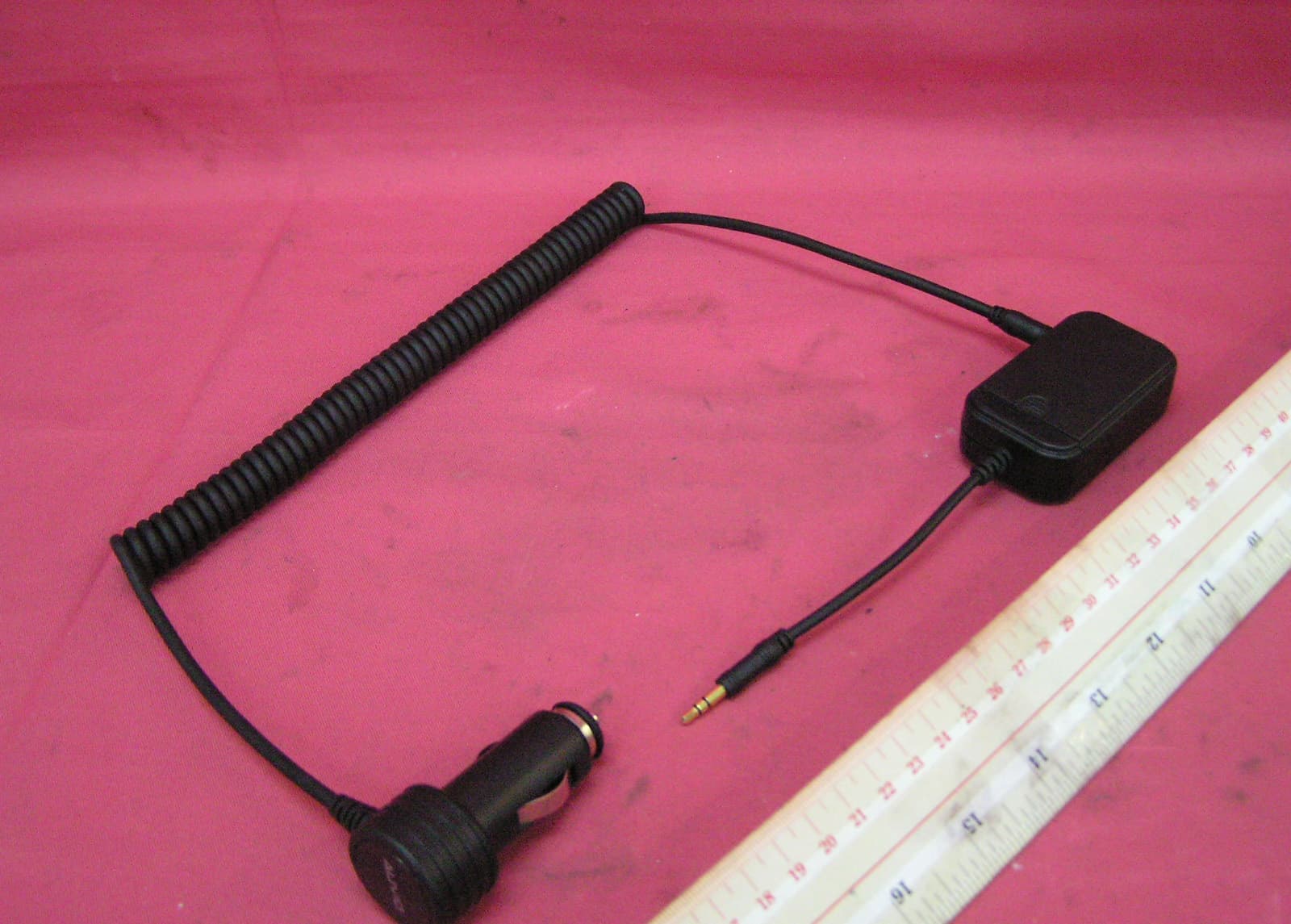
AAO1200876
Nov 30, 2011Universal FM Transmitter
Equipment Class
DXX - Part 15 Low Power Communication Device Transmitter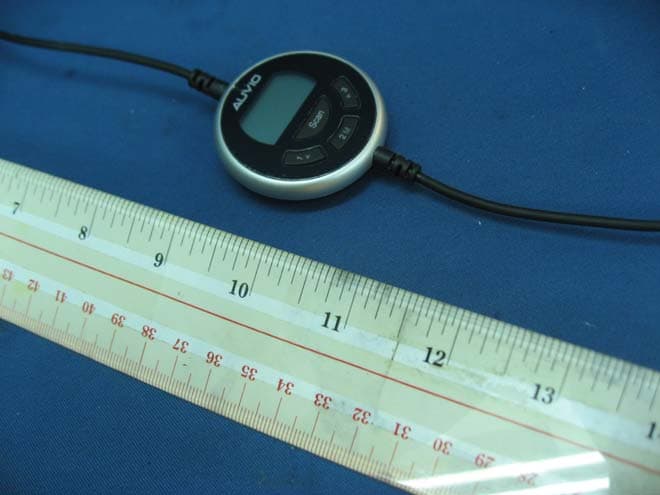
AAO1200962
Aug 02, 2011Universal FM Transmitter
Equipment Class
DXX - Part 15 Low Power Communication Device Transmitter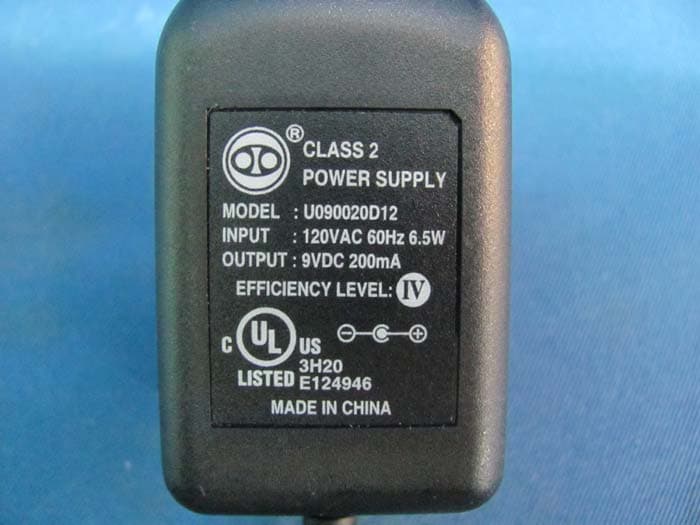
AAO1500044T
Apr 02, 20112.4GHz Digital Wireless Rear Speaker Kit - Transmitter
Equipment Class
DSS - Part 15 Spread Spectrum Transmitter