EHA-802CF13Portable computer with WLAN
Intermec Technologies Corporation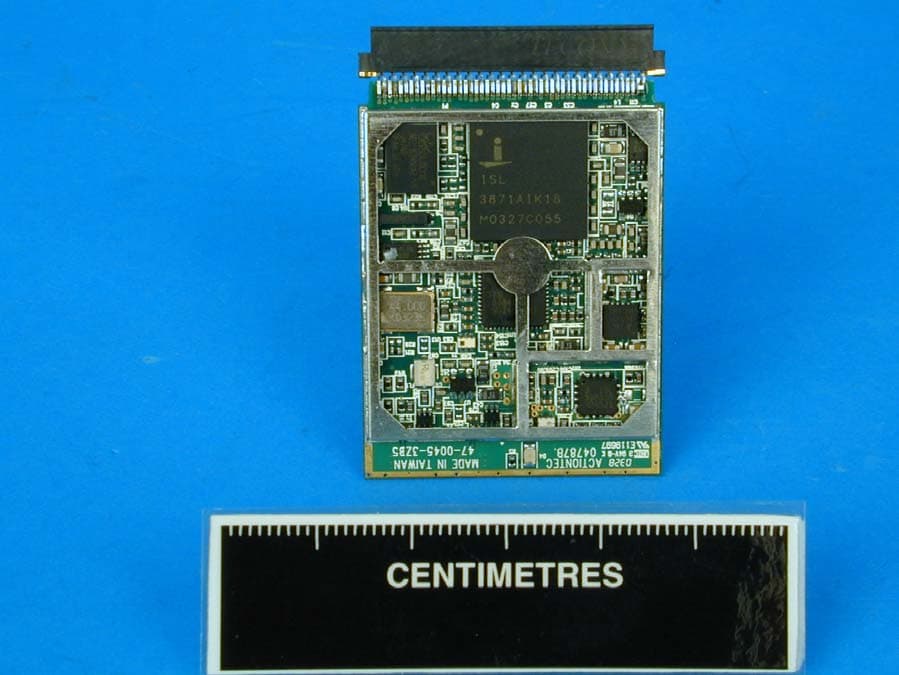
Click to zoom
Application Details
- Equipment Class
- DSS - Part 15 Spread Spectrum Transmitter
- Date of Grant
- Dec 17, 2003
- Application Purpose
- Original Equipment
- Date of Application
- Dec 17, 2003
- Equipment Note
- Portable computer with WLAN
- Frequency Range
- 2400.00000000 - 2483.50000000
- Country
- United States
Documents & Files
Document Text
Text extracted from the exhibit documents filed with the FCC. Open a document above to read the original.
Users Manual
Quick Start Model 730 Mobile Computer Guide 2 Model 730 Color Quick Start Guide Thank youfor purchasing the Intermec Model730ColorMobileComputerwith Microsoft Windows Mobile 2003. You will find your Model 730 useful in a variety of applications. Its integrated peripherals and rugged design ensure reliable service for years to come. This guide provides information needed to get started using your Model 730. For more de- tailed information refer to “Where to Find More Information” on page 20 of this guide. 3Model 730 Color Quick Start Guide Table of Contents Model 730 Color Mobile Computer Description4................. Setting up your Model 7305........... Learning About the Keypad7........... Gold Plane Keys7............................. Alpha Blue Plane Keys-Numeric Keypad7.......... Linear Imager/Keypad Shift and Notification LED8... Action and Up/Down Navigational Buttons8........ Battery Status LED9.......................... About Microsoft Windows Mobile 2003 software for Pocket PC10....... The Today Screen11.......................... Navigation Bar and Command Bar12.............. Pop-up Menus12............................. Entering Information13........................ Battery Management14............... Linear Imager15..................... Data Collection Applet15............. Wireless Printing16.................. Wireless Network17.................. Warm Resetting Your Model 73017..... Cold Resetting Your Model 73018...... Troubleshooting18................... Cleaning Your Model 73020........... Case and Display20........................... Where to Find More Information20..... End User License Agreement21......... Intermec Technologies Corporation End User License Agreement26.. Product Warranty27................. Obtaining Warranty Service27................... Patent Information28................ 4 Model 730 Color Quick Start Guide Model 730 Color Mobile Computer Description Front View Backlight (Gold + 3) Gold plane key ON/OFF Navigational key Imager/ Alpha LED Power Status LED Alpha (Blue) plane key Battery compartment Speaker Stylus IrDA Back View 5Model 730 Color Quick Start Guide IrDA Scanner trigger Charging/Docking connector Microphone Headset jack Scanner trigger or Recorder button left side of unit Linear Imager lens Secure Digital (SD) card slot Setting Up Your Model 730 Battery pack Hand strap clip-in slot 1 Unclip Hand Strap and move Hand Strap outoftheway. Remove Battery Pack and insert new or fresh pack. Replace Hand Strap when done. 2 6 Model 730 Color Quick Start Guide 1Insert SD card (if applicable). Remove the cover screw and lift cover off Reinstall cover Insert SD Card into card slot with label side toward keypad. 1a 1c 1b 2Connect to AC Adapter or dock (dock not shown). 3Charge battery pack (4 hours) before us- ing. However, to ensure proper charging, perform the remaining steps first, with the AC adapter or dock connected. 4ThefirsttimeyouturnonyourModel730 it boots to the operating system. After a few seconds you see the Windows Mobile 2003 Welcome screen. Tap your stylus to advance to the next screen. 7Model 730 Color Quick Start Guide 5Youwillbepromptedthroughtheseveral screens to complete the setup process. Read the display messages and follow the in- structions. When you reach the Windows Mobile Today screen, you have completed the setup. Learning About The Keypad Gold Plane Keys TheGoldbplane keys provide you access to display controls, special characters, and Win- dows Mobile 2003 options. Press the goldbkey for each gold plane key stroke you wish to make. For example to turn on the front light, press and hold the goldb key plus the3key. To turn the front light off press and hold the gold and the3key again. Alpha (Blue) Plane Keys-Numeric Keypad TheAlpha (Blue)Fplane keys work a bit differently than the gold plane keys. When you press the Alpha key, the Imager/Alpha CLED lights ‘red’ to indicate Alpha mode. ThekeypadstaysintheAlphamodeuntilyou press it again. For example, pressing the AlphaFkey and the1key allows the next letter to be capi- talized. Again it stays in this mode until you press the Alpha key again. Another example of how this works, if you want to type a ‘c’ press theFkey and the 2key three times. If you need a letter that is on the same key as the last letter entered, wait two seconds after you pressed the last key 8 Model 730 Color Quick Start Guide then you can enter the correct series of key- strokes to create the next letter. LinearImager/KeypadShiftand Notification LED The Linear Imager/Keypad Shift and Noti- fication LEDCturns red, green, or yel- low. SMomentary Green:Indicatesa‘goodscan’. SBlinking Green: Indicates that the imager is initializing. SSteady Red: Indicates the keypad is shifted totheAlpha(Blue)planeandtheModel 730 is On. SYellow:Whenkeypadisinalphamode, the LED momentarily changes from red to yellow indicating a ‘good scan’. ThisLEDisalsotheWindowsMobile 2003 Notification signal. It blinks yellow at regular intervals indicating a Calendar or Task activity occurred. Action and Up/Down Navigational Buttons SActionbutton:Presstoopenanitem(simi- lar to pressing ENTER on the keypad). SUp/Downcontrols: Press to scroll through a list (similar to pressing the arrow keys on akeyboard). 9Model 730 Color Quick Start Guide Battery Status LED Power to run your Model 730 is supplied by a powerful Li-Ion battery pack designed to give you approximately 6-10 hours of operation (depending on application). In addition, your Model 730 contains backup capabilities to prevent loss of data when the main battery is discharged or when switching out battery packs. Formaximumeffectiveness it is important to leave the main battery installed in your Model 730 even if it is discharged.If the main bat- tery is removed, it should be replaced within 10 minutes to avoid the possibility of data loss. The Battery status LEDBturns red, green, or yellow. SSteady Green: Battery is more than 95% charged and unit is on a charger. SBlinking Red: Battery is…
Text truncated - open the document above for the full version.
Users Manual
P/N 073893-001 Note: You only need to read this information if your Intermec product has an 802.11b radio. Important 802CFI3 Radio Information! Contents For Users in the United States and Canada .................................................................................................... 2 For Users Outside of the United States and Canada....................................................................................... 2 Pour les utilisateurs en dehors du Canada et des Etats-unis ............................................................................ 4 Für Benutzer außerhalb von Kanada und den Vereinigten Staaten ................................................................. 5 Per gli utenti al di fuori del Canada o degli Stati Uniti ................................................................................... 6 Para Usuarios Fuera de Canada o de los Estados Unidos ................................................................................ 6 Para Usuários Fora do Canadá ou dos Estados Unidos ................................................................................... 7 .......................................................................................................... 8 2 For Users in the United States and Canada Place this supplement in your manual. This device complies with Part 15 of the FCC Rules and with RSS-210 of Industry Canada. Operation is subject to the following two conditions: (1) This device may not cause harmful interference, and (2) This device must accept any interference received, including interference that can cause undesired operation. For body worn and headset operation, this radio has been tested and meets the FCC RF exposure guidelines when used with the Intermec accessories supplied or designated for this product. Use of other accessories may not ensure compliance with FCC RF exposure guidelines. Specific Absorption Rate, or SAR is a measurement of radio frequency energy. The FCC permits a maximum SAR value of 1.6 W/kg. The highest SAR value for this product when worn on the body, as described in this user guide, is 0.856 W/kg. The highest SAR value for this product when used with an industry standard headset, as described in this user guide, is 0.001 W/kg. Agency Approvals: See user’s guide instructions for handling, charging, and replacing batteries. Failure to follow those instructions can result in personal injury, fire, or battery explosion. Industry Canada Compliance This Class B digital apparatus meets all requirements of the Canadian Interference-Causing Equipment Regulations. This device requires a radio license unless it is used totally inside a building. (The user must obtain this license.) Cet appareil numérique de la classe B respecte toutes les exigences du Règlement sur le matériel brouilleur du Canada. Cet appareil exige une license radio à moins d’être entièrement installé dans un bâtiment. (L’utilisateur doit obtenir cette license.) For Users Outside of the United States and Canada Place this supplement in your manual. The Intermec product you purchased transmits and receives data using a 2.4 GHz Direct Sequence Spread Spectrum system. Programming and configuration information for the transceivers is also provided in the host device documentation. Please check the Intermec web site for additional documentation at www.intermec.com. Hereby, Intermec Technologies Corporation declares that this Compact Flash Card radio is in compliance with the essential requirements and other relevant provisions of R&TTE Directive (1999/5/EC). This product has been assessed to the following standards: • ETSI EN 300 328-2 v1.2.1 (2001-12) • ETSI EN 301 489-17 v1.2.1 (2002-08) • EN 60950:1992 (incl. Amdt. 1-4, 11) 3 The original Declaration of Conformity is available on the Intermec Technologies Corporation web site at www.intermec.com. For body worn and headset operation, this device has been tested and found compliant to the CENELEC EN 50361 standard for RF exposure when used with the Intermec accessories supplied or designated for this product. Use of other accessories may not ensure compliance with these RF exposure guidelines. Specific Absorption Rate (SAR) is a measurement of radio frequency energy. The CENELEC standard permits a maximum SAR value of 2.0 W/kg. The highest measured SAR value for this product when worn on the body, as described in this user guide, is 0.440 W/kg. The highest SAR value for this product when used with an industry standard headset, as described in this user guide, is 0.001 W/kg. The transmitter module’s output power is 59.3 mW. The products using this module are intended for business and industrial environments. They should not be used in residential environments and by children. This product is marked with this logo and uses radio frequency bands that are not harmonized throughout the European Community. The following table indicates the areas of intended use of the equipment and any known restrictions. Country of Intended Use License Yes No Required Restrictions Details Austria X Belgium X Denmark X Finland X France X X Outdoor frequency operation restricted to 2446.5 MHz to 2483.5 MHz. Germany X Greece X Ireland X Italy X Luxembourg X The Netherlands X Portugal X Spain X Sweden X United Kingdom X Other non-EU: Iceland X Liechtenstein X Norway X Switzerland X Japan X Additional EMI/RFI Compliance This device meets the Class B limit requirements of CISPR 22. 4 Pour les utilisateurs en dehors du Canada et des Etats-unis Veuillez placer ce supplément dans votre manuel. Le produit Intermec que vous avez acheté peut transmettre et recevoir des données à l’aide d’un système d’étalement du spectre en séquence directe de 2,4 GHz. Les informations de programmation et de configuration pour les émetteurs-récepteurs sont également fournies dans la documentation de l’appareil hôte. Pour obtenir toute documentation supplémentaire, veuillez consulter le site web d’Intermec, à l’adresse www.intermec.com.…
Text truncated - open the document above for the full version.
External Photos
Exhibit 3 Please see TUVPS report no. OR611453-03
Internal Photos
Exhibit 9: Internal photographs See also Exhibit 6 test report OR611453-03, pages 89 to 91. Top view, 802.11b radio module Bottom view 802.11b radio module Top view shielding removed, 802.11b radio module Bottom view shielding removed, 802.11b radio module
RF Exposure Info
REPORT ON The Specific Absorption Rate Assessment Of The Intermec Technologies Corporation 730 Handheld Computer. Report Number: WS611453 - 01 Issue 2.00December 2003 TUV Product Service Ltd. Segensworth Road, Titchfield Fareham, Hampshire, United Kingdom, PO15 5RH Tel: +44 (0) 1329 443300, Fax: +44 (0) 1329 443331 www.tuvps.co.uk Report Number WS611453 – 01 Issue 2.00Page 1 of 50 REPORT ON:The Specific Absorption Rate Assessment Of The Intermec Technologies Corporation 730 Handheld Computer. Report No: WS611453 - 01 Issue 2.00 FCC ID:EHA-802CFI3 PREPARED FOR:Intermec Mobile Systems Division 550 Second Street S.E Cedar Rapids IA 52401 ATTESTATION:The wireless portable device described within this report have been shown to be capable of compliance for localised specific absorption rate (SAR) for General Population/Uncontrolled Exposure Limits as defined in the European standard EN50361: 2002 of 2.0W/kg, FCC standard Supplement C (Edition 01-01) to OET Bulletin 65 (Edition 97-01) and RSS-102 Issue 1 (Provisional) September 25, 1999 of 1.6 W/kg. The devices were tested in accordance with the measurement procedures specified in European standard EN50361: 2002, Supplement C (Edition 01- 01) to OET Bulletin 65 (Edition 97-01), RSS-102 Issue 1 (Provisional) September 25 and IEEE1528-200x (Draft December 2002). All reported testing was carried out on a sample of equipment to demonstrate compliance with the above standards. The sample tested was found to comply with the requirements in the applied rules. A. Miller Senior SAR Test Engineer APPROVED BY: M Jenkins Wireless Group Leader DATED:17 th December 2003 DISTRIBUTION:Intermec Technologies CorporationCopy No: 1 Intermec Technologies Corporation (CD ROM).Copy No(s): 2 BABT Copy No.: 3 Copy No.: Note: The test results reported herein relate only to the item tested as identified above and on the Status Page. FCC ID: EHA-802CFI3 Report Number WS611453 – 01 Issue 2.00Page 2 of 50 CONTENTS EXECUTIVE SUMMARY3 1.1Status4 1.2Summary5 1.3Test Result Summary6 TEST DETAILS8 2.1Test Equipment9 2.2Test Software9 2.3Dielectric Properties of Simulant Liquids10 2.4Test Conditions11 2.5Measurement Uncertainty11 2.6SAR Measuring System12 Probe and Amplifier Specification Probe Calibration SAR Measurement Procedure 2.7EN50361: 200130 Draft IEEE Std 1528 Test Positions OET65(c) Flat Phantom Test Position – Graphical Representation 2.8SAR Distributions (Area Scans – 2D)32 2.9Test Positional Photographs44 2.10Record Photographs46 For copyright details see page 50 of 50. FCC ID: EHA-802CFI3 Report Number WS611453 – 01 Issue 2.00Page 3 of 50 EXECUTIVE SUMMARY The Specific Absorption Rate Assessment Of The Intermec Technologies Corporation Pocket PC Model 730. Document History This Report replaces Report WS611453-01 and is issued to correct typographical errors in the original report PROJECT MANAGER: M. FOLEY FCC ID: EHA-802CFI3 Report Number WS611453 – 01 Issue 2.00Page 4 of 50 1.1STATUS MANUFACTURING DESCRIPTIONHand Held Computer Terminal STATUS OF TESTSpecific Absorption Rate Testing APPLICANTIntermec Technologies Corporation MANUFACTURERIntermec Technologies Corporation MODEL NUMBER / TYPE730 Production Prototype Device SERIAL / IMEI NUMBERAgency-C2-05 HARDWARE VERSION730A1E4004001 RADIO LANActionTec Compact Flash Type II + 802.11b Card TYPE802CF13 (Ver. 1.00B) POWER17.5 dBm RADIO BLUETOOTHActionTec UART/USB Bluetooth Module TYPEBTM210 (Version 0.6) POWER2.5 dBm BATTERY MANUFACTURERIntermec TYPE OR MODEL NUMBER318-011-004 TEST SPECIFICATIONS: US Federal Government, Code of Federal Regulations, Title 47 Telecommunication, Chapter I Federal Communications Commission, part 2, section 1093. Federal Communications Commission (FCC) OET Bulletin 65c, Edition 01-01, Evaluating Compliance with FCC Guidelines for Human Exposure to Radiofrequency Electromagnetic Fields – Additional Information for Evaluating Compliance of Mobile and Portable Devices with FCC Limits for Human Exposure to Radiofrequency Emissions CENELEC EN 50360: July 2001, Product Standard to demonstrate the compliance of mobile phones with the basic restrictions related to human exposure electromagnetic (300 MHz - 3 GHz). CENELEC EN 50361: July 2001, Basic standard for the measurement of Specific Absorption Rate related to human exposure to electromagnetic fields from mobile phones (300 MHz - 3 GHz). RSS-102 Issue 1 (Provisional) September 25, 1999: Evaluation Procedure for Mobile and Portable Radio Transmitters with respect to Health Canada’s Safety Code 6 for Exposure of Humans to radio Frequency Fields REFERENCES: IEEE 1528 –200X: DRAFT Recommended Practice for Determining the Peak Spatial-Average Specific Absorption Rate (SAR) in the Human Body Due to Wireless Communications Devices: Experimental Techniques Council Recommendations 1999/519/EC on the limitations of exposure of the general public to electromagnetic fields (0 Hz - 3 GHz) annex II. BABT REGISTRATION NUMBER:WS610741. RECEIPT OF TEST SAMPLES:20 th September 2003. START OF TEST:20 th September 2003. FINISH OF TEST:22 nd September 2003. FCC ID: EHA-802CFI3 Report Number WS611453 – 01 Issue 2.00Page 5 of 50 1.2SUMMARY The unit supplied for testing is an Intermec Technologies Pocket PC Model 730, which offers 2.4GHz 802.11b Wireless LAN and Bluetooth connectivity. The terminal utilizes the ActionTec 802CF13 Compact Flash 802.11b RLAN radio card and the ActionTec Bluetooth module. SAR testing was performed at both the left and right ear of the phantom at both handset positions stated in the test specification. Testing was performed at the middle frequency and at the top and the bottom frequencies for the position giving maximum SAR. The sequence used accorded with the block diagram of tests given in EN 50361; OET65 (c) and IEEE1528. Testing was performed at maximum power of the device (17.5dBm). This was achieved using Client supplied Software. SAR testing also performed with the device set in CW Mode placed against a Flat Phantom dimensions 220mmx…
Text truncated - open the document above for the full version.
RF Exposure Info
REPORT ON The Specific Absorption Rate Assessment Of The Intermec BTM210 Bluetooth Radio. FCC ID: EHA-BTM210 Report Number: WS611453 - 02 November 2003 TUV Product Service Ltd. Segensworth Road, Titchfield Fareham, Hampshire, United Kingdom, PO15 5RH Tel: +44 (0) 1329 443300, Fax: +44 (0) 1329 443331 www.tuvps.co.uk Report Number WS611453 - 02 Page 1 of 45 REPORT ON:The Specific Absorption Rate Assessment Of The Intermec BTM210 Bluetooth Radio. Report No: WS611453 - 02 FCC ID:EHA-BTM210 PREPARED FOR:Intermec Mobile Systems Division 550 Second Street S.E Cedar Rapids IA 52401 ATTESTATION:The wireless portable device described within this report have been shown to be capable of compliance for localised specific absorption rate (SAR) for General Population/Uncontrolled Exposure Limits as defined in the European standard EN50361: 2002 of 2.0W/kg, FCC standard Supplement C (Edition 01-01) to OET Bulletin 65 (Edition 97-01) and RSS-102 Issue 1 (Provisional) September 25, 1999 of 1.6 W/kg. The measurements shown in this report were made in accordance with the procedures specified in European standard EN50361: 2002, Supplement C (Edition 01-01) to OET Bulletin 65 (Edition 97-01), RSS- 102 Issue 1 (Provisional) September 25 and IEEE1528-200x (Draft December 2002). All reported testing was carried out on a sample of equipment to demonstrate compliance with the above standards. The sample tested was found to comply with the requirements in the applied rules. A. Miller Senior SAR Test Engineer APPROVED BY: M Jenkins Wireless Group Leader DATED:03 rd November 2003 DISTRIBUTION:Intermec Technologies CorporationCopy No: 1 Intermec Technologies Corporation (CD ROM).Copy No: 2 BABT Copy No.: 3 Copy No.: Note: The test results reported herein relate only to the item tested as identified above and on the Status Page. FCC ID: EHA-BTM210 Report Number WS611453 - 02 Page 2 of 45 CONTENTS EXECUTIVE SUMMARY3 1.1Status4 1.2Summary5 1.3Test Result Summary6 TEST DETAILS8 2.1Test Equipment9 2.2Test Software9 2.3Dielectric Properties of Simulant Liquids10 2.4Test Conditions11 2.5Measurement Uncertainty11 2.6SAR Measuring System12 Probe and Amplifier Specification Probe Calibration SAR Measurement Procedure 2.7EN50361: 200130 Draft IEEE Std 1528 Test Positions OET65(c) Flat Phantom Test Position – Graphical Representation 2.8SAR Distributions (Area Scans – 2D)32 2.9Test Positional Photographs40 2.10Record Photographs41 For copyright details see page 45 of 45. FCC ID: EHA-BTM210 Report Number WS611453 - 02 Page 3 of 45 EXECUTIVE SUMMARY The Specific Absorption Rate Assessment Of The Intermec BTM210 Bluetooth Radio. PROJECT MANAGER: M. FOLEY FCC ID: EHA-BTM210 Report Number WS611453 - 02 Page 4 of 45 1.1STATUS MANUFACTURING DESCRIPTIONBluetooth Radio Module STATUS OF TESTSpecific Absorption Rate Testing APPLICANTIntermec Technologies Corporation MANUFACTURERActionTec HARDWARE VERSION2A RADIO MODULE2.4GHz FHSS Personal Area Network Transceiver (Intermec Handheld 730 Pocket PC) TYPEPart 15 Spread Spectrum Transmitter MAXIMUM RATED POWER0 dBm TYPE OR MODEL NUMBERBTM210 SERIAL / IMEI NUMBER33200039 TEST SPECIFICATIONS: Federal Communications Commission, Code of Federal Regulations, Title 47 (CFR47), Vol. 1, Chapter 1, Part 2 (§2.1091 and §2.1093). Federal Communications Commission (FCC) OET Bulletin 65c, Edition 01-01, Evaluating Compliance with FCC Guidelines for Human Exposure to Radiofrequency Electromagnetic Fields – Additional Information for Evaluating Compliance of Mobile and Portable Devices with FCC Limits for Human Exposure to Radiofrequency Emissions CENELEC EN 50360: July 2001, Product Standard to demonstrate the compliance of mobile phones with the basic restrictions related to human exposure electromagnetic (300 MHz - 3 GHz). CENELEC EN 50361: July 2001, Basic standard for the measurement of Specific Absorption Rate related to human exposure to electromagnetic fields from mobile phones (300 MHz - 3 GHz). RSS-102 Issue 1 (Provisional) September 25, 1999: Evaluation Procedure for Mobile and Portable Radio Transmitters with respect to Health Canada’s Safety Code 6 for Exposure of Humans to radio Frequency Fields REFERENCES: IEEE 1528 –200X: DRAFT Recommended Practice for Determining the Peak Spatial-Average Specific Absorption Rate (SAR) in the Human Body Due to Wireless Communications Devices: Experimental Techniques Council Recommendations 1999/519/EC on the limitations of exposure of the general public to electromagnetic fields (0 Hz - 3 GHz) annex II. BABT REGISTRATION NUMBER:WS611543. RECEIPT OF TEST SAMPLES:9 th October 2003. START OF TEST:9 th October 2003. FINISH OF TEST:10 th October 2003. FCC ID: EHA-BTM210 Report Number WS611453 - 02 Page 5 of 45 1.2SUMMARY The Device supplied for testing an Bluetooth Radio Module installed in an Intermec 730 Handheld Computer. The Device was assessed to ascertain the worst-case position, against each phantom, with regards to SAR levels. The worst-case position recording the highest SAR levels was identified as the Module side of the device. All SAR testing was carried out with the Device in this configuration. SAR testing was performed with the device set in CW test mode using software supplied by the client. The device was placed against the left Cheek of the SAM Phantom and was in contact, to simulate the worst-case position. Testing was carried out at the top, middle and bottom frequency of each of the device-operating band. SAR testing was then performed with the device set in CW test Mode and placed against a Flat Phantom dimensions 220mm (l) x150mm (w) x200mm (d) and with a sidewall thickness of 2.0mm. The phantom was filled to a depth of 150mm with 2450MHz Body simulant liquid. The dielectric properties were in accordance with the requirements for the dielectric properties specified in Supplement C (Edition 01-01) to OET Bulletin 65 (Edition 97-01). Testing was performed at the maximum power from a supply voltage of +3.2V dc. The testing was performed with pow…
Text truncated - open the document above for the full version.
Test Report
TEST REPORT FCC Part 15C Testing in support of an Application for Grant of Equipment Authorisation of an Intermec 730 Handheld Computer Terminal 802.11b Radio Module FCC ID: EHA-802CFI3 Report Number: OR611453/03 Issue 2December 2003 BABT. Segensworth Road, Titchfield Fareham, Hampshire, United Kingdom, PO15 5RH Tel: +44(0)1329 443300, Fax: +44(0)1329 443331 www.babt.com Report Number OR611453/03 Issue 1Page 1 of 97 REPORT ONFCC Part 15C Testing in support of an Application for Grant of Equipment Authorisation of an Intermec 730 Handheld Computer Terminal 802.11b Radio Module FCC ID: EHA-802CFI3 Report No OR611453/03 Issue 2 December 2003 EQUIPMENT:802.11b Radio Module FCC ID:EHA-802CFI3 SPECIFICATION:47 CFR 15.247 PREPARED FOR:Intermec Technologies Corporation 550 Second Street S.E Cedar Rapids IOWA 52401 USA MANUFACTURERS REPRESENTATIVE:Mr Scott Holub APPROVED BY: K W ADSETTSM JENKINS EMC SignatoryRadio Signatory DATED:17 December 200317 December 2003 DISTRIBUTIONIntermec TechnologiesCopy 1 (CD) TÜV Product ServiceCopy 2 Copy No Total No of Pages 99 (Inclusive of Annex A) Report Number OR611453/03 Issue 2Page 2 of 97 FCC ID: EHA-802CFI3 CONTENTS Page No 1REPORT SUMMARY 1.1Status ...................................................................................................................................... 4 1.2Introduction ............................................................................................................................. 5 1.3Location of Testing ................................................................................................................. 5 1.4Brief Summary of Results....................................................................................................... 5 1.5 Product Information................................................................................................................6 1.6 Deviations from the Standard................................................................................................. 7 1.7 Modification Record ................................................................................................................ 8 2TEST DETAILS – MODIFICATION STATE 0 2.1Measurement at Band Edge................................................................................................. 10 2.26dB Bandwidth...................................................................................................................... 12 2.3Maximum Peak Output Power ............................................................................................. 26 2.4Spurious Conducted Emissions ........................................................................................... 28 2.5Spurious Conducted Emissions Power Line ........................................................................ 65 2.6Spurious Radiated Emissions .............................................................................................. 69 2.7Peak Power Spectral Density ............................................................................................... 74 3TEST DETAILS – MODIFICATION STATE 1 3.1Maximum Peak Output Power ............................................................................................. 77 3.2Peak Power Spectral Density ............................................................................................... 79 4TEST EQUIPMENT 4.1Test Equipment and Ancillaries Used .................................................................................. 82 4.2Measurement Uncertainty .................................................................................................... 84 5PHOTOGRAPHS OF TEST SAMPLE 5.1Photographs of test sample..................................................................................................86 6ACCREDITATION, DISCLAIMERS AND COPYRIGHT 6.1Accreditation, Disclaimers and Copyright ............................................................................ 97 Report Number OR611453/03 Issue 2Page 3 of 97 FCC ID: EHA-802CFI3 SECTION 1 REPORT SUMMARY Document History This Report replaces Report OR611453-03 Issue 1 and is issued to correct typographical errors and include omitted Test Photographs in the original report. FCC Part 15C Testing in support of an Application for Grant of Equipment Authorisation of an Intermec 730 Handheld Computer Terminal 802.11b Radio Module FCC ID: EHA-802CFI3 Report Number OR611453/03 Issue 2Page 4 of 97 FCC ID: EHA-802CFI3 1.1STATUS OBJECTIVETo undertake measurements to determine the Equipment Under Test's (EUT's) compliance with the specification. MANUFACTURING DESCRIPTION802.11b Module for use with host unit 730 APPLICANTIntermec Technologies 550 Second Street S.E Cedar Rapids IOWA 52401 USA MANUFACTURERS TYPE NUMBERActionTec Compact Flash Type II + 802.11b Card MANUFACTURERS PART NUMBER802CF13 (Ver. 1.00B) HARDWARE REVISION730A1E4004001 TEST SPECIFICATION NUMBERFCC Part 15 Subpart C REGISTRATION NUMBEROR611453 QUANTITY OF ITEMS TESTEDOne SECURITY CLASSIFICATION OF EUTUnclassified INCOMING RELEASEDeclaration of Build Status SERIAL NUMBEROR611453 DATE2003 DISPOSALHeld pending disposal REFERENCE NUMBERN/A DATEN/A START OF TEST21/10/2003 FINISH OF TEST28/11/2003 TEST ENGINEERSS Bennett R Henley B Airs M Larkin J Holcombe RELATED DOCUMENTSANSI C63.4 2001. Methods of Measurement of Radio- Noise Emissions from Low-Voltage Electrical and Electronic Equipment in the Range of 9 kHz to 40 GHz. FCC Public Notice document (DA 00-705 released 30 March 2000) Report Number OR611453/03 Issue 2Page 5 of 97 FCC ID: EHA-802CFI3 1.2INTRODUCTION The information contained within this report is intended to show verification of c…
Text truncated - open the document above for the full version.
Contact Information
Applicant
Brian Rudick(VP & GC, Honeywell Scanning & Mobility)
Test Firm
TUV SUD Product ServiceJensen Adams
Technical Specifications
| # | Rule Parts | Frequency Range | Power Output | Emission | Tolerance |
|---|---|---|---|---|---|
| 1 | 15C | 2.40 GHz - 2.48 GHz | 72.44 mW | 22M0G1D | 25.0000000000 ppm |
Other Applications from Intermec Technologies Corporation
EHA-1015CP01X1
Sep 29, 20131015CP01
Equipment Class
NII - Unlicensed National Information Infrastructure TX
EHA-1015CP01SX1
Sep 08, 20131015CP01S
Equipment Class
PCE - PCS Licensed Transmitter held to ear
EHA-RC12ABGN
Aug 19, 2013WLAN board
Equipment Class
DSS - Part 15 Spread Spectrum Transmitter
EHA-1000CP01F
Feb 19, 20131000CP01F9, 1000CP02F9, 1001CP01F9
Equipment Class
DTS - Digital Transmission System
EHA-INBT02
Dec 11, 2012BT Board
Equipment Class
DSS - Part 15 Spread Spectrum Transmitter