EHABTM210Bluetooth Radio Module
Intermec Technologies CorporationApplication Details
- Equipment Class
- DSS - Part 15 Spread Spectrum Transmitter
- Date of Grant
- Dec 10, 2003
- Application Purpose
- Original Equipment
- Date of Application
- Dec 10, 2003
- Equipment Note
- Bluetooth Radio Module
- Frequency Range
- 2400.00000000 - 2483.50000000
- Country
- United States
Documents & Files
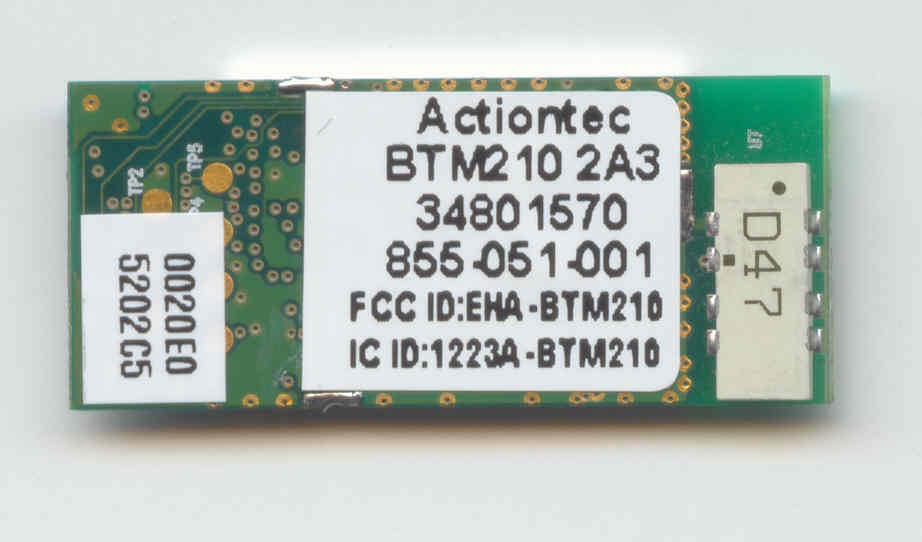
Document Text
Text extracted from the exhibit documents filed with the FCC. Open a document above to read the original.
Users Manual
P/N 073869-001 Note: You only need to read this information if your Intermec product has a Bluetooth™ compatible module from Actiontec ® Electronics. Important BTM210 Bluetooth Radio Information! Contents For Users in the United States and Canada .................................................................................................... 2 For Users Outside of the United States and Canada....................................................................................... 2 Pour les utilisateurs en dehors du Canada et des Etats-unis ............................................................................ 4 Für Benutzer außerhalb von Kanada und den Vereinigten Staaten ................................................................. 5 Per gli utenti al di fuori del Canada o degli Stati Uniti ................................................................................... 6 Para Usuarios Fuera de Canada o de los Estados Unidos ................................................................................ 7 Para Usuários Fora do Canadá ou dos Estados Unidos ................................................................................... 8 ............................................................................ 9 2 For Users in the United States and Canada Place this supplement in your manual. This device complies with Part 15 of the FCC rules and with RSS-210 of Industry Canada. Operation is subject to the following two conditions: (1) This device may not cause harmful interference, and (2) This device must accept any interference received, including interference that can cause undesired operation. Federal Communications Commission Compliance FCC Digital Emissions Compliance: This equipment has been tested and found to comply with the limits for a Class B digital device, pursuant to Part 15 of the FCC Rules. These limits are designed to provide reasonable protection against harmful interference in a residential installation. This equipment generates, uses, and can radiate radio frequency energy and, if not installed and used in accordance with the instructions, may cause harmful interference to radio communications. However, there is no guarantee that interference will not occur in a particular installation. If this equipment does cause harmful interference to radio or television reception, which can be determined by turning the equipment off and on, the user is encouraged to try to correct the interference by one or more of the following measures: • Reorient or relocate the radio or television receiving antenna. • Increase the separation between the computer equipment and receiver. • Connect the equipment to an outlet on a circuit different from that to which the radio or television receiver is connected. • Consult the dealer or an experienced radio television technician for help. For body and head worn operation, this radio has been tested and meets the FCC RF exposure guidelines when used with the Intermec accessories supplied or designated for this product. Use of other accessories may not ensure compliance with FCC RF exposure guidelines. Specific Absorption Rate, or SAR, is a measurement of radio frequency energy. The FCC permits a maximum SAR value of 1.6 W/kg. The highest SAR value for this product when worn on the body, as described in this user guide, is 0.033 W/kg. The highest SAR value for this product when worn on the head, as described in this user guide, is 0.042 W/kg. Changes or modifications not expressly approved by Intermec could void the user’s authority to operate this equipment. For Users Outside of the United States and Canada Place this supplement in your manual. The Intermec product you purchased transmits and receives data using a 2.4 GHz Frequency Hopping Spread Spectrum system. Programming and configuration information for the transceivers is also provided in the host device documentation. Please check the Intermec web site for additional documentation at www.intermec.com. Hereby, Intermec Technologies Corporation declares that this Bluetooth module is in compliance with the essential requirements and other relevant provisions of R&TTE Directive (1999/5/EC). 3 This product has been assessed to the following standards: • ETSI EN 300 328-2 v1.2.1 (2001-12) • ETSI EN 301 489-17 v1.2.1 (2002-08) • EN 60950:1992 (incl. Amdt. 1-4, 11) The original Declaration of Conformity is available on the Intermec Technologies Corporation web site at www.intermec.com. For body and head worn operation, this product has been tested and found compliant to the CENELEC EN 50361 standard for RF exposure when used with the Intermec accessories supplied or designated for this product. Use of other accessories may not ensure compliance with these RF exposure guidelines. Specific Absorption Rate, or SAR, is a measurement of radio frequency energy. The CENELEC standard permits a maximum SAR value of 2.0 W/kg. The highest measured SAR value for this product when worn on the body, as described in this user guide, is 0.017 W/kg. The highest SAR value for this product when used against the head, as described in this user guide, is 0.020 W/kg. The transmitter module’s output power is 1 mW. The products using this module are intended for business and industrial environments. They should not be used in residential environments and by children. This product is marked with this logo and uses radio frequency bands that are not harmonized throughout the European Community. The following table indicates the areas of intended use of the equipment and any known restrictions. Country of Intended Use License Yes No Required Restrictions Details Austria X Belgium X Denmark X Finland X France X Germany X Greece X Ireland X Italy X Luxembourg X The Netherlands X Portugal X Spain X Sweden X United Kingdom X Other non-EU: Iceland X Liechtenstein X Norway X Switzerland X Japan X Additional EMI/RFI Compliance This device meets the Class B limit requirements of CISPR 22. 4 Pour les utilisat…
Text truncated - open the document above for the full version.
Attestation Statements
1 Intermec Technolo gies Corp Norand Mobile Systems Division 550 Second Street S.E. Cedar Ra pids, IA 52401 USA TRANSMITTER MODULAR APPROVAL ATTESTATION Federal Communications Commission Authorization and Evaluation Division 7435 Oakland Mil a Road Columbia, Maryland 21046 Re: Application Modular Approval Certification for FCC ID: EHA-BTM210 Gentlemen The following attestation addresses the eight requirements to support modular approval as required by the FCC Public Notice DA00-1407 “Part 15 Unlicensed Modular Transmitter Approval”. Transmitter modular approval, conditional requirements. 1) The BTM210 radio module has its own shielding and is tested herein extended outside of an Intermec 730 terminal. The shield is added during manufacturing and is not easily removed. Instructions to end-users will warn of possible regulatory consequences for modifying the radio in any manner. 2) As a radio module designed specifically for data transfer, only data and power is presented to the radio. The radio circuitry buffers all modulation and control of the transmitter. Control of the transmitter is via data commands and software instructions contained within the module. The transmitter presented in the report is tested with the radio operated at the maximum power. Data commands may reduce the power transmitted but may not influence the modulation content. 3) This radio module does not contain an on-board voltage regulator. The transmitter is specified to operate across a voltage range of +3.3V +/- 0.3volt. Within the test report we show the operation of the transmitter across a voltage range of +3.0 to +3.6 volts. Testing shows the power output and operating frequency is maintained within the parameters defined in the regulations. The 3.3-volt source is a standard supply voltage in many “state of the art” mobile computers and portable printers. Products that do not have the industry standard 3.3 volts to operate the radio will have to incorporate a regulator to operate the radio within the +3.3v +/-0.3 volt range. All Intermec products have either a highly regulated supply sourced from the AC powerline or rechargeable batteries. For battery operated units there is a low battery cut-off to insure stable operation of the computer and memory. When low battery is detected all function ceases at a voltage that insures the processing and storage of data is not corrupted. The low battery detect also serves to maintain the operating voltage of the radio within the parameter specified above. Resellers for the radio will be instructed to maintain the voltage tolerances listed herein. 4) The radio uses an on-board antenna. The provisions to address a connector that meets the unique coupler requirements does not apply. 2 5) The radio is tested herein is on an extended flexible cable connected to an Intermec 730. The radio is extended four inches (10-cm) beyond the host computer. The extender allows the radio to be placed horizontal and vertical for a complete evaluation of the radiated characteristics of the shielding on the radio. AC power to the Intermec 730 operated the unit during testing. AC line conducted emissions are presented utilizing the same 730 operating from the Intermec charger for the unit. Alternate AC power sources for the radio is required to meet the emissions limits stated in CFR47 Part 15.207. As the primary radio integrator, Intermec performs AC conducted emission testing and generates FCC Class I Permissive Change reports to address alternate AC power supplies for the radio. OEM integrators will be informed of their regulatory obligations to perform unintentional and intentional radiator emissions testing and certification on their final product as required in the FCC rules. 6) As a small module the radio is not always accessible to the end user once the radio is integrated within a product. Products that restrict access to the radio will have an external label that is visible to users. The label will state “Contains: FCC ID: EHA-BTM210”. Currently Intermec must install the radio during manufacturing. If and when the radio can be installed as a service retrofit, the service instructions will include labeling requirements for the exterior of the final product that addresses visibility of the FCC ID. The BTM210 radio is not an option that the end user can install. The radio may be offered as an OEM radio to selected customers. Those Resellers will also be instructed to label the exterior of products where access to the PC card is restricted. 7) The radio module as manufactured is completely controlled by the onboard processor. There are no influences to the operation of the transmitter the end user can induce that will operate the radio outside of scope of the regulations. This radio complies to the operating conditions outlined in FCC Part 15.247 as a Frequency Hopping Spread Spectrum transmitter operating in the 2400-2483.5 MHz band. 8) The transmitter herein was tested with the antenna that is integrated on the radio module. Compliance to RF exposure requirements for this antenna is included within this application for approval. Appropriate warning statement will be placed with each end product user information based on the results of the RF exposure data filed with this application. OEM Resellers will be advised to include a similar statement to inform the users of any requirements for RF safety. Please contact me by telephone at (319) 369-3865 or by e-mail ([email protected]) if there are questions or additional information needed concerning this attestation. Sincerely, Scott Holub Regulatory Compliance Engineer III Telephone Number +319 369 3865 Fax Number +319 369 3299
Block Diagram
Exhibit 4 Please see Actiontec specifications document Version 0.6 contained in Exhibt 12 for the block diagram.
Cover Letter(s)
1 Intermec Technolo gies Corp Norand Mobile Systems Division 550 Second Street S.E. Cedar Ra pids, IA 52401 USA 10-DEC-2003 BABT 34 Molesey Road Walton on Thames Surrey KT12 4RQ Dear Sir or Madam: We, Intermec Technologies Corporation, Cedar Rapids, Iowa, hereby authorize TÜV Product Service Limited, Segensworth Road, Fareham, Hampshire, United Kingdom, PO15 5RH, to act as our agent in all matters relating to applications for equipment authorization, including the signing of all documents relating to these matters. I further certify that the applicant nor any party to the application is subject to a denial of Federal benefits, that includes FCC benefits, pursuant to Section 5301 of the Anti-Drug Abuse Act of 1988, 21 U.S.C. Section 862. This authorization expires on 30-DEC-2003. Sincerely, Scott Holub Regulatory Compliance Engineer III Telephone Number +319 369 3865 Fax Number +319 369 3299 2 Intermec Technolo gies Corp Norand Mobile Systems Division 550 Second Street S.E. Cedar Ra pids, IA 52401 USA 07-NOV-2003 BABT 34 Molesey Road Walton on Thames Surrey KT12 4RQ Re: Request of Confidentiality Pursuant to Sections 0.457(d)(1)(ii) and 0.459 of the Commission’s Rules, the Applicant hereby requests confidential treatment of information accompanying as outlined below: Example: Schematics, Technical Description, Bill of Materials, Theory of Operation. The above materials contain trade secrets and proprietary information not customarily released to the public. The public disclosure of these matters might be harmful to the Applicant and provide unjustified benefits to its competitors. The Applicant understands that pursuant to Rule 0.457(d)(1)(ii), disclosure of this Application and all accompanying documentation will not be made before the date of the Grant for this Application. Sincerely, Scott Holub Regulatory Compliance Engineer III Telephone Number +319 369 3865 Fax Number +319 369 3299
Cover Letter(s)
Hilton Carr From: Hilton Carr Sent: 12 September 2005 10:43 To: Hilton Carr Subject: FW: 730 FCC Grant Status 12/09/2005 From: [email protected] [mailto:[email protected]] Sent: 09 September 2005 21:01 To: [email protected] Cc: [email protected] Subject: RE: 730 FCC Grant Status Hi Hilton, When do you anticipate that you can get to changing the verbiage on the EHABTM210 grants? I am holding on a permissive change on this filing until the changes on these grants are completed. Best Regards, Scott -----Original Message----- From: Holub, Scott Sent: Wednesday, August 31, 2005 9:59 AM To: 'Hilton Carr' Cc: 'Michael Lowry' Subject: RE: 730 FCC Grant Status Hi Hilton, Just a reminder to see if you have had a chance to look at the EHABTM210 grant. I believe that the 20 cm separation and the prohibition against collocation verbiage can be removed from this grant due to the low power of the radio module. Having this grant be a portable configuration helps us with a C2PC that we are currently in process with at the FCC. Let me know if you have questions. Regards, Scott -----Original Message----- From: Holub, Scott Sent: Monday, August 22, 2005 7:46 PM To: 'Hilton Carr' Cc: 'Michael Lowry' Subject: RE: 730 FCC Grant Status Hi Hilton, We discussed changing the grant notes on the EHABTM210 over a year ago to remove the 20 cm spacing restriction that was put on the original grant. We have added a couple of Class 2 Permissive Changes to this original grant for the 730 hand held without my picking up that the notes didn't get changed. We are in the process of using this Bluetooth module again in another product that will start out as a portable device. I am concerned that the FCC will question this, since the 730 is a mobile device with portable conditions. Our new hand held will start out as a portable device and I fear that the FCC will question using the mobile EHABTM210 grant for this certification. Is it possible for you to get these grant notes changed? Let me know if there are questions. Best Regards, Scott -----Original Message----- From: Holub, Scott Sent: Tuesday, July 06, 2004 9:29 AM To: 'Hilton Carr' Subject: RE: 730 FCC Grant Status Hi Hilton, Those grant notes look good to me. Let me know if there are other questions. Best Regards, Scott -----Original Message----- From: Hilton Carr [mailto:[email protected]] Sent: Friday, July 02, 2004 10:39 AM To: '[email protected]' Subject: RE: 730 FCC Grant Status Scott, Sorry for the delay. I suggest changing the EHABTM210 Grant to read "Output Power is EIRP. Limited Modular Approval . This module must only be installed and operated in the Intermec family of Handheld computers and compatible hosts in accordance to the installation conditions for satisfying the RF exposure compliance." Followed by the "CE" Grant note. The Company name is given rather than the more usual "Grantees" to permit use in with both EHA and HN2 grantee codes. I have started looking at the 802CF13 grants ( original and Permisive changE0 and will propose wording to you next week. Please let me know if you are happy with my proposed wording for the BTM210. Best Regards Hilton Carr Task Manager, Certification and Technical Development On behalf of BABT TCB (UK0004) 12/09/2005 BABT, an accredited UK Certification/Notified Body and company of TÜV Product Service Ltd., 34 Molesey Road - Walton-on-Thames - Surrey - KT12 4RQ - UK Direct Tel: +44 (0) 1932 251227 Fax: +44 (0) 1932 251201 Email: [email protected] -----Original Message----- From: [email protected] [mailto:[email protected]] Sent: 02 July 2004 14:07 To: [email protected] Cc: [email protected] Subject: RE: 730 FCC Grant Status Hi Hilton, I haven't heard back on this. Are you going to be able to address this issue? Thanks, Scott -----Original Message----- From: Holub, Scott Sent: Monday, June 28, 2004 9:22 AM To: 'Hilton Carr' Cc: 'Phil Dolling' Subject: RE: 730 FCC Grant Status Hi Hilton, Have you looked at the 730 grants that I asked to have some of the verbiage changed on? I will soon be needing to do some permissive changes to those grants and would like to get them cleaned up before the changes get submitted. Thanks, Scott -----Original Message----- From: Phil Dolling [mailto:[email protected]] Sent: Friday, June 11, 2004 4:28 AM To: Scott Holub (E-mail) Subject: FW: 730 FCC Grant Status Scott, Hilton has told me this morning that he will be contacting you direct with regard to your requests. Regards Phil -----Original Message----- From: Phil Dolling Sent: Monday, June 07, 2004 10:26 AM To: '[email protected]' Cc: Michael Lowry; Hilton Carr Subject: RE: 730 FCC Grant Status Hello Scott, 12/09/2005 I will have to talk to Hilton on this one because grant note changes are definitely his department. I'll see when is is available. By the way, how do you wish to proceed on the RTTE TCF for the 700C? Regards Phil -----Original Message----- From: [email protected] [mailto:[email protected]] Sent: Friday, June 04, 2004 8:31 PM To: [email protected]; [email protected] Cc: [email protected] Subject: FW: 730 FCC Grant Status Hi Phil, We are currently working on adding collocation permissive changes to the 700C FCC grants. The printer we are working on will also support the 730 hand held. I would like to make the FCC grants for the EHABTM210 and EHA- 802CFI3 radios be more common with the grants for the 700C radios. I have asked, and the FCC has agreed to put the grants in audit mode so the the grants can be changed. The FCC does require that BABT does the test changes in the grant notes. I would like to know if you can make the grant changes so that the notes are similar to the LUBBTM-1 Bluetooth and the HN22011B-2 grants that are attached. I would like the collocation restriction removed from the EHABTM210 grant, and collocation with the EHA-802CFI3 grant added. I would also like the collocation for the EHABTM210 added to the EHA-802CFI3 grant. Thi…
Text truncated - open the document above for the full version.
External Photos
Exhibit 3 Please see TUVPS report no. OR611453-02
Internal Photos
Exhibit 9 Please see TUVPS report no. OR611453-02
Test Report
TEST REPORT FCC Part 15C Testing in support of an Application for Grant of Equipment Authorisation of an Intermec BTM210 Bluetooth Radio FCC ID: EHA-BTM210 Report Number: OR611453-02 Issue 3December 2003 BABT. Segensworth Road, Titchfield Fareham, Hampshire, United Kingdom, PO15 5RH Tel: +44(0)1329 443300, Fax: +44(0)1329 443331 www.babt.com Report Number OR611453-02 Issue 3Page 1 of 68 REPORT ONFCC Part 15C Testing in support of an Application for Grant of Equipment Authorisation of an Intermec BTM210 Bluetooth Radio FCC ID: EHA-BTM210 Report No OR611453-02 Issue 3 December 2003 EQUIPMENT:Bluetooth Radio Module FCC ID:EHA-BTM210 SPECIFICATION:47 CFR 15.247 PREPARED FOR:Intermec Technologies Corporation 550 Second Street S.E Cedar Rapids IOWA 52401 USA MANUFACTURERS REPRESENTATIVE:Mr Scott Holub APPROVED BY: C H GOULDM JENKINS EMC SignatoryRadio Signatory DATED:10 th December 2003 10 th December 2003 DISTRIBUTION Intermec TechnologiesCopy 1 (CD) TÜV Product ServiceCopy 2 Copy No Total No of Pages 70 (Inclusive of Annex A) ENGINEERING STATEMENT The measurements shown in this report were made in accordance with the procedures described on test pages. All reported testing was carried out on a sample equipment to demonstrate limited compliance with FCC CFR 47: Part 15. The sample tested was found to comply with the requirements defined in the applied rules. Test Engineers; M Larkin R Henley Report Number OR611453-02 Issue 3Page 2 of 68 FCC ID: EHA-BTM210 CONTENTS Page No 1REPORT SUMMARY 1.1Status ........................................................................................................................................4 1.2Introduction ...............................................................................................................................5 1.3Location of Testing ...................................................................................................................5 1.4Brief Summary of Results.........................................................................................................5 1.5 Product Information..................................................................................................................6 1.6 Deviations from the Standard...................................................................................................7 1.7 Modification Record ..................................................................................................................8 2TEST DETAILS 2.120dB Bandwidth........................................................................................................................10 2.2Channel Dwell Time (DH1).......................................................................................................20 2.3Channel Dwell Time (DH3).......................................................................................................22 2.4Channel Dwell Time (DH5).......................................................................................................24 2.5Channel Separation ..................................................................................................................26 2.6Number of Hopping Channels ..................................................................................................28 2.7Maximum Peak Output Power .................................................................................................33 2.8Spurious Conducted Emissions ...............................................................................................35 2.9Spurious Radiated Emissions ..................................................................................................45 2.10Band Edge Measurements – Bottom Channel ........................................................................51 2.11Band Edge Measurements – Top Channel..............................................................................53 2.12Spurious Conducted Emissions Power Lines ..........................................................................55 2.13Maximum Peak Output Power (EIRP Method) ........................................................................59 3TEST EQUIPMENT 3.1Test Equipment and Ancillaries Used ......................................................................................62 3.2Measurement Uncertainty ........................................................................................................63 4PHOTOGRAPHS OF TEST SAMPLE 4.1Photographs of test sample......................................................................................................65 5ACCREDITATION, DISCLAIMERS AND COPYRIGHT 5.1Accreditation, Disclaimers and Copyright ................................................................................68 ANNEX A FCC Compliance Letter ............................................................................................................A.2 Report Number OR611453-02 Issue 3Page 3 of 68 FCC ID: EHA-BTM210 SECTION 1 REPORT SUMMARY Document History This Report replaces Report OR611453-02 Issue 2 and is issued to include omitted test results in the original report and in Issue 2. FCC Part 15C Testing in support of an Application for Grant of Equipment Authorisation of an Intermec BTM210 Bluetooth Radio FCC ID: EHA-BTM210 Report Number OR611453-02 Issue 3Page 4 of 68 FCC ID: EHA-BTM210 1.1STATUS OBJECTIVETo undertake measurements to determine the Equipment Under Test's (EUT's) compliance with the specification. MANUFACTURING DESCRIPTIONBluetooth Radio Module APPLICANTIntermec Technologies Norand Mobile Systems Division 550 Second Street S.E Cedar Rapids IOWA 52401 USA MANUFACTURERS TYPE NUMBERBTM210 MANUFACTURERS PART NUMBERBTM210 SERIAL NUMBER0020E0935C9D HARDWARE REVISION0.6 TEST SPECIFICATION NUMBERFCC Part 15 Subpart C REGISTRATION NUMBEROR611453 QUANTITY OF ITEMS TESTEDOne SECURITY CLASSIFICATION OF EUTUnclassified INCOMING RELEASEDeclaration of Build Status SERIAL NUMBEROR611453 DATE DI…
Text truncated - open the document above for the full version.
Test Setup Photos
Exhibit 7 Please see TUVPS report no. OR611453-02
Contact Information
Applicant
Brian Rudick(VP & GC, Honeywell Scanning & Mobility)
Test Firm
TUV SUD Product ServiceJensen Adams
Technical Specifications
| # | Rule Parts | Frequency Range | Power Output | Tolerance |
|---|---|---|---|---|
| 1 | 15C | 2.40 GHz - 2.48 GHz | 558.00 µW | 6.2500000000 ppm |
Other Applications from Intermec Technologies Corporation
EHA-1015CP01X1
Sep 29, 20131015CP01
Equipment Class
NII - Unlicensed National Information Infrastructure TX
EHA-1015CP01SX1
Sep 08, 20131015CP01S
Equipment Class
PCE - PCS Licensed Transmitter held to ear
EHA-RC12ABGN
Aug 19, 2013WLAN board
Equipment Class
DSS - Part 15 Spread Spectrum Transmitter
EHA-1000CP01F
Feb 19, 20131000CP01F9, 1000CP02F9, 1001CP01F9
Equipment Class
DTS - Digital Transmission System
EHA-INBT02
Dec 11, 2012BT Board
Equipment Class
DSS - Part 15 Spread Spectrum Transmitter