J9CQCP-2760Dual Band Cellular Phone
Qualcomm Technologies, Inc.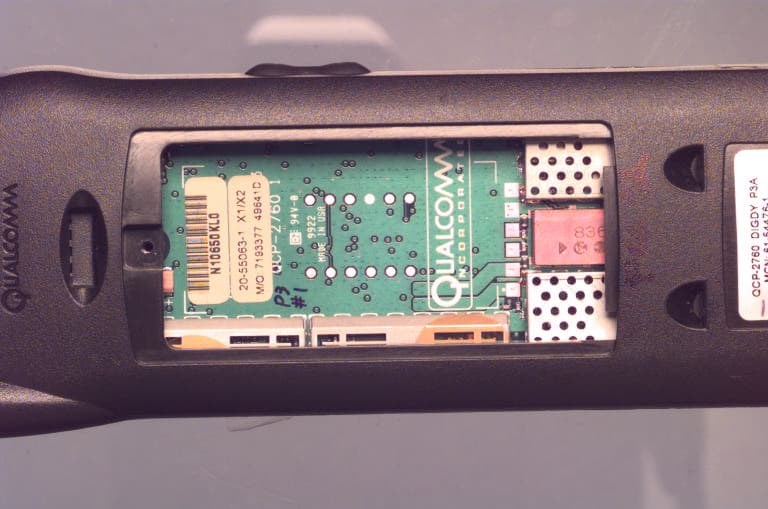
Click to zoom
Application Details
- Equipment Class
- TNE - Licensed Non-Broadcast Transmitter Held to Ear
- Date of Grant
- Sep 21, 1999
- Application Purpose
- Original Equipment
- Date of Application
- Jun 27, 1999
- Equipment Note
- Dual Band Cellular Phone
- Frequency Range
- 1851.25000000 - 1908.75000000
- Company
- Qualcomm Technologies, Inc.
- Country
- United States
Documents & Files
Document Text
Text extracted from the exhibit documents filed with the FCC. Open a document above to read the original.
Users Manual
QUALCOMM Incorporated 6455 Lusk Boulevard, San Diego, California 92121-2779 U.S.A. http://www.qualcomm.com/cdma DCN 80-B6337-1, Rev. X1 QCP-860 1 END 4 7 2 5 8 0 3 6 9 pwr C ι S029_56A1 -- QUALCOMM -- Apr 20 Thu 8:43 am D R [ MENU ] [ BOOK ] SEND User’s Guide for QCP ™ 860, QCP ™ 1960, and QCP ™ 2760 Phones User’s Guide for QCP™ 860, QCP™ 1960, and QCP™ 2760 Phones This manual is based on the production versions of the QCP 860, QCP 1960, and QCP 2760 telephones. Software changes may have occurred after this printing. QUALCOMM reserves the right to make changes in technical and product specifications without prior notice. The products and equipment described in this documentation are manufactured under one or more of the following U.S. patents.4,901,307 5,056,109 5,099,204 5,101,501 5,103,459 5,107,225 5,109,390 5,193,094 5,228,054 5,257,283 5,265,119 5,267,261 5,267,262 5,280,472 5,283,536 5,289,527 5,307,405 5,309,474 5,337,338 5,339,046 5,341,456 5,383,219 5,392,287 5,396,516 D356,560 5,408,697 5,414,728 5,414,796 5,416,797 5,426,392 5,437,055 D361,065 5,442,322 5,442,627 5,452,473 5,461,639 5,469,115 5,469,471 5,471,497 5,475,870 5,479,475 5,483,696 5,485,486 5,487,175 5,490,165 5,497,395 5,499,280 5,504,773 5,506,865 5,509,015 5,509,035 5,511,067 5,511,073 5,513,176 5,515,177 5,517,323 5,519,761 5,528,593 5,530,928 5,533,011 5,535,239 5,539,531 5,544,196 5,544,223 5,546,459 5,548,812 5,559,881 5,559,865 5,561,618 5,564,083 5,566,000 5,566,206 5,566,357 5,568,483 5,574,773 5,574,987 D375,740 5,576,662 5,577,022 5,577,265 D375,937 5,588,043 D376,804 5,589,756 5,590,069 5,590,406 5,590,408 5,592,548 5,594,718 5,596,570 5,600,754 5,602,834 5,602,833 5,603,096 5,604,459 5,604,730 5,608,722 5,614,806 5,617,060 5,621,752 5,621,784 5,621,853 5,625,876 5,627,857 5,629,955 5,629,975 5,638,412 5,640,414 5,642,398 5,644,591 5,644,596 5,646,991 5,652,814 5,654,979 5,655,220 5,657,420 5,659,569 5,663,807 5,666,122 5,673,259 5,675,581 5,675,644 5,680,395 5,687,229 D386,186 5,689,557 5,691,974 5,692,006 5,696,468 5,697,055 5,703,902 5,704,001 5,708,448 5,710,521 5,710,758 5,710,768 5,710,784 5,715,236 5,715,526 5,722,044 5,722,053 5,722,061 5,722,063 5,724,385 5,727,123 5,729,540 5,732,134 5,732,341 5,734,716 5,737,687 5,737,708 5,742,734 D393,856 5,748,104 5,751,725 5,751,761 5,751,901 5,754,533 5,754,542 5,754,733 5,757,767 5,757,858 5,758,266 5,761,204 5,764,687 5,774,496 5,777,990 5,778,024 5,778,338 5,781,543 5,781,856 5,781,867 5,784,406 5,784,532 5,790,589 5,790,632 5,793,338 D397,110 5,799,005 5,799,254 5,802,105 5,805,648 5,805,843 5,812,036 5,812,094 5,812,097 5,812,538 5,812,607 5,812,651 5,812,938 5,818,871 5,822,318 5,825,253 5,828,348 5,828,661 5,835,065 5,835,847 5,839,052 5,841,806 5,842,124 5,844,784 5,844,885 5,844,899 5,844,985 5,848,063 5,848,099 5,850,612 5,852,421 5,854,565 5,854,786 5,857,147 5,859,612 5,859,838 5,859,840 5,861,844 5,862,471 5,862,474 5,864,760 5,864,763 5,867,527 5,867,763 5,870,427 5,870,431 5,870,674 5,872,481 5,872,774 5,872,775 5,872,823 5,877,942 5,878,036 5,870,631 5,881,053 5,881,368 5,884,157 5,884,193 5,884,196 Other patents pending. FCC/IC Notice This device complies with part 15 of the FCC rules. Operation is subject to the following two conditions: (1) This device may not cause harmful interference, and (2) this device must accept any interference received, including interference that may cause undesired operation. Copyright © 1998, 1999 QUALCOMM Incorporated. All rights reserved. Printed in the United States of America. QUALCOMM is a US-registered trademark and registered service mark of QUALCOMM Incorporated. Smart Keys and QCP are trademarks of QUALCOMM Incorporated. User’s Guide for QCP 860, QCP 1960, and QCP 2760 Phones 1 ContentsQuick Start . . . . . . . . . . . . . . . . . . . . . . . . 2 Quick menu reference . . . . . . . . . . 3 Getting to Know Your Phone . . . . . . . . 4 Safe operating instructions . . . . . . 4Customer Support. . . . . . . . . . . . . . 4Keys on your phone . . . . . . . . . . . . 5Icons on the screen . . . . . . . . . . . . . 6Using Smart Keys . . . . . . . . . . . . . . 7Turning the phone on and off . . . . 7About standby mode . . . . . . . . . . . 8Viewing your phone number . . . . 8Using keyguard . . . . . . . . . . . . . . . . 8Locking the phone . . . . . . . . . . . . . 9Setting the banner . . . . . . . . . . . . . . 9Charging the batteries . . . . . . . . . 10Adding an external battery . . . . . 10Accessories . . . . . . . . . . . . . . . . . . . 12 Making and Receiving Calls . . . . . . . . 13 Redialing calls . . . . . . . . . . . . . . . . 13Service provider features . . . . . . . 14Adjusting the volume . . . . . . . . . . 16Setting the ringer type . . . . . . . . . 16 Phone Book . . . . . . . . . . . . . . . . . . . . . . 17 Saving a number . . . . . . . . . . . . . . 17 Saving a name with a number . . 18Entering pauses and hyphens . . 21Dialing from the phone book . . . 21Changing the phone book . . . . . 23Searching the phone book . . . . . 24 Voice Mail, Pages, and Text Messages 25 Types of messages . . . . . . . . . . . . 25Alerts . . . . . . . . . . . . . . . . . . . . . . . 25Voice mail . . . . . . . . . . . . . . . . . . . 26Pages and text messages . . . . . . . 26 Menus . . . . . . . . . . . . . . . . . . . . . . . . . . . 28 Menu items . . . . . . . . . . . . . . . . . . 29 Internet Browser and Data Capability 35 Internet browser. . . . . . . . . . . . . . 35Data capability . . . . . . . . . . . . . . . 40 Caring for Your Phone . . . . . . . . . . . . . 43 Phone . . . . . . . . . . . . . . . . . . . . . . . 43Antenna . . . . . . . . . . . . . . . . . . . . . 44Battery . . . . . . . . . . . . . . . . . . . . . . 44 Safety Information . . . . . . . . . . . . . . . . . 46 Radio Frequency (RF) energy . . 46Driving safely . . . . . . . . . . . . . . . . 48 Index . . . . . . . . . . . . . . . . . . . . . . . . . . . . 51 2 Quick Start Quick StartTo turn on your phoneä Press for about a second, until the ico…
Text truncated - open the document above for the full version.
Cover Letter(s)
Applicant: QUALCOMM INC.FCC ID: J9CQCP-2760 Request of Confidentiality Federal Communications Commission Authorization and Evaluation Division Re:Request of Confidentiality Pursuant to Sections 0.457 and 0.459 of the Commission’s Rules, the Applicant hereby requests confidential treatment of information accompanying this Application as outlined below: Description All schematics/block diagrams All parts lists The above materials contain trade secrets and proprietary information not customarily released to the public. The public disclosure of these matters might be harmful to the Applicant and provide unjustified benefits to its competitors. The Applicant understands that pursuant to Rule 0.457, disclosure of this Application and all accompanying documentation will not be made before the date of the Grant for this Application. QUALCOMM, INC. John Forrester EMC Engineer
ID Label/Location Info
Applicant: QUALCOMM INC.FCC ID: J9CQCP-2760 Exhibit 19 FCC Identification Label Information QCP 2760 Label Drawings Actual size of the label that is placed on the rear side near the bottom of the phone Enlarged version of the label that is placed on the rear side near the bottom of the phone. Actual size of the label that is placed inside the battery well, under the internal battery. Enlarged version of the label that is placed inside the battery well, under the internal battery.
ID Label/Location Info
Exhibit 19 FCC Identification Label Information QCP 2760 Label Drawings Actual size of the label that is placed on the rear side near the bottom of the phone Enlarged version of the label that is placed on the rear side near the bottom of the phone. Actual size of the label that is placed inside the battery well, under the internal battery. Enlarged version of the label that is placed inside the battery well, under the internal battery.
RF Exposure Info
QUALCOMM QCP 2760 SPECIFIC ABSORPTION RATE (SAR) REPORT Prepared By:______________Date: _________ Dan Laramie Engineer Approved By:______________Date: __________ Jay Moulton Director Regulatory Group Company QUALCOMM Inc. Document No. XX-XXXXX-X QCP-2760 SAR REPORT Issue No: 1 Date June 1999 Equipment QCP-2760 Page Number 2 Dan LaramieFile Ref: CONTENTS 1 INTRODUCTION.................................................................................................................3 2 SAR TEST FACILITY..........................................................................................................3 3 APPLICABLE REGULATIONS........................................................................................4 4 SAR TEST RESULTS SUMMARY...................................................................................5 5 TECHNICAL DESCRIPTION.............................................................................................4 5.1 DESCRIPTION OF SAR TEST FACILITY .......................................................................................................6 5.2 SAR SYSTEM THEORY...................................................................................................................................11 6 TEST SAMPLE OPERATION..........................................................................................13 7 CALIBRATION DATES OF TEST EQUIPMENT..........................................................13 8 SAR TEST SYSTEM VALIDATION.....................................................................14 9 SAR MEASUREMENT PROCEDURE..................................................................17 10 SAR MEASUREMENT UNCERTAINTY......................................................................23 11 TEST DATA SUMMARY.................................................................................26 12 DRAWINGS / PHOTOS..................................................................................29 13 SAR PLOTS..................................................................................Appendix A 14 DOSIMETRY EQUIPMENT DATA SHEETS........................................Appendix B Company QUALCOMM Inc. Document No. XX-XXXXX-X QCP-2760 SAR REPORT Issue No: 1 Date June 1999 Equipment QCP-2760 Page Number 3 Dan LaramieFile Ref: 1INTRODUCTION This test report describes an environmental evaluation measurement of specific absorption rate (SAR) distribution in simulated human head tissues exposed to radio frequency (RF) radiation from a wireless portable device manufactured by QUALCOMM Inc. These measurements were performed for compliance with the rules and regulations of the U.S. Federal Communications Commission (FCC). The testing was performed in June 1999 in the QUALCOMM SAR Test Facility. The wireless device is described as follows; EUT Type:CDMA and Analog Phone Trade Name:QUALCOMM Inc. Model:QCP-2760 Tx Frequency :824.04 – 848.97 and 1851.25 – 1908.75 MHz Max. Output Power:27.58 dBm ERP Analog and 25.2 dBm ERP PCS Modulation:CDMA and Analog Antenna:Retracting whip w/ helix Trade Name / Model:QUALCOMM QCP 2760 FCC Classification:Non-Broadcast Transmitter Held to Ear Application Type:Certification Serial Number :WKVR Place of Test:QUALCOMM Inc., San Diego, CA, USA Date of Test:June 21, 1999 FCC Rule Part:2.1093; ET Docket 96.326; part 25 2SAR TEST FACILITY SAR tests were performed in the Qualcomm SAR Test Facility located at the following address: Qualcomm Incorporated Building AA. 10290 Campus Point Drive San Diego CA 92121-1522 Company QUALCOMM Inc. Document No. XX-XXXXX-X QCP-2760 SAR REPORT Issue No: 1 Date June 1999 Equipment QCP-2760 Page Number 4 Dan LaramieFile Ref: 3APPLICABLE REGULATIONS The QCP-2760 is designed to comply with the specific absorption rate SAR limits for distances within 20 cm of the transmitting elements of the MES, and with general public uncontrolled environment Maximum Permissible Exposure (MPE) limits at distances greater than 20 cm from the transmitting elements of the device, as required by Sections 1.1307 through 1.1310, 2.1091 and 2.1093 of the 47 C.F.R. (1997). These FCC RF safety limits, which are based on a hybrid combination of the SAR and MPE requirements from ANSI/IEEE C95.1-1992 and the National Council on Radiation Protection and Measurements (NCRP) report no. 86, are also consistent with the RF safety limits defined in the IRPA Guidelines on Protection Against Non-Ionizing Radiation which are reportedly in the process of being adopted in Europe, as codified in European Pre-Standard ENV 59166-2 approved by CENELEC (1994). This test report pertains specifically to the following limit from the Code of Federal Regulations 47 “Limits for General Population/Uncontrolled exposure: 0.08 W/kg as averaged over the whole-body and spatial peak SAR not exceeding 1.6 W/kg as averaged over any 1 gram of tissue (defined as a tissue volume in the shape of a cube). Exceptions are the hands, wrists, feet and ankles where the spatial peak SAR shall not exceed 4 W/kg, as averaged over any 10 grams of tissue (defined as a tissue volume in the shape of a cube).” 4 SAR TEST RESULTS SUMMARY This device has been tested for localised specific absorption rate (SAR) for uncontrolled environment/general population exposure limits specified in ANSI/IEEE Std. C95.1 ~ 1992 and has been tested in accordance with the measurement procedures specified in ANSI/IEEE Std. C95.3 ~ 1992 . Normal antenna operating positions were incorporated, with the device transmitting at frequencies consistent with normal usage of the device. The device has been shown to be capable of compliance for localised specific absorption rate (SAR) for uncontrolled environment/general population exposure limits specified in ANSI/IEEE std. C95.1-1992 Company QUALCOMM Inc. Document No. XX-XXXXX-X QCP-2760 SAR REPORT Issue No: 1 Date June 1999 Equipment QCP-2760 Page Number 5 Dan LaramieFile Ref: 5TECHNICAL DESCRIPTION The test sample consisted of a QUALCOMM QCP-2760. …
Text truncated - open the document above for the full version.
RF Exposure Info
This document was generated in response to a request for additional technical information by Frank Coperich in regards to the type approval of the QCP-2760. The information included is related to the four specific topics discussed in the following email received by John Forrester on September 17, 1999: To:John Forrester, Qualcomm Inc. From:Frank Coperich [email protected] FCC Application Processing Branch Re:CC ID J9CQCP-2760 Applicant:Qualcomm Incorporated Correspondence Reference Number:9668 731 Confirmation Number:EA94691 Date of Original E-Mail:09/17/1999 1. The operators manual indicates this phone has provision for headset and leather case to allow hands-free operations. This would allow this phone to operate in body-worn configurations and SAR for such operating conditions should be addressed. Information for the type or specific body-worn holster or carrying case should be provided, especially the separation distance provided by the holster for body-worn use and any metallic components in the belt-clip or other parts of the holster. Caution statements should also be included in the operators manual to alert users on how to use the holster(s) and those that have not been SAR tested might not comply with FCC RF exposure requirements and should not be used. Similar operating instructions should also be included in the manual for operating under body-worn conditions in data mode (Internet access etc.) instead of using a headset. 2. This phone has several battery options, an internal and one (or more ?) external batteries. Please clarify which battery was used on the phone tested for SAR and the amount of SAR variations to be expected due to the different battery options - either by tests or other supporting information to indicate there is sufficient SAR margin to cover any variation due to battery options. The same battery issues should also be address for body-mount operations, with respect to SAR/performance and battery thickness/body separation distance. 3. Dipole validation results obtained before the SAR tests and original validation data provided by SAR system manufacturer for cellular and PCS band should be provided to support system accuracy. 4. Please indicate the crest factor(s) used in the SAR tests 1) SAR with leather case and headset when phone is worn on torso The QCP-2760’s operator’s manual has been modified to include a warning to alert users that body-worn accessories not tested by Qualcomm may not meet FCC RF exposure requirements. The following caption is incorporated into the user’s manual: Caution: Only QUALCOMM-supplied leather cases have been tested to meet FCC RF exposure requirements. Other devices may not meet this requirement. To verify that the QCP-2760 is indeed SAR compliant, additional SAR testing was performed with the a leather case and headset. The phone was then attached to a flat phantom, and tested for SAR compliance. The unit was tested at the worst case frequency and antenna position (retracted) for both FM and PCS modes. The testing concluded that the unit meets the SAR limit of 1.6 mW/g. Photos, test data, and dipole verification documents related to these tests are in the proceeding pages. 2) Battery options with phone It was determined that the smallest battery resulted in the worst case SAR because of the higher current densities, and as such the data submitted is for the worst case. It was determined that the worst case configuration was when the phone used with the internal battery only. When external batteries are added, the current density decreases due to the physical volume added to the unit. For this reason, the SAR testing was performed with the internal battery only. 3) SAR validation results for original SAR testing Manufacturer Calibration Data: 4)Crest factors used in SAR tests The crest factor for all FM analog SAR scans is set to 1.0, and for CDMA it has been experimentally determined to be 4.765 dB. However, this only effects the measurement when the power levels are high to such a degree that there is some saturation of the dipoles in the near field probe. The low power spectral densities of CDMA, for this device, do not approach those power levels and as such it has no effect on these measurements.
RF Exposure Info
This document was generated in response to a request for additional technical information by Frank Coperich in regards to the type approval of the QCP-2760. The information included is related to the two specific topics discussed in the following email received by John Forrester on September 21, 1999: To:John Forrester, Qualcomm Inc. From:Frank Coperich [email protected] FCC Application Processing Branch Re: FCC IDJ9CQCP-2760 Applicant:Qualcomm Incorporated Correspondence Reference Number:9722 731 Confirmation Number:EA94691 Date of Original E-Mail:09/21/1999 1.) Brain equivalent tissue properties were used for testing body-worn SAR. Compliance will be determined by adjusting the existing SAR numbers to the corresponding muscle equivalent tissue properties. The numbers will be somewhat higher (10-15%) but compliant. Body-mount conditions were test with the antenna retracted. With the antenna extended in body-worn conditions, it may have higher coupling to the body tissue (somewhat different than next to the side of the head where the antenna extends beyond the head). Please confirm that retracted antenna position for body-mount use, as indicated in the response, represent worst case SAR for body-mount conditions after taking into account muscle parameters and antenna extended conditions. 2.) Please indicate what power levels were the dipole validations for 900 MHz and 1800 MHz performed at and also provide original manufacturer data for the 1800 MHz dipole validation (SAR numbers, dielectric properties and power level) for comparison; only 900 MHz was submitted. 1) Confirmation that retracted antenna position is worst case SAR for body-mount conditions The following pages contain data confirming that the antenna retracted position is the worst case position for body-mount use of the phone. The SAR test showed that with the antenna extended, the SAR level dropped to 0.369 mW/g. The phone was tested again with the antenna retracted to verify that the SAR level reported in earlier tests was repeatable. These tests confirm that the “antenna retracted” position is indeed the worst case position. Antenna in Extended Position Antenna in Retracted Position Validation 9-21-99 2) Power levels for dipole validations and manufacturer data for 1800 MHz dipole. The power level used for both 900 MHz and 1800 MHz dipole validations is 10 dBm (conducted power). The manufacturer data for the 1800 MHz dipole is in the following pages.
Test Report
Applicant: QUALCOMM INC.FCC ID: J9CQCP-2760 Cover Letter Federal Communications Commission Authorization and Evaluation Division Re:Application for Cellular Transceiver Type Acceptance QUALCOMM herein submits the Application for Equipment Authorization (FCC Form 731) and Exhibits for Type Acceptance of a Cellular Transceiver, FCC ID J9CQCP-2760. Applicant:QUALCOMM, INC. 5775 Morehouse Dr. San Diego, CA 92121-1714 Manufacture:QUALCOMM, INC. 10300 Campus Point Drive San Diego, California 92121 The equipment, QUALCOMM model # QCP 2760, is for mobile station cellular system use. The QCP 2760 is in full compliance with all parts of EIA/TIA/IS-98-A Mobile Station-Land Station Compatibility Specification, issue July 1996, and also in full compliance with all parts of ANSI J- STD-008, Personal Station-Base Station Compatibility Requirements for 1.8 to 2.0 GHz Code Division Multiple Access (CDMA) Personal Communications Systems, issue August 1995. Information concerning how the ESN protection requirements are met is provided in Exhibit 3. Applicant: QUALCOMM INC.FCC ID: J9CQCP-2760 Request of Confidentiality Federal Communications Commission Authorization and Evaluation Division Re:Request of Confidentiality Pursuant to Sections 0.457 and 0.459 of the Commission’s Rules, the Applicant hereby requests confidential treatment of information accompanying this Application as outlined below: Description All schematics/block diagrams All parts lists The above materials contain trade secrets and proprietary information not customarily released to the public. The public disclosure of these matters might be harmful to the Applicant and provide unjustified benefits to its competitors. The Applicant understands that pursuant to Rule 0.457, disclosure of this Application and all accompanying documentation will not be made before the date of the Grant for this Application. QUALCOMM, INC. John Forrester EMC Engineer Applicant: QUALCOMM INC.FCC ID: J9CQCP-2760 List of Exhibits ExhibitDescriptionFCC Reference 1Certification of Test Data2.911 2General Information2.1033(c), 2.1061, 3ESN Protection22.919 4List of Semiconductor Devices2.983(d)(6) 5RF Output Power Measured Data - FM2.1046 6RF Output Power Measured Data -CDMA2.1046, 24.232 7Modulation Audio Response Measured Data2.1047(a), 22.907(a) 8Modulation Limiting Measured Data2.1047(b) 9Occupied Bandwidth Measured Data - FM2.1049, 22.917 10Occupied Bandwidth Measured Data2.1049, 24.238 11Conducted Spurious Emissions Measured Data2.1051, 22.917 12Conducted Spurious Emissions Measured Data2.1051, 24.238 13Radiated Spurious Emissions Measured Data2.1053 14Frequency Stability vs. Temperature and Voltage Measured Data 2.1055 15Frequency Stability vs. Temperature and Voltage Measured Data 2.1055. 24.235 16Measurement Procedures and Techniques 17FCC Letter of Site Recognition 18Circuit Diagram2.983(d)(7) 19Identification (Labels) Information2.983(f) 20Photographs2.983(g) 21User’s Manual2.983(d)(8) 22 SAR data Applicant: QUALCOMM INC.FCC ID: J9CQCP-2760 Exhibit 1 Certification of Test Data The data, data evaluation and equipment configuration represented herein are a true and accurate representation of the measurements of the sample’s radio frequency interference emissions characteristics as of the dates and at the times of the test under the conditions herein specified. This applies to all tests that where performed that did not require an Open Area Test Site (OATS). Tests that required an OATS site were performed by TUV Product Services. Equipment Tested: QCP-2760 Dates of Test:June 14 – June 24 1999 Test Performed by: Engineer:John A. Forrester, __________________ Applicant: QUALCOMM INC.FCC ID: J9CQCP-2760 Exhibit 2 General Information 1.Production Plans - Section 2.1033 (c) Quantity Production Planned 2.Technical Description - Section 2.983 (d) (1)Types of emission 40K0F8W 40K0F1D 1M25F9W F3E voice F3D supervisory audio tones, signaling tones F1D wideband data signal (2)Frequency range The frequency range of the equipment in Domestic Public Cellular Radio Telecommunications Service bands, 824 - 849 MHz and 869 - 894 MHz for FM. The channel spacing is 30 kHz for FM. The frequency range of the equipment in the Personal Communications Services (PCS) bands, 1851.25 – 1908.75 MHz and 1931.25 – 1988.75 MHz. The channel spacing is 1.25 MHz for CDMA. (3)Operating power levels The transmitter output power is independent of whether the equipment operates in the cellular system FM or CDMA mode. The equipment supports Class 3 Mobile Station Power Class, and its power output capability is reported to the Land Station via Station Class Mark. The equipment will respond to commands from the Land Station to change power levels as defined in the EIA/TIA/IS-98 Specification. The equipment will respond to commands from the Land Station to change power levels as defined in the J-STD 008 Specification. (4)Maximum output power The equipment supports the maximum output power for Class 3 Mobile Station which is -2 dBW ERP, and meets the 7 W ERP (+8 dBW) maximum power limitation of Section 22.904. The equipment is within the limited 2 watts E.I.R.P. peak power of CFR 47 Part 24.232 (b) and is able to limit the output power to the minimum necessary for successful communications. (5)DC supply voltage and current range The equipment is powered by lithium ion rechargeable batteries which have a voltage range of 4.1 to 3.4 Vdc. Applicant: QUALCOMM INC.FCC ID: J9CQCP-2760 (6)List of semiconductor active devices See exhibit 4. (7)Circuit diagram See exhibit 18. (8)User’s manual See exhibit 21. (9)Transmitter adjustment procedure All frequency adjustments are set at the factory and there are no frequency field adjustments for this product. Under digital mode, frequency is locked to the base station and controlled by VCTCXO adjustments to offset any possible errors. (10)Frequency stability device A voltage controlled, temperature compensated, crystal oscillator (VCTCXO) is employed as a frequency re…
Text truncated - open the document above for the full version.
Contact Information
Applicant
Paul Guckian(Vice President, Regulatory Engineering)
Technical Contact
Qualcomm Inc.John A Forrester
[email protected]858-845-7428
6455 Lusk Boulevard · San Diego, California · United States
Non-Technical Contact
Qualcomm Inc.John A Forrester
[email protected]858-845-7428
Technical Specifications
| # | Rule Parts | Frequency Range | Power Output | Emission | Tolerance |
|---|---|---|---|---|---|
| 3 | 24E | 1.85 GHz - 1.91 GHz | 454.00 mW | 1M25F9W | 0.00025 % |
Other Applications from Qualcomm Technologies, Inc.
J9C-M2X75
Aug 13, 2024Module
Equipment Class
CBE - Citizens Band End User DevicesJ9C-M2X72
Aug 13, 2024Module
Equipment Class
PCB - PCS Licensed Transmitter
J9C-QCNCM825
Aug 26, 2023Qualcomm WiFi 7/BT Combo module
Equipment Class
6CD - 15E 6 GHz Low Power Dual Client
J9C-QCNCM865
Apr 04, 2023Qualcomm WiFi 7/BT Combo module
Equipment Class
NII - Unlicensed National Information Infrastructure TX
J9CQCARD7280N
Nov 07, 2022QCARD7280
Equipment Class
DTS - Digital Transmission System